
One Coat Systems for New Steel Bridge Structures

One Coat Systems for New Steel Bridge Structures

Learning Outcomes • At the end of this webinar you will be able to: – Define a one-coat system for bridge structures – Report the results of a two year study conducted by the Federal Highway Administration – Report the results of a Federal Highway Administration funded study conducted by Connecticut DOT – State the advantageous and disadvantageous of using a one-coat system on a bridge structure
Introduction • Federal Highway Administration (FHWA) funded two studies that evaluate the use of a one-coat system to protect bridges from corrosion
Why a One-Coat System? • The typical coating system consists of 3 coats: – Zinc-Rich Primer – Epoxy Intermediate Coat – Polyurethane Topcoat • Going to a one-coat system will lower: – Overall Cost – Amount of time and space needed for application
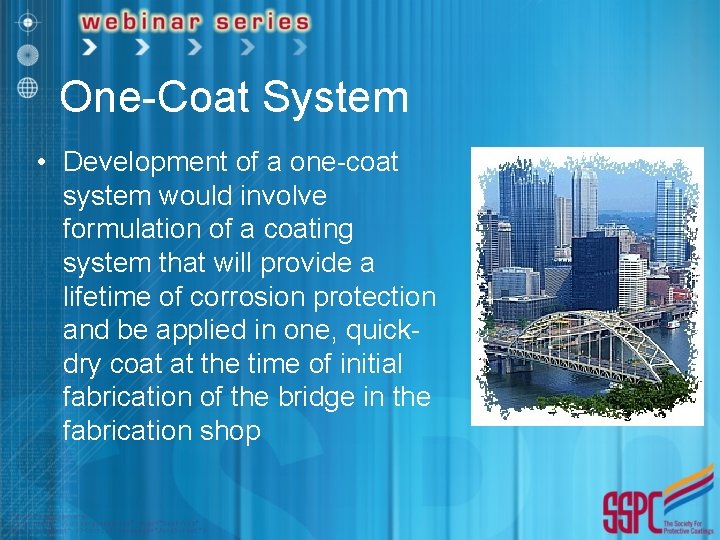
One-Coat System • Development of a one-coat system would involve formulation of a coating system that will provide a lifetime of corrosion protection and be applied in one, quickdry coat at the time of initial fabrication of the bridge in the fabrication shop
One-Coatings • The current standard for evaluating coatings applied to structural steel is “AASHTO R 31, Project Work Plan for the Laboratory Evaluation of Structural Steel Coatings” • Performance of a one-coating system should equal or exceed the performance of the current “gold” standard system: IOZ/EP/URE
FHWA Study • Test panels prepared to SSPC SP 10 level of cleanliness with an anchor profile between 2 -3 mils • 2 control systems – 3 coat system – 2 coat system • 8 one-coat test systems
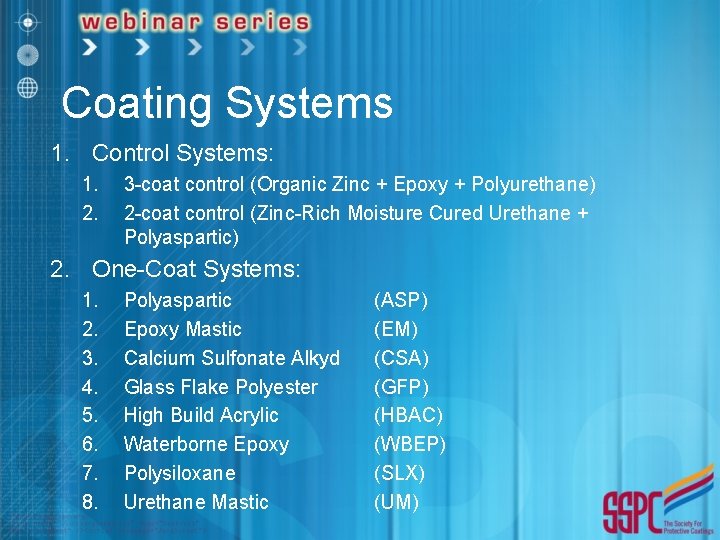
Coating Systems 1. Control Systems: 1. 2. 3 -coat control (Organic Zinc + Epoxy + Polyurethane) 2 -coat control (Zinc-Rich Moisture Cured Urethane + Polyaspartic) 2. One-Coat Systems: 1. 2. 3. 4. 5. 6. 7. 8. Polyaspartic Epoxy Mastic Calcium Sulfonate Alkyd Glass Flake Polyester High Build Acrylic Waterborne Epoxy Polysiloxane Urethane Mastic (ASP) (EM) (CSA) (GFP) (HBAC) (WBEP) (SLX) (UM)
FHWA Study • Performance of coating systems were evaluated by: – – – – Volatile content Binder content Pigment content Pencil scratch hardness DFT Accelerated Laboratory Testing Surface Defects Adhesion Strength
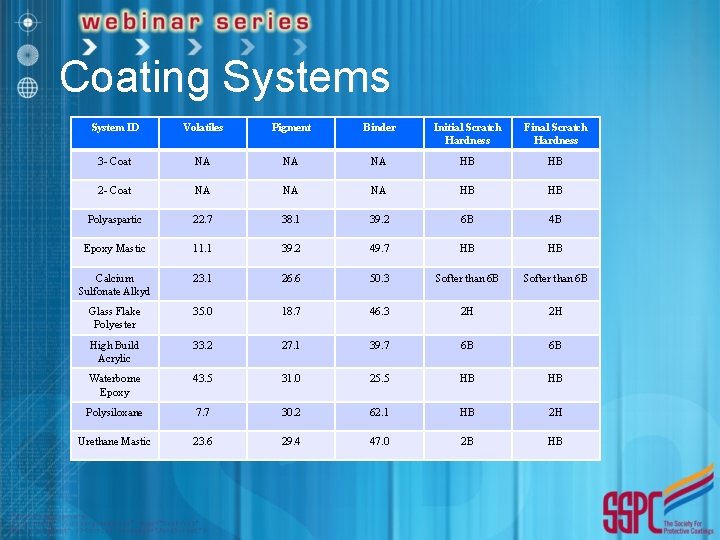
Coating Systems System ID Volatiles Pigment Binder Initial Scratch Hardness Final Scratch Hardness 3 - Coat NA NA NA HB HB 2 - Coat NA NA NA HB HB Polyaspartic 22. 7 38. 1 39. 2 6 B 4 B Epoxy Mastic 11. 1 39. 2 49. 7 HB HB Calcium Sulfonate Alkyd 23. 1 26. 6 50. 3 Softer than 6 B Glass Flake Polyester 35. 0 18. 7 46. 3 2 H 2 H High Build Acrylic 33. 2 27. 1 39. 7 6 B 6 B Waterborne Epoxy 43. 5 31. 0 25. 5 HB HB Polysiloxane 7. 7 30. 2 62. 1 HB 2 H Urethane Mastic 23. 6 29. 4 47. 0 2 B HB
Pencil Scratch Hardness • Tested per ASTM D 3363 -05, “Standard Test Method for Film Hardness by Pencil Test
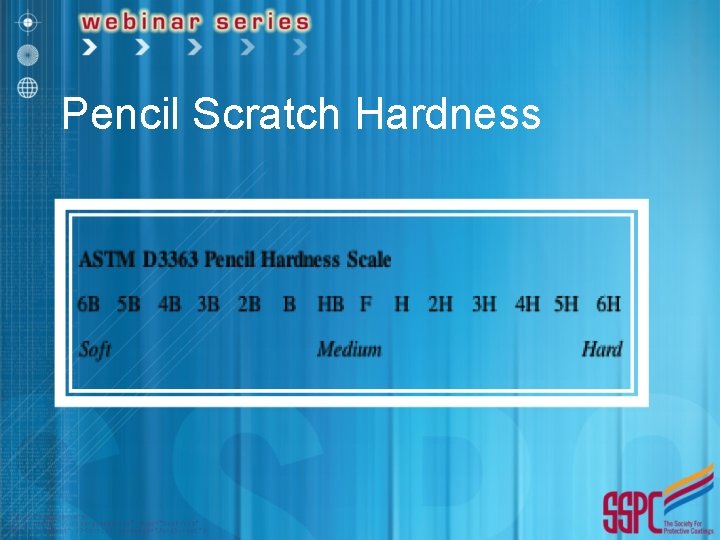
Pencil Scratch Hardness
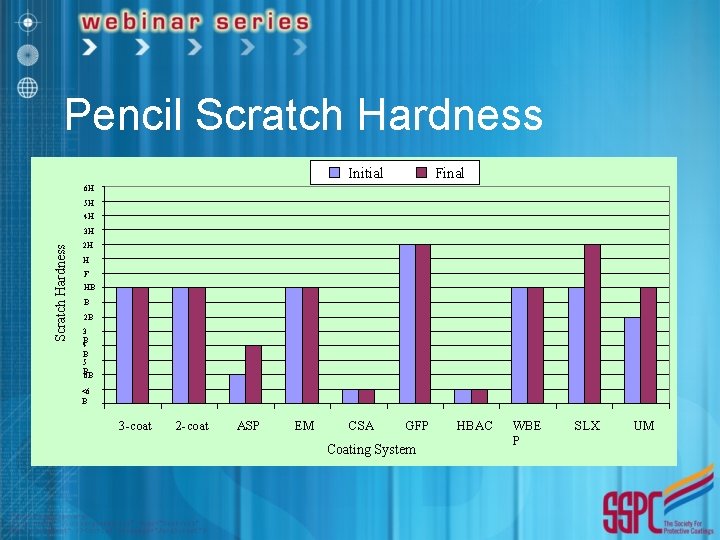
Pencil Scratch Hardness Initial Final 6 H 5 H 4 H Scratch Hardness 3 H 2 H H F HB B 2 B 3 B 4 B 5 B 6 B <6 B 3 -coat 2 -coat ASP EM CSA GFP Coating System HBAC WBE P SLX UM
DFT • Measured per SSPC PA 2, “ Measurement of Dry Film Thickness with Magnetic Gage” • Appendix 6 - Method for Measuring Dry Film Thickness of Thin Coatings on Coated Steel Test Panels that Had Been Abrasive Blast Cleaned
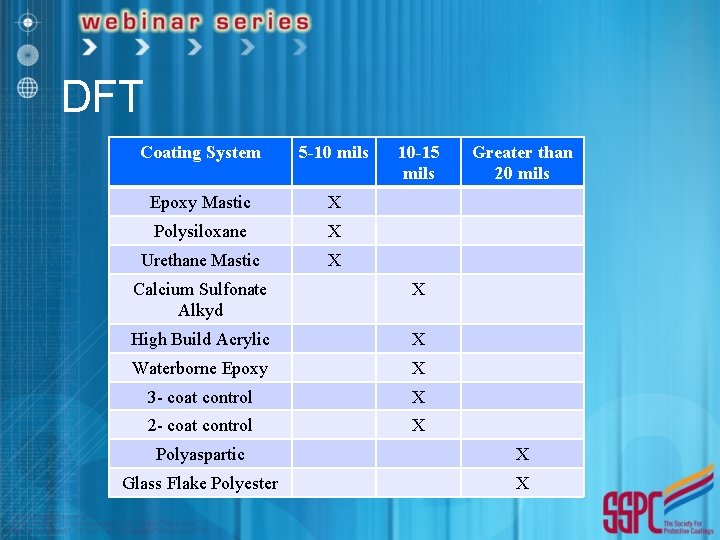
DFT Coating System 5 -10 mils Epoxy Mastic X Polysiloxane X Urethane Mastic X 10 -15 mils Calcium Sulfonate Alkyd X High Build Acrylic X Waterborne Epoxy X 3 - coat control X 2 - coat control X Greater than 20 mils Polyaspartic X Glass Flake Polyester X
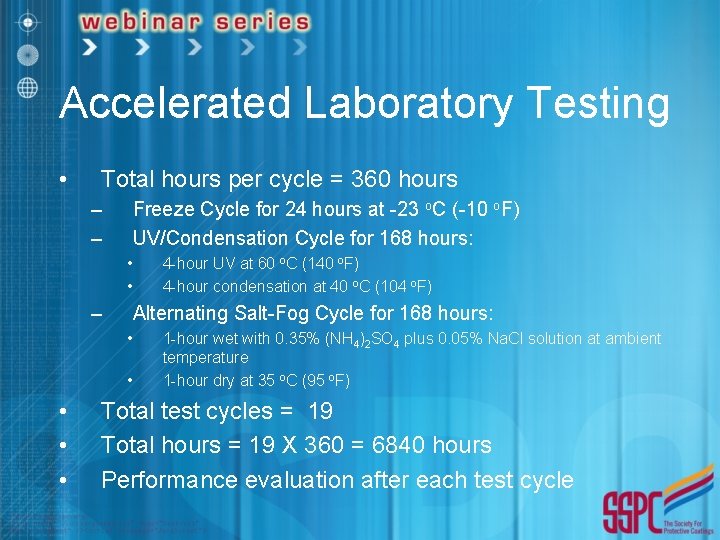
Accelerated Laboratory Testing • Total hours per cycle = 360 hours – – Freeze Cycle for 24 hours at -23 o. C (-10 o. F) UV/Condensation Cycle for 168 hours: • • – Alternating Salt-Fog Cycle for 168 hours: • • • 4 -hour UV at 60 o. C (140 o. F) 4 -hour condensation at 40 o. C (104 o. F) 1 -hour wet with 0. 35% (NH 4)2 SO 4 plus 0. 05% Na. Cl solution at ambient temperature 1 -hour dry at 35 o. C (95 o. F) Total test cycles = 19 Total hours = 19 X 360 = 6840 hours Performance evaluation after each test cycle
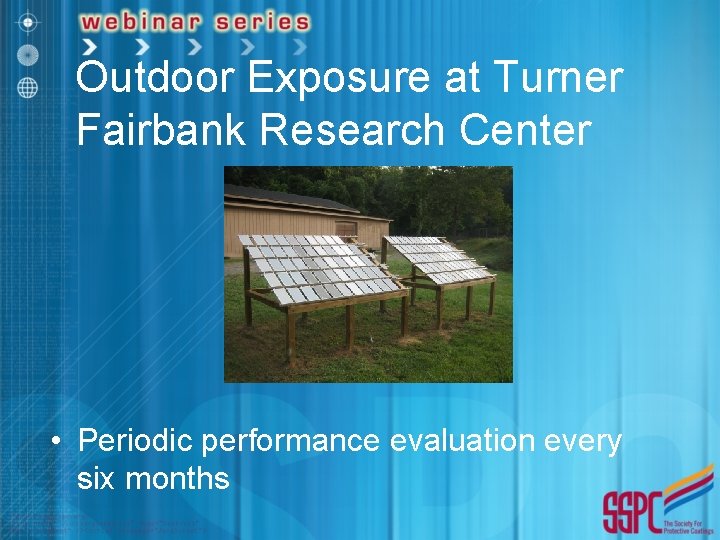
Outdoor Exposure at Turner Fairbank Research Center • Periodic performance evaluation every six months
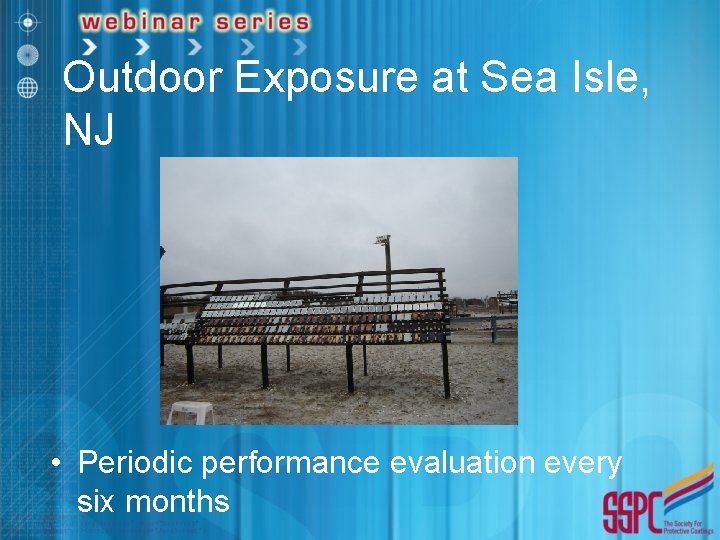
Outdoor Exposure at Sea Isle, NJ • Periodic performance evaluation every six months
Outdoor Exposure Test Sites • Due to insufficient data, test results obtained from the outdoor exposure test sites will not be included in this presentation and will be reported at a future time
Outdoor Exposure Test Sites • Data being gathered on panels at these sites are: – Gloss per ASTM D 523, Standard Test Method for Specular Gloss – Color per ASTM D 2244, Standard Practice for Calculation of Color Tolerances and Color Differences from Instrumentally Measured Color Coordinates – Coating Impedance per Electrochemical Impedance Spectroscopy (EIS)
Electrochemical Impedance Spectroscopy (EIS) • EIS studies the system response to the application of a periodic small amplitude ac signal. These measurements are carried out at different ac frequencies and, thus, the name impedance spectroscopy was adopted • Analysis of the system response contains information about the interface, its structure and reactions taking place
Electrochemical Impedance Spectroscopy (EIS) • EIS is used to forecast the remaining life of a coating system
Rust Creepage • Measured per ASTM D 7087 -05 a, “Standard Test Method for an Imaging Technique to Measure Rust Creepage at Scribe on Coated Test Panels Subjected to Corrosive Environment”
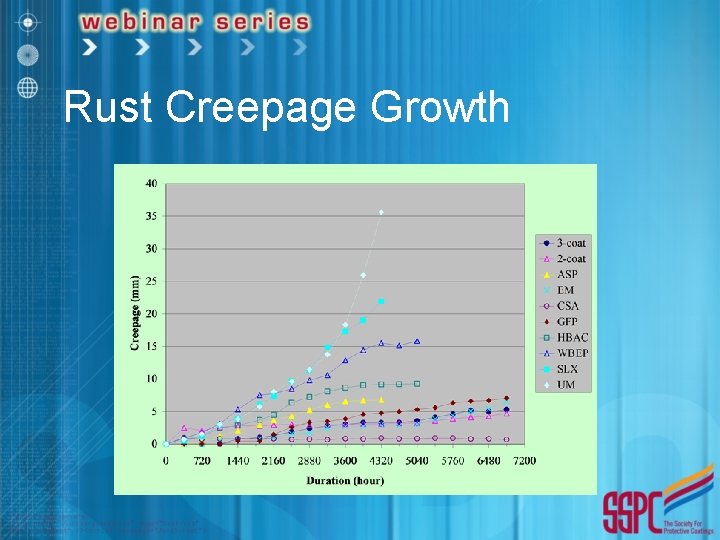
Rust Creepage Growth
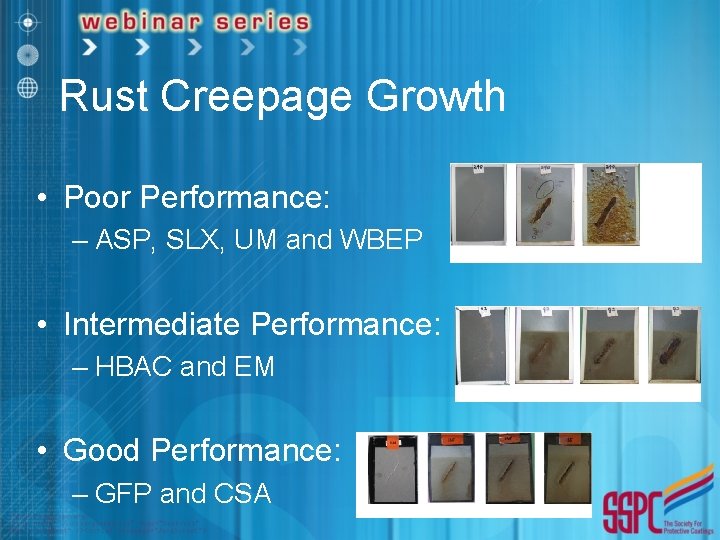
Rust Creepage Growth • Poor Performance: – ASP, SLX, UM and WBEP • Intermediate Performance: – HBAC and EM • Good Performance: – GFP and CSA
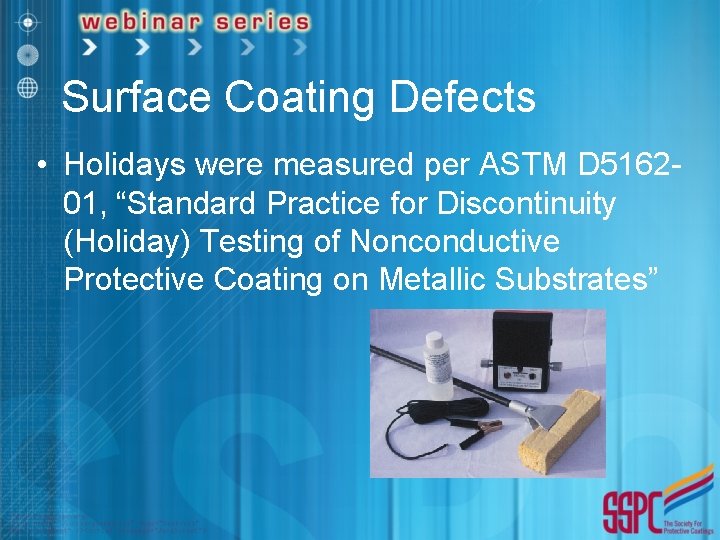
Surface Coating Defects • Holidays were measured per ASTM D 516201, “Standard Practice for Discontinuity (Holiday) Testing of Nonconductive Protective Coating on Metallic Substrates”
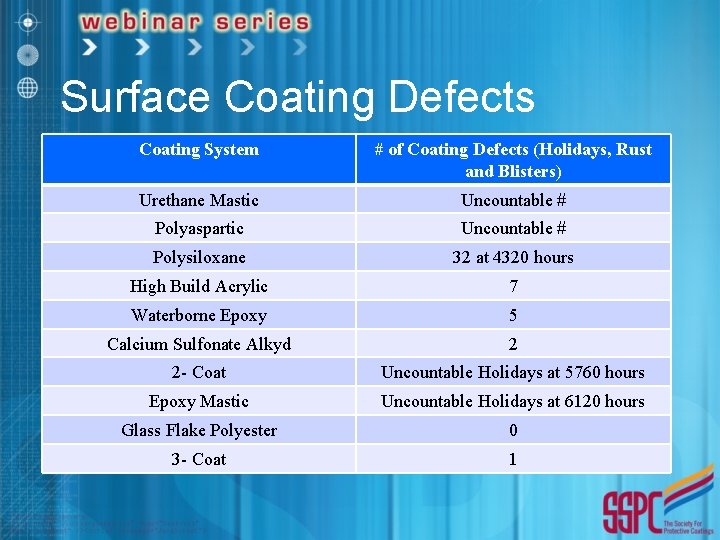
Surface Coating Defects Coating System # of Coating Defects (Holidays, Rust and Blisters) Urethane Mastic Uncountable # Polyaspartic Uncountable # Polysiloxane 32 at 4320 hours High Build Acrylic 7 Waterborne Epoxy 5 Calcium Sulfonate Alkyd 2 2 - Coat Uncountable Holidays at 5760 hours Epoxy Mastic Uncountable Holidays at 6120 hours Glass Flake Polyester 0 3 - Coat 1
Adhesion • Adhesion was measured per ASTM D 454101, “Standard Test Method for Pull-Off Strength for Coatings Using portable Adhesion Testers” • Initial adhesion tests were conducted using a pneumatic adhesion tester, which was replaced with a new hydraulic adhesion tester in the middle of the study
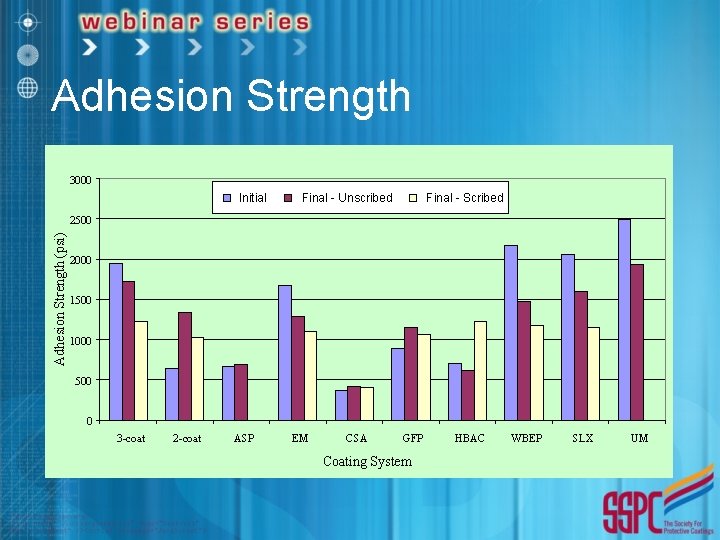
Adhesion Strength 3000 Initial Final--Unscribed Final--Scribed Adhesion Strength (psi) 2500 2000 1500 1000 500 0 3 -coat 2 -coat ASP EM CSA GFP Coating System HBAC WBEP SLX UM
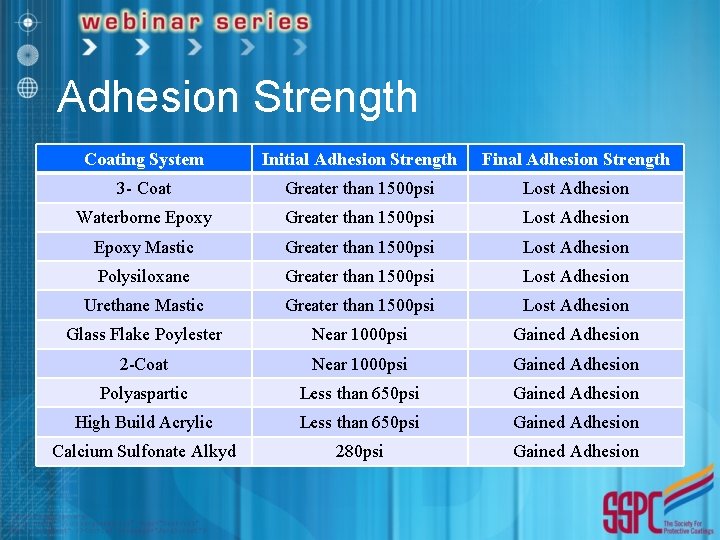
Adhesion Strength Coating System Initial Adhesion Strength Final Adhesion Strength 3 - Coat Greater than 1500 psi Lost Adhesion Waterborne Epoxy Greater than 1500 psi Lost Adhesion Epoxy Mastic Greater than 1500 psi Lost Adhesion Polysiloxane Greater than 1500 psi Lost Adhesion Urethane Mastic Greater than 1500 psi Lost Adhesion Glass Flake Poylester Near 1000 psi Gained Adhesion 2 -Coat Near 1000 psi Gained Adhesion Polyaspartic Less than 650 psi Gained Adhesion High Build Acrylic Less than 650 psi Gained Adhesion Calcium Sulfonate Alkyd 280 psi Gained Adhesion
FHWA Study Findings • Based on the initial coating characteristics of eight one-coat materials and two controls, and their 20 month performance data, the following findings were made: – Calcium sulfonate alkyd has been the best performer – Glass flake polyester is an excellent coating system and is the 2 nd best in overall performance – Both of these coating systems out performed the control systems • Organic Zinc + Epoxy + Polyurethane • Zinc-rich Moisture Cured Urethane + Polyaspartic

• Second Study
2005 FHWA Connecticut DOT Study • 3 one- coat systems were tested per “AASHTO R 31, Project Work Plan for the Laboratory Evaluation of Structural Steel Coatings” – Polyaspartic – Polysiloxane – Waterborne Epoxy
2005 FHWA Connecticut DOT Study • The 3 coating systems were tested for: – Accelerated testing – Rust Creepage – Gloss Retention – Color Retention – Adhesive Strength – Abrasion Resistance
Accelerated Testing • Polyaspartic and Waterborne Epoxy coating systems did not blister after 15, 336 hour cyclic weathering exposures
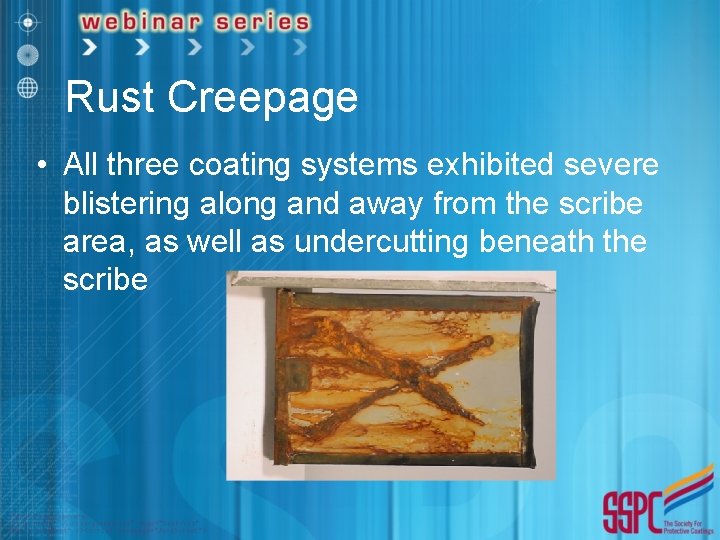
Rust Creepage • All three coating systems exhibited severe blistering along and away from the scribe area, as well as undercutting beneath the scribe
Aesthetics • Color retention for the three systems was excellent. • The gloss retention was approximately 4050% for polyaspartic and waterborne epoxy coating systems • Polysiloxane did not complete test- was pulled early due to poor performance
Adhesion • Adhesion strength of the materials was high and well in excess of the suggested minimum (600 psi) adhesion values prescribed by AASHTO Specification R 31
Abrasion Resistance • The coating system that exhibited the best abrasion resistance was polyaspartic with waterborne epoxy performing the worst
2005 FHWA Connecticut DOT Study Findings • The two systems that performed the best were: – Polyaspartic – Waterborne Epoxy • Neither materials tested as well IOZ/Epoxy/Polyurethane and are recommended only for mild environments
Summary • In summary, while not yet equal to the standard three-coat systems, one-coat materials tested show significant promise

What is the Next Step? • To determine the ultimate field performance of one-coat systems. . Field exposure will be targeted to different demanding environments, e. g. , freshwater marine, saltwater marine, inland dry, and control test sites
- Slides: 42