
ONE CHILD POLICY WHAT IS A ONE CHILD

- Slides: 8
ONE CHILD POLICY
WHAT IS A ‘ONE CHILD POLICY’ • A one child policy is a form of population planning • It was enforced in China from 1979 – 2015 • https: //www. bbc. co. uk/news/world-asia-34665539
WHERE CAN A ONE CHILD POLICY WORK? Nigeria Zimbabwe • Population 190. 9 million (2017) • Average birth rate 5. 53 per woman (2016) • Rate of poverty 33. 1% (extreme 86. 9 million) • Rate of unemployment 23. 10% (2018) • Population 16. 53 (2017) • Average birth rate 3. 76 per woman (2016) • Rate of poverty 72. 3% (2011) • Rate of unemployment (unconfirmed) 90% https: //youtu. be/AAJB 2 k 0 j 2 w. Q
WHERE CAN A ONE CHILD POLICY WORK? Philippines • Avg. Birth Rate: 2. 92 births per women (2016) • Unemployment Rate: 5. 10% (2018 -2019) • Poverty Rate: 22 million Filipinos / one-fifth of the country's population still liv e below the national poverty line. China • Avg. Birth Rate: 1. 62 births per women (2016) • Unemployment Rate: 3. 80% (2018 -2019) • Poverty Rate: 1. 4% of population living at $1. 90 a day (2014) • Population: 1, 415, 045, 928
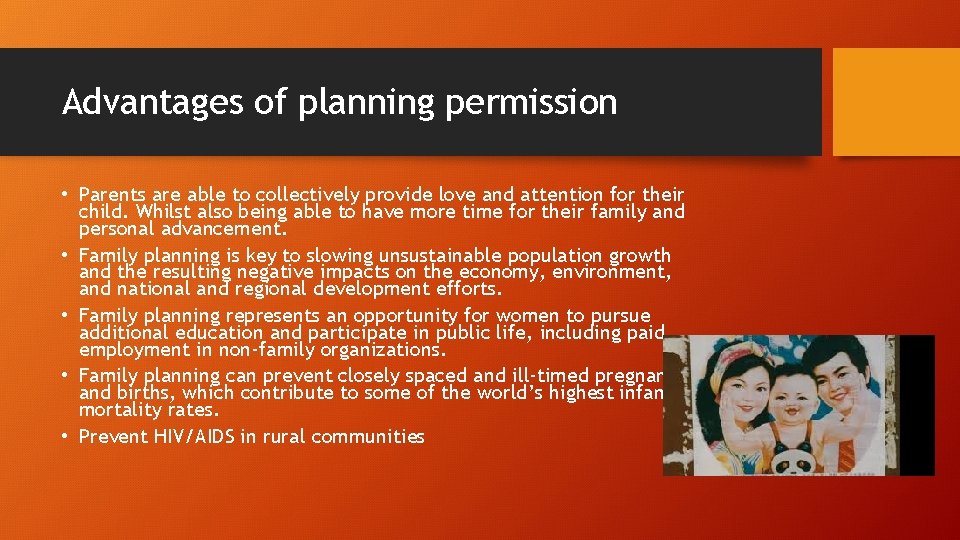
Advantages of planning permission • Parents are able to collectively provide love and attention for their child. Whilst also being able to have more time for their family and personal advancement. • Family planning is key to slowing unsustainable population growth and the resulting negative impacts on the economy, environment, and national and regional development efforts. • Family planning represents an opportunity for women to pursue additional education and participate in public life, including paid employment in non-family organizations. • Family planning can prevent closely spaced and ill-timed pregnancies and births, which contribute to some of the world’s highest infant mortality rates. • Prevent HIV/AIDS in rural communities
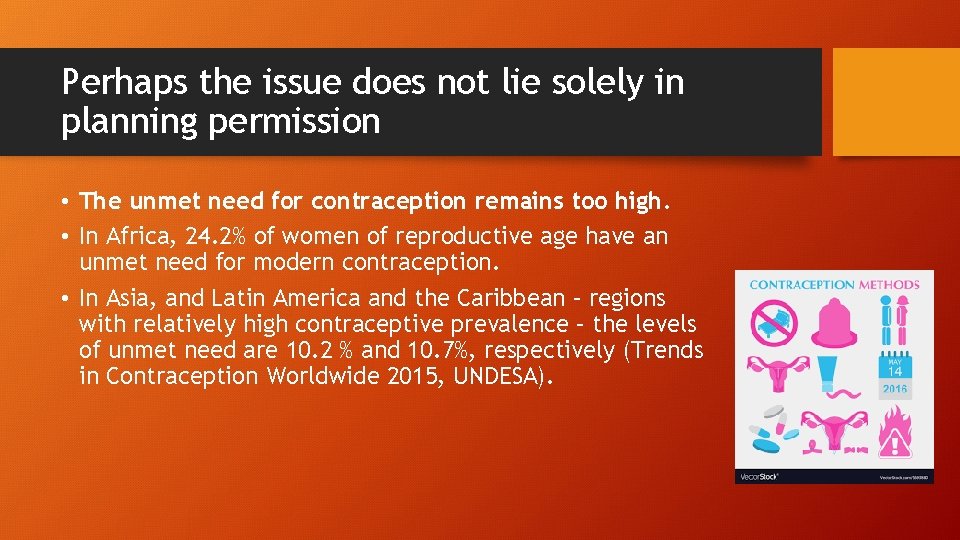
Perhaps the issue does not lie solely in planning permission • The unmet need for contraception remains too high. • In Africa, 24. 2% of women of reproductive age have an unmet need for modern contraception. • In Asia, and Latin America and the Caribbean – regions with relatively high contraceptive prevalence – the levels of unmet need are 10. 2 % and 10. 7%, respectively (Trends in Contraception Worldwide 2015, UNDESA).
Disadvantages of a one child policy • The solution is not a one child policy – it is the availability of contraception in developing countries • It can to parents killing their children – there are situation where female twins were discarded • How will it be enforced effectively? Even in the one child policy adopted in China there were loopholes (e. g. for multiple births) • Cultural and traditional differences – the purpose of having children is so they can look after you in later life. • Violation of Article 8 of the European Convention on Human Rights provides a right to respect for one's "private and family life,
TIME TO DEBATE