
Oncology Assessment and Management of Patients With Cancer



- Slides: 32
Oncology Assessment and Management of Patients With Cancer Breast Prepared by Dr. Iman Abdullah
Out Line Ø Ø Ø § § § § Pathophysiology of the Malignant Process Proliferative Patterns Characteristics of Malignant Cells Management of Cancer Radiation Therapy Types of Radiation Toxicity Nursing Management in Radiation Therapy Chemotherapy Administration of Chemotherapeutic Agents Special Problems Extravasation Toxicity Nursing Management in Chemotherapy
Out Line Ø Ø Ø Ø Anatomic and Physiologic Overview of Breast Assessment Malignant Conditions of the Breast Types of Breast Cancer Risk Factors Breast Cancer Prevention Strategies in the High-Risk Patient Clinical Manifestations Assessment and Diagnostic Findings Staging or Classification of Tumors Prognosis Surgical Management Nursing Process Systemic Treatments
Learning Objectives On completion of this lecture, the student will be able to: Compare the structure and function of the normal cell and the cancer cell Differentiate between benign and malignant tumors. Describe the roles of radiation therapy, and chemotherapy in treating cancer. Describes the special nursing needs of patients receiving chemotherapy. Develop a teaching plan for breast self-examination
Cont. Identify the diagnostic tests used to detect the breast disorders. Use the nursing process as a framework for care of the patient undergoing breast cancer surgery. Compare therapeutic usefulness of chemotherapy, surgery and radiation in treating breast cancer Describe the physical, psychological and rehabilitative needs of the patient who has had mastectomy
Pathophysiology of the Malignant Process Cancer is a disease process that begins when an abnormal cell is transformed by the genetic mutation of the cellular DNA. Proliferative Patterns Characteristics of Malignant Cells
Management of Cancer Surgery Radiation therapy Chemotherapy Bone Marrow Transplantation Hyperthermia Targeted therapies Photodynamic therapy
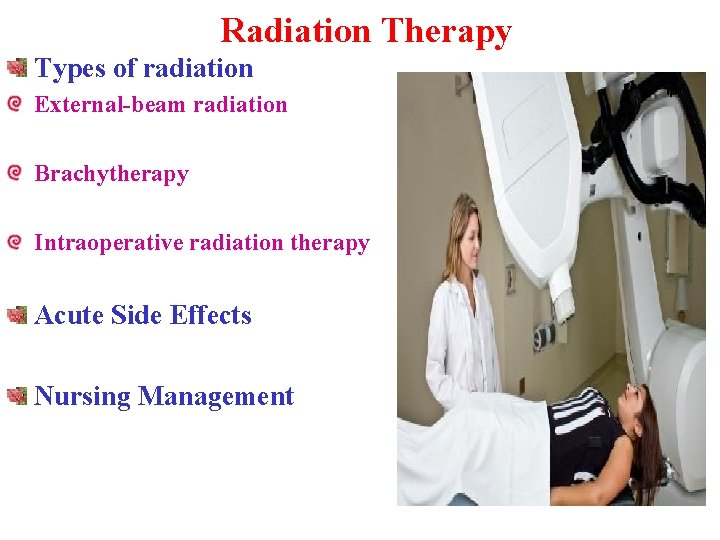
Radiation Therapy Types of Radiation External Radiation Internal radiation Radiation Dosage
Toxicity Ø Altered skin integrity is a common effect Ø Alterations in oral mucosa Ø The entire gastrointestinal mucosa may be involved Ø Anorexia nausea, and vomiting, and diarrhea Ø If sites containing bone marrow (Anemia, Leukopenia, Thrombocytopenia (bleeding) Ø Systemic side effects
Nursing Management in Radiation Therapy Protecting skin and oral mucosa Protecting caregivers
Chemotherapy Administration of Chemotherapeutic Agents The route of administration usually depends on: Ø The type of agent Ø The required dose Ø The type, location, and extent of tumor being treated Special Problems Extravasation Ø Indications of extravasation during administration of vesicant agents
Toxicity Cells with rapid growth rates (eg, epithelium, bone marrow, hair follicles, sperm) are very susceptible to damage, and various body systems may be affected as well. Gastrointestinal System Hematopoietic System Cardiopulmonary System Renal System Reproductive System Neurologic System Miscellaneous
Nursing Management in Chemotherapy Assessing fluid and electrolyte status Modifying risks for infection and bleeding Administering chemotherapy Protecting caregivers
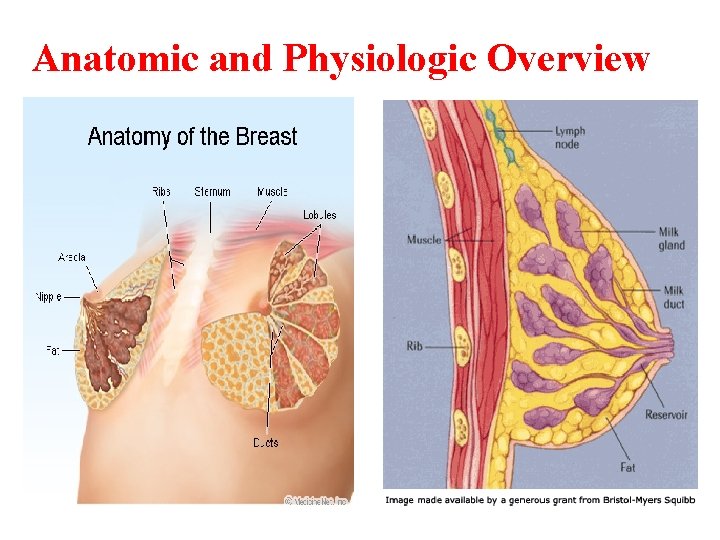
Anatomic and Physiologic Overview
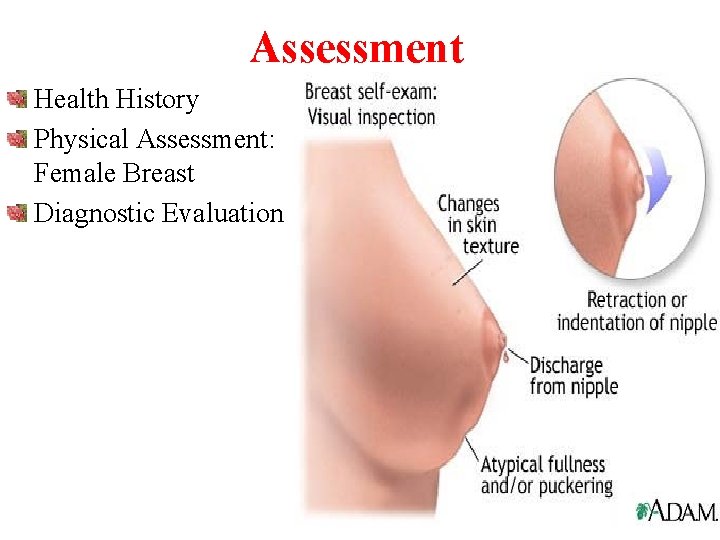
Assessment Health History Physical Assessment: Female Breast Diagnostic Evaluation
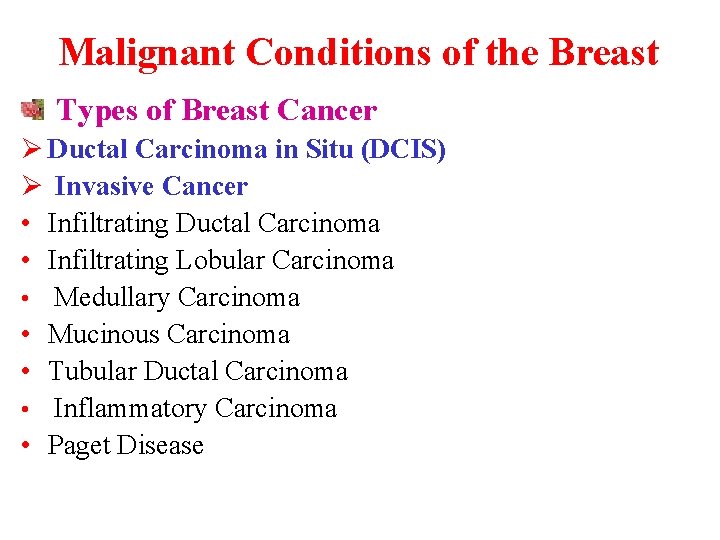
Malignant Conditions of the Breast Types of Breast Cancer Ø Ductal Carcinoma in Situ (DCIS) Ø Invasive Cancer • Infiltrating Ductal Carcinoma • Infiltrating Lobular Carcinoma • Medullary Carcinoma • Mucinous Carcinoma • Tubular Ductal Carcinoma • Inflammatory Carcinoma • Paget Disease
Risk Factors Non Genetic Risk Factors Gender and Age Personal History Hormonal Factors Radiation Exposure Benign Proliferative Breast Disease Fat Intake and Obesity Alcohol Use Other Possible Risk Factors
Genetic Risk Factors More than 80% of all breast cancer cases have no known family history of the disease. In familial cases, the risk is determined by which family member has the disease. Having a first-degree relative increase the risk twofold. Protective Factors
Breast Cancer Prevention Strategies in the High-Risk Patient Long-Term Surveillance Chemoprevention Prophylactic Mastectomy
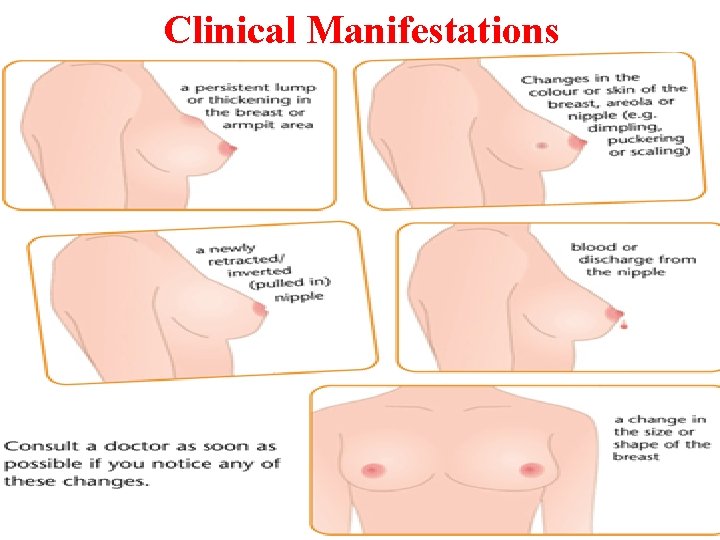
Clinical Manifestations
Assessment and Diagnostic Findings Techniques to determine the diagnosis of breast cancer include various types of biopsy, which have been discussed previously.
Staging or Classification of Tumors Stage 0 Stage 1 Stage II and stage III, stage IV
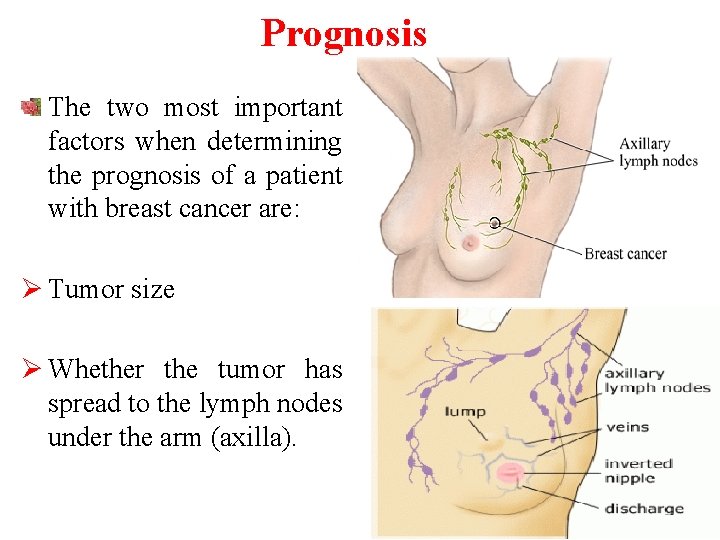
Prognosis The two most important factors when determining the prognosis of a patient with breast cancer are: Ø Tumor size Ø Whether the tumor has spread to the lymph nodes under the arm (axilla).
Surgical Management Modified Radical Mastectomy Total Mastectomy Breast Conservation Treatment
Nursing Process The Patient Undergoing Surgery for Breast Cancer Assessment Diagnosis (Preoperative Nursing Diagnosis) Diagnosis (Postoperative Nursing Diagnosis) Potential Complications Planning and Goals Preoperative Nursing Interventions Postoperative Nursing Interventions
Monitoring and managing potential complications Lymphedem Hematoma Formation Seroma Formation Infection Promoting Home and Community-Based Care
Radiation Therapy Types of radiation External-beam radiation Brachytherapy Intraoperative radiation therapy Acute Side Effects Nursing Management
Systemic Treatments I- Chemotherapy Common physical side effects of chemotherapy for breast cancer Specific side effects vary with the type of chemotherapeutic agent used. The side effects of the anthracyclines Nursing Management
II- Hormonal Therapy Managing Side Effects of Adjuvant Hormonal Therapy in Breast Cancer Ø Hot Flashes Ø Vaginal Dryness Ø Nausea and Vomiting Ø Musculoskeletal Symptoms Ø Risk of Endometrial Cancer Ø Risk for Thromboembolic Events Ø Risk for Osteoporosis or Fractures
III- Targeted Therapy Trastuzumab (Herceptin) is a monoclonal antibody that binds specifically to the HER-2/neuprotein. This protein, which regulates cell growth, is present in small amounts on the surface of normal breast cells and in most breast cancers. Trastuzumab targets and inactivates the HER-2/neuprotein, thus slowing tumor growth. Unlike chemotherapy, trastuzumab spares the normal cells and has limited adverse reactions, which may include fever, chills, nausea, vomiting, diarrhea, and headache.
Reference Brunner, L. and Suddarath, D. (2010). Text Book of Medical Surgical Nursing. 12 th Edition. J. B. Lippincott Williams & Wilikins, Library of Congress Catalging-in. Publication Data. ]
Thank you