
Onboarding Training Coaching and Mentoring How to Hire
Onboarding, Training, Coaching and Mentoring How to Hire, Train and Retain the Best Employees © 2019 Michael Gregory Consulting LLC
Part Two of a Three Part Series • Part 1: Hiring Smart to Attract the Right Employees • Part 2: Onboarding and Training Employees Through Mentoring, and Coaching – first ten slides quick review • Part 3: Retaining Employees & Developing Talent with Ethical Behavior and Addressing Stress © 2019 Michael Gregory Consulting LLC
Your Hired • Anticipation • Plan out first day - orientation • Plan out first week • Help employee develop their own action plan over the first year • Mentor • Coach • Example • Continuous feedback © 2019 Michael Gregory Consulting LLC
Orientation • Orientation on day one • Who – introductions, openness, first impressions • What – roles, goals, expectations • When – describe the day, week, month etc. • Where – work area, facilities, team members © 2019 Michael Gregory Consulting LLC
Orientation • Why – demonstrate that you care • How – open, friendly, professional • Mentors • Training • Other areas demonstrating your culture © 2019 Michael Gregory Consulting LLC
Retaining Employees • Trust • Sharing career aspirations • Develop a plan • Help them execute their plan • Listen • Keep promises • Be loyal to those not present • Seek to understand • Say please and thank you © 2019 Michael Gregory Consulting LLC
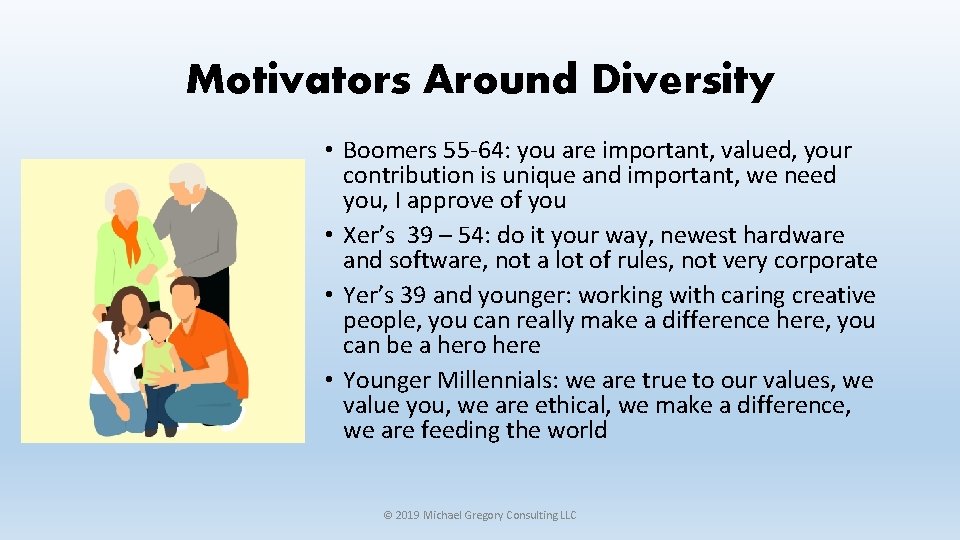
Motivators Around Diversity • Boomers 55 -64: you are important, valued, your contribution is unique and important, we need you, I approve of you • Xer’s 39 – 54: do it your way, newest hardware and software, not a lot of rules, not very corporate • Yer’s 39 and younger: working with caring creative people, you can really make a difference here, you can be a hero here • Younger Millennials: we are true to our values, we value you, we are ethical, we make a difference, we are feeding the world © 2019 Michael Gregory Consulting LLC
Remember • Know your niche • Time to reinforce your firm to the new hire. Go over • • • © 2019 Michael Gregory Consulting LLC Qualities needed Staff management metrics Project management skills Quality control culture Investment in People
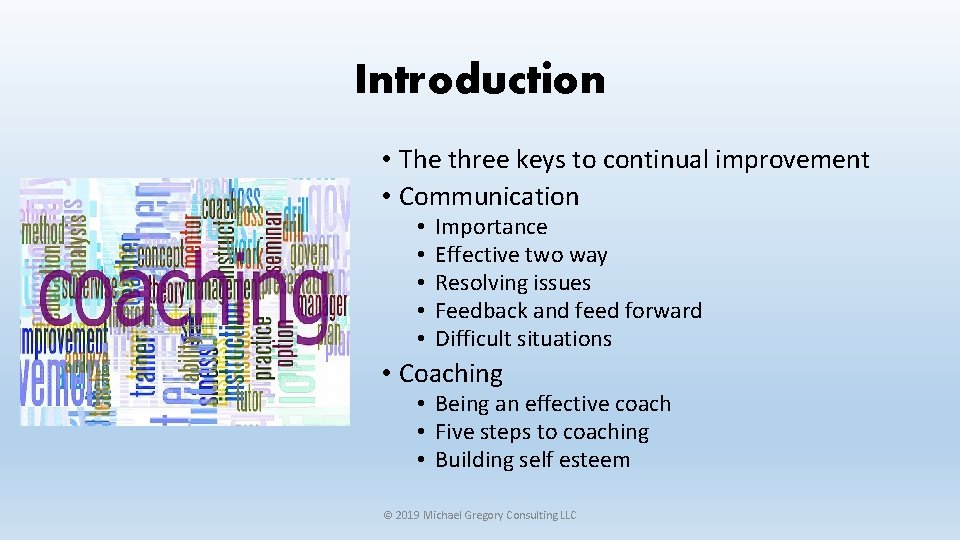
Introduction • The three keys to continual improvement • Communication • • • Importance Effective two way Resolving issues Feedback and feed forward Difficult situations • Coaching • Being an effective coach • Five steps to coaching • Building self esteem © 2019 Michael Gregory Consulting LLC
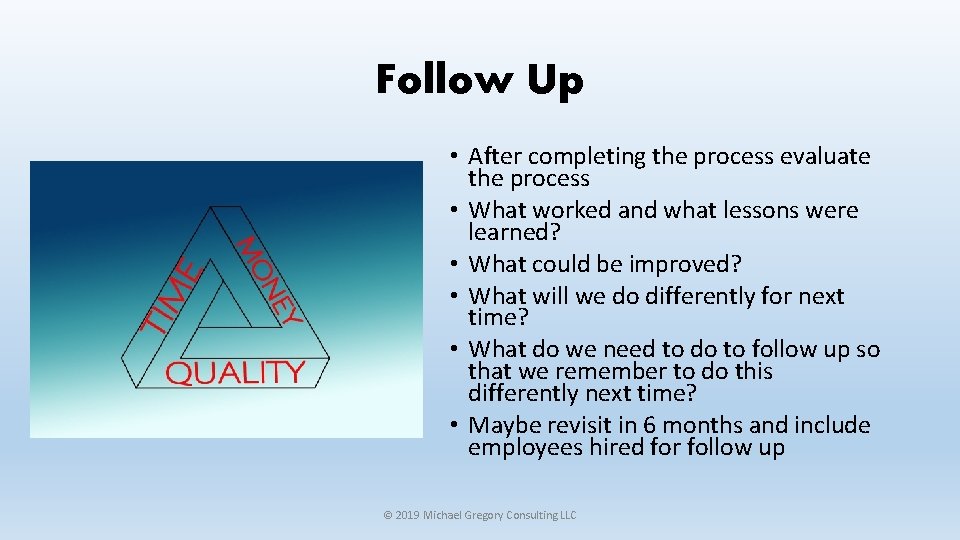
Follow Up • After completing the process evaluate the process • What worked and what lessons were learned? • What could be improved? • What will we do differently for next time? • What do we need to do to follow up so that we remember to do this differently next time? • Maybe revisit in 6 months and include employees hired for follow up © 2019 Michael Gregory Consulting LLC
The Three Keys to Building Trust • Catch your employees doing something right at least once a week and thank them for something specific • Get them the resources they need from their perspective and don’t micromanage • Give them a chance to shine © 2019 Michael Gregory Consulting LLC
Communication • Why is it important? • Managers spend over 80% of their time communicating • 95% percent of managers think they are good at, but only 30% of employees think there managers are good at it – this should tell managers something • Communication is a process • We should listen twice as much as we speak – do you? © 2019 Michael Gregory Consulting LLC

Effective Two Way Communication • Two-way communication involves active listening • Think about a friend of yours that is a good listener • • • Good eye contact Leans forward slightly when listening Nodding and paraphrasing Asks clarifying questions Avoids distractions • When the other person is not listening how do you feel? • What do you need to do? © 2019 Michael Gregory Consulting LLC
How to Actively Listen • Let the other person finish speaking • Repeat in your own words what they said, but try and do it even better than they did • Ask the other person if this is what they meant • If yes, great and continue, if no, ask for further clarification © 2019 Michael Gregory Consulting LLC
How to Actively Listen (continued) • Check perceptions (men and women) Men are from Mars and Women are from Venus • Listen with openness • Listen with awareness • Ask questions © 2019 Michael Gregory Consulting LLC
Choosing Questions to Obtain Specific Responses • Open: how do you feel and what do you think? • Closed: specific answers (yes no) • Fact finding: What % and # of responses • Follow up: ask for an opinion • Feedback: obtain particular type of feedback – how does this compare with that? © 2019 Michael Gregory Consulting LLC

Listening…

The keys to active listening are: Paraphrase, Summarize, Ask open-ended questions, and Empathize.
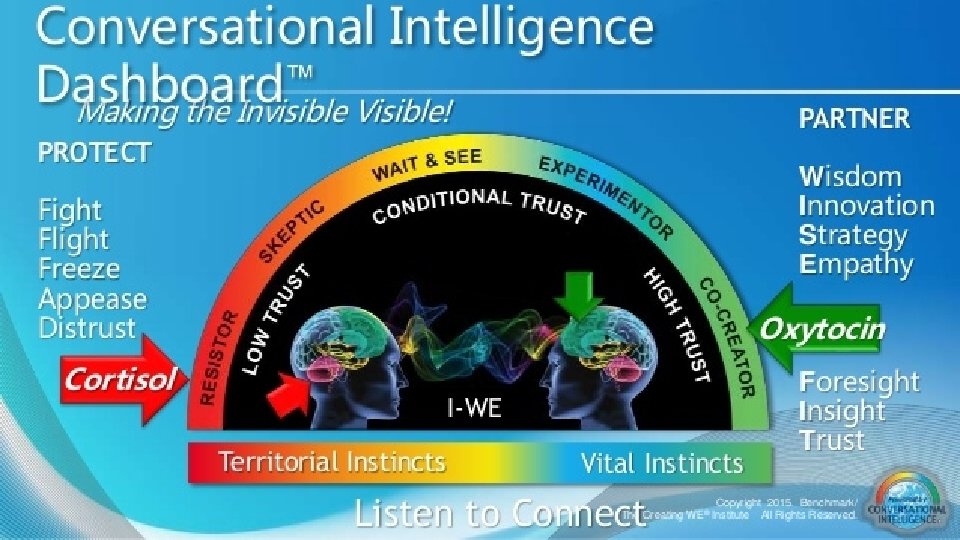

It’s About Us
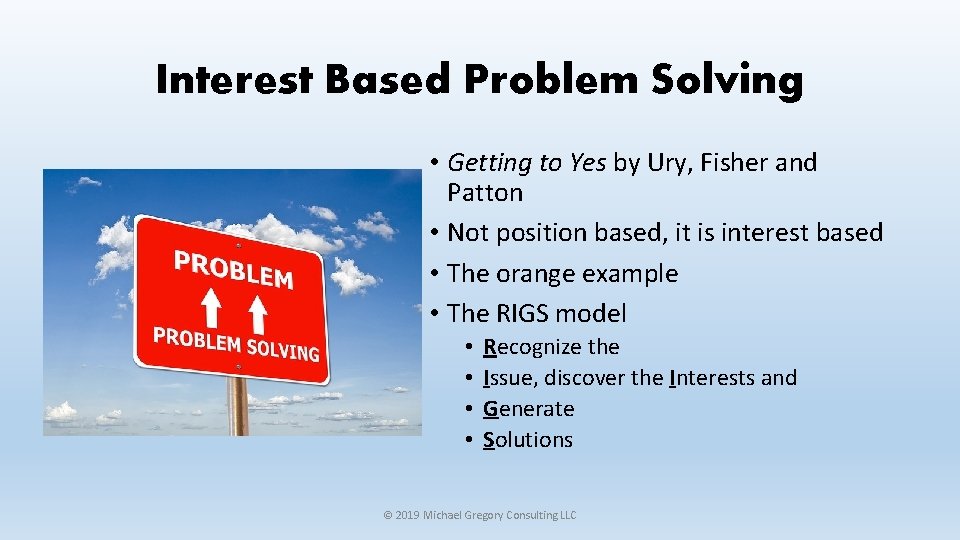
Interest Based Problem Solving • Getting to Yes by Ury, Fisher and Patton • Not position based, it is interest based • The orange example • The RIGS model • • Recognize the Issue, discover the Interests and Generate Solutions © 2019 Michael Gregory Consulting LLC
RIGS Model Expanded • Recognize an issue • I think • I feel • Identify Interests • Economic • Social • Environmental • Generate alternatives • Brainstorm together • Identify and evaluate alternatives • Select a Solution, test it and change if necessary © 2019 Michael Gregory Consulting LLC
Resolving Issues Through Mediation • Mediation model using FIFI • What are the Facts? • What are the Issues? Once you have identified the issues take them one at a time • What are the Feelings behind the issue? That is what is the emotion and why is there this emotion? • What are the Interests of the parties? • Then it is possible to work towards an interest based solution © 2019 Michael Gregory Consulting LLC
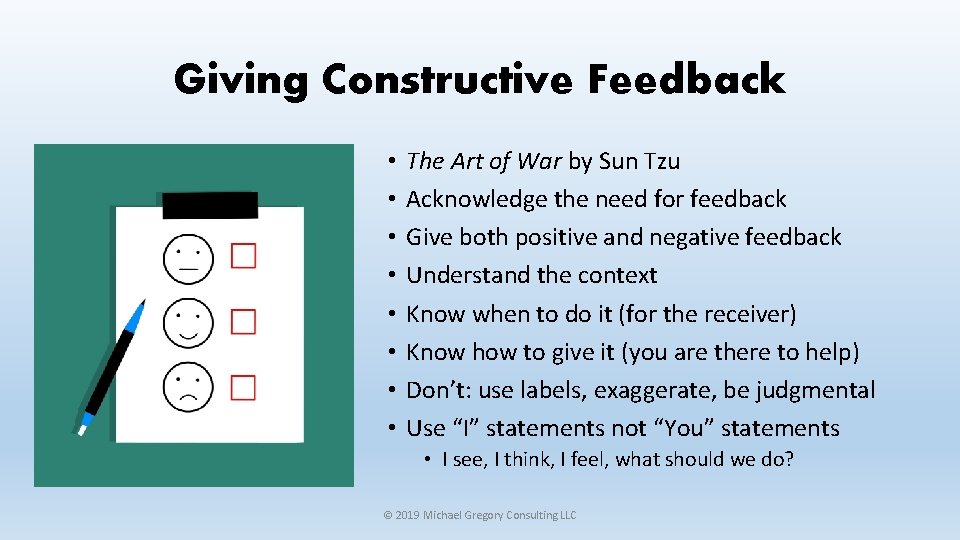
Giving Constructive Feedback • • The Art of War by Sun Tzu Acknowledge the need for feedback Give both positive and negative feedback Understand the context Know when to do it (for the receiver) Know how to give it (you are there to help) Don’t: use labels, exaggerate, be judgmental Use “I” statements not “You” statements • I see, I think, I feel, what should we do? © 2019 Michael Gregory Consulting LLC
Feed Forward • • • Means others suggestions for the future Demonstrates you are there to help Builds trust We can change the future It makes the other person feel valued How to do it: • • • Ask for two suggestions for the future Only positive comments allowed Listen actively and take notes Agree on what we will each do in the future This is short and sweet © 2019 Michael Gregory Consulting LLC
Dealing with Difficult People • In your own words write down 5 characteristics of difficult people you know • So what do you do? • • • Clearly define the situation in objective words Consider alternative Consider implications of alternatives Discuss with your mentor Pick the best solution One alternative is do nothing – no change Be constructive – not anger and complaining When you are calm use constructive behavior If you cannot impact – minimize contact © 2019 Michael Gregory Consulting LLC
Other Considerations • Messages that motivate considering diversity • What matters most to that employee? • • Make the review process interactive What can I do to help you? What should I do less of? What should I keep doing? • Have a list of things and ask the employee to prioritize • Talk about the top 3 and ask if you are doing enough • Talk about the bottom 3 and ask if you are doing to much • The dialogue is very informative and helpful © 2019 Michael Gregory Consulting LLC
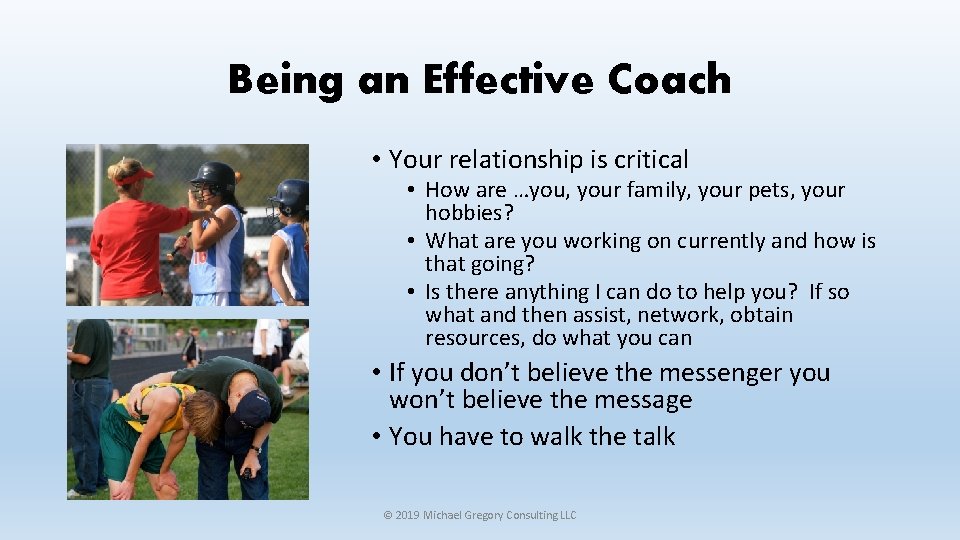
Being an Effective Coach • Your relationship is critical • How are …you, your family, your pets, your hobbies? • What are you working on currently and how is that going? • Is there anything I can do to help you? If so what and then assist, network, obtain resources, do what you can • If you don’t believe the messenger you won’t believe the message • You have to walk the talk © 2019 Michael Gregory Consulting LLC
Five Steps to Coaching • What’s up? Identify the opportunity • What’s so? Obtain the facts and data to define the problem • What’s possible? Jointly develop a plan, goals, and options • Let’s go: Implement the plan, development commitments and check in periodically • How’d it go? Lessons learned, celebrate success, improvements for next time © 2019 Michael Gregory Consulting LLC
Building Self Esteem • What is important to your employee? • Have a conversation around that. • Compliments, support, shared information, given complete information for decisions, being accepted, mistakes ignored, important life events recognized, being delegated to, being asked for help, receiving credit when credit is due, being asked to lead something, being empathetic, receiving tangible rewards, having feelings recognized, having others admit mistakes, being invited for coffee, being able to voice opinions, being praised, having others share experiences and more. • Respond to your employees needs © 2019 Michael Gregory Consulting LLC
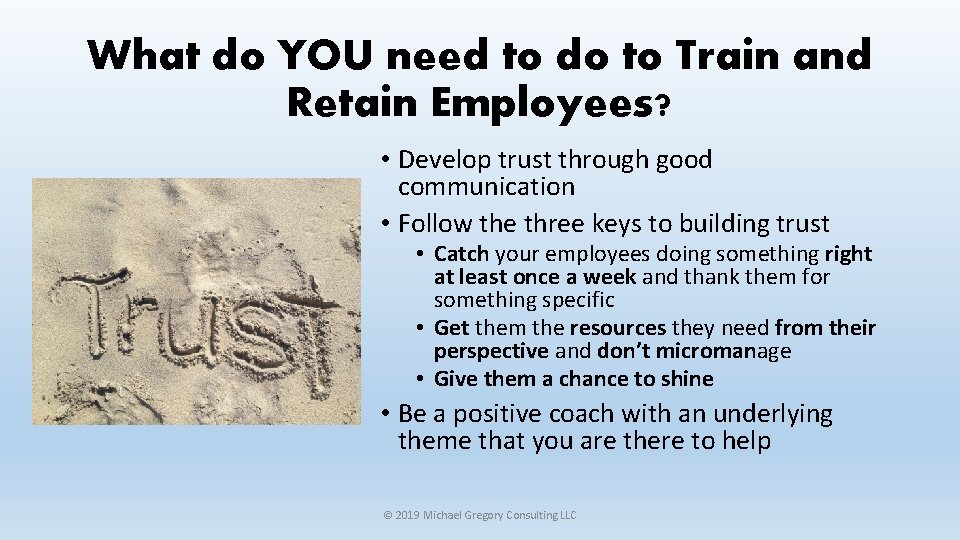
What do YOU need to do to Train and Retain Employees? • Develop trust through good communication • Follow the three keys to building trust • Catch your employees doing something right at least once a week and thank them for something specific • Get them the resources they need from their perspective and don’t micromanage • Give them a chance to shine • Be a positive coach with an underlying theme that you are there to help © 2019 Michael Gregory Consulting LLC
How to Hire, Train and Retain the Best Employees - Hiring Michael Gregory 651 -633 -5311 mg@mikegreg. com www. collabeffect. com
Summary • The three keys to building trust • Communication • • • Importance Effective two way Resolving issues Feedback and feed forward Difficult situations • Coaching • Being an effective coach • Five steps to coaching • Building self esteem © 2019 Michael Gregory Consulting LLC
Onboarding, Training, Coaching and Mentoring How to Hire, Train and Retain the Best Employees © 2019 Michael Gregory Consulting LLC
What’s Next? • Part 3: Retaining Employees & Developing Talent with Ethical Behavior and Addressing Stress © 2019 Michael Gregory Consulting LLC
- Slides: 35