
ONBOARDING Making the First 90 Days Really Count

ONBOARDING Making the First 90 Days Really Count Deborah Lipman Slobodnik, Principal February 5, 2013 Options for Change • 780 Boylston Street #14 C • Boston, MA 02199 • USA Telephone 857 -233 -5616 • Email deborahslobodnik@optionsforchange. com
A Brief Overview of Today’s Presenter • Co-Founder and principal, Options for Change, 25 years experience Developing Leaders, Building Effective Teams, Changing Culture • Selected by clients and colleagues as one of the Top 10 Executive Coaches in the Boston area • Trained and coached other consultants and professionals on change, teams and coaching • Developed over 600 pages of proprietary strategic and tactical tools and training on the web for: – – Culture change Change management Executive coaching Team coaching • OFC has worked with over 500 organizations and 1000 leaders and teams 2 © 2011
Let’s Make this a Conversation • Webinars do not have to be one sided lectures • Here’s my proposal to keep it interesting and to get the most out of it • Rules of Engagement: – Let’s make it a conversation – Ask spontaneous questions; identify yourself by first name – Feel free to follow up with me with questions or comments – Contact info is on the cover 3 © 2011
Webinar Agenda • • The ROI of Onboarding Best Practices New Leader Assimilation Major Onboarding Derailer 4 © 2011
The ROI of Onboarding • Fifty percent of newly hired executives quit or are fired within the first three years • The cost of turnover is 14 times the base salary for those earning under $100 K* • Those earning between $100 K and $250 K, the cost of turnover is 40 times base salary. * This number includes both indirect costs, such as missed opportunities and lost productivity • When a person is new in their role, they consume value for the first three months they are in the organization. After that point, they begin adding value. However, they only begin to add more value than they have consumed after 6. 2 months, which is called the Breakeven Point Data Source: Human Capital Institute, 4/11 White Paper, page 2 5 © 2011

Breakeven Point Chart 6 © 2011
Organizational 90 Day Approach 1. 2. 3. 4. 5. 6. 7. 8. 9. 10. Develop, implement and manage a 90 day onboarding plan Facilitate introductions with senior leaders who model the culture Help the new leader achieve early wins, but not immediately Provide continuous feedback Assign a mentor or coach, someone who can help assimilate the new leader in the cultural and political environment Provide regular check- ins on goals and deliverables Direct new leader to resources and information Provide training for the steepest learning curve Around 90 days conduct a informal 360 with key stakeholders and peers to provide feedback and further individualized development Make Onboarding a process, not an event 7 © 2011
Supervisor’s Role in 90 Day Approach • Meet one on one and review 90 day approach • Have facilitated discussion around 90 day objectives and build the 90 day plan • Plan leader assimilation session for sometime between weeks 4 and 6 • Agree on one to review progress every 3 weeks • Help identify key peers and potential organization mentor • Identify quick wins 8 © 2011
7 Onboarding Best Practices for Leaders 1. Build relationships. First impressions are critical, reach out 2. Don’t be a hero. Everything doesn’t have to be fixed in a day; listen, observe and ask questions, strive to understand the underlying situation and process 3. Look for quick wins: Look for low hanging fruit but make sure it’s ripe 4. Respect the existing culture. Things will be done differently, take a step back before charging in too quickly 5. Be visible and approachable. Look for opportunities to connect with other leaders and teams 6. Get clarity on expectations. Set realistic goals for the first 30, 60 90 days. Ask for feedback and coaching 7. Assimilate. Give your team an opportunity to learn how you operate. Learn about their backgrounds and have them teach you about their jobs 9 © 2011
New Leader Assimilation Process: Best completed in first 4 -6 weeks 1. Team convenes separately and makes a list of questions for leader 2. Typical questions: 1. 2. 3. 4. 5. 6. 7. 8. 9. 10. Tell us your background, early family life, education, career What do you do when you’re not working? Hidden talents? How would you describe your leadership style? What core beliefs and/or values influence you? What are your strengths as a leader? What are your challenges What pushes your buttons? Describe your ideal work environment and team culture What’s the best method and style of communicating with you? What’s your most used style of decision making? Default style? Anything else you’d like to share? 3. Team leader joins team to discuss. Allow 2 -3 hours 4. Ideally, an outcome is team Rules of Engagement 5. Facilitated by 3 rd party 10 © 2011
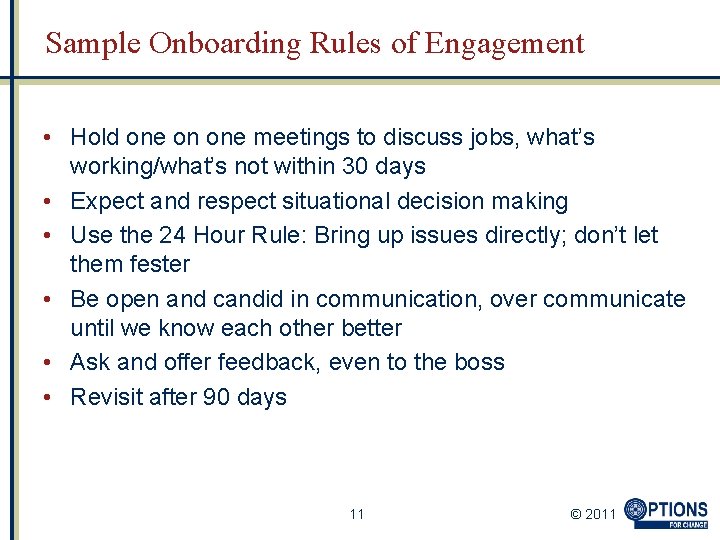
Sample Onboarding Rules of Engagement • Hold one on one meetings to discuss jobs, what’s working/what’s not within 30 days • Expect and respect situational decision making • Use the 24 Hour Rule: Bring up issues directly; don’t let them fester • Be open and candid in communication, over communicate until we know each other better • Ask and offer feedback, even to the boss • Revisit after 90 days 11 © 2011
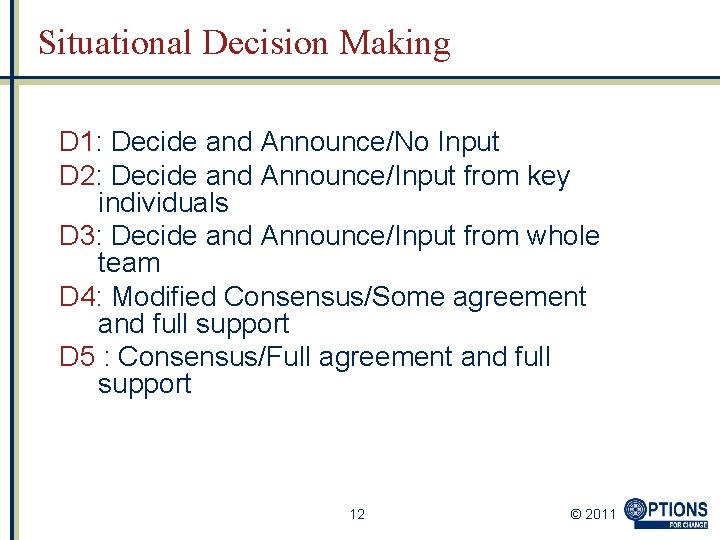
Situational Decision Making D 1: Decide and Announce/No Input D 2: Decide and Announce/Input from key individuals D 3: Decide and Announce/Input from whole team D 4: Modified Consensus/Some agreement and full support D 5 : Consensus/Full agreement and full support 12 © 2011
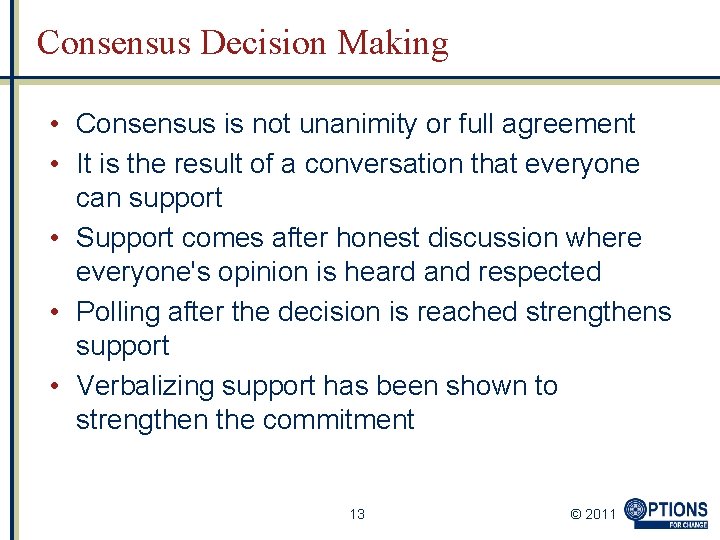
Consensus Decision Making • Consensus is not unanimity or full agreement • It is the result of a conversation that everyone can support • Support comes after honest discussion where everyone's opinion is heard and respected • Polling after the decision is reached strengthens support • Verbalizing support has been shown to strengthen the commitment 13 © 2011
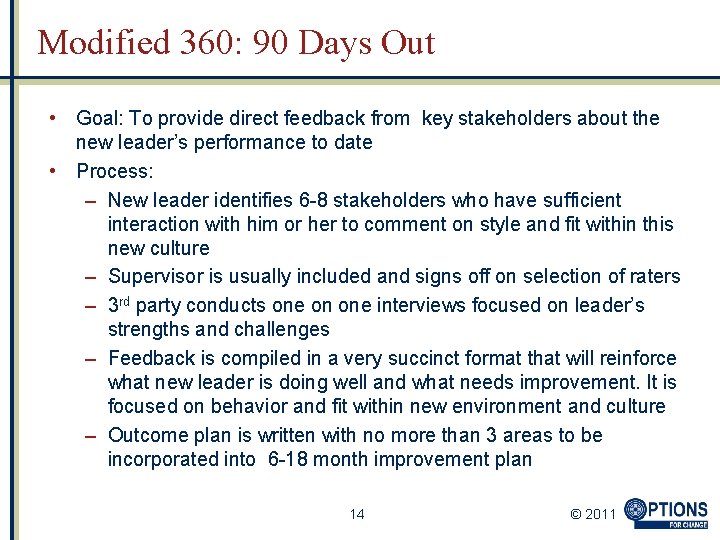
Modified 360: 90 Days Out • Goal: To provide direct feedback from key stakeholders about the new leader’s performance to date • Process: – New leader identifies 6 -8 stakeholders who have sufficient interaction with him or her to comment on style and fit within this new culture – Supervisor is usually included and signs off on selection of raters – 3 rd party conducts one on one interviews focused on leader’s strengths and challenges – Feedback is compiled in a very succinct format that will reinforce what new leader is doing well and what needs improvement. It is focused on behavior and fit within new environment and culture – Outcome plan is written with no more than 3 areas to be incorporated into 6 -18 month improvement plan 14 © 2011
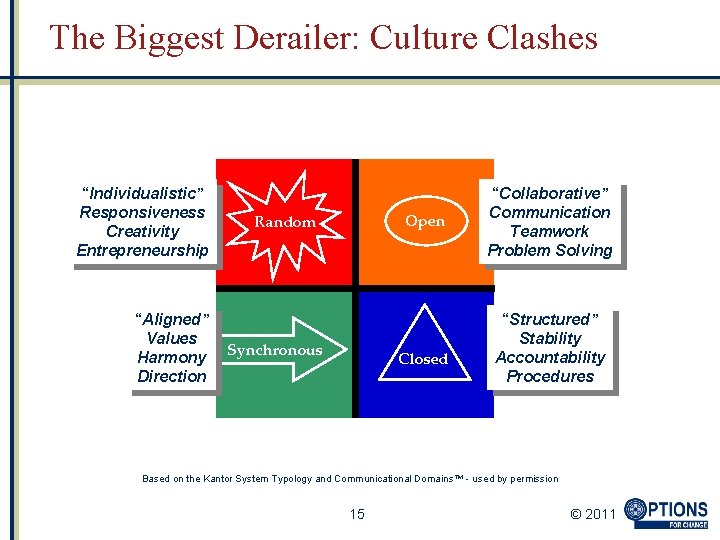
The Biggest Derailer: Culture Clashes “Individualistic” Responsiveness Creativity Entrepreneurship “Aligned” Values Harmony Direction Open Random Synchronous Closed “Collaborative” Communication Teamwork Problem Solving “Structured” Stability Accountability Procedures Based on the Kantor System Typology and Communicational Domains™ - used by permission 15 © 2011
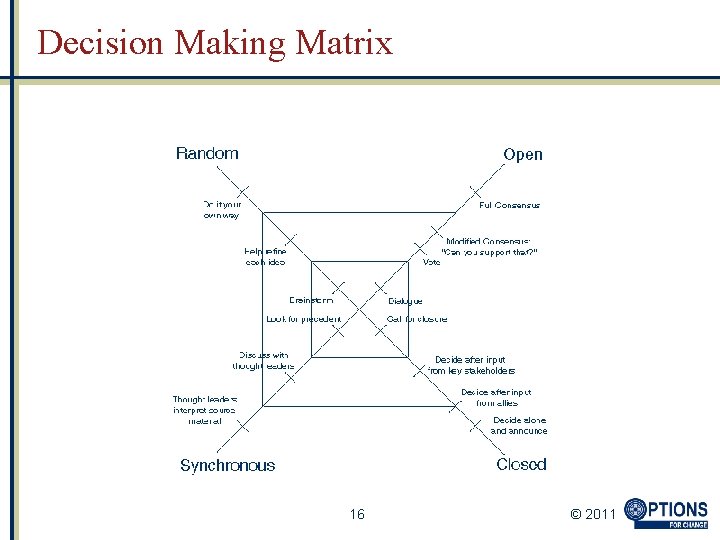
Decision Making Matrix 16 © 2011
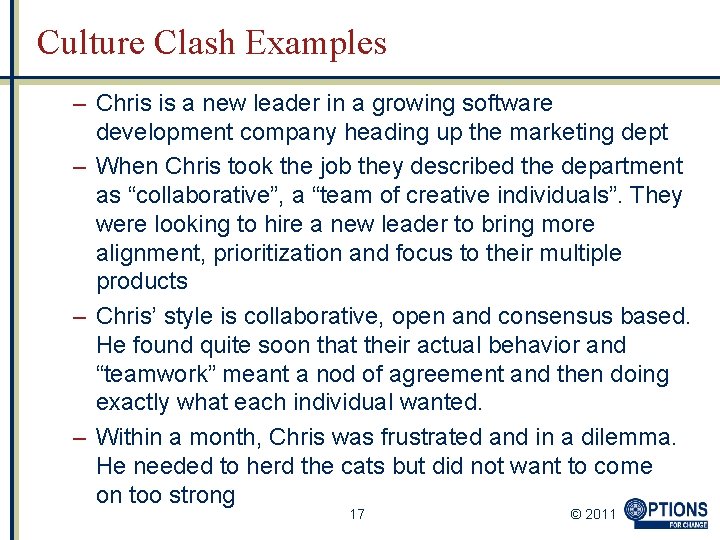
Culture Clash Examples – Chris is a new leader in a growing software development company heading up the marketing dept – When Chris took the job they described the department as “collaborative”, a “team of creative individuals”. They were looking to hire a new leader to bring more alignment, prioritization and focus to their multiple products – Chris’ style is collaborative, open and consensus based. He found quite soon that their actual behavior and “teamwork” meant a nod of agreement and then doing exactly what each individual wanted. – Within a month, Chris was frustrated and in a dilemma. He needed to herd the cats but did not want to come on too strong 17 © 2011
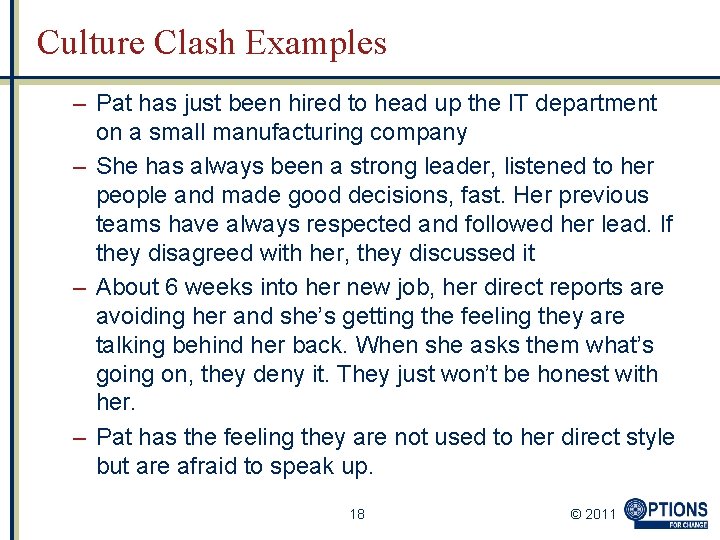
Culture Clash Examples – Pat has just been hired to head up the IT department on a small manufacturing company – She has always been a strong leader, listened to her people and made good decisions, fast. Her previous teams have always respected and followed her lead. If they disagreed with her, they discussed it – About 6 weeks into her new job, her direct reports are avoiding her and she’s getting the feeling they are talking behind her back. When she asks them what’s going on, they deny it. They just won’t be honest with her. – Pat has the feeling they are not used to her direct style but are afraid to speak up. 18 © 2011
- Slides: 18