
OnBoard Data Handling for the PAMELA Experiment Ralf
On-Board Data Handling for the PAMELA Experiment Ralf Wischnewski Roma 2 & DESY-Zeuthen Alghero, 30. 9. 2002 R. Wischnewski
The task Space requirements Pamela CPU: PSCU On-board DAQ design Data downlink Status & Summary R. Wischnewski
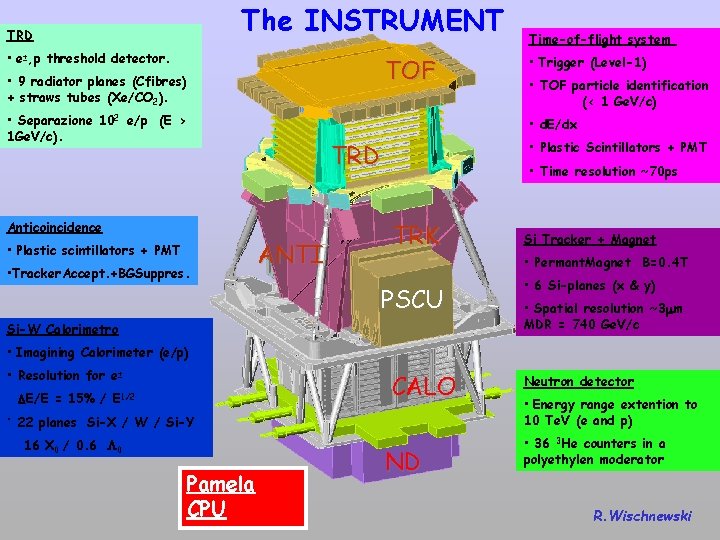
The INSTRUMENT TRD • e±, p threshold detector. TOF • 9 radiator planes (Cfibres) + straws tubes (Xe/CO 2). • Separazione 102 e/p (E > 1 Ge. V/c). Time-of-flight system • Trigger (Level-1) • TOF particle identification (< 1 Ge. V/c) • d. E/dx TRD Anticoincidence • Plastic scintillators + PMT • Tracker. Accept. +BGSuppres. ANTI • Plastic Scintillators + PMT • Time resolution ~70 ps TRK Si Tracker + Magnet • Permant. Magnet B=0. 4 T PSCU Si-W Calorimetro • 6 Si-planes (x & y) • Spatial resolution ~3 m MDR = 740 Ge. V/c • Imagining Calorimeter (e/p) • Resolution for e± E/E = 15% / • CALO E 1/2 22 planes Si-X / W / Si-Y 16 X 0 / 0. 6 0 Pamela CPU ND Neutron detector • Energy range extention to 10 Te. V (e and p) • 36 3 He counters in a polyethylen moderator R. Wischnewski
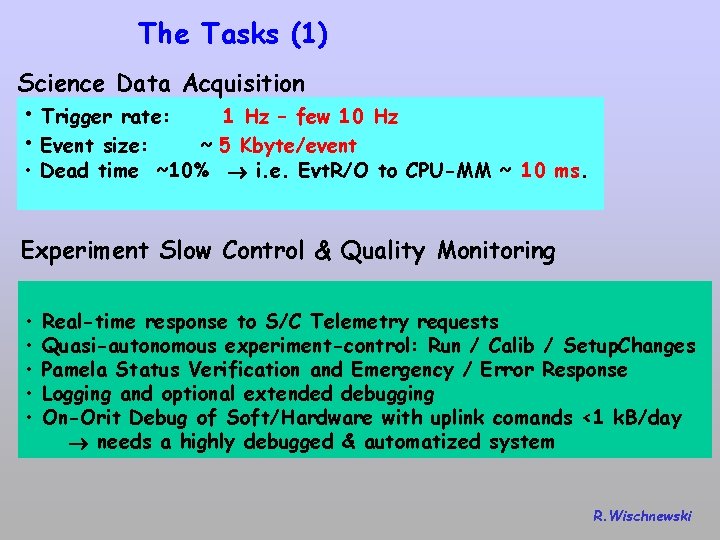
The Tasks (1) Science Data Acquisition • Trigger rate: 1 Hz – few 10 Hz • Event size: ~ 5 Kbyte/event • Dead time ~10% i. e. Evt. R/O to CPU-MM ~ 10 ms. Experiment Slow Control & Quality Monitoring • • • Real-time response to S/C Telemetry requests Quasi-autonomous experiment-control: Run / Calib / Setup. Changes Pamela Status Verification and Emergency / Error Response Logging and optional extended debugging On-Orit Debug of Soft/Hardware with uplink comands <1 k. B/day needs a highly debugged & automatized system R. Wischnewski
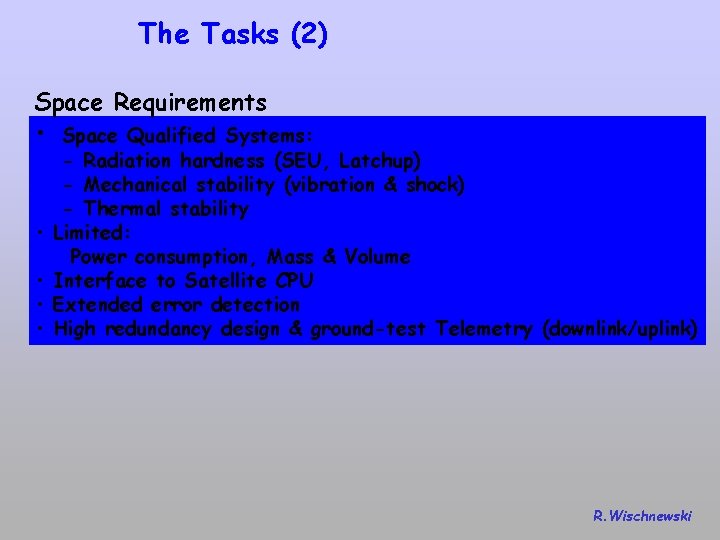
The Tasks (2) Space Requirements • Space Qualified Systems: • • - Radiation hardness (SEU, Latchup) - Mechanical stability (vibration & shock) - Thermal stability Limited: Power consumption, Mass & Volume Interface to Satellite CPU Extended error detection High redundancy design & ground-test Telemetry (downlink/uplink) R. Wischnewski
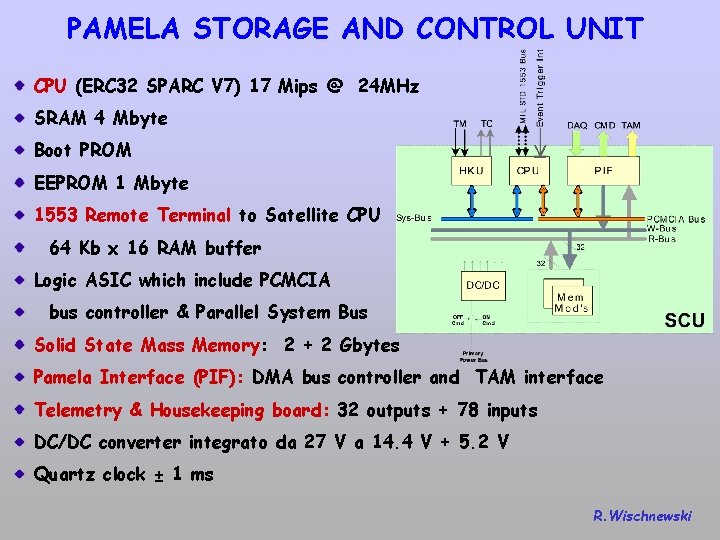
PAMELA STORAGE AND CONTROL UNIT CPU (ERC 32 SPARC V 7) 17 Mips @ 24 MHz SRAM 4 Mbyte Boot PROM EEPROM 1 Mbyte 1553 Remote Terminal to Satellite CPU 64 Kb x 16 RAM buffer Logic ASIC which include PCMCIA bus controller & Parallel System Bus Solid State Mass Memory: 2 + 2 Gbytes Pamela Interface (PIF): DMA bus controller and TAM interface Telemetry & Housekeeping board: 32 outputs + 78 inputs DC/DC converter integrato da 27 V a 14. 4 V + 5. 2 V Quartz clock ± 1 ms R. Wischnewski
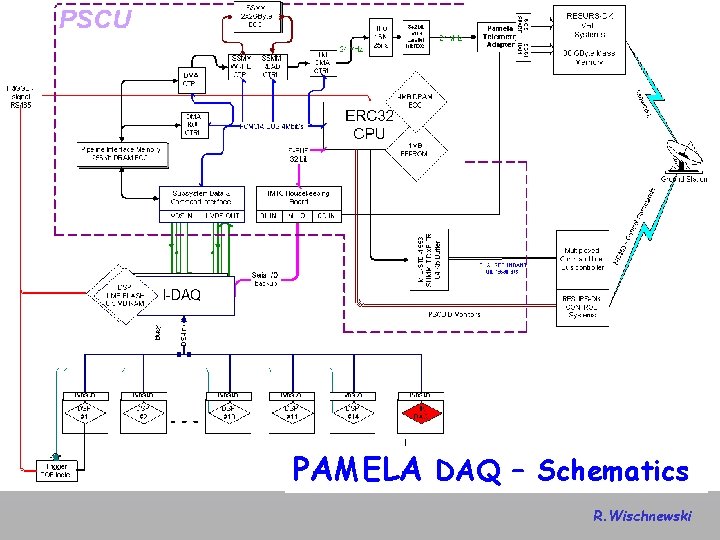
PAMELA DAQ – Schematics R. Wischnewski
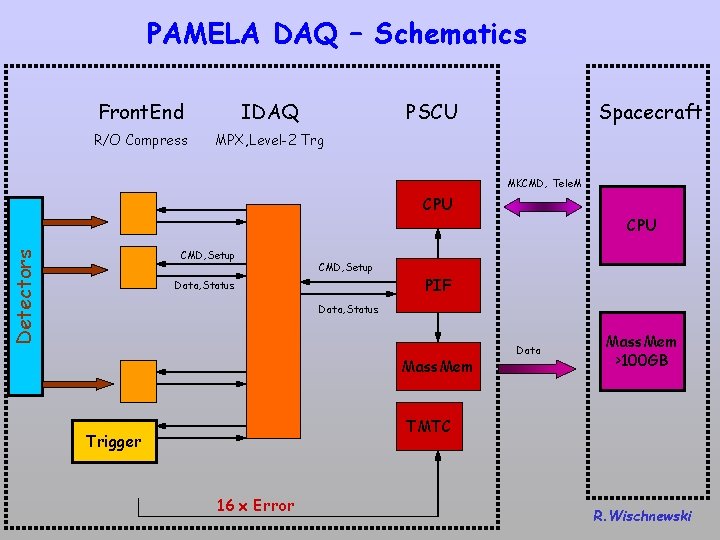
PAMELA DAQ – Schematics Front. End IDAQ PSCU R/O Compress MPX, Level-2 Trg Spacecraft MKCMD, Tele. M CPU Detectors CMD, Setup Data, Status CPU PIF Data, Status Mass. Mem Data Mass. Mem >100 GB TMTC Trigger 16 x Error R. Wischnewski
Data Downlink to S/C and Earth Science and HK data (1 -2 GB) to be transfered from Pamela to Satellite Mass. Memory (>100 GB) every few hours. Asynchronous request from Master S/C-CPU. Downlink from S/C to earth during ground station passages (Moscow & Sturup/Sweden) @ 320 Mbps over a few minutes. Needs fast analysis for uplink response on next orbit. All operations based on pre-defined absolute time schedule, arbited from S/C and uplinked from Ground. R. Wischnewski
MM S/C Pamela Data Path: S/C to Ground DLink S/C R. Wischnewski
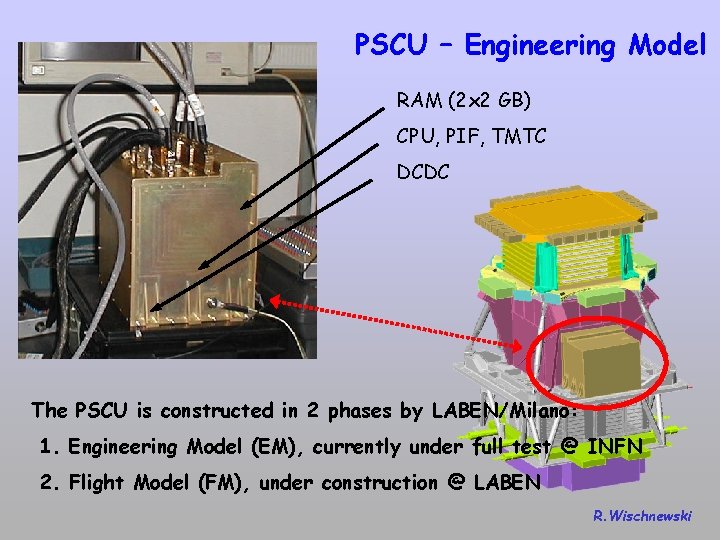
PSCU – Engineering Model RAM (2 x 2 GB) CPU, PIF, TMTC DCDC The PSCU is constructed in 2 phases by LABEN/Milano: 1. Engineering Model (EM), currently under full test @ INFN 2. Flight Model (FM), under construction @ LABEN R. Wischnewski
PAMELA ENGINEERING MODEL Assembly of the Engineering Model (EM) is the major functionality and I/F test to be passed before the final Flight Model (FM) is build: System compability test; Mechan. & electr. interface test; Test procedure definiton for ground test equipment (EGSE). Note: The PSCU is (with Power Supply) the main Interface between Pamela and the Satllite. R. Wischnewski
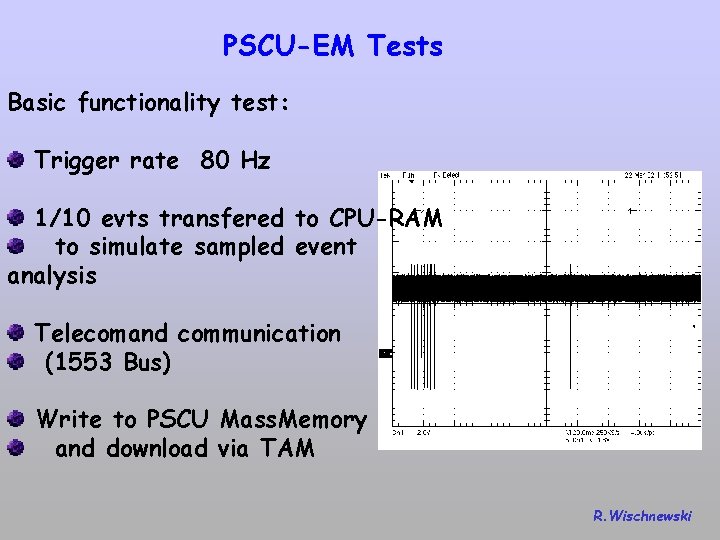
PSCU-EM Tests Basic functionality test: Trigger rate 80 Hz 1/10 evts transfered to CPU-RAM to simulate sampled event analysis Telecomand communication (1553 Bus) Write to PSCU Mass. Memory and download via TAM R. Wischnewski
PSCU TEST EQUIPMENT Full functionality test of PSCU needs an “Electrical Ground Support Equipment” (EGSE), simulating all system interfaces: power supply (27 V) Control Command (ON/OFF, RESET) bus 1553 for telecomands telemetry I-DAQ board to receive FE Comands and reply detector data in real time monitor for PSCU electrical/thermal status debugger and monitoring SW simulator for Housekeeping input event trigger simulation science data readout (TAM) R. Wischnewski
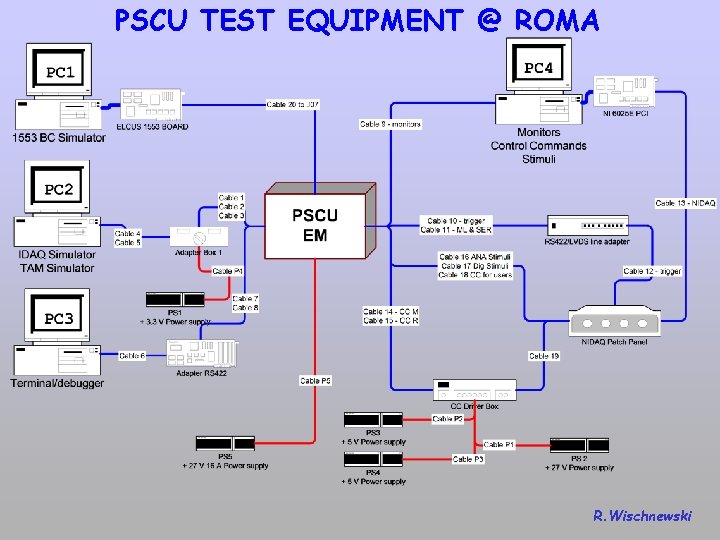
PSCU TEST EQUIPMENT @ ROMA R. Wischnewski
PSCU - ON-BOARD SOFTWARE RTEMS as Operation System: (Real-Time Executive for Multiprocessor systems) multitasking preemptive or monotonic scheduling comunication zone and intertask synchronisation interrupt handling optional: task & interrupt priority dynamic memory allocation RTEMS is supported by ESA/ESTEC including Cross Compiler ERC 32 CC with: GNU C compiler Linker, assembler, archiver etc. Standalone C-library RTEMS real-time kernel with ERC 32 BSP ERC 32 boot-prom utility Standalone simulator ERC 32 GNU debugger with ERC 32 simulator & DDD R. Wischnewski
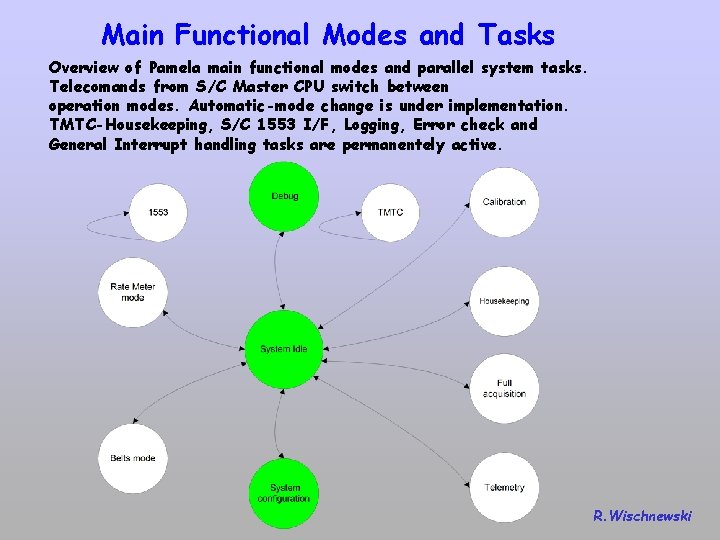
Main Functional Modes and Tasks Overview of Pamela main functional modes and parallel system tasks. Telecomands from S/C Master CPU switch between operation modes. Automatic-mode change is under implementation. TMTC-Housekeeping, S/C 1553 I/F, Logging, Error check and General Interrupt handling tasks are permanentely active. R. Wischnewski
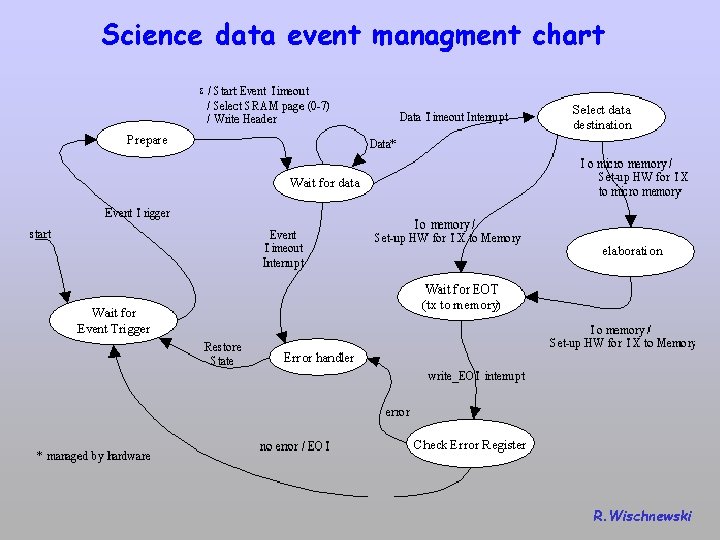
Science data event managment chart R. Wischnewski
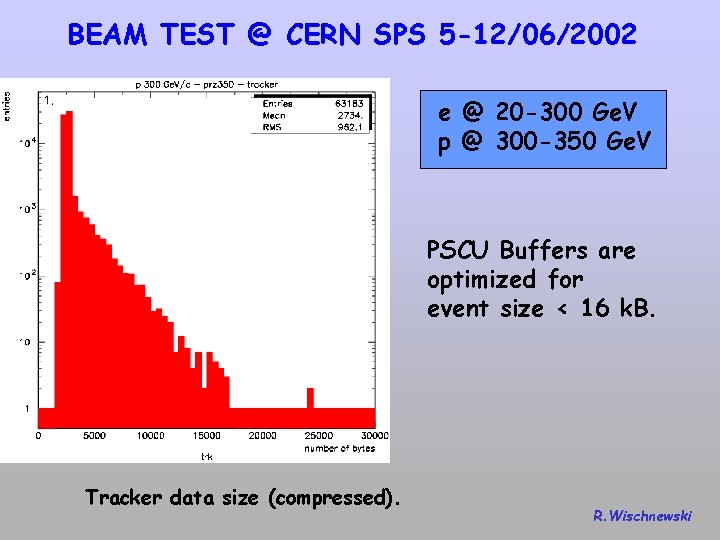
BEAM TEST @ CERN SPS 5 -12/06/2002 e @ 20 -300 Ge. V p @ 300 -350 Ge. V PSCU Buffers are optimized for event size < 16 k. B. Tracker data size (compressed). R. Wischnewski
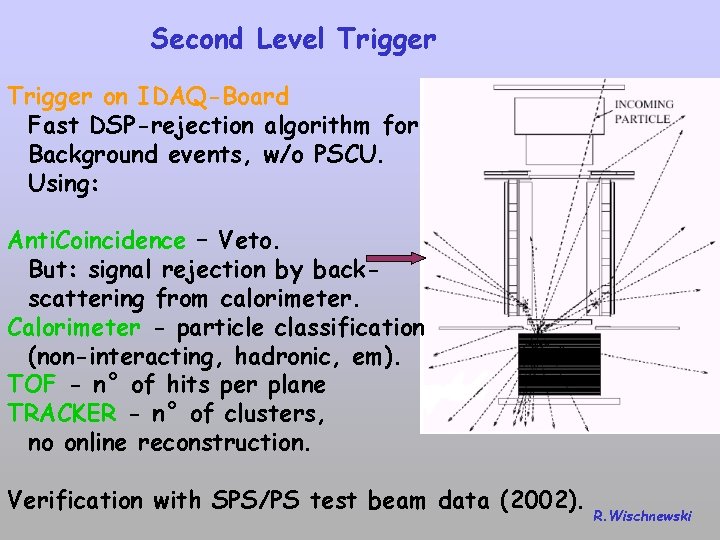
Second Level Trigger on IDAQ-Board Fast DSP-rejection algorithm for Background events, w/o PSCU. Using: Anti. Coincidence – Veto. But: signal rejection by backscattering from calorimeter. Calorimeter - particle classification (non-interacting, hadronic, em). TOF - n° of hits per plane TRACKER - n° of clusters, no online reconstruction. Verification with SPS/PS test beam data (2002). R. Wischnewski
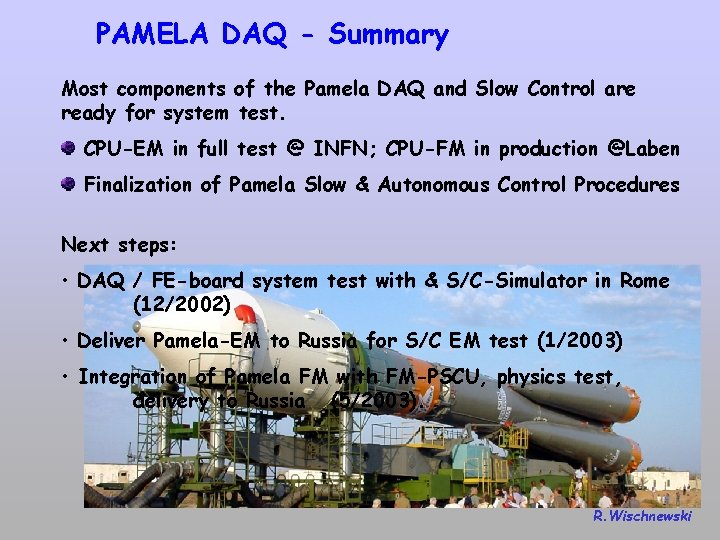
PAMELA DAQ - Summary Most components of the Pamela DAQ and Slow Control are ready for system test. CPU-EM in full test @ INFN; CPU-FM in production @Laben Finalization of Pamela Slow & Autonomous Control Procedures Next steps: • DAQ / FE-board system test with & S/C-Simulator in Rome (12/2002) • Deliver Pamela-EM to Russia for S/C EM test (1/2003) • Integration of Pamela FM with FM-PSCU, physics test, delivery to Russia (5/2003). R. Wischnewski
- Slides: 21