
ONAP Reference Architecture for R 2 and Beyond
ONAP Reference Architecture for R 2 and Beyond Tiger Team Presentation Parviz Yegani – Futurewei Technologies Contributors: Vimal Begwani (AT&T), Jamil Chawki (Orange), Andrew Mayer (AT&T), Alex Vul (Intel), Ramki Krishnan (VMware), Maopeng Zhang (ZTE), Stephen Terrill (Ericsson), <more contributors to be added> Jan. 9, 2018
ONAP High-Level Architecture for R 1 (Amsterdam)
Progress from the Architecture Subcommittee • For Amsterdam (R 1), the architecture was agreed, as discussed since ONS. - This was to reduce risk of late changes to the project teams, who have built their plans based on the current baseline. • Starting with R 2, there is consensus to resolve the following two architectural inconsistencies: 1) Orchestration Architecture - Architecture team agreed that Orchestration layer should be separate from Controller layer 2) Consistent Controller Layer Architecture and better alignment between App-C & VF-C Projects are drilling down to the next level of detail on interfaces and project alignment, and then the projects will review their R 2 plans with the ARC. • The next slide illustrates high-level architectures that was approved by TSC to meet R 1 schedule. 3
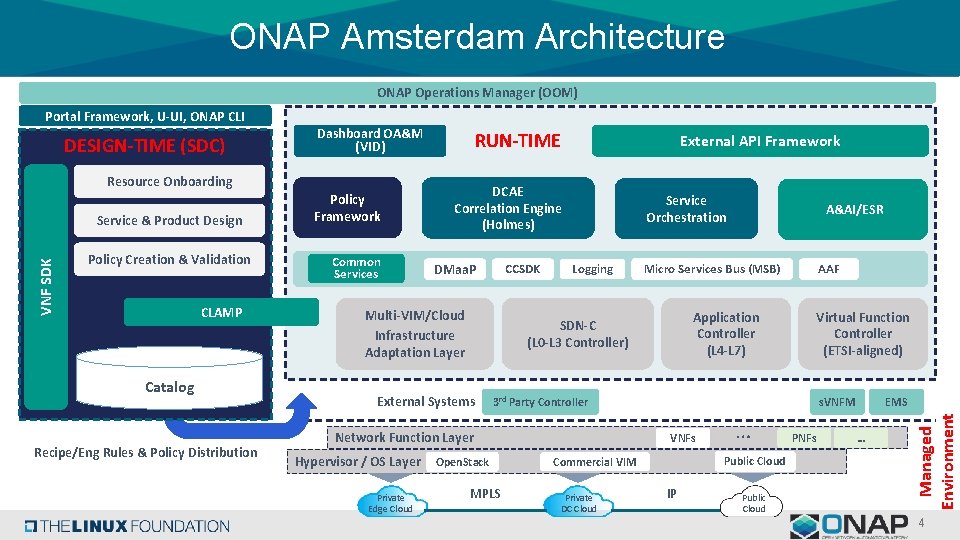
ONAP Amsterdam Architecture ONAP Operations Manager (OOM) Portal Framework, U-UI, ONAP CLI Dashboard OA&M (VID) Resource Onboarding VNF SDK Service & Product Design Policy Creation & Validation CLAMP Catalog Recipe/Eng Rules & Policy Distribution Policy Framework Common Services RUN-TIME External API Framework DCAE Correlation Engine (Holmes) DMaa. P CCSDK Multi-VIM/Cloud Infrastructure Adaptation Layer Service Orchestration Logging Private Edge Cloud Application Controller (L 4 -L 7) AAF Virtual Function Controller (ETSI-aligned) 3 rd Party Controller Network Function Layer Hypervisor / OS Layer Micro Services Bus (MSB) SDN-C (L 0 -L 3 Controller) External Systems A&AI/ESR s. VNFM VNFs Open. Stack MPLS Public Cloud Commercial VIM Private DC Cloud … IP Public Cloud PNFs EMS … Managed Environment DESIGN-TIME (SDC) 4
ONAP Reference Architecture for R 2 and Beyond
Architecture Design Considerations • Architecture Principles Were Reviewed Earlier and Agreed Upon by the Architecture Team: https: //wiki. onap. org/display/DW/Contributions? preview=/8225716/8232492/Architectural%20 principles_v 3. docx • ONAP is a layered architecture – Orchestration, Multi-Cloud, Controller, etc. • Functional role of each layer should be well defined per the architecture principles agreed by the architecture team (see the above link). • ONAP should support integrated design studio to capture full lifecycle management models (TOSCA models for NF, simple / nested services augmented with BPMN, Policy / Analytic design models, etc. ) • ONAP Should Support Cloud Agnostic Model and Multi-Cloud adaption layer while hiding infrastructure details • ONAP Target Goal is: Modular, Model-driven, Microservices-based architecture • Models drive interfaces between layers/components • ONAP should define well-described and consistent NB-APIs at all layers • Keep flexible capability for commercial solution (no vendor lock-in) • Agree to unified modeling for integration across all modules: VES in DCAE, Logging & monitor inside ONAP and more 6
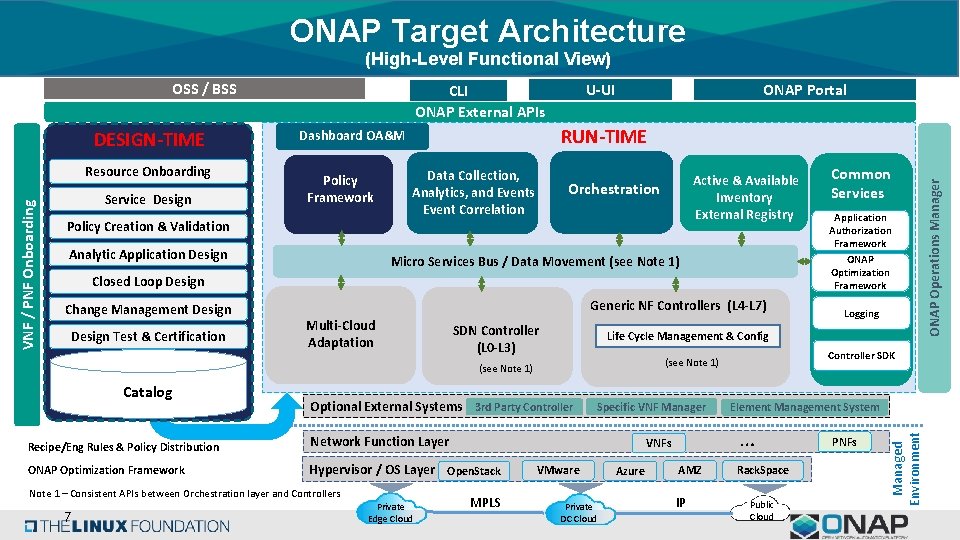
ONAP Target Architecture (High-Level Functional View) OSS / BSS Service Design Policy Framework Data Collection, Analytics, and Events Event Correlation Active & Available Inventory External Registry Orchestration Policy Creation & Validation Analytic Application Design Micro Services Bus / Data Movement (see Note 1) Closed Loop Design Change Management Design Test & Certification Generic NF Controllers (L 4 -L 7) Multi-Cloud Adaptation SDN Controller (L 0 -L 3) Network Function Layer ONAP Optimization Framework Hypervisor / OS Layer Open. Stack Note 1 – Consistent APIs between Orchestration layer and Controllers 7 Private Edge Cloud Specific VNF Manager VMware Private DC Cloud Azure Element Management System … VNFs MPLS Logging Controller SDK (see Note 1) Optional External Systems 3 rd Party Controller Recipe/Eng Rules & Policy Distribution Application Authorization Framework ONAP Common Optimization Services Framework Life Cycle Management & Config (see Note 1) Catalog Common Services AMZ IP Rack. Space Public Cloud PNFs ONAP Operations Manager VNF / PNF Onboarding Resource Onboarding RUN-TIME Dashboard OA&M Managed Environment DESIGN-TIME ONAP Portal U-UI CLI ONAP External APIs
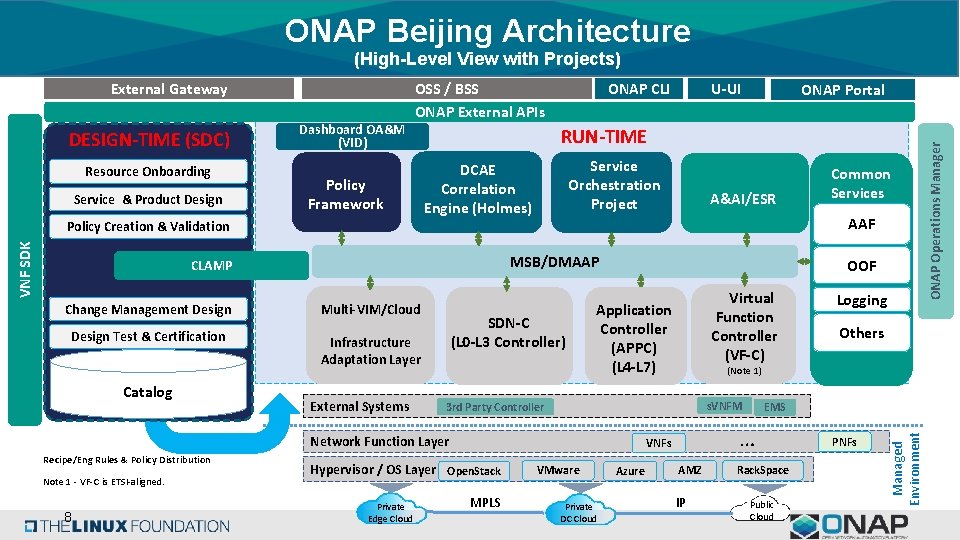
ONAP Beijing Architecture (High-Level View with Projects) Resource Onboarding Service & Product Design Dashboard OA&M (VID) Policy Framework ONAP CLI U-UI ONAP Portal RUN-TIME Service Orchestration Project DCAE Correlation Engine (Holmes) A&AI/ESR AAF VNF SDK Policy Creation & Validation MSB/DMAAP CLAMP Change Management Design Multi-VIM/Cloud Design Test & Certification Infrastructure Adaptation Layer Catalog External Systems SDN-C (L 0 -L 3 Controller) Common OOF Services Note 1 - VF-C is ETSI-aligned. s. VNFM 8 MPLS Private DC Cloud Azure Others EMS … VNFs VMware Logging (Note 1) 3 rd Party Controller Hypervisor / OS Layer Open. Stack Private Edge Cloud Virtual Function Controller (VF-C) Application Controller (APPC) (L 4 -L 7) Network Function Layer Recipe/Eng Rules & Policy Distribution Common Services AMZ IP Rack. Space Public Cloud PNFs ONAP Operations Manager DESIGN-TIME (SDC) OSS / BSS ONAP External APIs Managed Environment External Gateway
ONAP Orchestration Alignment
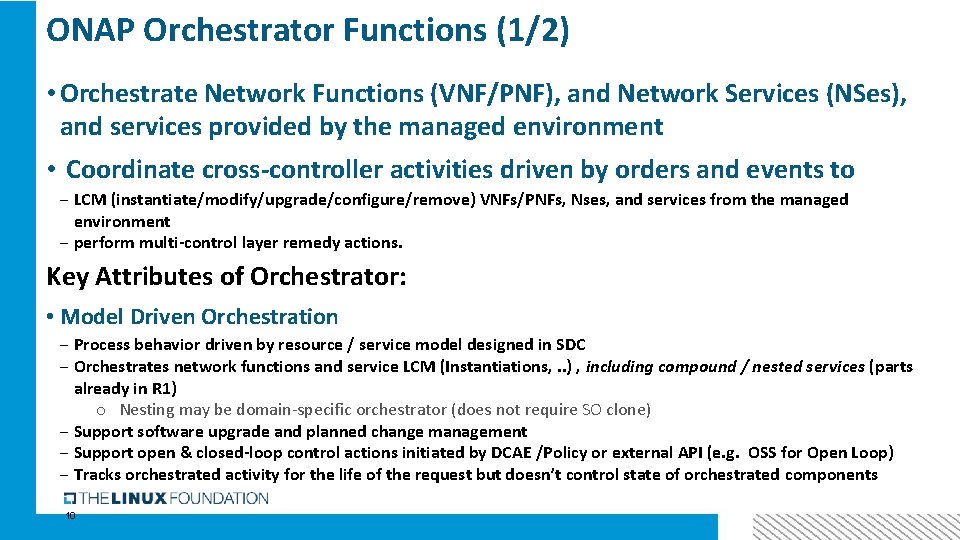
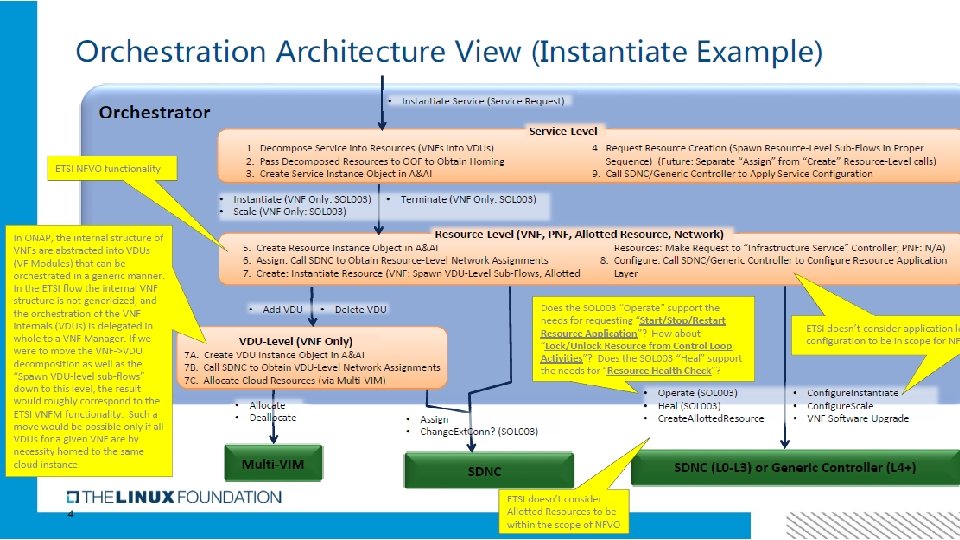
ONAP Orchestrator Functions (1/2) • Orchestrate Network Functions (VNF/PNF), and Network Services (NSes), and services provided by the managed environment • Coordinate cross-controller activities driven by orders and events to ‒ LCM (instantiate/modify/upgrade/configure/remove) VNFs/PNFs, Nses, and services from the managed environment ‒ perform multi-control layer remedy actions. Key Attributes of Orchestrator: • Model Driven Orchestration ‒ Process behavior driven by resource / service model designed in SDC ‒ Orchestrates network functions and service LCM (Instantiations, . . ) , including compound / nested services (parts already in R 1) o Nesting may be domain-specific orchestrator (does not require SO clone) ‒ Support software upgrade and planned change management ‒ Support open & closed-loop control actions initiated by DCAE /Policy or external API (e. g. OSS for Open Loop) ‒ Tracks orchestrated activity for the life of the request but doesn’t control state of orchestrated components 10
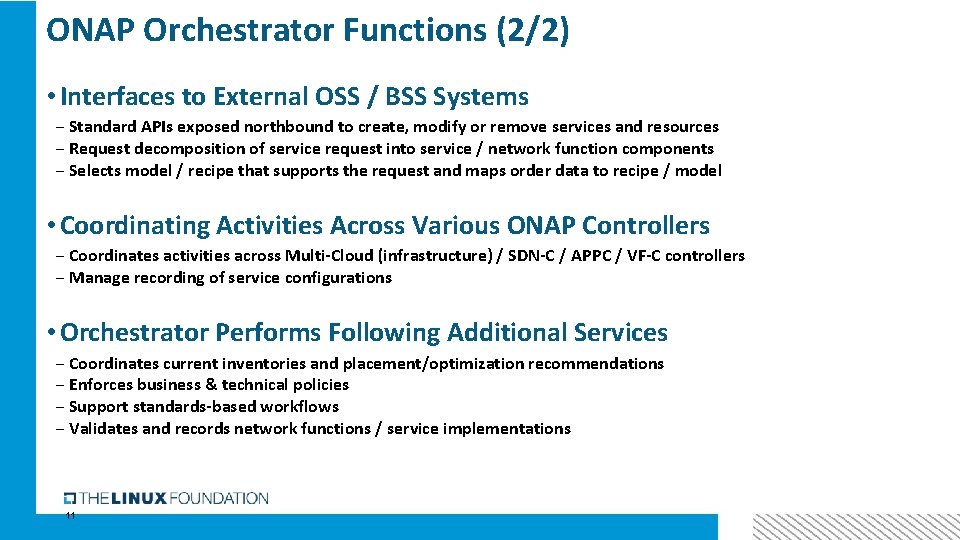
ONAP Orchestrator Functions (2/2) • Interfaces to External OSS / BSS Systems ‒ Standard APIs exposed northbound to create, modify or remove services and resources ‒ Request decomposition of service request into service / network function components ‒ Selects model / recipe that supports the request and maps order data to recipe / model • Coordinating Activities Across Various ONAP Controllers ‒ Coordinates activities across Multi-Cloud (infrastructure) / SDN-C / APPC / VF-C controllers ‒ Manage recording of service configurations • Orchestrator Performs Following Additional Services ‒ Coordinates current inventories and placement/optimization recommendations ‒ Enforces business & technical policies ‒ Support standards-based workflows ‒ Validates and records network functions / service implementations 11
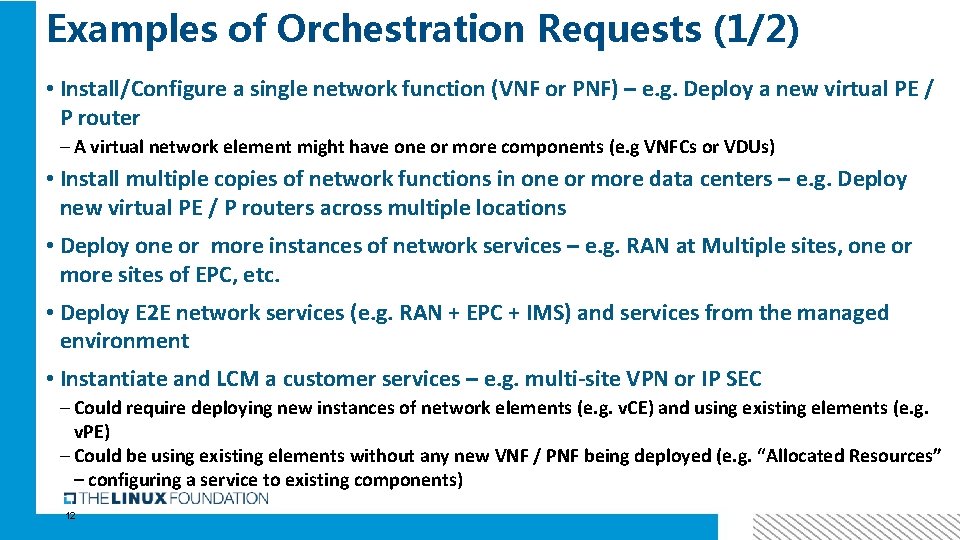
Examples of Orchestration Requests (1/2) • Install/Configure a single network function (VNF or PNF) – e. g. Deploy a new virtual PE / P router ‒ A virtual network element might have one or more components (e. g VNFCs or VDUs) • Install multiple copies of network functions in one or more data centers – e. g. Deploy new virtual PE / P routers across multiple locations • Deploy one or more instances of network services – e. g. RAN at Multiple sites, one or more sites of EPC, etc. • Deploy E 2 E network services (e. g. RAN + EPC + IMS) and services from the managed environment • Instantiate and LCM a customer services – e. g. multi-site VPN or IP SEC ‒ Could require deploying new instances of network elements (e. g. v. CE) and using existing elements (e. g. v. PE) ‒ Could be using existing elements without any new VNF / PNF being deployed (e. g. “Allocated Resources” – configuring a service to existing components) 12
Examples of Orchestration Requests (2/2) • Create a new instance of a network slice segment ‒ Could be leveraging existing network services (RAN, v. EPC, etc. ) • Create a new instance of a network service slice – e. g. Io. T or e. MBB slice ‒ Could be leveraging previously created network slice segments • Implement a software upgrade / change management ‒ Could require Coordination of activities across Multi-VIM (infrastructure)/SDN-C/app-C/VF-C controllers • Orchestrate remedial actions requested as part of Closed or open loop action ‒ Could require adding new compute / network resource to the existing functional elements (i. e. VNF) ‒ Create a new instance of VNF and migrate traffic ‒ Could require Coordination of activities across Multi-Cloud (infrastructure)/SDN-C/App-C/VF-C controllers) 13
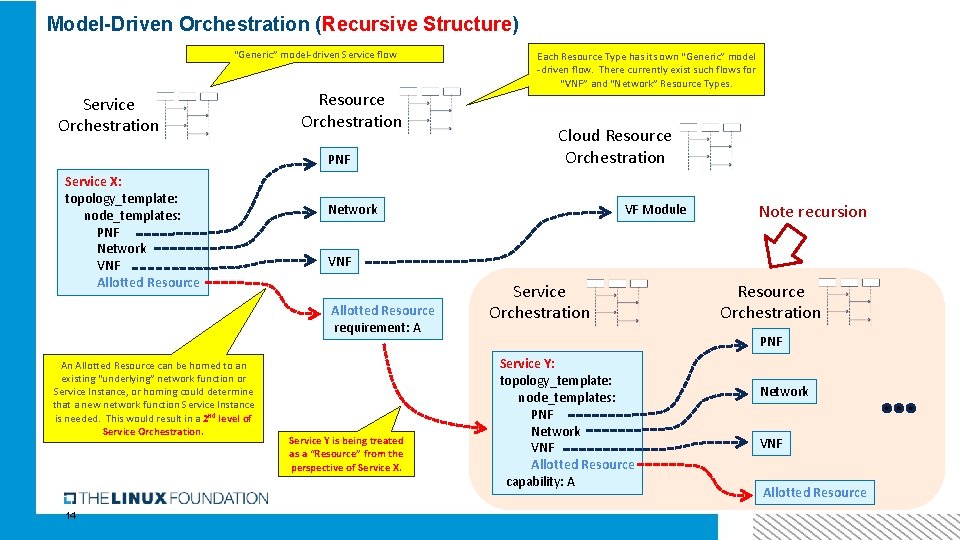
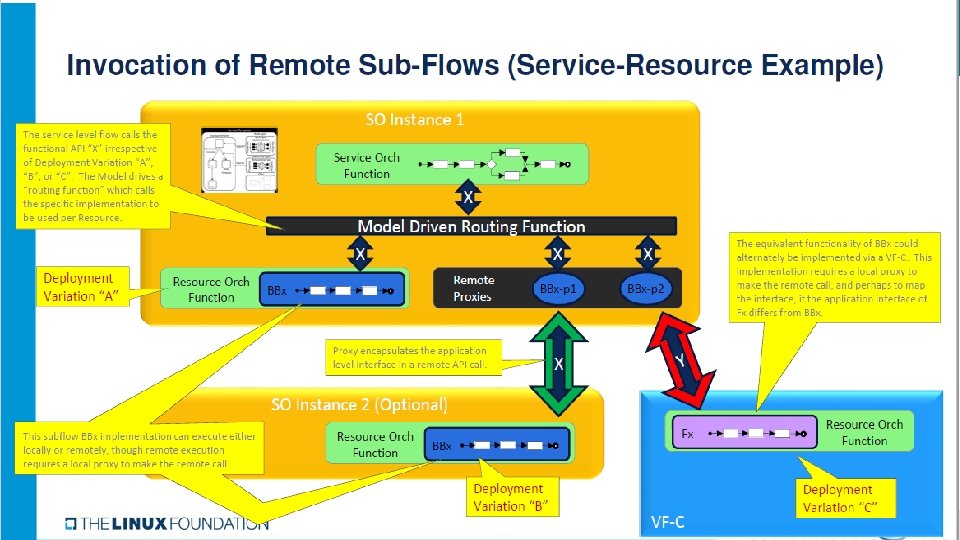
Model-Driven Orchestration (Recursive Structure) “Generic” model-driven Service flow Service Orchestration Resource Orchestration PNF Service X: topology_template: node_templates: PNF Network VNF Allotted Resource 14 Cloud Resource Orchestration VF Module Network Note recursion VNF Allotted Resource requirement: A An Allotted Resource can be homed to an existing “underlying” network function or Service Instance, or homing could determine that a new network function Service Instance is needed. This would result in a 2 nd level of Service Orchestration. Each Resource Type has its own “Generic” model -driven flow. There currently exist such flows for “VNF” and “Network” Resource Types. Service Y is being treated as a “Resource” from the perspective of Service X. Service Orchestration Resource Orchestration PNF Service Y: topology_template: node_templates: PNF Network VNF Allotted Resource capability: A Network VNF Allotted Resource
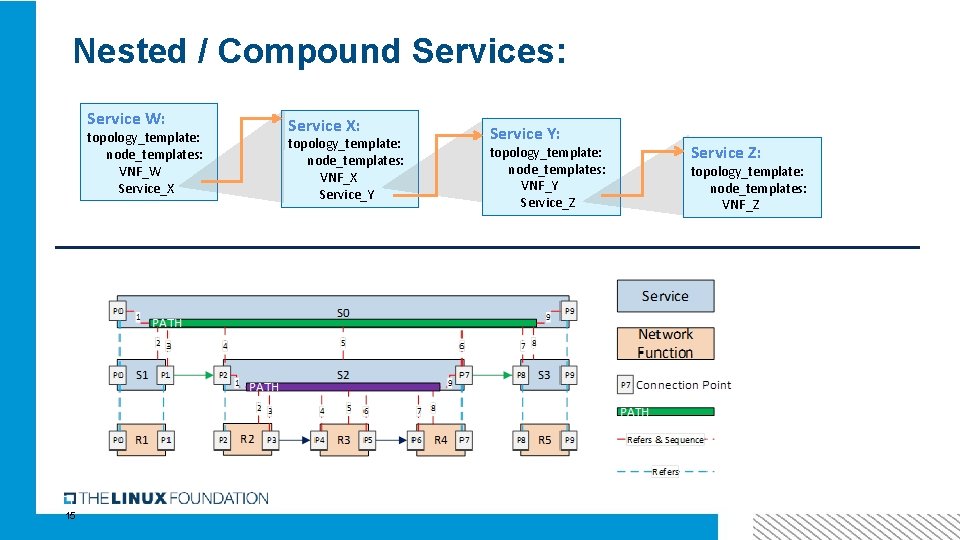
Nested / Compound Services: Service W: topology_template: node_templates: VNF_W Service_X 15 Service X: topology_template: node_templates: VNF_X Service_Y Service Y: topology_template: node_templates: VNF_Y Service_Z Service Z: topology_template: node_templates: VNF_Z
Conclusions • Service Providers require the ability to define Services that can be leveraged by higher order Services and other compounded services / segments / slices. • Consistent with ETSI MANO, ONAP should NOT separate Service Orchestration and Resource Orchestration into two separate named components, because each Resource can be exposed as a Service o What appears as a “Resource” from one Service’s perspective, may actually be a Service from another perspective • In Addition, ONAP scope is much broader than ETSI MANO (MANO limited to Cloud infrastructure services and management of VNF as a basic resource (ignoring the application of the VNF)), therefore SO should support full orchestration scope of ONAP • To achieve alignment with MANO for common functionality, SO should expose APIs for basic resource onboarding/LCM (VNF). This is SOL-001, SOL-004 and SOL-005. • or simple network service onboarding/LCM (composed of one or more VNFs) and related models. In addition, ONAP SO should Support “Service reuse” to drive model driven run-time behavior for complex services: • • Compounded Services (e. g. Residential v. CPE, Network Slicing Segments, etc. ) Nested Services (e. g. E 2 E Slice) • ONAP should provide Service Providers deployment flexibility to address scalability, geographic distribution and redundancy / resiliency o But should not impose extra complexity and cost on service providers by separating service / resource orchestration that provides little known benefit 16
APPC & VF-C Convergence Note – A major goal of the ONAP platform (R 2 or a later release) is to specify a common set of functions to unify the APP-C and VF-C functionalities.
Role Of Controllers in ONAP Controllers configure and maintain the health of network functional elements and services throughout their lifecycle. • Programmable network application management platform ‒ Behavior patterns programmed via models and policies ‒ Standards based models & protocols for multi-vendor implementation ‒ Operational control, coordinated state changes across devices, etc. • Manages the health of the network services & VNFs in its scope ‒ Policy-based optimization to meet SLAs ‒ Event-based control loop automation to solve local issues in near real-time ‒ Executes action for outer control loop automation (Driven by DCAE, Policy, etc. ) • Local source of truth ‒ Manages inventory within its scope ‒ All stages/states of lifecycle ‒ Configuration audits • ONAP has a layered architecture, with the role of controller clearly defined ‒ Need to avoid duplicating functions across layers within the controller layer (e. g. DCAE, Service/Resource Orchestration, etc. ) 18
Functional Description of ONAP Components
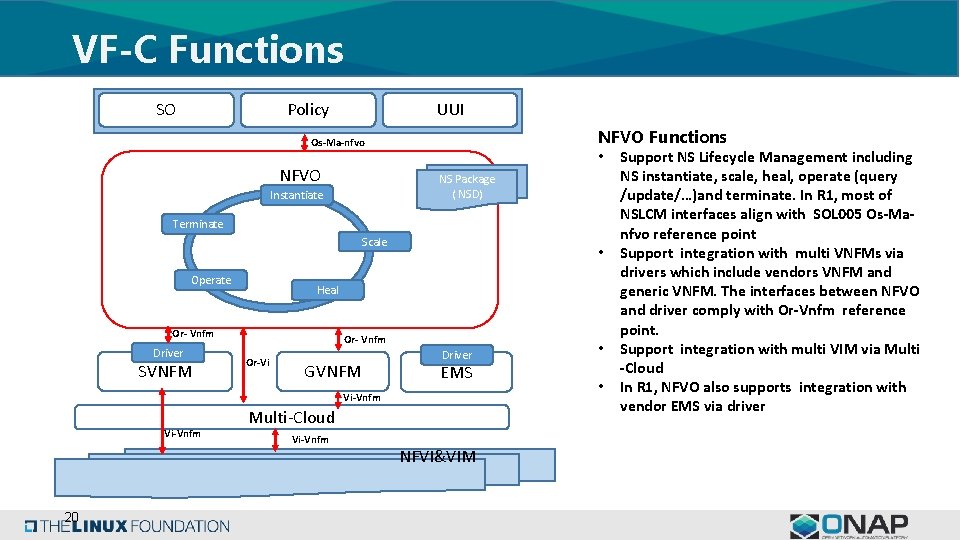
VF-C Functions SO Policy UUI Os-Ma-nfvo NFVO VNF Package NS Package ( VNFD) ( NSD) Instantiate Terminate Scale Operate Heal Or- Vnfm Driver SVNFM Or- Vnfm Or-Vi GVNFM Driver EMS Vi-Vnfm 20 Multi-Cloud Vi-Vnfm NFVI&VIM NFVO Functions • Support NS Lifecycle Management including NS instantiate, scale, heal, operate (query /update/…)and terminate. In R 1, most of NSLCM interfaces align with SOL 005 Os-Manfvo reference point • Support integration with multi VNFMs via drivers which include vendors VNFM and generic VNFM. The interfaces between NFVO and driver comply with Or-Vnfm reference point. • Support integration with multi VIM via Multi -Cloud • In R 1, NFVO also supports integration with vendor EMS via driver
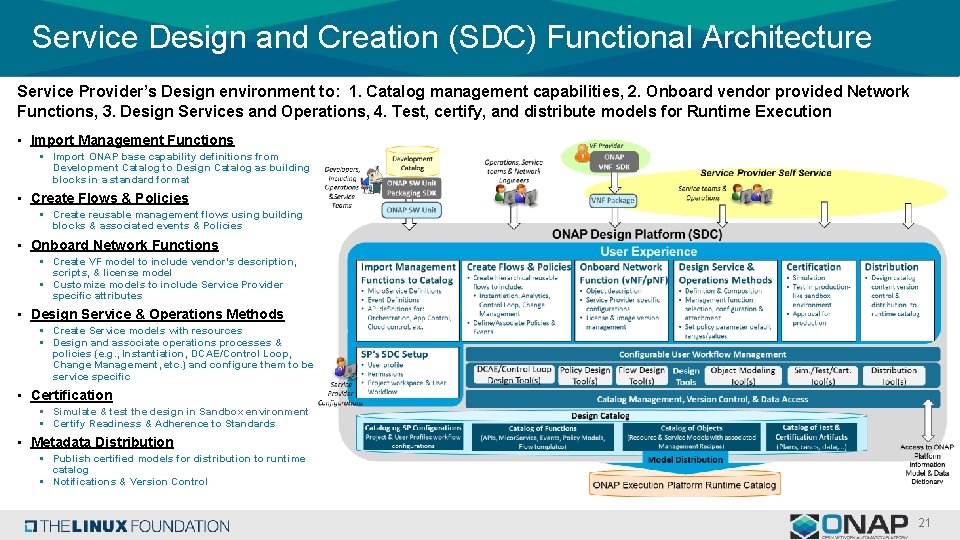
Service Design and Creation (SDC) Functional Architecture Service Provider’s Design environment to: 1. Catalog management capabilities, 2. Onboard vendor provided Network Functions, 3. Design Services and Operations, 4. Test, certify, and distribute models for Runtime Execution • Import Management Functions § Import ONAP base capability definitions from Development Catalog to Design Catalog as building blocks in a standard format • Create Flows & Policies § Create reusable management flows using building blocks & associated events & Policies • Onboard Network Functions § Create VF model to include vendor’s description, scripts, & license model § Customize models to include Service Provider specific attributes • Design Service & Operations Methods § Create Service models with resources § Design and associate operations processes & policies (e. g. , Instantiation, DCAE/Control Loop, Change Management, etc. ) and configure them to be service specific • Certification § Simulate & test the design in Sandbox environment § Certify Readiness & Adherence to Standards • Metadata Distribution § Publish certified models for distribution to runtime catalog § Notifications & Version Control 21
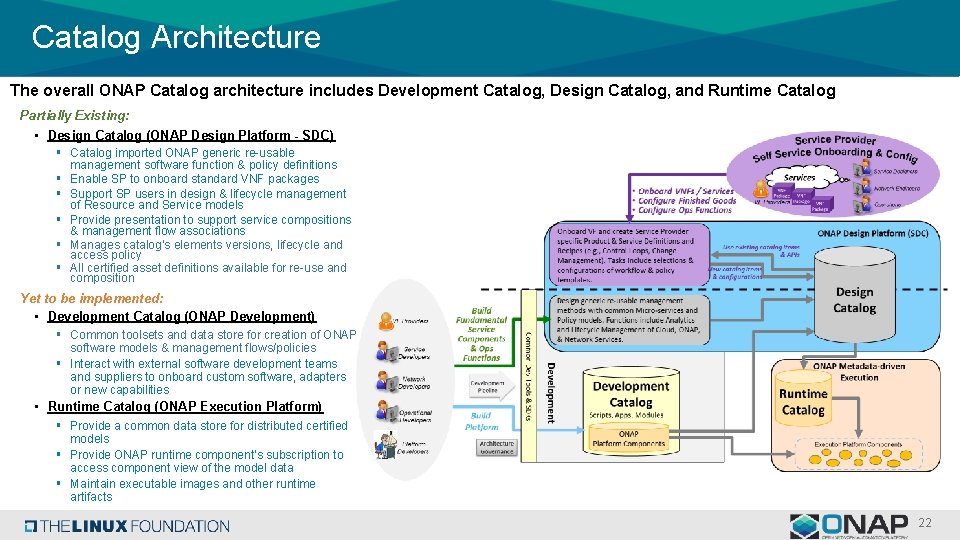
Catalog Architecture The overall ONAP Catalog architecture includes Development Catalog, Design Catalog, and Runtime Catalog Partially Existing: • Design Catalog (ONAP Design Platform - SDC) § Catalog imported ONAP generic re-usable management software function & policy definitions § Enable SP to onboard standard VNF packages § Support SP users in design & lifecycle management of Resource and Service models § Provide presentation to support service compositions & management flow associations § Manages catalog’s elements versions, lifecycle and access policy § All certified asset definitions available for re-use and composition Yet to be implemented: • Development Catalog (ONAP Development) § Common toolsets and data store for creation of ONAP software models & management flows/policies § Interact with external software development teams and suppliers to onboard custom software, adapters or new capabilities • Runtime Catalog (ONAP Execution Platform) § Provide a common data store for distributed certified models § Provide ONAP runtime component’s subscription to access component view of the model data § Maintain executable images and other runtime artifacts 22
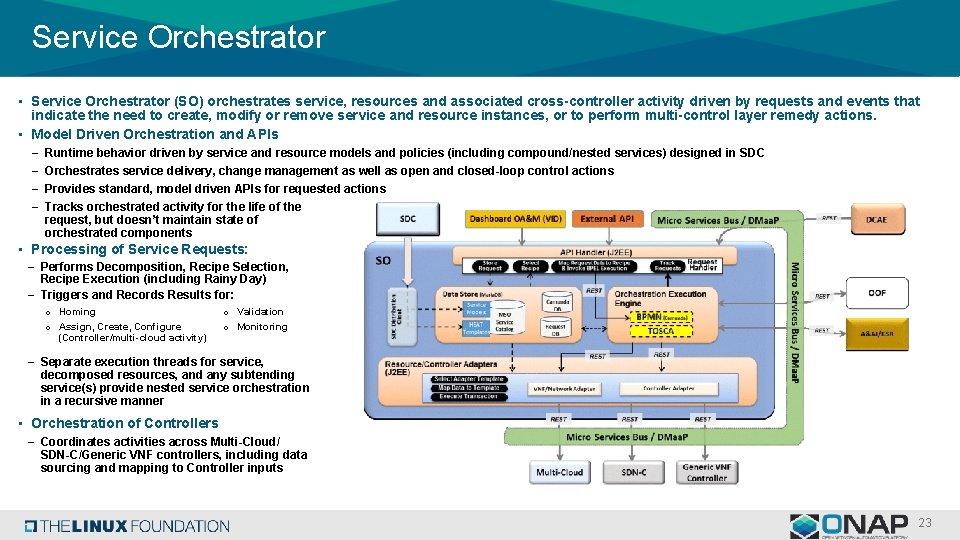
Service Orchestrator • Service Orchestrator (SO) orchestrates service, resources and associated cross-controller activity driven by requests and events that indicate the need to create, modify or remove service and resource instances, or to perform multi-control layer remedy actions. • Model Driven Orchestration and APIs ‒ ‒ Runtime behavior driven by service and resource models and policies (including compound/nested services) designed in SDC Orchestrates service delivery, change management as well as open and closed-loop control actions Provides standard, model driven APIs for requested actions Tracks orchestrated activity for the life of the request, but doesn’t maintain state of orchestrated components • Processing of Service Requests: ‒ Performs Decomposition, Recipe Selection, Recipe Execution (including Rainy Day) ‒ Triggers and Records Results for: o Homing o Validation o Assign, Create, Configure (Controller/multi-cloud activity) o Monitoring ‒ Separate execution threads for service, decomposed resources, and any subtending service(s) provide nested service orchestration in a recursive manner • Orchestration of Controllers ‒ Coordinates activities across Multi-Cloud/ SDN-C/Generic VNF controllers, including data sourcing and mapping to Controller inputs 23
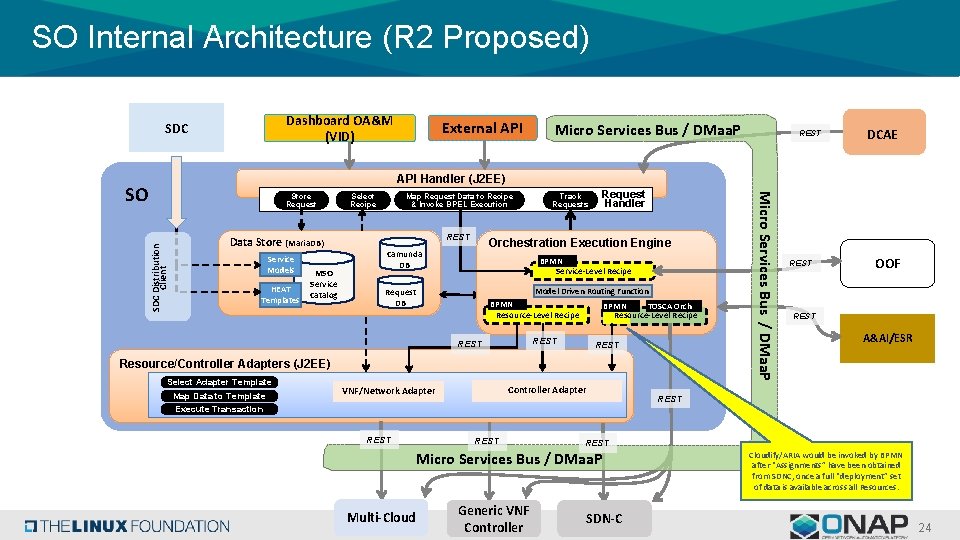
SO Internal Architecture (R 2 Proposed) Dashboard OA&M (VID) SDC External API Micro Services Bus / DMaa. P REST DCAE API Handler (J 2 EE) SDC Distribution Client Store Request Data Store (Maria. DB) Service Models HEAT Templates MSO Service Catalog Select Recipe Map Request Data to Recipe & Invoke BPEL Execution REST Track Requests Request Handler Orchestration Execution Engine Camunda DB BPMN Service-Level Recipe Model Driven Routing Function BPMN TOSCA Orch BPMN Resource-Level Recipe Request DB REST Resource/Controller Adapters (J 2 EE) Select Adapter Template Map Data to Template Execute Transaction Controller Adapter VNF/Network Adapter REST Generic VNF Controller REST OOF REST A&AI/ESR REST Micro Services Bus / DMaa. P Multi-Cloud Micro Services Bus / DMaa. P SO SDN-C Cloudify/ARIA would be invoked by BPMN after “Assignments” have been obtained from SDNC, once a full “deployment” set of data is available across all Resources. 24
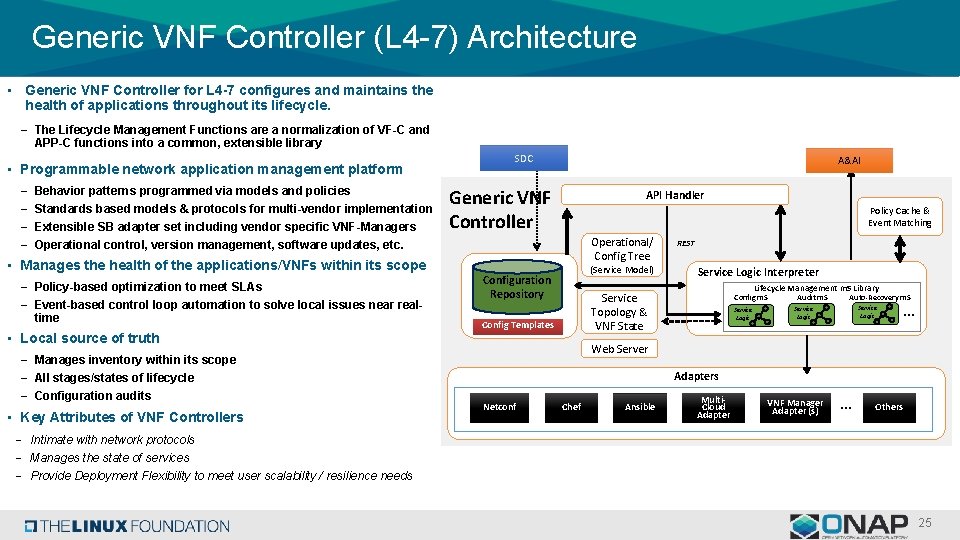
Generic VNF Controller (L 4 -7) Architecture • Generic VNF Controller for L 4 -7 configures and maintains the health of applications throughout its lifecycle. ‒ The Lifecycle Management Functions are a normalization of VF-C and APP-C functions into a common, extensible library SDC • Programmable network application management platform ‒ ‒ Behavior patterns programmed via models and policies Standards based models & protocols for multi-vendor implementation Extensible SB adapter set including vendor specific VNF-Managers Operational control, version management, software updates, etc. • Manages the health of the applications/VNFs within its scope ‒ Policy-based optimization to meet SLAs ‒ Event-based control loop automation to solve local issues near realtime • Local source of truth ‒ Manages inventory within its scope ‒ All stages/states of lifecycle ‒ Configuration audits • Key Attributes of VNF Controllers A&AI Generic VNF Controller API Handler Policy Cache & Event Matching Operational/ Config Tree (Service Model) Configuration Repository REST Service Logic Interpreter Lifecycle Management m. S Library Service Topology & VNF State Config Templates Config m. S Service Logic Audit m. S Auto-Recovery m. S Service Logic … Web Server Adapters Netconf Chef Ansible Multi. Cloud Adapter VNF Manager Adapter (s) … Others − Intimate with network protocols − Manages the state of services − Provide Deployment Flexibility to meet user scalability / resilience needs 25
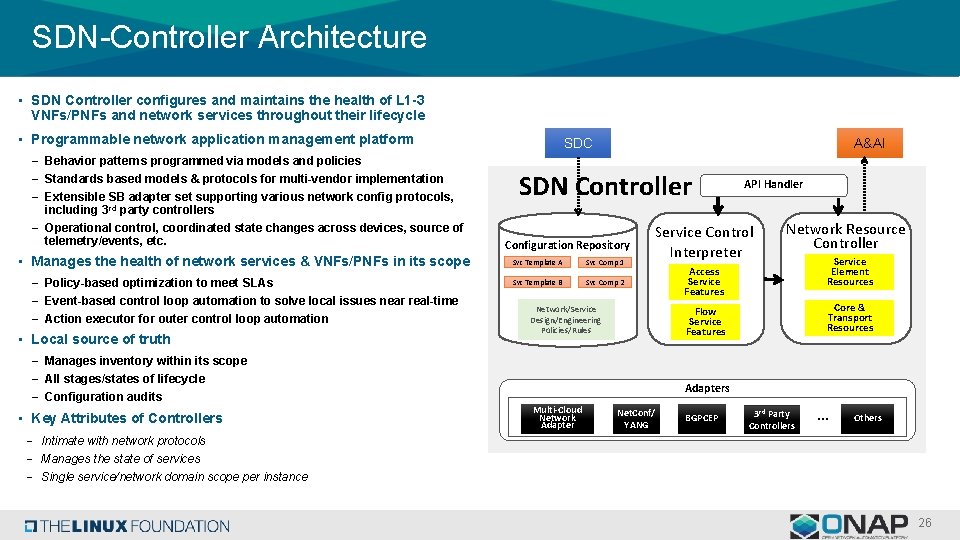
SDN-Controller Architecture • SDN Controller configures and maintains the health of L 1 -3 VNFs/PNFs and network services throughout their lifecycle • Programmable network application management platform SDC ‒ Behavior patterns programmed via models and policies ‒ Standards based models & protocols for multi-vendor implementation ‒ Extensible SB adapter set supporting various network config protocols, including 3 rd party controllers ‒ Operational control, coordinated state changes across devices, source of telemetry/events, etc. A&AI SDN Controller Configuration Repository • Manages the health of network services & VNFs/PNFs in its scope ‒ Policy-based optimization to meet SLAs ‒ Event-based control loop automation to solve local issues near real-time ‒ Action executor for outer control loop automation Svc Template A Svc Comp 1 Svc Template B Svc Comp 2 Service Control Interpreter Network/Service Design/Engineering Policies/Rules • Local source of truth ‒ Manages inventory within its scope ‒ All stages/states of lifecycle ‒ Configuration audits API Handler Network Resource Controller Access Service Features Service Element Resources Core & Transport Resources Flow Service Features Adapters Multi-Cloud Network Adapter • Key Attributes of Controllers Net. Conf/ YANG BGPCEP 3 rd Party Controllers … Others − Intimate with network protocols − Manages the state of services − Single service/network domain scope per instance 26
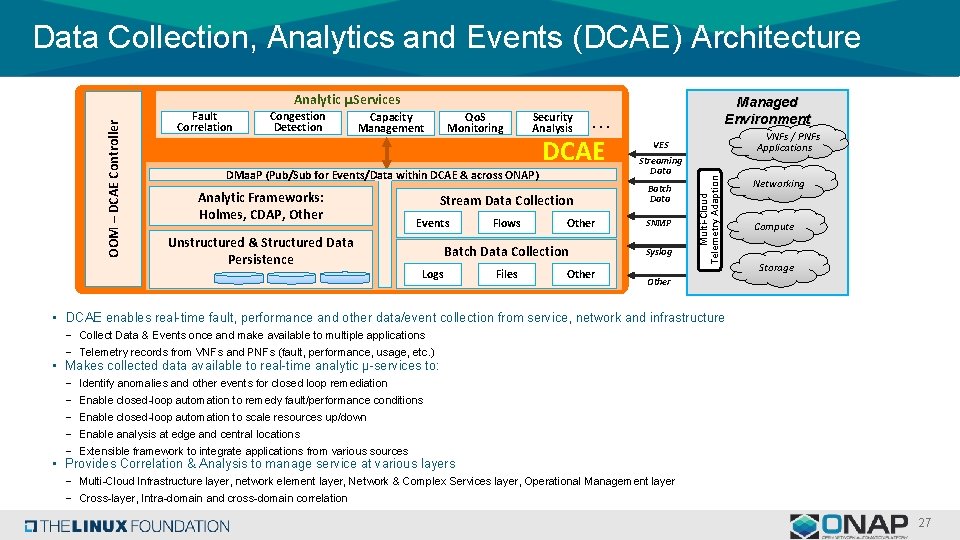
Data Collection, Analytics and Events (DCAE) Architecture Congestion Detection Qo. S Monitoring Capacity Management Security Analysis DMaa. P (Pub/Sub for Events/Data within DCAE & across ONAP) Analytic Frameworks: Holmes, CDAP, Other … DCAE Stream Data Collection Unstructured & Structured Data Persistence Events Flows Other Batch Data Collection Logs Files Managed Environment Other VNFs / PNFs Applications VES Streaming Data Batch Data SNMP Syslog Multi-Cloud Telemetry Adaption Fault Correlation OOM – DCAE Controller Analytic µServices Networking Compute Storage Other • DCAE enables real-time fault, performance and other data/event collection from service, network and infrastructure ‒ Collect Data & Events once and make available to multiple applications ‒ Telemetry records from VNFs and PNFs (fault, performance, usage, etc. ) • Makes collected data available to real-time analytic µ-services to: ‒ ‒ ‒ Identify anomalies and other events for closed loop remediation Enable closed-loop automation to remedy fault/performance conditions Enable closed-loop automation to scale resources up/down Enable analysis at edge and central locations Extensible framework to integrate applications from various sources • Provides Correlation & Analysis to manage service at various layers ‒ Multi-Cloud Infrastructure layer, network element layer, Network & Complex Services layer, Operational Management layer ‒ Cross-layer, Intra-domain and cross-domain correlation 27
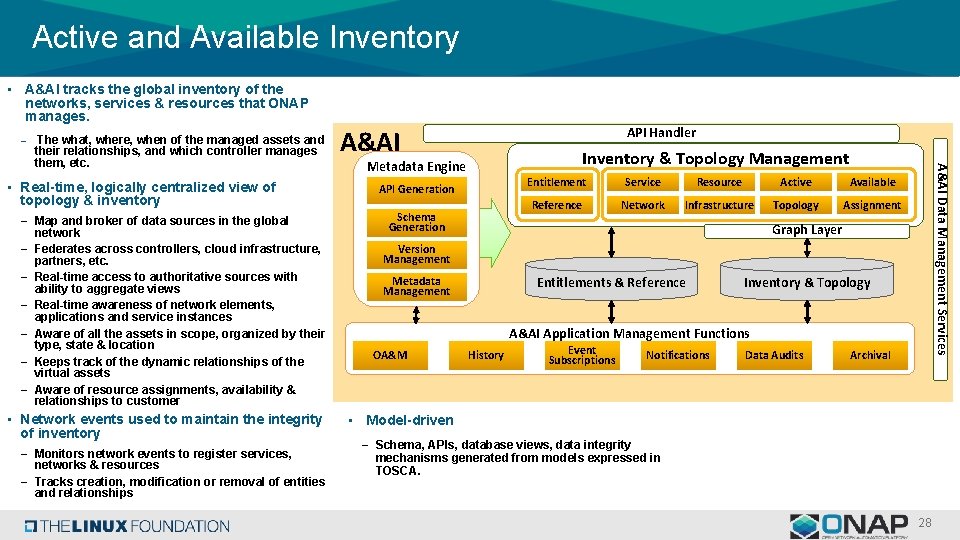
Active and Available Inventory • A&AI tracks the global inventory of the networks, services & resources that ONAP manages. ‒ The what, where, when of the managed assets and • Real-time, logically centralized view of topology & inventory ‒ Map and broker of data sources in the global network ‒ Federates across controllers, cloud infrastructure, partners, etc. ‒ Real-time access to authoritative sources with ability to aggregate views ‒ Real-time awareness of network elements, applications and service instances ‒ Aware of all the assets in scope, organized by their type, state & location ‒ Keeps track of the dynamic relationships of the virtual assets ‒ Aware of resource assignments, availability & relationships to customer • Network events used to maintain the integrity of inventory ‒ Monitors network events to register services, networks & resources ‒ Tracks creation, modification or removal of entities and relationships Inventory & Topology Management Metadata Engine API Generation Schema Generation Entitlement Service Resource Active Available Reference Network Infrastructure Topology Assignment A&AI Data Management Services their relationships, and which controller manages them, etc. API Handler A&AI Graph Layer Version Management Metadata Management Entitlements & Reference Inventory & Topology A&AI Application Management Functions OA&M History Event Subscriptions Notifications Data Audits Archival • Model-driven ‒ Schema, APIs, database views, data integrity mechanisms generated from models expressed in TOSCA. 28
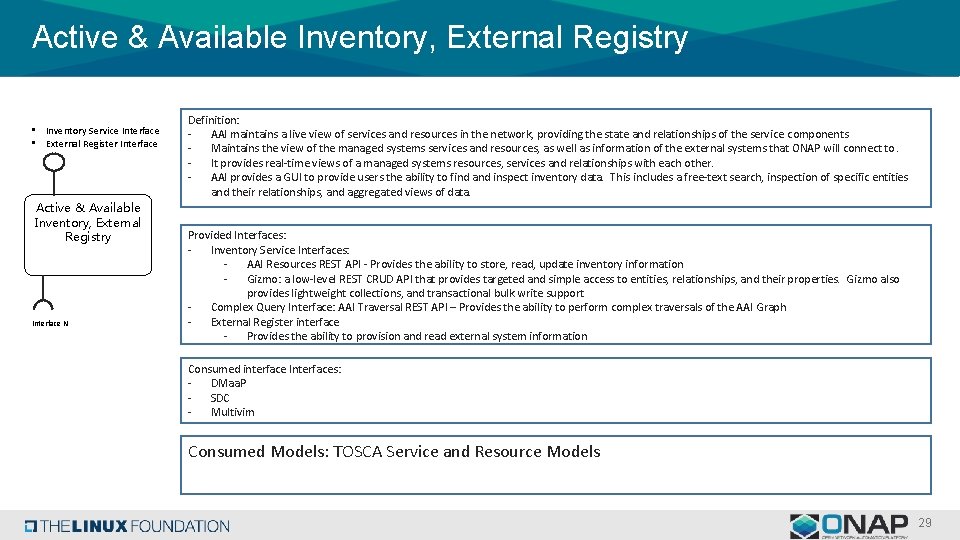
Active & Available Inventory, External Registry • Inventory Service Interface • External Register Interface Active & Available Inventory, External Registry Interface N Definition: - AAI maintains a live view of services and resources in the network, providing the state and relationships of the service components - Maintains the view of the managed systems services and resources, as well as information of the external systems that ONAP will connect to. - It provides real-time views of a managed systems resources, services and relationships with each other. - AAI provides a GUI to provide users the ability to find and inspect inventory data. This includes a free-text search, inspection of specific entities and their relationships, and aggregated views of data. Provided Interfaces: - Inventory Service Interfaces: - AAI Resources REST API - Provides the ability to store, read, update inventory information - Gizmo: a low-level REST CRUD API that provides targeted and simple access to entities, relationships, and their properties. Gizmo also provides lightweight collections, and transactional bulk write support - Complex Query Interface: AAI Traversal REST API – Provides the ability to perform complex traversals of the AAI Graph - External Register interface - Provides the ability to provision and read external system information Consumed interface Interfaces: - DMaa. P - SDC - Multivim Consumed Models: TOSCA Service and Resource Models 29
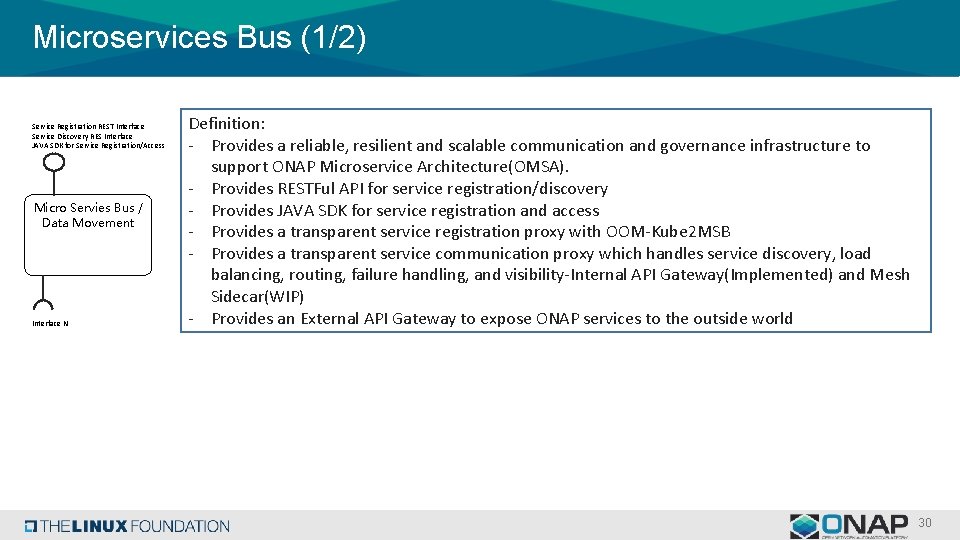
Microservices Bus (1/2) Service Registration REST Interface Service Discovery RES Interface JAVA SDK for Service Registration/Access Micro Servies Bus / Data Movement Interface N Definition: - Provides a reliable, resilient and scalable communication and governance infrastructure to support ONAP Microservice Architecture(OMSA). - Provides RESTFul API for service registration/discovery - Provides JAVA SDK for service registration and access - Provides a transparent service registration proxy with OOM-Kube 2 MSB - Provides a transparent service communication proxy which handles service discovery, load balancing, routing, failure handling, and visibility-Internal API Gateway(Implemented) and Mesh Sidecar(WIP) - Provides an External API Gateway to expose ONAP services to the outside world 30
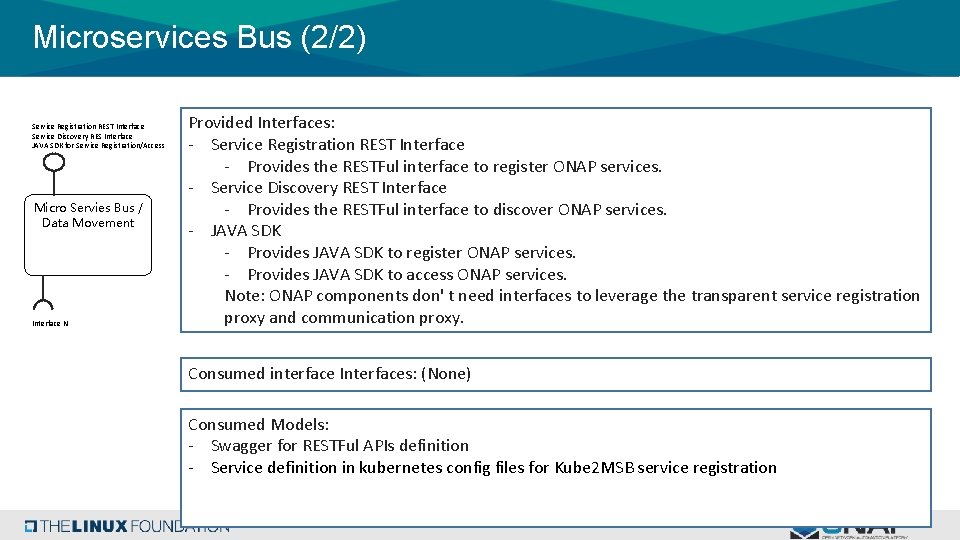
Microservices Bus (2/2) Service Registration REST Interface Service Discovery RES Interface JAVA SDK for Service Registration/Access Micro Servies Bus / Data Movement Interface N Provided Interfaces: - Service Registration REST Interface - Provides the RESTFul interface to register ONAP services. - Service Discovery REST Interface - Provides the RESTFul interface to discover ONAP services. - JAVA SDK - Provides JAVA SDK to register ONAP services. - Provides JAVA SDK to access ONAP services. Note: ONAP components don' t need interfaces to leverage the transparent service registration proxy and communication proxy. Consumed interface Interfaces: (None) Consumed Models: - Swagger for RESTFul APIs definition - Service definition in kubernetes config files for Kube 2 MSB service registration 31
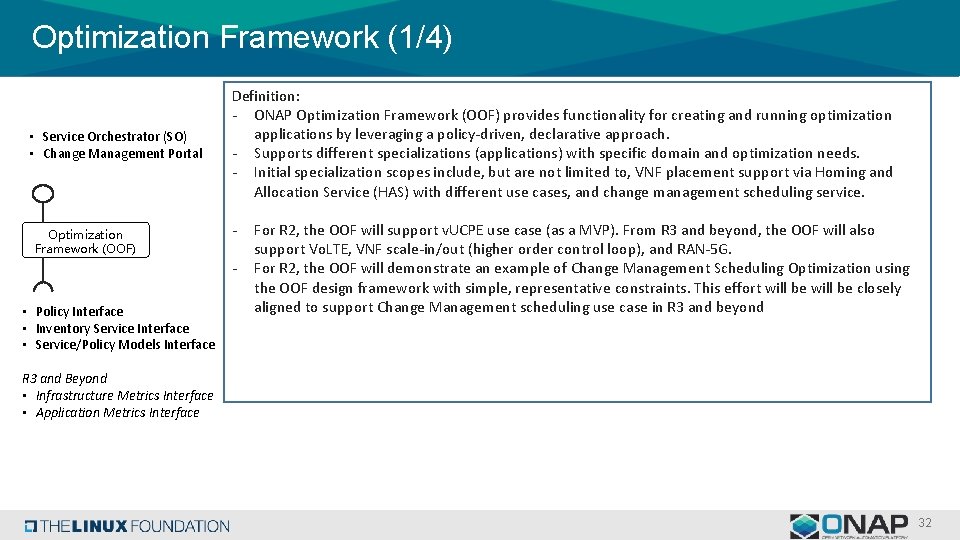
Optimization Framework (1/4) • Service Orchestrator (SO) • Change Management Portal Optimization Framework (OOF) Definition: - ONAP Optimization Framework (OOF) provides functionality for creating and running optimization applications by leveraging a policy-driven, declarative approach. - Supports different specializations (applications) with specific domain and optimization needs. - Initial specialization scopes include, but are not limited to, VNF placement support via Homing and Allocation Service (HAS) with different use cases, and change management scheduling service. - • Policy Interface • Inventory Service Interface • Service/Policy Models Interface For R 2, the OOF will support v. UCPE use case (as a MVP). From R 3 and beyond, the OOF will also support Vo. LTE, VNF scale-in/out (higher order control loop), and RAN-5 G. For R 2, the OOF will demonstrate an example of Change Management Scheduling Optimization using the OOF design framework with simple, representative constraints. This effort will be closely aligned to support Change Management scheduling use case in R 3 and beyond R 3 and Beyond • Infrastructure Metrics Interface • Application Metrics Interface 32
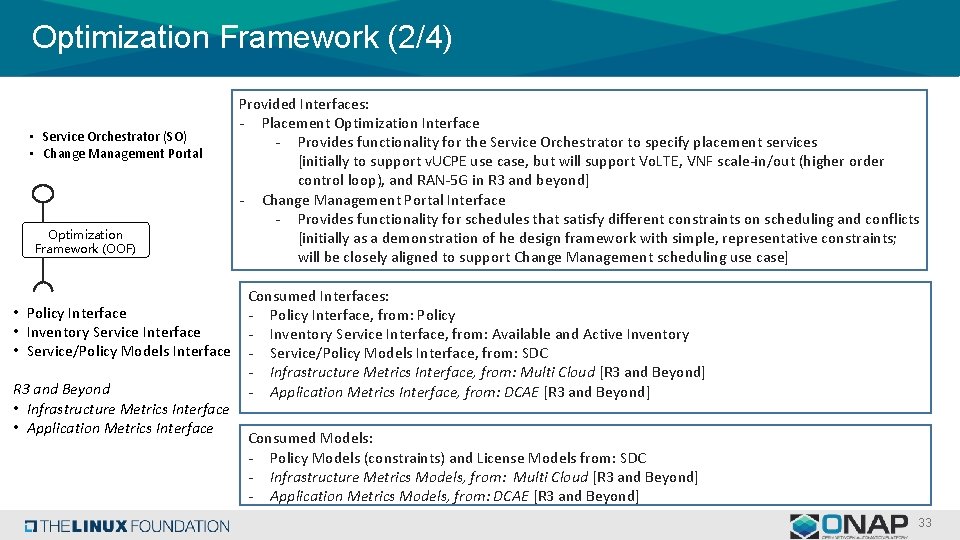
Optimization Framework (2/4) • Service Orchestrator (SO) • Change Management Portal Optimization Framework (OOF) • Policy Interface • Inventory Service Interface • Service/Policy Models Interface R 3 and Beyond • Infrastructure Metrics Interface • Application Metrics Interface Provided Interfaces: - Placement Optimization Interface - Provides functionality for the Service Orchestrator to specify placement services [initially to support v. UCPE use case, but will support Vo. LTE, VNF scale-in/out (higher order control loop), and RAN-5 G in R 3 and beyond] - Change Management Portal Interface - Provides functionality for schedules that satisfy different constraints on scheduling and conflicts [initially as a demonstration of he design framework with simple, representative constraints; will be closely aligned to support Change Management scheduling use case] Consumed Interfaces: - Policy Interface, from: Policy - Inventory Service Interface, from: Available and Active Inventory - Service/Policy Models Interface, from: SDC - Infrastructure Metrics Interface, from: Multi Cloud [R 3 and Beyond] - Application Metrics Interface, from: DCAE [R 3 and Beyond] Consumed Models: - Policy Models (constraints) and License Models from: SDC - Infrastructure Metrics Models, from: Multi Cloud [R 3 and Beyond] - Application Metrics Models, from: DCAE [R 3 and Beyond] 33
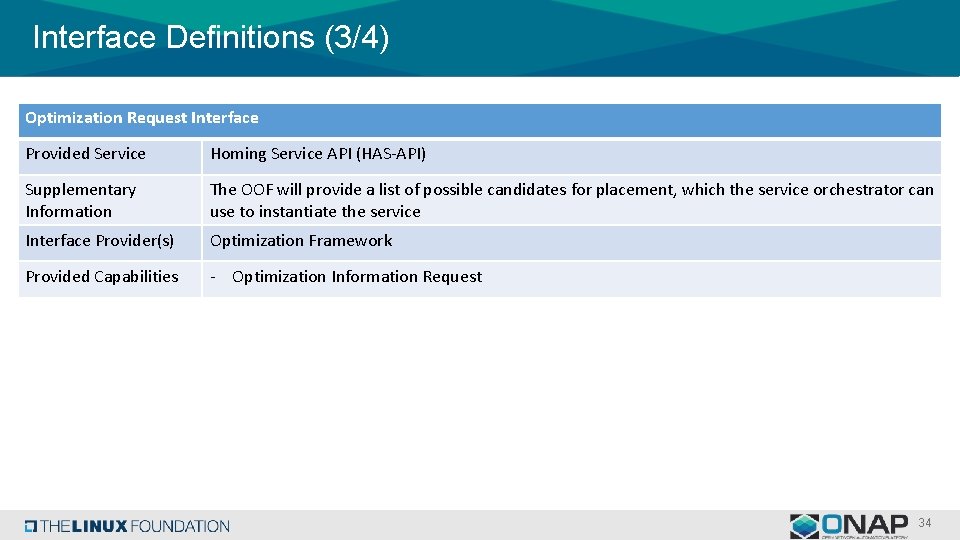
Interface Definitions (3/4) Optimization Request Interface Provided Service Homing Service API (HAS-API) Supplementary Information The OOF will provide a list of possible candidates for placement, which the service orchestrator can use to instantiate the service Interface Provider(s) Optimization Framework Provided Capabilities - Optimization Information Request 34
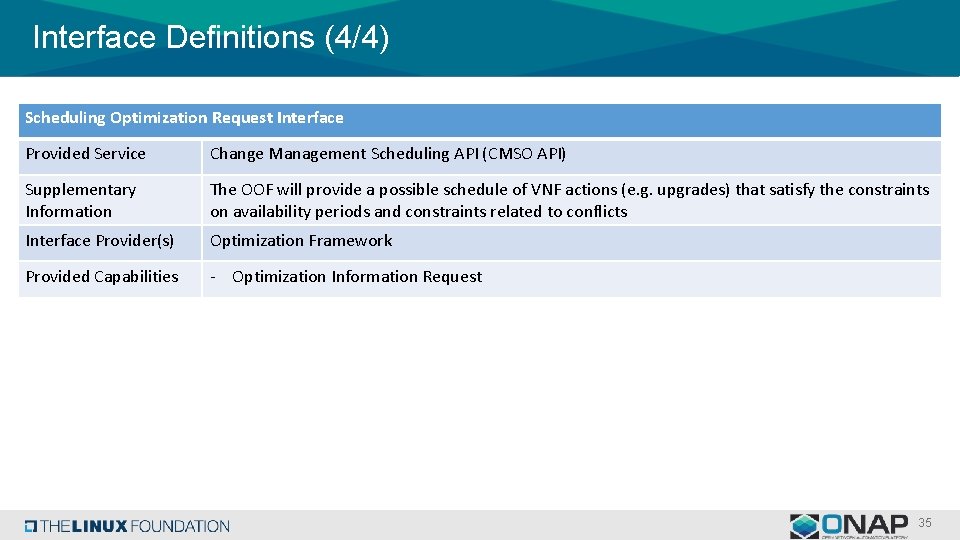
Interface Definitions (4/4) Scheduling Optimization Request Interface Provided Service Change Management Scheduling API (CMSO API) Supplementary Information The OOF will provide a possible schedule of VNF actions (e. g. upgrades) that satisfy the constraints on availability periods and constraints related to conflicts Interface Provider(s) Optimization Framework Provided Capabilities - Optimization Information Request 35
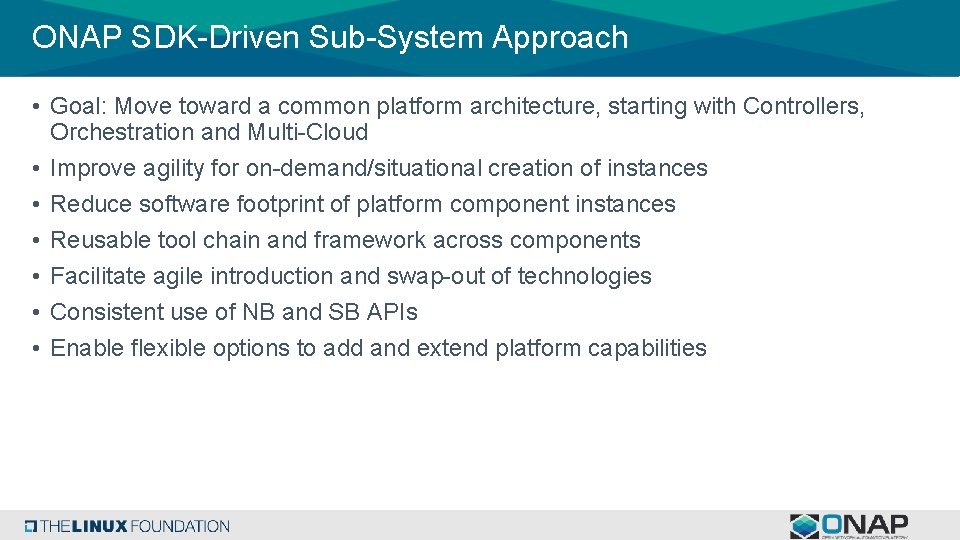
ONAP SDK-Driven Sub-System Approach • Goal: Move toward a common platform architecture, starting with Controllers, Orchestration and Multi-Cloud • Improve agility for on-demand/situational creation of instances • Reduce software footprint of platform component instances • Reusable tool chain and framework across components • Facilitate agile introduction and swap-out of technologies • Consistent use of NB and SB APIs • Enable flexible options to add and extend platform capabilities
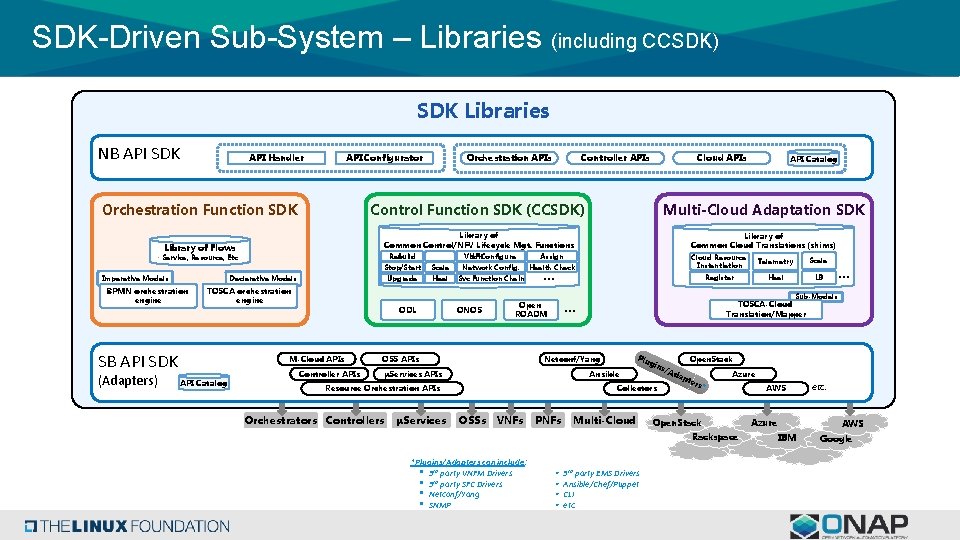
SDK-Driven Sub-System – Libraries (including CCSDK) SDK Libraries NB API SDK API Handler API Configurator Orchestration Function SDK Library of Flows Library of Common Cloud Translations (shims) Rebuild A VNF udit. Configure Assign Stop/Start Scale Network Config. Health Check Upgrade Heal Svc Function Chain (Adapters) ODL M-Cloud APIs API Catalog Controller APIs API Catalog Library of Common Control/NFV Lifecycle Mgt. Functions TOSCA orchestration engine SB API SDK Cloud APIs Multi-Cloud Adaptation SDK Declarative Models BPMN orchestration engine Controller APIs Control Function SDK (CCSDK) • Service, Resource, Etc. Imperative Models Orchestration APIs ONOS … Plu gin VNFs Heal LB PNFs Multi-Cloud da pte rs* Azure Open. Stack Rackspace *Plugins/Adapters can include: • 3 rd party VNFM Drivers • 3 rd party SFC Drivers • Netconf/Yang • SNMP • • … Open. Stack s/A Collectors OSSs Register Sub-Models Ansible μServices APIs μServices Scale TOSCA-Cloud Translation/Mapper Netconf/Yang Resource Orchestration APIs Orchestrators Controllers Telemetry … Open ROADM OSS APIs Cloud Resource Instantiation 3 rd party EMS Drivers Ansible/Chef/Puppet CLI etc. AWS Azure etc. AWS IBM Google
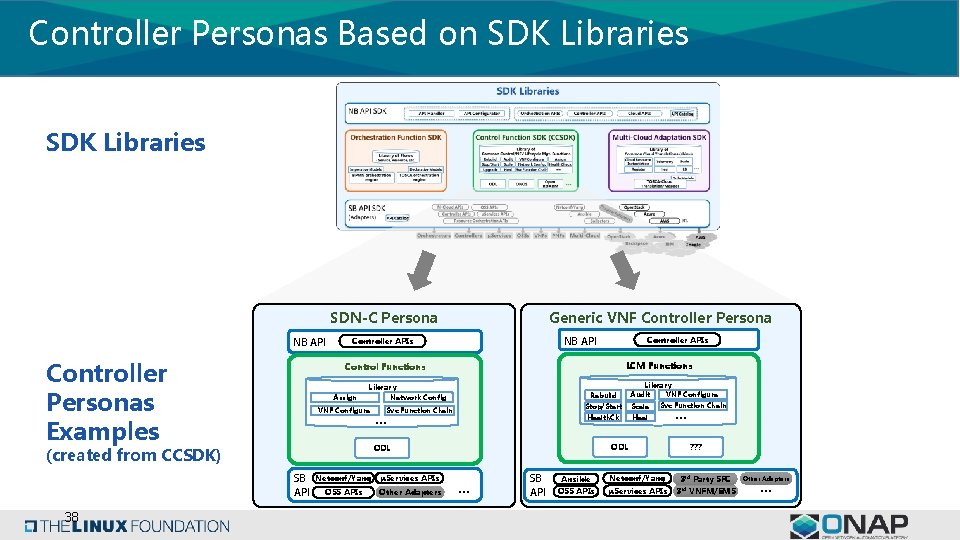
Controller Personas Based on SDK Libraries SDN-C Persona NB API Controller Personas Examples NB API Controller APIs LCM Functions Control Functions Library Network Config Assign VNF Configure Svc Function Chain … SB API Netconf/Yang μServices APIs OSS APIs Other Adapters Library Rebuild Audit VNF Configure Stop/Start Scale Svc Function Chain Health. Ck Heal ODL (created from CCSDK) 38 Generic VNF Controller Persona SB API … … ? ? ? Ansible Netconf/Yang 3 rd Party SFC OSS APIs μServices APIs 3 rd VNFM/EMS Other Adapters …
ONAP APIs Work in Progress …
MEF and ONAP Joint Collaboration • • 40 Work jointly with MEF and ONAP External API Project in defining Use Cases and Information Model for Legato and Interlude Leverage MEF Operational Threads and revise MEF 56, Interface Profile Specification: Service Configuration and Activation, to reflect consistent Use Cases The Service Descriptor Model is key to Model Driven Orchestration Work with ONAP and TM Forum define the Service Catalog and Service Instantiation API is a model driven and extensible fashion
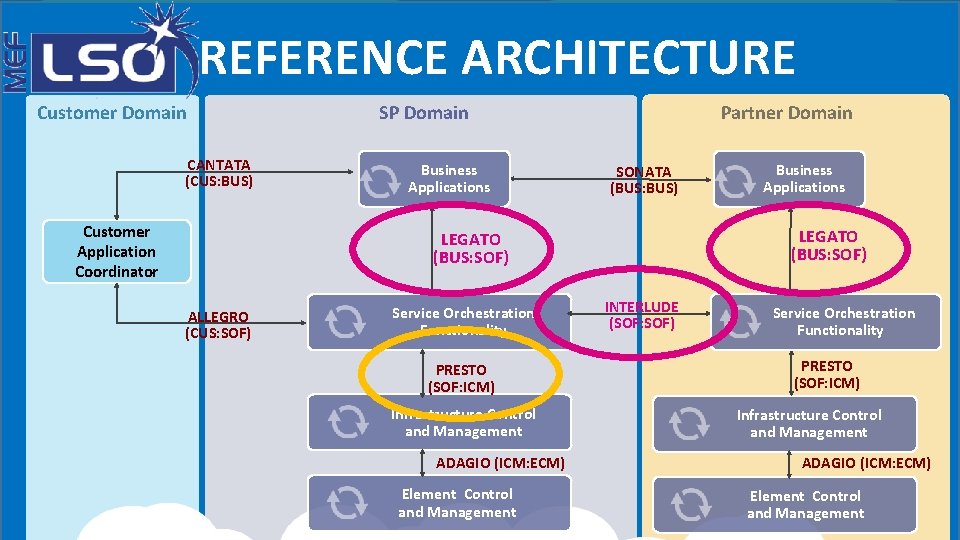
REFERENCE ARCHITECTURE Customer Domain CANTATA (CUS: BUS) Customer Application Coordinator Partner Domain SP Domain Business Applications SONATA (BUS: BUS) LEGATO (BUS: SOF) ALLEGRO (CUS: SOF) Service Orchestration Functionality E PRESTO (SOF: ICM) Infrastructure Control and Management ADAGIO (ICM: ECM) Element Control and Management Business Applications INTERLUDE (SOF: SOF) Service Orchestration Functionality PRESTO (SOF: ICM) Infrastructure Control and Management ADAGIO (ICM: ECM) Element Control and Management
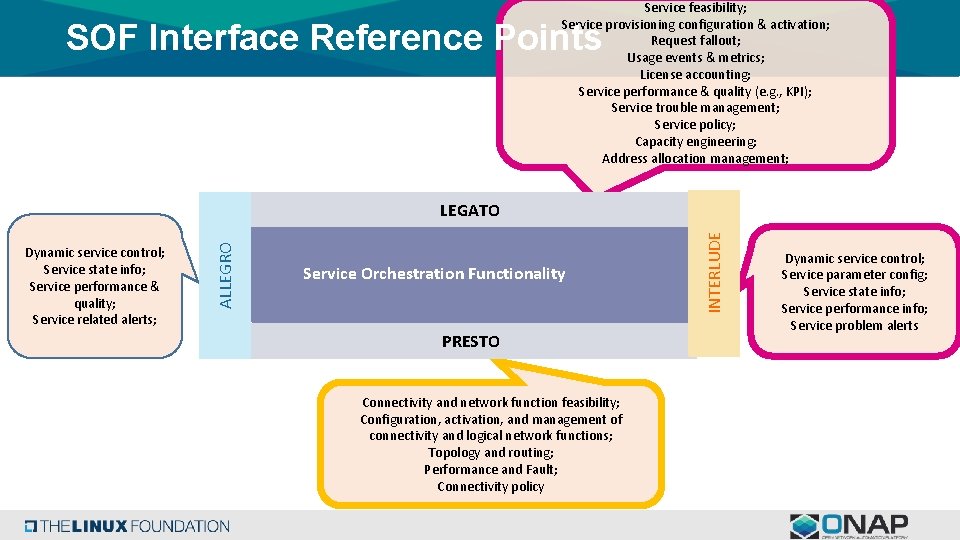
Service feasibility; Service provisioning configuration & activation; Request fallout; Usage events & metrics; License accounting; Service performance & quality (e. g. , KPI); Service trouble management; Service policy; Capacity engineering; Address allocation management; SOF Interface Reference Points Service Orchestration Functionality PRESTO Connectivity and network function feasibility; Configuration, activation, and management of connectivity and logical network functions; Topology and routing; Performance and Fault; Connectivity policy INTERLUDE Dynamic service control; Service state info; Service performance & quality; Service related alerts; ALLEGRO LEGATO Dynamic service control; Service parameter config; Service state info; Service performance info; Service problem alerts
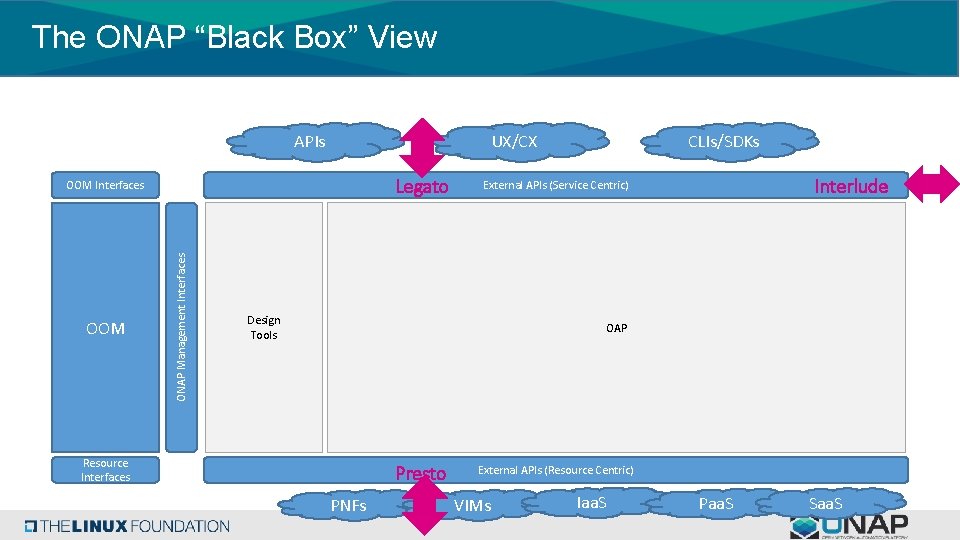
The ONAP “Black Box” View APIs UX/CX Legato OOM ONAP Management Interfaces OOM Interfaces CLIs/SDKs Interlude External APIs (Service Centric) Design Tools OAP Resource Interfaces Presto PNFs External APIs (Resource Centric) VIMs Iaa. S Paa. S Saa. S
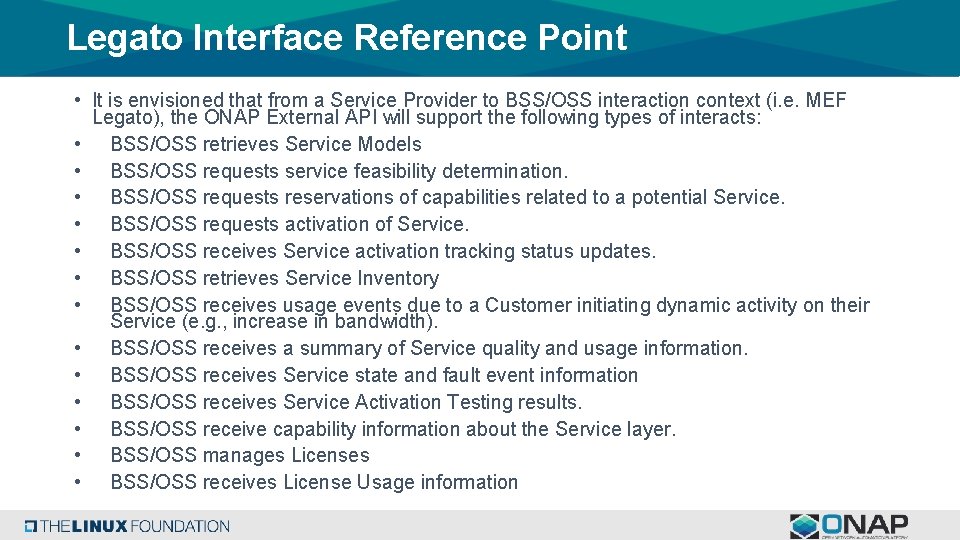
Legato Interface Reference Point • It is envisioned that from a Service Provider to BSS/OSS interaction context (i. e. MEF Legato), the ONAP External API will support the following types of interacts: • BSS/OSS retrieves Service Models • BSS/OSS requests service feasibility determination. • BSS/OSS requests reservations of capabilities related to a potential Service. • BSS/OSS requests activation of Service. • BSS/OSS receives Service activation tracking status updates. • BSS/OSS retrieves Service Inventory • BSS/OSS receives usage events due to a Customer initiating dynamic activity on their Service (e. g. , increase in bandwidth). • BSS/OSS receives a summary of Service quality and usage information. • BSS/OSS receives Service state and fault event information • BSS/OSS receives Service Activation Testing results. • BSS/OSS receive capability information about the Service layer. • BSS/OSS manages Licenses • BSS/OSS receives License Usage information
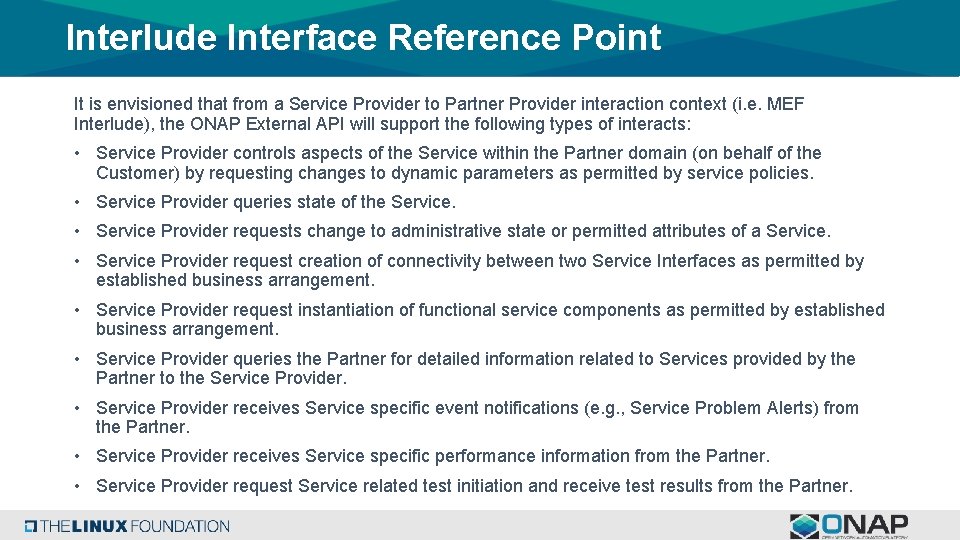
Interlude Interface Reference Point It is envisioned that from a Service Provider to Partner Provider interaction context (i. e. MEF Interlude), the ONAP External API will support the following types of interacts: • Service Provider controls aspects of the Service within the Partner domain (on behalf of the Customer) by requesting changes to dynamic parameters as permitted by service policies. • Service Provider queries state of the Service. • Service Provider requests change to administrative state or permitted attributes of a Service. • Service Provider request creation of connectivity between two Service Interfaces as permitted by established business arrangement. • Service Provider request instantiation of functional service components as permitted by established business arrangement. • Service Provider queries the Partner for detailed information related to Services provided by the Partner to the Service Provider. • Service Provider receives Service specific event notifications (e. g. , Service Problem Alerts) from the Partner. • Service Provider receives Service specific performance information from the Partner. • Service Provider request Service related test initiation and receive test results from the Partner.
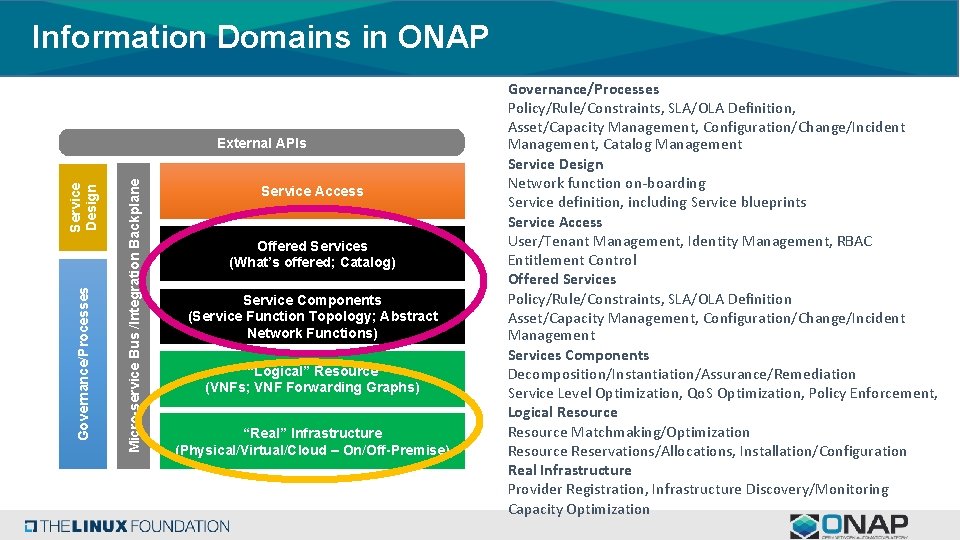
Information Domains in ONAP Micro-service Bus /Integration Backplane Governance/Processes Service Design External APIs Service Access Offered Services (What’s offered; Catalog) Service Components (Service Function Topology; Abstract Network Functions) “Logical” Resource (VNFs; VNF Forwarding Graphs) “Real” Infrastructure (Physical/Virtual/Cloud – On/Off-Premise) Governance/Processes Policy/Rule/Constraints, SLA/OLA Definition, Asset/Capacity Management, Configuration/Change/Incident Management, Catalog Management Service Design Network function on-boarding Service definition, including Service blueprints Service Access User/Tenant Management, Identity Management, RBAC Entitlement Control Offered Services Policy/Rule/Constraints, SLA/OLA Definition Asset/Capacity Management, Configuration/Change/Incident Management Services Components Decomposition/Instantiation/Assurance/Remediation Service Level Optimization, Qo. S Optimization, Policy Enforcement, Logical Resource Matchmaking/Optimization Resource Reservations/Allocations, Installation/Configuration Real Infrastructure Provider Registration, Infrastructure Discovery/Monitoring Capacity Optimization
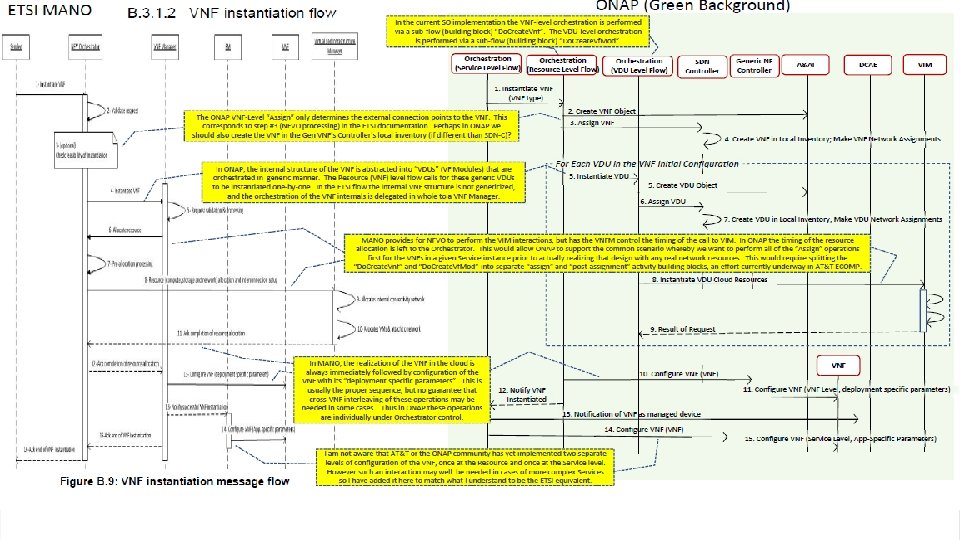
Orchestration Approach Comparison ONAP vs ETSI MANO (Gil) Work in Progress … Note - Attached slides provide a side-by-side comparison of the ETSI MANO approach to orchestration vs the ONAP (ECOMP) approach.
48
49
50
Vodafone Orchestration Proposal (Susana) Work in Progress …
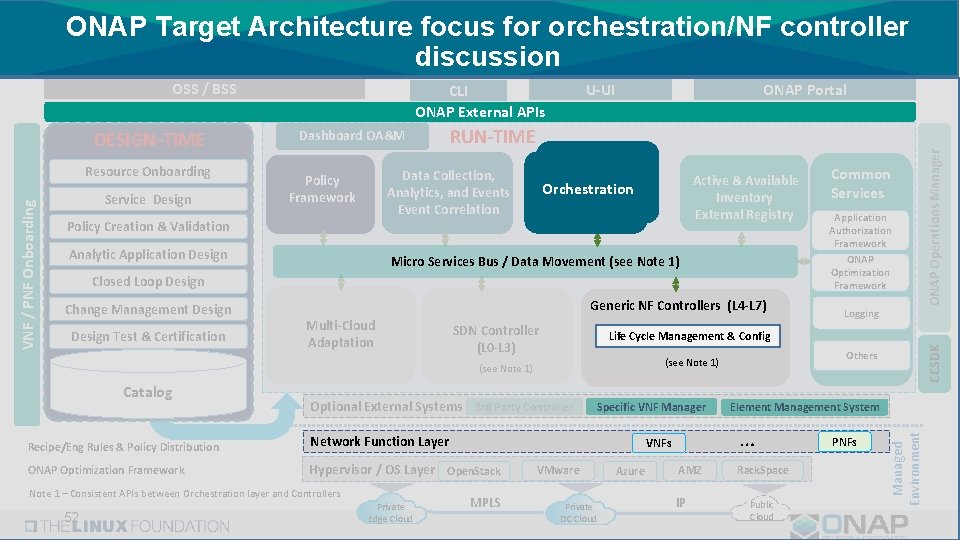
ONAP Target Architecture focus for orchestration/NF controller discussion Service Design RUN-TIME Data Collection, Analytics, and Events Event Correlation Policy Framework Active & Available Inventory External Registry Orchestration Policy Creation & Validation Analytic Application Design Micro Services Bus / Data Movement (see Note 1) Closed Loop Design Change Management Design Test & Certification Generic NF Controllers (L 4 -L 7) Multi-Cloud Adaptation SDN Controller (L 0 -L 3) Network Function Layer ONAP Optimization Framework Hypervisor / OS Layer Open. Stack Note 1 – Consistent APIs between Orchestration layer and Controllers 52 Private Edge Cloud Specific VNF Manager VMware Private DC Cloud Azure Element Management System … VNFs MPLS Logging Others (see Note 1) Optional External Systems 3 rd Party Controller Recipe/Eng Rules & Policy Distribution Application Authorization Framework ONAP Common Optimization Services Framework Life Cycle Management & Config (see Note 1) Catalog Common Services ONAP Operations Manager VNF / PNF Onboarding Resource Onboarding Dashboard OA&M AMZ IP CCSDK DESIGN-TIME ONAP Portal U-UI CLI ONAP External APIs Rack. Space Public Cloud PNFs Managed Environment OSS / BSS
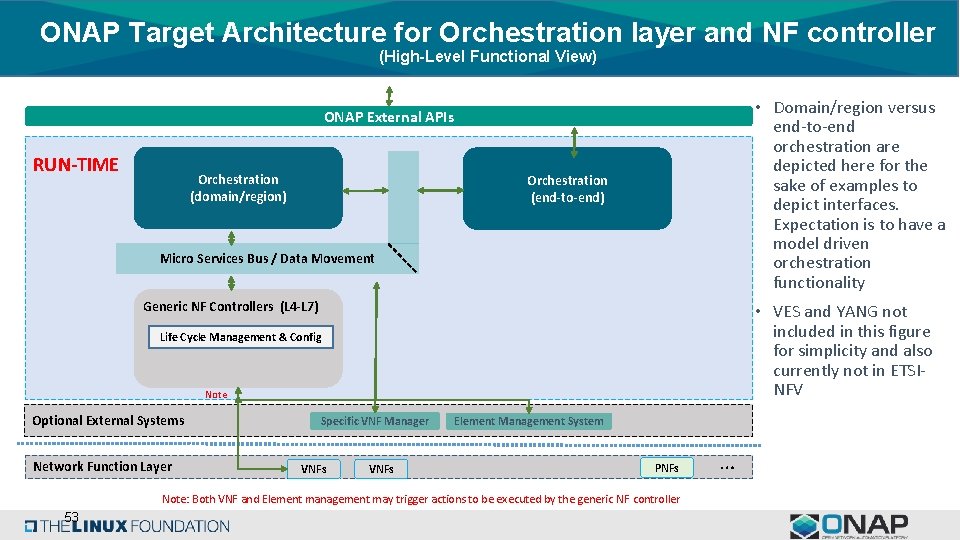
ONAP Target Architecture for Orchestration layer and NF controller (High-Level Functional View) • Domain/region versus end-to-end orchestration are depicted here for the sake of examples to depict interfaces. Expectation is to have a model driven orchestration functionality ONAP External APIs RUN-TIME Orchestration (domain/region) Orchestration (end-to-end) Micro Services Bus / Data Movement Generic NF Controllers (L 4 -L 7) • VES and YANG not included in this figure for simplicity and also currently not in ETSINFV Life Cycle Management & Config Note Optional External Systems Network Function Layer Specific VNF Manager VNFs Element Management System PNFs VNFs Note: Both VNF and Element management may trigger actions to be executed by the generic NF controller 53 …
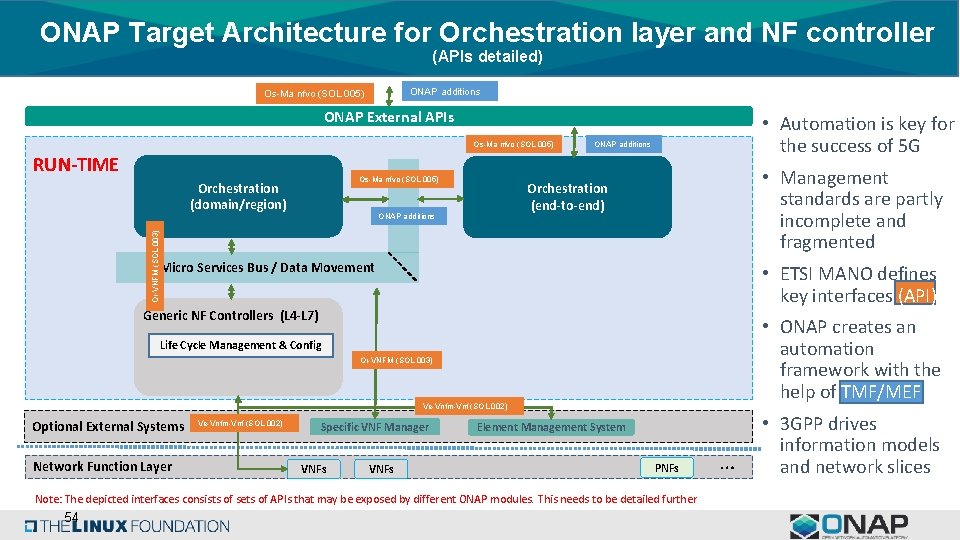
ONAP Target Architecture for Orchestration layer and NF controller (APIs detailed) ONAP additions Os-Ma nfvo (SOL 005) ONAP External APIs Os-Ma nfvo (SOL 005) RUN-TIME Os-Ma nfvo (SOL 005) Orchestration (domain/region) • Automation is key for the success of 5 G ONAP additions • Management standards are partly incomplete and fragmented Orchestration (end-to-end) Or-VNFM (SOL 003) ONAP additions Micro Services Bus / Data Movement • ETSI MANO defines key interfaces (API) Generic NF Controllers (L 4 -L 7) • ONAP creates an automation framework with the help of TMF/MEF Life Cycle Management & Config Or-VNFM (SOL 003) Ve-Vnfm-Vnf (SOL 002) Optional External Systems Network Function Layer Ve-Vnfm-Vnf (SOL 002) Specific VNF Manager VNFs Element Management System PNFs VNFs Note: The depicted interfaces consists of sets of APIs that may be exposed by different ONAP modules. This needs to be detailed further 54 … • 3 GPP drives information models and network slices
- Slides: 54