
ONAP Casablanca Change Management Traffic Distribution Workflow ATT
ONAP Casablanca – Change Management & Traffic Distribution Workflow AT&T, Orange Poland Ajay Mahimkar Łukasz Rajewski Tomasz Osiński 9. 01. 2019
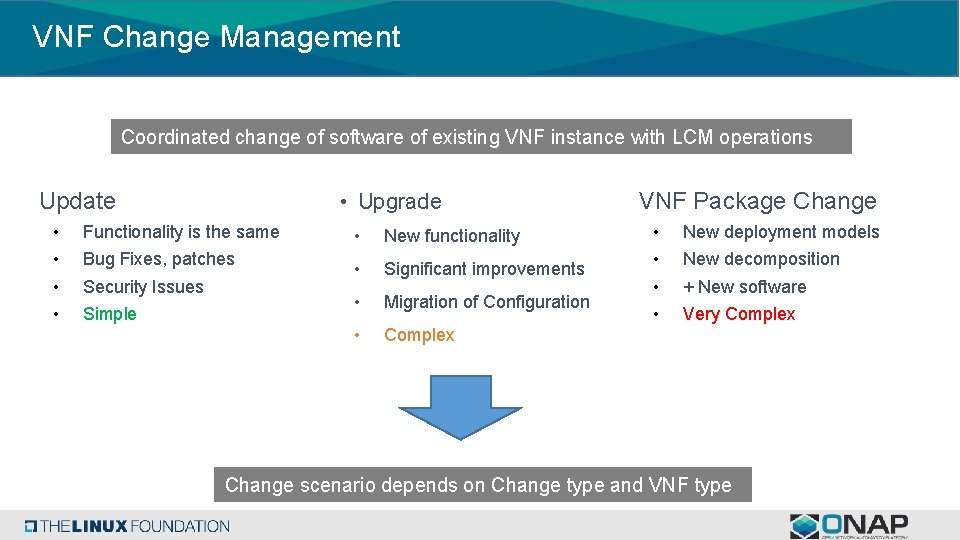
VNF Change Management Coordinated change of software of existing VNF instance with LCM operations Update • • • Upgrade Functionality is the same Bug Fixes, patches Security Issues Simple • New functionality • Significant improvements • Migration of Configuration • Complex VNF Package Change • • New deployment models New decomposition + New software Very Complex Change scenario depends on Change type and VNF type

Change Management Workflows § Change process workflow • Different operations that should be performed on VNF instance (new, old or modified) • Operations must by executed in specified order – only then change can be successful • Performed automatically in time of change that must be scheduled before • Workflow can be different for each type of VNF and for different versions (v 1. 0 -> v 2. 0 != v 1. 0 -> v 1. 2 ) © ONAP Wiki 2018
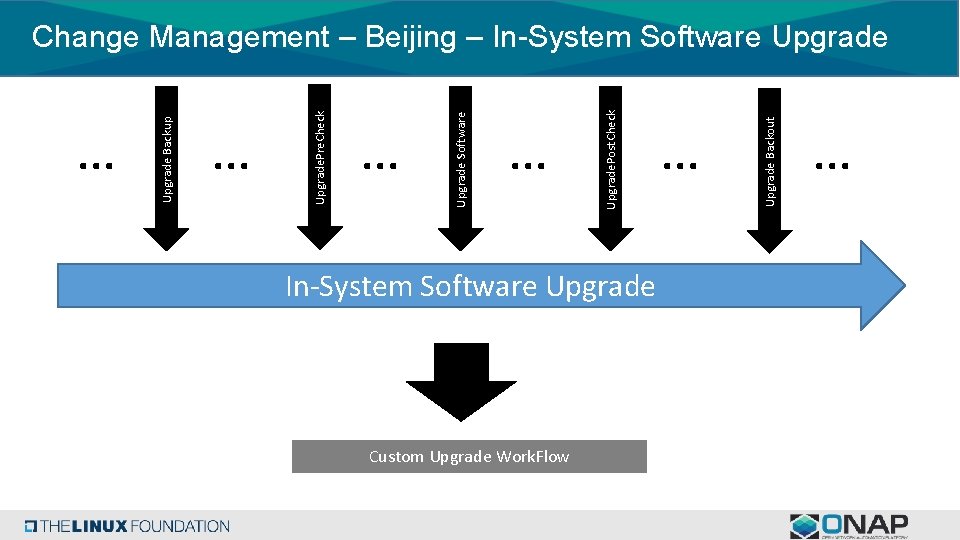
In-System Software Upgrade Custom Upgrade Work. Flow … Upgrade Backout … Upgrade. Post. Check … Upgrade Software … Upgrade. Pre. Check … Upgrade Backup Change Management – Beijing – In-System Software Upgrade …
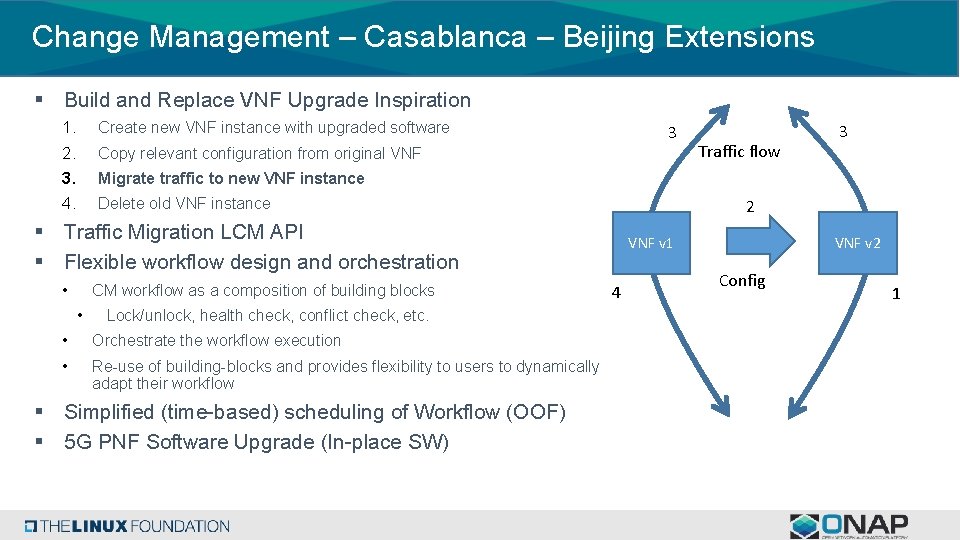
Change Management – Casablanca – Beijing Extensions § Build and Replace VNF Upgrade Inspiration 1. Create new VNF instance with upgraded software 2. Copy relevant configuration from original VNF 3. Migrate traffic to new VNF instance 4. Delete old VNF instance 3 2 § Traffic Migration LCM API § Flexible workflow design and orchestration • CM workflow as a composition of building blocks • Lock/unlock, health check, conflict check, etc. • Orchestrate the workflow execution • Re-use of building-blocks and provides flexibility to users to dynamically adapt their workflow § Simplified (time-based) scheduling of Workflow (OOF) § 5 G PNF Software Upgrade (In-place SW) Traffic flow 3 VNF v 1 4 VNF v 2 Config 1
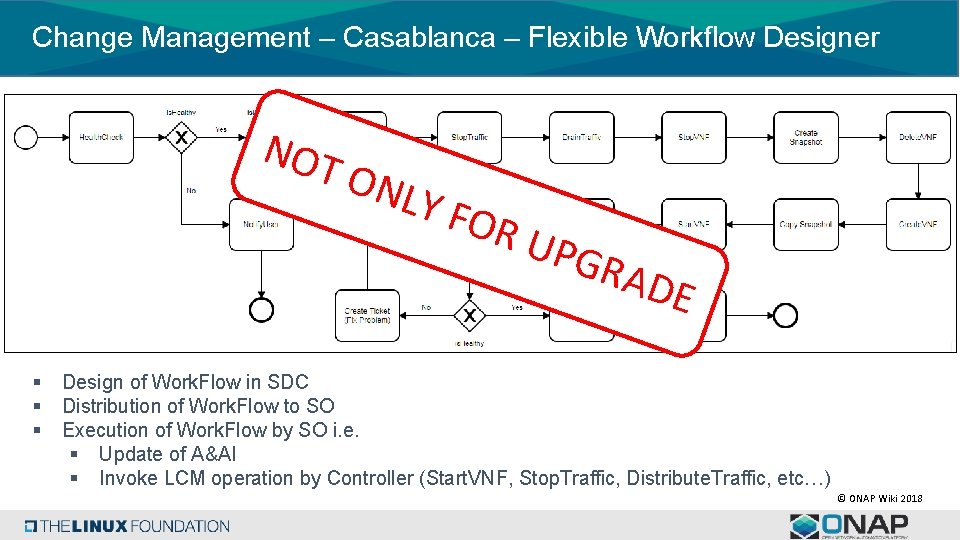
Change Management – Casablanca – Flexible Workflow Designer NOT O NLY § § § FOR UPG RAD E Design of Work. Flow in SDC Distribution of Work. Flow to SO Execution of Work. Flow by SO i. e. § Update of A&AI § Invoke LCM operation by Controller (Start. VNF, Stop. Traffic, Distribute. Traffic, etc…) © ONAP Wiki 2018
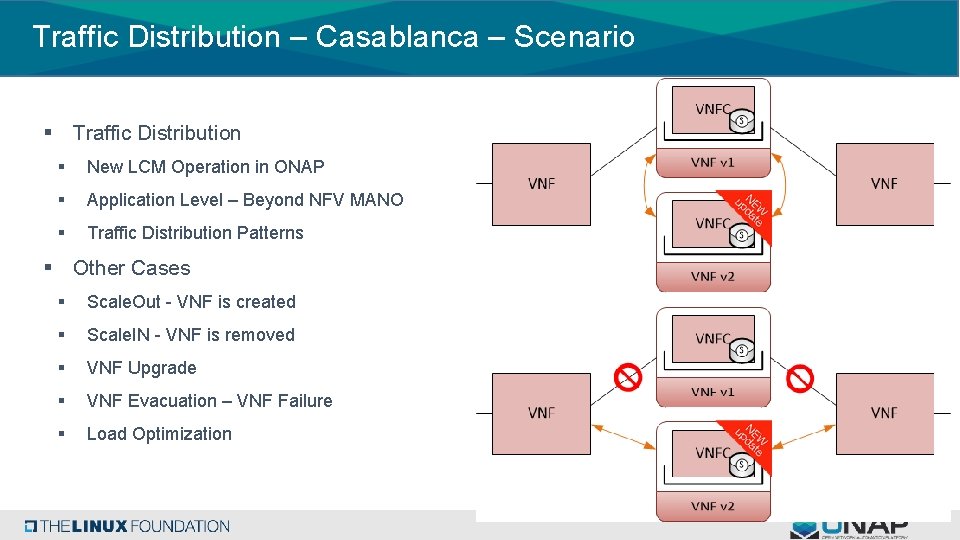
Traffic Distribution – Casablanca – Scenario § Traffic Distribution § New LCM Operation in ONAP § Application Level – Beyond NFV MANO § Traffic Distribution Patterns § Other Cases § Scale. Out - VNF is created § Scale. IN - VNF is removed § VNF Upgrade § VNF Evacuation – VNF Failure § Load Optimization
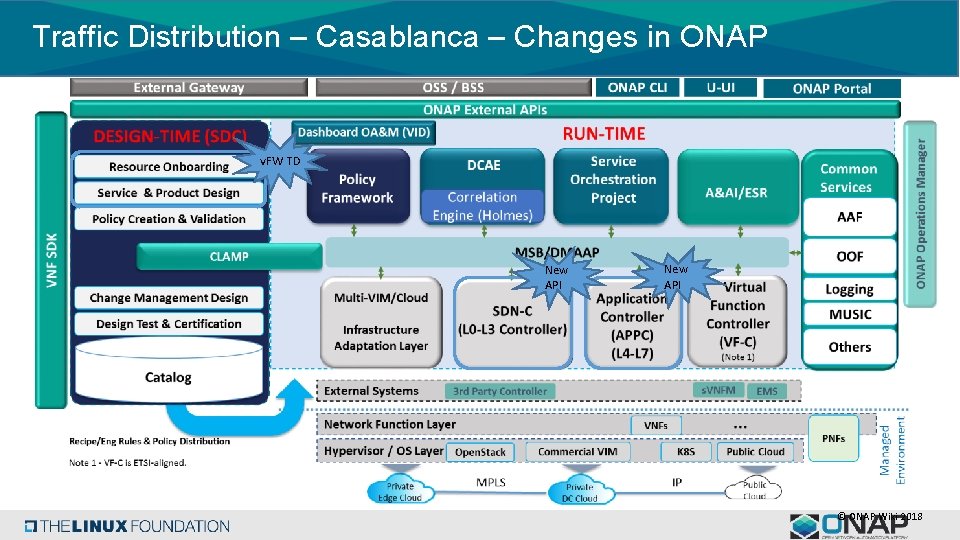
Traffic Distribution – Casablanca – Changes in ONAP v. FW TD New API © ONAP Wiki 2018
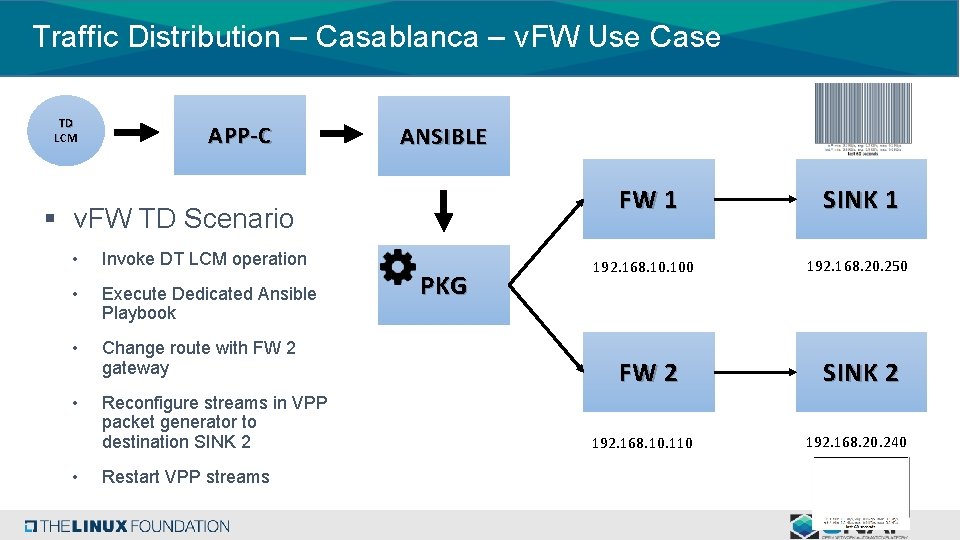
Traffic Distribution – Casablanca – v. FW Use Case TD LCM APP-C ANSIBLE FW 1 § v. FW TD Scenario • Invoke DT LCM operation • Execute Dedicated Ansible Playbook • Change route with FW 2 gateway • Reconfigure streams in VPP packet generator to destination SINK 2 • Restart VPP streams PKG 192. 168. 100 FW 2 192. 168. 10. 110 SINK 1 192. 168. 20. 250 SINK 2 192. 168. 20. 240
ONAP Dublin – Change Management Traffic Distribution Requirements v 1. 2
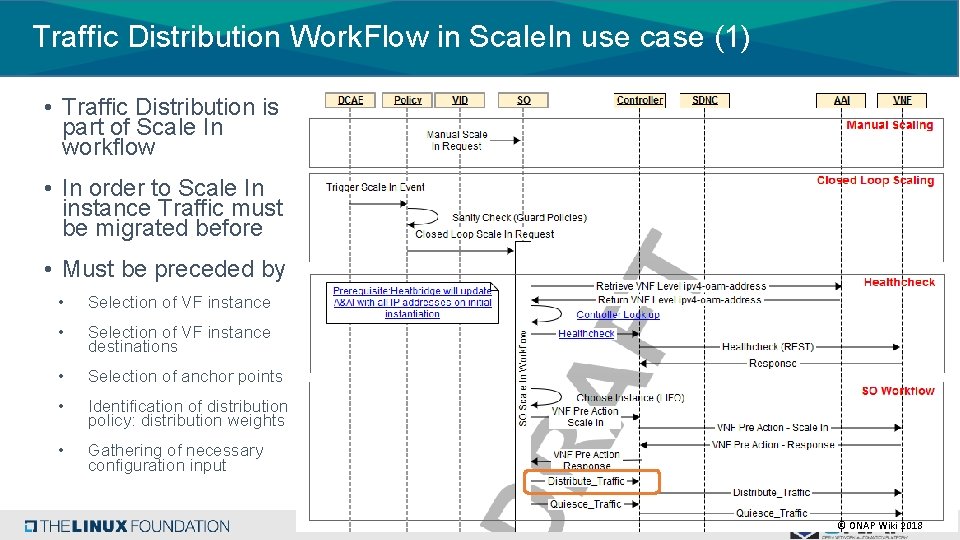
Traffic Distribution Work. Flow in Scale. In use case (1) • Traffic Distribution is part of Scale In workflow • In order to Scale In instance Traffic must be migrated before • Must be preceded by • Selection of VF instance destinations • Selection of anchor points • Identification of distribution policy: distribution weights • Gathering of necessary configuration input © ONAP Wiki 2018
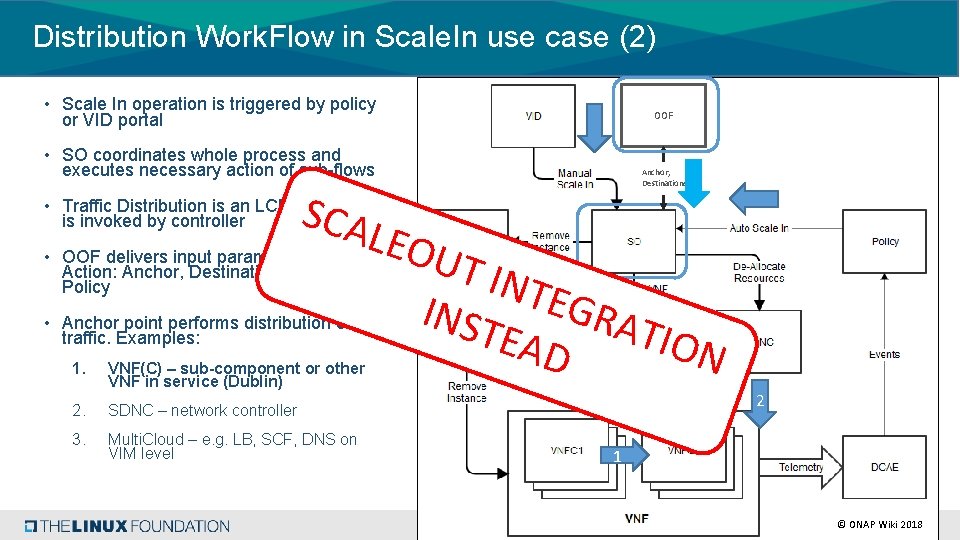
Distribution Work. Flow in Scale. In use case (2) • Scale In operation is triggered by policy or VID portal OOF • SO coordinates whole process and executes necessary action of sub-flows Anchor, Destinations SCA • Traffic Distribution is an LCM action and is invoked by controller L EOU • OOF delivers input parameters for DT Action: Anchor, Destinations, Distribution T IN Policy T E G I N R • Anchor point performs distribution of A S T traffic. Examples: T E ION 3 A D 1. VNF(C) – sub-component or other VNF in service (Dublin) 2. SDNC – network controller 3. Multi. Cloud – e. g. LB, SCF, DNS on VIM level 2 1 © ONAP Wiki 2018
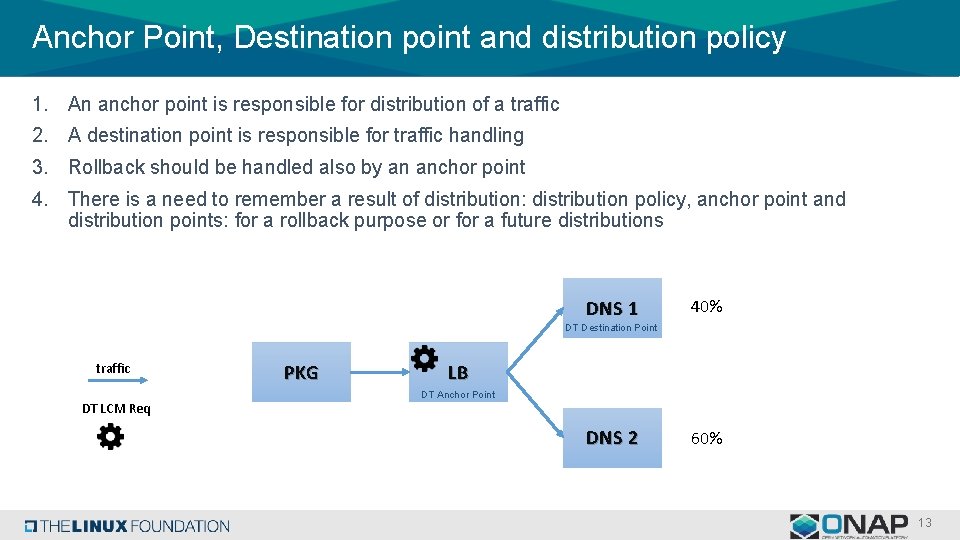
Anchor Point, Destination point and distribution policy 1. An anchor point is responsible for distribution of a traffic 2. A destination point is responsible for traffic handling 3. Rollback should be handled also by an anchor point 4. There is a need to remember a result of distribution: distribution policy, anchor point and distribution points: for a rollback purpose or for a future distributions DNS 1 40% DT Destination Point traffic DT LCM Req PKG LB DT Anchor Point DNS 2 60% 13
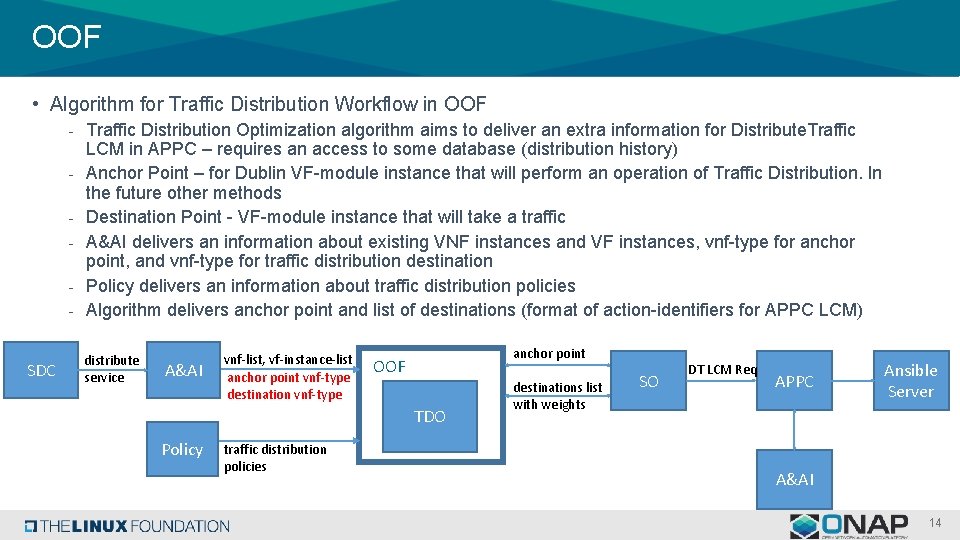
OOF • Algorithm for Traffic Distribution Workflow in OOF - Traffic Distribution Optimization algorithm aims to deliver an extra information for Distribute. Traffic LCM in APPC – requires an access to some database (distribution history) - Anchor Point – for Dublin VF-module instance that will perform an operation of Traffic Distribution. In the future other methods - Destination Point - VF-module instance that will take a traffic - A&AI delivers an information about existing VNF instances and VF instances, vnf-type for anchor point, and vnf-type for traffic distribution destination - Policy delivers an information about traffic distribution policies - Algorithm delivers anchor point and list of destinations (format of action-identifiers for APPC LCM) SDC distribute service A&AI vnf-list, vf-instance-list anchor point vnf-type destination vnf-type anchor point OOF TDO Policy traffic distribution policies destinations list with weights SO DT LCM Req APPC Ansible Server A&AI 14
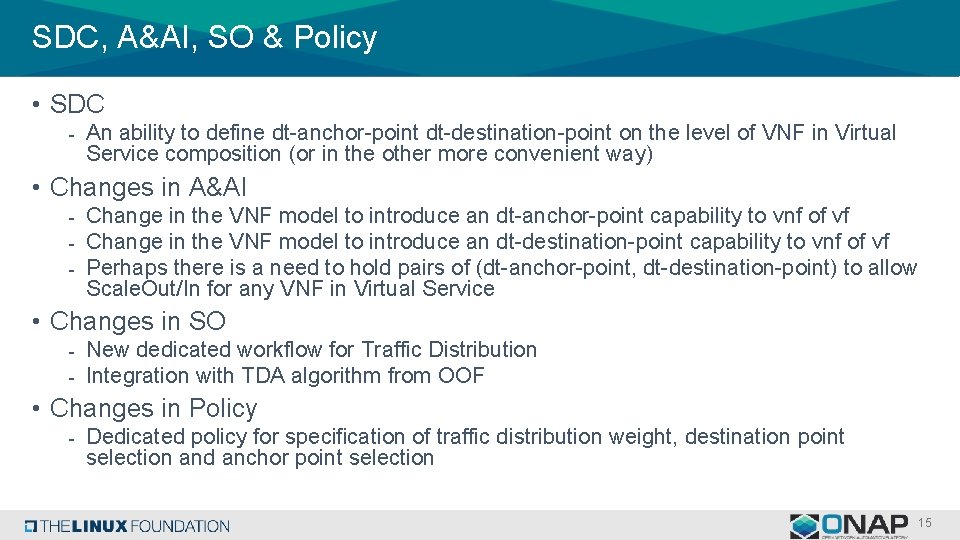
SDC, A&AI, SO & Policy • SDC - An ability to define dt-anchor-point dt-destination-point on the level of VNF in Virtual Service composition (or in the other more convenient way) • Changes in A&AI - Change in the VNF model to introduce an dt-anchor-point capability to vnf of vf - Change in the VNF model to introduce an dt-destination-point capability to vnf of vf - Perhaps there is a need to hold pairs of (dt-anchor-point, dt-destination-point) to allow Scale. Out/In for any VNF in Virtual Service • Changes in SO - New dedicated workflow for Traffic Distribution - Integration with TDA algorithm from OOF • Changes in Policy - Dedicated policy for specification of traffic distribution weight, destination point selection and anchor point selection 15
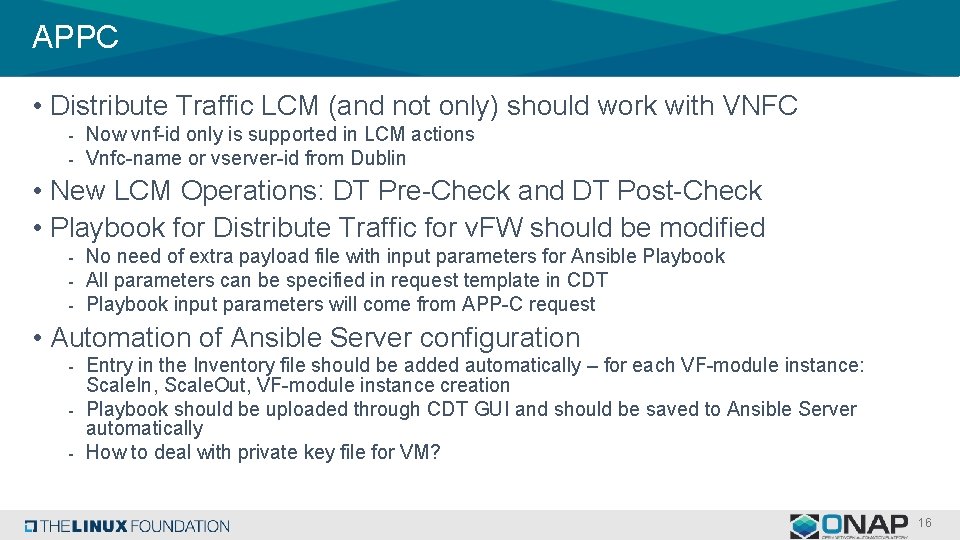
APPC • Distribute Traffic LCM (and not only) should work with VNFC - Now vnf-id only is supported in LCM actions - Vnfc-name or vserver-id from Dublin • New LCM Operations: DT Pre-Check and DT Post-Check • Playbook for Distribute Traffic for v. FW should be modified - No need of extra payload file with input parameters for Ansible Playbook - All parameters can be specified in request template in CDT - Playbook input parameters will come from APP-C request • Automation of Ansible Server configuration - Entry in the Inventory file should be added automatically – for each VF-module instance: Scale. In, Scale. Out, VF-module instance creation - Playbook should be uploaded through CDT GUI and should be saved to Ansible Server automatically - How to deal with private key file for VM? 16
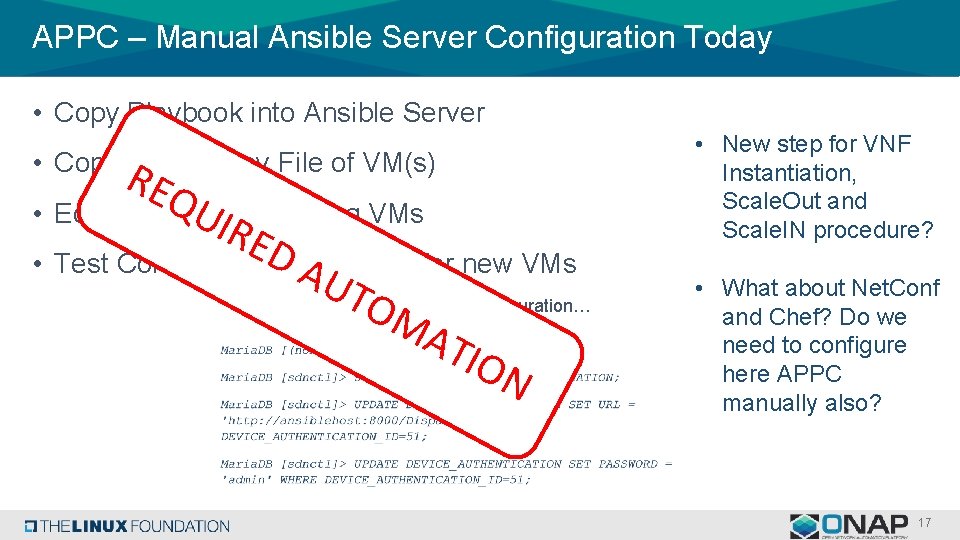
APPC – Manual Ansible Server Configuration Today • Copy Playbook into Ansible Server REQ • Copy Private Key File of VM(s) UI file adding VMs • Edit Inventory RED • Test Configuration of A Ansible for new VMs U TOMy. SQL DB Configuration… + APPC MA TIO N • New step for VNF Instantiation, Scale. Out and Scale. IN procedure? • What about Net. Conf and Chef? Do we need to configure here APPC manually also? 17
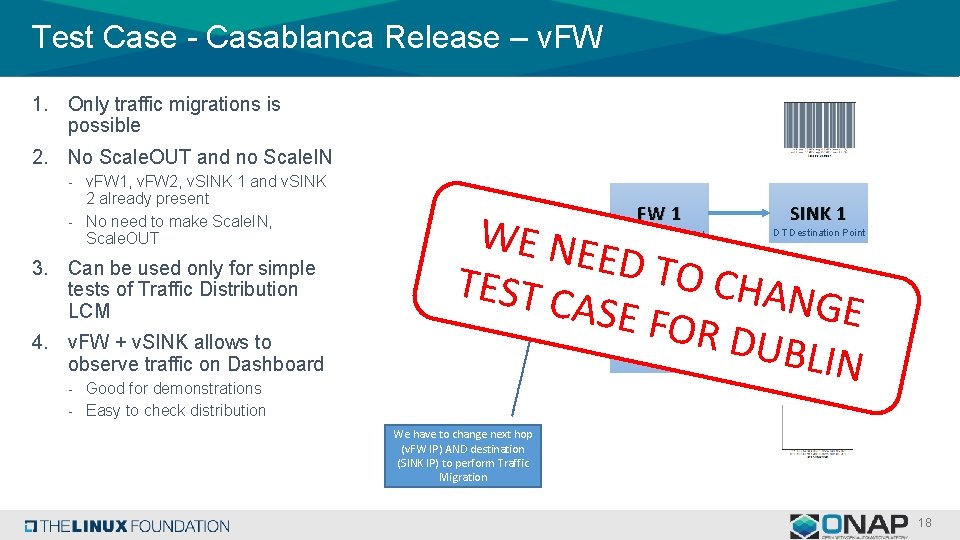
Test Case - Casablanca Release – v. FW 1. Only traffic migrations is possible 2. No Scale. OUT and no Scale. IN - v. FW 1, v. FW 2, v. SINK 1 and v. SINK 2 already present - No need to make Scale. IN, Scale. OUT 3. Can be used only for simple tests of Traffic Distribution LCM 4. v. FW + v. SINK allows to observe traffic on Dashboard - Good for demonstrations - Easy to check distribution FW 1 SINK 1 DT Destination Point WE NE ED TO PKG TEST C CHANG ASE FO E FW 2 R DU SINK 2 BLIN DT Anchor Point We have to change next hop (v. FW IP) AND destination (SINK IP) to perform Traffic Migration 18
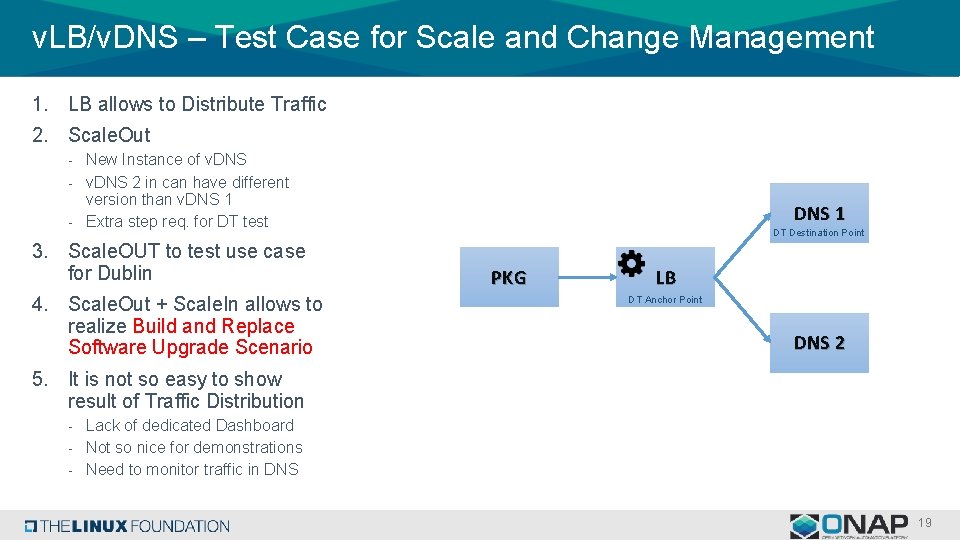
v. LB/v. DNS – Test Case for Scale and Change Management 1. LB allows to Distribute Traffic 2. Scale. Out - New Instance of v. DNS - v. DNS 2 in can have different version than v. DNS 1 - Extra step req. for DT test 3. Scale. OUT to test use case for Dublin 4. Scale. Out + Scale. In allows to realize Build and Replace Software Upgrade Scenario DNS 1 DT Destination Point PKG LB DT Anchor Point DNS 2 5. It is not so easy to show result of Traffic Distribution - Lack of dedicated Dashboard - Not so nice for demonstrations - Need to monitor traffic in DNS 19
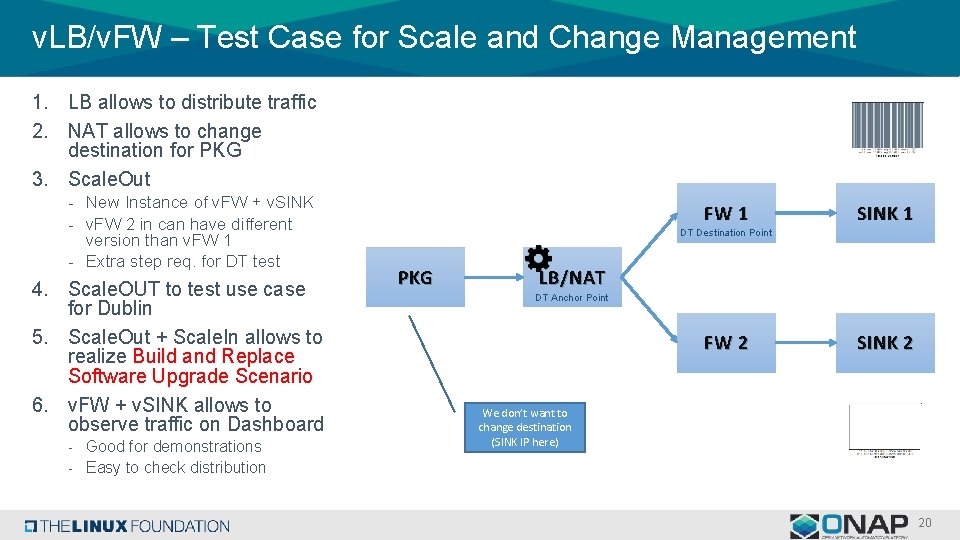
v. LB/v. FW – Test Case for Scale and Change Management 1. LB allows to distribute traffic 2. NAT allows to change destination for PKG 3. Scale. Out - New Instance of v. FW + v. SINK - v. FW 2 in can have different version than v. FW 1 - Extra step req. for DT test 4. Scale. OUT to test use case for Dublin 5. Scale. Out + Scale. In allows to realize Build and Replace Software Upgrade Scenario 6. v. FW + v. SINK allows to observe traffic on Dashboard - Good for demonstrations - Easy to check distribution FW 1 SINK 1 DT Destination Point PKG LB/NAT DT Anchor Point FW 2 SINK 2 We don’t want to change destination (SINK IP here) 20
s Traffic Distribution – Sequence Diagrams with Description 21
Traffic Distribution Workflow – Preparation Phase (1) • Purpose: preparation of necessary input parameters for execution of phase • Goal is to determine: - Destination Point VNFC List - Anchor Point VNFCs Map (for each Destination VNFC can be different) - Distribution Weights or Distribution Policy for each Destination VNFC and its Anchor Point • Dependencies - SO – Coordinates whole process of preparation for traffic distribution - OOF – It is used to retrieve required input parameters - AAI – Has information about current topology and anchor VNF type for VNF type being distributed. It allows also to retrieve additional properties that could be used for selection of destination or anchor point - Policy – selection of distribution point and anchor point, distribution policy (i. e. distr. weights) • Should be ready for a future use in a distribution rollback process (to revert a partial distribution) 22
Traffic Distribution Workflow – Preparation Phase (2) 23
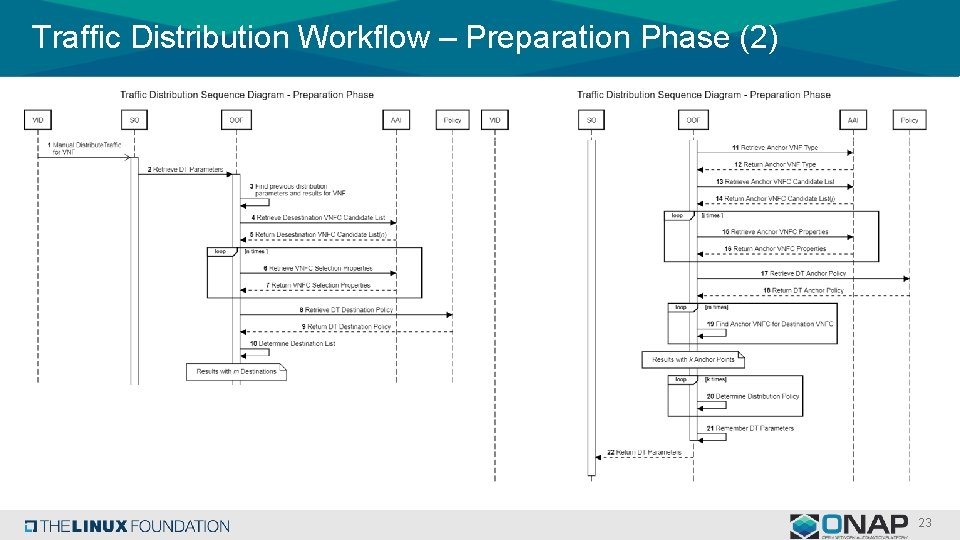
Traffic Distribution Workflow – Preparation Phase (3) 1. DT Workflow is triggered manually from VID – alternatively can be triggered by DMaa. P event. Action is invoked for specific VNF Instance (VNF that traffic should be distributed) and Service Instance which holds this VNF instance. Some extra parameters could be specified at this stage to influence a generic way how OOF calculates conditions for distribution i. e. - List of VNFC that should be excluded from a distribution - List of VNFC that should be included in a distribution - Distribution. Id (some identifier of TD being kept in OOF) to revert previous result of previous distribution – for rollback of previously failed traffic distribution - Mode: Distribution/Reverse Distribution 2. SO asks OOF to retrieve parameters required for distribution: destinations, anchor points and distribution policy (e. g. distribution weights, load balancing mode – specific to anchor point) - Alternatively A&AI can be considered to store this information 3. Retrieve remembered values of previously calculated destinations, anchor points and distribution policy (for specified Distribution. Id, Vnf. Id) - Useful for Reverse Distribution - May be useful for calculation of future distribution parameters for particular Vnf. Id on historical distributions basis 24
Traffic Distribution Workflow – Preparation Phase (4) 4 -5. Retrieve a list of all VNFC that belong to the specified Vnf. Id. This list of candidates for distribution must be filtered later on 6 -7. For each VNFC Destination candidate we retrieve some properties from A&AI that may be useful for their filtering - This properties will be determined later on – when first algorithm for destination selection will be designed. If there will be no such properties for Dublin this step will be omitted 8 -9. From Policy we take values of some policies for destination selection algorithm - TBD: what policy should be used here for? Maybe something similar to Config. Scale. Out should be considered instead? 10. OOF executes an algorithm that selects a list of destination VNFCs. It results with m VNFC Destination points. Algorithm will use following information - List of n VNFC Candidate Results of past distribution (if specified in the request) Distribution policy, like preferred regions Additional properties from A&AI when required by the algorithm 25
Traffic Distribution Workflow – Preparation Phase (5) 11 -12. Retrieve a VNF Type of Anchor point that is specific to the Destination VNF type - VNF must belong to the same Virtual service like the one that destination VNF belongs to - Anchor VNF type should be defined in the design time in SDC - Information about the Anchor VNF type should be kept in A&AI 13 -14. Retrieve a list of all VNFC that are a type of Anchor VNF type. This list of candidates for distribution must be filtered later on 15 -16. For each VNFC Anchor point candidate we retrieve some properties from A&AI that may be useful for their filtering - This properties will be determined later on – when first algorithm for destination selection will be designed. If there will be no such properties for Dublin this step will be omitted 17 -18. From Policy we take values of some policies for anchor point selection algorithm - TBD: what policy should be used here for? Maybe something similar to Config. Scale. Out should be considered instead? 26
Traffic Distribution Workflow – Preparation Phase (5) 19. For each VNFC Destination point candidate OOF executes an algorithm for anchor point determination. It results with k VNFC Anchor points. Algorithm will use following information - List of m Destination Points List of j Anchor Point candidates Results of past distribution (if specified in the request) – i. e. already distributed VNFC by this Anchor point selection policy, like preferred regions Additional properties from A&AI when required by the algorithm 20. For each VNFC Anchor point OOF executes an algorithm for distribution policy determination - Expression of policy may vary depending on the Anchor type (percentage, explicit like least connections, round robin etc. ) but Ansible/Chef script should receive always the same format - How to unify it? 21. Determined list of Destinations, associated Anchor Points and Distribution policies - Useful to build future rollback mechanism based on the same procedure Information must be stored in some database. But where? Local DB of OOF? There must mechanisms that will clear this data on regular basis Parameters are remembered under one identifier: Distribution. Id 22. Result is returned from OOF to SO, preparation phase is completed 27
Traffic Distribution Workflow – Execution Phase (1) • Purpose: execution of traffic distribution workflow base on information calculated by OOF - Loop: for each destination the same set o operations - Question is if procedure should not be grouped by anchor points • Procedure must determine - Destination VNFCs - Anchor Point VNFCs (for each Destination VNFC can be different) - Distribution Weights or Distribution Policy • Dependencies - SO OOF Controllers(APPC, SDNC) Anchor VNFCs Destination VNFCs • Should be ready for future use in distribution rollback process (to revert partial distribution) 28
Traffic Distribution Workflow – Execution Phase (2) 29
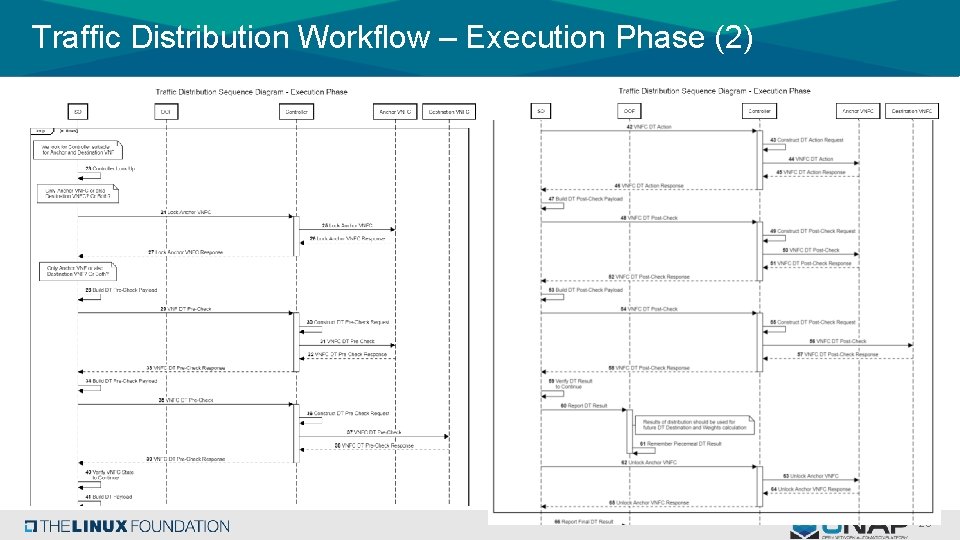
Traffic Distribution Workflow – Execution Phase (4) 23. We look up for controller (SDNC, APPC) specific for Anchor VNFC and Destination VNFC 24 -27. SO Locks Anchor Point VNFC and? Destination VNFC – to avoid any concurrent changes 28 -33. SO Executes DT Pre-Check LCM action on Anchor Point VNFC with help of Controller - As input Ansible/Chef script will receive proposed parameters for future distribution - When Pre-Check fails distribution should be stopped. If some distributions were already performed rollback should be invoked 34 -39. SO Executes DT Pre-Check LCM action on Destination Point VNFC with help of Controller - As input Ansible/Chef script will receive proposed parameters for future distribution - When Pre-Check fails distribution should be stopped. If some distributions were already performed rollback should be invoked 40. Pre-Check status is verified – if it failed distribution is stopped and rollback is triggered 42 -46. SO Executes Distribute Traffic LCM action on Anchor Point VNFC with help of Controller - Anchor Point performs the distribution on associated destination - When distribution fails further steps should be stopped. If some distributions were already performed rollback should be invoked 30
Traffic Distribution Workflow – Execution Phase (5) 47 -52. SO Executes DT Post-Check LCM action on Anchor Point VNFC with help of Controller - As input Ansible/Chef script will receive proposed parameters of already performed distribution - When Post-Check fails (result is different than expected) further distribution should be stopped. If some distributions were already performed rollback should be invoked 53 -58. SO Executes DT Post-Check LCM action on Destination Point VNFC with help of Controller - As input Ansible/Chef script will receive proposed parameters of already performed distribution - When Post-Check fails (result is different than expected) further distribution should be stopped. If some distributions were already performed rollback should be invoked 59. Overall result of distribution to particular Destination VNFC is verified – rollback is invoked when some steps were not completed successfully 60 -61. Result of distribution (successful or not) is remembered in OOF (to reuse is in further preparation phase i. e. during rollback) 62 -65. SO Unlocks Anchor Point VNFC and? Destination VNFC – to allow further changes 31
- Slides: 31