
On the Ultimate Speed of Magnetic Switching Joachim




- Slides: 21
On the Ultimate Speed of Magnetic Switching Joachim Stöhr Stanford Synchrotron Radiation Laboratory Collaborators: H. C. Siegmann, C. Stamm, I. Tudosa, Y. Acremann ( Stanford ) A. Vaterlaus (ETH Zürich) magnetic imaging A. Kashuba (Landau Inst. Moscow) ; A. Dobin (Seagate) theory D. Weller, G. Ju, B. Lu (Seagate Technologies) G. Woltersdorf, B. Heinrich (S. F. U. Vancouver) samples
The Technology Problem: Smaller and Faster The ultrafast technology gap want to reliably switch small magnetic “bits”
186 years of “Oersted switching”…. How can we switch faster ?
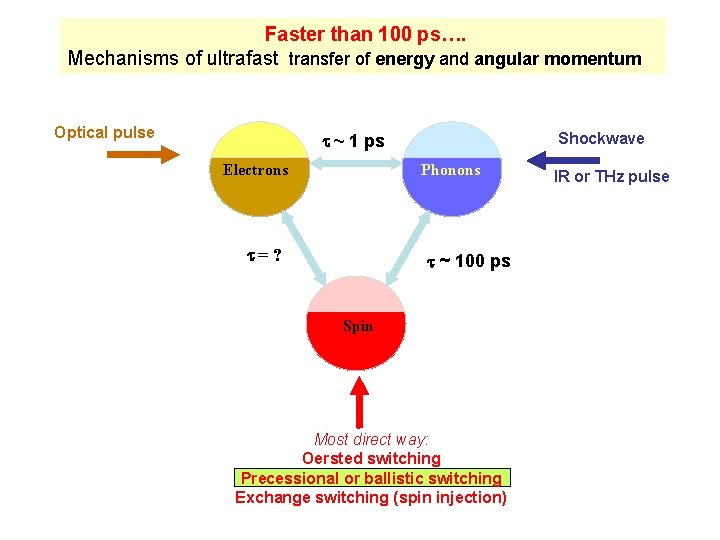
Faster than 100 ps…. Mechanisms of ultrafast transfer of energy and angular momentum Optical pulse t ~ 1 ps Electrons Shockwave Phonons t= ? t ~ 100 ps Spin Most direct way: Oersted switching Precessional or ballistic switching Exchange switching (spin injection) IR or THz pulse
Precessional or ballistic switching: Discovery
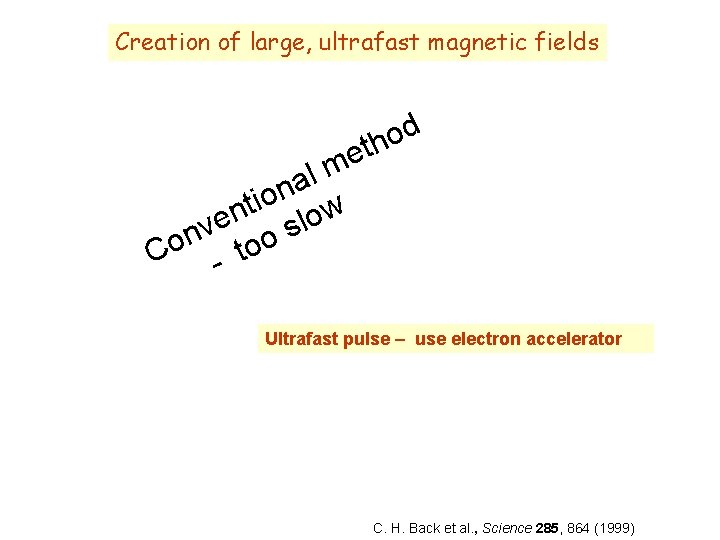
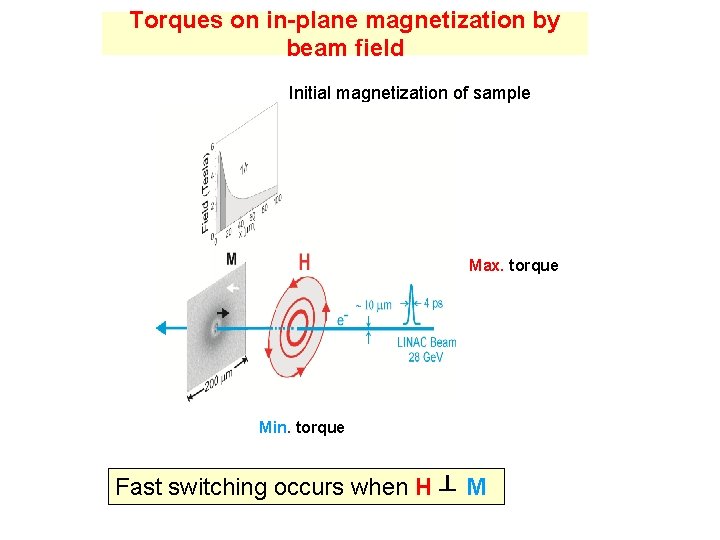
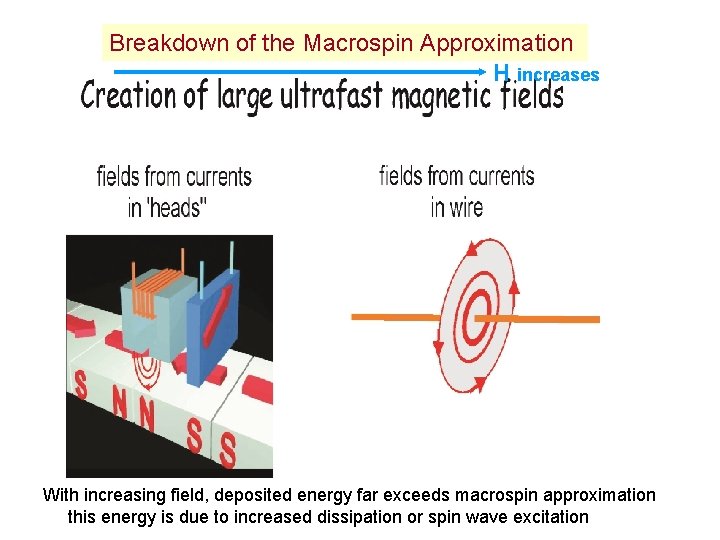
Creation of large, ultrafast magnetic fields d o th e m l a n o i t w n o e l v s n o Co - to Ultrafast pulse – use electron accelerator C. H. Back et al. , Science 285, 864 (1999)
Torques on in-plane magnetization by beam field Initial magnetization of sample Max. torque Min. torque Fast switching occurs when H ┴ M
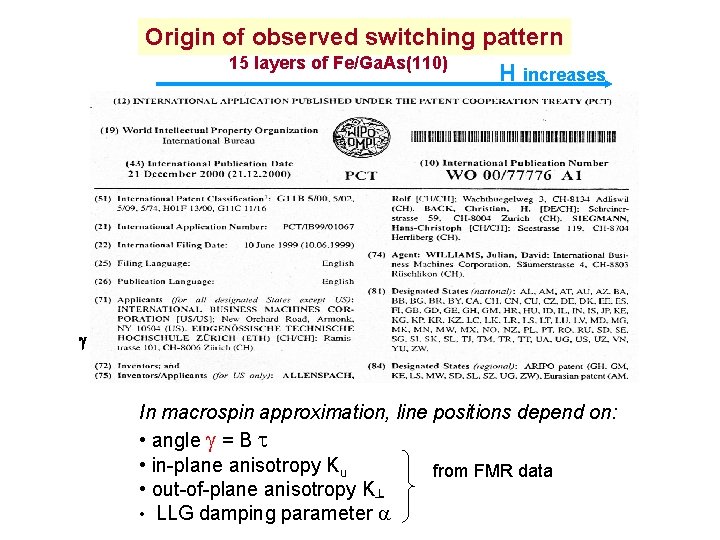
Precessional or ballistic switching: 1999 Patent issued December 21, 2000: R. Allenspach, Ch. Back and H. C. Siegmann
Precessional switching case 1: Perpendicular anisotropy sample I. Tudosa, C. Stamm, A. B. Kashuba, F. King, H. C. Siegmann, J. Stöhr, G. Ju, B. Lu, and D. Weller Nature 428, 831 (2004)
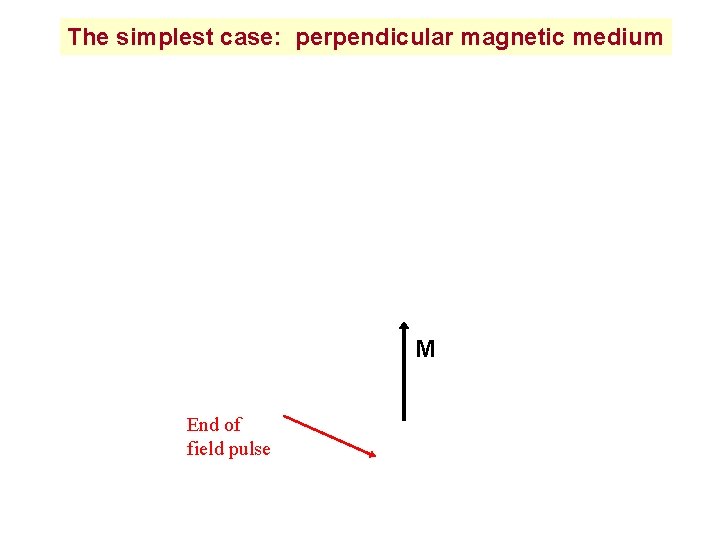
The simplest case: perpendicular magnetic medium M End of field pulse
Pattern of perpendicular anisotropy sample Co. Cr. Pt perpendicular recording media (Seagate)
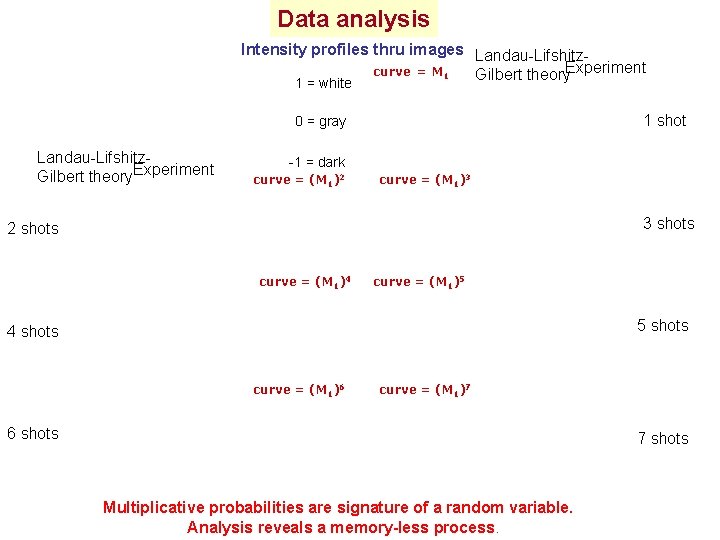
Multiple shot switching of perpendicular sample Co. Cr. Pt recording film Light areas mean M Dark areas mean M Tudosa et al. , Nature 428, 831 (2004)
Data analysis Intensity profiles thru images Landau-Lifshitz. Experiment curve = M 1 Gilbert theory 1 = white 1 shot 0 = gray Landau-Lifshitz. Gilbert theory. Experiment -1 = dark curve = (M 1)2 curve = (M 1)3 3 shots 2 shots curve = (M 1)4 curve = (M 1)5 5 shots 4 shots curve = (M 1)6 curve = (M 1)7 6 shots 7 shots Multiplicative probabilities are signature of a random variable. Analysis reveals a memory-less process.
Magnetization fracture under ultrafast field pulse excitation Non-deterministic region partly due to fractured magnetization
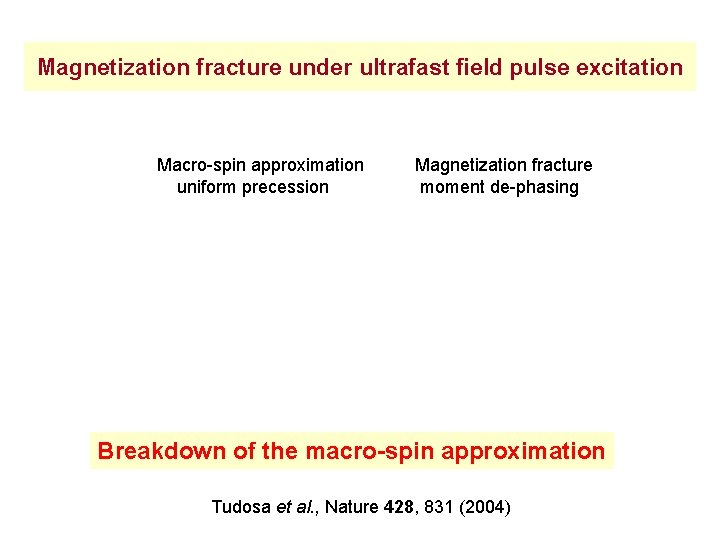
Magnetization fracture under ultrafast field pulse excitation Macro-spin approximation uniform precession Magnetization fracture moment de-phasing Breakdown of the macro-spin approximation Tudosa et al. , Nature 428, 831 (2004)
Precessional switching case 2: In-plane anisotropy sample C. Stamm, I. Tudosa, H. C. Siegmann, J. J. Stöhr, A. Yu. Dobin, G. Woltersdorf, B. Heinrich and A. Vaterlaus Phys. Rev. Lett. 94, 197603 (2005)
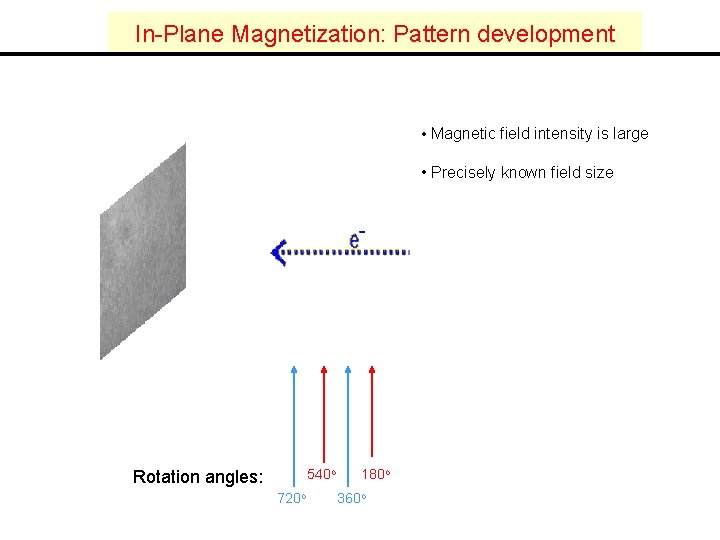
In-Plane Magnetization: Pattern development • Magnetic field intensity is large • Precisely known field size 540 o Rotation angles: 720 o 180 o 360 o
Origin of observed switching pattern 15 layers of Fe/Ga. As(110) H increases g In macrospin approximation, line positions depend on: • angle g = B t • in-plane anisotropy Ku from FMR data • out-of-plane anisotropy K┴ • LLG damping parameter a
Breakdown of the Macrospin Approximation H increases With increasing field, deposited energy far exceeds macrospin approximation this energy is due to increased dissipation or spin wave excitation
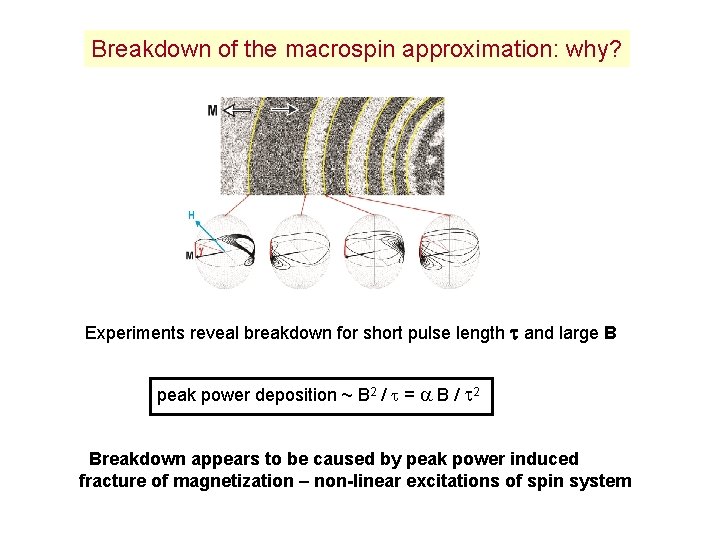
Breakdown of the macrospin approximation: why? Experiments reveal breakdown for short pulse length t and large B peak power deposition ~ B 2 / t = a B / t 2 Breakdown appears to be caused by peak power induced fracture of magnetization – non-linear excitations of spin system
Conclusions • The breakdown of the macrospin approximation for fast field pulses limits the reliability of magnetic switching • Breakdown is believed to arise from energy & angular momentum transfer within the spin system – excitation of higher spin wave modes • Details are not well understood…. For more, see: http: //www-ssrl. slac. stanford. edu/stohr and J. Stöhr and H. C. Siegmann Magnetism: From Fundamentals to Nanoscale Dynamics 800+ page textbook ( Springer, to be published in Spring 2006 )