
On the Speedup of SingleDisk Failure Recovery in
![[Xiang, To. S’ 11] Hybrid Recovery Ø Idea: use a combination of row and](https://slidetodoc.com/presentation_image_h2/ad4828f349a09d78b88aeb10b6e2208c/image-10.jpg "[Xiang, To. S’ 11] Hybrid Recovery Ø Idea: use a combination of row and")
![[Khan, FAST’ 12] Enumeration Recovery D 0 D 1 D 2 D 3 C](https://slidetodoc.com/presentation_image_h2/ad4828f349a09d78b88aeb10b6e2208c/image-11.jpg "[Khan, FAST’ 12] Enumeration Recovery D 0 D 1 D 2 D 3 C")
- Slides: 31
On the Speedup of Single-Disk Failure Recovery in XOR-Coded Storage Systems: Theory and Practice Yunfeng Zhu 1, Patrick P. C. Lee 2, Yuchong Hu 2, Liping Xiang 1, Yinlong Xu 1 1 University of Science and Technology of China 2 The Chinese University of Hong Kong MSST’ 12 1
Modern Storage Systems Ø Large-scale storage systems have seen deployment in practice • Cloud storage • Data centers • P 2 P storage Ø Data is distributed over a collection of disks • Disk physical storage device … disks 2
How to Ensure Data Reliability? Ø Disks can crash or have bad data Ø Data reliability is achieved by keeping data redundancy across disks • Replication • Efficient computation • High storage overhead • Erasure codes (e. g. , Reed-Solomon codes) • Less storage overhead than replication, with same fault tolerance • More expensive computation than replication 3
XOR-Based Erasure Codes Ø XOR-based erasure codes • Encoding/decoding involve XOR operations only • Low computational overhead Ø Different redundancy levels • 2 -fault tolerant: RDP, EVENODD, X-Code • 3 -fault tolerant: STAR • General-fault tolerant: Cauchy Reed-Solomon (CRS) 4
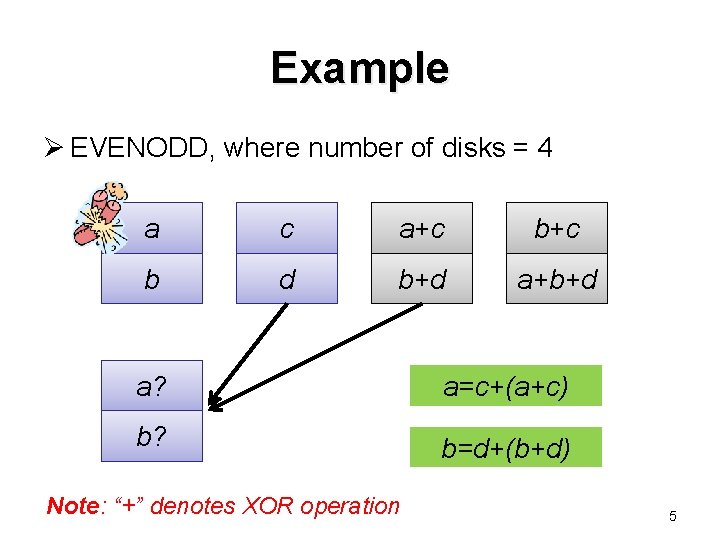
Example Ø EVENODD, where number of disks = 4 a c a+c b d b+d a+b+d a? a=c+(a+c) b? b=d+(b+d) Note: “+” denotes XOR operation 5
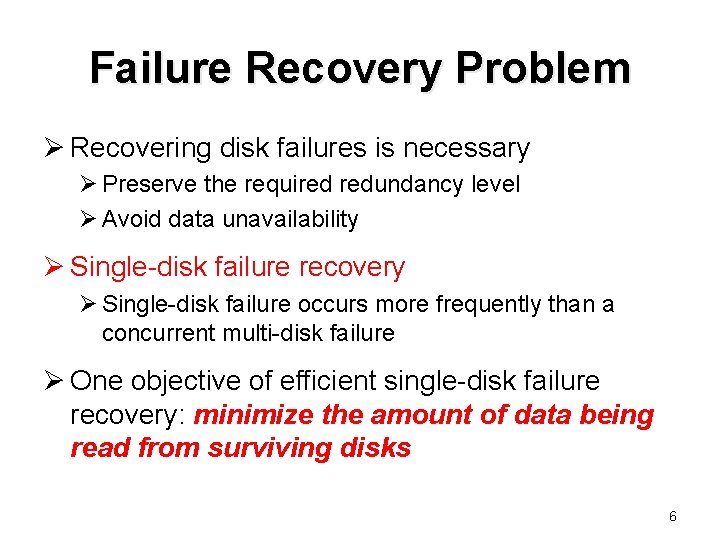
Failure Recovery Problem Ø Recovering disk failures is necessary Ø Preserve the required redundancy level Ø Avoid data unavailability Ø Single-disk failure recovery Ø Single-disk failure occurs more frequently than a concurrent multi-disk failure Ø One objective of efficient single-disk failure recovery: minimize the amount of data being read from surviving disks 6
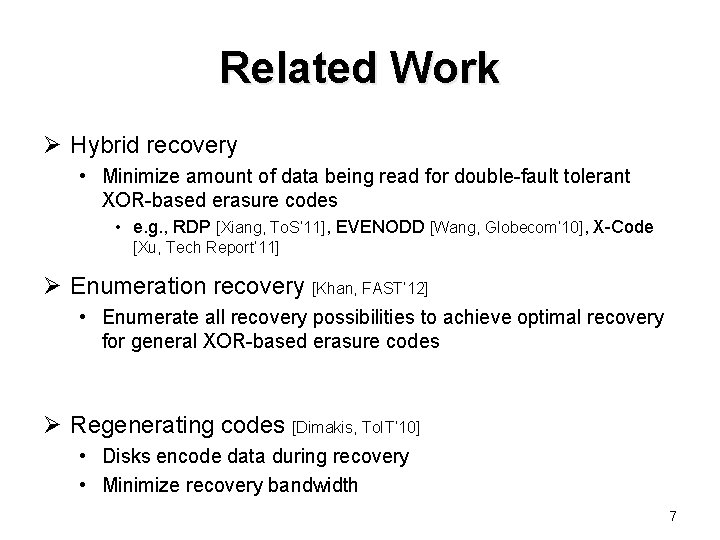
Related Work Ø Hybrid recovery • Minimize amount of data being read for double-fault tolerant XOR-based erasure codes • e. g. , RDP [Xiang, To. S’ 11], EVENODD [Wang, Globecom’ 10], X-Code [Xu, Tech Report’ 11] Ø Enumeration recovery [Khan, FAST’ 12] • Enumerate all recovery possibilities to achieve optimal recovery for general XOR-based erasure codes Ø Regenerating codes [Dimakis, To. IT’ 10] • Disks encode data during recovery • Minimize recovery bandwidth 7
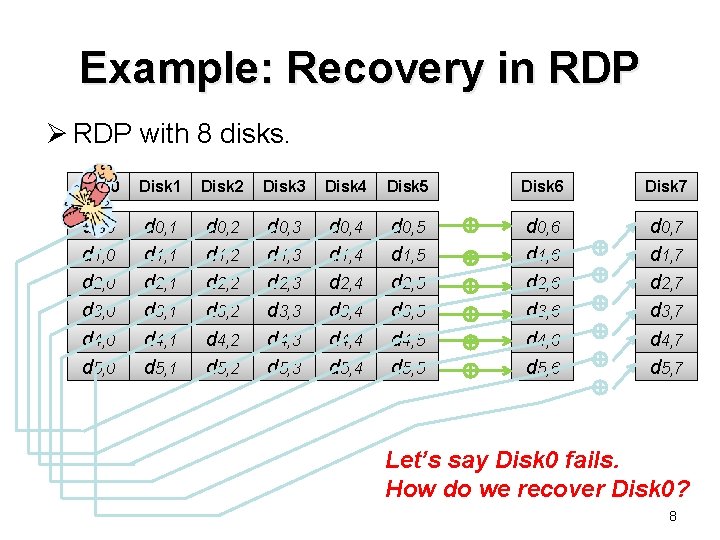
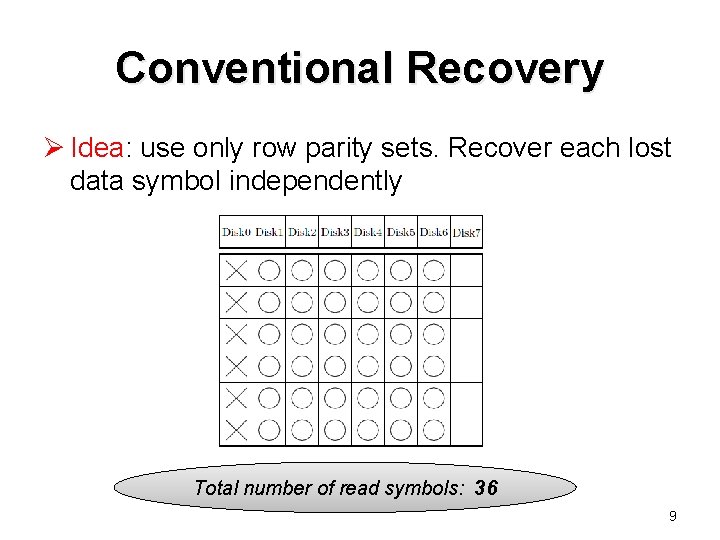
Example: Recovery in RDP Ø RDP with 8 disks. Disk 0 Disk 1 Disk 2 Disk 3 Disk 4 Disk 5 d 0, 0 d 1, 0 d 2, 0 d 3, 0 d 4, 0 d 5, 0 d 0, 1 d 1, 1 d 2, 1 d 3, 1 d 4, 1 d 5, 1 d 0, 2 d 1, 2 d 2, 2 d 3, 2 d 4, 2 d 5, 2 d 0, 3 d 1, 3 d 2, 3 d 3, 3 d 4, 3 d 5, 3 d 0, 4 d 1, 4 d 2, 4 d 3, 4 d 4, 4 d 5, 4 d 0, 5 d 1, 5 d 2, 5 d 3, 5 d 4, 5 d 5, 5 ⊕ ⊕ ⊕ Disk 6 Disk 7 d 0, 6 d 1, 6 d 2, 6 d 3, 6 d 4, 6 d 5, 6 d 0, 7 d 1, 7 d 2, 7 d 3, 7 d 4, 7 d 5, 7 ⊕ ⊕ ⊕ Let’s say Disk 0 fails. How do we recover Disk 0? 8
Conventional Recovery Ø Idea: use only row parity sets. Recover each lost data symbol independently Total number of read symbols: 36 9
[Xiang, To. S’ 11] Hybrid Recovery Ø Idea: use a combination of row and diagonal parity sets to maximize overlapping symbols Total number of read symbols: 27 10
[Khan, FAST’ 12] Enumeration Recovery D 0 D 1 D 2 D 3 C 0 C 1 C 2 D 0 D 2 D 1 D 3 D 2 C 0 D 3 C 1 Data C 3 Generator Matrix Conventional Recovery download 4 symbols (D 2, D 3, C 0, C 1) to recover D 0 and D 1 C 2 C 3 Codeword Disk 0 Disk 1 Disk 2 Disk 3 Total read symbols: 3 Recovery Equations for D 0 Recovery Equations for D 1 D 0 D 2 C 0 D 1 D 3 C 1 D 0 D 3 C 2 D 1 D 2 C 0 C 1 C 2 D 0 D 3 C 0 C 1 C 3 D 1 D 2 C 3 D 0 D 2 C 1 C 2 C 3 D 1 D 3 C 0 C 2 C 3 11
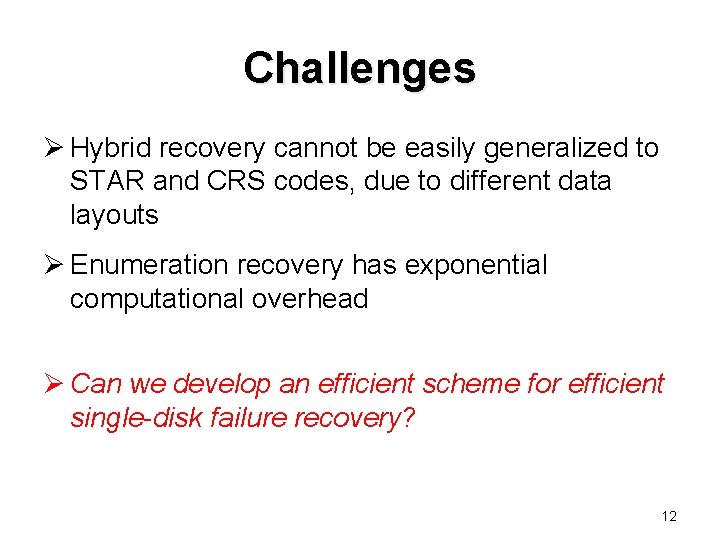
Challenges Ø Hybrid recovery cannot be easily generalized to STAR and CRS codes, due to different data layouts Ø Enumeration recovery has exponential computational overhead Ø Can we develop an efficient scheme for efficient single-disk failure recovery? 12
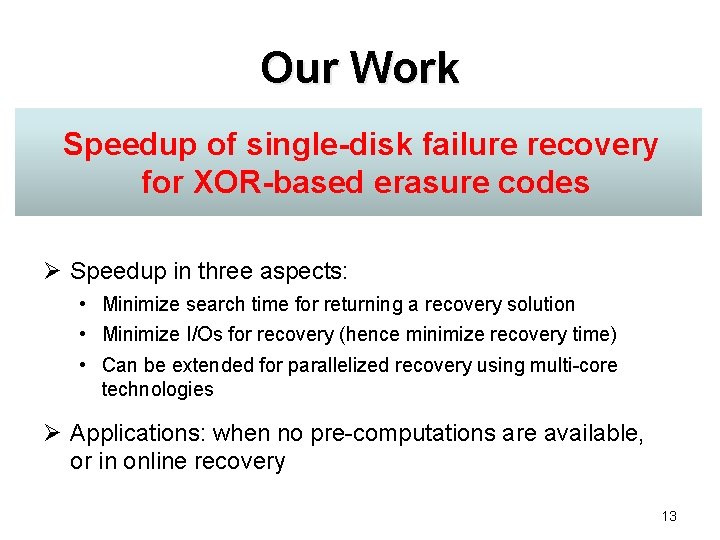
Our Work Speedup of single-disk failure recovery for XOR-based erasure codes Ø Speedup in three aspects: • Minimize search time for returning a recovery solution • Minimize I/Os for recovery (hence minimize recovery time) • Can be extended for parallelized recovery using multi-core technologies Ø Applications: when no pre-computations are available, or in online recovery 13
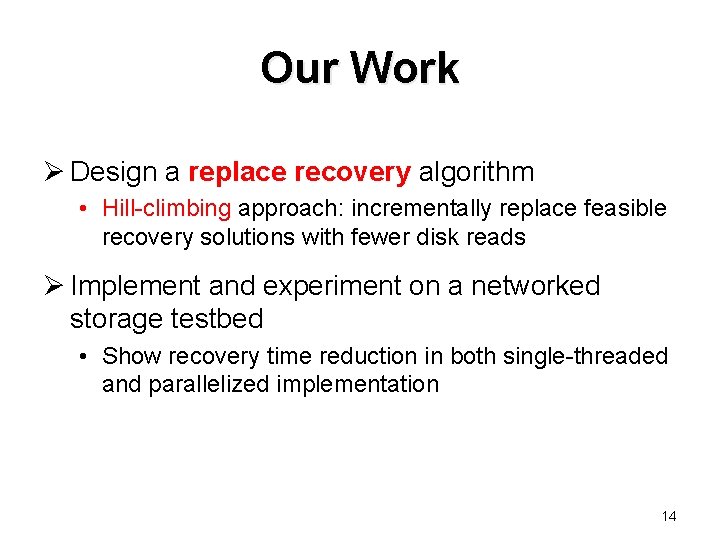
Our Work Ø Design a replace recovery algorithm • Hill-climbing approach: incrementally replace feasible recovery solutions with fewer disk reads Ø Implement and experiment on a networked storage testbed • Show recovery time reduction in both single-threaded and parallelized implementation 14
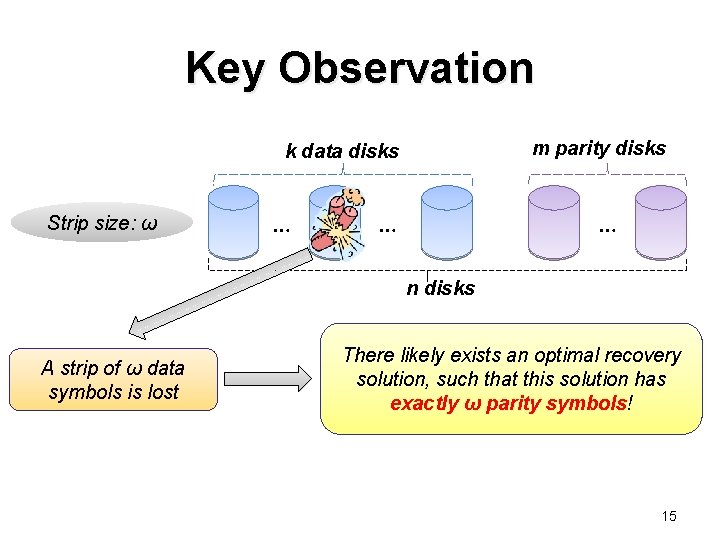
Key Observation m parity disks k data disks Strip size: ω … … … n disks A strip of ω data symbols is lost There likely exists an optimal recovery solution, such that this solution has exactly ω parity symbols! 15
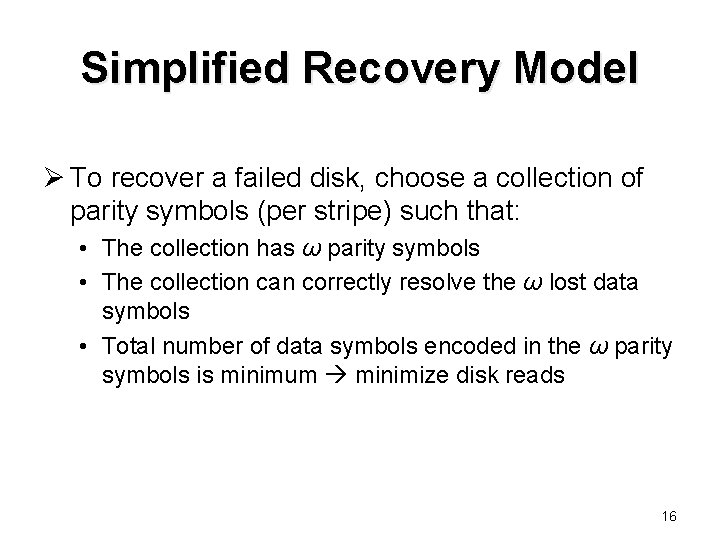
Simplified Recovery Model Ø To recover a failed disk, choose a collection of parity symbols (per stripe) such that: • The collection has ω parity symbols • The collection can correctly resolve the ω lost data symbols • Total number of data symbols encoded in the ω parity symbols is minimum minimize disk reads 16
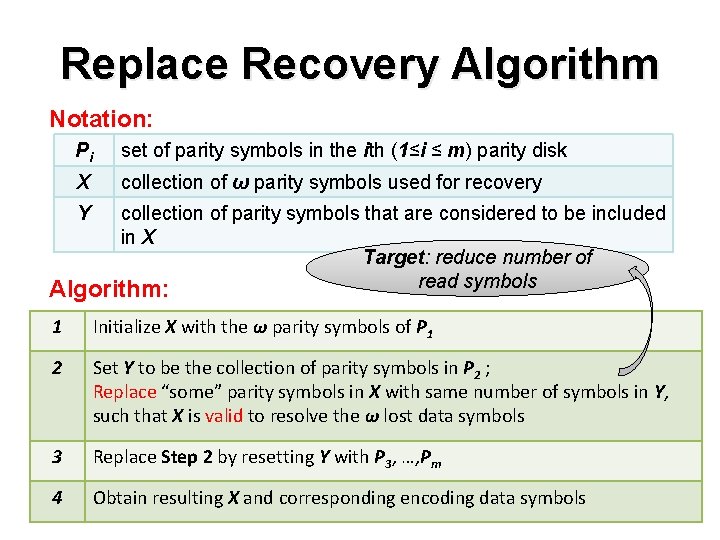
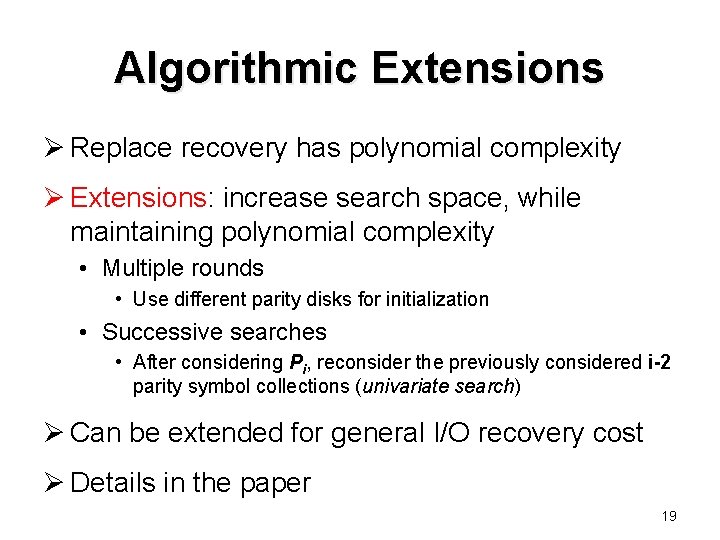
Replace Recovery Algorithm Notation: Pi set of parity symbols in the ith (1≤i ≤ m) parity disk X collection of ω parity symbols used for recovery Y collection of parity symbols that are considered to be included in X Target: reduce number of read symbols Algorithm: 1 Initialize X with the ω parity symbols of P 1 2 Set Y to be the collection of parity symbols in P 2 ; Replace “some” parity symbols in X with same number of symbols in Y, such that X is valid to resolve the ω lost data symbols 3 Replace Step 2 by resetting Y with P 3, …, Pm 4 Obtain resulting X and corresponding encoding data symbols 17
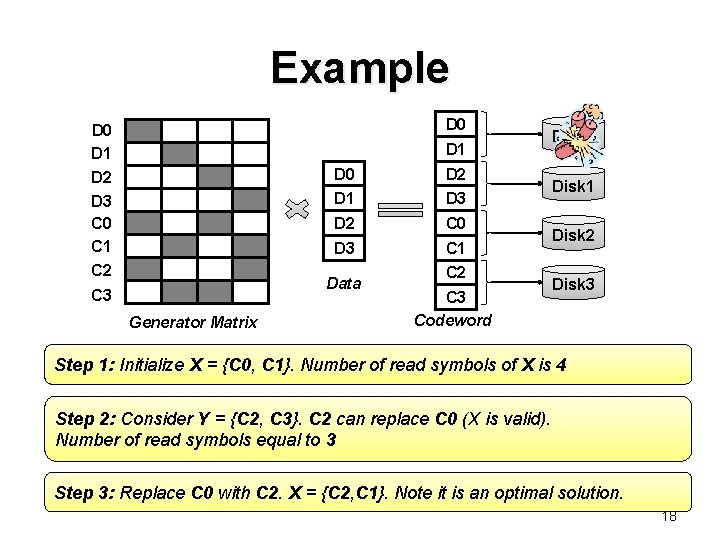
Example D 0 D 1 D 2 D 3 C 0 C 1 C 2 D 0 D 2 D 1 D 3 D 2 C 0 D 3 C 1 Data C 3 Generator Matrix C 2 C 3 Codeword Disk 0 Disk 1 Disk 2 Disk 3 Step 1: Initialize X = {C 0, C 1}. Number of read symbols of X is 4 Step 2: Consider Y = {C 2, C 3}. C 2 can replace C 0 (X is valid). Number of read symbols equal to 3 Step 3: Replace C 0 with C 2. X = {C 2, C 1}. Note it is an optimal solution. 18
Algorithmic Extensions Ø Replace recovery has polynomial complexity Ø Extensions: increase search space, while maintaining polynomial complexity • Multiple rounds • Use different parity disks for initialization • Successive searches • After considering Pi, reconsider the previously considered i-2 parity symbol collections (univariate search) Ø Can be extended for general I/O recovery cost Ø Details in the paper 19
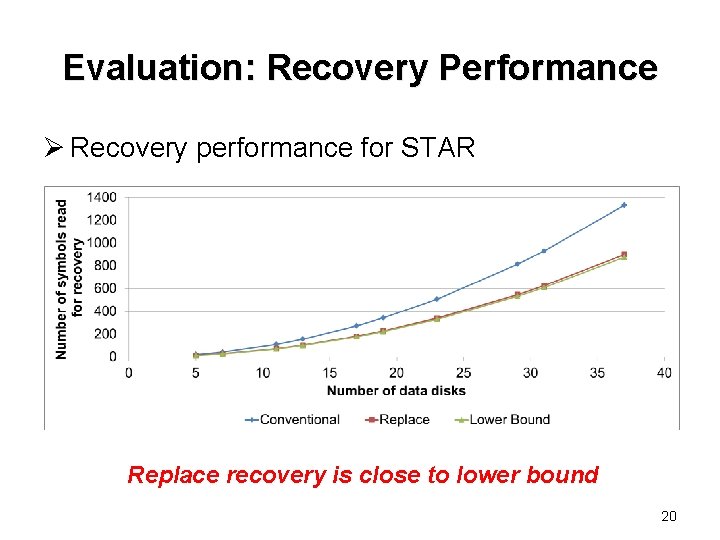
Evaluation: Recovery Performance Ø Recovery performance for STAR Replace recovery is close to lower bound 20
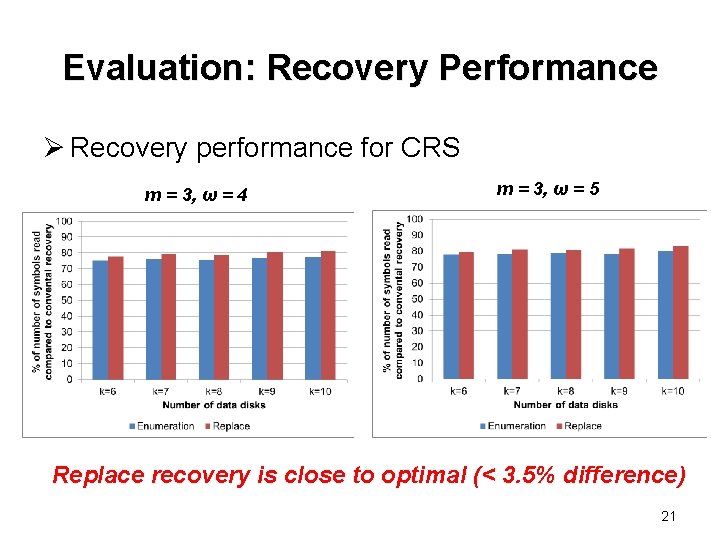
Evaluation: Recovery Performance Ø Recovery performance for CRS m = 3, ω = 4 m = 3, ω = 5 Replace recovery is close to optimal (< 3. 5% difference) 21
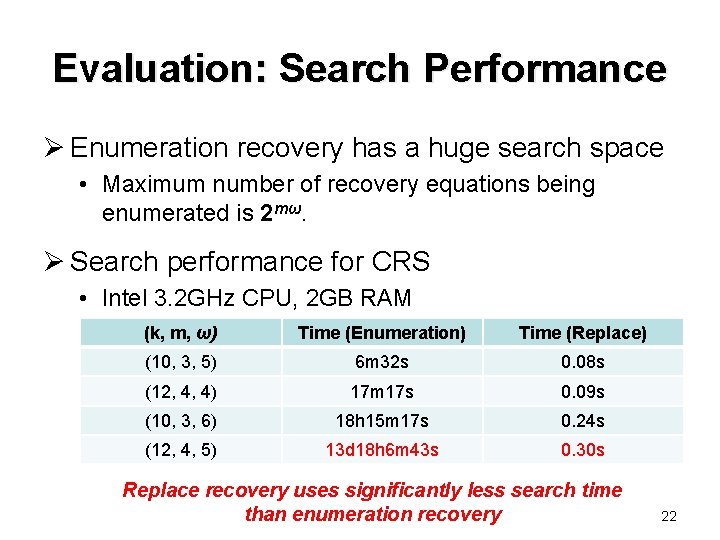
Evaluation: Search Performance Ø Enumeration recovery has a huge search space • Maximum number of recovery equations being enumerated is 2 mω. Ø Search performance for CRS • Intel 3. 2 GHz CPU, 2 GB RAM (k, m, ω) Time (Enumeration) Time (Replace) (10, 3, 5) 6 m 32 s 0. 08 s (12, 4, 4) 17 m 17 s 0. 09 s (10, 3, 6) 18 h 15 m 17 s 0. 24 s (12, 4, 5) 13 d 18 h 6 m 43 s 0. 30 s Replace recovery uses significantly less search time than enumeration recovery 22
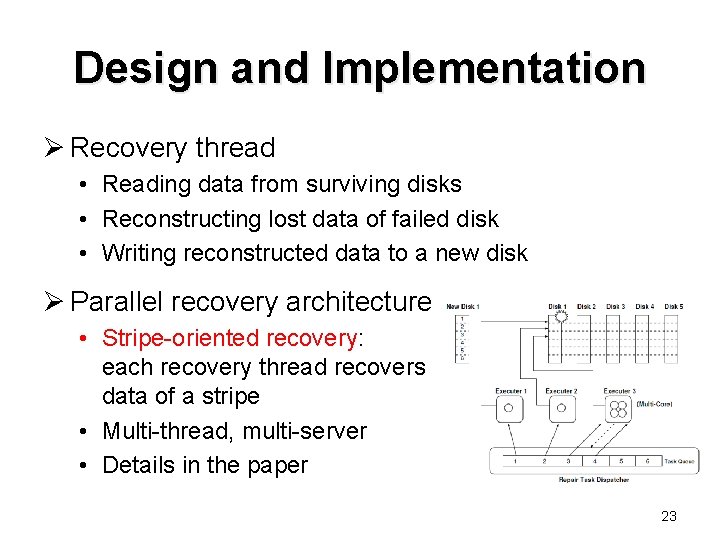
Design and Implementation Ø Recovery thread • Reading data from surviving disks • Reconstructing lost data of failed disk • Writing reconstructed data to a new disk Ø Parallel recovery architecture • Stripe-oriented recovery: each recovery thread recovers data of a stripe • Multi-thread, multi-server • Details in the paper 23
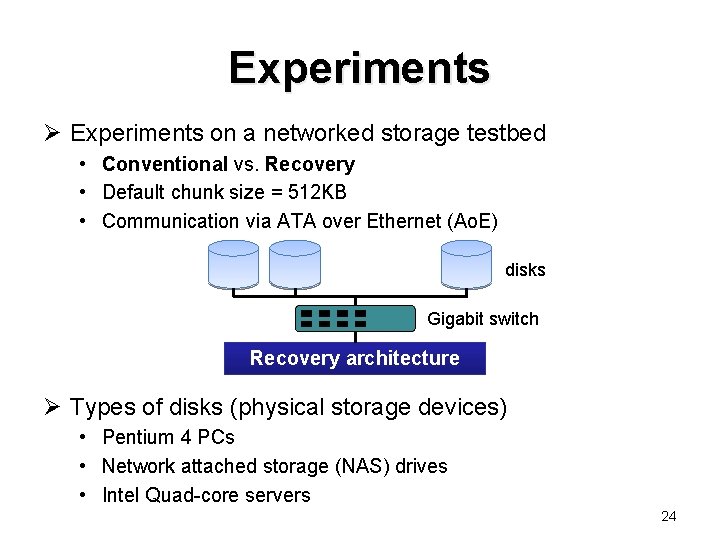
Experiments Ø Experiments on a networked storage testbed • Conventional vs. Recovery • Default chunk size = 512 KB • Communication via ATA over Ethernet (Ao. E) disks Gigabit switch Recovery architecture Ø Types of disks (physical storage devices) • Pentium 4 PCs • Network attached storage (NAS) drives • Intel Quad-core servers 24
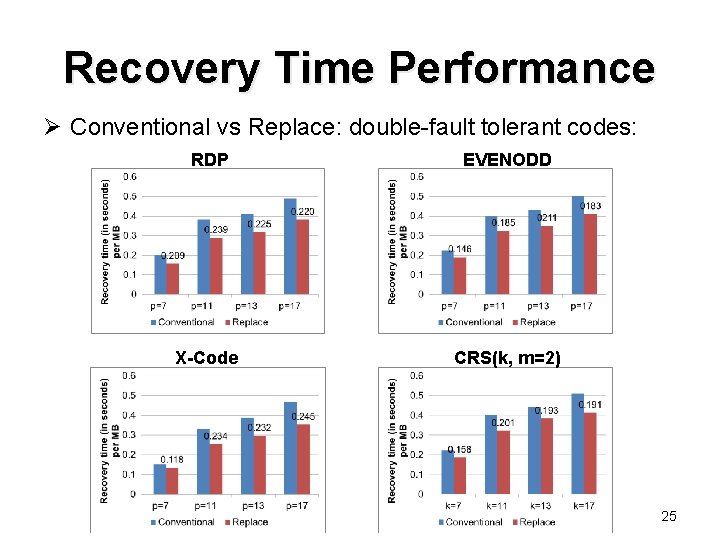
Recovery Time Performance Ø Conventional vs Replace: double-fault tolerant codes: RDP EVENODD X-Code CRS(k, m=2) 25
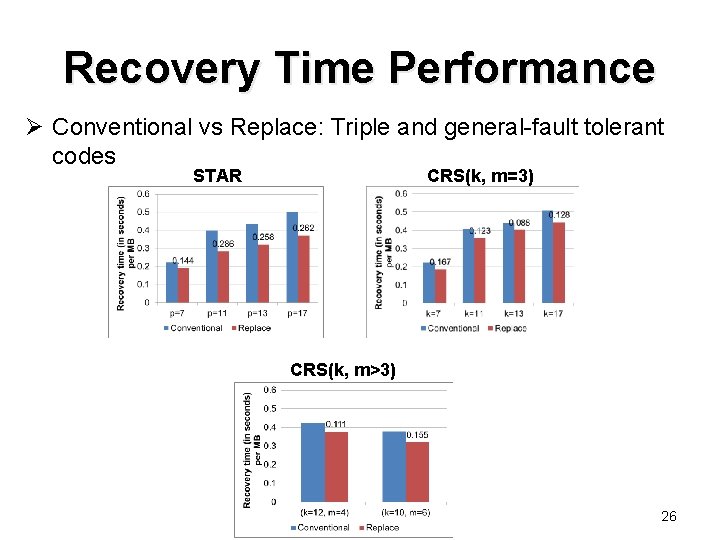
Recovery Time Performance Ø Conventional vs Replace: Triple and general-fault tolerant codes STAR CRS(k, m=3) CRS(k, m>3) 26
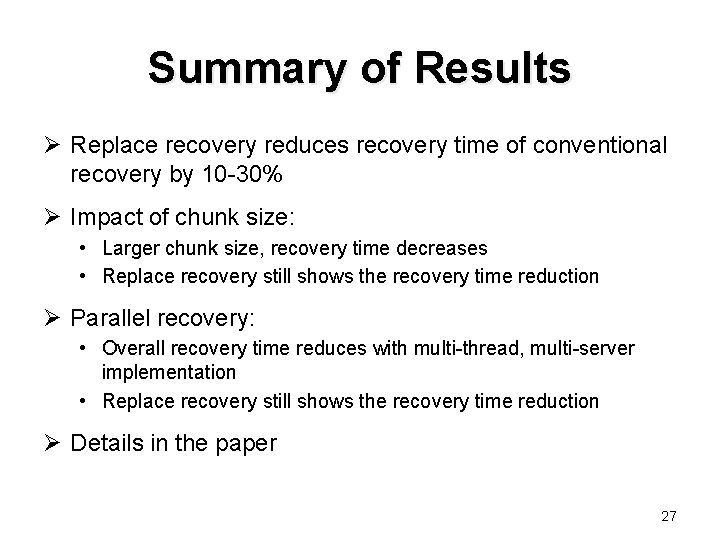
Summary of Results Ø Replace recovery reduces recovery time of conventional recovery by 10 -30% Ø Impact of chunk size: • Larger chunk size, recovery time decreases • Replace recovery still shows the recovery time reduction Ø Parallel recovery: • Overall recovery time reduces with multi-thread, multi-server implementation • Replace recovery still shows the recovery time reduction Ø Details in the paper 27
Conclusions Ø Propose a replace recovery algorithm • provides near-optimal recovery performance for STAR and CRS codes • has a polynomial computational complexity Ø Implement replace recovery on a parallelized architecture Ø Show via testbed experiments that replace recovery speeds up recovery over conventional Ø Source code: • http: //ansrlab. cse. cuhk. edu. hk/software/zpacr/ 28
Backup 29
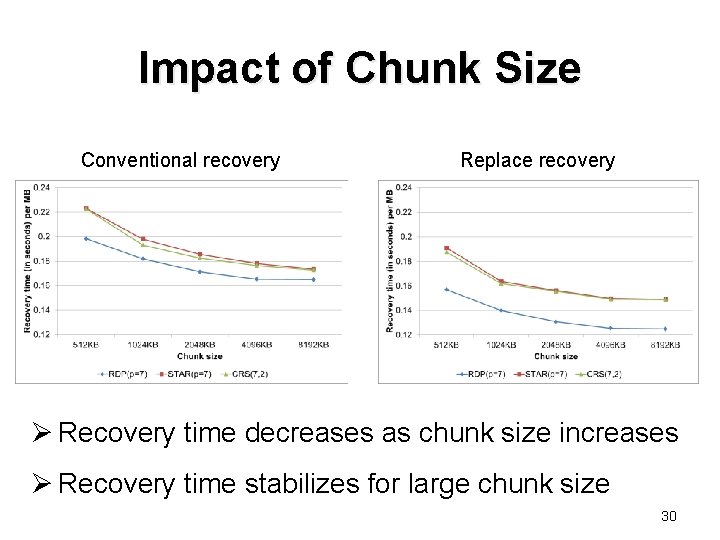
Impact of Chunk Size Conventional recovery Replace recovery Ø Recovery time decreases as chunk size increases Ø Recovery time stabilizes for large chunk size 30
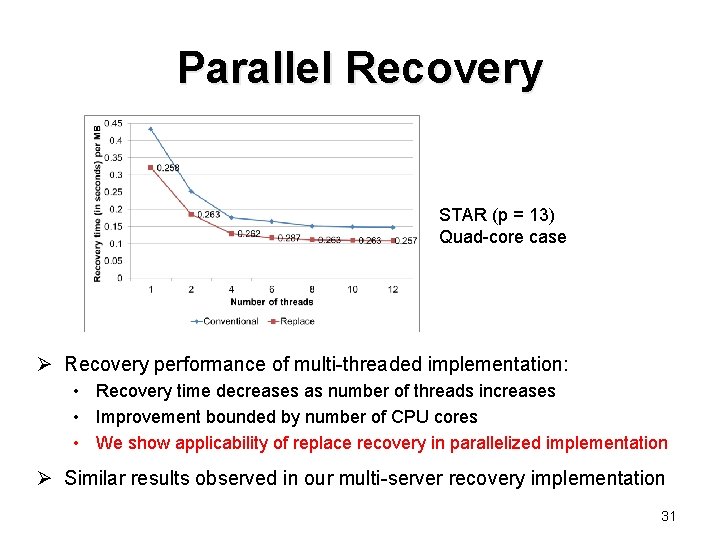
Parallel Recovery STAR (p = 13) Quad-core case Ø Recovery performance of multi-threaded implementation: • Recovery time decreases as number of threads increases • Improvement bounded by number of CPU cores • We show applicability of replace recovery in parallelized implementation Ø Similar results observed in our multi-server recovery implementation 31