
On the Role of Dataset Complexity in CaseBased
On the Role of Dataset Complexity in Case-Based Reasoning Derek Bridge UCC Ireland (based on work done with Lisa Cummins)
Dataset
classifier
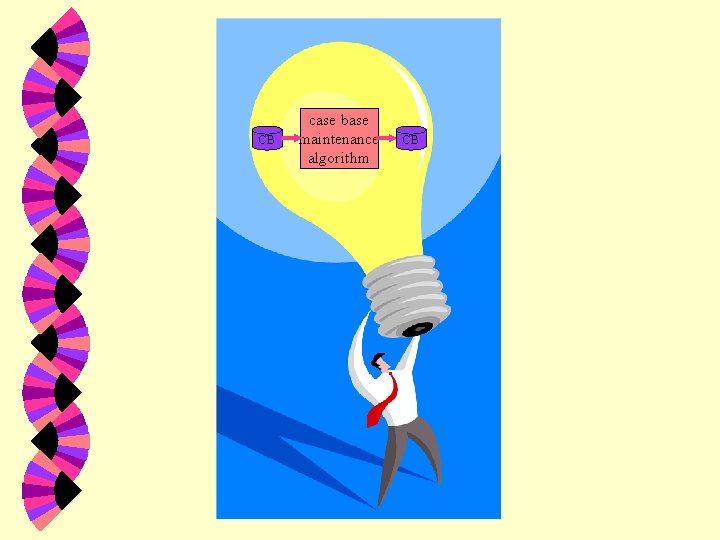
CB case base maintenance algorithm CB
Overview Ø Dataset complexity measures Ø Classification experiment Ø Case base maintenance experiment Ø Going forward
Overview Ø Dataset complexity measures Ø Classification experiment Ø Case base maintenance experiment Ø Going forward
Dataset Complexity Measures • Measures of classification difficulty • apparent difficulty, since we measure a dataset which samples the problem space • Little impact on CBR • Fornells et al. , ICCBR 2009 • Cummins & Bridge, ICCBR 2009 • (Little impact on ML in general!)
Dataset Complexity Measures • Survey of 12 geometrical measures • Ho & Basu, 2002 • DCo. L: open source C++ library of 13 measures • Orriols-Puig et al. , 2009 • We have found 4 candidate measures in the CBR literature
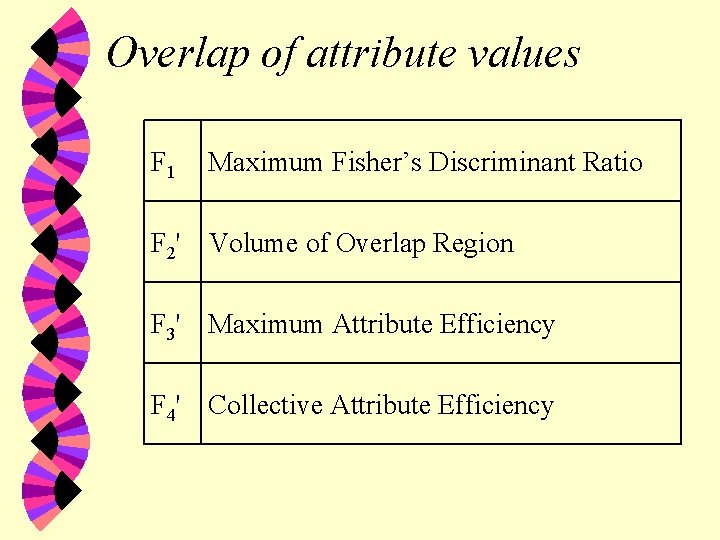
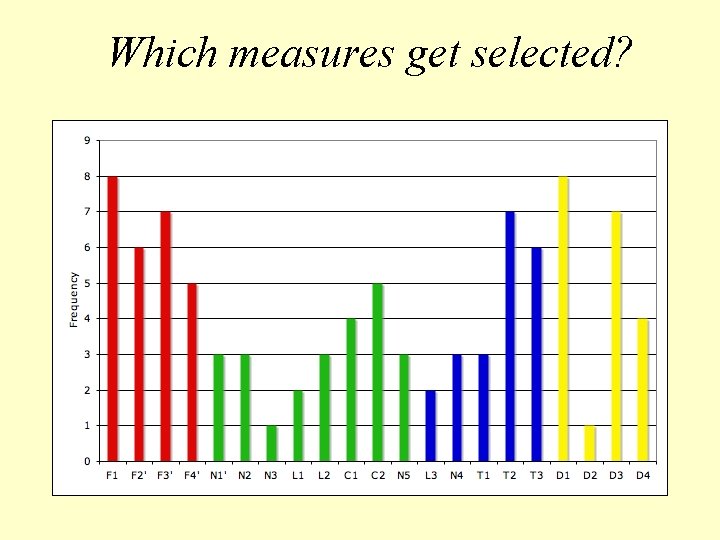
Overlap of attribute values F 1 Maximum Fisher’s Discriminant Ratio F 2' Volume of Overlap Region F 3' Maximum Attribute Efficiency F 4' Collective Attribute Efficiency
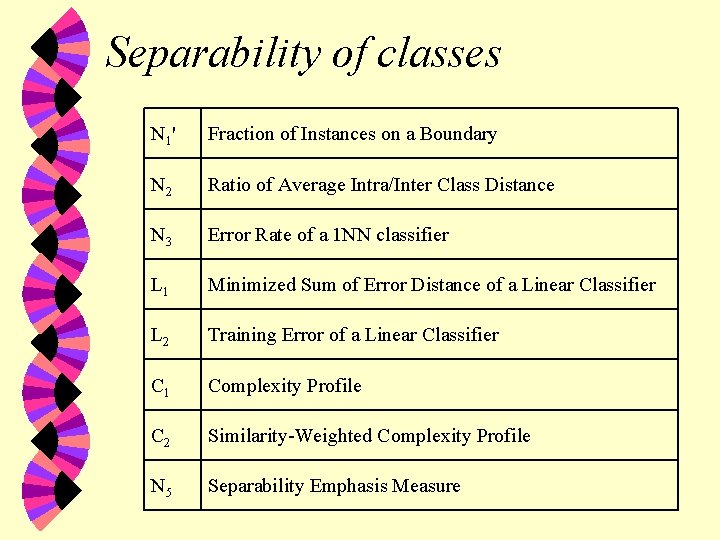
Separability of classes N 1 ' Fraction of Instances on a Boundary N 2 Ratio of Average Intra/Inter Class Distance N 3 Error Rate of a 1 NN classifier L 1 Minimized Sum of Error Distance of a Linear Classifier L 2 Training Error of a Linear Classifier C 1 Complexity Profile C 2 Similarity-Weighted Complexity Profile N 5 Separability Emphasis Measure
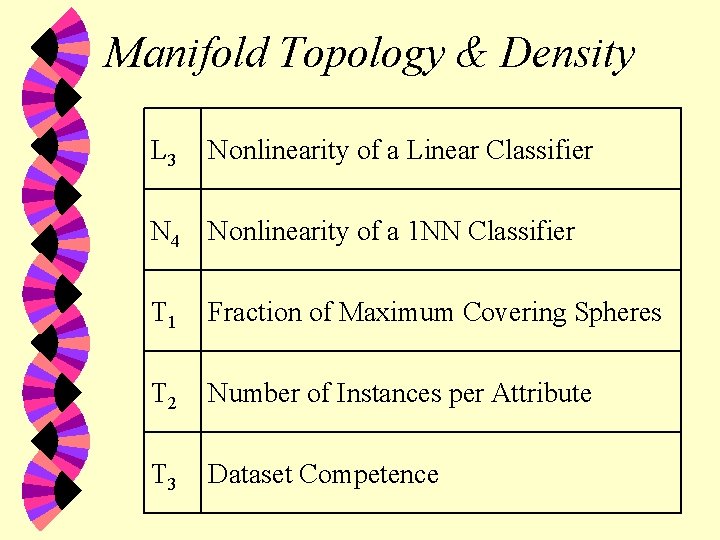
Manifold Topology & Density L 3 Nonlinearity of a Linear Classifier N 4 Nonlinearity of a 1 NN Classifier T 1 Fraction of Maximum Covering Spheres T 2 Number of Instances per Attribute T 3 Dataset Competence
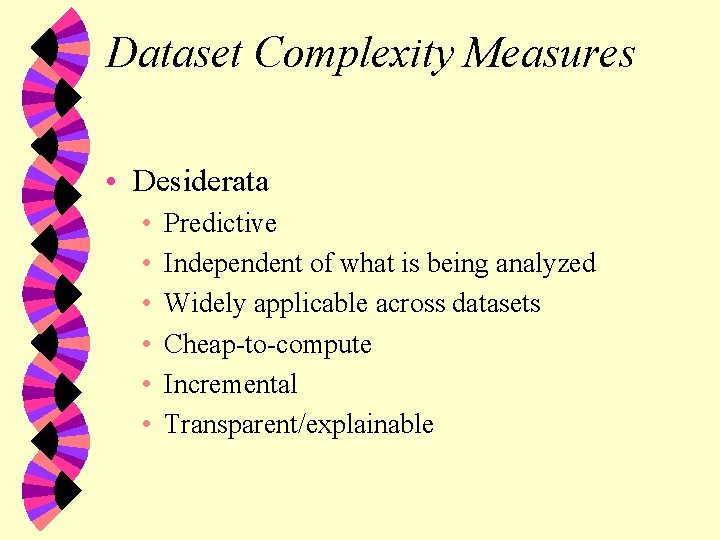
Dataset Complexity Measures • Desiderata • • • Predictive Independent of what is being analyzed Widely applicable across datasets Cheap-to-compute Incremental Transparent/explainable
Overview ü Dataset complexity measures Ø Classification experiment Ø Case base maintenance experiment Ø Going forward
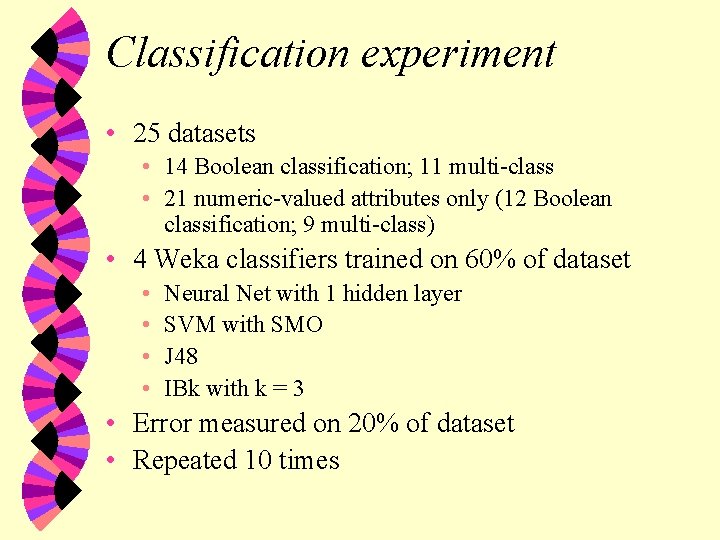
Classification experiment • 25 datasets • 14 Boolean classification; 11 multi-class • 21 numeric-valued attributes only (12 Boolean classification; 9 multi-class) • 4 Weka classifiers trained on 60% of dataset • • Neural Net with 1 hidden layer SVM with SMO J 48 IBk with k = 3 • Error measured on 20% of dataset • Repeated 10 times
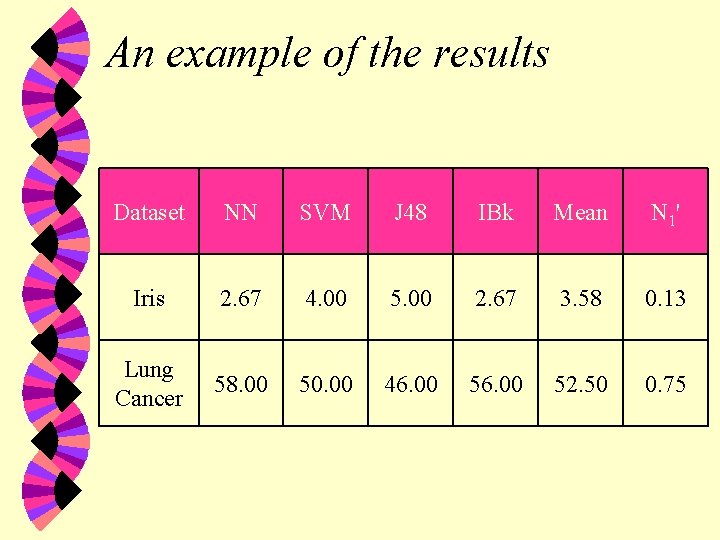
An example of the results Dataset NN SVM J 48 IBk Mean N 1' Iris 2. 67 4. 00 5. 00 2. 67 3. 58 0. 13 Lung Cancer 58. 00 50. 00 46. 00 52. 50 0. 75
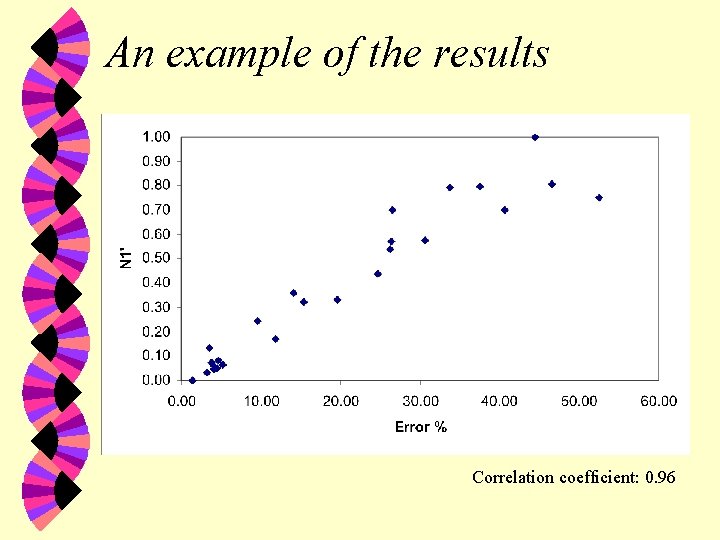
An example of the results Correlation coefficient: 0. 96
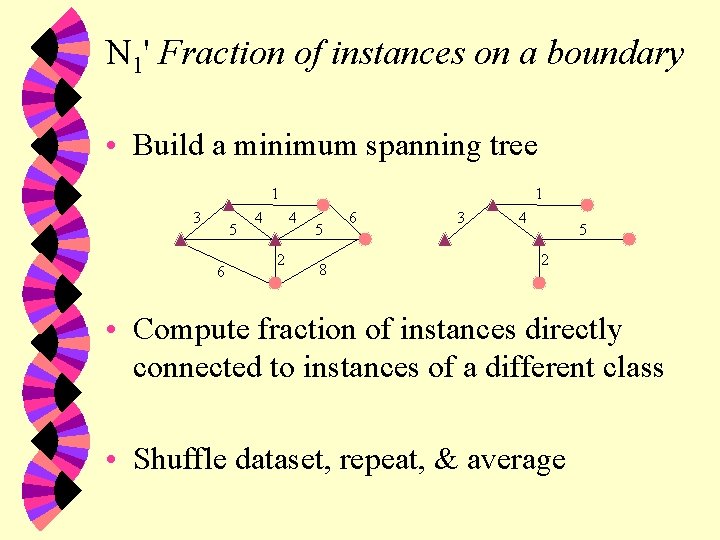
N 1' Fraction of instances on a boundary • Build a minimum spanning tree 1 3 5 6 4 1 4 2 5 8 6 3 4 5 2 • Compute fraction of instances directly connected to instances of a different class • Shuffle dataset, repeat, & average
Other competitive measures • N 3 Error Rate of a 1 NN Classifier • leave-one-out error rate of 1 NN on the dataset • N 2 Ratio of Average Intra/Inter Class Distance • sum distances to nearest neighbour of same class • divide by sum of distances to nearest neighbour of different class • L 2 Training Error of a Linear Classifier • build, e. g. , SVM on dataset • compute error on original dataset • problems with multi-class; problems with symbolic values
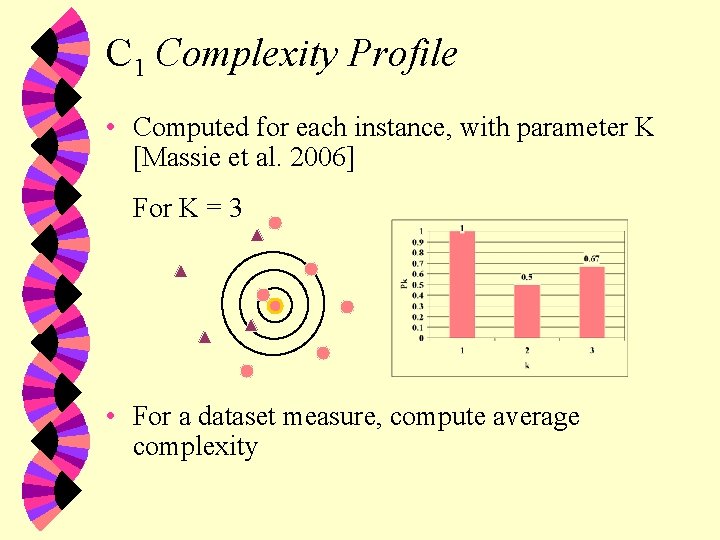
C 1 Complexity Profile • Computed for each instance, with parameter K [Massie et al. 2006] For K = 3 • For a dataset measure, compute average complexity
Other measures from CBR • C 2 Similarity-Weighted Complexity Profile • use similarity values when computing Pk • N 5 Separability Emphasis Measure [Fornells et al. ’ 09] • N 5 = N 1' × N 2 • T 3 Dataset Competence [Smyth & Mc. Kenna ’ 98] • competence groups based on overlapping coverage sets • group coverage based on size and similarity • dataset competence as sum of group coverages
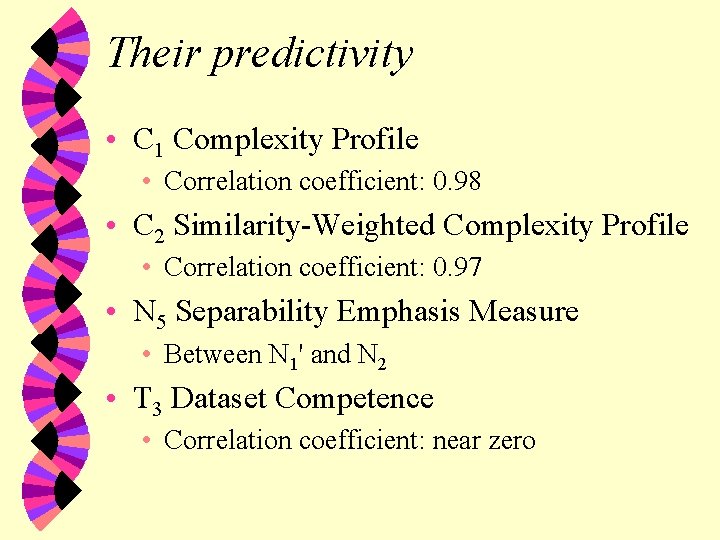
Their predictivity • C 1 Complexity Profile • Correlation coefficient: 0. 98 • C 2 Similarity-Weighted Complexity Profile • Correlation coefficient: 0. 97 • N 5 Separability Emphasis Measure • Between N 1' and N 2 • T 3 Dataset Competence • Correlation coefficient: near zero
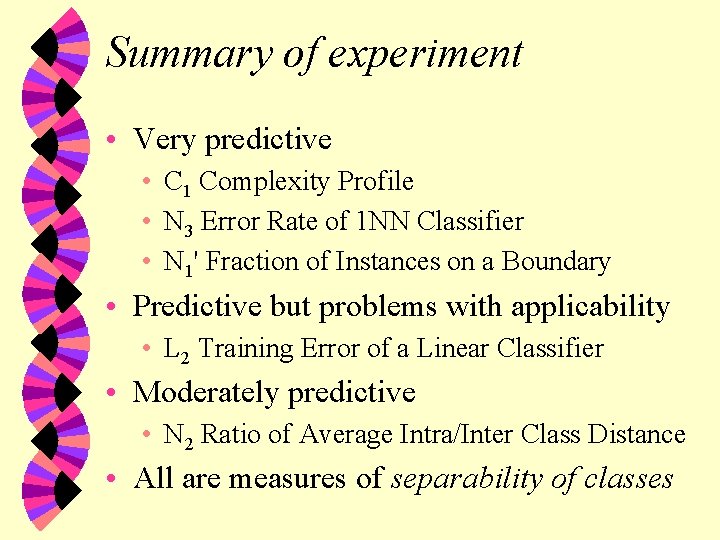
Summary of experiment • Very predictive • C 1 Complexity Profile • N 3 Error Rate of 1 NN Classifier • N 1' Fraction of Instances on a Boundary • Predictive but problems with applicability • L 2 Training Error of a Linear Classifier • Moderately predictive • N 2 Ratio of Average Intra/Inter Class Distance • All are measures of separability of classes
Overview ü Dataset complexity measures ü Classification experiment Ø Case base maintenance experiment Ø Going forward
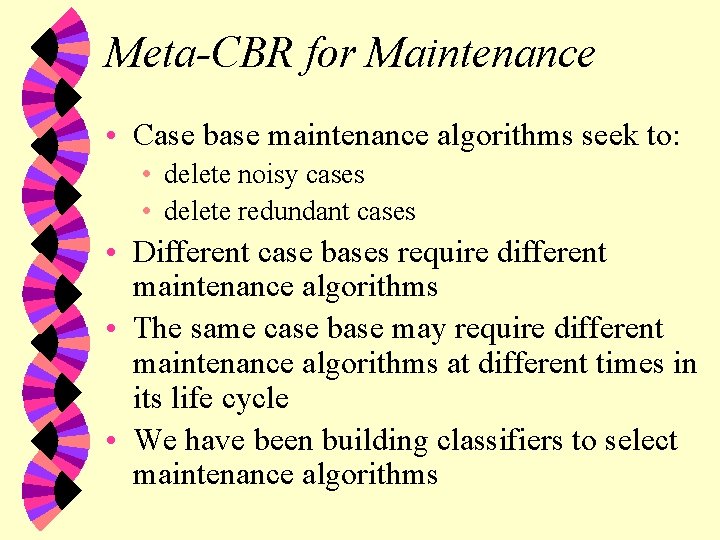
Meta-CBR for Maintenance • Case base maintenance algorithms seek to: • delete noisy cases • delete redundant cases • Different case bases require different maintenance algorithms • The same case base may require different maintenance algorithms at different times in its life cycle • We have been building classifiers to select maintenance algorithms
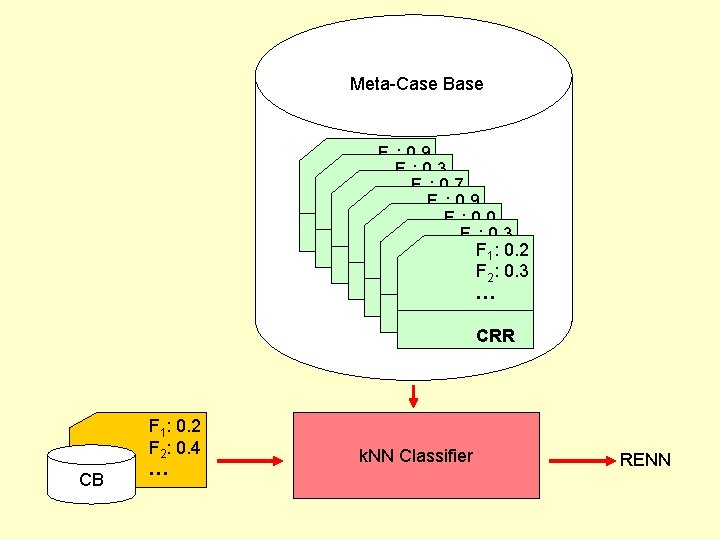
Meta-Case Base F 1: 0. 9 : 0. 3 F 2 F : 10. 4 F : 0. 7 …F 2: 10. 4 F : 0. 9 …F 2: 10. 4 F : 0. 0 …F 2: 10. 4 : 0. 3 : 10. 4 RENN…F 2 F : 0. 2 : 10. 4 RENN…F 2 F RENN…F 2: 0. 3 RENN… RENN CRR CB F 1: 0. 2 F 2: 0. 4 … k. NN Classifier RENN
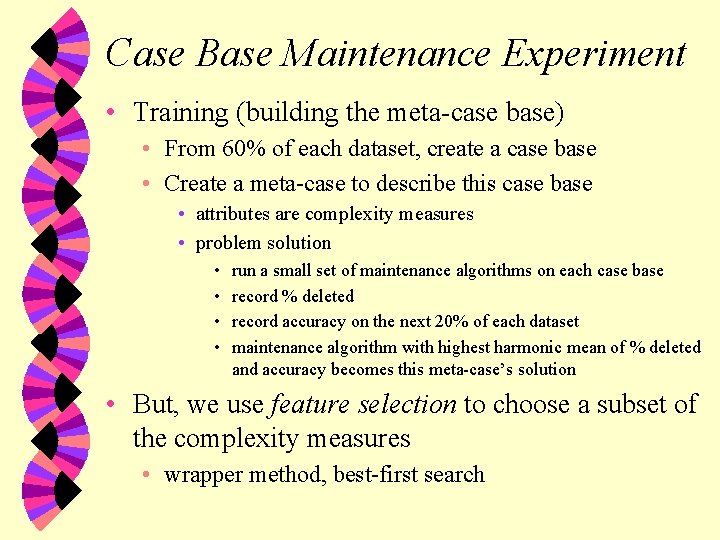
Case Base Maintenance Experiment • Training (building the meta-case base) • From 60% of each dataset, create a case base • Create a meta-case to describe this case base • attributes are complexity measures • problem solution • • run a small set of maintenance algorithms on each case base record % deleted record accuracy on the next 20% of each dataset maintenance algorithm with highest harmonic mean of % deleted and accuracy becomes this meta-case’s solution • But, we use feature selection to choose a subset of the complexity measures • wrapper method, best-first search
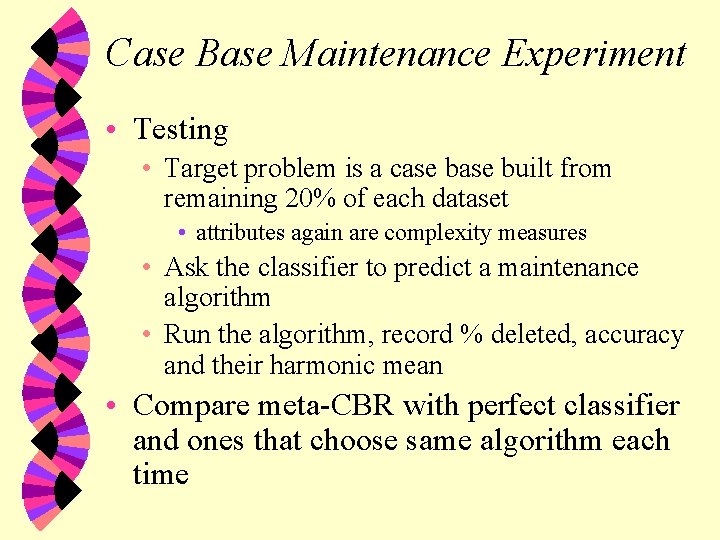
Case Base Maintenance Experiment • Testing • Target problem is a case built from remaining 20% of each dataset • attributes again are complexity measures • Ask the classifier to predict a maintenance algorithm • Run the algorithm, record % deleted, accuracy and their harmonic mean • Compare meta-CBR with perfect classifier and ones that choose same algorithm each time
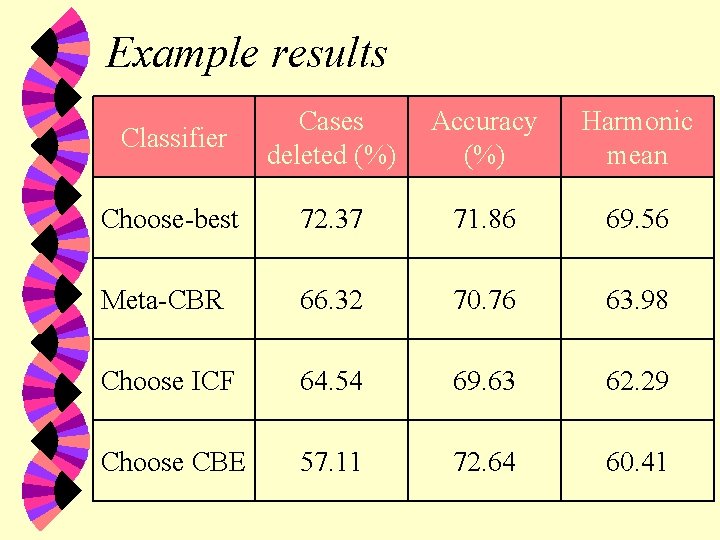
Example results Classifier Cases deleted (%) Accuracy (%) Harmonic mean Choose-best 72. 37 71. 86 69. 56 Meta-CBR 66. 32 70. 76 63. 98 Choose ICF 64. 54 69. 63 62. 29 Choose CBE 57. 11 72. 64 60. 41
Which measures get selected?
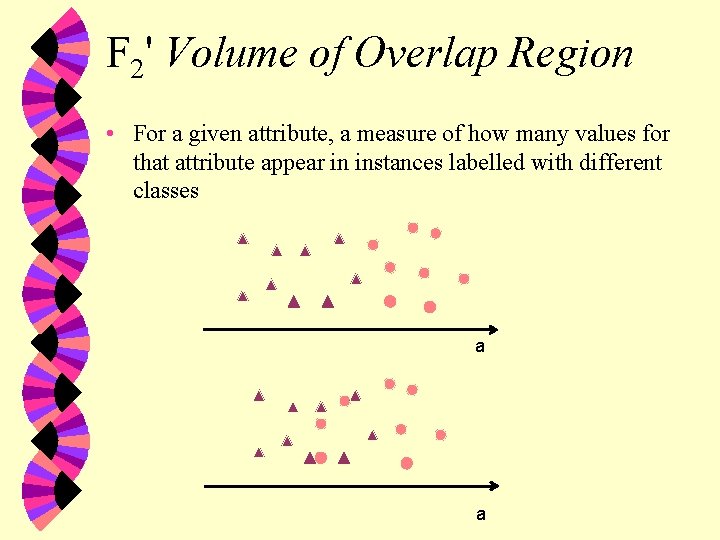
F 2' Volume of Overlap Region • For a given attribute, a measure of how many values for that attribute appear in instances labelled with different classes a a
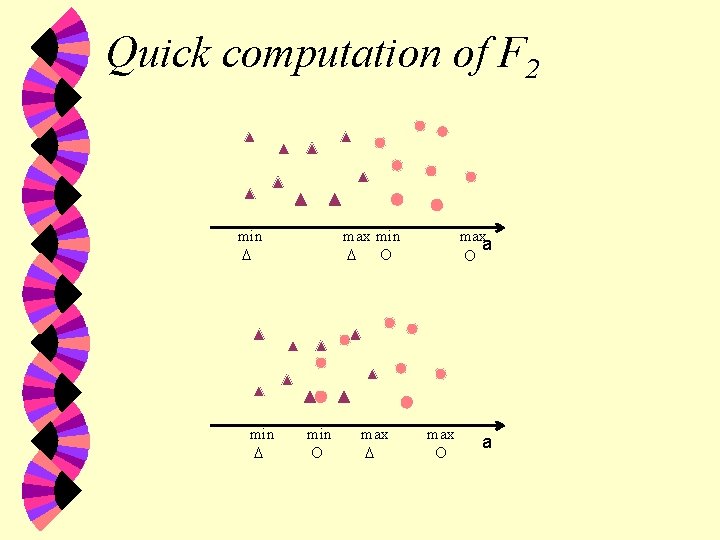
Quick computation of F 2 min max a max a
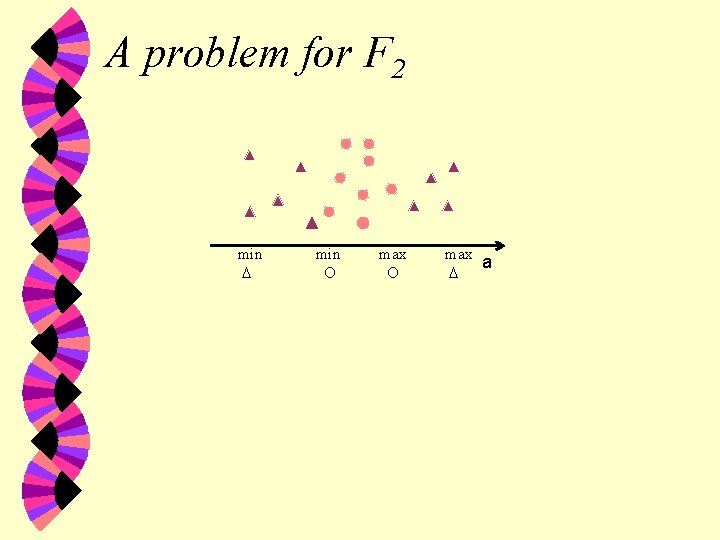
A problem for F 2 min max a
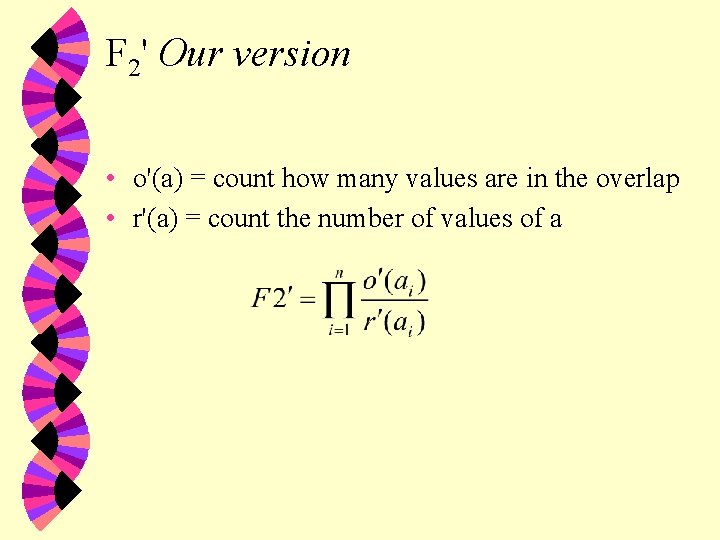
F 2' Our version • o'(a) = count how many values are in the overlap • r'(a) = count the number of values of a
Summary of experiment • Feature selection • chose between 2 and 18 attributes, average 9. 2 • chose range of measures, across Ho & Basu’s categories • always at least one measure of overlap of attribute values, e. g. F 2' • but measures of class separability only about 50% of the time • But this is just one experiment
Overview ü Dataset complexity measures ü Classification experiment ü Case base maintenance experiment Ø Going forward
Going forward • Use of complexity measures in CBR (and ML) • More research into complexity measures: • experiments with more datasets, different datasets, more classifiers, … • new measures, e. g. Information Gain • applicability of measures • missing values • loss functions • dimensionality reduction, e. g. PCA • the CBR similarity assumption and measures of case alignment [Lamontagne 2006, Hüllermeier 2007, Raghunandan et al. 2008]
- Slides: 36