
On the role of conical waves in the




- Slides: 14
On the role of conical waves in the self-focusing and filamentation of ultrashort pulses or a reinterpretation of the spatiotemporal dynamics of ultrashort pulses in Kerr media Miguel A. Porras Departamento de Física Aplicada. Universidad Politécnica de Madrid Alberto Parola, Daniele Faccio, Paolo Di Trapani University of Insubria, Como, Italy Arnaud Couairon Centre de Physique Théorique, CNRS, Palaiseau, France 1
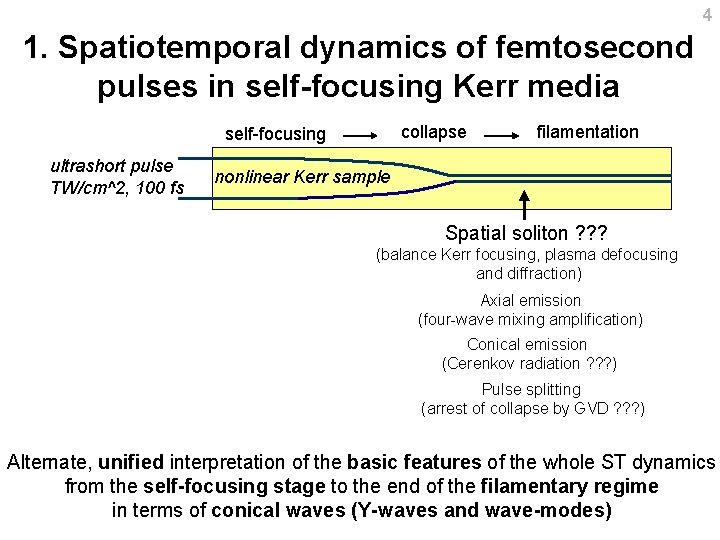
2 1. Spatiotemporal dynamics of femtosecond pulses in self-focusing Kerr media self-focusing ultrashort pulse TW/cm^2, 100 fs collapse filamentation nonlinear Kerr sample Self-focusing stage: fast nearly pure spatial dynamics self-similar compression towards a universal transversal profile: the Townes profile Collapse region: enormous intensities (hundreds of TW/cm^2) onset of higher-order nonlinear phenomena birth of a full-spatiotemporal dynamics
1. Spatiotemporal dynamics of femtosecond pulses in self-focusing Kerr media collapse self-focusing ultrashort pulse TW/cm^2, 100 fs filamentation nonlinear Kerr sample k CE 0 AE w 0 w temporal frequency time splitting and narrowing intensity transverse frequency Filamentary regime: Axial emission (spectral broadening, new temporal frequencies) Conical emission (new spatiotemporal frequencies) Pulse temporal splitting, narrowing and recombination Several self-refocusing cycles, etc Spatiotemporal spectrum recombination time 3
4 1. Spatiotemporal dynamics of femtosecond pulses in self-focusing Kerr media collapse self-focusing ultrashort pulse TW/cm^2, 100 fs filamentation nonlinear Kerr sample Spatial soliton ? ? ? (balance Kerr focusing, plasma defocusing and diffraction) Axial emission (four-wave mixing amplification) Conical emission (Cerenkov radiation ? ? ? ) Pulse splitting (arrest of collapse by GVD ? ? ? ) Alternate, unified interpretation of the basic features of the whole ST dynamics from the self-focusing stage to the end of the filamentary regime in terms of conical waves (Y-waves and wave-modes)
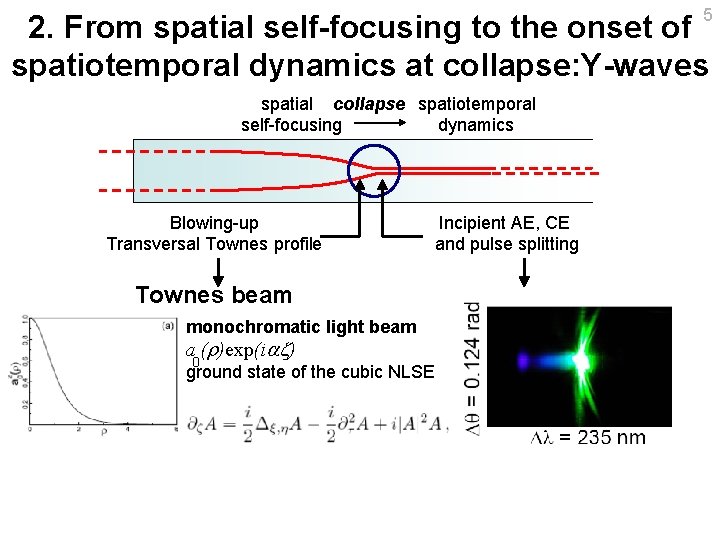
5 2. From spatial self-focusing to the onset of spatiotemporal dynamics at collapse: Y-waves spatial collapse spatiotemporal self-focusing dynamics Blowing-up Transversal Townes profile Townes beam monochromatic light beam a (r)exp(iaz) 0 ground state of the cubic NLSE Incipient AE, CE and pulse splitting
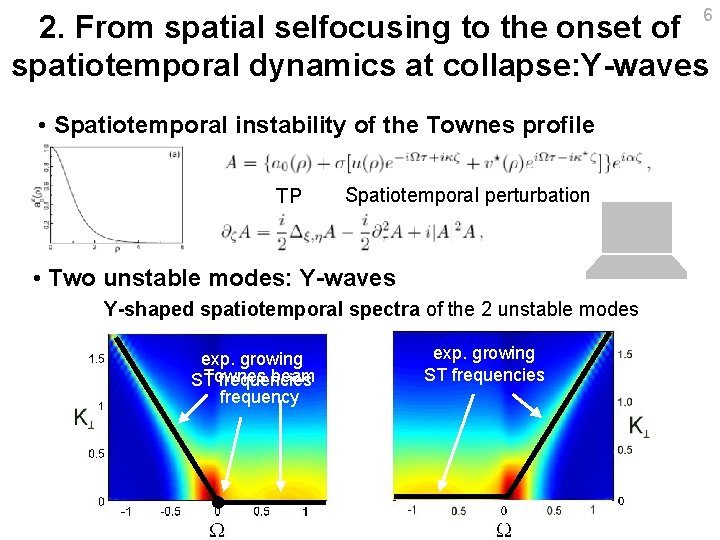
6 2. From spatial selfocusing to the onset of spatiotemporal dynamics at collapse: Y-waves • Spatiotemporal instability of the Townes profile TP Spatiotemporal perturbation • Two unstable modes: Y-waves Y-shaped spatiotemporal spectra of the 2 unstable modes exp. growing Townes beam ST frequencies frequency exp. growing ST frequencies
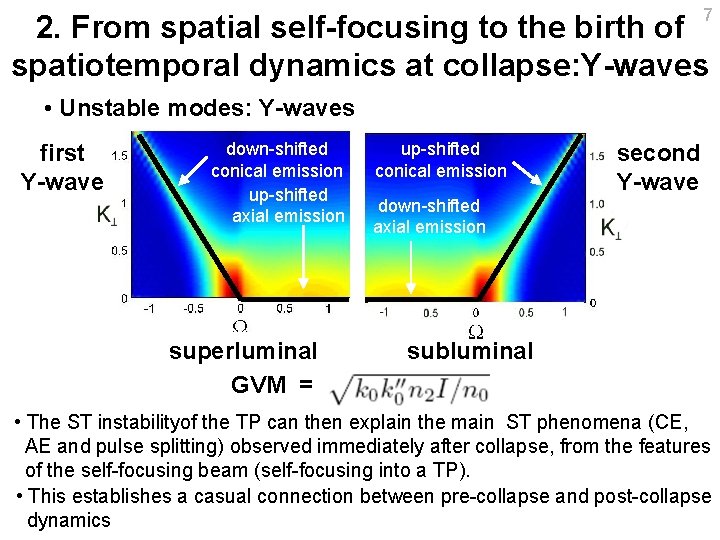
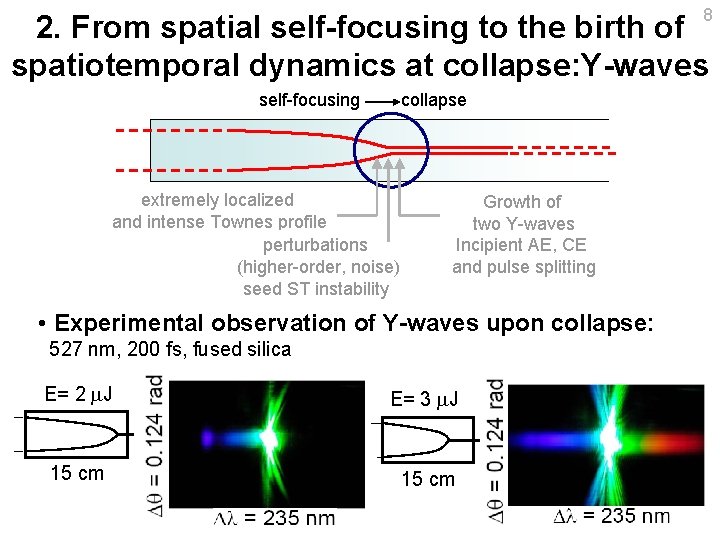
7 2. From spatial self-focusing to the birth of spatiotemporal dynamics at collapse: Y-waves • Unstable modes: Y-waves first Y-wave down-shifted conical emission up-shifted axial emission superluminal GVM = up-shifted conical emission second Y-wave down-shifted axial emission subluminal • The ST instabilityof the TP can then explain the main ST phenomena (CE, AE and pulse splitting) observed immediately after collapse, from the features of the self-focusing beam (self-focusing into a TP). • This establishes a casual connection between pre-collapse and post-collapse dynamics
8 2. From spatial self-focusing to the birth of spatiotemporal dynamics at collapse: Y-waves self-focusing collapse extremelylocalized and andintense. Townesprofile perturbations (higher-order, noise) seed ST instability Growth of two Y-waves Incipient AE, CE and pulse splitting • Experimental observation of Y-waves upon collapse: 527 nm, 200 fs, fused silica E= 2 m. J E= 3 m. J 15 cm
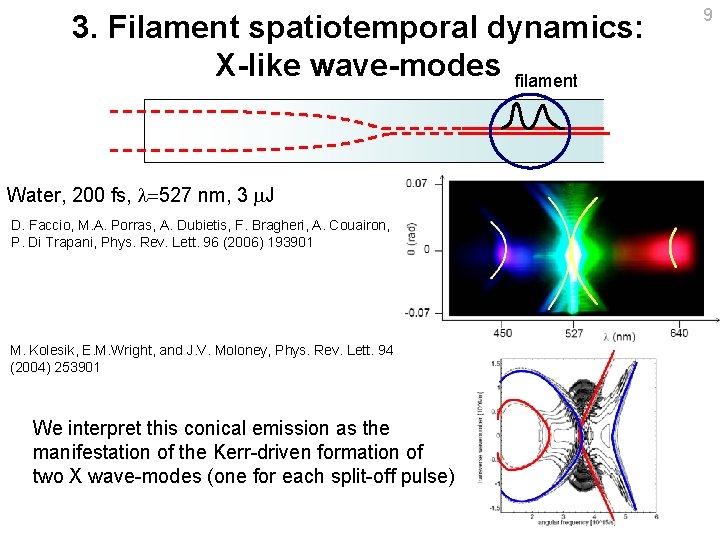
3. Filament spatiotemporal dynamics: X-like wave-modes filament Water, 200 fs, l=527 nm, 3 m. J D. Faccio, M. A. Porras, A. Dubietis, F. Bragheri, A. Couairon, P. Di Trapani, Phys. Rev. Lett. 96 (2006) 193901 M. Kolesik, E. M. Wright, and J. V. Moloney, Phys. Rev. Lett. 94 (2004) 253901 We interpret this conical emission as the manifestation of the Kerr-driven formation of two X wave-modes (one for each split-off pulse) 9
3. Filament spatiotemporal dynamics: X wave-modes • Wave-modes: spatiotemporal localized waves that can propagate in a linear dispersive medium without any temporal dispersion broadening Pulsed (polychromatic) Bessel beam free parameters 10
3. Filament spatiotemporal dynamics: wave-modes X-wave: Longitudinal wave number: Transversal dispersion curve of WMs water b=0, a= -0. 025 fs/mm water b=0, a = 0. 025 fs/mm 11
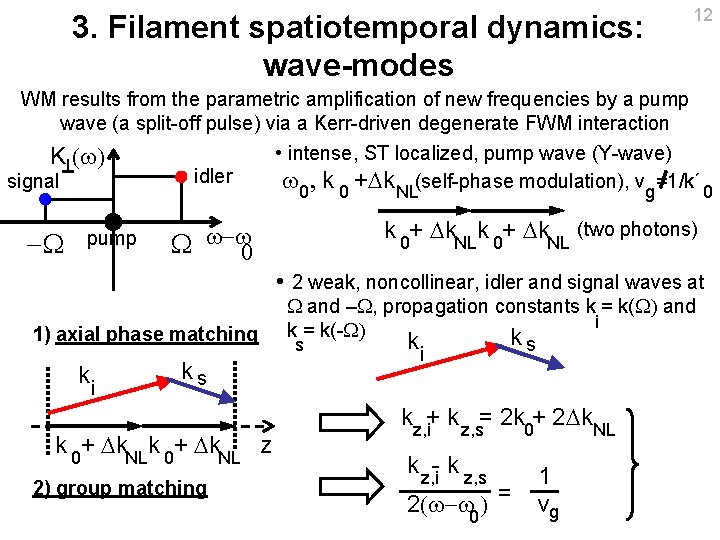
3. Filament spatiotemporal dynamics: wave-modes 12 WM results from the parametric amplification of new frequencies by a pump wave (a split-off pulse) via a Kerr-driven degenerate FWM interaction K (w) signal -W pump idler W w-w 0 • intense, ST localized, pump wave (Y-wave) w 0, k 0 +Dk NL(self-phase modulation), vg=1/k´ 0 k 0+ Dk. NL (two photons) • 2 weak, noncollinear, idler and signal waves at 1) axial phase matching ki ks k 0+ Dk. NL z 2) group matching W and –W, propagation constants k = k(W) and i k = k(-W) ks ki s kz, i+ k z, s= 2 k 0+ 2 Dk NL k z, i- k z, s 2(w-w 0 ) = 1 vg
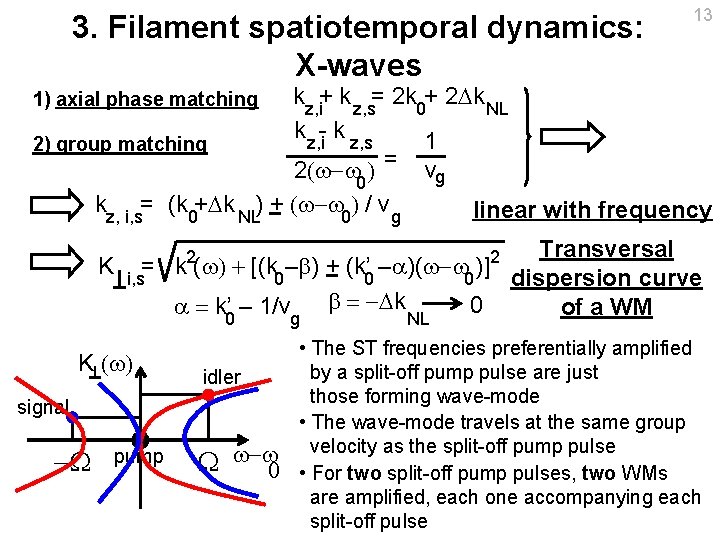
3. Filament spatiotemporal dynamics: X-waves 1) axial phase matching 2) group matching 13 kz, i+ k z, s= 2 k 0+ 2 Dk NL k z, i- k z, s 1 2(w-w ) = v 0 kz, i, s= (k 0+Dk NL) + (w-w 0) / v g g linear with frequency Transversal K i, s= k (w) + [(k 0–b) + (k’ 0 –a)(w-w 0 )] dispersion curve 0 a = k’ 0 – 1/vg b = -Dk NL of a WM 2 K (w) signal -W pump 2 • The ST frequencies preferentially amplified by a split-off pump pulse are just idler those forming wave-mode • The wave-mode travels at the same group velocity as the split-off pump pulse w-w W 0 • For two split-off pump pulses, two WMs are amplified, each one accompanying each split-off pulse
Conclusory remarks • We have introduced a interpretation of the spatiotemporal dynamics of ultrashort pulses in self-focusing Kerr media in terms of conical waves. • In this interpretation the only essential nonlinearity is the Kerr nonlinearity. Higher-order effects play a secondary role. • Conical waves (X-waves and Y-waves) are essentially linear waves, but are nonlinearly created (by Kerr-driven instability degenerate FWM). • Y-waves can explain the excitation of the post-collapse filamentary regime from self-similar self-focusing prior to collapse. • X-waves armonize the apparent stationarity of the filament with its actual complex spatiotemporal dynamics. • Results are presented for media with normal dispersion but can be readily rewritten for anomalous dispersion. 14