
ON THE ROAD TO BUSINESS APPLICATIONS OF SEMANTIC
ON THE ROAD TO BUSINESS APPLICATIONS OF SEMANTIC WEB TECHNOLOGY Sematic Web in Business - How to Proceed IASW 2005 - 27. 8. 2005 Kari Oinonen Kiertotie 14 as 3, 40250 Jyväskylä, e-mail: karioinonen@kolumbus. fi
Purpose of the paper ● The purpose of the paper is to aid semantic technology to wider use in business applications.
Presentation structure Business applications and Semantic WEB ● Development trends and Semantic WEB ● On the need of general application and business framework ● Road Map Plan ● How to continue ●
Business applications and Semantic WEB General status of sematic Web in business applications ● Topics that slow down adoption of this technology into business use ●
Business applications and Semantic WEB General status of sematic Web in business applications ● ● Applications are existing: ● ● ● Public applications Industrial applications Applications that are not public
Business applications and Semantic WEB General status of sematic Web in business applications ● Topics that slow down adoption of this technology into business use: ● ● ● ● Complexcity of the technology or its usage. The technology and its potential is not yet generally known in business world. Publicly available technology examples are more or less trivial. Existing business applications and business models. Guarantee of investments in the technology. New application areas are not easy to recognice. Lack in the integration of problem, domain and technology expertice.
Development trends and Semantic WEB ● General technology trends: ● ● ● ● Life-cycle Dynamization Multiplication cycle Transition from macro to micro level Synchronization Scaling up or down Uneven development of parts Automation Ref. Altchuller, G. 1998
Development trends and Semantic WEB ● Changes in communication technology: ● ● Technology convergence in telecommunication. Internet infrastructure gaining importance.
Development trends and Semantic WEB ● Changes in business needs: ● ● ● Complexity is increasing. Management of information related to several different life-cycle -phases of a product or service. Management of information belonging to different engineering disciplines. Management of information originally created and maintained in separate IT systems or solutions. Management of information originally created and maintained in different organizations.
On the need of general application and business framework ● ● ● More interoperability between semantic applications. Many of the needed tools in technology are available, but a common understanging of how to use those tools is lacking. Road map -process creates a more unified view of how the technology can or could be used best way. Road map -description aids other people to understand the technology, how it can be used, relations to other needed or beneficial technologies, where it can be used and what will be future development steps. Ontology management. Information security.
Road map plan ● Road map definition process Use suitable well defined format. ●See an example in the next slide. ●Have appropriate people and organizations involved. ●Look at interdepencencies. ●
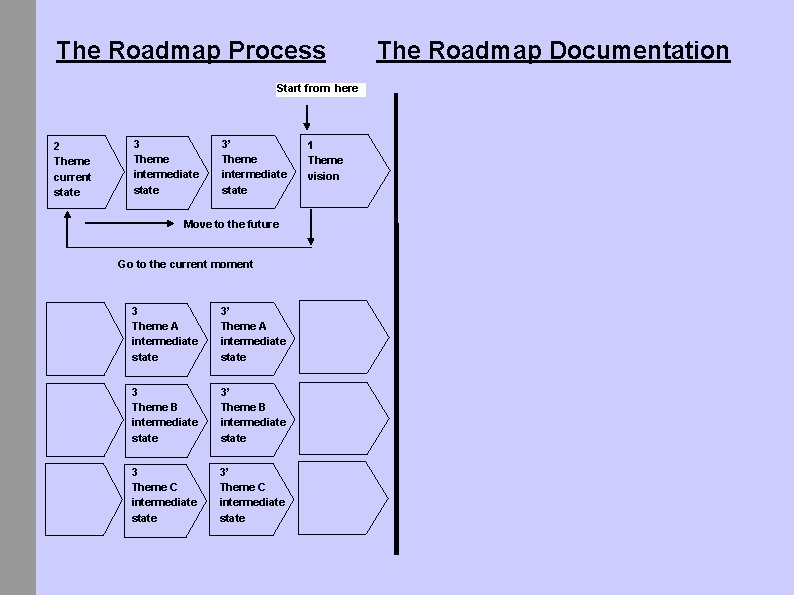
The Roadmap Process Start from here 2 Theme current state 3 Theme intermediate state 3’ Theme intermediate state Move to the future Go to the current moment 3 Theme A intermediate state 3’ Theme A intermediate state 3 Theme B intermediate state 3’ Theme B intermediate state 3 Theme C intermediate state 3’ Theme C intermediate state 1 Theme vision The Roadmap Documentation
Road map plan ● ● ● ● Road map and technology topic: What semantic technology standards to use and where. Relations and connectability to existing standards like STEP or modeling activities like Epistle or CIM-OSA or RUBIC. Needed functionality. Guarantee of future compatibility User interfaces – multidimensionality. Information integrity and security. Other fitting or supporting technology.
Road map plan ● ● ● ● Road map and use cases -topic: Finding of information and recources. Classification of information. Information collection. Maintenance of information links. Information analysis based on other information or knowledge. Knowledge management.
Road map plan ● ● ● ● Road map and business and usage -topic: The meaning of the technology in terms of costs and benefits for the end customer or user. The effects of sematic technology in service or knowledge business. Enterprise application integration or similar functionality. Life-cycle support of products and services. Network type of information models in heterogenous environment. Current and future needs in industry. The most promising application areas for the technology – business point of view.
Road map plan ● ● ● Road map and ontology -topic: Existence of and applicability of existing ontologies. Possibilities to form ontologies based on existing terms and concepts in use. Need of more local ontologies still maintaining interoperability. Maintenance and ownership of ontologies. Coordination of ontologies management.
How to continue ● ● ● Build a rough Road map plan by a small group of experts. Iterate and make changes as needed by input from industry, field experts and standards owners. Publish main results of the Roadmap.
Summary ● Business applications and Semantic WEB ● General technology trends and Semantic WEB ● On the need of general application and business framework ● Road Map Plan ● How to continue
- Slides: 18