
On The Road to an HIV Cure How
- Slides: 19
On The Road to an HIV Cure: How Far Have We Come Alan L. Landay, Ph. D Professor and Chairman of Immunology, Microbiology, and Medicine Rush University Medical Center Chicago, Illinois FORMATTED: 05/03/2016 Chicago, Illinois: May 9, 2016 From AL Landay, Ph. D, at Chicago, IL: May 9, 2016, IAS-USA.
Learning Objectives After attending this presentation, participants will be able to: �Describe the barriers that exist to achieving an HIV cure �Provide insights from current clinical trials focused on eliminating latently infected positive HIV cells �Describe the advances we have made in hostdirected therapies for cure research and their clinical applications Slide 2 of 19 From AL Landay, Ph. D, at Chicago, IL: May 9, 2016, IAS-USA.
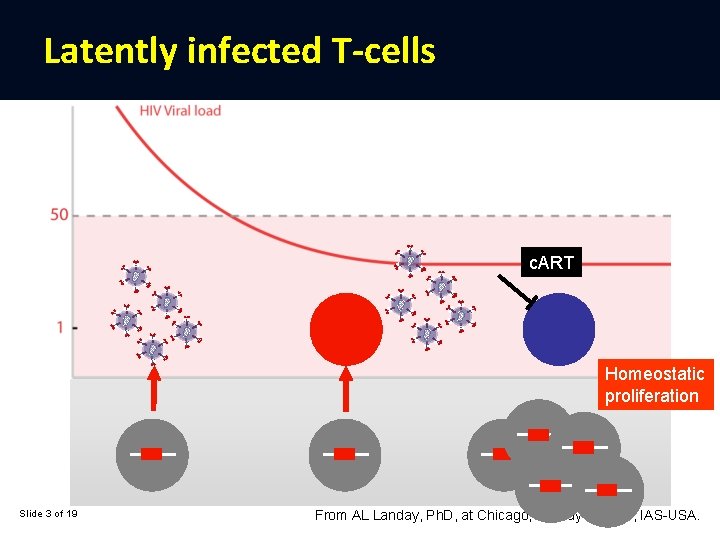
Latently infected T-cells c. ART Homeostatic proliferation Slide 3 of 19 From AL Landay, Ph. D, at Chicago, IL: May 9, 2016, IAS-USA.
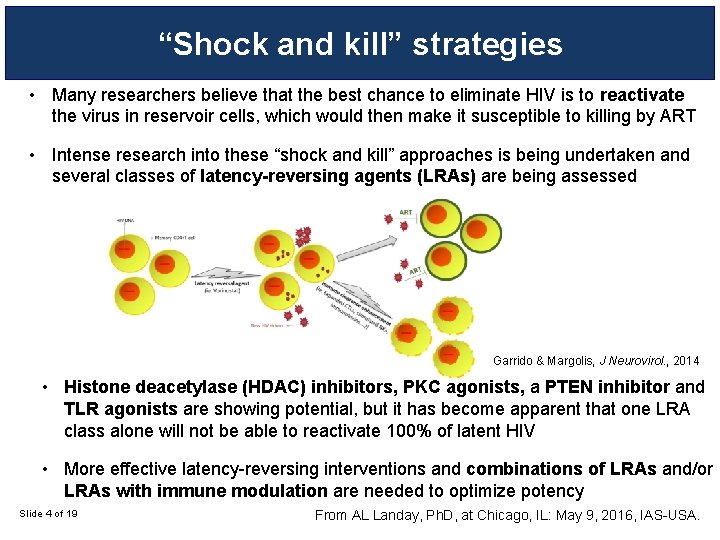
“Shock and kill” strategies • Many researchers believe that the best chance to eliminate HIV is to reactivate the virus in reservoir cells, which would then make it susceptible to killing by ART • Intense research into these “shock and kill” approaches is being undertaken and several classes of latency-reversing agents (LRAs) are being assessed Garrido & Margolis, J Neurovirol. , 2014 • Histone deacetylase (HDAC) inhibitors, PKC agonists, a PTEN inhibitor and TLR agonists are showing potential, but it has become apparent that one LRA class alone will not be able to reactivate 100% of latent HIV • More effective latency-reversing interventions and combinations of LRAs and/or LRAs with immune modulation are needed to optimize potency Slide 4 of 19 From AL Landay, Ph. D, at Chicago, IL: May 9, 2016, IAS-USA.
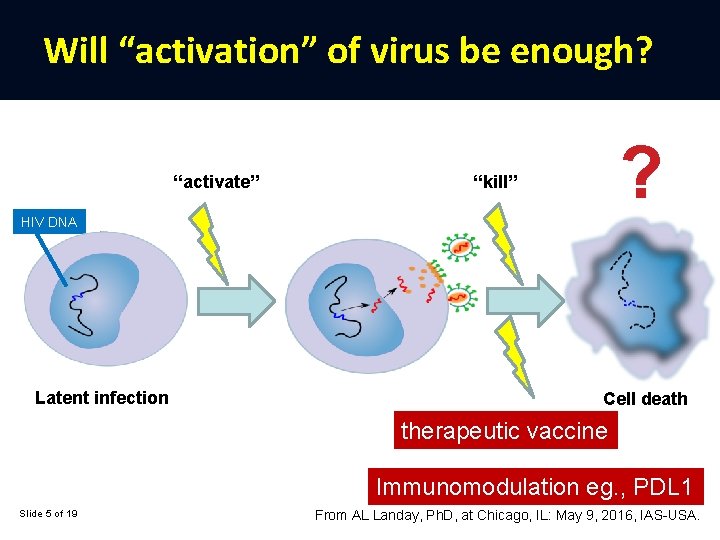
Will “activation” of virus be enough? “activate” ? “kill” HIV DNA Latent infection Cell death therapeutic vaccine Immunomodulation eg. , PDL 1 Slide 5 of 19 From AL Landay, Ph. D, at Chicago, IL: May 9, 2016, IAS-USA.
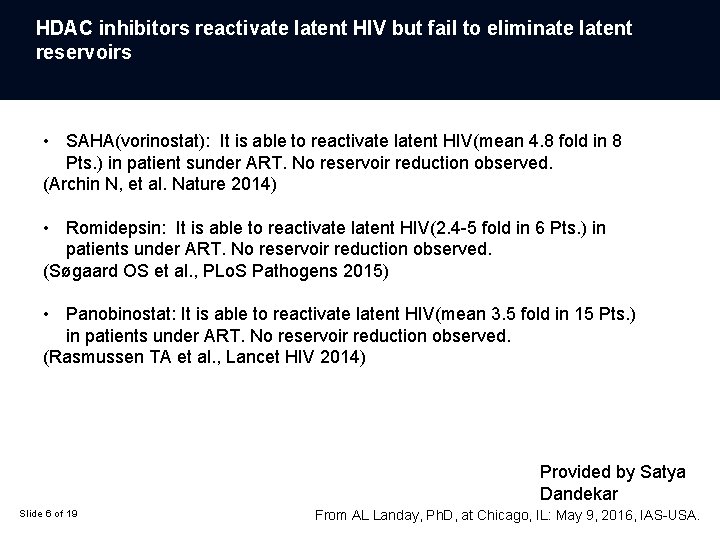
HDAC inhibitors reactivate latent HIV but fail to eliminate latent reservoirs • SAHA(vorinostat): It is able to reactivate latent HIV(mean 4. 8 fold in 8 Pts. ) in patient sunder ART. No reservoir reduction observed. (Archin N, et al. Nature 2014) • Romidepsin: It is able to reactivate latent HIV(2. 4 -5 fold in 6 Pts. ) in patients under ART. No reservoir reduction observed. (Søgaard OS et al. , PLo. S Pathogens 2015) • Panobinostat: It is able to reactivate latent HIV(mean 3. 5 fold in 15 Pts. ) in patients under ART. No reservoir reduction observed. (Rasmussen TA et al. , Lancet HIV 2014) Provided by Satya Dandekar Slide 6 of 19 From AL Landay, Ph. D, at Chicago, IL: May 9, 2016, IAS-USA.
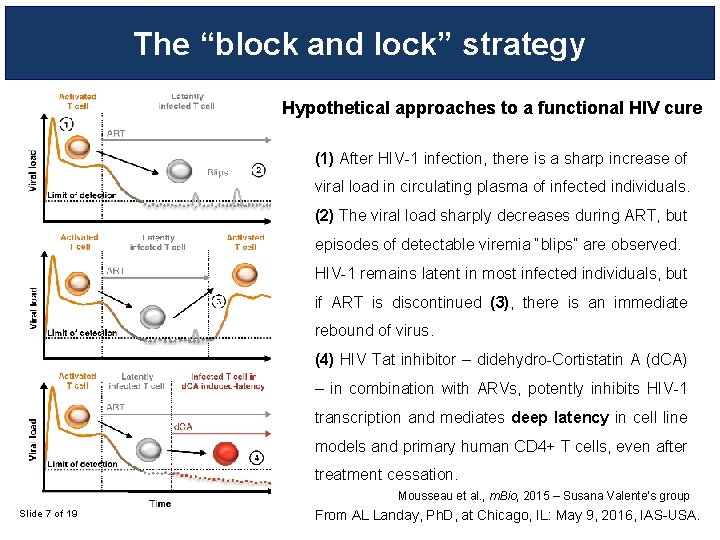
The “block and lock” strategy Hypothetical approaches to a functional HIV cure (1) After HIV-1 infection, there is a sharp increase of viral load in circulating plasma of infected individuals. (2) The viral load sharply decreases during ART, but episodes of detectable viremia “blips” are observed. HIV-1 remains latent in most infected individuals, but if ART is discontinued (3), there is an immediate rebound of virus. (4) HIV Tat inhibitor – didehydro-Cortistatin A (d. CA) – in combination with ARVs, potently inhibits HIV-1 transcription and mediates deep latency in cell line models and primary human CD 4+ T cells, even after treatment cessation. Mousseau et al. , m. Bio, 2015 – Susana Valente’s group Slide 7 of 19 From AL Landay, Ph. D, at Chicago, IL: May 9, 2016, IAS-USA.
Host Directed Therapies Therapeutic Vaccine Checkpoint Inhibitors Immune Modulator Drugs Cell Therapy Slide 8 of 19 From AL Landay, Ph. D, at Chicago, IL: May 9, 2016, IAS-USA.
Therapeutic Vaccines to Augment HIV Specific Responses • Result in decay of reservoir on ARV • Result in control of virus rebound off ARV Slide 9 of 19 From AL Landay, Ph. D, at Chicago, IL: May 9, 2016, IAS-USA.
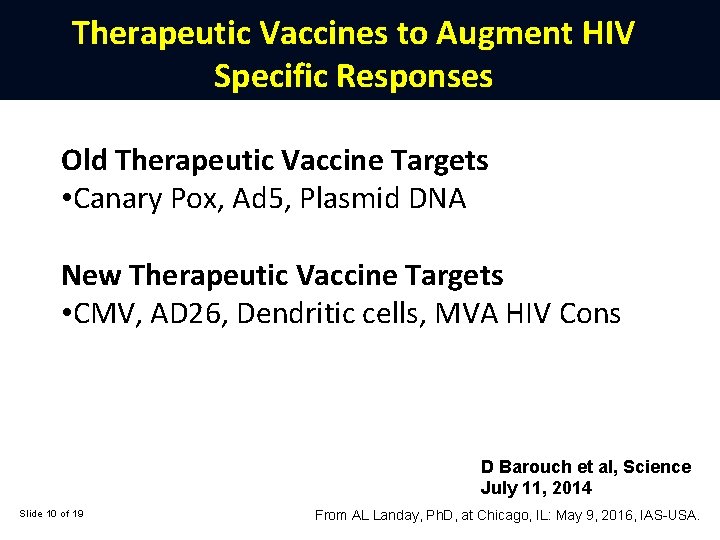
Therapeutic Vaccines to Augment HIV Specific Responses Old Therapeutic Vaccine Targets • Canary Pox, Ad 5, Plasmid DNA New Therapeutic Vaccine Targets • CMV, AD 26, Dendritic cells, MVA HIV Cons D Barouch et al, Science July 11, 2014 Slide 10 of 19 From AL Landay, Ph. D, at Chicago, IL: May 9, 2016, IAS-USA.
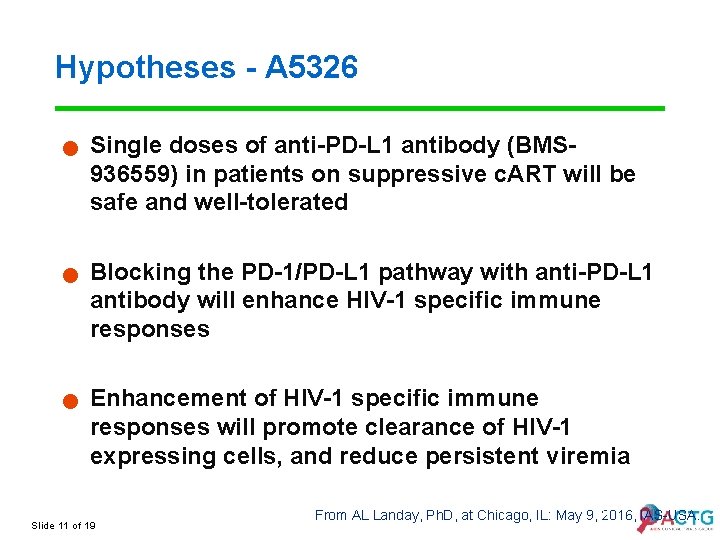
Hypotheses - A 5326 n n n Single doses of anti-PD-L 1 antibody (BMS 936559) in patients on suppressive c. ART will be safe and well-tolerated Blocking the PD-1/PD-L 1 pathway with anti-PD-L 1 antibody will enhance HIV-1 specific immune responses Enhancement of HIV-1 specific immune responses will promote clearance of HIV-1 expressing cells, and reduce persistent viremia Slide 11 of 19 11 From AL Landay, Ph. D, at Chicago, IL: May 9, 2016, IAS-USA.
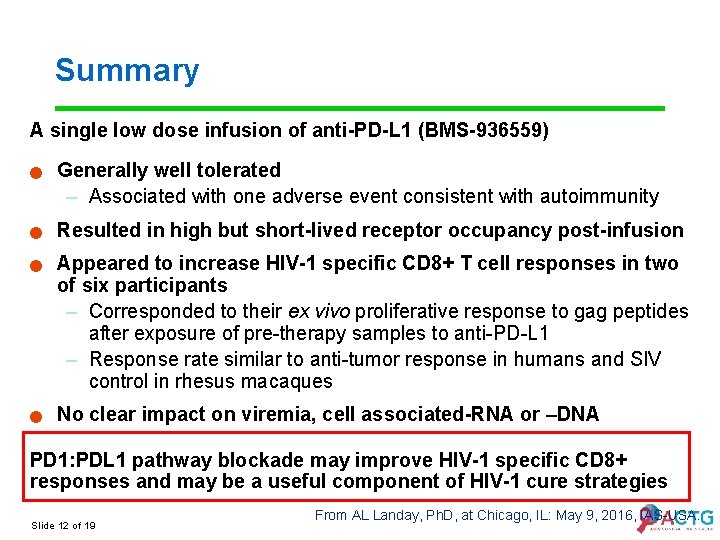
Summary A single low dose infusion of anti-PD-L 1 (BMS-936559) n n Generally well tolerated – Associated with one adverse event consistent with autoimmunity Resulted in high but short-lived receptor occupancy post-infusion Appeared to increase HIV-1 specific CD 8+ T cell responses in two of six participants – Corresponded to their ex vivo proliferative response to gag peptides after exposure of pre-therapy samples to anti-PD-L 1 – Response rate similar to anti-tumor response in humans and SIV control in rhesus macaques No clear impact on viremia, cell associated-RNA or –DNA PD 1: PDL 1 pathway blockade may improve HIV-1 specific CD 8+ responses and may be a useful component of HIV-1 cure strategies Slide 12 of 19 From AL Landay, Ph. D, at Chicago, IL: May 9, 2016, IAS-USA.
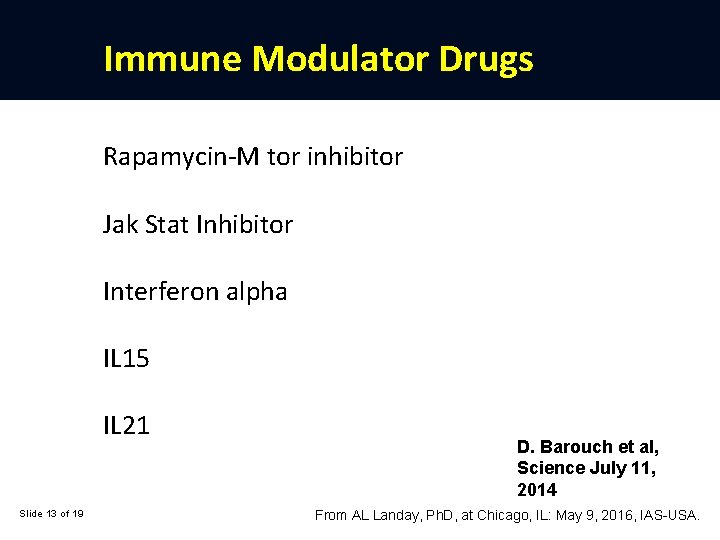
Immune Modulator Drugs Rapamycin-M tor inhibitor Jak Stat Inhibitor Interferon alpha IL 15 IL 21 Slide 13 of 19 D. Barouch et al, Science July 11, 2014 From AL Landay, Ph. D, at Chicago, IL: May 9, 2016, IAS-USA.
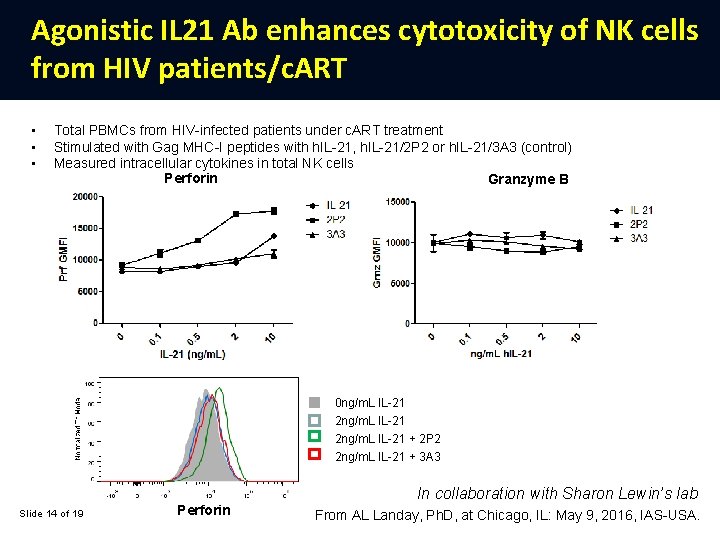
Agonistic IL 21 Ab enhances cytotoxicity of NK cells from HIV patients/c. ART • • • Total PBMCs from HIV-infected patients under c. ART treatment Stimulated with Gag MHC-I peptides with h. IL-21, h. IL-21/2 P 2 or h. IL-21/3 A 3 (control) Measured intracellular cytokines in total NK cells Perforin Granzyme B 0 ng/m. L IL-21 2 ng/m. L IL-21 + 2 P 2 2 ng/m. L IL-21 + 3 A 3 In collaboration with Sharon Lewin’s lab Slide 14 of 19 Perforin From AL Landay, Ph. D, at Chicago, IL: May 9, 2016, IAS-USA.
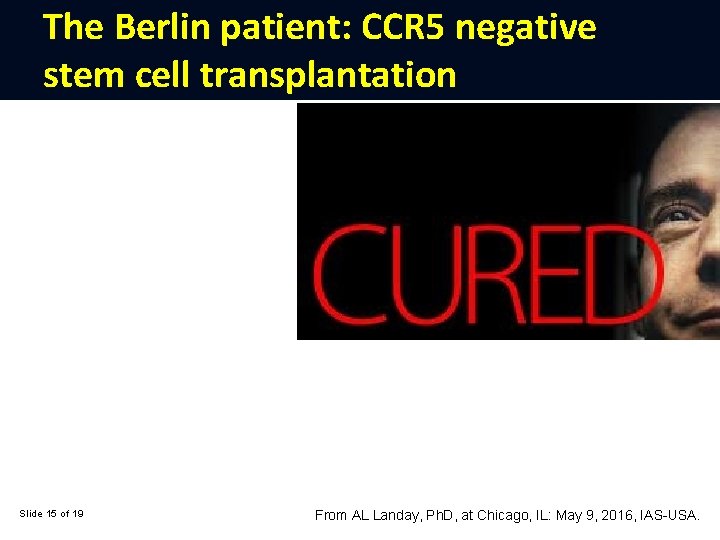
The Berlin patient: CCR 5 negative stem cell transplantation Slide 15 of 19 From AL Landay, Ph. D, at Chicago, IL: May 9, 2016, IAS-USA.
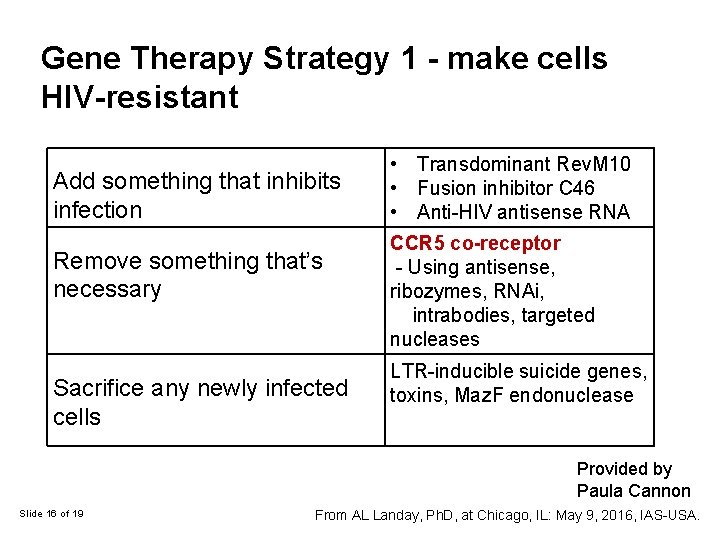
Gene Therapy Strategy 1 - make cells HIV-resistant Add something that inhibits infection Remove something that’s necessary Sacrifice any newly infected cells • Transdominant Rev. M 10 • Fusion inhibitor C 46 • Anti-HIV antisense RNA CCR 5 co-receptor - Using antisense, ribozymes, RNAi, intrabodies, targeted nucleases LTR-inducible suicide genes, toxins, Maz. F endonuclease Provided by Paula Cannon Slide 16 of 19 From AL Landay, Ph. D, at Chicago, IL: May 9, 2016, IAS-USA.
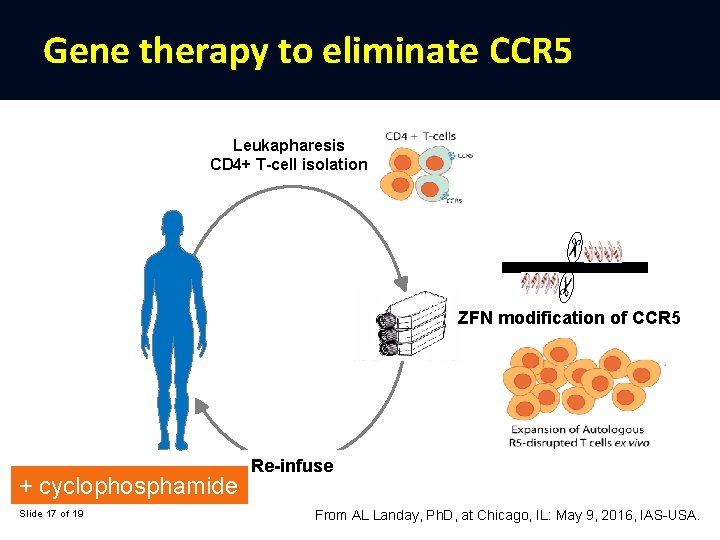
Gene therapy to eliminate CCR 5 Leukapharesis CD 4+ T-cell isolation ZFN modification of CCR 5 + cyclophosphamide Slide 17 of 19 Re-infuse From AL Landay, Ph. D, at Chicago, IL: May 9, 2016, IAS-USA.
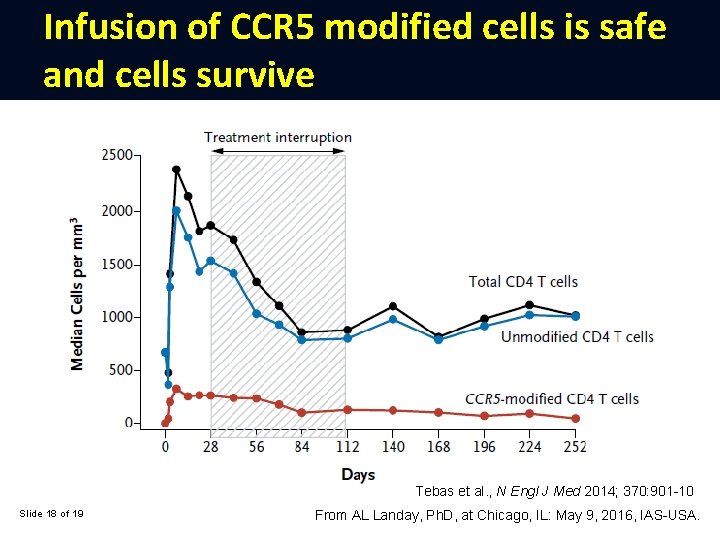
Infusion of CCR 5 modified cells is safe and cells survive Tebas et al. , N Engl J Med 2014; 370: 901 -10 Slide 18 of 19 From AL Landay, Ph. D, at Chicago, IL: May 9, 2016, IAS-USA.
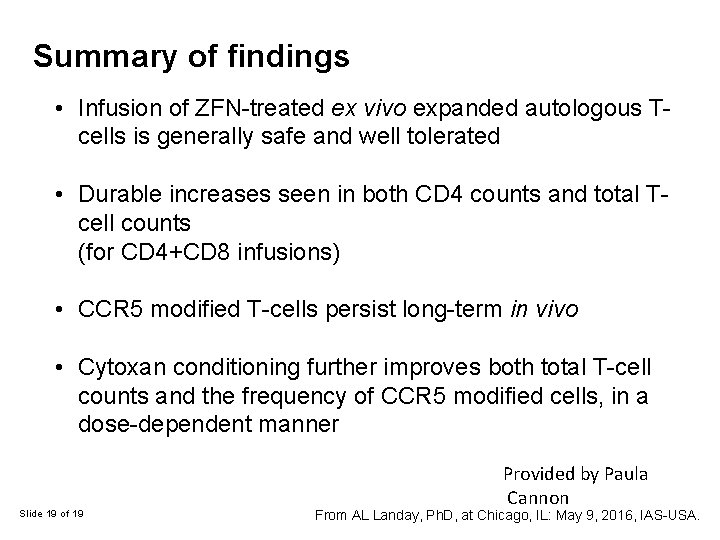
Summary of findings • Infusion of ZFN-treated ex vivo expanded autologous Tcells is generally safe and well tolerated • Durable increases seen in both CD 4 counts and total Tcell counts (for CD 4+CD 8 infusions) • CCR 5 modified T-cells persist long-term in vivo • Cytoxan conditioning further improves both total T-cell counts and the frequency of CCR 5 modified cells, in a dose-dependent manner Slide 19 of 19 Provided by Paula Cannon From AL Landay, Ph. D, at Chicago, IL: May 9, 2016, IAS-USA.