
On the resemblance and containment of documents Min
On the resemblance and containment of documents (Min. Hash) Andrei Z. Broder Ori Press oripress@mail. tau. ac. il Veronica Latzinnik latzinnik. veronica@gmail. com

Agenda ● ● ● Motivation Some definitions Estimating resemblance and containment Implementation Details Experimental results Summary 2
Motivation How do we determine if two documents are similar or contained in each other? Standard distance metrics (like Hamming) are defined on strings, and require the pairwise comparison of entire documents - not feasible for a large amount! 3
Resemblance and Containment Let A, B be two documents. Our goal is to estimate their resemblance and containment: r(A, B) - a number between 0 and 1, such that when the it is close to 1 it is likely that the documents are roughly the same. ● c(A, B) - a number between 0 and 1 that, when close to 1, indicates that A is roughly contained within B. ● d(A, B)=1 − r(A, B) ● 4
General idea ● We’ll be able to calculate resemblance/containment only using a small “sketch” of the document. ● The sketch will be computed relatively fast (linear in the size of the document) ● Resemblance and containment will be computed in linear time in the size of the sketches. - Resemblance requires a fixed size sketch - Containment required a sketch proportional to the document size (but it’s not that bad) 5
Preprocessing ● Tokenize the document (ignore punctuation, capitalization, and formatting) ● Tokens can be individual words, groups of words, or whole lines ● Each document can now be viewed as a sequence of tokens 6
Definitions - 1 ● Label a given document with D ● S(D, w) is the set of subsequences of tokens associated with D. We would like to obtain S(D, w). How? 7
Definitions - 2 ● A continuous subsequence in D is called a shingle. ● w-shingle is a shingle of size w (=k-mer) ● The multiset containing all of the shingles of D of size w is called the wshingling of D - S(D, w). 8
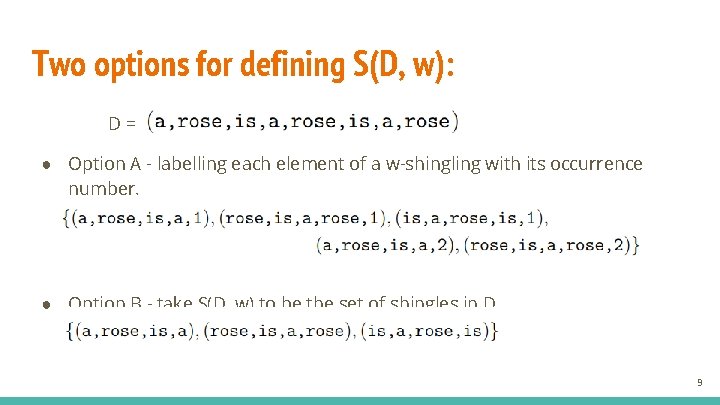
Two options for defining S(D, w): D= ● Option A - labelling each element of a w-shingling with its occurrence number. ● Option B - take S(D, w) to be the set of shingles in D. 9
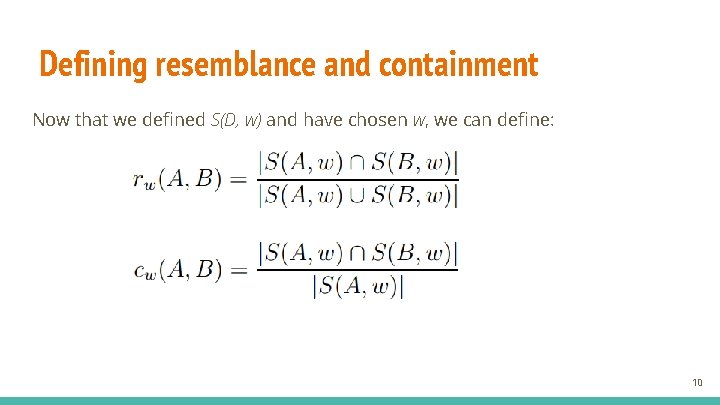
Defining resemblance and containment Now that we defined S(D, w) and have chosen w, we can define: 10
Recap ● We wanted to define metrics to estimate similarity and containment of documents. ● We defined how we want these metrics to behave. ● We defined S(D, w) as the set of subsequences representing the document. ● We defined r(A, B) and c(A, B) using S(D, w). ● Now we will present how r(A, B) and c(A, B) can be estimated. 11
Estimating the resemblance and the containment Our goal is to represent documents with relatively smaller “sketches” We want to be able to compute resemblance/containment using these sketches We’ll show 2 ways to generate sketches from a given document, and prove that they’re good 12
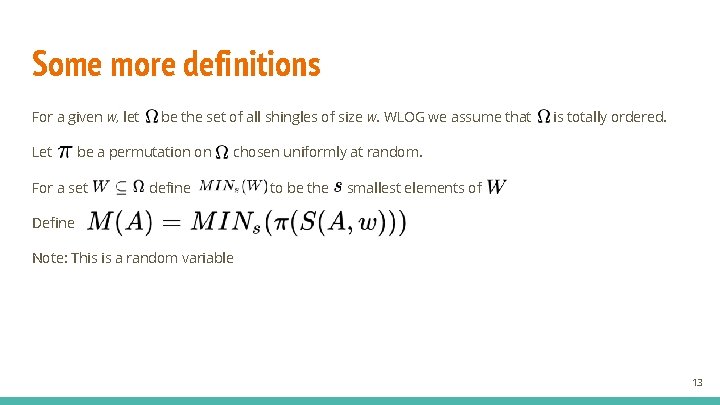
Some more definitions For a given w, let Let be the set of all shingles of size w. WLOG we assume that be a permutation on For a set is totally ordered. chosen uniformly at random. define to be the smallest elements of Define Note: This is a random variable 13
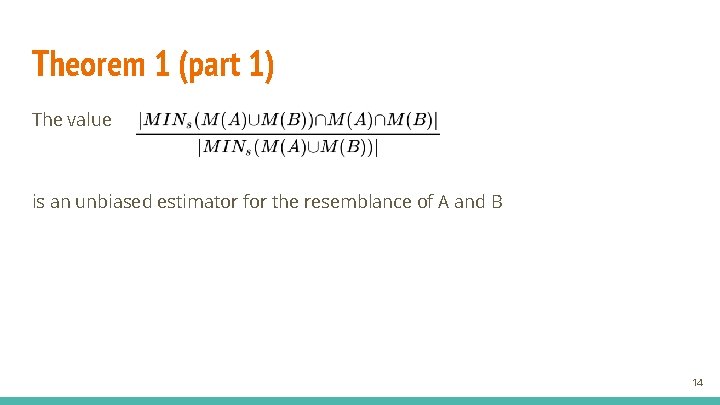
Theorem 1 (part 1) The value is an unbiased estimator for the resemblance of A and B 14
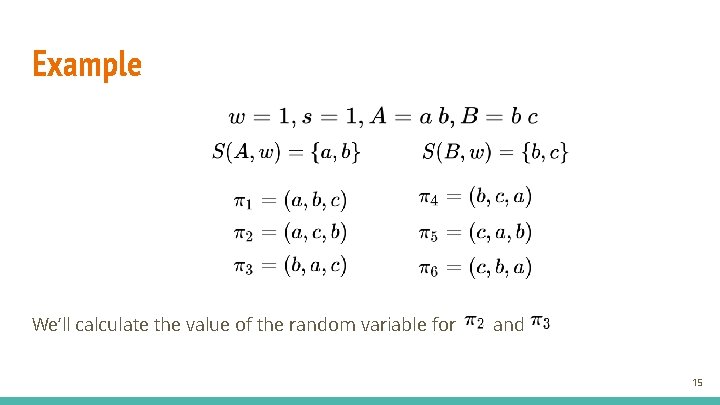
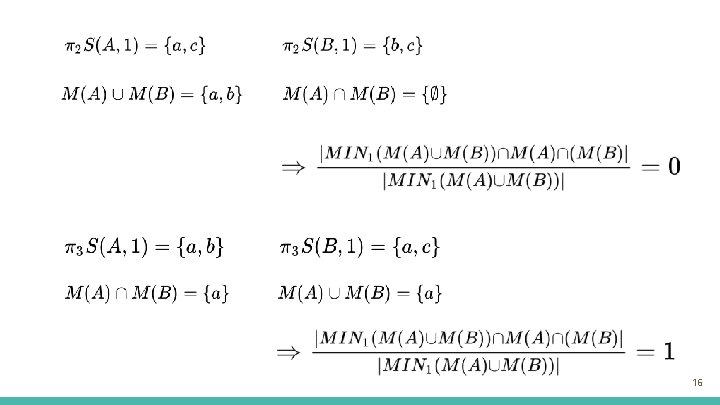
Example We’ll calculate the value of the random variable for and 15
16
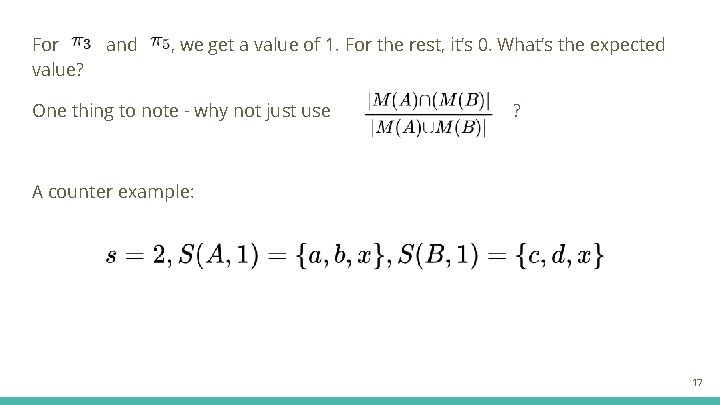
For value? and , we get a value of 1. For the rest, it’s 0. What’s the expected One thing to note - why not just use ? A counter example: 17
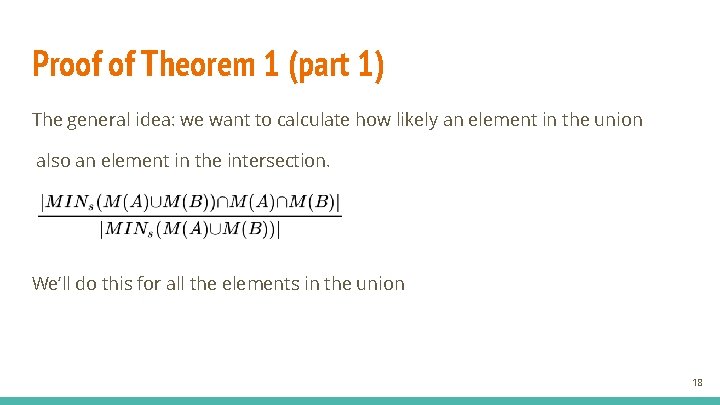
Proof of Theorem 1 (part 1) The general idea: we want to calculate how likely an element in the union also an element in the intersection. We’ll do this for all the elements in the union 18
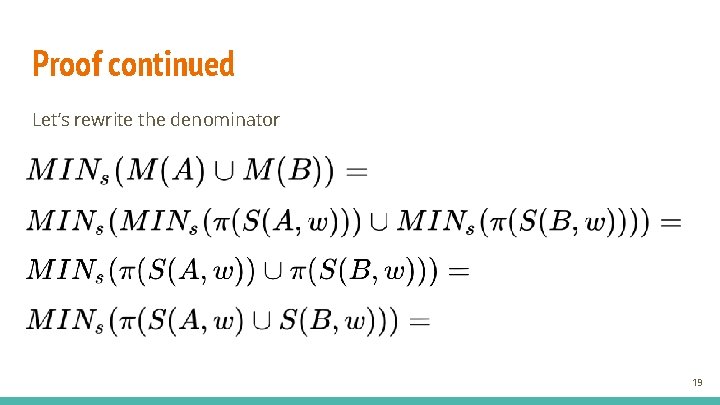
Proof continued Let’s rewrite the denominator 19
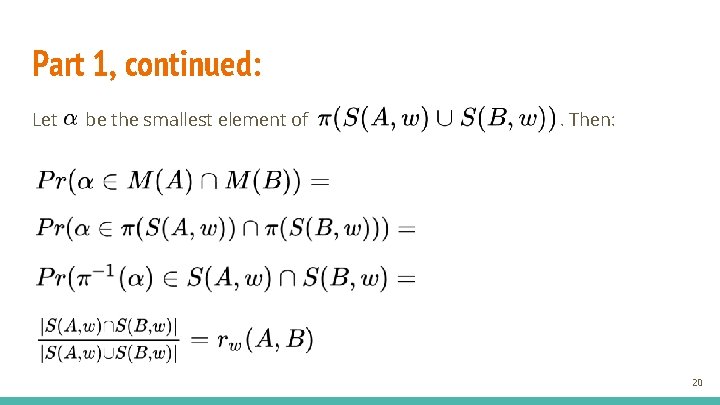
Part 1, continued: Let be the smallest element of . Then: 20
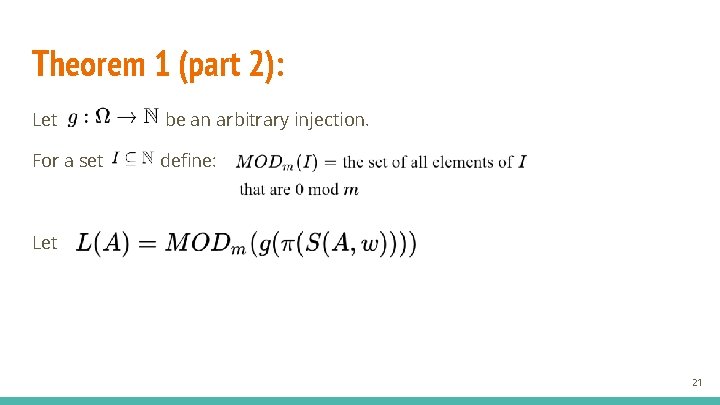
Theorem 1 (part 2): Let be an arbitrary injection. For a set define: Let 21
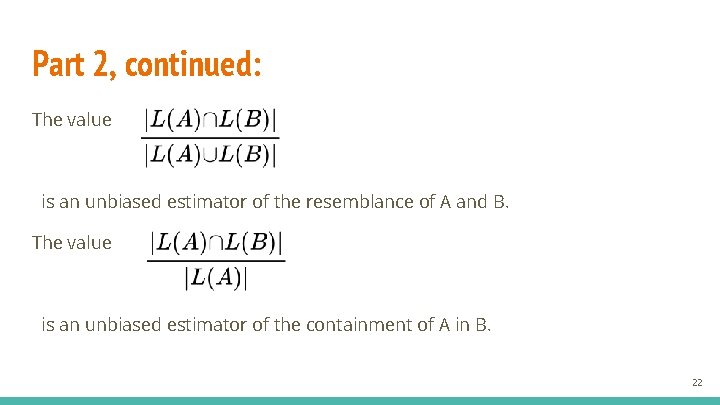
Part 2, continued: The value is an unbiased estimator of the resemblance of A and B. The value is an unbiased estimator of the containment of A in B. 22
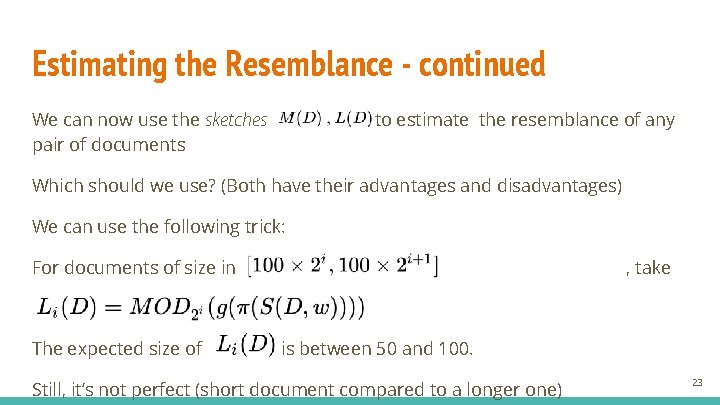
Estimating the Resemblance - continued We can now use the sketches pair of documents to estimate the resemblance of any Which should we use? (Both have their advantages and disadvantages) We can use the following trick: For documents of size in The expected size of , take is between 50 and 100. Still, it’s not perfect (short document compared to a longer one) 23
BREAK ● Motivation V ● Some definitions V ● Estimating resemblance and containment ● Implementation Details ● Experimental results ● Summary V 24
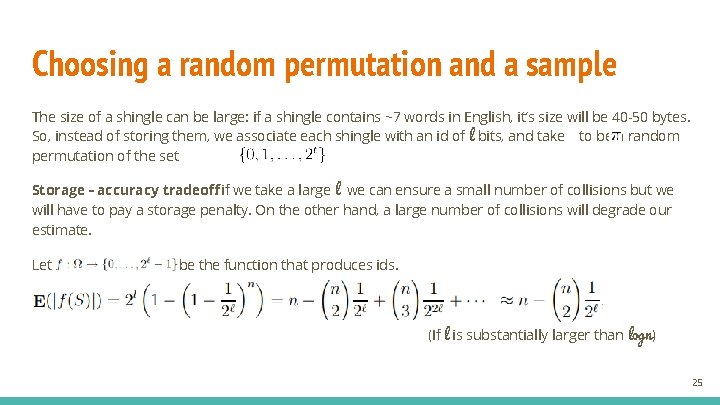
Choosing a random permutation and a sample The size of a shingle can be large: if a shingle contains ~7 words in English, it’s size will be 40 -50 bytes. So, instead of storing them, we associate each shingle with an id of l bits, and take to be a random permutation of the set. Storage - accuracy tradeoff: if we take a large l we can ensure a small number of collisions but we will have to pay a storage penalty. On the other hand, a large number of collisions will degrade our estimate. Let be the function that produces ids. (If l is substantially larger than logn) 25
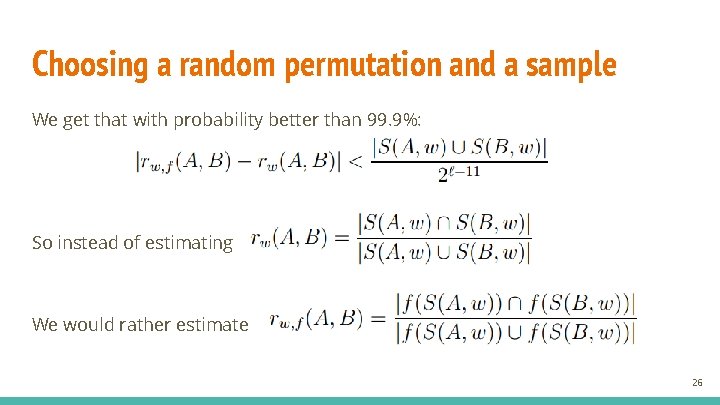
Choosing a random permutation and a sample We get that with probability better than 99. 9%: So instead of estimating We would rather estimate 26
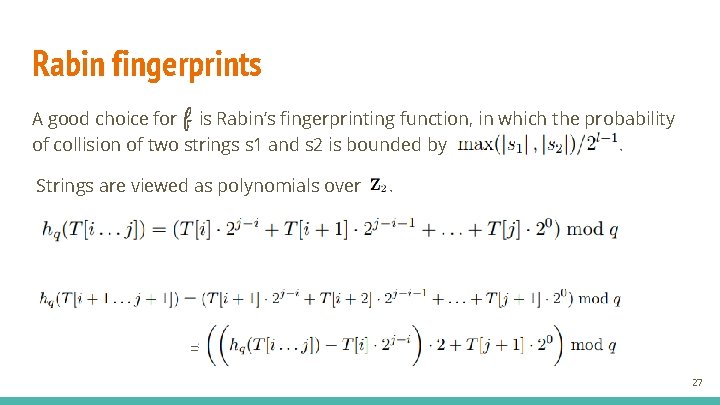
Rabin fingerprints A good choice for f is Rabin’s fingerprinting function, in which the probability of collision of two strings s 1 and s 2 is bounded by. Strings are viewed as polynomials over . = 27
Rabin fingerprints The efficient rolling hash calculation allows us to compute the fingerprints of all shingles in O(n) instead of O(wn). In general - if a word is shorter we can pad, if it is longer we can split. 28
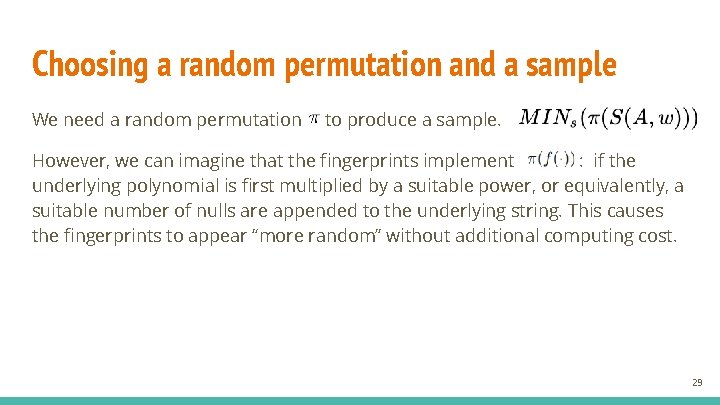
Choosing a random permutation and a sample We need a random permutation to produce a sample. However, we can imagine that the fingerprints implement : if the underlying polynomial is first multiplied by a suitable power, or equivalently, a suitable number of nulls are appended to the underlying string. This causes the fingerprints to appear “more random” without additional computing cost. 29
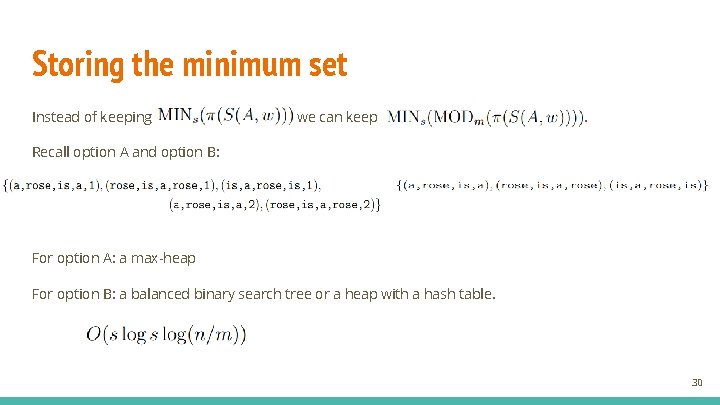
Storing the minimum set Instead of keeping we can keep . Recall option A and option B: For option A: a max-heap For option B: a balanced binary search tree or a heap with a hash table. 30
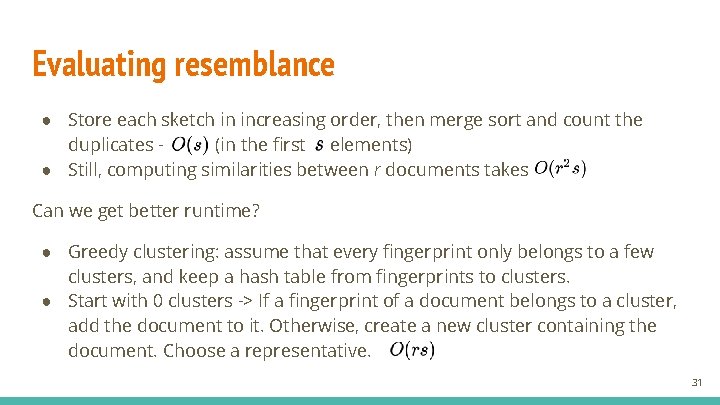
Evaluating resemblance ● Store each sketch in increasing order, then merge sort and count the duplicates (in the first elements) ● Still, computing similarities between r documents takes Can we get better runtime? ● Greedy clustering: assume that every fingerprint only belongs to a few clusters, and keep a hash table from fingerprints to clusters. ● Start with 0 clusters -> If a fingerprint of a document belongs to a cluster, add the document to it. Otherwise, create a new cluster containing the document. Choose a representative. 31
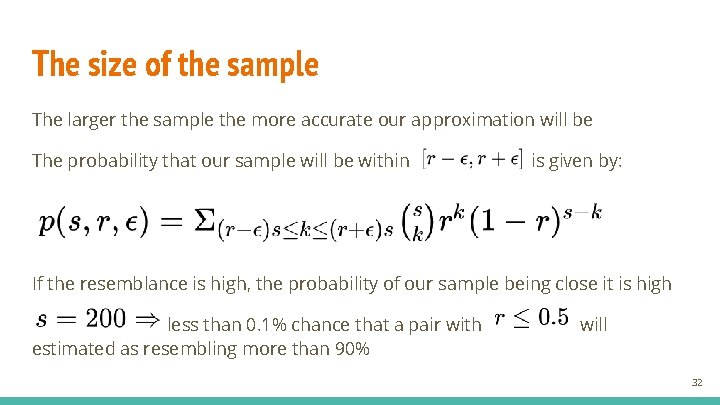
The size of the sample The larger the sample the more accurate our approximation will be The probability that our sample will be within is given by: If the resemblance is high, the probability of our sample being close it is high less than 0. 1% chance that a pair with estimated as resembling more than 90% will 32
Experimental results ● A clustering experiment of a collection of over 30, 000 documents, total input data > 150 Gb ○ ○ ○ ○ ● Sketching each document with 10 -words long shingles Running Rabin fingerprints with l = 40 to produce 40 -bit fingerprints Keeping 1 in 25 shingles Mapping every shingle to the documents it appears in a sorted <shingle, ID> list Creating <ID, 1> triples for every shingle that 2 documents share Summing the triples to <ID, count> triples Setting resemblance threshold to 50%, assigning documents to clusters and holding them in a union-find structure (in memory) Resulted in 3. 6 million clusters containing a total of 12. 3 million documents ○ ○ 2. 1 million clusters contained 5. 3 million identical documents 1. 5 million clusters contained 7 million documents (identical and similar) 33
Summary We presented an approach to estimating similarity and containment between documents. This approach is modeled as set intersection problem. The relative size of the intersections is evaluated by a process of random sampling; We showed that applying a good hash function and comparing only the minimum representative sets under it is a sufficient estimator. The process is done independently for each document, in linear time. 34

Any questions? Thank you! 35
- Slides: 35