
On the origin of the spinorbit alignment in
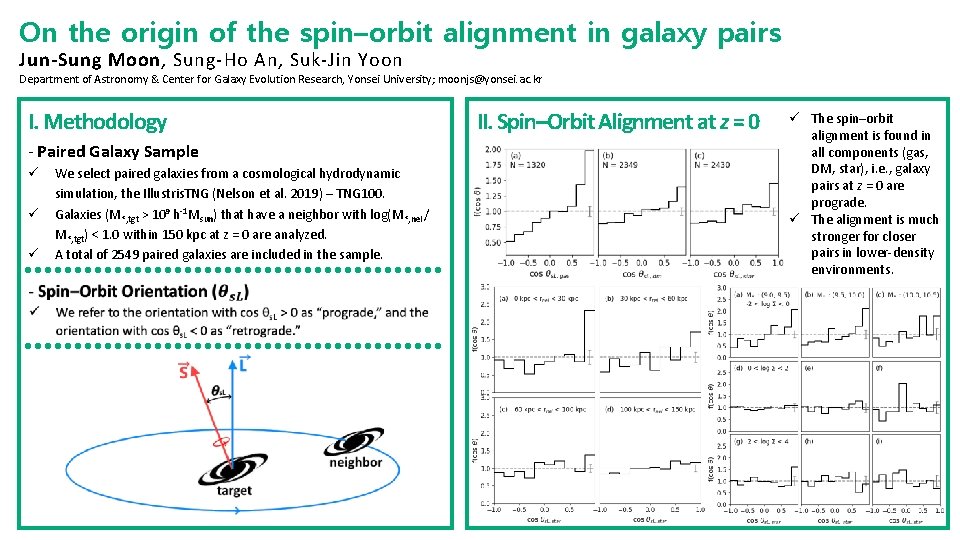
On the origin of the spin–orbit alignment in galaxy pairs Jun-Sung Moon, Sung-Ho An, Suk-Jin Yoon Department of Astronomy & Center for Galaxy Evolution Research, Yonsei University; moonjs@yonsei. ac. kr I. Methodology - Paired Galaxy Sample ü ü ü We select paired galaxies from a cosmological hydrodynamic simulation, the Illustris. TNG (Nelson et al. 2019) – TNG 100. Galaxies (M*, tgt > 109 h-1 Msun) that have a neighbor with log(M*, nei / M*, tgt) < 1. 0 within 150 kpc at z = 0 are analyzed. A total of 2549 paired galaxies are included in the sample. II. Spin–Orbit Alignment at z = 0 ü The spin–orbit alignment is found in all components (gas, DM, star), i. e. , galaxy pairs at z = 0 are prograde. ü The alignment is much stronger for closer pairs in lower-density environments.
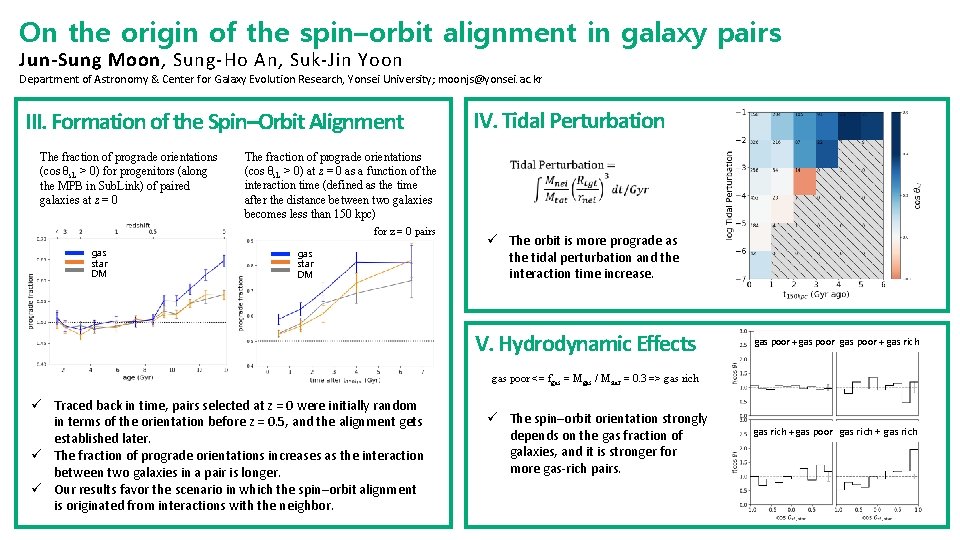
On the origin of the spin–orbit alignment in galaxy pairs Jun-Sung Moon, Sung-Ho An, Suk-Jin Yoon Department of Astronomy & Center for Galaxy Evolution Research, Yonsei University; moonjs@yonsei. ac. kr III. Formation of the Spin–Orbit Alignment The fraction of prograde orientations (cos θs. L > 0) for progenitors (along the MPB in Sub. Link) of paired galaxies at z = 0 The fraction of prograde orientations (cos θs. L > 0) at z = 0 as a function of the interaction time (defined as the time after the distance between two galaxies becomes less than 150 kpc) for z = 0 pairs gas star DM IV. Tidal Perturbation gas star DM ü The orbit is more prograde as the tidal perturbation and the interaction time increase. V. Hydrodynamic Effects gas poor + gas rich gas poor <= fgas = Mgas / Mstar = 0. 3 => gas rich ü Traced back in time, pairs selected at z = 0 were initially random in terms of the orientation before z = 0. 5, and the alignment gets established later. ü The fraction of prograde orientations increases as the interaction between two galaxies in a pair is longer. ü Our results favor the scenario in which the spin–orbit alignment is originated from interactions with the neighbor. ü The spin–orbit orientation strongly depends on the gas fraction of galaxies, and it is stronger for more gas-rich pairs. gas rich + gas poor gas rich + gas rich
- Slides: 2