
On the optimal taper geometry S A NTIPOV
- Slides: 6
On the optimal taper geometry S. A NTIPOV 02. 11. 18 MANY T HANKS TO EMANUELA, NIC OLO , AND BENOIT
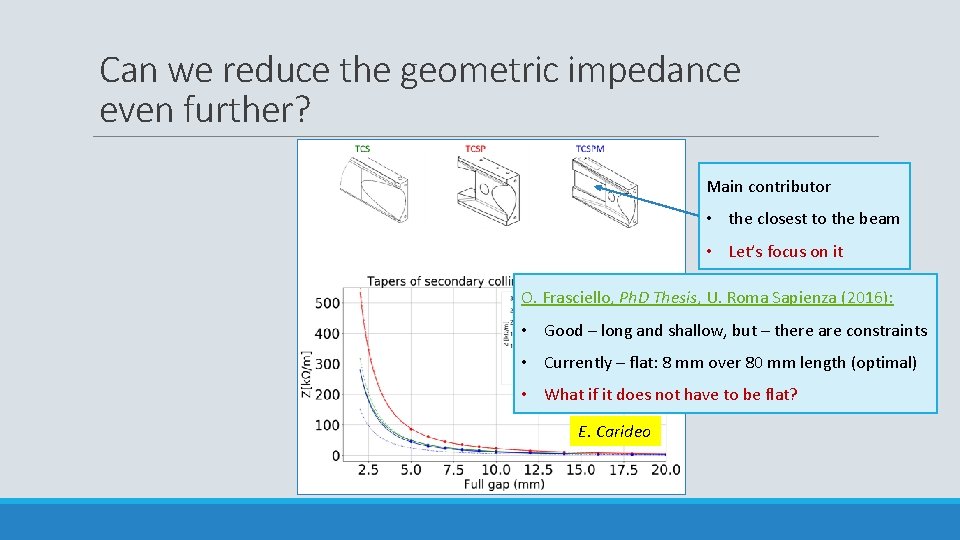
Can we reduce the geometric impedance even further? Main contributor • the closest to the beam • Let’s focus on it O. Frasciello, Ph. D Thesis, U. Roma Sapienza (2016): • Good – long and shallow, but – there are constraints • Currently – flat: 8 mm over 80 mm length (optimal) • What if it does not have to be flat? E. Carideo
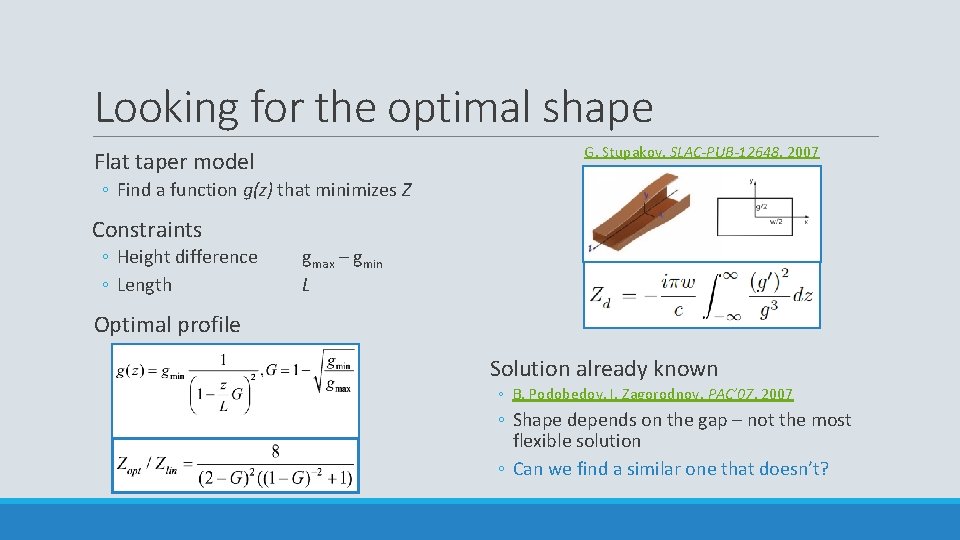
Looking for the optimal shape G. Stupakov, SLAC-PUB-12648, 2007 Flat taper model ◦ Find a function g(z) that minimizes Z Constraints ◦ Height difference ◦ Length gmax – gmin L Optimal profile Solution already known ◦ B. Podobedov, I. Zagorodnov, PAC’ 07, 2007 ◦ Shape depends on the gap – not the most flexible solution ◦ Can we find a similar one that doesn’t?
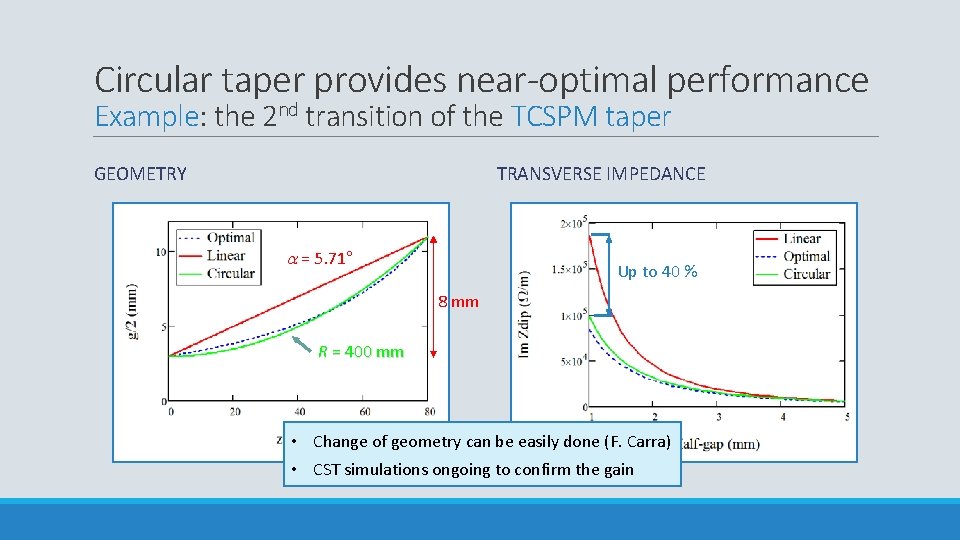
Circular taper provides near-optimal performance Example: the 2 nd transition of the TCSPM taper GEOMETRY TRANSVERSE IMPEDANCE a = 5. 71° Up to 40 % 8 mm R = 400 mm • Change of geometry can be easily done (F. Carra) • CST simulations ongoing to confirm the gain
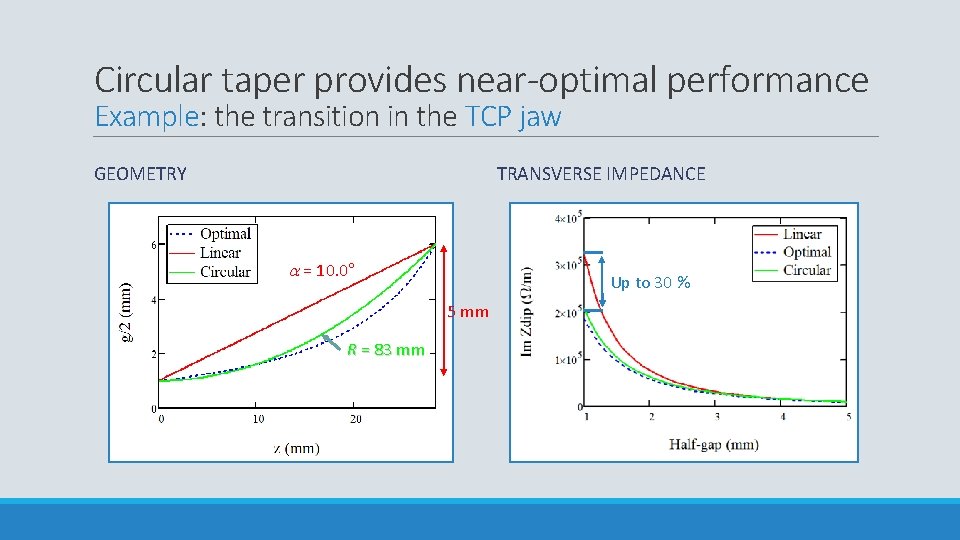
Circular taper provides near-optimal performance Example: the transition in the TCP jaw GEOMETRY TRANSVERSE IMPEDANCE a = 10. 0° Up to 30 % 5 mm R = 83 mm
Conclusion A rounded transition provides a near-optimal reduction of a broadband taper impedance ◦ Does not depend on the gap – suitable solution for the collimators Significant geometric impedance reduction for smaller gaps ◦ Up to 40% for the TCSPM tapers of the IR-7 secondary collimators ◦ Up to 30% for the Primary jaws in IR-7