
On the Main Sequence n Behaviour of a
On the Main Sequence n Behaviour of a main sequence star – Stable hydrogen burning n Characterised by slow evolution – As the He concentration rises, the core slowly contracts and heats up – Power output slowly rises eg, the sun is now somewhat hotter (5800 K rather than 5500 K) and 6% greater in radius than when it first formed (~5 x 10⁹ years ago) n and therefore some 40% more luminous n
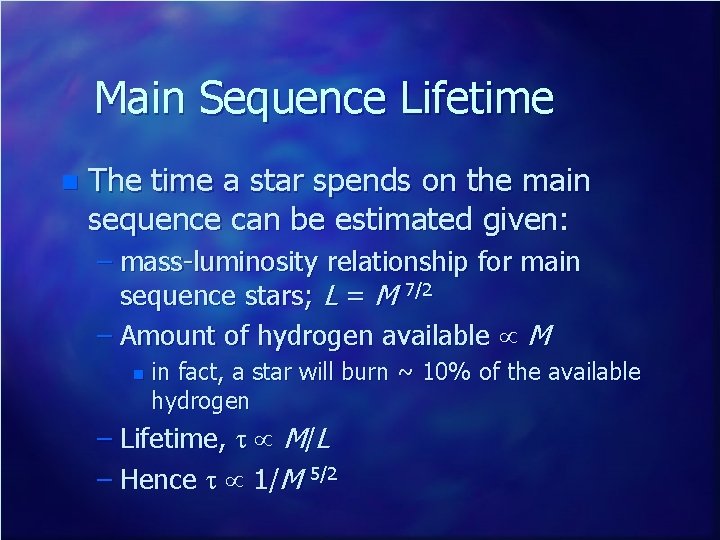
Main Sequence Lifetime n The time a star spends on the main sequence can be estimated given: – mass-luminosity relationship for main sequence stars; L = M 7/2 – Amount of hydrogen available µ M n in fact, a star will burn ~ 10% of the available hydrogen – Lifetime, t µ M/L – Hence t µ 1/M 5/2
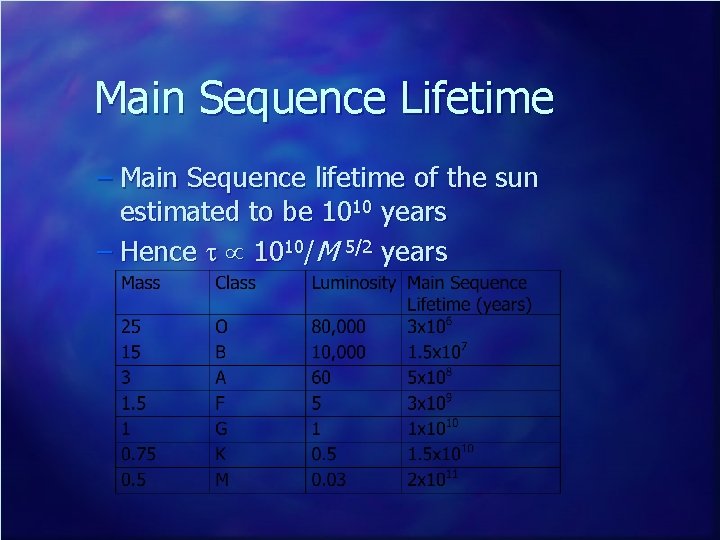
Main Sequence Lifetime – Main Sequence lifetime of the sun estimated to be 1010 years – Hence t µ 1010/M 5/2 years
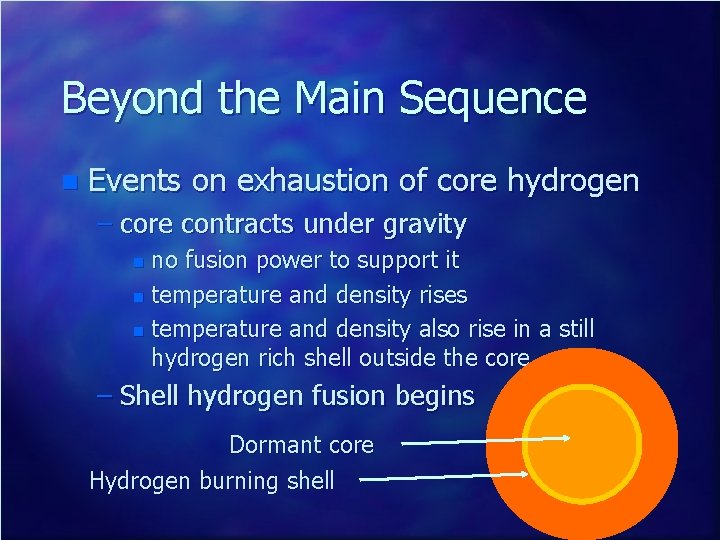
Beyond the Main Sequence n Events on exhaustion of core hydrogen – core contracts under gravity no fusion power to support it n temperature and density rises n temperature and density also rise in a still hydrogen rich shell outside the core n – Shell hydrogen fusion begins Dormant core Hydrogen burning shell
Beyond the Main Sequence – Helium “ash” from the shell falls into the core – Core mass increases, contraction continues n Temperatures and densities rise further – For a 1 solar mass star, this phase lasts ~ 1 x 10⁸ years – Core radius shrinks to ~ 1/3 of original size n from ~ 25% to ~ 10% of the total radius for a sun-like star – Temperature rises to ~ 108 K
Beyond the Main Sequence n External appearance – Dramatic changes – Increased energy output from the core leads to expansion and cooling of outer layers – Luminosity increases markedly – The star has become a Red Giant
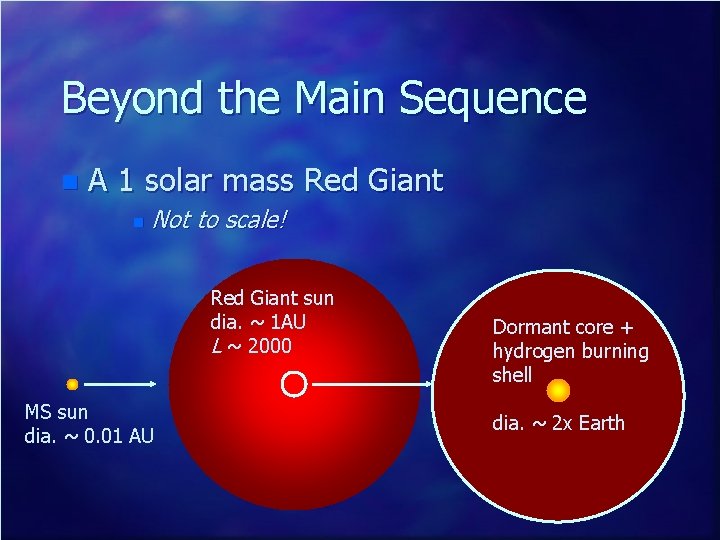
Beyond the Main Sequence n A 1 solar mass Red Giant n Not to scale! Red Giant sun dia. ~ 1 AU L ~ 2000 MS sun dia. ~ 0. 01 AU Dormant core + hydrogen burning shell dia. ~ 2 x Earth
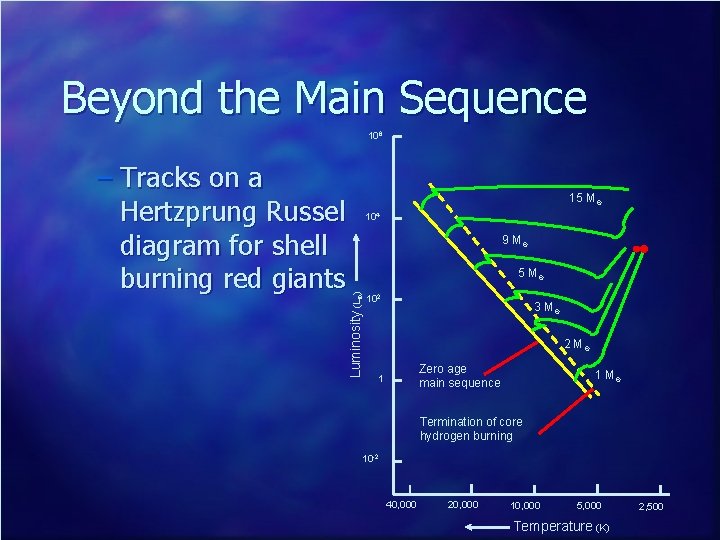
Beyond the Main Sequence 106 15 M¤ 104 9 M¤ 5 M¤ Luminosity (L¤) – Tracks on a Hertzprung Russel diagram for shell burning red giants 102 3 M¤ 2 M¤ Zero age main sequence 1 1 M¤ Termination of core hydrogen burning 10 -2 40, 000 20, 000 10, 000 5, 000 Temperature (K) 2, 500
Helium Burning – Core temperatures and densities are now high enough for helium burning to commence via the triple alpha process – Start of helium burning depends on the mass of a star – High mass stars (>2 solar masses) n Helium burning begins gradually – Low mass stars n Helium ignites explosively in a “Helium Flash”
The Helium Flash – The Helium Flash occurs in low mass stars because of the properties of the core – To achieve helium ignition, the core density reaches levels where quantum effects become important n A degenerate electron gas forms – Degenerate gas pressure independent of temperature

The Helium Flash – On helium ignition, energy production restarts in the core – Core temperature rises – Pressure (and hence density) does not drop n in a normal gas this would slow down the reaction rate, preventing a runaway reaction – Helium burning rate continues to increase n recall large temperature dependence!
The Helium Flash – Eventually temperatures rise sufficiently to lift the electron degeneracy – The pressure can now drop, slowing the reaction – These events take place in a few seconds! – Stable helium burning now commences

The Helium Flash n Consequences: – No leap in luminosity - energy absorbed internally n Lifting degeneracy and expanding the core – Hydrogen shell burning reduces n Temperature in this region drops – Total power output drops Outer layers contract and heat up n Luminosity decreases n
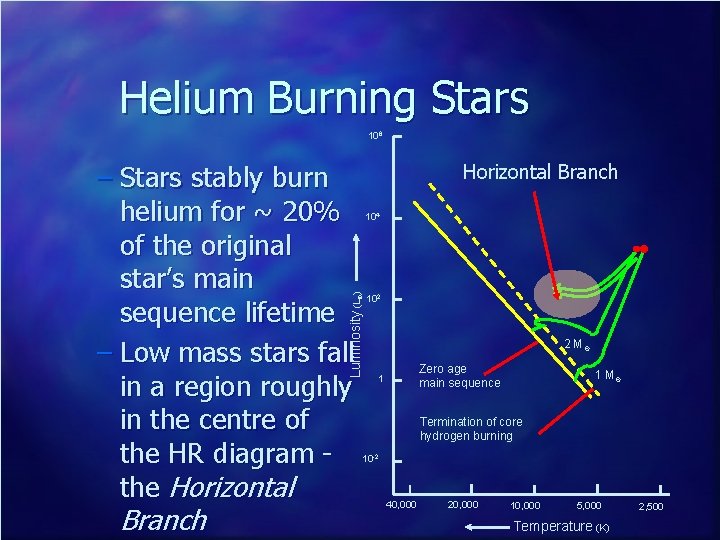
Helium Burning Stars 106 Horizontal Branch 104 Luminosity (L¤) – Stars stably burn helium for ~ 20% of the original star’s main sequence lifetime – Low mass stars fall in a region roughly in the centre of the HR diagram the Horizontal Branch 102 2 M¤ Zero age main sequence 1 1 M¤ Termination of core hydrogen burning 10 -2 40, 000 20, 000 10, 000 5, 000 Temperature (K) 2, 500
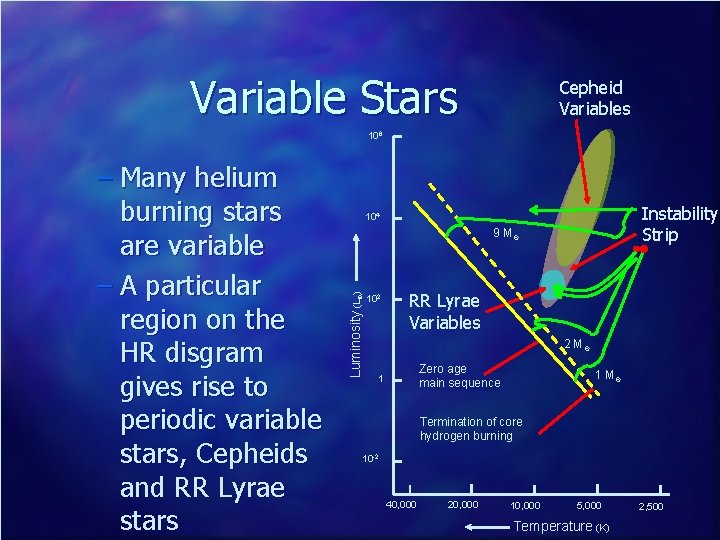
Variable Stars Cepheid Variables 106 Instability Strip 104 9 M¤ Luminosity (L¤) – Many helium burning stars are variable – A particular region on the HR disgram gives rise to periodic variable stars, Cepheids and RR Lyrae stars 102 RR Lyrae Variables 2 M¤ Zero age main sequence 1 1 M¤ Termination of core hydrogen burning 10 -2 40, 000 20, 000 10, 000 5, 000 Temperature (K) 2, 500
Cepheid Variables n Prototype, d Cephei – Luminosity varies by a factor of 2. 3 over a 5. 4 day period – Studies of the spectrum shows this is due to expansion and contraction of the star – The star’s temperature also changes n cooling on expansion, heating on contraction
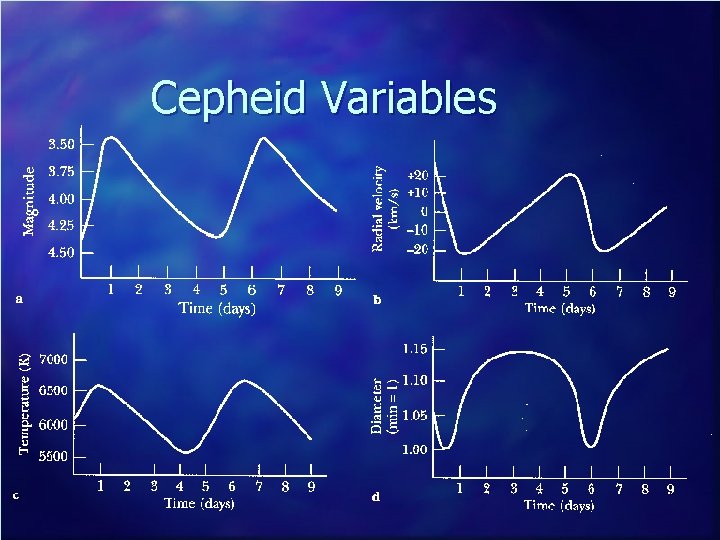
Cepheid Variables
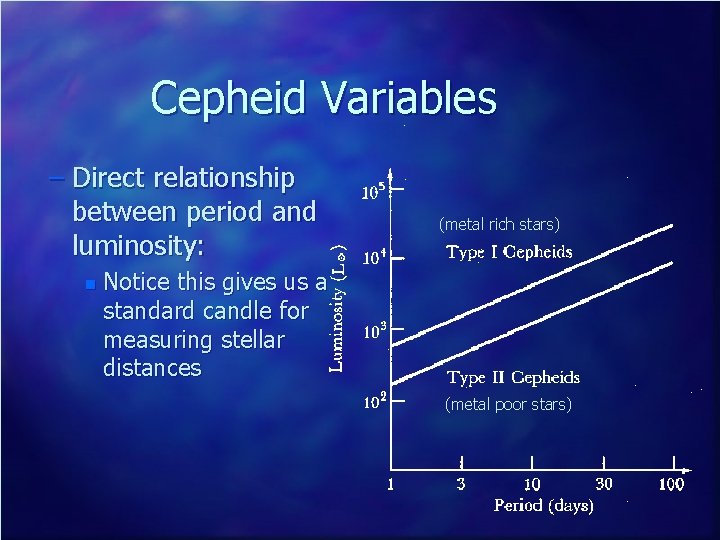
Cepheid Variables – Direct relationship between period and luminosity: n (metal rich stars) Notice this gives us a standard candle for measuring stellar distances (metal poor stars)
Cepheid Variables n Mechanism – Normally, oscillations of this type would be damped out. – A feasible mechanism would require: the star to trap heat when compressed (increasing pressure and driving expansion) n the star to release heat when expanded (allowing contraction) n
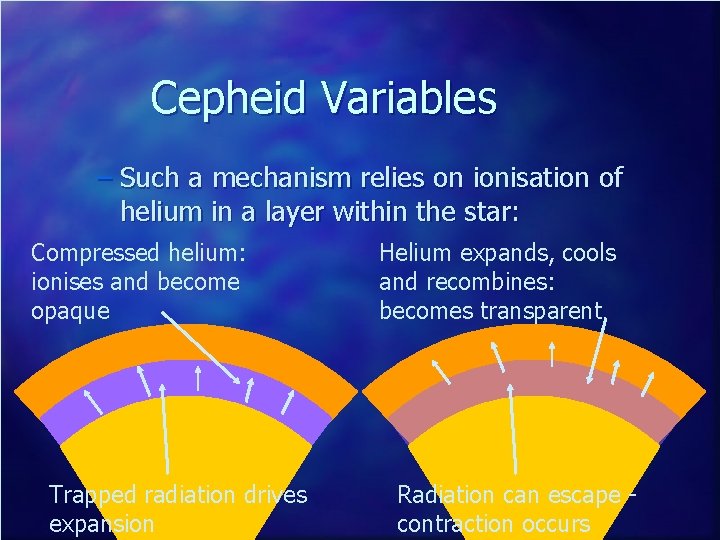
Cepheid Variables – Such a mechanism relies on ionisation of helium in a layer within the star: Compressed helium: ionises and become opaque Trapped radiation drives expansion Helium expands, cools and recombines: becomes transparent Radiation can escape contraction occurs
Cepheid Variables – Not all stars pulsate because either: – the star is too cool for an ionised helium layer to exist near the surface n occurs deeper, but convection disrupts it – in hot stars, the ionised helium layer is too close to the surface n insufficient density to trap radiation
RR Lyrae Variables n Low mass stars on the horizontal branch – Periods typically shorter than one day – All roughly the same luminosity – Another standard candle
Post-Helium Burning n Core helium burning lasts for ~20% of the main sequence lifetime – What happens next? – Depends on the mass of the star – Next Lecture - The Deaths of Stars
The Death of a Low Mass Star n Evolution of a sun-like star post heliumflash – The star moves onto the horizontal branch of the Hertzprung-Russell diagram – Helium burning produces carbon and oxygen “ash” – Eventually, the helium concentration falls too low to sustain burning in the core
Post Core Helium Burning n Similar sequence of events to the end of hydrogen burning – Core contraction and heating – Degenerate carbon/oxygen core forms – Helium shell burning commences
Post Core Helium Burning n External Appearance – The star moves off the horizontal branch and ascends the red giant region again, becoming even larger and more luminous – The star is now an Asymptotic Giant and is on the Asymptotic Giant Branch
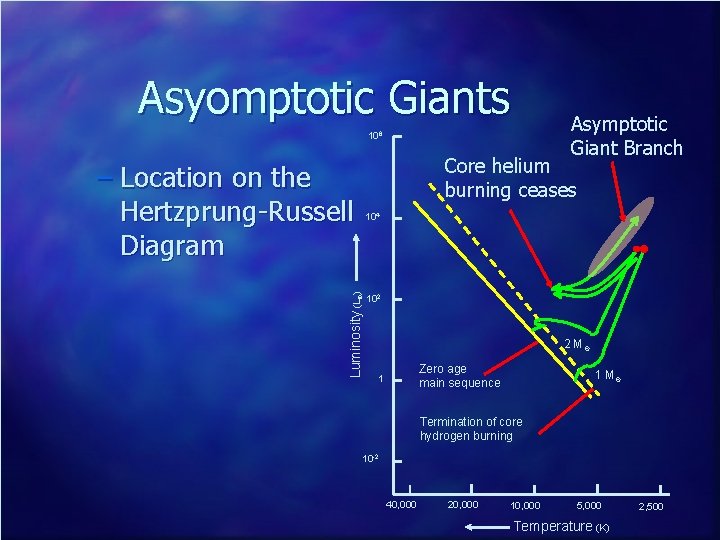
Asyomptotic Giants Asymptotic Giant Branch 106 Core helium burning ceases – Location on the Hertzprung-Russell Diagram Luminosity (L¤) 104 102 2 M¤ Zero age main sequence 1 1 M¤ Termination of core hydrogen burning 10 -2 40, 000 20, 000 10, 000 5, 000 Temperature (K) 2, 500
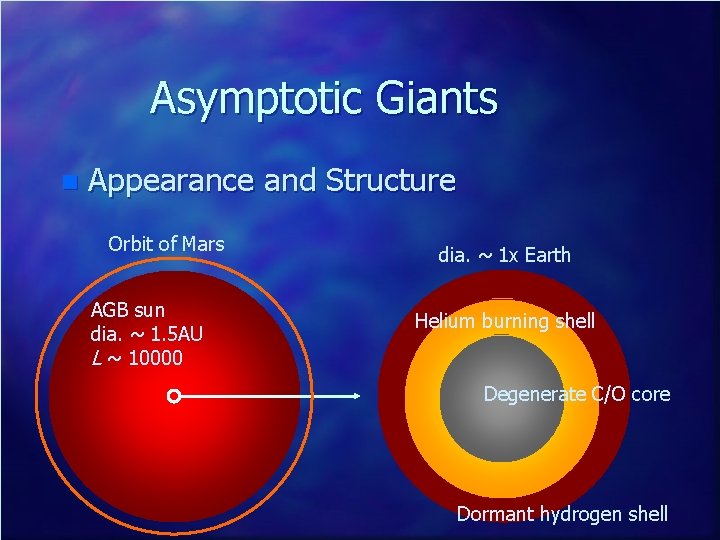
Asymptotic Giants n Appearance and Structure Orbit of Mars AGB sun dia. ~ 1. 5 AU L ~ 10000 dia. ~ 1 x Earth Helium burning shell Degenerate C/O core Dormant hydrogen shell
Asymptotic Giants n Material Redistribution – Convection layers may reach to the core – Carbon and oxygen brought to the surface – In consequence, molecular absorption bands often seen in the spectra of AGB stars – Soot coccoons may also form around such carbon stars
Late Evolution – As helium is consumed, the core contracts and heats up. – The hydrogen shell may re-ignite, producing more helium which re-fuels the temporarily depleted shell – Helium shell burning re-ignites in a helium shell flash, leading to a short-lived spike of luminosity - a Thermal Pulse – Luminosity rises by ~ 2
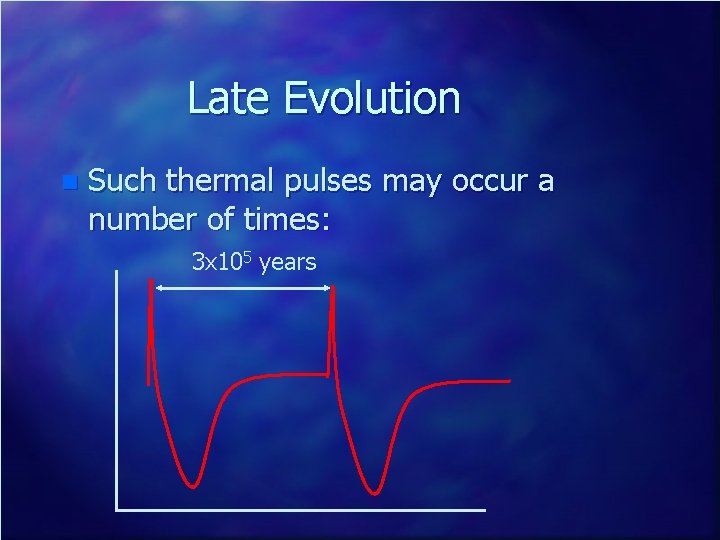
Late Evolution n Such thermal pulses may occur a number of times: 3 x 10⁵ years
Late Evolution n AGB stars produce strong stellar winds – Typical mass loss ~ 10 -4 solar masses per year 103 x a “normal” red giant n 1010 x the sun n – Combined with thermal pulses, such winds drive off the outer layers of the star – As much as 40% of a star’s mass may be lost in this way
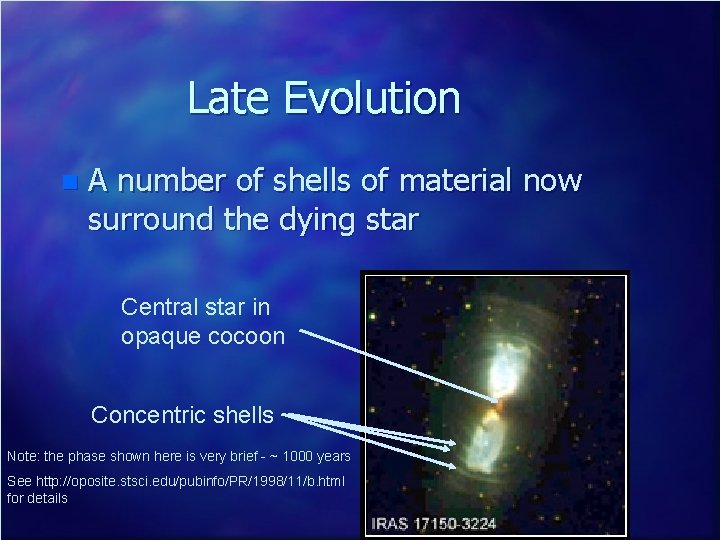
Late Evolution n A number of shells of material now surround the dying star Central star in opaque cocoon Concentric shells Note: the phase shown here is very brief - ~ 1000 years See http: //oposite. stsci. edu/pubinfo/PR/1998/11/b. html for details
The Final Stages n Ultimately, the hot carbon/oxygen core is exposed – Core surface temperature ~ 100, 000 K – Sufficient UV produced to ionise and excite the outer layers n The spectrum is now characterised by emission lines
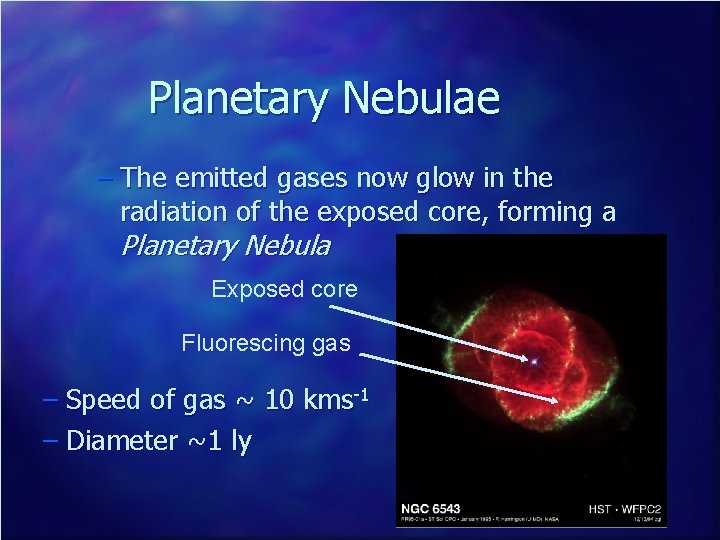
Planetary Nebulae – The emitted gases now glow in the radiation of the exposed core, forming a Planetary Nebula Exposed core Fluorescing gas – Speed of gas ~ 10 kms-1 – Diameter ~1 ly
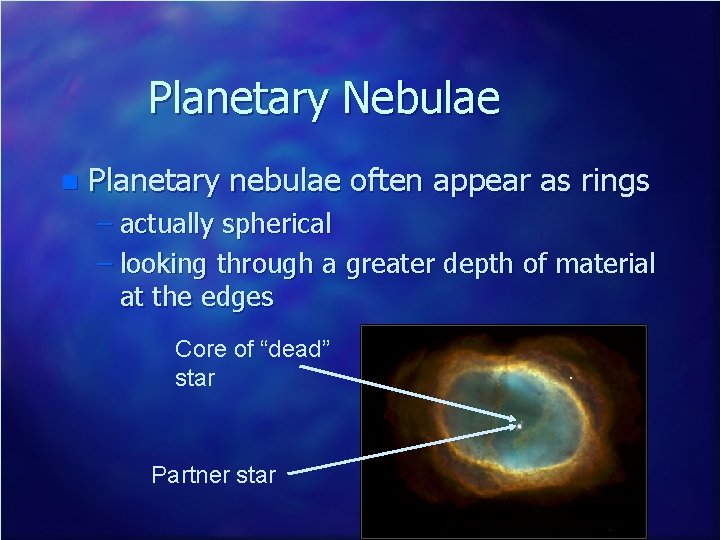
Planetary Nebulae n Planetary nebulae often appear as rings – actually spherical – looking through a greater depth of material at the edges Core of “dead” star Partner star
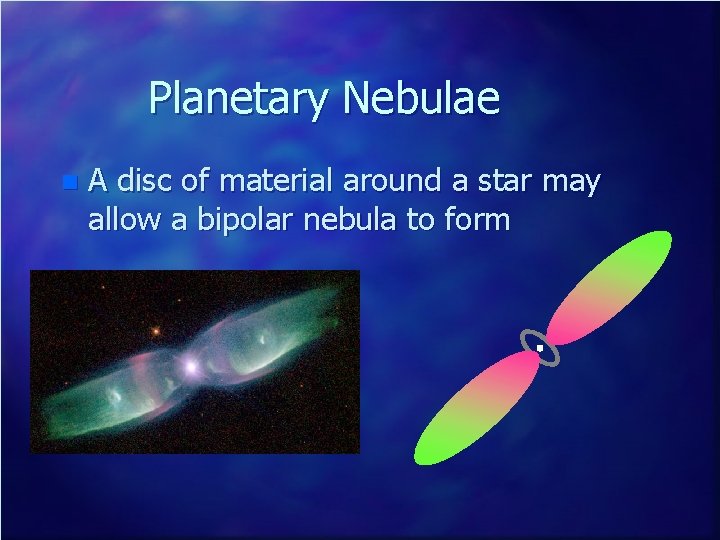
Planetary Nebulae n A disc of material around a star may allow a bipolar nebula to form
Planetary Nebulae n The planetary nebula phase is relatively short lived – The nebulae in the previous slides are estimated to be only a few thousand years old – The material rapidly disperses, leaving the central core
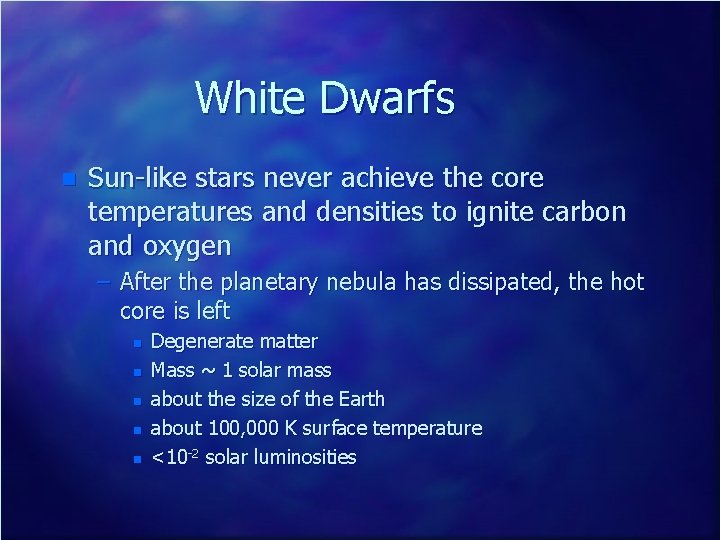
White Dwarfs n Sun-like stars never achieve the core temperatures and densities to ignite carbon and oxygen – After the planetary nebula has dissipated, the hot core is left n n n Degenerate matter Mass ~ 1 solar mass about the size of the Earth about 100, 000 K surface temperature <10 -2 solar luminosities
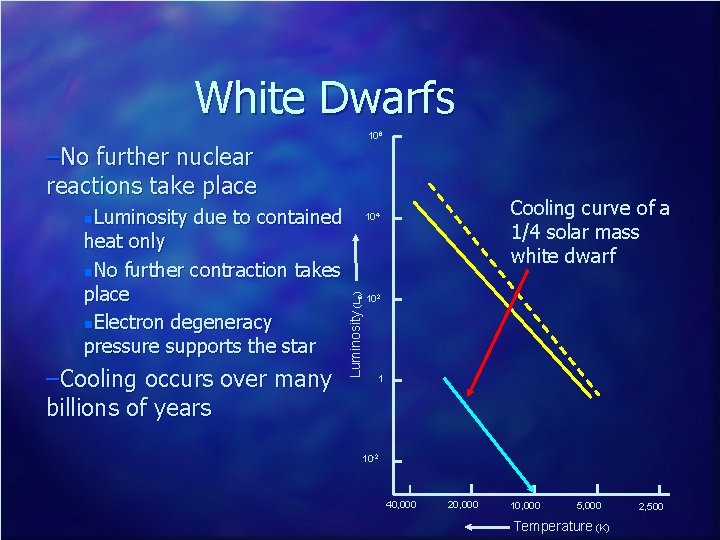
White Dwarfs 106 –No further nuclear reactions take place Luminosity due to contained heat only n. No further contraction takes place n. Electron degeneracy pressure supports the star Luminosity (L¤) –Cooling occurs over many billions of years Cooling curve of a 1/4 solar mass white dwarf 104 n 102 1 10 -2 40, 000 20, 000 10, 000 5, 000 Temperature (K) 2, 500
White Dwarfs n Bizarre properties: – All as a consequence of the properties of degenerate matter – Higher mass white dwarfs are smaller n hence dimmer – Maximum mass ~1. 4 solar masses n the Chandrasekhar Limit – These properties will be explored in a future lecture
The Death of a High Mass Star n High mass stars behave very differently – Higher core temperatures and densities imply burning beyond oxygen – Final stages often violent, leaving remnants even more bizarre than white dwarfs – To be discussed in the next lecture
- Slides: 42