
On the least covering radius of the binary
On the least covering radius of the binary linear codes of dimension 6 Tsonka Baicheva and Iliya Bouyukliev Institute of Mathematics and Informatics, Bulgaria
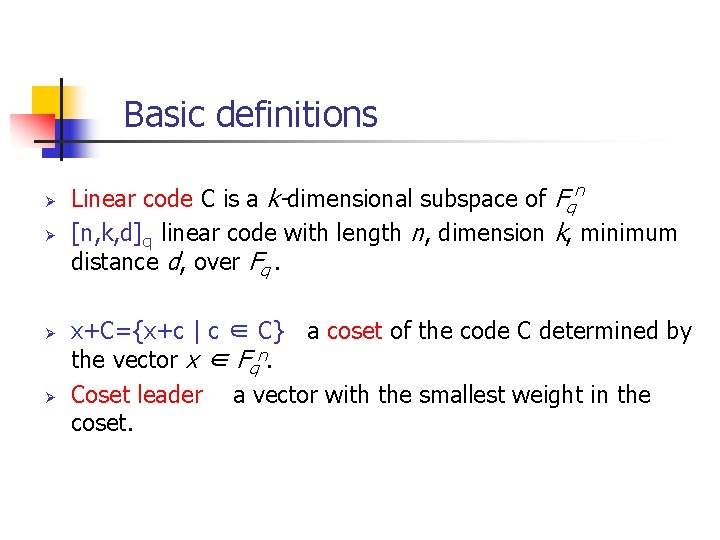
Basic definitions Ø Ø Linear code C is a k-dimensional subspace of Fqn [n, k, d]q linear code with length n, dimension k, minimum distance d, over Fq. x+C={x+c | c ∈ C} a coset of the code C determined by the vector x ∈ Fqn. Coset leader a vector with the smallest weight in the coset.
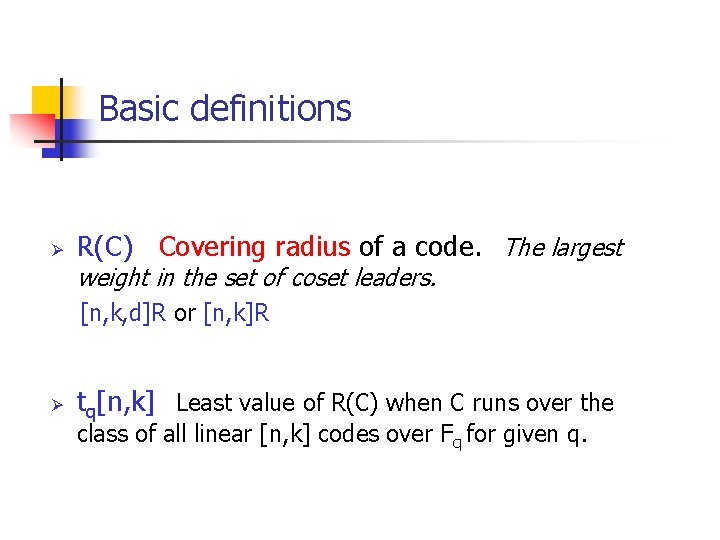
Basic definitions Ø R(C) Covering radius of a code. The largest weight in the set of coset leaders. [n, k, d]R or [n, k]R Ø tq[n, k] Least value of R(C) when C runs over the class of all linear [n, k] codes over Fq for given q.
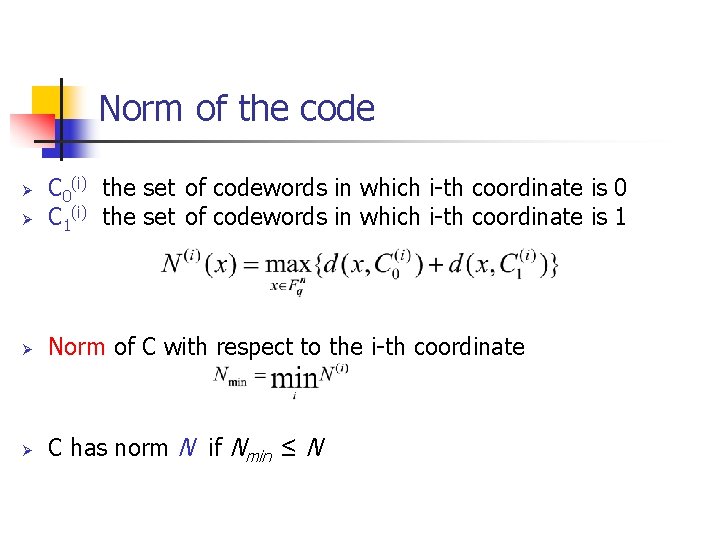
Norm of the code Ø C 0(i) the set of codewords in which i-th coordinate is 0 C 1(i) the set of codewords in which i-th coordinate is 1 Ø Norm of C with respect to the i-th coordinate Ø C has norm N if Nmin ≤ N Ø

Basic definitions Ø Ø C is normal if it has norm 2 R+1 If N(i) ≤ 2 R+1 then the i-th coordinate is acceptable with respect to 2 R+1 Theorem If C is an [n, k, d] code with n≤ 15, k≤ 5 or n-k≤ 9, then C is normal.
![ADS construction IA [n. A, k. A]RA IB [n. B, k. B]RB 0 IA](http://slidetodoc.com/presentation_image_h2/687cffa56d65d53136dec73a5d62016f/image-6.jpg "ADS construction IA [n. A, k. A]RA IB [n. B, k. B]RB 0 IA")
ADS construction IA [n. A, k. A]RA IB [n. B, k. B]RB 0 IA 0 IB [n. A+n. B-1, k. A+k. B-1]R. A⊕B R≤RA+RB = {(a, 0, b)|(a, 0)∈A, (0, b)∈B} ∪ {(a, 1, b)|(a, 1)∈A, (1, b)∈B}
![t 2[n, k], k≤ 5 Cohen, Karpovsky, Mattson, Jr. , Schatz ’ 85 Graham](http://slidetodoc.com/presentation_image_h2/687cffa56d65d53136dec73a5d62016f/image-7.jpg "t 2[n, k], k≤ 5 Cohen, Karpovsky, Mattson, Jr. , Schatz ’ 85 Graham")
t 2[n, k], k≤ 5 Cohen, Karpovsky, Mattson, Jr. , Schatz ’ 85 Graham and Sloane ’ 85
![t 2[n, 6] n 7 8 9 10 11 12 13 14 15 16](http://slidetodoc.com/presentation_image_h2/687cffa56d65d53136dec73a5d62016f/image-8.jpg "t 2[n, 6] n 7 8 9 10 11 12 13 14 15 16")
t 2[n, 6] n 7 8 9 10 11 12 13 14 15 16 t 2[n, 6] 1 1 1 2 2 3 3 3 4 4 n 17 18 19 20 21 22 23 24 25 26 t 2[n, 6] 5 5 5 6 6 6 -7 7 7 -8 8 -9 n 27 28 29 30 31 32 33 34 35 36 t 2[n, 6] 8 -9 9 -10 9 -11 n 37 38 39 40 t 2[n, 6] n t 2[n, 6] 10 -11 10 -12 11 -12 41 42 43 12 -14 13 -15 14 -16 14 -17 15 -17 47 48 49 50 51 52 53 17 -19 17 -20 18 -21 19 -22 57 58 59 60 61 62 63 21 -24 21 -25 22 -26 23 -27 11 -13 44 15 -18 54 20 -23 64 24 -28 11 -13 12 -14 45 46 16 -18 16 -19 55 56 20 -23 20 -24
![t 2[n, 6] Graham and Sloane ‘ 85](http://slidetodoc.com/presentation_image_h2/687cffa56d65d53136dec73a5d62016f/image-9.jpg "t 2[n, 6] Graham and Sloane ‘ 85")
t 2[n, 6] Graham and Sloane ‘ 85
![t 2[22, 6]=6 -7 If [22, 6] code C contains a repeated coordinate R(C)≥t](http://slidetodoc.com/presentation_image_h2/687cffa56d65d53136dec73a5d62016f/image-10.jpg "t 2[22, 6]=6 -7 If [22, 6] code C contains a repeated coordinate R(C)≥t")
t 2[22, 6]=6 -7 If [22, 6] code C contains a repeated coordinate R(C)≥t 2[20, 6]+1=7 ⇒ If a [22, 6] code has covering radius 6 it must be a projective one. Ø Ø Ø Bouyukliev ‘ 2006 Classification of all binary projective codes of dimension up to 6. There are 2 852 541 [22, 6] nonequavalent projective codes.
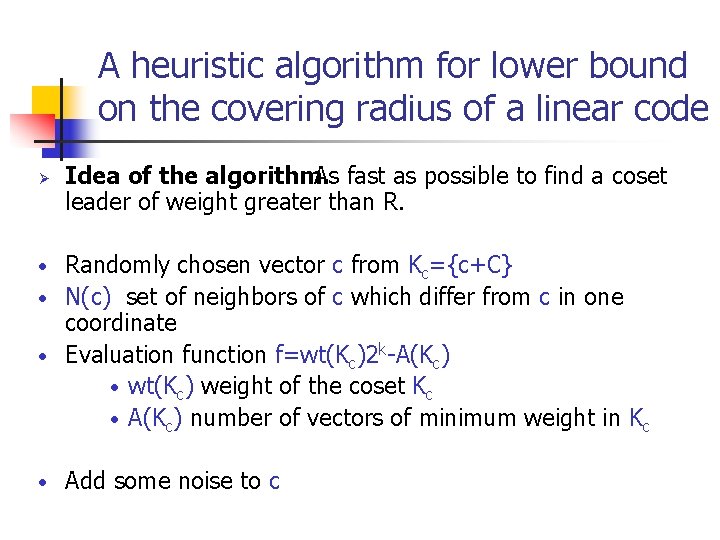
A heuristic algorithm for lower bound on the covering radius of a linear code Ø Idea of the algorithm. As fast as possible to find a coset leader of weight greater than R. Randomly chosen vector c from Kc={c+C} • N(c) set of neighbors of c which differ from c in one coordinate • Evaluation function f=wt(Kc)2 k-A(Kc) • wt(Kc) weight of the coset Kc • A(Kc) number of vectors of minimum weight in Kc • • Add some noise to c
![t 2[n, 6] Ø We show the nonexistence of 236 779 414 projective codes](http://slidetodoc.com/presentation_image_h2/687cffa56d65d53136dec73a5d62016f/image-12.jpg "t 2[n, 6] Ø We show the nonexistence of 236 779 414 projective codes")
t 2[n, 6] Ø We show the nonexistence of 236 779 414 projective codes of dimension 6 and even lengths 22 ≤ n ≤ 54 Ø t 2[22, 6]=6 -7 t 2[22, 6]=7 Ø t 2[24, 6]=7 -8 t 2[24, 6]=8 Ø Ø t 2[25, 6]=7 -8 t 2[25, 6]≥t 2[24, 6] t 2[25, 6]=8
![t 2[56, 6]=23 -24 Ø Ø If [56, 6] code C contains a repeated](http://slidetodoc.com/presentation_image_h2/687cffa56d65d53136dec73a5d62016f/image-13.jpg "t 2[56, 6]=23 -24 Ø Ø If [56, 6] code C contains a repeated")
t 2[56, 6]=23 -24 Ø Ø If [56, 6] code C contains a repeated coordinate R(C) ≥ t 2[54, 6]+1=23+1=24 Otherwise, C is a shortened version of the [63, 6] Simplex code with covering radius 31 and R(C) ≥ 31 -7=24 ⇒ t 2[56, 6]=24 and t 2[57, 6]=24 Ø For n≥ 64 every [n, 6] code must contain repeated coordinate and t 2[n, 6] ≥ t 2[n-2, 6]+1 ⇒ t 2[n, 6] ≥ | (n-8)/2 | for all n≥ 18
![t 2[n, 6]=| (n-8)/2 | for all n≥ 18 n 7 8 9 10](http://slidetodoc.com/presentation_image_h2/687cffa56d65d53136dec73a5d62016f/image-14.jpg "t 2[n, 6]=| (n-8)/2 | for all n≥ 18 n 7 8 9 10")
t 2[n, 6]=| (n-8)/2 | for all n≥ 18 n 7 8 9 10 11 12 13 14 15 16 t 2[n, 6] 1 1 1 2 2 3 3 3 4 4 n 17 18 19 20 21 22 23 24 25 26 t 2[n, 6] 5 5 5 6 6 6 -7 7 7 -8 8 -9 n 27 28 29 30 31 32 33 34 35 36 t 2[n, 6] 8 -9 9 -10 9 -11 10 -12 11 -13 12 -14 n 37 38 39 40 41 42 43 44 45 46 t 2[n, 6] 12 -14 13 -15 14 -16 14 -17 15 -18 16 -19 n 47 48 49 50 51 52 53 54 55 56 t 2[n, 6] 17 -19 17 -20 18 -21 19 -22 20 -23 20 -24 n 57 58 59 60 61 62 63 64 65 66 t 2[n, 6] 21 -24 21 -25 22 -26 23 -27 24 -28 28 29
![Construction of codes of R=t 2[n, 6] Theorem 20, Graham and Sloane ’ 85](http://slidetodoc.com/presentation_image_h2/687cffa56d65d53136dec73a5d62016f/image-15.jpg "Construction of codes of R=t 2[n, 6] Theorem 20, Graham and Sloane ’ 85")
Construction of codes of R=t 2[n, 6] Theorem 20, Graham and Sloane ’ 85 If C is an [n, k]R normal code, there are [n+2 i, k]R+i normal codes for all i≥ 0. 1 A 00 … … 1 00 111 B . A⊕B
![Construction of codes of R=t 2[n, 6] Ø Ø Ø There are 6 [7,](http://slidetodoc.com/presentation_image_h2/687cffa56d65d53136dec73a5d62016f/image-16.jpg "Construction of codes of R=t 2[n, 6] Ø Ø Ø There are 6 [7,")
Construction of codes of R=t 2[n, 6] Ø Ø Ø There are 6 [7, 6]1; 16 [8, 6]1; 4 [9, 6]1; 255 [10, 6]2; 100 [11, 6]2; 4126 [12, 6]3; 2101 [13, 6]3; 1 [14, 6]3; 15376 [15, 6]4 normal codes. The [19, 6, 7]5 normal code constructed by Graham and Sloane is unique. Thre are 22 [16, 6]4; 51289 [17, 6]5; 139 [18, 6]5; 1195 [20, 6]6; 3 [21, 6]6; 6627 [22, 6]7 projective codes.
![Upper bounds for t 2[n, 8] and t 2[n, 9] n DS of two](http://slidetodoc.com/presentation_image_h2/687cffa56d65d53136dec73a5d62016f/image-17.jpg "Upper bounds for t 2[n, 8] and t 2[n, 9] n DS of two")
Upper bounds for t 2[n, 8] and t 2[n, 9] n DS of two [9, 4]2 normal codes gives an [18, 8]4 normal code and [18+2 i, 8]4+i normal codes exists. DS of [8, 4]2 and [9, 4]2 normal codes gives an [17, 8]4 normal code and [17+2 i, 8]4+i normal codes exists. t 2[16, 8]=3. § ADS of [7, 4]1 and [14, 6]3 normal codes gives an [20, 9]4 normal code and [20+2 i, 9]4+i normal codes exists. ADS of [7, 4]1 and [19, 6]5 normal codes gives an [25, 9]6 normal code and [25+2 i, 9]6+i normal codes exists.
![Upper bounds for t 2[n, 8] and t 2[n, 9] Theorem 4](http://slidetodoc.com/presentation_image_h2/687cffa56d65d53136dec73a5d62016f/image-18.jpg "Upper bounds for t 2[n, 8] and t 2[n, 9] Theorem 4")
Upper bounds for t 2[n, 8] and t 2[n, 9] Theorem 4
- Slides: 18