
ON THE DISTORTION OF ATMOSPHERIC EDDYCORRELATION HEATFLUX MEASUREMENTS
- Slides: 1
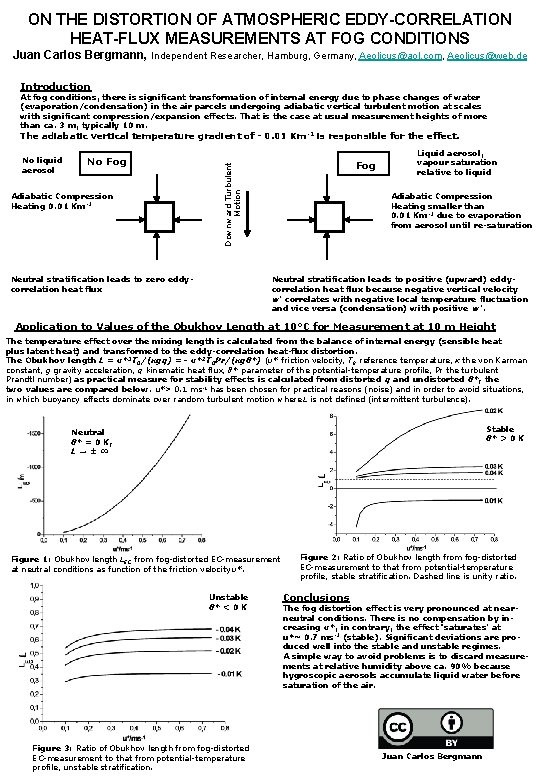
ON THE DISTORTION OF ATMOSPHERIC EDDY-CORRELATION HEAT-FLUX MEASUREMENTS AT FOG CONDITIONS Juan Carlos Bergmann, Independent Researcher, Hamburg, Germany, Aeolicus@aol. com, Aeolicus@web. de Introduction At fog conditions, there is significant transformation of internal energy due to phase changes of water (evaporation/condensation) in the air parcels undergoing adiabatic vertical turbulent motion at scales with significant compression/expansion effects. That is the case at usual measurement heights of more than ca. 3 m, typically 10 m. The adiabatic vertical temperature gradient of - 0. 01 Km -1 is responsible for the effect. No Fog Adiabatic Compression Heating 0. 01 Km-1 Fog Downward Turbulent Motion No liquid aerosol Neutral stratification leads to zero eddycorrelation heat flux Liquid aerosol, vapour saturation relative to liquid Adiabatic Compression Heating smaller than 0. 01 Km-1 due to evaporation from aerosol until re-saturation Neutral stratification leads to positive (upward) eddycorrelation heat flux because negative vertical velocity w’ correlates with negative local temperature fluctuation and vice versa (condensation) with positive w’. Application to Values of the Obukhov Length at 10°C for Measurement at 10 m Height The temperature effect over the mixing length is calculated from the balance of internal energy (sensible heat plus latent heat) and transformed to the eddy-correlation heat-flux distortion. The Obukhov length L = u*3 T 0/(κgq) = - u*2 T 0 Pr/(κgθ*) (u* friction velocity, T 0 reference temperature, κ the von Karman constant, g gravity acceleration, q kinematic heat flux, θ* parameter of the potential-temperature profile, Pr the turbulent Prandtl number) as practical measure for stability effects is calculated from distorted q and undistorted θ*, the two values are compared below. u*> 0. 1 ms-1 has been chosen for practical reasons (noise) and in order to avoid situations, in which buoyancy effects dominate over random turbulent motion where L is not defined (intermittent turbulence). Stable θ* > 0 K Neutral θ* = 0 K, L→±∞ Figure 1: Obukhov length LEC from fog-distorted EC-measurement at neutral conditions as function of the friction velocity u*. Unstable θ* < 0 K Figure 3: Ratio of Obukhov length from fog-distorted EC-measurement to that from potential-temperature profile, unstable stratification. Figure 2: Ratio of Obukhov length from fog-distorted EC-measurement to that from potential-temperature profile, stable stratification. Dashed line is unity ratio. Conclusions The fog distortion effect is very pronounced at nearneutral conditions. There is no compensation by increasing u*, in contrary, the effect ‘saturates’ at u*~ 0. 7 ms-1 (stable). Significant deviations are produced well into the stable and unstable regimes. A simple way to avoid problems is to discard measurements at relative humidity above ca. 90% because hygroscopic aerosols accumulate liquid water before saturation of the air. Juan Carlos Bergmann