
On the coupling between neoclassical and turbulent mechanisms
On the coupling between neoclassical and turbulent mechanisms presented by Carlos Hidalgo Hangzhou International Stellarator Workshop, March 2018 1 / 17
New directions in science are launched by new tools much more often than by new concepts Freeman Dyson Tools to unravel the coupling between neoclassical and turbulent mechanisms to discover new things that have to be explained 2 / 17
Neoclassical and turbulent transport channels are not decoupled in magnetically confined plasmas. This coupling should be considered in the optimization criteria. ü Neoclassical electric fields and Zonal Flows ü Neoclassical electric fields and turbulence spreading 3 / 17
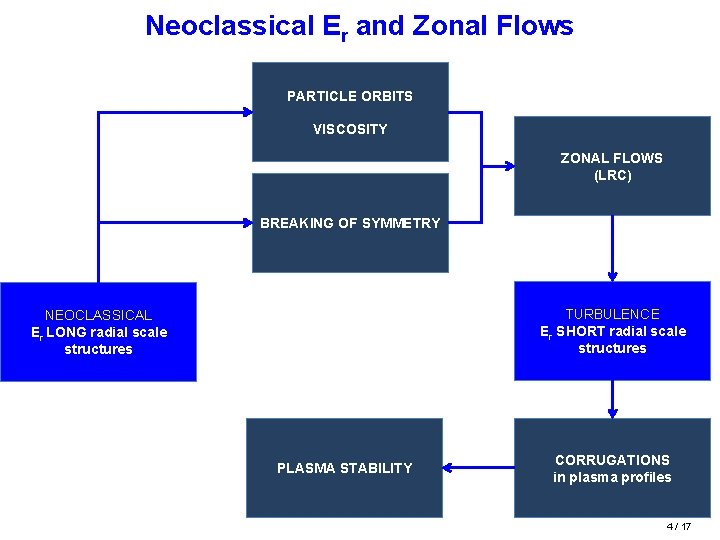
Neoclassical Er and Zonal Flows PARTICLE ORBITS VISCOSITY ZONAL FLOWS (LRC) BREAKING OF SYMMETRY TURBULENCE Er SHORT radial scale structures NEOCLASSICAL Er LONG radial scale structures PLASMA STABILITY CORRUGATIONS in plasma profiles 4 / 17
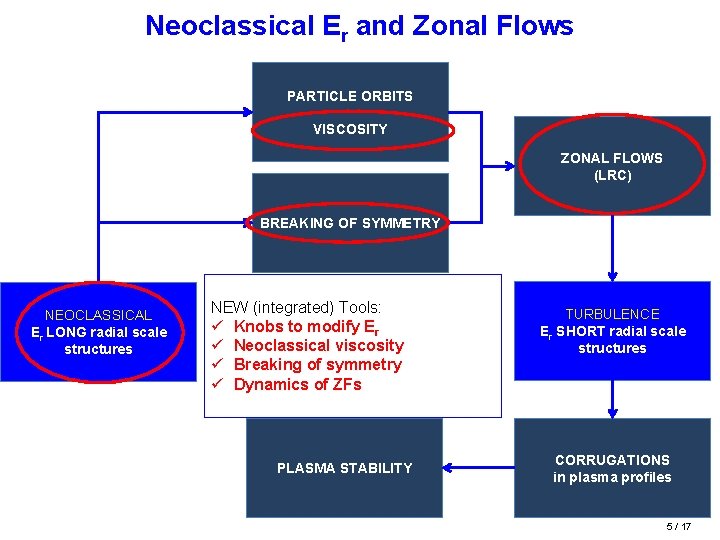
Neoclassical Er and Zonal Flows PARTICLE ORBITS VISCOSITY ZONAL FLOWS (LRC) BREAKING OF SYMMETRY NEOCLASSICAL Er LONG radial scale structures NEW (integrated) Tools: ü Knobs to modify Er ü Neoclassical viscosity ü Breaking of symmetry ü Dynamics of ZFs PLASMA STABILITY TURBULENCE Er SHORT radial scale structures CORRUGATIONS in plasma profiles 5 / 17
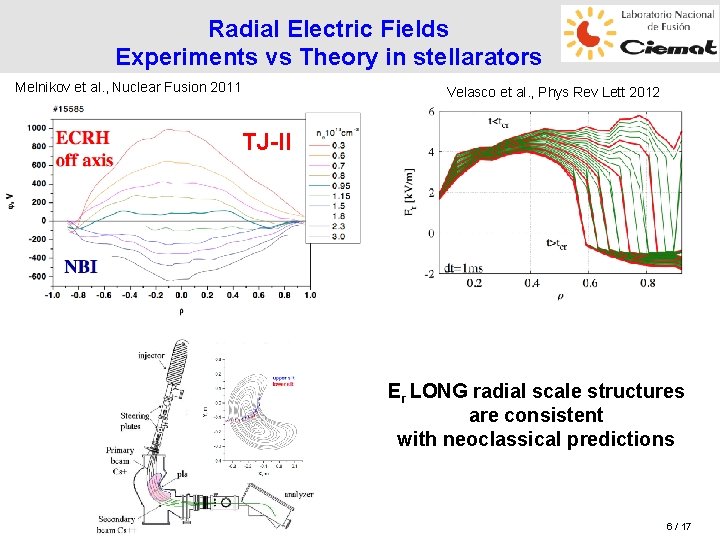
Radial Electric Fields Experiments vs Theory in stellarators Melnikov et al. , Nuclear Fusion 2011 Velasco et al. , Phys Rev Lett 2012 TJ-II Er LONG radial scale structures are consistent with neoclassical predictions 6 / 17
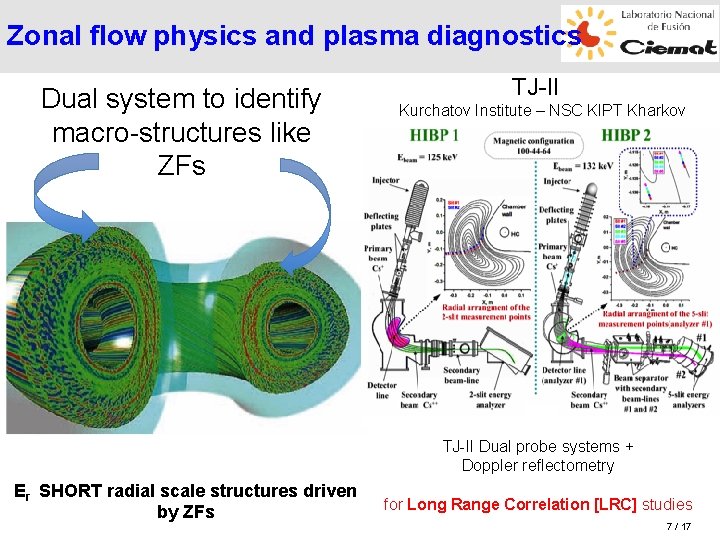
Zonal flow physics and plasma diagnostics Dual system to identify macro-structures like ZFs TJ-II Kurchatov Institute – NSC KIPT Kharkov TJ-II Dual probe systems + Doppler reflectometry Er SHORT radial scale structures driven by ZFs for Long Range Correlation [LRC] studies 7 / 17
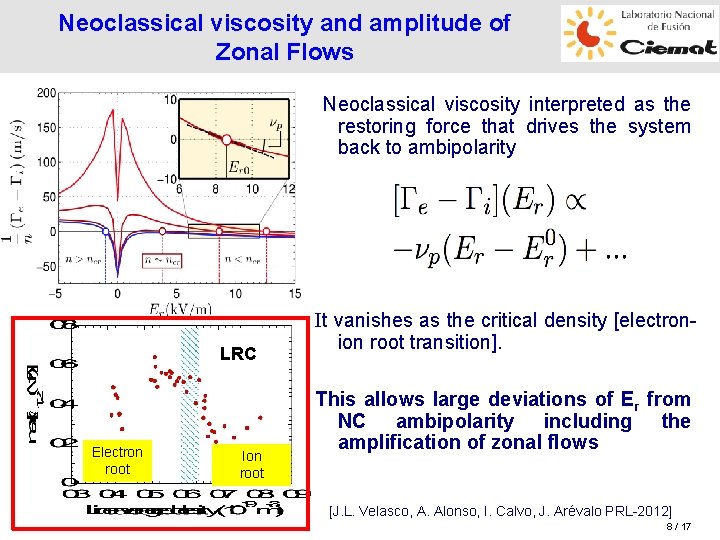
Neoclassical viscosity and amplitude of Zonal Flows Neoclassical viscosity interpreted as the restoring force that drives the system back to ambipolarity LRC Electron root It vanishes as the critical density [electronion root transition]. This allows large deviations of Er from NC ambipolarity including the amplification of zonal flows [J. L. Velasco, A. Alonso, I. Calvo, J. Arévalo PRL-2012] 8 / 17
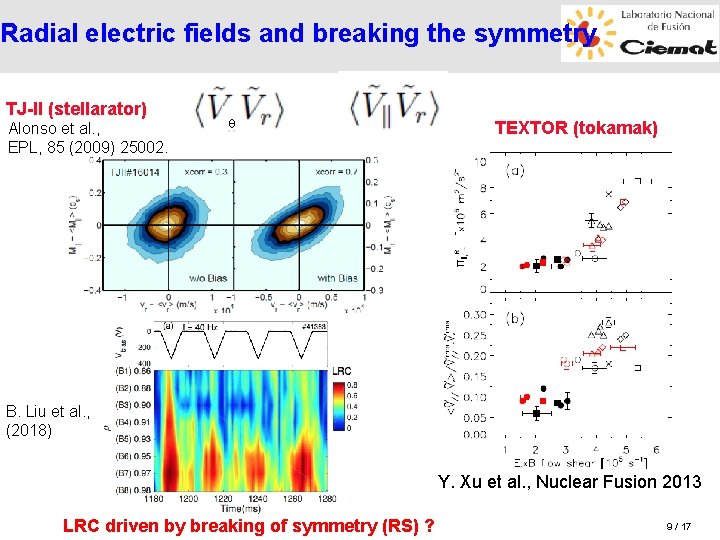
Radial electric fields and breaking the symmetry TJ-II (stellarator) Alonso et al. , EPL, 85 (2009) 25002. q TEXTOR (tokamak) B. Liu et al. , (2018) Y. Xu et al. , Nuclear Fusion 2013 LRC driven by breaking of symmetry (RS) ? 9 / 17
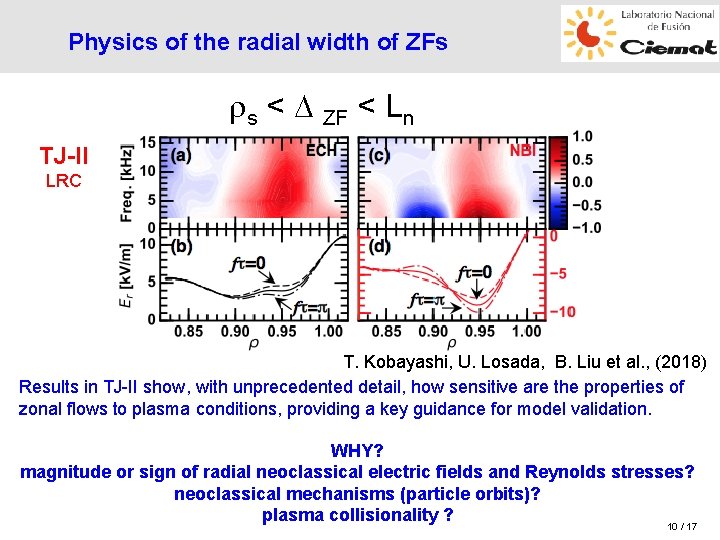
Physics of the radial width of ZFs rs < D ZF < Ln TJ-II LRC T. Kobayashi, U. Losada, B. Liu et al. , (2018) Results in TJ-II show, with unprecedented detail, how sensitive are the properties of zonal flows to plasma conditions, providing a key guidance for model validation. WHY? magnitude or sign of radial neoclassical electric fields and Reynolds stresses? neoclassical mechanisms (particle orbits)? plasma collisionality ? 10 / 17
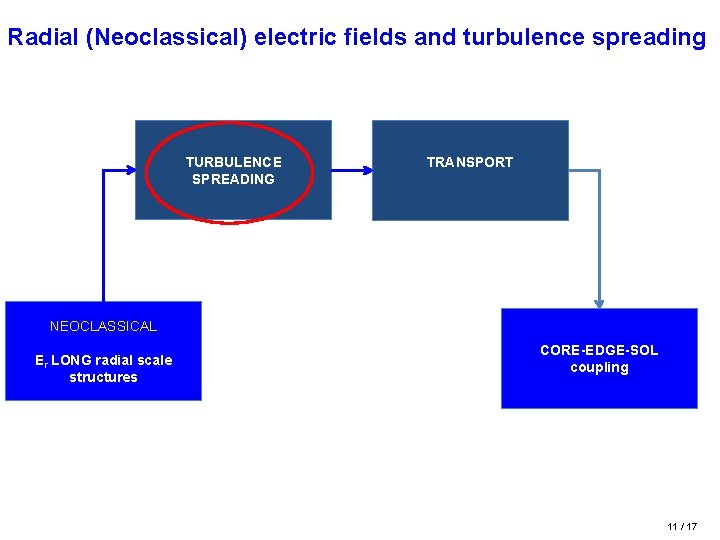
Radial (Neoclassical) electric fields and turbulence spreading TURBULENCE SPREADING TRANSPORT NEOCLASSICAL Er LONG radial scale structures CORE-EDGE-SOL coupling 11 / 17
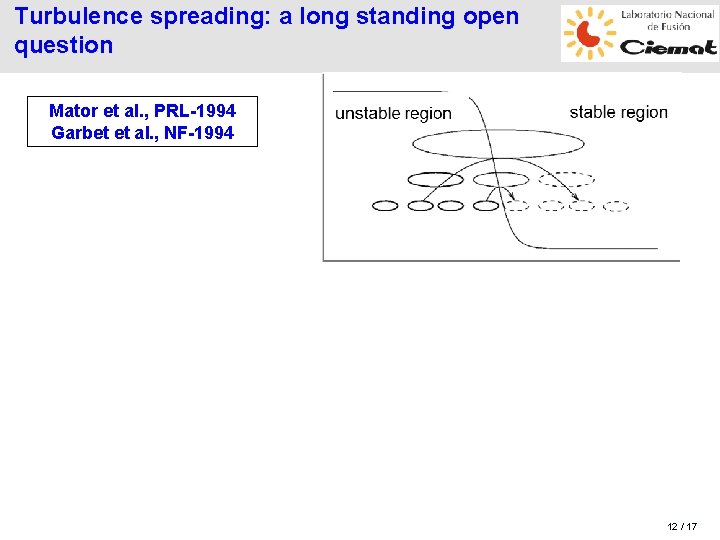
Turbulence spreading: a long standing open question Mator et al. , PRL-1994 Garbet et al. , NF-1994 12 / 17
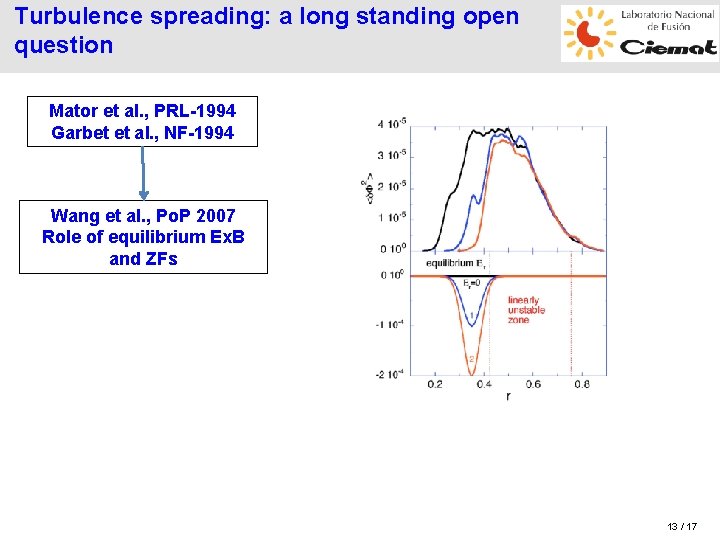
Turbulence spreading: a long standing open question Mator et al. , PRL-1994 Garbet et al. , NF-1994 Wang et al. , Po. P 2007 Role of equilibrium Ex. B and ZFs 13 / 17
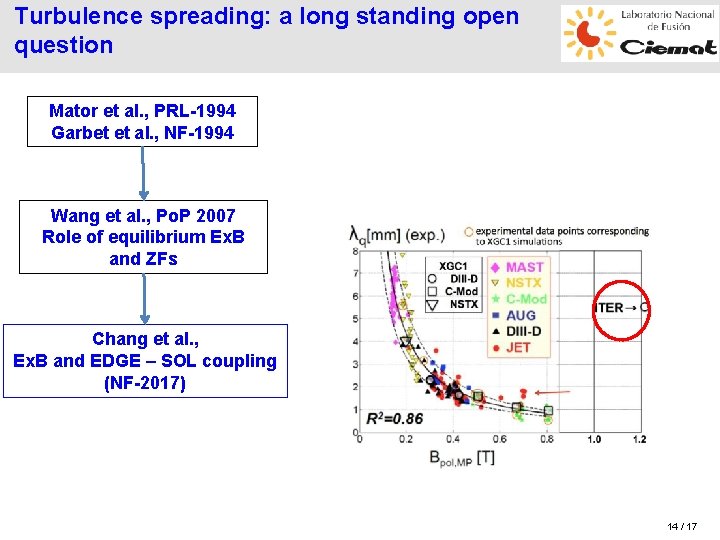
Turbulence spreading: a long standing open question Mator et al. , PRL-1994 Garbet et al. , NF-1994 Wang et al. , Po. P 2007 Role of equilibrium Ex. B and ZFs Chang et al. , Ex. B and EDGE – SOL coupling (NF-2017) 14 / 17
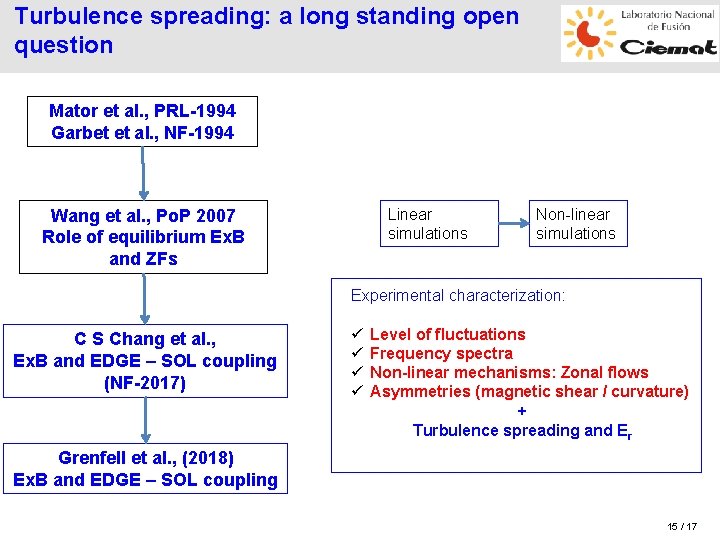
Turbulence spreading: a long standing open question Mator et al. , PRL-1994 Garbet et al. , NF-1994 Linear simulations Wang et al. , Po. P 2007 Role of equilibrium Ex. B and ZFs Non-linear simulations Experimental characterization: C S Chang et al. , Ex. B and EDGE – SOL coupling (NF-2017) ü ü Level of fluctuations Frequency spectra Non-linear mechanisms: Zonal flows Asymmetries (magnetic shear / curvature) + Turbulence spreading and Er Grenfell et al. , (2018) Ex. B and EDGE – SOL coupling 15 / 17
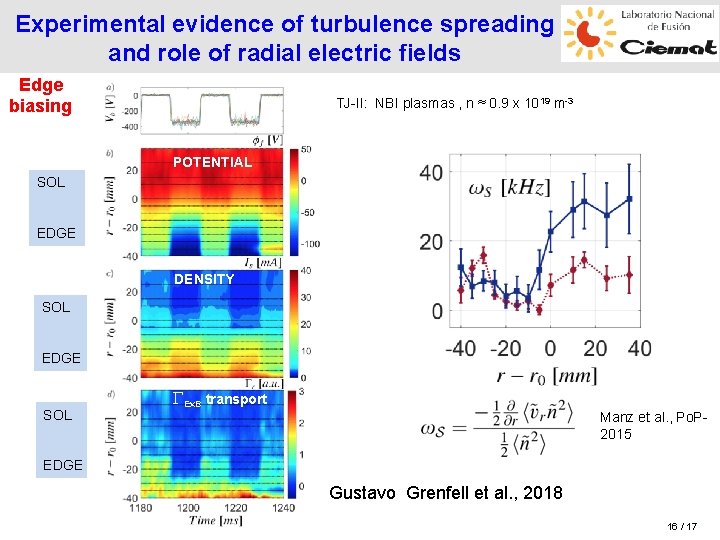
Experimental evidence of turbulence spreading and role of radial electric fields Edge biasing TJ-II: NBI plasmas , n ≈ 0. 9 x 10¹⁹ m-3 POTENTIAL SOL EDGE DENSITY SOL EDGE SOL GEx. B transport Manz et al. , Po. P 2015 EDGE Gustavo Grenfell et al. , 2018 16 / 17
New directions in science are launched by new tools much more often than by new concepts Freeman Dyson The interplay between neoclassical radial electric fields and turbulence is instrumental to: a) Determine the non-linear saturation mechanisms of plasma turbulence (CONFINEMENT OPTIMIZATION) b) Control the level of EDGE-SOL turbulent coupling (POWER EXHAUST OPTIMIZATION) 17 / 17
- Slides: 17