
On the CostEffectiveness of Trust Zone Defense on
- Slides: 25
On the Cost-Effectiveness of Trust. Zone Defense on ARM Platform NAIWEI LIU, WANYU ZANG, MENG YU, RAVI SANDHU UTSA ICS LAB; ROOSEVELT UNIVERSITY
Contents §Abstract and Introduction §Related Work §Cache-Based Security Threats and Attack §Design and Implementations §Experimental Results §Evaluation §Future Work §Conclusion 2
Abstract and Introduction §Abstract § § § In Recent years, many research efforts had been made on secure and safe environment on ARM platform. ARM structure and chips based on ARM had been taking up a lot of number of products in the market. Security problems and potential risks had been discussed. Cache and similar design brings in ‘trouble’ for security purposes. Uniqueness on ARM-based products made things even tougher to solve. What will we do? § Design defense framework for ARM § Evaluate by experiments § Optimization 3
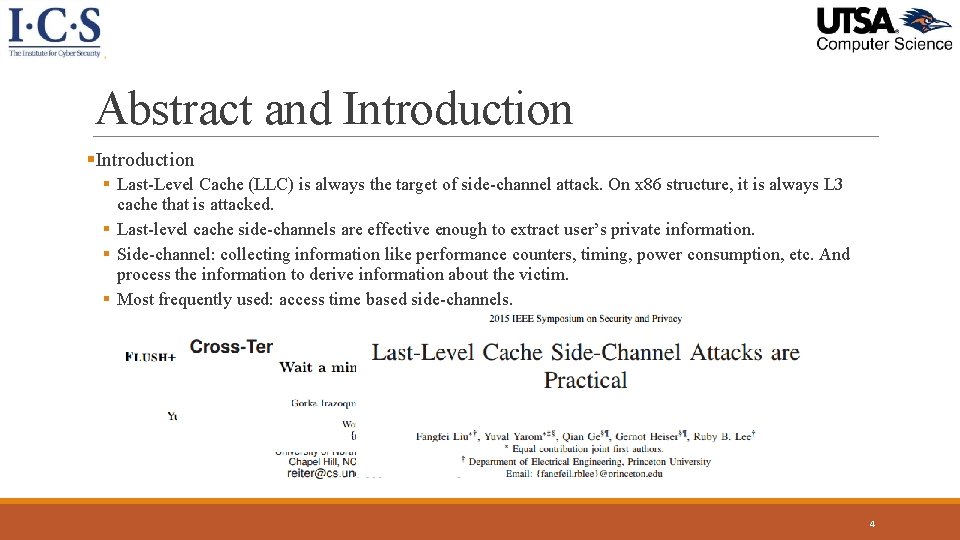
Abstract and Introduction § Last-Level Cache (LLC) is always the target of side-channel attack. On x 86 structure, it is always L 3 cache that is attacked. § Last-level cache side-channels are effective enough to extract user’s private information. § Side-channel: collecting information like performance counters, timing, power consumption, etc. And process the information to derive information about the victim. § Most frequently used: access time based side-channels. 4
Abstract and Introduction §Introduction (Continued) § Side-channel attack based via LLC can be dangerous, even without compromising OS. § Both on single OS machine and Virtual Machines (VMs) can be attacked. § Typical type: FLUSH+RELOAD § LLC is shared. § FLUSH+RELOAD can be practical using unprivileged instructions. § AES key of Open. SSL is recovered by this attack in lab test. § Threats to the Internet of Things (Io. T) and devices § Modern Trust. Zone Design on ARM platform 5
Abstract and Introduction §Introduction (Continued) § Contributions § § § Research on side-channel and covert-channel attack: bandwidth and effect. Investigation on Flush operations on ARM platform and overhead. Study of Trust. Zone technology and previous security design based on Trust. Zone. Investigation on critical instructions related to Trust. Zone operations. Test of cache flush operations: overhead and effect. Different discussion based on ARMv 8 -A and ARMv 8 -M structures. 6
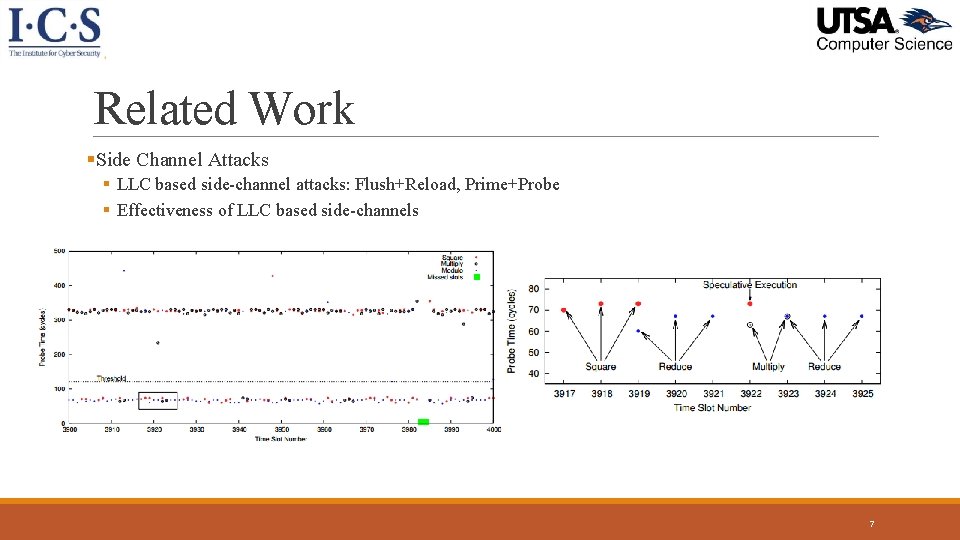
Related Work §Side Channel Attacks § LLC based side-channel attacks: Flush+Reload, Prime+Probe § Effectiveness of LLC based side-channels 7
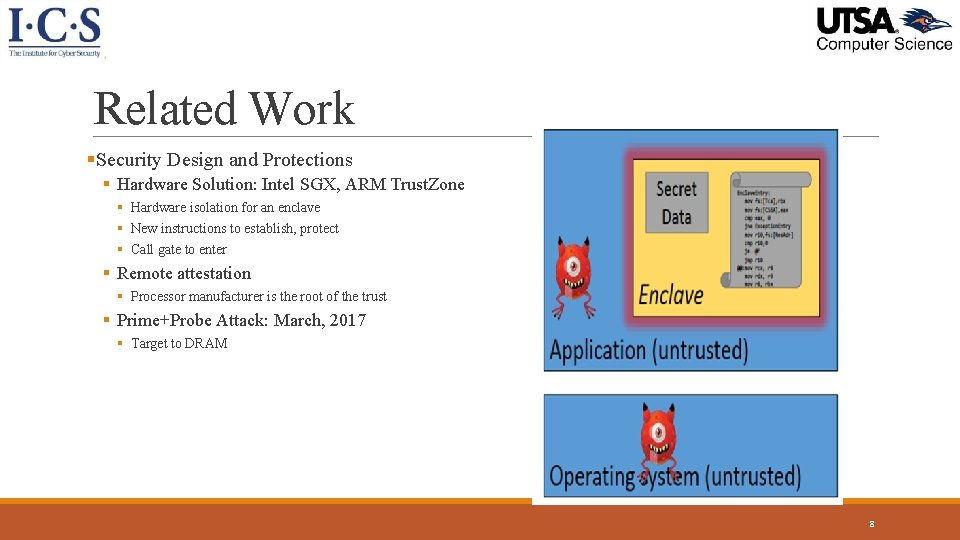
Related Work §Security Design and Protections § Hardware Solution: Intel SGX, ARM Trust. Zone § Hardware isolation for an enclave § New instructions to establish, protect § Call gate to enter § Remote attestation § Processor manufacturer is the root of the trust § Prime+Probe Attack: March, 2017 § Target to DRAM 8
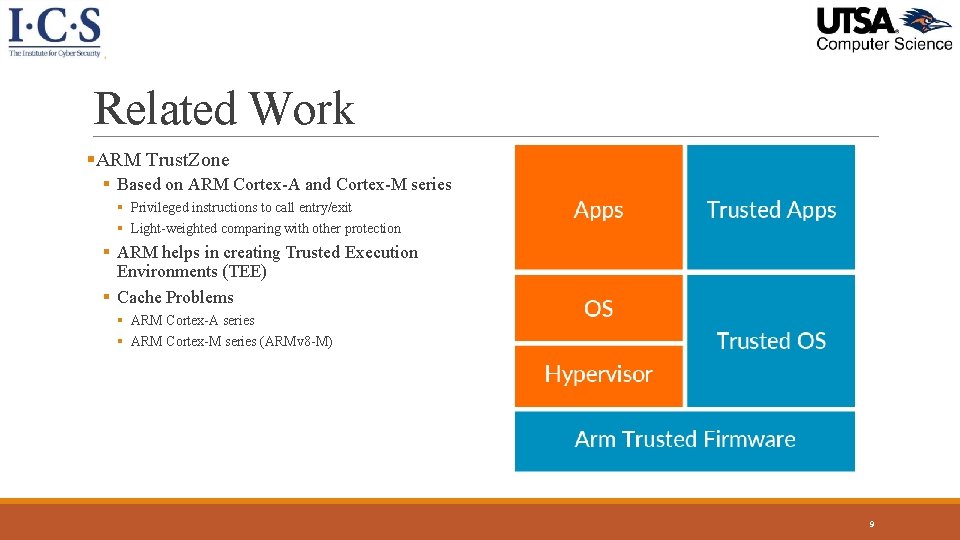
Related Work §ARM Trust. Zone § Based on ARM Cortex-A and Cortex-M series § Privileged instructions to call entry/exit § Light-weighted comparing with other protection § ARM helps in creating Trusted Execution Environments (TEE) § Cache Problems § ARM Cortex-A series § ARM Cortex-M series (ARMv 8 -M) 9
Related Work §Previous Defense Strategy against Side-Channels § § LLC-level Protection (memory access control) Cache enclaves (Trusted vs. Untrusted) Scheduler-based solutions Others §Cache Flush against Side-Channels § Benefits: easy to implement, ensure safety § Problems: high overhead, not adaptive to every situation 10
Cache-Based Security Threats and Attack §Overview §Users’ memory access are not protected by Trust. Zone – Covert Channel (Sharing resources) §Trust. Zone Entry/Exit without Flushing cache – Side-Channel (Malicious collecting access time) § Flush+Reload Attack § Prime+Probe Attack §Malicious eavesdropping 11
Cache-Based Security Threats and Attack §Side-Channel Attack Experiment §Flush+Reload Attack § § step 0: attacker maps shared library → shared memory, shared in cache step 1: attacker flushes the shared line step 2: victim loads data while performing encryption step 3: attacker reloads data → fast access if the victim loaded the line §Prime+Probe Attack § step 0: attacker fills the cache (prime) § step 1: victim evicts cache lines while performing encryption § step 2: attacker probes data to determine if the set was accessed 12
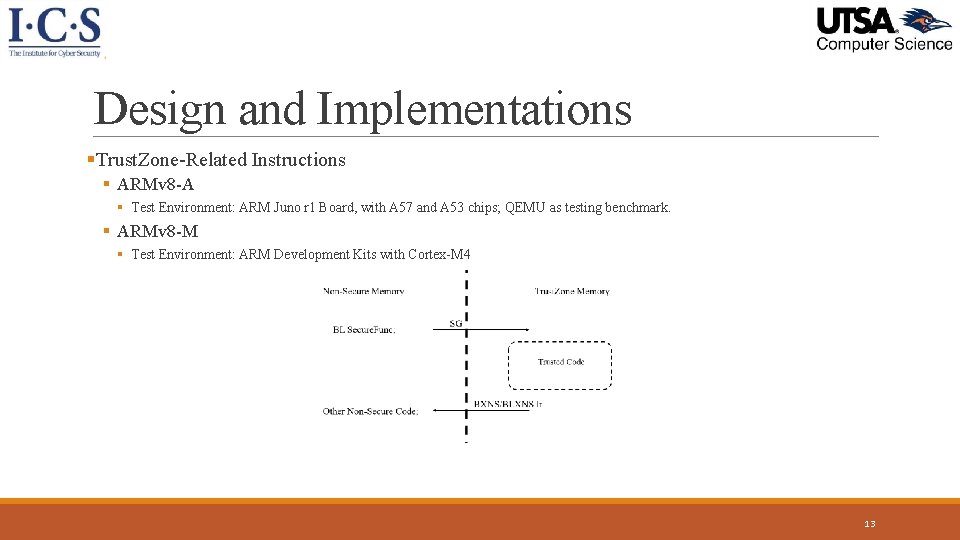
Design and Implementations §Trust. Zone-Related Instructions § ARMv 8 -A § Test Environment: ARM Juno r 1 Board, with A 57 and A 53 chips; QEMU as testing benchmark. § ARMv 8 -M § Test Environment: ARM Development Kits with Cortex-M 4 13
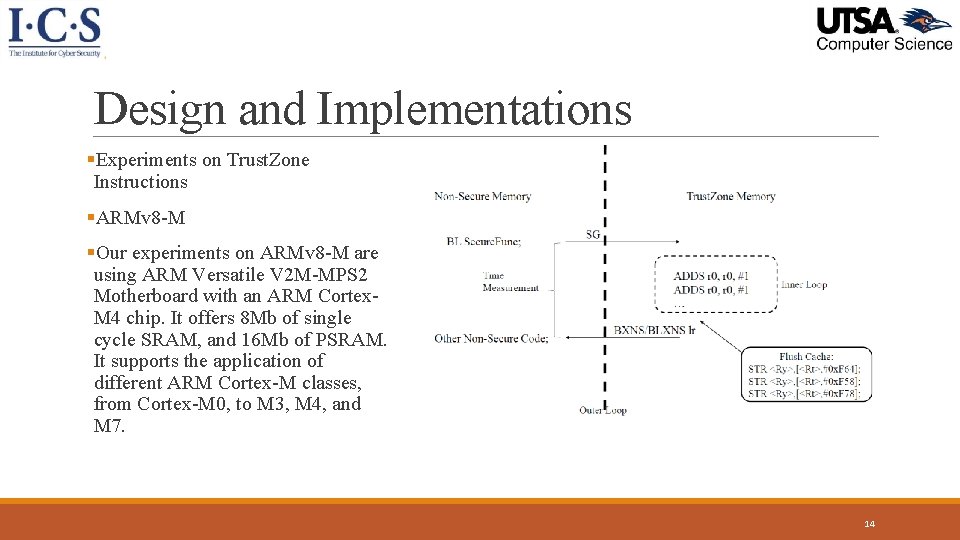
Design and Implementations §Experiments on Trust. Zone Instructions §ARMv 8 -M §Our experiments on ARMv 8 -M are using ARM Versatile V 2 M-MPS 2 Motherboard with an ARM Cortex. M 4 chip. It offers 8 Mb of single cycle SRAM, and 16 Mb of PSRAM. It supports the application of different ARM Cortex-M classes, from Cortex-M 0, to M 3, M 4, and M 7. 14
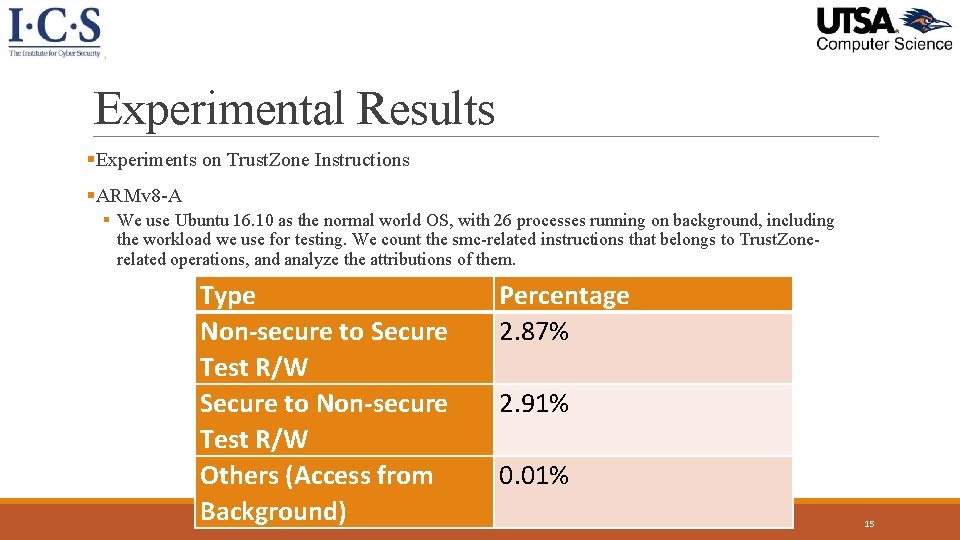
Experimental Results §Experiments on Trust. Zone Instructions §ARMv 8 -A § We use Ubuntu 16. 10 as the normal world OS, with 26 processes running on background, including the workload we use for testing. We count the smc-related instructions that belongs to Trust. Zonerelated operations, and analyze the attributions of them. Type Non-secure to Secure Test R/W Secure to Non-secure Test R/W Others (Access from Background) Percentage 2. 87% 2. 91% 0. 01% 15
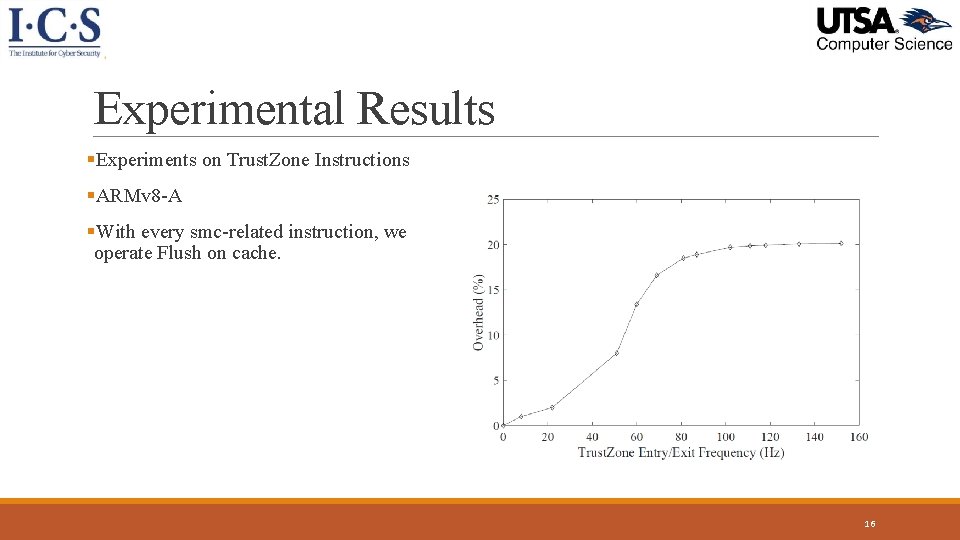
Experimental Results §Experiments on Trust. Zone Instructions §ARMv 8 -A §With every smc-related instruction, we operate Flush on cache. 16
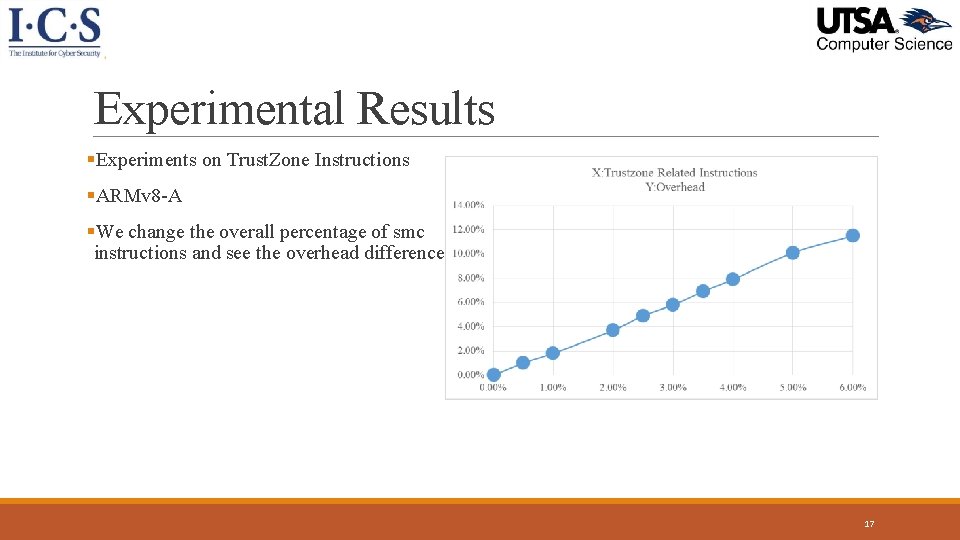
Experimental Results §Experiments on Trust. Zone Instructions §ARMv 8 -A §We change the overall percentage of smc instructions and see the overhead difference. 17
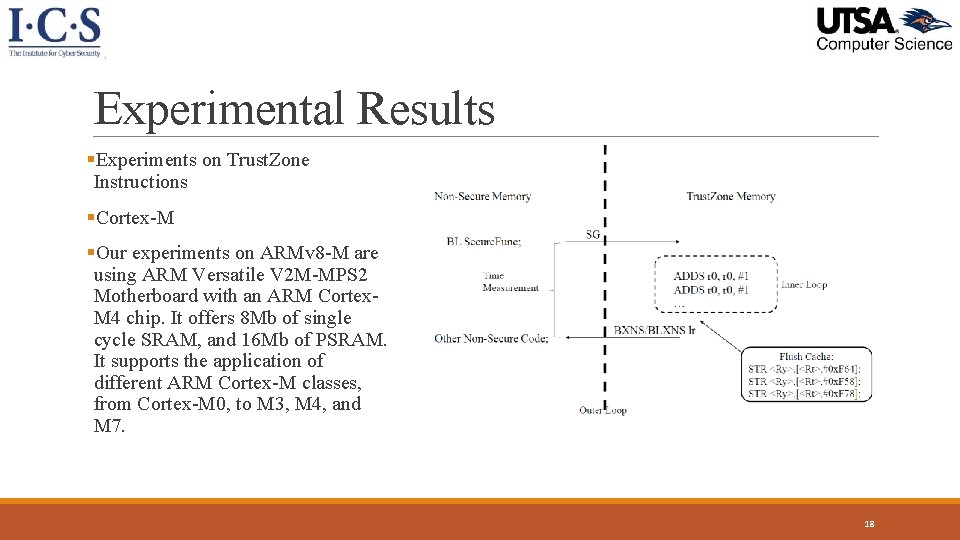
Experimental Results §Experiments on Trust. Zone Instructions §Cortex-M §Our experiments on ARMv 8 -M are using ARM Versatile V 2 M-MPS 2 Motherboard with an ARM Cortex. M 4 chip. It offers 8 Mb of single cycle SRAM, and 16 Mb of PSRAM. It supports the application of different ARM Cortex-M classes, from Cortex-M 0, to M 3, M 4, and M 7. 18
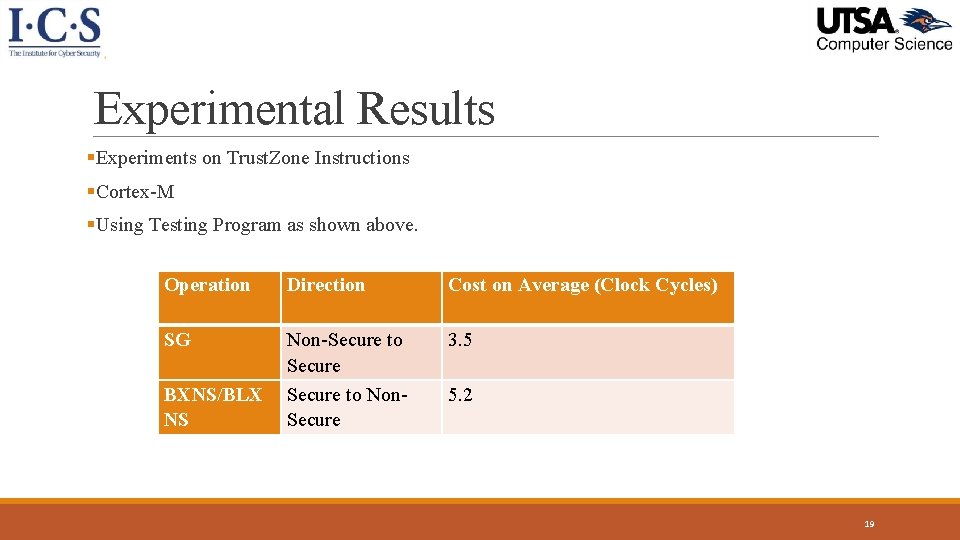
Experimental Results §Experiments on Trust. Zone Instructions §Cortex-M §Using Testing Program as shown above. Operation Direction Cost on Average (Clock Cycles) SG Non-Secure to Non. Secure 3. 5 BXNS/BLX NS 5. 2 19
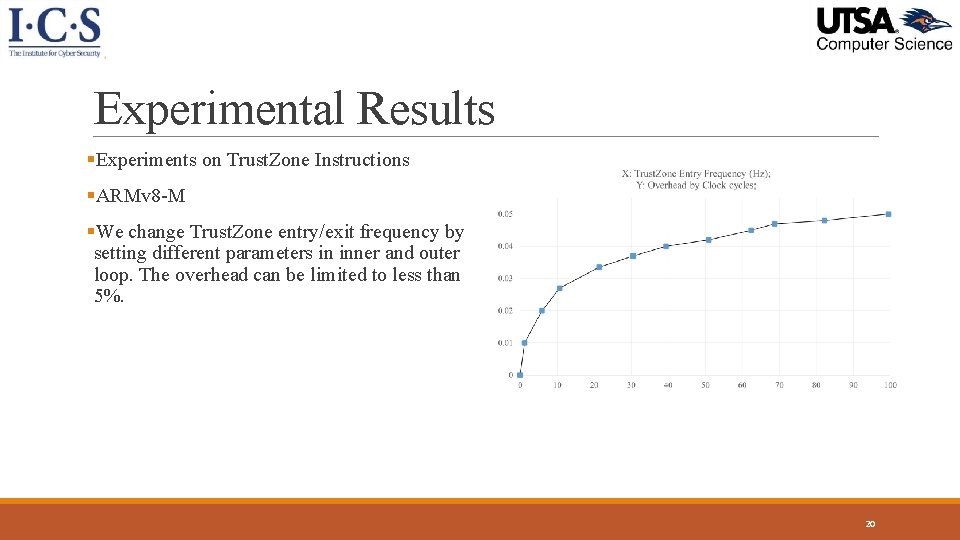
Experimental Results §Experiments on Trust. Zone Instructions §ARMv 8 -M §We change Trust. Zone entry/exit frequency by setting different parameters in inner and outer loop. The overhead can be limited to less than 5%. 20
Evaluation §On the cost-effectiveness balance of defending by Flush operations § § Flush operations are necessary, but they cost much; We can never wipe out the risk, but can cut down bandwidth; Adaptive strategy can be used to keep the balance of performance and effectiveness; Even better on ARMv 8 -M chips. 21
Evaluation §On Trust. Zone related instructions § § § Most of the apps and users are not ‘making use of’ Trust. Zone features; On Io. T devices, Trust. Zone is not costing much resources; It is possible to move some of the hardware/software security design into Trust. Zone surface; Cortex-M series chips perform better than Cortex-A series chips. On Cortex-A series chips or x 86 chips, cache flush operations are just some instructions with privileges. However, the case are different on ARMv 8 -M. The allocation of a memory address to a cache address is defined by the designers of the applications. § Because of the special structure of ARMv 8 -M, the cache Flush operations are sets of DSB (Data Synchronization Barrier) operations, with address-related instructions. 22
Future Work §Implementations and Experiments § Design and implement a defense framework based on ARMv 8 -M. § Test the performance of defense framework using some benchmarks, and optimize the framework to good effectiveness and lower overhead. § Port defense framework to new ARMv 8 -M boards: M 23 and M 33 series chips. §Theory Work § Study adaptive control method in theory to match the experimental results, and predict the optimal solution of best adaptive control in defense. § Investigate entropy theory based on experimental results, predictions and related theory. § Discuss performance of implemented defense framework in theory, and try to have theoretical conclusion on defense against cache-based attack. 23
Conclusion §Cache-based attack are new focal point on security design, with risks of leaking information through side-channel and covert channels. §Flushing cache is effective to cut down the risk, but with high performance overhead, and sometimes not affordable. §On Io. T devices, the performance of connecting with Trust. Zone can be better, which brings the possibility to making use of Trust. Zone. 24
Thank you! Naiwei Liu, UTSA ICS Lab, Naiwei. liu@utsa. edu Ravi Sandhu, UTSA ICS Lab, ravi. sandhu@utsa. edu Meng Yu, Roosevelt University, myu 04@Roosevelt. edu 25