
On the Competitiveness of AIMDTCP within a General

![Comparison with other Schedulers TCP B • [CJ] TCP Þ EQUI B Shortest Remaining](https://slidetodoc.com/presentation_image_h2/9d5ab859c55f7bd00e049599b6592c56/image-11.jpg "Comparison with other Schedulers TCP B • [CJ] TCP Þ EQUI B Shortest Remaining")
![a [MPT] [ECBD] Previous Results (Batch) EQUI(J) £ 2 OPT(J) £ 3. 73](https://slidetodoc.com/presentation_image_h2/9d5ab859c55f7bd00e049599b6592c56/image-15.jpg "a [MPT] [ECBD] Previous Results (Batch) EQUI(J) £ 2 OPT(J) £ 3. 73")
![aa aa a [MPT] Previous Results (Lower Bounds) EQUI(J) ³ W(n) OPT(J) Non. Clair(J)](https://slidetodoc.com/presentation_image_h2/9d5ab859c55f7bd00e049599b6592c56/image-16.jpg "aa aa a [MPT] Previous Results (Lower Bounds) EQUI(J) ³ W(n) OPT(J) Non. Clair(J)")
![Previous Results (Upper Bounds) [KP] [EP] BAL 1+e(J) OPT 1(J) TCP 2+e(J) EQUI OPT](https://slidetodoc.com/presentation_image_h2/9d5ab859c55f7bd00e049599b6592c56/image-17.jpg "Previous Results (Upper Bounds) [KP] [EP] BAL 1+e(J) OPT 1(J) TCP 2+e(J) EQUI OPT")
![Proof Sketch Reduction [E] EQUI 2+e(J) OPT 1(J) £ O(1)](https://slidetodoc.com/presentation_image_h2/9d5ab859c55f7bd00e049599b6592c56/image-18.jpg "Proof Sketch Reduction [E] EQUI 2+e(J) OPT 1(J) £ O(1)")
![New Results A=1 c=½ AÞ¥ cÞ 1 [F] say no & Locally) (Free Market](https://slidetodoc.com/presentation_image_h2/9d5ab859c55f7bd00e049599b6592c56/image-19.jpg "New Results A=1 c=½ AÞ¥ cÞ 1 [F] say no & Locally) (Free Market")
- Slides: 27
On the Competitiveness of AIMD-TCP within a General Network Jeff Edmonds
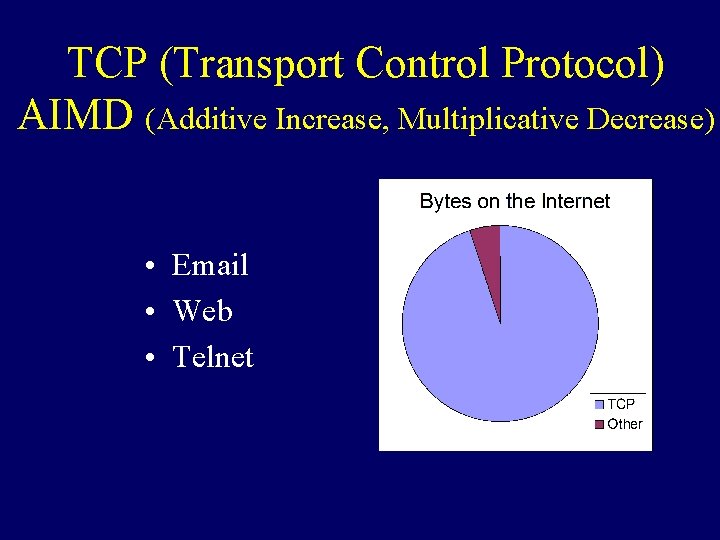
TCP (Transport Control Protocol) AIMD (Additive Increase, Multiplicative Decrease) • Email • Web • Telnet
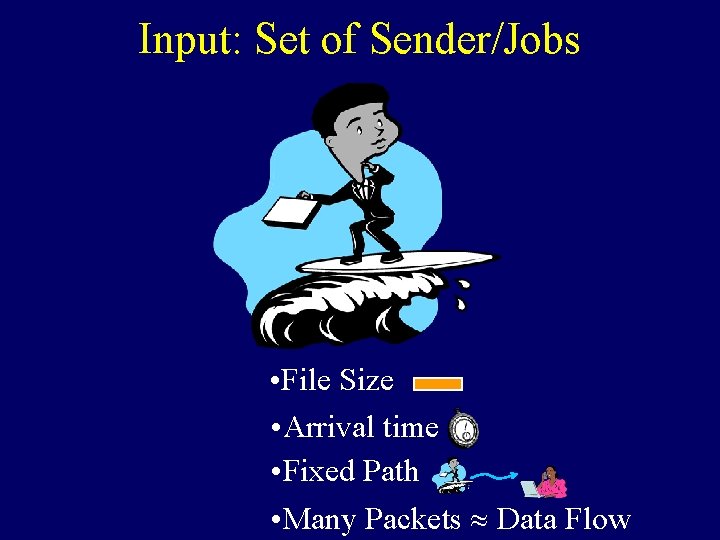
Input: Set of Sender/Jobs • File Size • Arrival time • Fixed Path • Many Packets » Data Flow
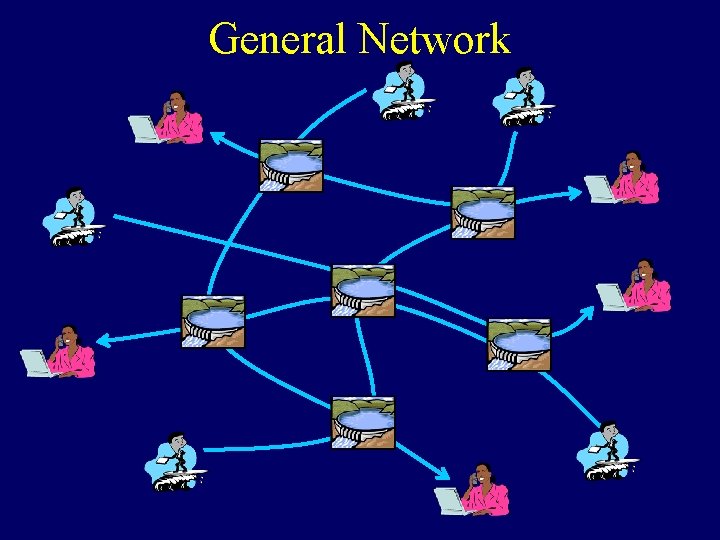
General Network
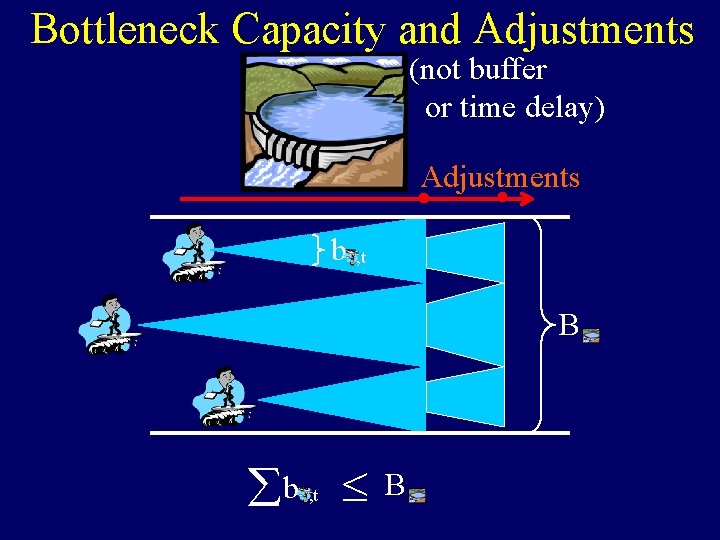
Bottleneck Capacity and Adjustments (not buffer or time delay) Adjustments b , t B åb £ , t B
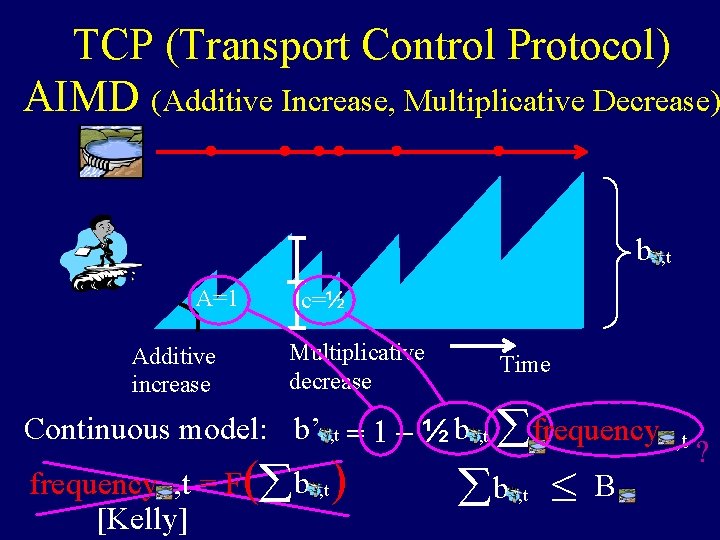
TCP (Transport Control Protocol) AIMD (Additive Increase, Multiplicative Decrease) b , t A=1 Additive increase c=½ Multiplicative decrease Time Continuous model: b’ , t = 1 - ½ b , t å frequency , t = F(å b , t ) [Kelly] åb £ , t B , t ?
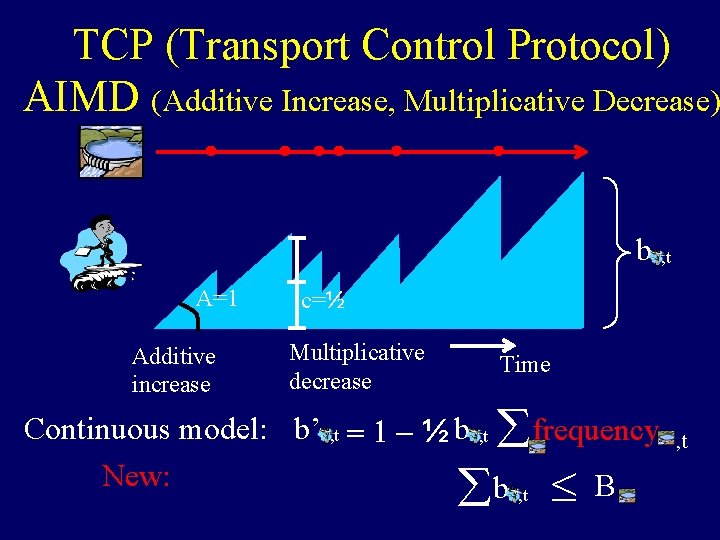
TCP (Transport Control Protocol) AIMD (Additive Increase, Multiplicative Decrease) b , t A=1 Additive increase c=½ Multiplicative decrease Time Continuous model: b’ , t = 1 - ½ b , t å frequency New: å b , t £ B , t
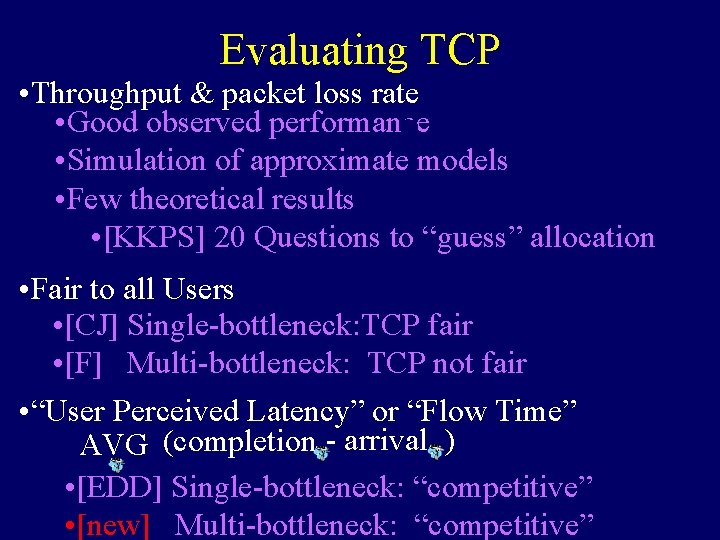
Evaluating TCP • Throughput & packet loss rate • Good observed performance • Simulation of approximate models • Few theoretical results • [KKPS] 20 Questions to “guess” allocation • Fair to all Users • [CJ] Single-bottleneck: TCP fair • [F] Multi-bottleneck: TCP not fair • “User Perceived Latency” or “Flow Time” AVG (completion - arrival ) • [EDD] Single-bottleneck: “competitive” • [new] Multi-bottleneck: “competitive”
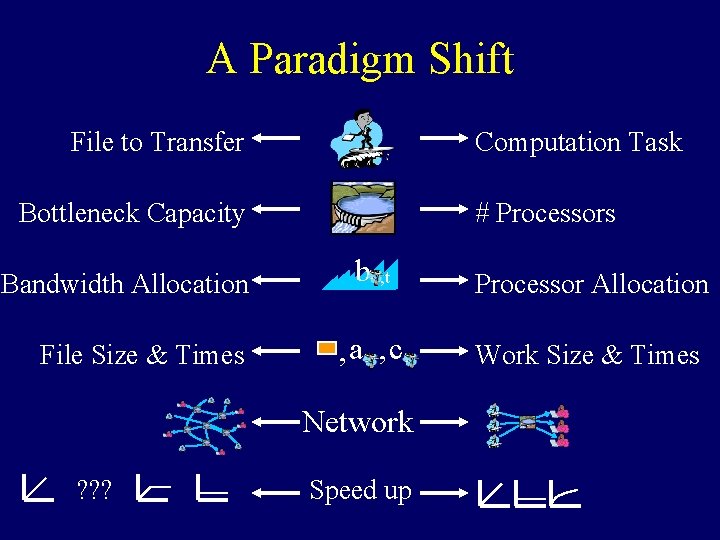
A Paradigm Shift File to Transfer Computation Task Bottleneck Capacity Bandwidth Allocation File Size & Times # Processors b , t Processor Allocation , a , c Work Size & Times Network ? ? ? Speed up
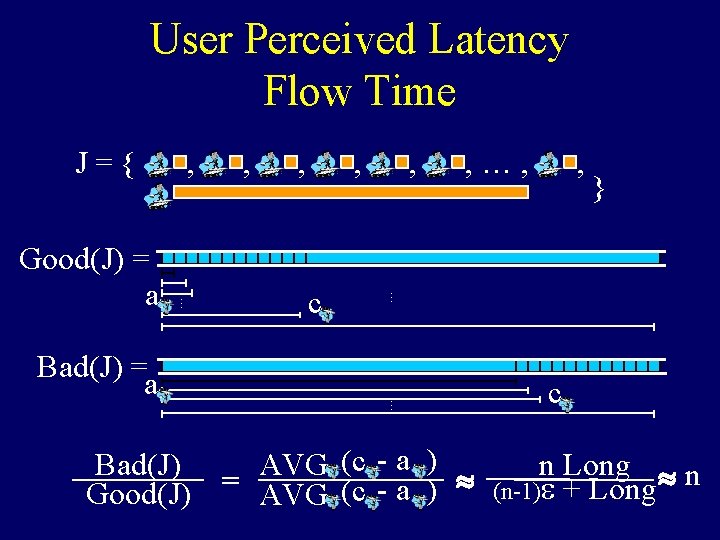
User Perceived Latency Flow Time J={ , , , c , , …, , } … … Bad(J) = a … Good(J) = a , Bad(J) = AVG (c - a ) » Good(J) AVG (c - a ) c n Long » n (n-1)e + Long
Comparison with other Schedulers TCP B • [CJ] TCP Þ EQUI B Shortest Remaining Work First B • Optimal
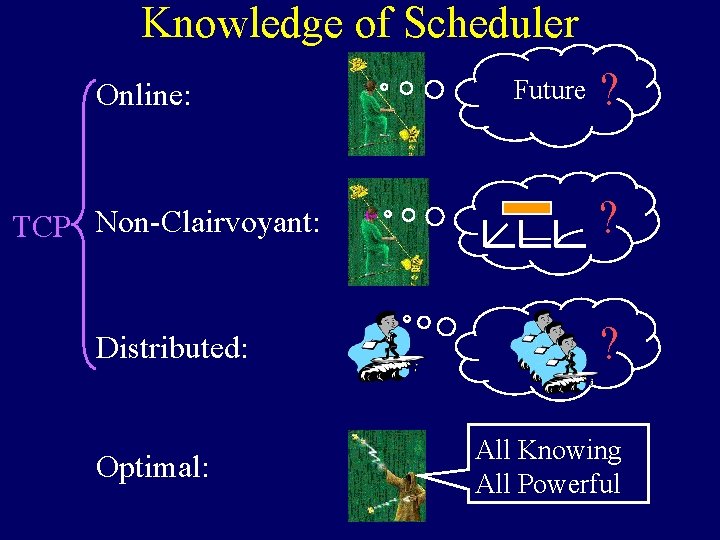
Knowledge of Scheduler Online: Future ? TCP Non-Clairvoyant: ? Distributed: ? Optimal: All Knowing All Powerful
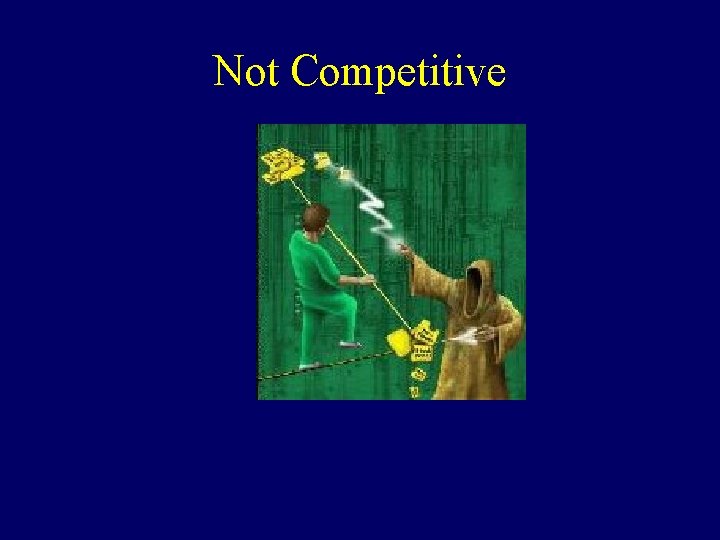
Not Competitive
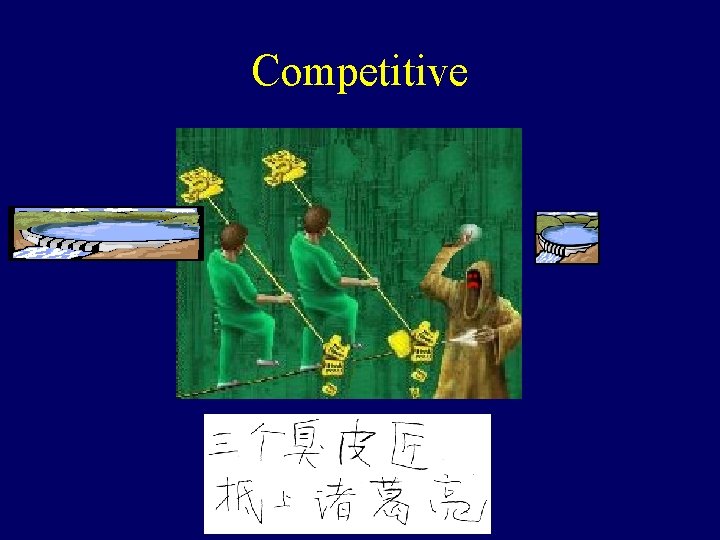
Competitive
a [MPT] [ECBD] Previous Results (Batch) EQUI(J) £ 2 OPT(J) £ 3. 73
aa aa a [MPT] Previous Results (Lower Bounds) EQUI(J) ³ W(n) OPT(J) Non. Clair(J) ³ W(n½) OPT(J)
Previous Results (Upper Bounds) [KP] [EP] BAL 1+e(J) OPT 1(J) TCP 2+e(J) EQUI OPT 1(J) £ O(1/e) B-TCP BROADCAST 4+e(J) £ O(1/e) OPT 1(J) ? [EDD]
Proof Sketch Reduction [E] EQUI 2+e(J) OPT 1(J) £ O(1)
New Results A=1 c=½ AÞ¥ cÞ 1 [F] say no & Locally) (Free Market Fair: ? ? f » £m f TCP 2+e(J) £ O(1/e) OPT 1(J) TCPO(m 3)(J) £ O(m) OPT 1(J)
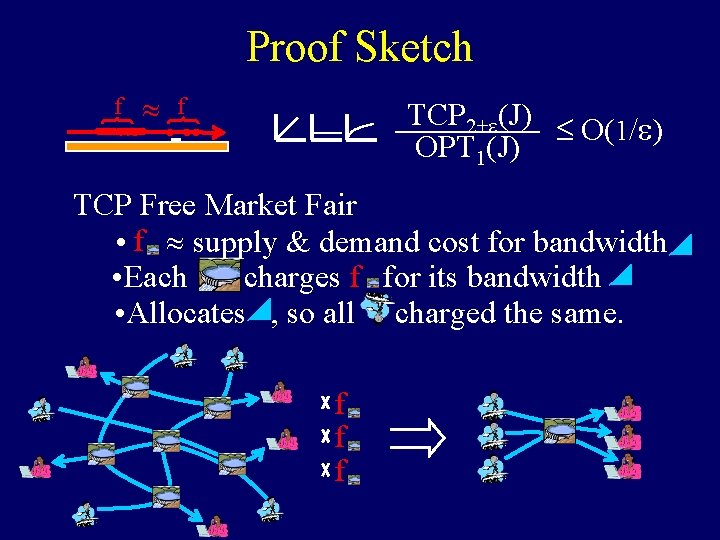
Proof Sketch f » f TCP 2+e(J) £ O(1/e) OPT 1(J) TCP Free Market Fair • f » supply & demand cost for bandwidth • Each charges f for its bandwidth • Allocates , so all charged the same. f f f
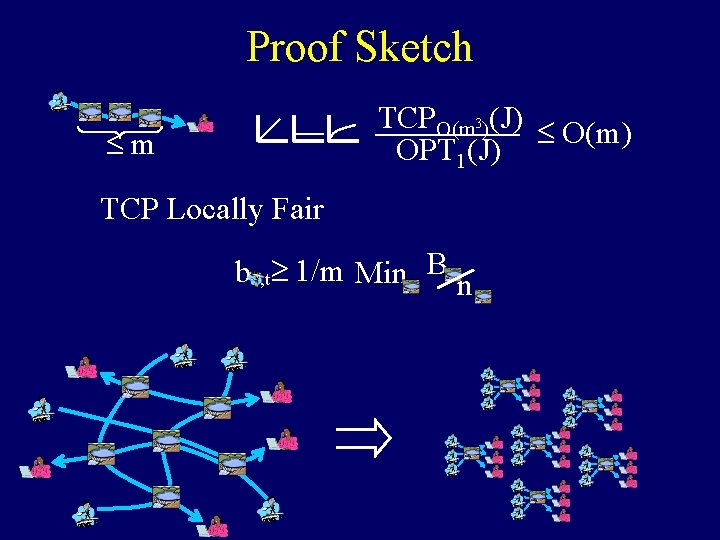
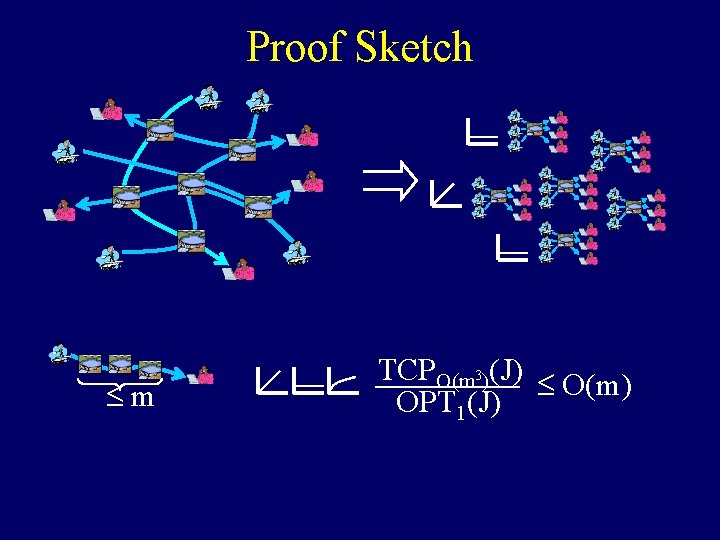
Proof Sketch TCPO(m 3)(J) £ O(m) OPT 1(J) £m TCP Locally Fair b , t ³ 1/m Min B n
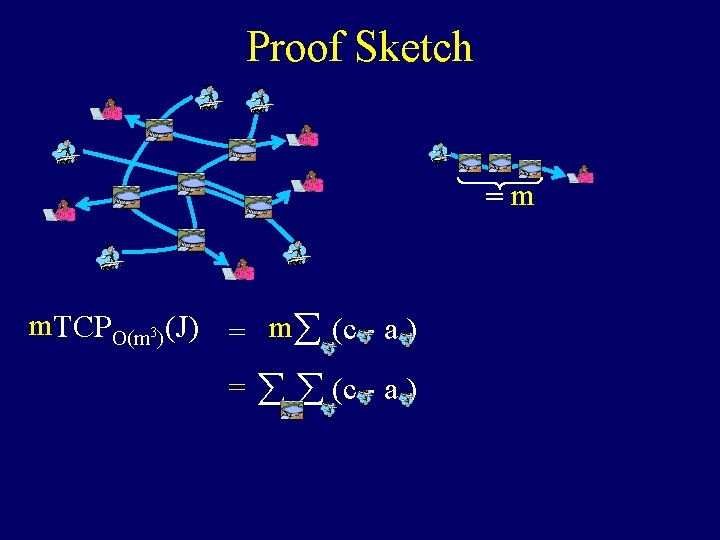
Proof Sketch =m m. TCPO(m 3)(J) = må (c - a ) = å å (c - a )
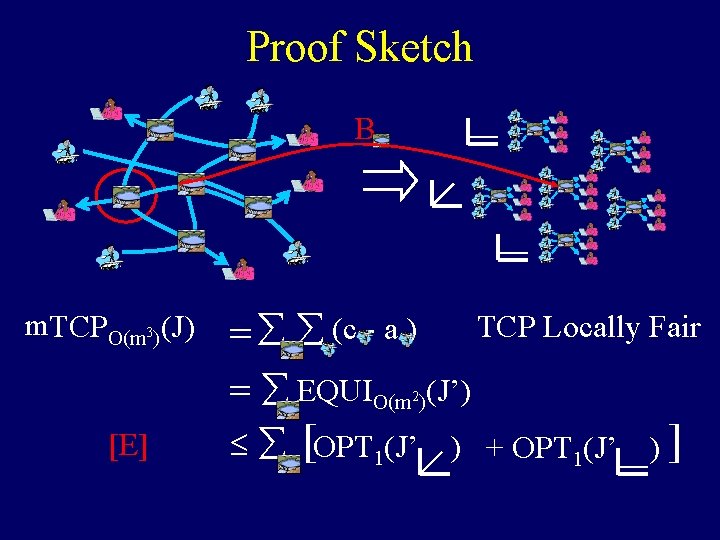
Proof Sketch B m. TCPO(m 3)(J) TCP Locally Fair = å å (c - a ) = å EQUIO(m )(J’) £ å [OPT 1(J’ ) + OPT 1(J’ ) ] 2 [E]
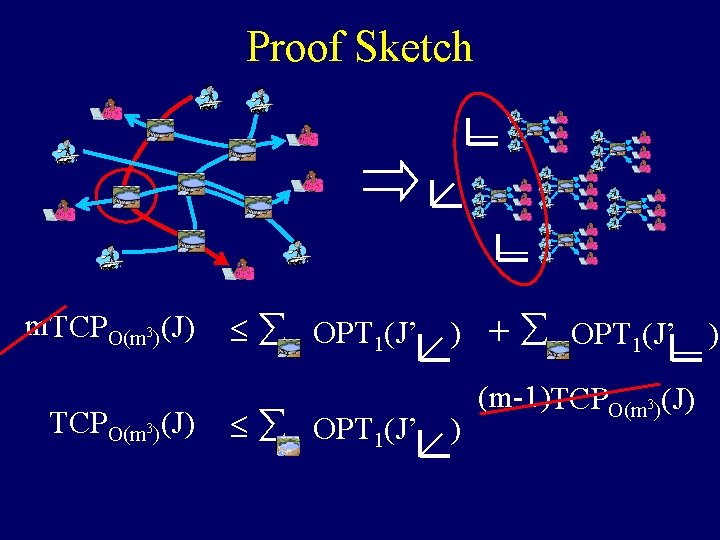
Proof Sketch m. TCPO(m 3)(J) £ £ å å OPT 1(J’ ) ) +å OPT 1(J’ (m-1)TCPO(m 3)(J) )
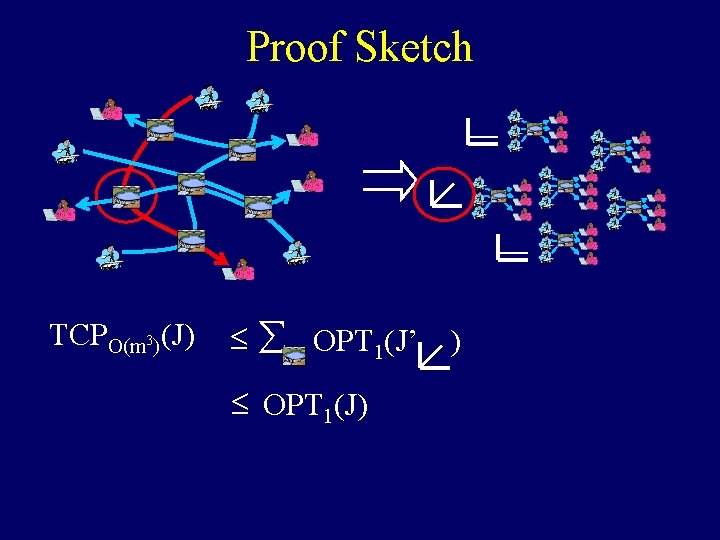
Proof Sketch TCPO(m 3)(J) £ å OPT 1(J’ £ OPT 1(J) )
Proof Sketch £m TCPO(m 3)(J) £ O(m) OPT 1(J)
Conclusion TCP is Competitive