
On the Benefits and Pitfalls of Extending a
On the Benefits and Pitfalls of Extending a Statically Typed Language JIT Compiler for Dynamic Scripting Languages Jose Castanos, David Edelsohn, Kazuaki Ishizaki, Toshio Nakatani, Takeshi Ogasawara, Priya Nagpurkar, Peng Wu IBM Research © 2012 IBM Corporation
Scripting Languages Compilers: A Tale of Two Worlds q. Customary VM and JIT design targeting one scripting language – in-house VM developed from scratch and designed to facilitate the JIT – in-house JIT that understands target language semantics q. The reusing JIT phenomenon – reuse the prevalent interpreter implementation of a scripting language – attach an existing mature JIT – (optionally) extend the “reusing” JIT to optimize target scripting languages q. Heavy development investment, most noticeably in Javascript – where performance transfers to competitiveness q. Considerations for reusing JITs – Reuse common services from mature JIT infrastructure – Harvest the benefits of mature optimizations – Compatibility with standard implementation by reusing VM q. Such VM+JIT bundle significantly reduces the performance gap between scripting languages and statically typed ones – Sometimes more than 10 x speedups over interpreters 2 q. Willing to sacrifice some performance, but still expect substantial speedups from compilation On the Benefits and Pitfalls of Extending a Statically Typed Language JIT Compiler for Dynamic Scripting Languages © 2012 IBM Corporation

Scripting Languages Compilers: A Tale of Two Worlds q. Customary VM and JIT design targeting one scripting language – in-house VM developed from scratch and designed to facilitate the JIT – in-house JIT that understands target language semantics q. The reusing JIT phenomenon – reuse the prevalent interpreter implementation of a scripting language – attach an existing mature JIT – (optionally) extend the “reusing” JIT to optimize target scripting languages q. Heavy development investment, most noticeably in Javascript – where performance transfers to competitiveness q. Considerations for reusing JITs – Reuse common services from mature JIT infrastructure – Harvest the benefits of mature optimizations – Compatibility with standard implementation by reusing VM q. Such VM+JIT bundle significantly reduces the performance gap between scripting languages and statically typed ones – Sometimes more than 10 x speedups over interpreters 3 q. Willing to sacrifice some performance, but still expect substantial speedups from compilation On the Benefits and Pitfalls of Extending a Statically Typed Language JIT Compiler for Dynamic Scripting Languages © 2012 IBM Corporation
Outline Let’s take an in-depth look at the reusing JIT phenomenon – – Common pitfalls of reusing JIT approach The state-of-the-art of reusing JIT approach Recommendation of reusing JIT designers Conclusions We focus on the world of Python JIT 1. Fiorano JIT: attach Testarossa JIT to Cpython interpreter 2. Jython: translating Python codes into Java codes • Runtime written in Java 3. Py: customary VM + trace JIT based on RPython 4. Unladen-swallow JIT: based on LLVM JIT (google) 5. Iron. Python: translating Python codes into CLR (Microsoft) 4 On the Benefits and Pitfalls of Extending a Statically Typed Language JIT Compiler for Dynamic Scripting Languages © 2012 IBM Corporation

What’s Added to the Fiorano JIT? q. No-opt level compilation support q. Python-specific optimization support – Runtime profiling in CPython interpreter – Guard-based specialization • specialization for arithmetic & compare • built-ins such as xrange, sin, and, cos • Caching the results of LOAD_GLOBAL (watch invalidation) – Versioning • built-ins such as instanceof • Fast path versioning for LOAD_ATTR/STORE_ATTR/CALL • Guard-based & fast path versioning for GET_ITER/FOR_ITER, UNPACK_SEQUENCE – Unboxing optimization for some integer and float • Extending the escape analysis optimization in the Testarossa JIT 5 Python program VM CPython Profiler Selector Python bytecode JIT Python bytecode -> Intermediate representation profile information IR Python-specific Optimizations Reusing JITs are from Mars, and Dynamic Scripting Languages are from Venus Testarossa – Translated CPython bytecode into Testaross IR (IRGEN) – Added method hotness profiling and compilation trigger Optimizations and code generation binary code cache New component Existing component © 2012 IBM Corporation
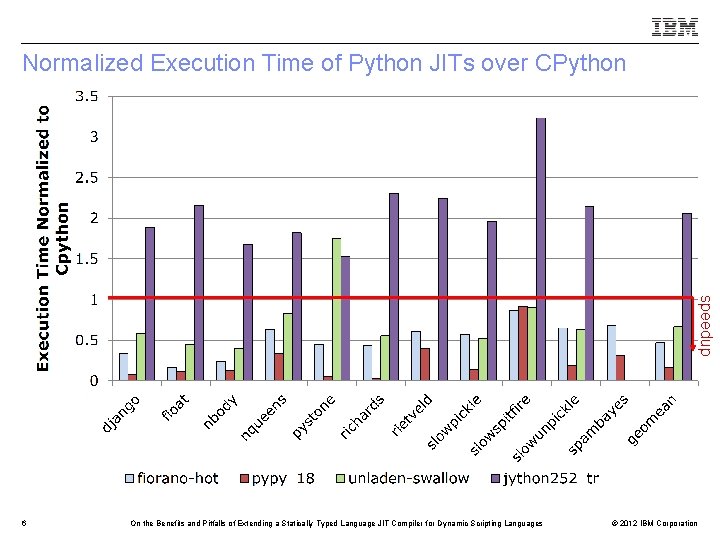
Normalized Execution Time of Python JITs over CPython speedup 6 On the Benefits and Pitfalls of Extending a Statically Typed Language JIT Compiler for Dynamic Scripting Languages © 2012 IBM Corporation
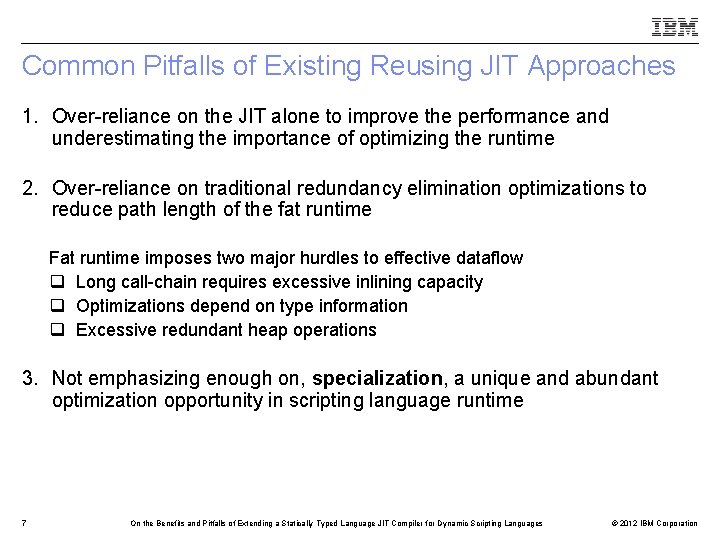
Common Pitfalls of Existing Reusing JIT Approaches 1. Over-reliance on the JIT alone to improve the performance and underestimating the importance of optimizing the runtime 2. Over-reliance on traditional redundancy elimination optimizations to reduce path length of the fat runtime Fat runtime imposes two major hurdles to effective dataflow q Long call-chain requires excessive inlining capacity q Optimizations depend on type information q Excessive redundant heap operations 3. Not emphasizing enough on, specialization, a unique and abundant optimization opportunity in scripting language runtime 7 On the Benefits and Pitfalls of Extending a Statically Typed Language JIT Compiler for Dynamic Scripting Languages © 2012 IBM Corporation
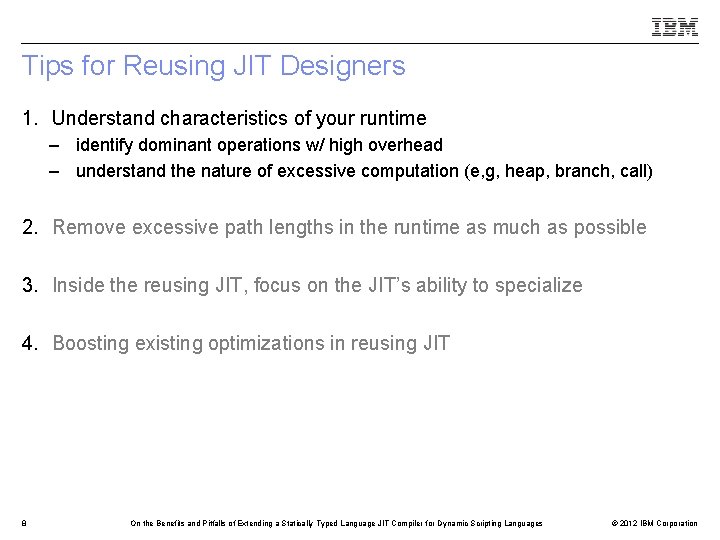
Tips for Reusing JIT Designers 1. Understand characteristics of your runtime – identify dominant operations w/ high overhead – understand the nature of excessive computation (e, g, heap, branch, call) 2. Remove excessive path lengths in the runtime as much as possible 3. Inside the reusing JIT, focus on the JIT’s ability to specialize 4. Boosting existing optimizations in reusing JIT 8 On the Benefits and Pitfalls of Extending a Statically Typed Language JIT Compiler for Dynamic Scripting Languages © 2012 IBM Corporation
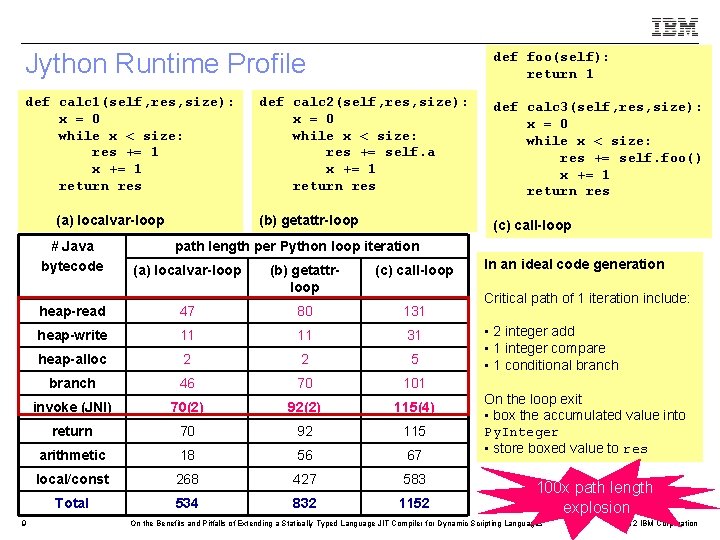
Jython Runtime Profile def foo(self): return 1 def calc 1(self, res, size): x = 0 while x < size: res += 1 x += 1 return res def calc 2(self, res, size): x = 0 while x < size: res += self. a x += 1 return res def calc 3(self, res, size): x = 0 while x < size: res += self. foo() x += 1 return res (b) getattr-loop (c) call-loop (a) localvar-loop # Java bytecode 9 path length per Python loop iteration (a) localvar-loop (b) getattrloop (c) call-loop heap-read 47 80 131 heap-write 11 11 31 heap-alloc 2 2 5 branch 46 70 101 invoke (JNI) 70(2) 92(2) 115(4) return 70 92 115 arithmetic 18 56 67 local/const 268 427 583 Total 534 832 1152 In an ideal code generation Critical path of 1 iteration include: • 2 integer add • 1 integer compare • 1 conditional branch On the loop exit • box the accumulated value into Py. Integer • store boxed value to res 100 x path length explosion On the Benefits and Pitfalls of Extending a Statically Typed Language JIT Compiler for Dynamic Scripting Languages © 2012 IBM Corporation
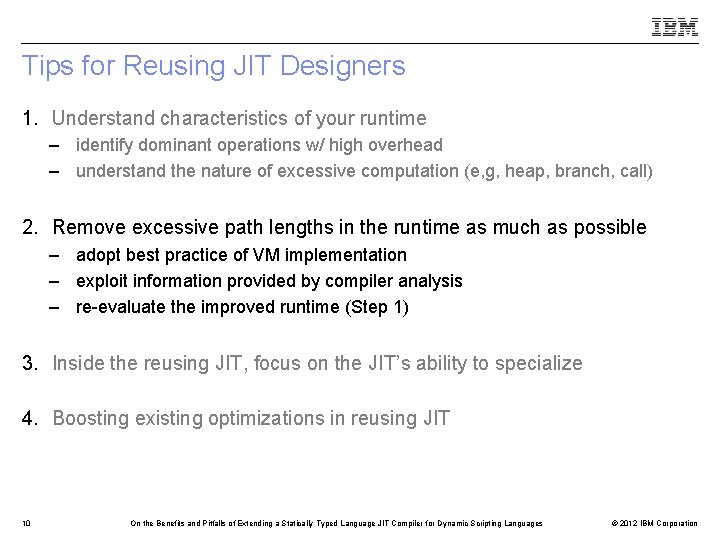
Tips for Reusing JIT Designers 1. Understand characteristics of your runtime – identify dominant operations w/ high overhead – understand the nature of excessive computation (e, g, heap, branch, call) 2. Remove excessive path lengths in the runtime as much as possible – adopt best practice of VM implementation – exploit information provided by compiler analysis – re-evaluate the improved runtime (Step 1) 3. Inside the reusing JIT, focus on the JIT’s ability to specialize 4. Boosting existing optimizations in reusing JIT 10 On the Benefits and Pitfalls of Extending a Statically Typed Language JIT Compiler for Dynamic Scripting Languages © 2012 IBM Corporation
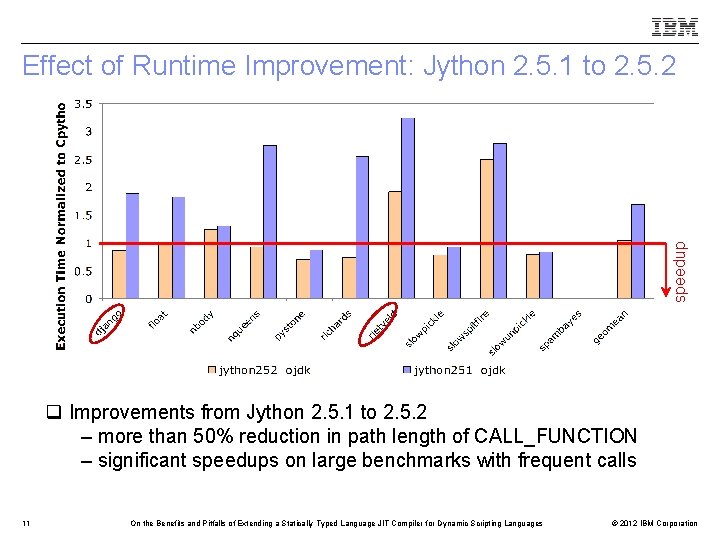
speedup Effect of Runtime Improvement: Jython 2. 5. 1 to 2. 5. 2 q Improvements from Jython 2. 5. 1 to 2. 5. 2 – more than 50% reduction in path length of CALL_FUNCTION – significant speedups on large benchmarks with frequent calls 11 On the Benefits and Pitfalls of Extending a Statically Typed Language JIT Compiler for Dynamic Scripting Languages © 2012 IBM Corporation
Tips for Reusing JIT Designers 1. Understand characteristics of your runtime – identify dominant operations w/ high overhead – understand the nature of excessive computation (e, g, heap, branch, call) 2. Remove excessive path lengths in the runtime as much as possible – adopt best practice of VM implementation – exploit information provided by compiler analysis – re-evaluate the improved runtime (Step 1) 3. Inside the reusing JIT, focus on the JIT’s ability to specialize – Coverage: how many are specialized and specialized successfully – Degree of strength reduction: how fast is the fast version of specialization 4. Boosting existing optimizations in reusing JIT 12 On the Benefits and Pitfalls of Extending a Statically Typed Language JIT Compiler for Dynamic Scripting Languages © 2012 IBM Corporation
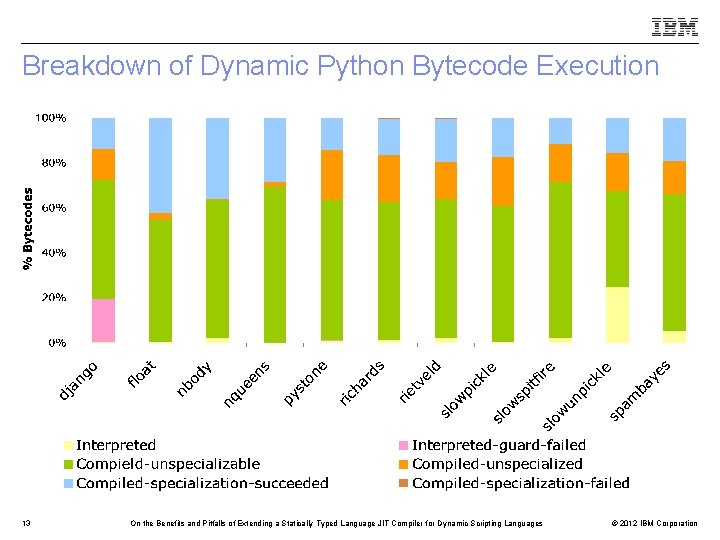
Breakdown of Dynamic Python Bytecode Execution 13 On the Benefits and Pitfalls of Extending a Statically Typed Language JIT Compiler for Dynamic Scripting Languages © 2012 IBM Corporation
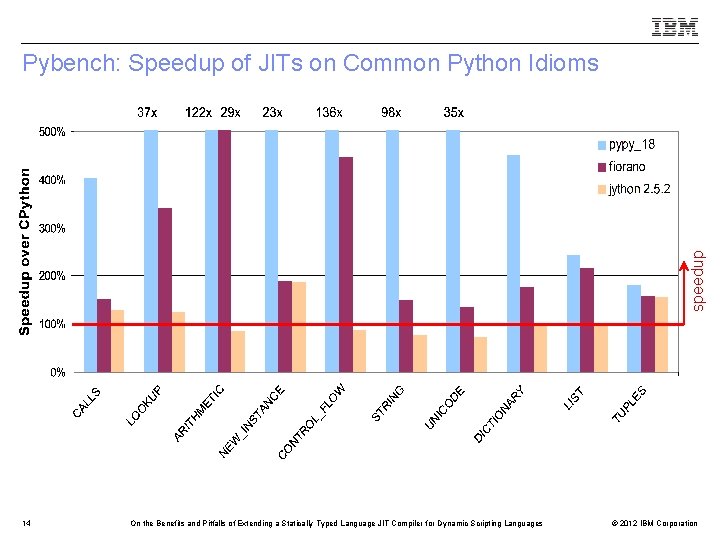
speedup Pybench: Speedup of JITs on Common Python Idioms 14 On the Benefits and Pitfalls of Extending a Statically Typed Language JIT Compiler for Dynamic Scripting Languages © 2012 IBM Corporation
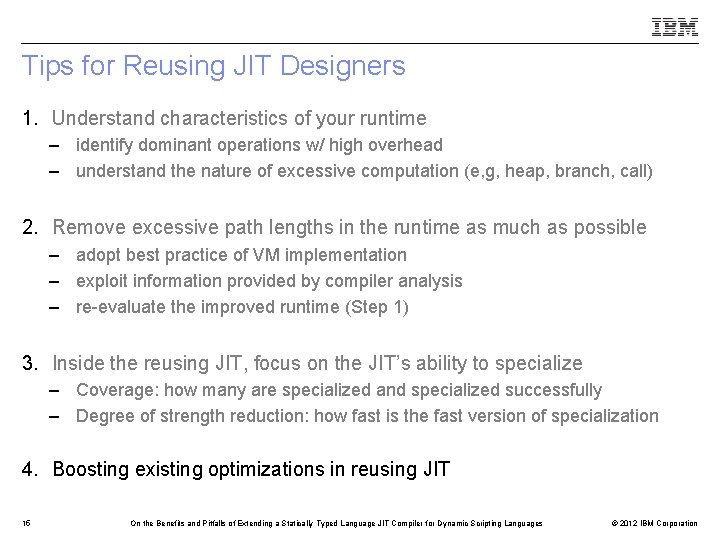
Tips for Reusing JIT Designers 1. Understand characteristics of your runtime – identify dominant operations w/ high overhead – understand the nature of excessive computation (e, g, heap, branch, call) 2. Remove excessive path lengths in the runtime as much as possible – adopt best practice of VM implementation – exploit information provided by compiler analysis – re-evaluate the improved runtime (Step 1) 3. Inside the reusing JIT, focus on the JIT’s ability to specialize – Coverage: how many are specialized and specialized successfully – Degree of strength reduction: how fast is the fast version of specialization 4. Boosting existing optimizations in reusing JIT 15 On the Benefits and Pitfalls of Extending a Statically Typed Language JIT Compiler for Dynamic Scripting Languages © 2012 IBM Corporation
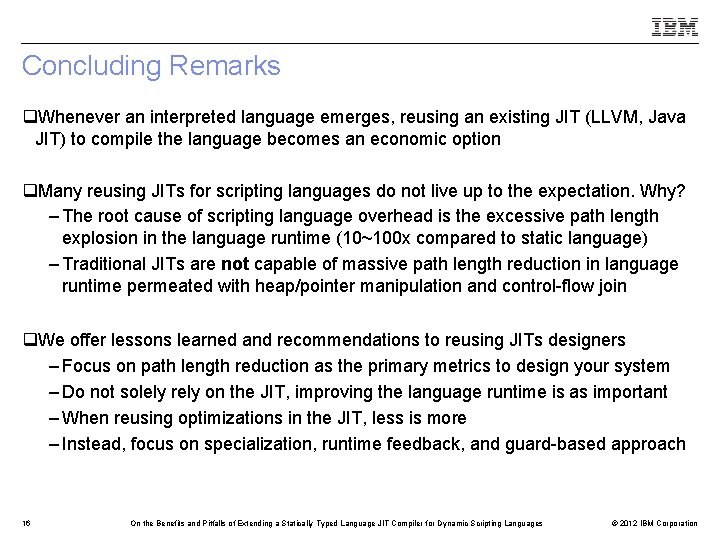
Concluding Remarks q. Whenever an interpreted language emerges, reusing an existing JIT (LLVM, Java JIT) to compile the language becomes an economic option q. Many reusing JITs for scripting languages do not live up to the expectation. Why? – The root cause of scripting language overhead is the excessive path length explosion in the language runtime (10~100 x compared to static language) – Traditional JITs are not capable of massive path length reduction in language runtime permeated with heap/pointer manipulation and control-flow join q. We offer lessons learned and recommendations to reusing JITs designers – Focus on path length reduction as the primary metrics to design your system – Do not solely rely on the JIT, improving the language runtime is as important – When reusing optimizations in the JIT, less is more – Instead, focus on specialization, runtime feedback, and guard-based approach 16 On the Benefits and Pitfalls of Extending a Statically Typed Language JIT Compiler for Dynamic Scripting Languages © 2012 IBM Corporation
q. BACK UP 17 On the Benefits and Pitfalls of Extending a Statically Typed Language JIT Compiler for Dynamic Scripting Languages © 2012 IBM Corporation
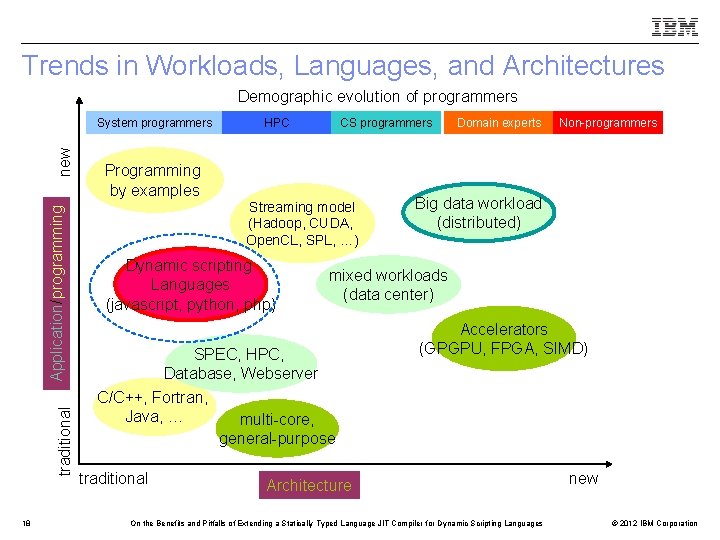
Trends in Workloads, Languages, and Architectures Demographic evolution of programmers traditional Application/programming new System programmers 18 Programming by examples HPC CS programmers Streaming model (Hadoop, CUDA, Open. CL, SPL, …) Dynamic scripting Languages (javascript, python, php) traditional Non-programmers Big data workload (distributed) mixed workloads (data center) SPEC, HPC, Database, Webserver C/C++, Fortran, Java, … Domain experts Accelerators (GPGPU, FPGA, SIMD) multi-core, general-purpose Architecture On the Benefits and Pitfalls of Extending a Statically Typed Language JIT Compiler for Dynamic Scripting Languages new © 2012 IBM Corporation
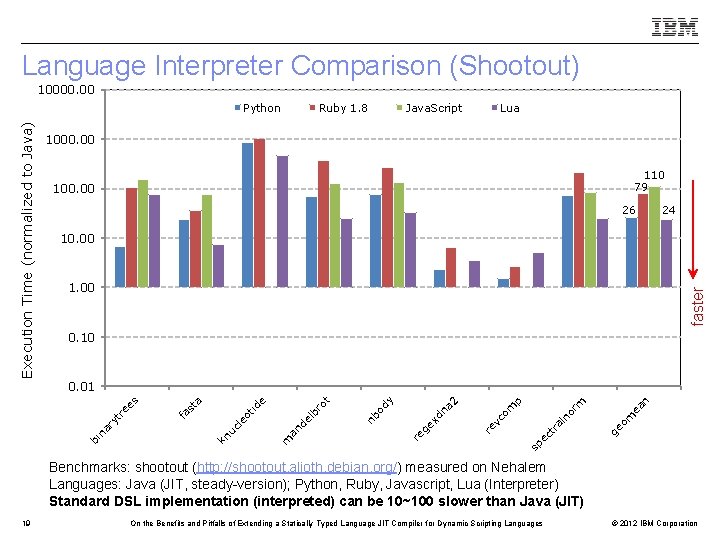
Language Interpreter Comparison (Shootout) 10000. 00 Ruby 1. 8 Java. Script Lua 1000. 00 110 79 100. 00 26 24 10. 00 1. 00 faster Execution Time (normalized to Java) Python 0. 10 tr ec n om sp ge no al vc o re ea rm p m a 2 xd n ge re lb m an de eo cl nb od y ro t e tid ta fa s kn u bi n ar yt r ee s 0. 01 Benchmarks: shootout (http: //shootout. alioth. debian. org/) measured on Nehalem Languages: Java (JIT, steady-version); Python, Ruby, Javascript, Lua (Interpreter) Standard DSL implementation (interpreted) can be 10~100 slower than Java (JIT) 19 On the Benefits and Pitfalls of Extending a Statically Typed Language JIT Compiler for Dynamic Scripting Languages © 2012 IBM Corporation
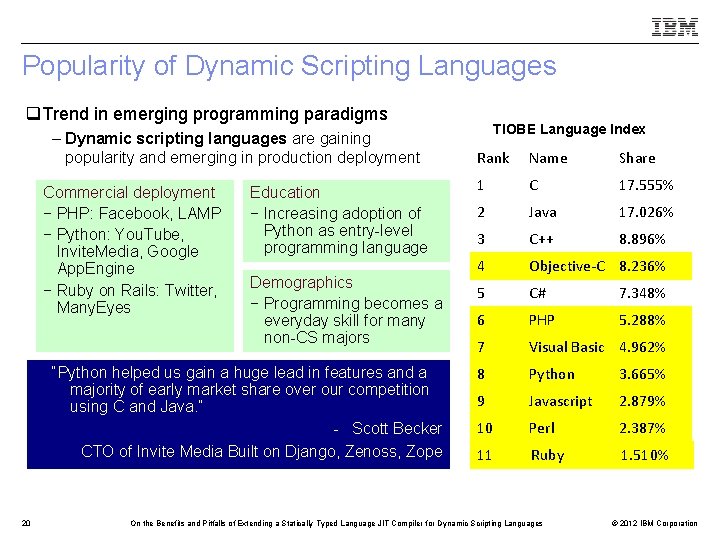
Popularity of Dynamic Scripting Languages q. Trend in emerging programming paradigms – Dynamic scripting languages are gaining popularity and emerging in production deployment Commercial deployment - PHP: Facebook, LAMP - Python: You. Tube, Invite. Media, Google App. Engine - Ruby on Rails: Twitter, Many. Eyes Education - Increasing adoption of Python as entry-level programming language Demographics - Programming becomes a everyday skill for many non-CS majors “Python helped us gain a huge lead in features and a majority of early market share over our competition using C and Java. ” - Scott Becker CTO of Invite Media Built on Django, Zenoss, Zope 20 TIOBE Language Index Rank Name Share 1 C 17. 555% 2 Java 17. 026% 3 C++ 8. 896% 4 Objective-C 8. 236% 5 C# 7. 348% 6 PHP 5. 288% 7 Visual Basic 4. 962% 8 Python 3. 665% 9 Javascript 2. 879% 10 Perl 2. 387% 11 Ruby 1. 510% On the Benefits and Pitfalls of Extending a Statically Typed Language JIT Compiler for Dynamic Scripting Languages © 2012 IBM Corporation
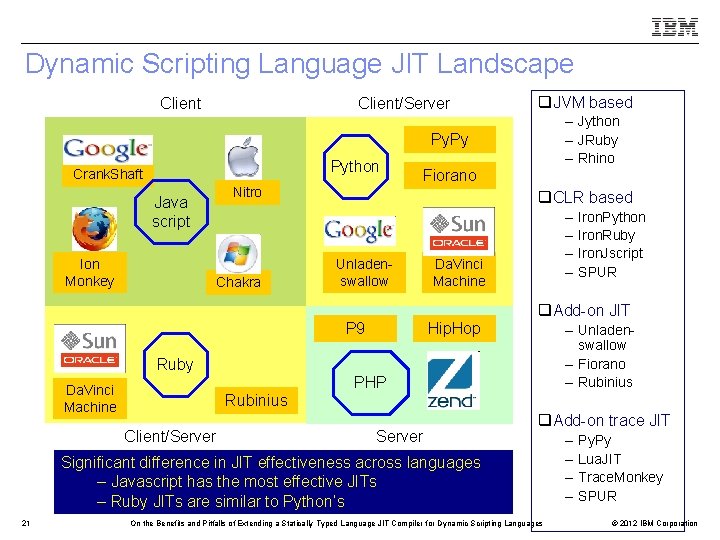
Dynamic Scripting Language JIT Landscape Client/Server q. JVM based – Jython – JRuby – Rhino Py. Py Python Crank. Shaft Nitro Java script Ion Monkey Fiorano Chakra q. CLR based Unladenswallow – – Da. Vinci Machine Iron. Python Iron. Ruby Iron. Jscript SPUR q. Add-on JIT P 9 Hip. Hop – Unladenswallow – Fiorano – Rubinius Ruby Da. Vinci Machine Rubinius Client/Server PHP Server q. Add-on trace JIT Significant difference in JIT effectiveness across languages – Javascript has the most effective JITs – Ruby JITs are similar to Python’s 21 On the Benefits and Pitfalls of Extending a Statically Typed Language JIT Compiler for Dynamic Scripting Languages – – Py. Py Lua. JIT Trace. Monkey SPUR © 2012 IBM Corporation
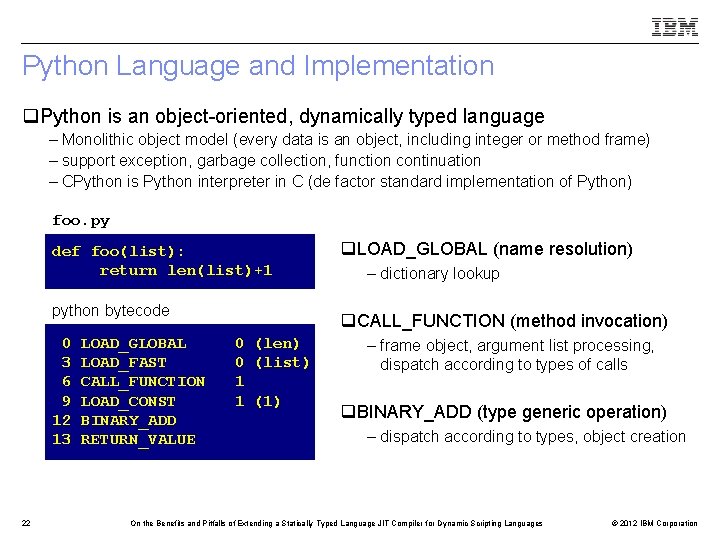
Python Language and Implementation q. Python is an object-oriented, dynamically typed language – Monolithic object model (every data is an object, including integer or method frame) – support exception, garbage collection, function continuation – CPython is Python interpreter in C (de factor standard implementation of Python) foo. py def foo(list): return len(list)+1 python bytecode 0 3 6 9 12 13 22 LOAD_GLOBAL LOAD_FAST CALL_FUNCTION LOAD_CONST BINARY_ADD RETURN_VALUE q. LOAD_GLOBAL (name resolution) – dictionary lookup q. CALL_FUNCTION (method invocation) 0 (len) 0 (list) 1 1 (1) – frame object, argument list processing, dispatch according to types of calls q. BINARY_ADD (type generic operation) – dispatch according to types, object creation On the Benefits and Pitfalls of Extending a Statically Typed Language JIT Compiler for Dynamic Scripting Languages © 2012 IBM Corporation
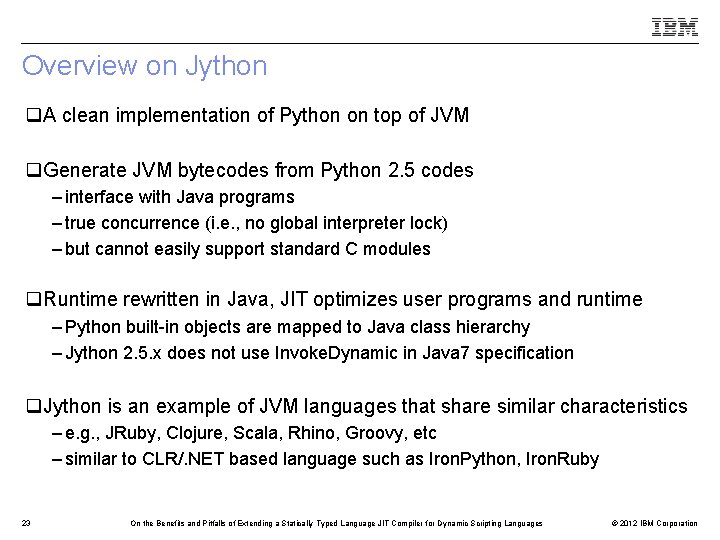
Overview on Jython q. A clean implementation of Python on top of JVM q. Generate JVM bytecodes from Python 2. 5 codes – interface with Java programs – true concurrence (i. e. , no global interpreter lock) – but cannot easily support standard C modules q. Runtime rewritten in Java, JIT optimizes user programs and runtime – Python built-in objects are mapped to Java class hierarchy – Jython 2. 5. x does not use Invoke. Dynamic in Java 7 specification q. Jython is an example of JVM languages that share similar characteristics – e. g. , JRuby, Clojure, Scala, Rhino, Groovy, etc – similar to CLR/. NET based language such as Iron. Python, Iron. Ruby 23 On the Benefits and Pitfalls of Extending a Statically Typed Language JIT Compiler for Dynamic Scripting Languages © 2012 IBM Corporation
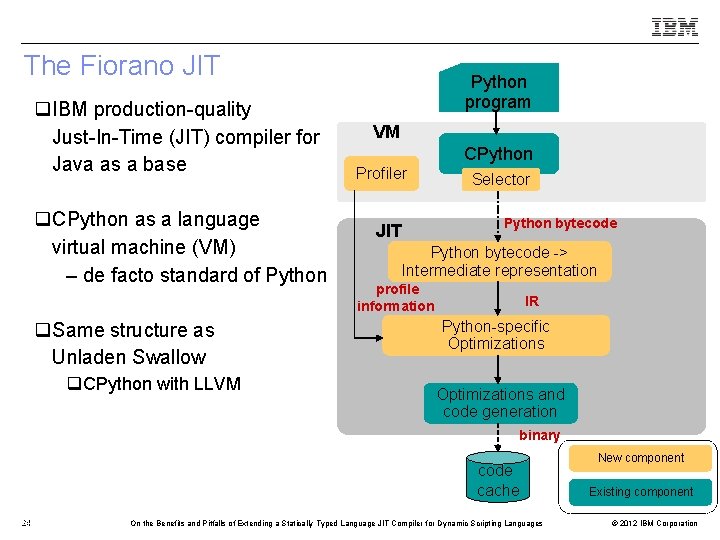
Overview of our Approach The Fiorano JIT q. IBM production-quality Just-In-Time (JIT) compiler for Java as a base q. CPython as a language virtual machine (VM) – de facto standard of Python q. Same structure as Unladen Swallow q. CPython with LLVM Python program VM CPython Profiler JIT Selector Python bytecode -> Intermediate representation profile information IR Python-specific Optimizations and code generation binary code cache 24 24 On the Benefits and Pitfalls of Extending a Statically Typed Language JIT Compiler for Dynamic Scripting Languages New component Existing component © 2012 IBM Corporation
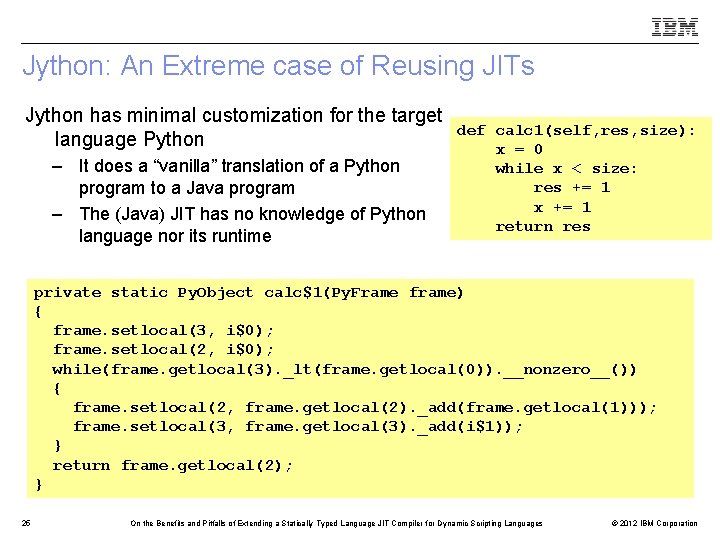
Jython: An Extreme case of Reusing JITs Jython has minimal customization for the target language Python – It does a “vanilla” translation of a Python program to a Java program – The (Java) JIT has no knowledge of Python language nor its runtime def calc 1(self, res, size): x = 0 while x < size: res += 1 x += 1 return res private static Py. Object calc$1(Py. Frame frame) { frame. setlocal(3, i$0); frame. setlocal(2, i$0); while(frame. getlocal(3). _lt(frame. getlocal(0)). __nonzero__()) { frame. setlocal(2, frame. getlocal(2). _add(frame. getlocal(1))); frame. setlocal(3, frame. getlocal(3). _add(i$1)); } return frame. getlocal(2); } 25 On the Benefits and Pitfalls of Extending a Statically Typed Language JIT Compiler for Dynamic Scripting Languages © 2012 IBM Corporation
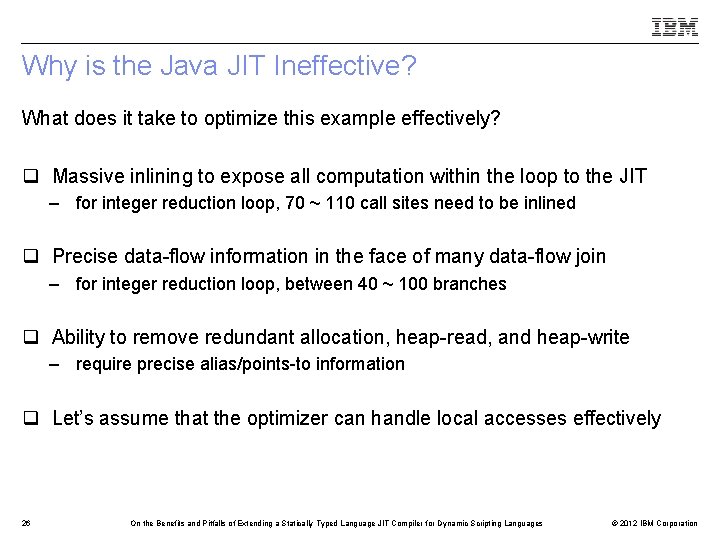
Why is the Java JIT Ineffective? What does it take to optimize this example effectively? q Massive inlining to expose all computation within the loop to the JIT – for integer reduction loop, 70 ~ 110 call sites need to be inlined q Precise data-flow information in the face of many data-flow join – for integer reduction loop, between 40 ~ 100 branches q Ability to remove redundant allocation, heap-read, and heap-write – require precise alias/points-to information q Let’s assume that the optimizer can handle local accesses effectively 26 On the Benefits and Pitfalls of Extending a Statically Typed Language JIT Compiler for Dynamic Scripting Languages © 2012 IBM Corporation
Py. Py (Customary Interpreter + JIT) q. A Python implementation written in RPython – interface with CPython modules may take a big performance hit q. RPython is a restricted version of Python, e. g. , (after start-up time) – Well-typed according to type inference rules of RPython – Class definitions do not change – Tuple, list, dictionary are homogeneous (across elements) – Object model implementation exposes runtime constants – Various hint to trace selection engine to capture user program scope q. Tracing JIT through both user program and runtime – A trace is a single-entry-multiple-exit code sequence (like long extended basic block) – Tracing automatically incorporates runtime feedback and guards into the trace q. The optimizer fully exploit the simple topology of a trace to do very powerful dataflow based redundancy elimination 27 On the Benefits and Pitfalls of Extending a Statically Typed Language JIT Compiler for Dynamic Scripting Languages © 2012 IBM Corporation
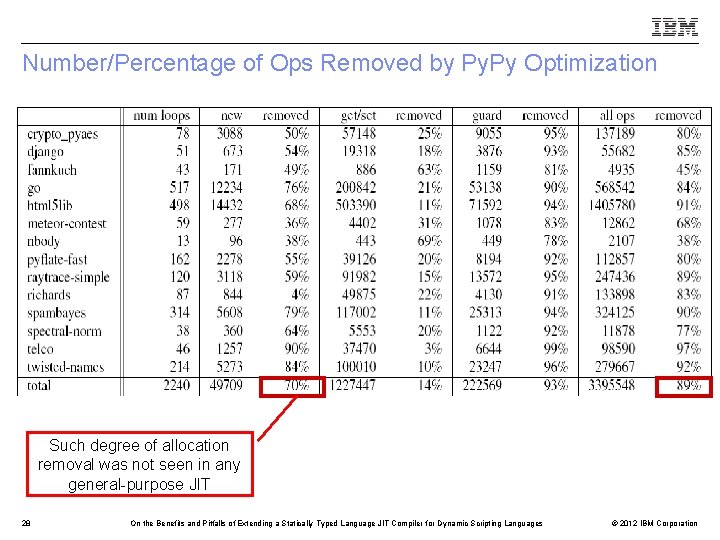
Number/Percentage of Ops Removed by Py. Py Optimization Such degree of allocation removal was not seen in any general-purpose JIT 28 On the Benefits and Pitfalls of Extending a Statically Typed Language JIT Compiler for Dynamic Scripting Languages © 2012 IBM Corporation
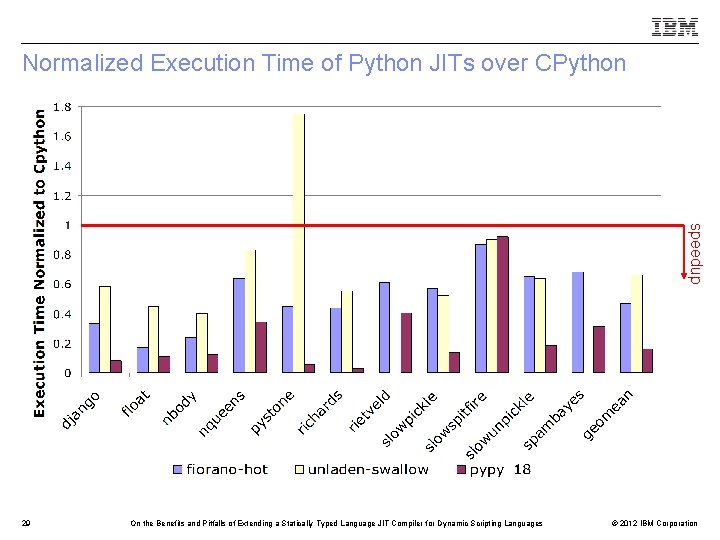
Normalized Execution Time of Python JITs over CPython speedup 29 On the Benefits and Pitfalls of Extending a Statically Typed Language JIT Compiler for Dynamic Scripting Languages © 2012 IBM Corporation
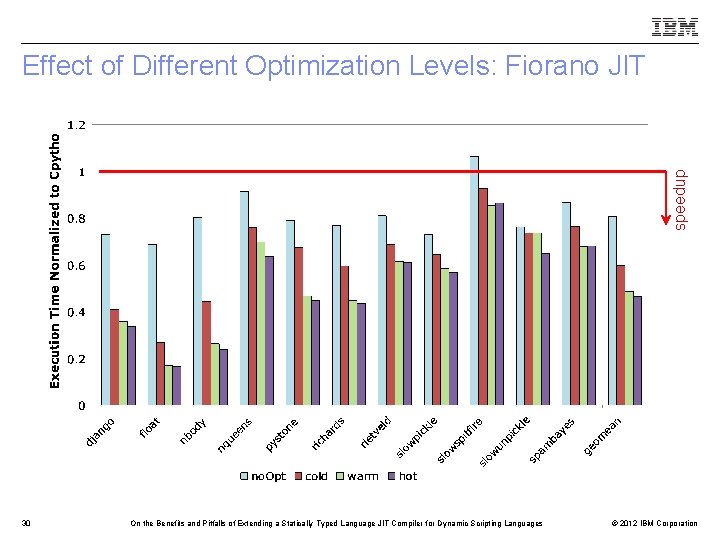
speedup Effect of Different Optimization Levels: Fiorano JIT 30 On the Benefits and Pitfalls of Extending a Statically Typed Language JIT Compiler for Dynamic Scripting Languages © 2012 IBM Corporation
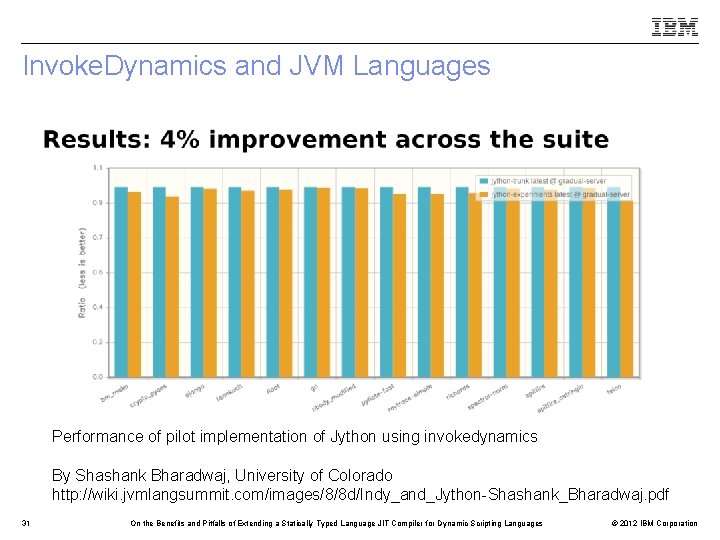
Invoke. Dynamics and JVM Languages Performance of pilot implementation of Jython using invokedynamics By Shashank Bharadwaj, University of Colorado http: //wiki. jvmlangsummit. com/images/8/8 d/Indy_and_Jython-Shashank_Bharadwaj. pdf 31 On the Benefits and Pitfalls of Extending a Statically Typed Language JIT Compiler for Dynamic Scripting Languages © 2012 IBM Corporation
Evolution of Javascript JITs q Google – V 8: • efficient object representation • hidden classes • GC – Crankshaft: “traditional” optimizer (Dec 2010) • adaptive compilation • aggressive profiling • optimistic assumptions • SSA, invariant code motion, register allocation, inlining • Overall, improved over V 8 by 50% q Mozilla – Trace. Monkey • trace-JIT, aggressive type specialization – Jaeger. Monkey (Sept, 2010, Firefox 4) • method-JIT, inlining – Ion. Monkey (2011) q Apple – Nitro JIT (Safari 5) – “ 30% faster than Safari 4, 3% faster than Chrome 5, 2 X faster than Firefox 3. 6” q Microsoft – Chakra JIT (IE 9) • async compilation – Beta release of Chrome with native client • type optimization integrated • fast interpreter • C/C++ codes executed inside browser with • library optimization security restrictions close to Javascripts JIT compilation for Javascript is a reality Ø all major browser/mobile vendors have their own Javascript engine! Ø Nodejs: server-side Javascript using asynchronous event driven model 32 On the Benefits and Pitfalls of Extending a Statically Typed Language JIT Compiler for Dynamic Scripting Languages © 2012 IBM Corporation
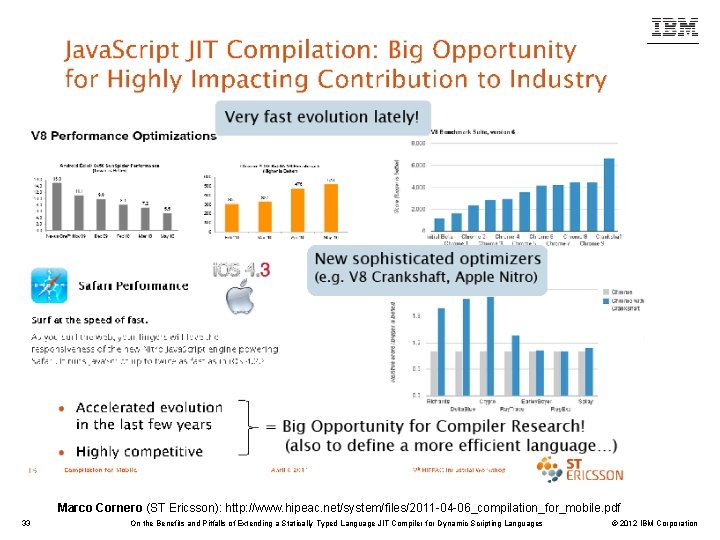
Marco Cornero (ST Ericsson): http: //www. hipeac. net/system/files/2011 -04 -06_compilation_for_mobile. pdf 33 On the Benefits and Pitfalls of Extending a Statically Typed Language JIT Compiler for Dynamic Scripting Languages © 2012 IBM Corporation
Google: Crankshaft JIT q. A new JIT compiler for V 8 (Dec 2010) – Performance improvement by 50%, upto 2 X (V 8 benchmark) – Mostly benefits codes with hot loops, not for very short scripts (Sun. Spider) – Improved start-up time for web apps, e. g. , gmail q. Crankshaft JIT (adaptive compilation): – Base compiler: simple code generation – Runtime profiler: identify hot codes and collect type info – Optimizing compiler (hot codes only): SSA, loop invariant code motion, linearscan RA, inlining, using runtime type info – Deoptimization support: can bail out of optimized codes if runtime assumption (e. g. , type) is no longer valid 34 On the Benefits and Pitfalls of Extending a Statically Typed Language JIT Compiler for Dynamic Scripting Languages © 2012 IBM Corporation
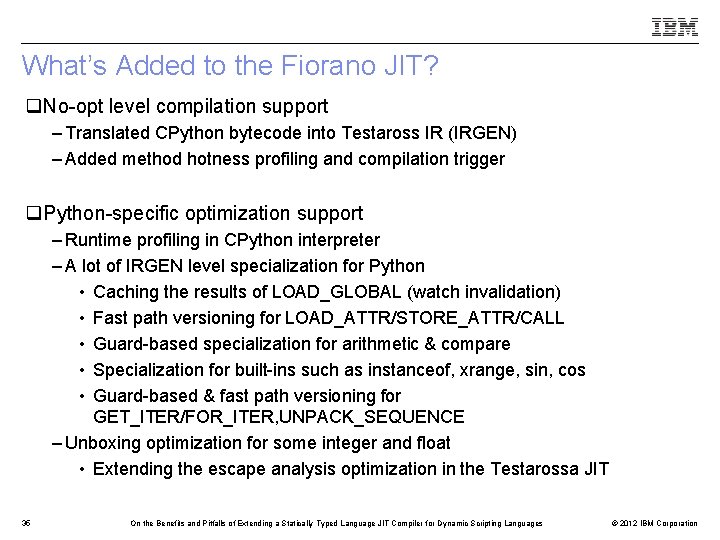
What’s Added to the Fiorano JIT? q. No-opt level compilation support – Translated CPython bytecode into Testaross IR (IRGEN) – Added method hotness profiling and compilation trigger q. Python-specific optimization support – Runtime profiling in CPython interpreter – A lot of IRGEN level specialization for Python • Caching the results of LOAD_GLOBAL (watch invalidation) • Fast path versioning for LOAD_ATTR/STORE_ATTR/CALL • Guard-based specialization for arithmetic & compare • Specialization for built-ins such as instanceof, xrange, sin, cos • Guard-based & fast path versioning for GET_ITER/FOR_ITER, UNPACK_SEQUENCE – Unboxing optimization for some integer and float • Extending the escape analysis optimization in the Testarossa JIT 35 On the Benefits and Pitfalls of Extending a Statically Typed Language JIT Compiler for Dynamic Scripting Languages © 2012 IBM Corporation
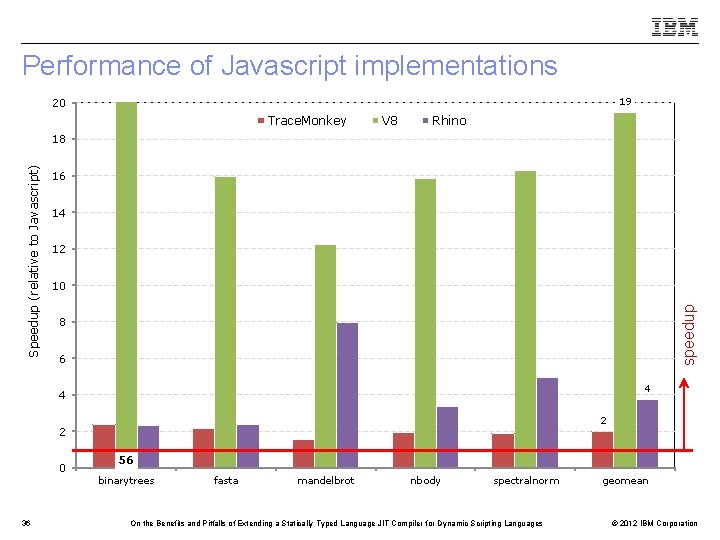
Performance of Javascript implementations 19 20 Trace. Monkey V 8 Rhino 16 14 12 10 speedup Speedup (relative to Javascript) 18 8 6 4 4 2 2 0 36 56 binarytrees fasta mandelbrot nbody spectralnorm On the Benefits and Pitfalls of Extending a Statically Typed Language JIT Compiler for Dynamic Scripting Languages geomean © 2012 IBM Corporation
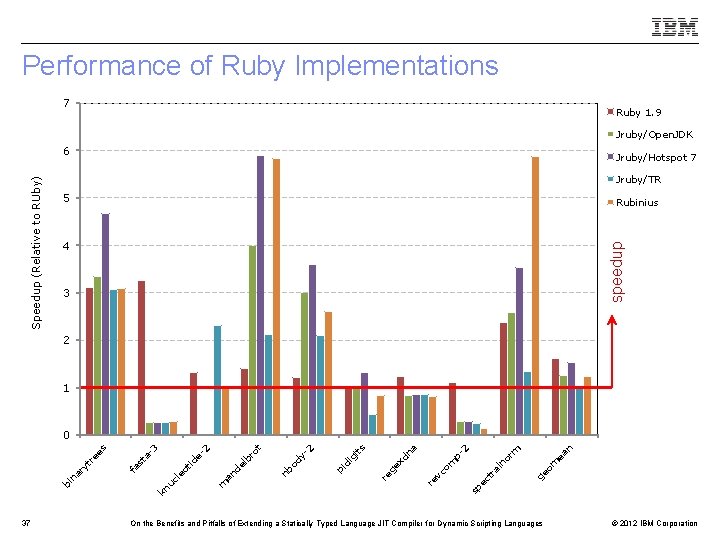
Performance of Ruby Implementations 7 Ruby 1. 9 Jruby/Open. JDK Jruby/Hotspot 7 Jruby/TR 5 Rubinius 4 speedup Speedup (Relative to RUby) 6 3 2 1 37 n ge om ea rm no sp ec tr al p 2 m re vc o na re ge xd gi ts pi di 2 ynb od t an m le o uc de tid lb ro e 2 ast fa kn bi na ry tr ee s 3 0 On the Benefits and Pitfalls of Extending a Statically Typed Language JIT Compiler for Dynamic Scripting Languages © 2012 IBM Corporation
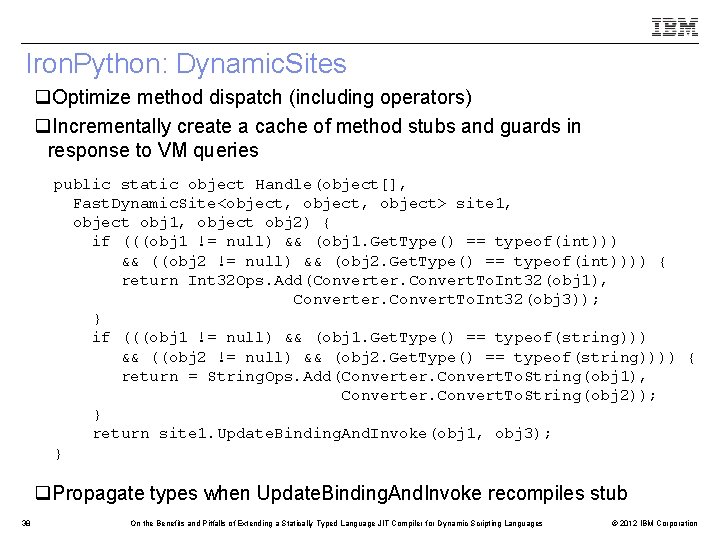
Iron. Python: Dynamic. Sites q. Optimize method dispatch (including operators) q. Incrementally create a cache of method stubs and guards in response to VM queries public static object Handle(object[], Fast. Dynamic. Site<object, object> site 1, object obj 2) { if (((obj 1 != null) && (obj 1. Get. Type() == typeof(int))) && ((obj 2 != null) && (obj 2. Get. Type() == typeof(int)))) { return Int 32 Ops. Add(Converter. Convert. To. Int 32(obj 1), Converter. Convert. To. Int 32(obj 3)); } if (((obj 1 != null) && (obj 1. Get. Type() == typeof(string))) && ((obj 2 != null) && (obj 2. Get. Type() == typeof(string)))) { return = String. Ops. Add(Converter. Convert. To. String(obj 1), Converter. Convert. To. String(obj 2)); } return site 1. Update. Binding. And. Invoke(obj 1, obj 3); } q. Propagate types when Update. Binding. And. Invoke recompiles stub 38 On the Benefits and Pitfalls of Extending a Statically Typed Language JIT Compiler for Dynamic Scripting Languages © 2012 IBM Corporation
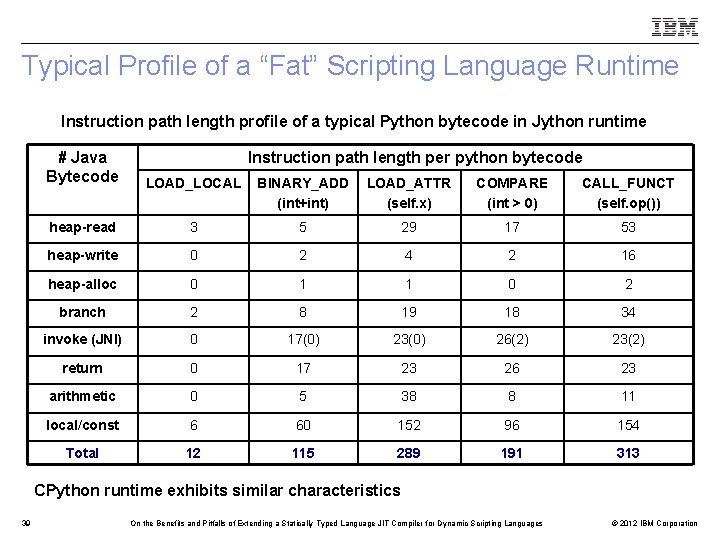
Typical Profile of a “Fat” Scripting Language Runtime Instruction path length profile of a typical Python bytecode in Jython runtime # Java Bytecode Instruction path length per python bytecode LOAD_LOCAL BINARY_ADD (int+int) LOAD_ATTR (self. x) COMPARE (int > 0) CALL_FUNCT (self. op()) heap-read 3 5 29 17 53 heap-write 0 2 4 2 16 heap-alloc 0 1 1 0 2 branch 2 8 19 18 34 invoke (JNI) 0 17(0) 23(0) 26(2) 23(2) return 0 17 23 26 23 arithmetic 0 5 38 8 11 local/const 6 60 152 96 154 Total 12 115 289 191 313 CPython runtime exhibits similar characteristics 39 On the Benefits and Pitfalls of Extending a Statically Typed Language JIT Compiler for Dynamic Scripting Languages © 2012 IBM Corporation
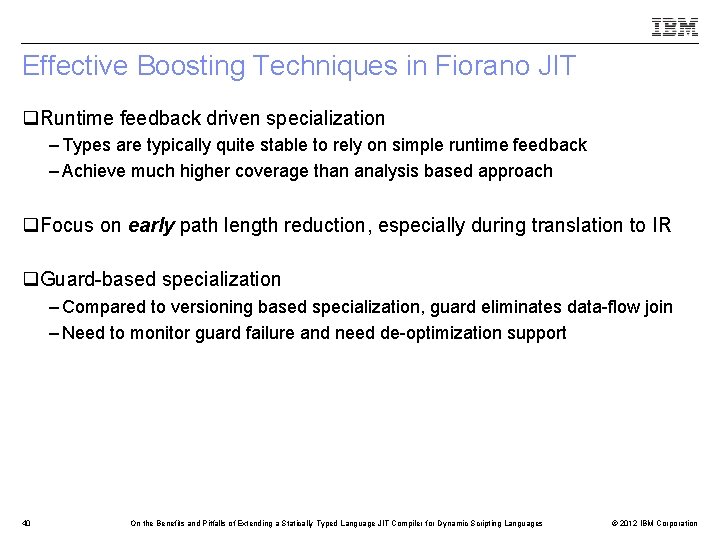
Effective Boosting Techniques in Fiorano JIT q. Runtime feedback driven specialization – Types are typically quite stable to rely on simple runtime feedback – Achieve much higher coverage than analysis based approach q. Focus on early path length reduction, especially during translation to IR q. Guard-based specialization – Compared to versioning based specialization, guard eliminates data-flow join – Need to monitor guard failure and need de-optimization support 40 On the Benefits and Pitfalls of Extending a Statically Typed Language JIT Compiler for Dynamic Scripting Languages © 2012 IBM Corporation
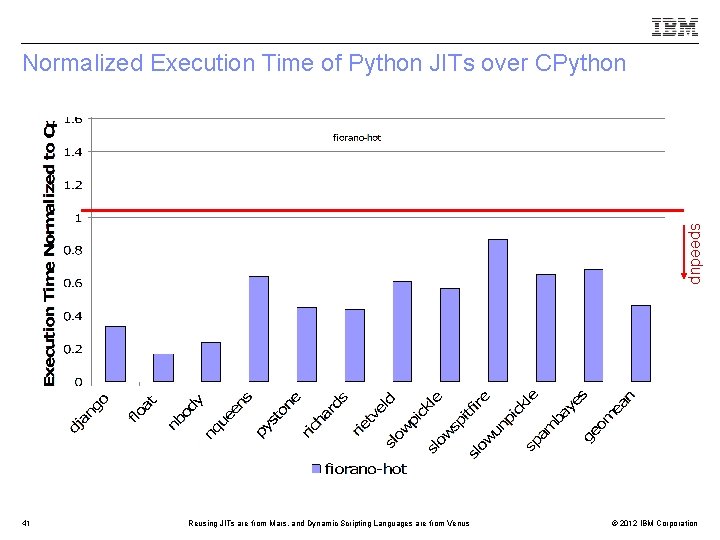
Normalized Execution Time of Python JITs over CPython speedup 41 Reusing JITs are from Mars, and Dynamic Scripting Languages are from Venus © 2012 IBM Corporation
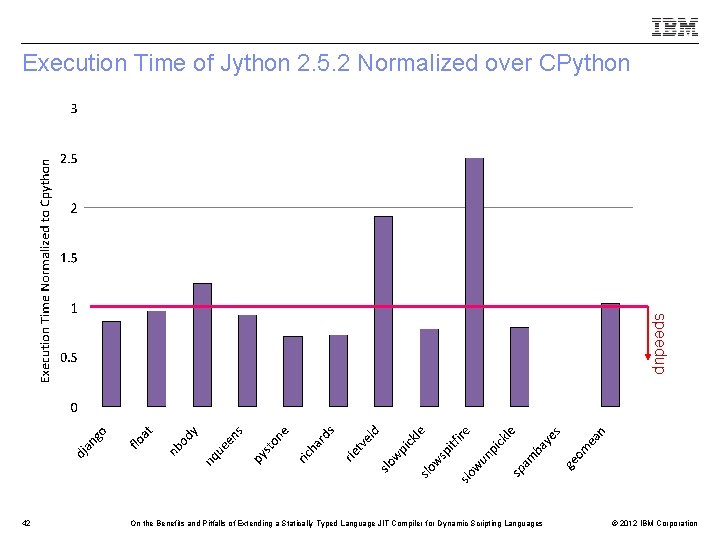
Execution Time of Jython 2. 5. 2 Normalized over CPython speedup 42 On the Benefits and Pitfalls of Extending a Statically Typed Language JIT Compiler for Dynamic Scripting Languages © 2012 IBM Corporation
- Slides: 42