
On the Analysis of the Zeus Botnet Crimeware
On the Analysis of the Zeus Botnet Crimeware Toolkit H. Binsalleeh, T. Ormerod, A. Boukhtouta, P. Sinha, A. Youssef, M. Debbabi, and L. Wang Presented by Anh Ho
Overview What is Zeus? Who are the Researchers? What did they find? Conclusion Questions?
What is Zeus? • Botnet for hire • “King of the Underground Crimeware Toolkits” – Symantec • 3. 6 million US infections – Damballa, July 2009 • User friendly Interface • Competitive price

The Researchers • National Cyber Forensics and Training Alliance Canada • Computer Security Laboratory, Concordia University
Command Control Server • Control Panel – PHP scripts to monitor the botnet • My. SQL Database – Collects the stolen information for the botmaster
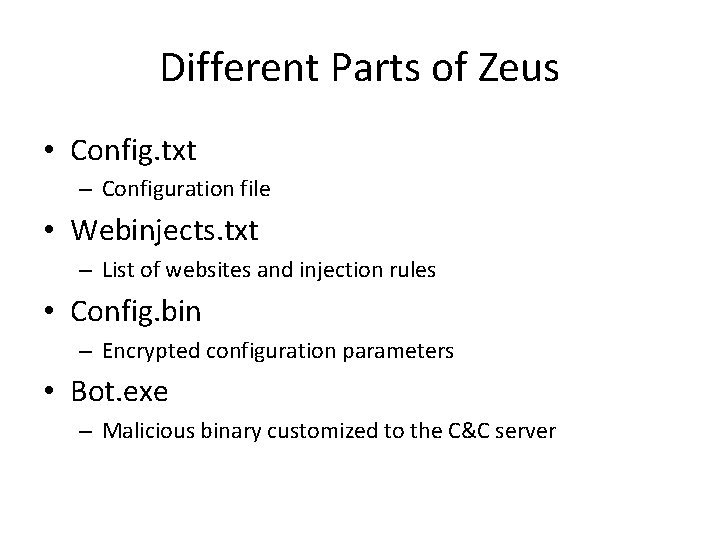
Different Parts of Zeus • Config. txt – Configuration file • Webinjects. txt – List of websites and injection rules • Config. bin – Encrypted configuration parameters • Bot. exe – Malicious binary customized to the C&C server
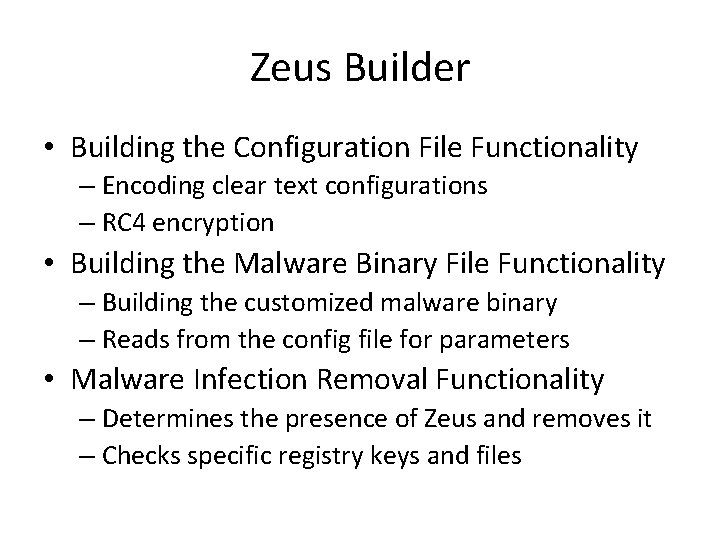
Zeus Builder • Building the Configuration File Functionality – Encoding clear text configurations – RC 4 encryption • Building the Malware Binary File Functionality – Building the customized malware binary – Reads from the config file for parameters • Malware Infection Removal Functionality – Determines the presence of Zeus and removes it – Checks specific registry keys and files
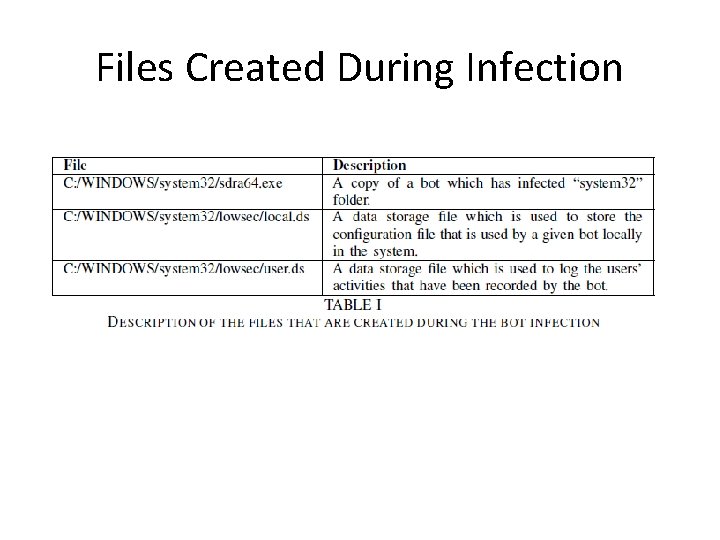
Files Created During Infection
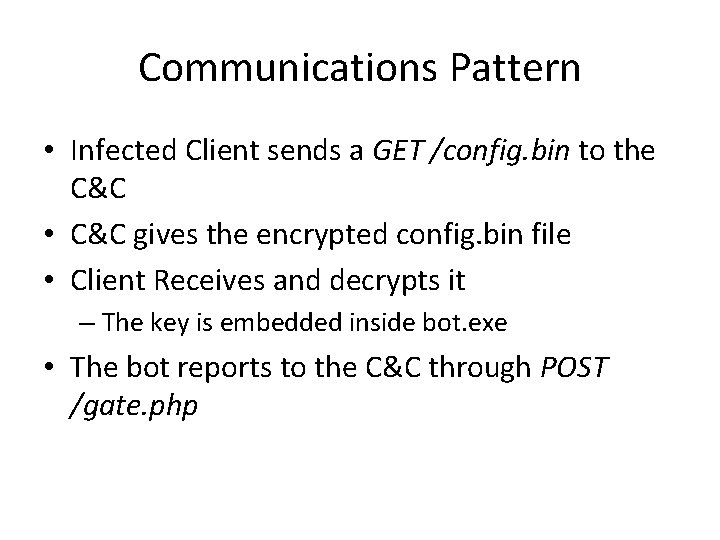
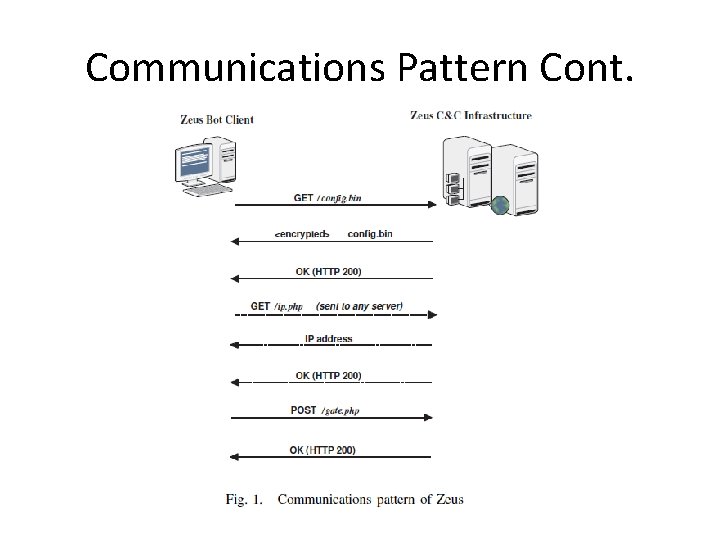
Communications Pattern • Infected Client sends a GET /config. bin to the C&C • C&C gives the encrypted config. bin file • Client Receives and decrypts it – The key is embedded inside bot. exe • The bot reports to the C&C through POST /gate. php
Communications Pattern Cont.
De-obfuscation Process • Round 1 – 4 byte decryption key, 1 byte seed – Decrypts a section from Text/Code and writes it into virtual memory

De-obfuscation Process Cont.
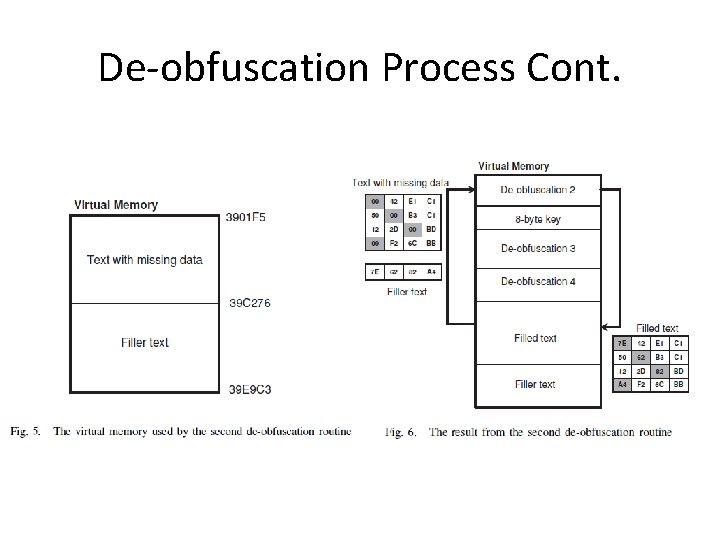
De-obfuscation Process Cont. • Round 2 – Copies two binary blocks from Text/Code – Concatenates them – Writes it into virtual memory – Fills “holes” or zero bytes with filler text
De-obfuscation Process Cont.
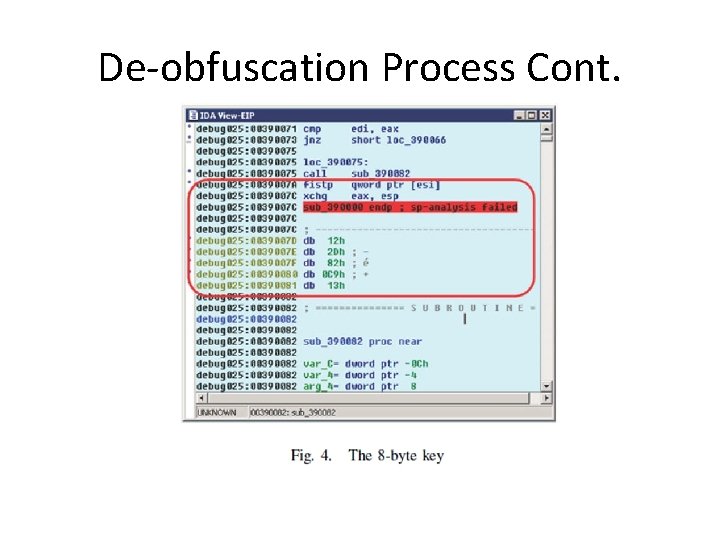
De-obfuscation Process Cont. • Round 3 – Decrypts the output of the second de-obfuscation with the 8 byte key by XOR
De-obfuscation Process Cont.
De-obfuscation Process Cont. • Round 4 – Uses the previously decrypted bytes to modify the rest of the Text/Code
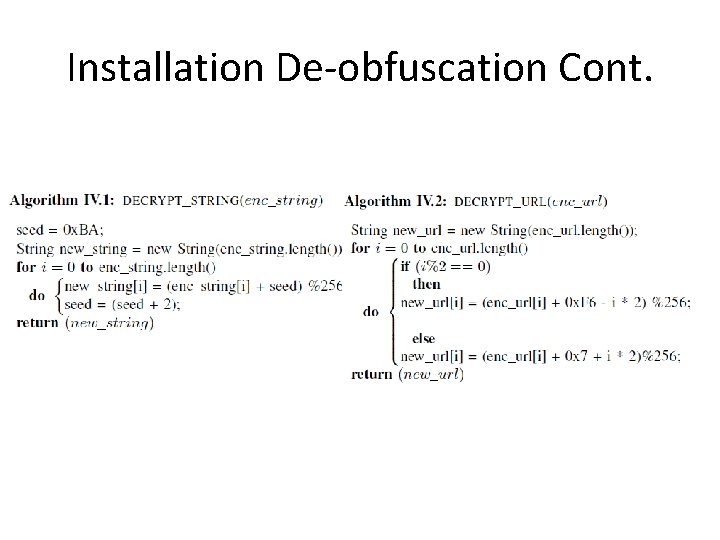
Installation De-obfuscation • Transforms arbitrarily long strings into readable text • Round 1 – De-obfuscates DLL libraries and function names • Round 2 – Decrypts URLs in the configuration file
Installation De-obfuscation Cont.
Installation Process • Loads the Load. Library and Get. Proc. Address from Kernel 32. dll • Decrypts strings shown before • Load. Library and Get. Proc. Address loads more methods from the Windows DLLs • Checks the process table for Outpost. exe (Agnitum Security) • Checks for zlclient. exe (Zonelabs Internet Security)
Installation Process Cont. • Appends path – C: /Windows/System 32/sdra 64. exe to HKEY_LOCAL_MACHINE/SOFTWARE/Microsoft/Windows. NT/Current. V ersion/Winlogon/Userinit – Allows for persistence on startup • Injects the Zeus binary into the virtual memory of winlogon. exe
On First Installation • Makes a copy of itself and stores it in: – C: /Windows/System 32/sdra 64. exe – Evades signature detection by appending random bytes to the end • Duplicates the Modification, Access, and Creation times to alter it’s creation date
First Installation Cont. • Creates a folder at: – C: /Windows/System 32/lowsec • Two new files: – User. ds • Stores the dynamic config file – Local. ds • Stores the stolen information until ready to send to the drop location
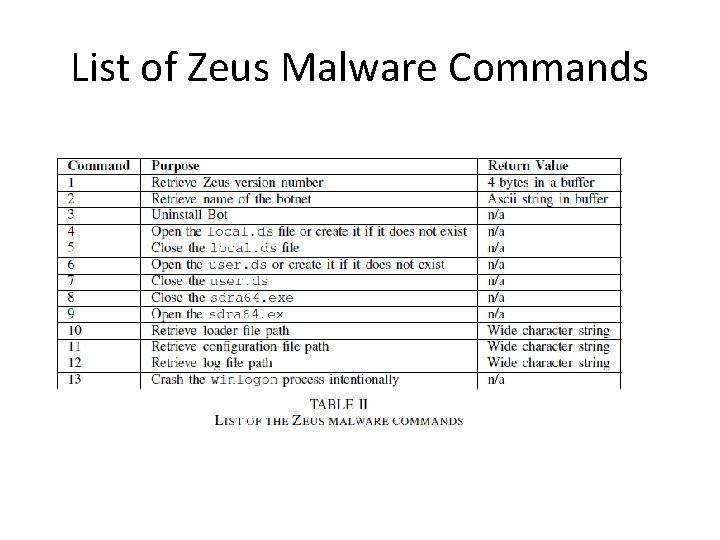
List of Zeus Malware Commands
Conclusion • Designed a tool for the automated recovery of the encryption key • Able to inject falsified information into the botnet in order to defame the business model

Questions?
- Slides: 26