
On Studying Organizational Cultures Pettigrew A M On

- Slides: 40
報告題目: On Studying Organizational Cultures 出處:Pettigrew, A. M. “On Studying Organizational Cultures, ” Administrative Science Quarterly (24: 4), 1979, pp. 570 -581. 理論:Organizational culture theory 報告人:黃正乙 799630073 梁煌達 799630099 指導教授:戴敏育 博士 報告日期: 2011. 03. 26
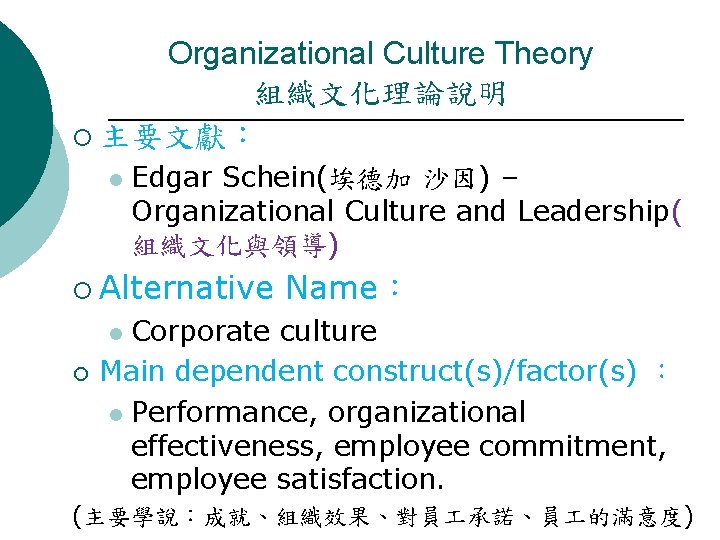
Organizational Culture Theory 組織文化理論說明 ¡ 主要文獻: l Edgar Schein(埃德加 沙因) – Organizational Culture and Leadership( 組織文化與領導) ¡ Alternative Name: Corporate culture Main dependent construct(s)/factor(s) : l Performance, organizational effectiveness, employee commitment, employee satisfaction. l ¡ (主要學說:成就、組織效果、對員 承諾、員 的滿意度)
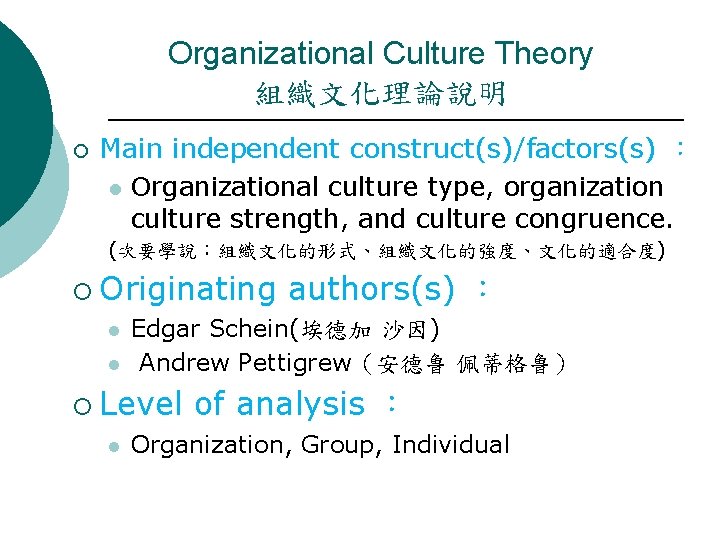
Organizational Culture Theory 組織文化理論說明 ¡ Main independent construct(s)/factors(s) : l Organizational culture type, organization culture strength, and culture congruence. (次要學說:組織文化的形式、組織文化的強度、文化的適合度) ¡ Originating l l Edgar Schein(埃德加 沙因) Andrew Pettigrew(安德鲁 佩蒂格鲁) ¡ Level l authors(s) : of analysis : Organization, Group, Individual
報告主題 On Studying Organizational Cultures Author(s): Andrew M. Pettigrew (安德鲁 M. 佩蒂格鲁) Source: Administrative Science Quarterly, Vol. 24, No. 4, Qualitative Methodology (Dec. , 1979), pp. 570 -581
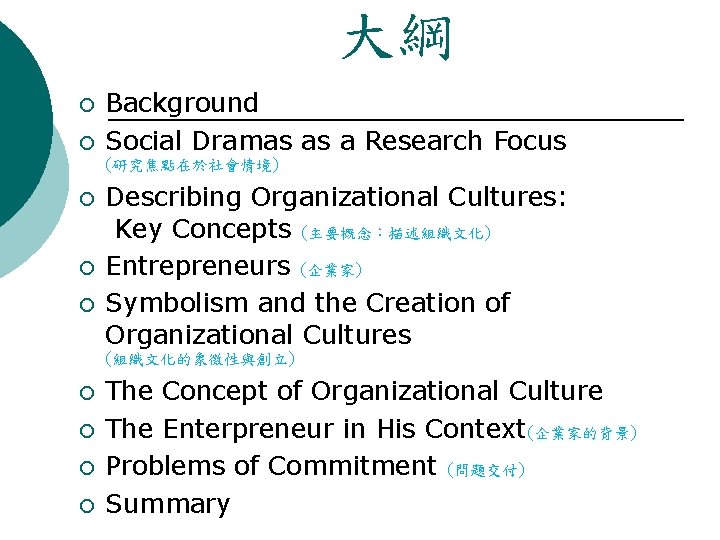
大綱 ¡ ¡ Background Social Dramas as a Research Focus (研究焦點在於社會情境) ¡ ¡ ¡ Describing Organizational Cultures: Key Concepts (主要概念:描述組織文化) Entrepreneurs (企業家) Symbolism and the Creation of Organizational Cultures (組織文化的象徵性與創立) ¡ ¡ The Concept of Organizational Culture The Enterpreneur in His Context(企業家的背景) Problems of Commitment (問題交付) Summary
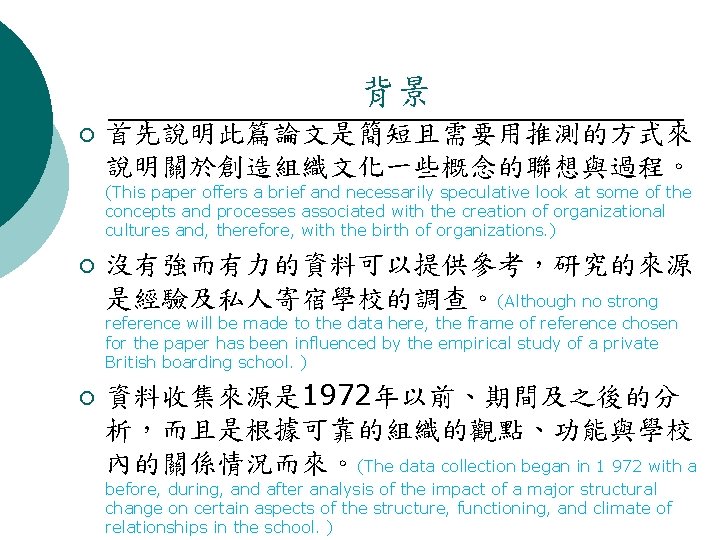
背景 ¡ 首先說明此篇論文是簡短且需要用推測的方式來 說明關於創造組織文化一些概念的聯想與過程。 (This paper offers a brief and necessarily speculative look at some of the concepts and processes associated with the creation of organizational cultures and, therefore, with the birth of organizations. ) ¡ 沒有強而有力的資料可以提供參考,研究的來源 是經驗及私人寄宿學校的調查。(Although no strong reference will be made to the data here, the frame of reference chosen for the paper has been influenced by the empirical study of a private British boarding school. ) ¡ 資料收集來源是 1972年以前、期間及之後的分 析,而且是根據可靠的組織的觀點、功能與學校 內的關係情況而來。(The data collection began in 1 972 with a before, during, and after analysis of the impact of a major structural change on certain aspects of the structure, functioning, and climate of relationships in the school. )
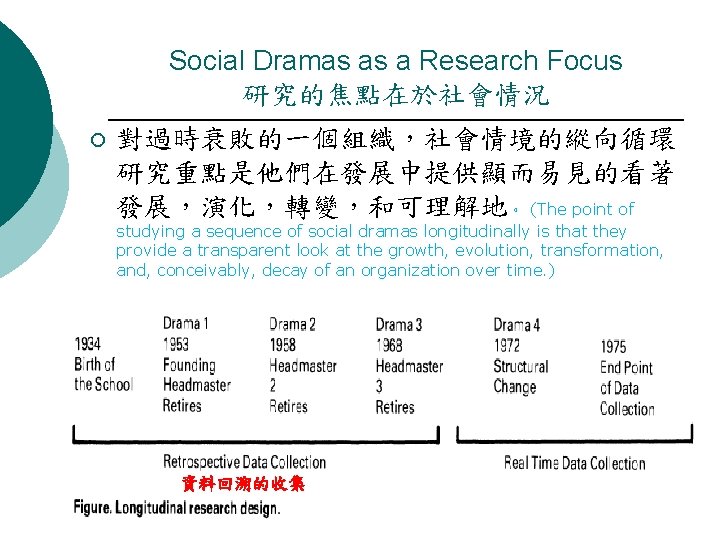
Social Dramas as a Research Focus 研究的焦點在於社會情況 ¡ 對過時衰敗的一個組織,社會情境的縱向循環 研究重點是他們在發展中提供顯而易見的看著 發展,演化,轉變,和可理解地。 (The point of studying a sequence of social dramas longitudinally is that they provide a transparent look at the growth, evolution, transformation, and, conceivably, decay of an organization over time. ) 資料回溯的收集
This kind of design has a number of potential advantages (這種設計有許多潛在的優勢) 1. 每個情境所提供資料收集都有清楚的重點,在 這樣的一連串長期趨勢時間中實際重要的考量 包含事件,人和過程。 (Each drama provides a clear point of data collection, an important practical consideration in such an extended stream of time, events, people, and processes) 2. 每個情境能舉出在深入案例研究中,作為詳細 的案例研究,因此能把少許的情境提供到當今 運作的社會制度。 (Each drama can act as an in-depth case study within the overall case study and thereby provide a dramatic glimpse into the current workings of the social system)
This kind of design has a number of potential advantages (這種設計有許多潛在的優勢) 3. 一連串情境的縱向研究允許改變閱讀者帶領組 織的發展,對連續和甚至隨之而來的每個情境 影響以及導致的過程,強調並且控制每個情境 的影響 。 (The longitudinal study of a sequence of dramas allows varying readings to be taken of the development of the organization, of the impact of one drama on successive and even consequent dramas, and of the kinds of mechanisms that lead to, accentuate, and regulate the impact of each drama) 4. 作為關於轉變的過程的問題暗示,只能在情境 提供關於常規結果和其意義。 (As the point about mechanisms of transformation implies, only dramas can provide consequence and meaning in relation to routines)
This kind of design has a number of potential advantages (這種設計有許多潛在的優勢) 5. 提供機會去檢查情境的研究持續過程,在 學校內研究集中於持續的過程與組織化的 目標,並且對於信任,能力關係和文化方 面的系統變化與他們發生和轉變的問題有 關。 (Examining the dramas affords the opportunity to study continuous processes. In the school study the focus on continuous process relates to questions of organizational goals, their emergence and transformation, and to changes in systems of beliefs, power relationships, and culture. )
Describing Organizational Cultures: Key Concepts (主要概念: 描述組織文化) ¡ 在一連串的社會情境分析,對於建立的一研 究設計的好處之一是它給予研究組織文化的 出現和發展的可能性。而使用學校的例子研 究,透過感覺與實際行動討論組織以怎樣目 的來承諾並有條理的產生,而其中的意識形 態,語言,習慣和虛構的人(或事物)將被我 們放進組織文化的標籤內。 (One of the benefits of a research design built around the analysis of a sequence of social dramas is the possibility it affords to study the emergence and development of organizational cultures. Using the example of the school study, I will discuss how purpose, commitment, and order are generated in an organization both through the feelings and actions of its founder and through the amalgam of beliefs, ideology, language, ritual, and myth we collapse into the label of organizational culture)
Entrepreneurs (企業家) ¡ Collins and Moore (柯林斯與穆爾, 1970) l 他們的研究在對企業家和過程是在一定程度上發 起是為了要提供有系統的知識使成為" 自由世界 堅持自由 " ,而在別處企業家是被描繪成英雄。 (their research on entrepreneurs and the process of founding an organization partly to provide systematic knowledge to allow "the free world to stay free. " Elsewhere entrepreneurs are portrayed as heroes. ) ¡ Boswell (博斯韋爾, 1972: 70) l 由於不同的方式他的做法是堅定的,一方面和他 自己支持,毅力以及另一方面才能。 (His course is determined by fiats of various key outsiders on the one hand his own supply of persistence, guts, and ability on the other. )
Entrepreneurs (企業家) ¡ 從這篇研究所得結論是企業家在高執行公司內 傾向獲得有高度需要成就感和適度的權力,企 業家在低執行公司傾向於有低當時關於研究的 組織文化適合成就和低的對權力的需要(羅伯 茨,1968; Wainer和魯賓,1969). (The kinds of conclusions drawn from this research are that entrepreneurs in high-performing firms tend to have high needs for achievement and moderate needs for power while entrepreneurs in lowperforming firms tend to have low On Studying Organizational Cultures needs for achievement and either high or low needs for. )
Symbolism and the Creation of Organizational Cultures (組織文化的象徵性與創立) ¡ 研究文獻方面有許多不同的方法大部分都圍繞 著組織演化的誕生與發展主題。(There have been a number of different approaches in the research literature around theme of the birth, growth, and evolution of organizations) ¡ 塞爾茲尼克和克拉克的他們的角色和傳奇故事 的定義相當相似。塞爾茲尼克透過任務的陳述 在組織體制裡談論價值的具體化,而活動的計 畫是選擇以徵人方式和社會化程度來探討,而 克拉克把傳奇故事定義為一個集體理解在一正 式成立的組織裡的獨特的成就的系統。(Selznick talks of the embodiment of values in an organizational structure through statements of mission, program of activity, selective recruitment, and socialization, while Clark defines saga as a system of collective understanding of unique accomplishment in a formally established group)
Symbolism and the Creation of Organizational Cultures (組織文化的象徵性與創立) ¡ 企業家可以看出不僅是創造者一些比較理性的及有形 的方面事情,如組織結構和技術方面等,而且也作為 創新的象徵性、意識形態、看法、信仰、習慣和虛構 的事物,更多的文化方面是表現力和構成的組織生活, 因此代表了新的組織設置可以研究的轉變過程的信念, 從沒有信仰到新的信仰,從沒有規則到新規則的成立, 從沒有文化到新的文化,並在總體上觀察到的轉變思 想的結構與表現方式。(Entrepreneurs may be seen not only as creators of some of the more rational and tangible aspects of organizations such as structures and technologies but also as creators of symbols, ideologies, languages, beliefs, rituals, and myths, aspects of the more cultural and expressive components of organizational life. New organizations thus represent settings where it is possible to study transition processes from no beliefs to new beliefs, from no rules to new rules, from no culture to new culture, and in general terms to observe the translation of ideas into structural and expressive forms)
The Concept of Organizational Culture (組織文化的概念 ) ¡ 文化是公開的系統和在某ㄧ特定時期某ㄧ群 集體接受某種意涵 (Culture is the system of such publicly and collectively accepted mean-ings operating for a given group at a given time. ) ¡ 人所擁有的發明與溝通能力與其他動物相比 , 的確是認為是獨特的 (Indeed what is sup-posed to be distinctive about man compared with other animals is his capacity to invent and communicate determi-nants of his own behavior (White, 1949; Cassirer, 1 953). )
THE ENTREPRENEUR IN HIS CONTEXT (企業家背景) ¡ 焦點在於企業家需要的條件及能力往往都過 分強調個人素質的企業家,而忘記這些素質 都必須作出有效地調整(調動)和特定的機構 環境。 (The focus on entrepreneurs in terms of sets of needs and abilities tends both to overly emphasize the per-sonal qualities of entrepreneurs and to forget that those qualities have to be mobilized and made effective within a particular institutional context. )
THE ENTREPRENEUR IN HIS CONTEXT (企業家背景) ¡ 企業家精神領導組成部分,不僅是涉及解釋 個人驅動的企業家條件的技能和機會,而且 還與企業家與他們的追隨者之間的互動過程, 更在一般的過程中通過這些目的與承諾持續 在組織內產生。 (The leadership component of entrepreneurship, therefore, is not just concerned with the explanation of the individual drive of the entrepreneur in terms of skills and opportunities, but also with the interac-tive processes between entrepreneurs and their followers and the more general processes through which purpose and commitment are generated and sustained within an organization. )
THE ENTREPRENEUR IN HIS CONTEXT (企業家背景) ¡ 創業的領導層面是動態體制和領導關係的追 隨者以及熟練的個人特質調配。 (Thus the leadership aspect of entrepreneurship is a function of institutional dynamics and leader-follower rela-tions as well as the skillful deployment of personal qualities. )
Problems of Commitment (承諾的問題) ¡ 繼坎特(1972)和布坎南(1 974)承諾 是指參與者願意提供能量和效忠組織,要切 實重視其目標和價值觀,從而為自己的組織 著想。 (Following Kanter (1 972) and Buchanan (1 974) commitment is defined as the willingness of participants to give energy and loyalty to an organization, to be effectively attached to its goals and values and thereby to the organization for its own sake. )
Problems of Commitment (承諾的問題) ¡ 承諾的機制的作用是部分地脫離了他的一些 人從已經存在附件和重新導向他的系統語言 和信仰的形成方式在他的社交關係對組織的 需要和目的。這樣,一套完全不同個體塑造 成一個集合的整體。 (The role of commitment mechanisms is partly to dis-engage the person from some of his preexisting attach-ments and to redirect his system of language and beliefs and the patterning in his social relationships toward the or-ganization's needs and purposes. In this way, a set of dispa-rate individuals are fashioned into a collective whole. )
Problems of Commitment (承諾的問題) ¡ 一個願景於“意識提升“在新組織將成為其來 源、信譽的形式及過程是溝通成功的關鍵。 (Critical to the success of a vision in "consciousness raising" in a new organization will be the credibility of its source and the form and process by which it is communicated. )
Problems of Commitment (承諾的問題) ¡ 龐迪(1975)探討了領導才能像“一種語言遊戲。 “他指出語言是其中一個關鍵 具對社會影響力且 一個領導者的有效性可能會受到影響由語言重疊與 他的追隨者並在程度上領導者可以創造字詞解釋從 而提供為集體經驗。這可能是其中一個關鍵過程它 標識是給一個組織因此個人可以承諾他們的情感和 精力。 (Pondy (1 975) has discussed leadership as "a language game. " He noted that language is one of the key tools of social influence and that a leader's effectiveness is likely to be influenced by the language overlap with his followers and by the extent to which a leader can create words that explain and thereby give order to collective experiences. This may be one of the key processes by which identity is given to an organization and therefore to which individuals can commit their emotions and energies. )
Problems of Commitment (承諾的問題) ¡ 已經有一個數字的假設在前面的論點。之一是員 的承諾是一個必要條件成功一個新的組織。第二個 原因是這些承諾並非自動產生出來的互動但必須贏 得。部分收益無疑將來自能量和遠見的企業家,從 他的個性化招聘並通過語言和風格與他溝通他的遠 見。願景成為一種意識形態經過認可的。 (There have been a number of assumptions in the preceding argument. One has been that employee commitment is a necessary condition for the success of a new organization. A second is that such commitments are not generated automatically out of interaction, but must be earned. Part of the earning will undoubtedly come from the energy and vi-sion of the entrepreneur, from his personalized recruiting and through the language and style with which he com- municates his vision. A vision becomes an ideology through the endorsement of the organization. )
Problems of Commitment (承諾的問題) ¡ 可以傳播意識形態的意義,需要參與及行為一致性 推動了日常任務的性能,並解決其人民所關切 。 這些過程密切交織在一起的機制是犧牲和投資,構 成疆界管理體制的完整性和趨勢,以及所產生潛在 的社會團體儀式同質性的背景和組織的神話。 (The ideology can im- part meaning, demand involvement and behavioral consis- tency, motivate the performance of routine tasks, and re- solve the concerns of its people. Closely interwoven with these processes are the mechanisms of sacrifice and investment, the forms of boundary management and tenden- cies to institutional completeness, and the potential for community arising out of group rituals, homogeneity of back- ground, and organizational myths. )
SUMMARY (摘要) ¡ 問題已經透過接觸的概念符號,語言,思想,信仰, 儀式和神話。這些概念被定義然後其部分功能重疊 和分析關聯和尊敬。注意力都被吸引到他們的價值 不僅在理解創造新的文化,而且在相關過程揭開其 中企業家提供能量,宗旨和組織的承諾他們將成為 現實。 (The problem has been approached through the concepts of symbol, language, ideology, belief, ritual, and myth. These concepts have been defined and some of their functions and analytical interconnections and overlaps distinguished. Attention has been drawn to their value not only in under- standing the creation of new cultures, but also in unravelling the related processes by which entrepreneurs give energy, purpose, and commitment to the organizations they are bringing into being. )
SUMMARY (摘要) ¡ 奧尼(1961年),高夫曼(1961),與科 塞(1974)的作品似乎表示這些理念很可 能是有用的在某些種類的組織而不是其他的。 (The works of Etzioni (1961), Goffman (1961), and Coser (1974) would seem to indicate these concepts are more likely to be useful in certain kinds of organizations than others. )
SUMMARY (摘要) ¡ 由Pettigrew和布姆斯特德(1980年)研 究對本文中的商業組織組織文化的變化如何 影響到組織的發展活動,影響說明了使用的 概念。 (The study by Pettigrew and Bumstead (1980) of how varia- tions in organizational culture have affected the impact of organization development activities illustrates the use of the concepts in this paper in business organizations. )
The End Thanks a lot
參考來源 ¡ ¡ 管理學, 張緯良 著, 雙葉書廊出版,組織文化社會責任與管理道德, http: //www. fgu. edu. tw/newpage/fguwebs/sjfungweb/upl oad/images/File/management/fchap 05. ppt 盧萬方,香港大學教育學院,新高中中國語文課程學與教系列(4) 選修單元四:文化專題探討, http: //www. edb. gov. hk/File. Manager/TC/Content_5805/Session _1 -_Mr. %20 Lo. ppt 洪啟昌 著, 國立政治大學 教育研究所 博士論文, 2004, 教育行政機關組織 文化、知識管理與組織學習關係之研究 http: //nccuir. lib. nccu. edu. tw/handle/140. 119/32965 Edgar H. Schein, Organizational Culture , American Psychologist Feb. Vol. 45, 1990, 109 -119