
On standalone transmissions with short fixed LBT IEEE

On standalone transmissions with short fixed LBT IEEE Coexistence Workshop, July 2019 Proprietary and Confidential. © 2018 Broadcom Inc. All rights reserved. 1
Introduction ● Listen Before Talk or LBT is the procedure by which a device confirms the absence of other transmissions in the channel before starting its own transmission. LBT is a key procedure for transmission in an unlicensed channel. ● In NR-U/LAA/Wi-Fi, independent transmissions use the following types of LBT: ○ CAT 2 LBT where a device that intends to transmit checks the channel for a short fixed duration of time. ○ CAT 4 LBT where a device that intends to transmit checks the channel for a random duration of time. The random duration is a function of the device’s immediate transmission history (whether previous transmissions were successful or not), the nature of data to be transmitted (voice/video/best effort/background) etc. ● Wi-Fi uses CAT 4 LBT for almost all its transmissions. CAT 2 LBT is used in extremely rare cases, such as when abandoning the current channel due to DFS, which account for much less than 1% of transmissions. ● LAA uses CAT 4 LBT for the majority of its transmissions and CAT 2 LBT for up to 5% of DL transmissions. NR-U proposes to do the same too. ● This presentation discusses transmissions with short fixed duration (CAT 2) LBT. Proprietary and Confidential. © 2019 Broadcom Inc. All rights reserved.
Considerations on CAT 2 and CAT 4 LBT We discuss the following aspects: ● Latency of transmissions with CAT 2 LBT and CAT 4 LBT, the latency being defined as the average time required by a device implementing the LBT scheme to correctly transmit a packet. ● Fairness: Whether CAT 2 LBT can degrade the performance of devices that use other LBT schemes, for example CAT 4 LBT. Please note that the CAT 2 LBT being referred to here is the LBT performed for independent or standalone transmissions on the primary channel. These are transmissions that are outside any Channel Occupancy Time that is granted to an unlicensed device on successfully completing CAT 4 LBT. Proprietary and Confidential. © 2019 Broadcom Inc. All rights reserved.
Latency of CAT 2 and CAT 4 LBT ● ● ● The transmission latency is the time that a device implementing the LBT scheme requires to correctly transmit a packet. In an unloaded channel with low/no collision, CAT 2 and CAT 4 LBT have the same latency. In a loaded channel, the latency depends on the channel being busy due to the presence of transmissions from other devices, as well as on collisions. Collisions occur in the following ways: ○ As an example, if 2 NR-U nodes start sensing the channel at the same time, find it idle and start transmitting: ■ For CAT 2 LBT, the chance of collision is 100% ■ For CAT 4 LBT, the chance of collision is 25% for the highest priority traffic class and <<1% for the lowest priority traffic class ○ If additionally, some nodes cannot hear each other (the hidden nodes): ■ Transmissions with CAT 2 LBT can collide again in subsequent retransmissions. ■ CAT 4 LBT randomizes the sensing duration of the retransmissions which reduces the probability of subsequent collisions. So, CAT 4 LBT adapts the duration that a device senses a channel to the collision observed in the channel. On the contrary, CAT 2 LBT, due to its fixed sensing duration, cannot adapt to collisions. Proprietary and Confidential. © 2019 Broadcom Inc. All rights reserved.
Fairness of CAT 2 LBT ● Fairness of an LBT scheme measures whether devices that implement it degrade the performance of devices that do not implement it. ● We evaluate whether CAT 2 LBT can increase the latency of devices that perform CAT 4 LBT. ● In the event of collisions between transmissions with CAT 2 LBT and CAT 4 LBT, CAT 2 will sense the channel for the same fixed duration for its next transmission while CAT 4 will double its random wait time (in order to reduce collisions) for its next transmission. ● So, intuitively, CAT 2 LBT can increase/degrade the latency of CAT 4 LBT. ○ If the total % of CAT 2 LBTs are low, there may not be any measurable degradation. ○ On the other hand, if the % of CAT 2 LBTs is significant, it can degrade the performance of devices with CAT 4 LBT. Proprietary and Confidential. © 2019 Broadcom Inc. All rights reserved.
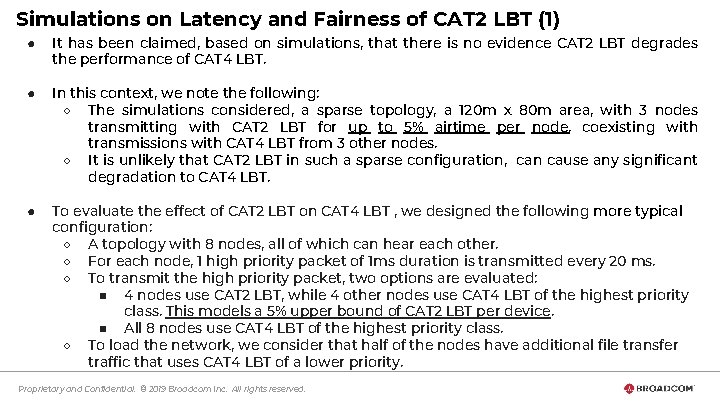
Simulations on Latency and Fairness of CAT 2 LBT (1) ● It has been claimed, based on simulations, that there is no evidence CAT 2 LBT degrades the performance of CAT 4 LBT. ● In this context, we note the following: ○ The simulations considered, a sparse topology, a 120 m x 80 m area, with 3 nodes transmitting with CAT 2 LBT for up to 5% airtime per node, coexisting with transmissions with CAT 4 LBT from 3 other nodes. ○ It is unlikely that CAT 2 LBT in such a sparse configuration, can cause any significant degradation to CAT 4 LBT. ● To evaluate the effect of CAT 2 LBT on CAT 4 LBT , we designed the following more typical configuration: ○ A topology with 8 nodes, all of which can hear each other. ○ For each node, 1 high priority packet of 1 ms duration is transmitted every 20 ms. ○ To transmit the high priority packet, two options are evaluated: ■ 4 nodes use CAT 2 LBT, while 4 other nodes use CAT 4 LBT of the highest priority class. This models a 5% upper bound of CAT 2 LBT per device. ■ All 8 nodes use CAT 4 LBT of the highest priority class. ○ To load the network, we consider that half of the nodes have additional file transfer traffic that uses CAT 4 LBT of a lower priority. Proprietary and Confidential. © 2019 Broadcom Inc. All rights reserved.
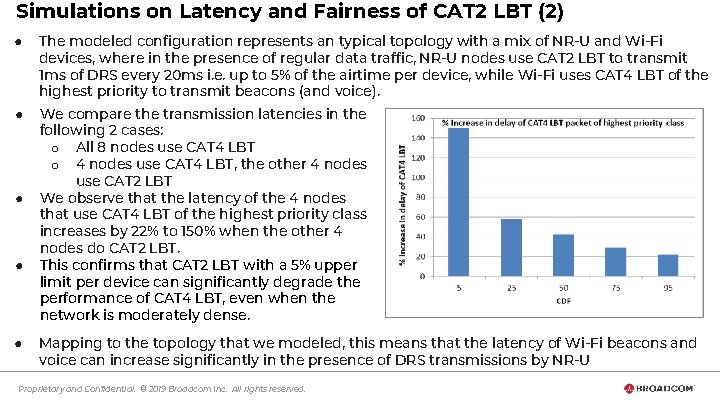
Simulations on Latency and Fairness of CAT 2 LBT (2) ● The modeled configuration represents an typical topology with a mix of NR-U and Wi-Fi devices, where in the presence of regular data traffic, NR-U nodes use CAT 2 LBT to transmit 1 ms of DRS every 20 ms i. e. up to 5% of the airtime per device, while Wi-Fi uses CAT 4 LBT of the highest priority to transmit beacons (and voice). ● We compare the transmission latencies in the following 2 cases: o All 8 nodes use CAT 4 LBT o 4 nodes use CAT 4 LBT, the other 4 nodes use CAT 2 LBT We observe that the latency of the 4 nodes that use CAT 4 LBT of the highest priority class increases by 22% to 150% when the other 4 nodes do CAT 2 LBT. This confirms that CAT 2 LBT with a 5% upper limit per device can significantly degrade the performance of CAT 4 LBT, even when the network is moderately dense. ● ● ● Mapping to the topology that we modeled, this means that the latency of Wi-Fi beacons and voice can increase significantly in the presence of DRS transmissions by NR-U Proprietary and Confidential. © 2019 Broadcom Inc. All rights reserved.
Conclusions and Recommendations ● In NR-U/LAA/Wi-Fi, standalone transmissions use either CAT 2 LBT which has a short fixed sensing duration, or CAT 4 LBT which has a random sensing duration. ● CAT 4 LBT achieves equivalent performance as CAT 2 LBT in an unloaded channel with low/no collision and optimal performance in a congested channel with more collisions. ● CAT 2 LBT can degrade the performance of nodes that do CAT 4 LBT. ● Such degradation can be observed even if CAT 2 LBT is limited to 5% per device, as the total percentage of CAT 2 LBTs in a network can scale with the number of devices performing CAT 2 LBT. ● Coexistence in a mixed-technology network will be improved by disallowing CAT 2 LBT. ● If CAT 2 LBT is considered essential to the functioning of certain devices, the upper bound of CAT 2 LBT should be reduced to much below 5% per device. Proprietary and Confidential. © 2019 Broadcom Inc. All rights reserved.
End Proprietary and Confidential. © 2018 Broadcom Inc. All rights reserved. 9
- Slides: 9