
On Risk Behavior Project Safeguarding children and adolescents
On Risk Behavior Project: Safeguarding children and adolescents in residential care and foster care from sexual abuse and harmful sexual behavior - and supporting healthy sexual development.
Program for this morning Structure and themes with reflective implication for you as upcoming professional practitioners – Perspectives on risk behavior and reflective actions based on your analytical capability – The dialogue game – wicked problems related to sexuality, signs and indicators in residential care setting – and making reflective professional decisions. 2
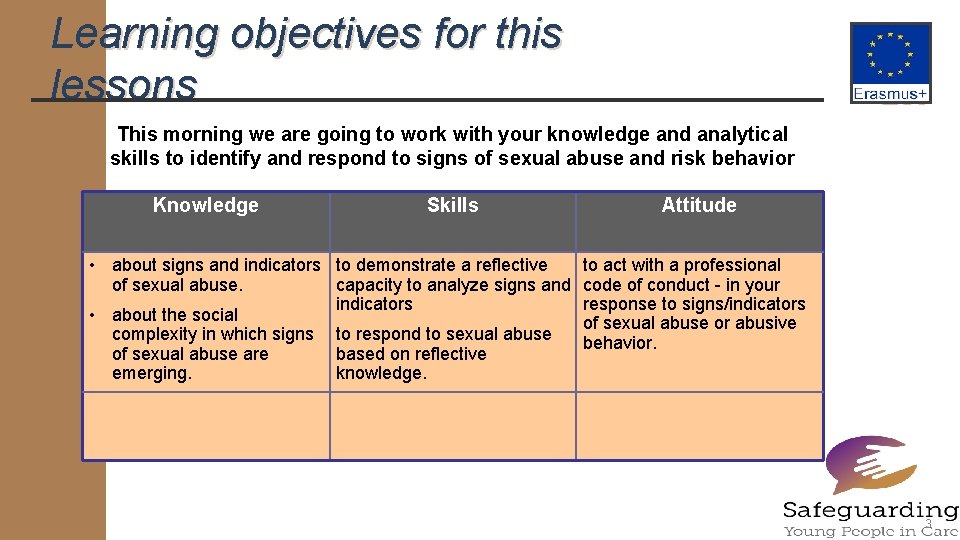
Learning objectives for this lessons This morning we are going to work with your knowledge and analytical skills to identify and respond to signs of sexual abuse and risk behavior Knowledge Skills • about signs and indicators to demonstrate a reflective of sexual abuse. capacity to analyze signs and indicators • about the social complexity in which signs to respond to sexual abuse based on reflective of sexual abuse are knowledge. emerging. Attitude to act with a professional code of conduct - in your response to signs/indicators of sexual abuse or abusive behavior. 3
What is risk behavior ? – The context for this lecture is in regard to children and adolescent placed in a institutional care setting. – That the individual is carrying a history of neglect or/and sexual abuse or/and other disability – these factors increase the probability of either being a perpetrator or a victim of sexual abuse. – Therefore a simple definition of risk behavior has no professional value – we need a complex definition of risk behavior based on professional analyzing of individuals, contextual and cumulative risks as a foundation for professional actions within the care setting. – As a professional you need to be aware of the behavioral signs that indicate a risk behavior for either being a victim of sexual abuse or in risk of inflicting harmful sexual behavior on others which in some cases are embedded within the same child/adolescent/person. 4
What are risk factors? Risks are often defaulted into individual and contextual factors – and the cumulating of risks. – Individual factors, due to genetics or early developed functional or dysfunctional coping strategies. Factors which seem to increase the likelihood of risk behavior, could be attachment disorders, cognitive problems, lack of social skills and lack of self-esteem and a negative self-perception. – Contextual factors: Risk factors in the environment of children/adolescents that increase the likelihood of being sexually abused/victimized or abusive. The factors are related to family, institutions, peers as well as to the local community or society in which the child/adolescent participates. – Cumulative risks will over a period aggravate the total risk impact on the child /adolescent. 5
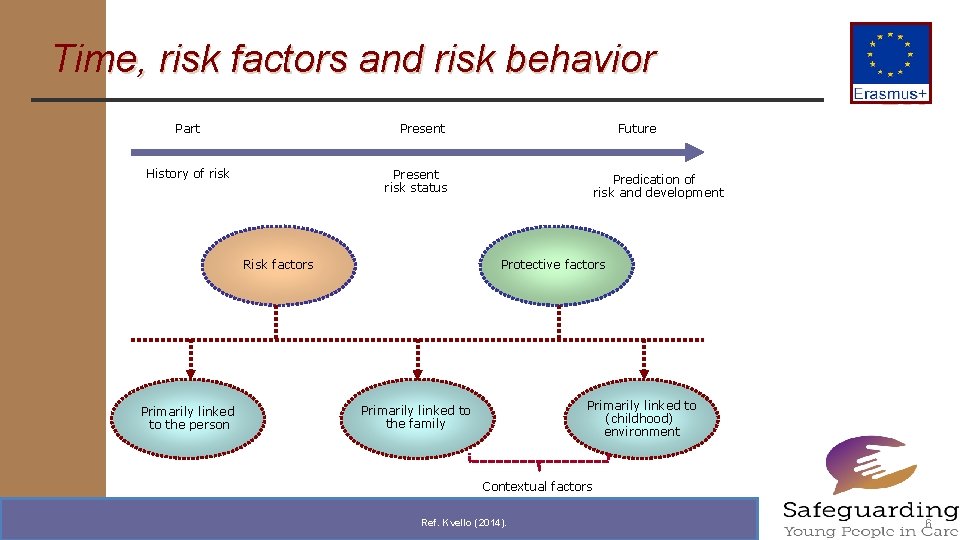
Time, risk factors and risk behavior Part Present History of risk Present risk status Risk factors Primarily linked to the person Future Predication of risk and development Protective factors Primarily linked to (childhood) environment Primarily linked to the family Contextual factors Ref. Kvello (2014). 6
Ambiguity of signs and indicators An important focus in your observations and analysis of signs is that other forms of neglect and abuse can blur the condition - so you could draw wrong conclusions. – Many of the signs that can indicate sexual abuse can also be other forms of severe neglect, traumatization or attachment disorder etc. . – E. g. "Children with sexual offensive behavior towards others have most often been victims of sexual abuse" False! “. . About one third of the children being sent to treatment for sexual offensive behavior has been subjected to sexual abuse. " (Stevnhøj & Strange. 2016, p. 74) Stay alert on signs of sexual abuse – but be aware of bias in your interpretations. – Therefore you need strong competences to observes the clustering of signs/indicators in the contextual setting of the child/adolescents history and socio-environment. A supporting tool for you in this analytical process could e. g. be the Assessment Framework (2013). 7
Signs drill Use annex A to drill your knowledge on signs of sexual abuse of children and adolescents. – Find a peer from another country (preferably somebody you have not worked with so far) – and outline your perspective on the various signs to each other – You have 15 min for the exercise Risk factors 8
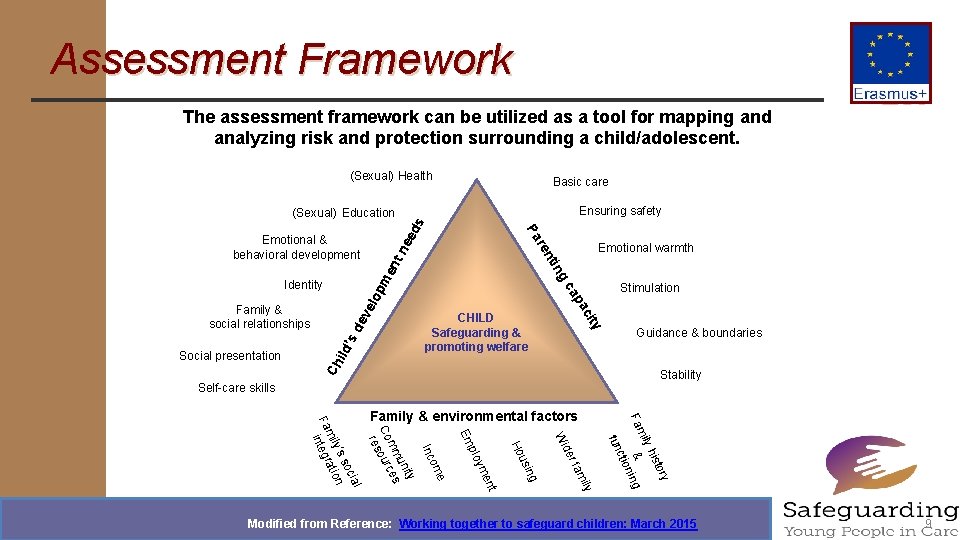
Assessment Framework The assessment framework can be utilized as a tool for mapping and analyzing risk and protection surrounding a child/adolescent. (Sexual) Health Basic care Ensuring safety y elo pm cit Guidance & boundaries Ch il CHILD Safeguarding & promoting welfare pa de v Stimulation ca d’s ing nt Social presentation Emotional warmth re Identity Family & social relationships en tn ee Emotional & behavioral development Pa ds (Sexual) Education Stability Self-care skills ily fam t ry isto yh mil & g Fa nin ctio r de fun Wi en ym ng usi plo Ho Em e om Inc ity un mm es Co sourc re ial soc y’s tion a mil Fa ntegr i Family & environmental factors Modified from Reference: Working together to safeguard children: March 2015 9
Protective factors - like risk factors - can be categorized into individual and contextual factors – Individual protective factors are conditions or attributes to the individual. The accumulated protection factors represent the resilience that a person possesses at a given time – resilience is a dynamic “size” within a given social context of coping. – Contextual protective factors - are related to family, school, other institutional settings, peers or/and friends in the local community (analog and digital communities) and in the larger society (social inclusive and exclusive/stigma factors). – As upcoming professionals you need strong competences to mitigate or eliminate risk and to increase sexual health and well-being of the child/adolescent - by using your professional resources and the resources of the persons itself in its social environment. Aiming to support the development of healthy coping strategies that will also function in stress settings. 10
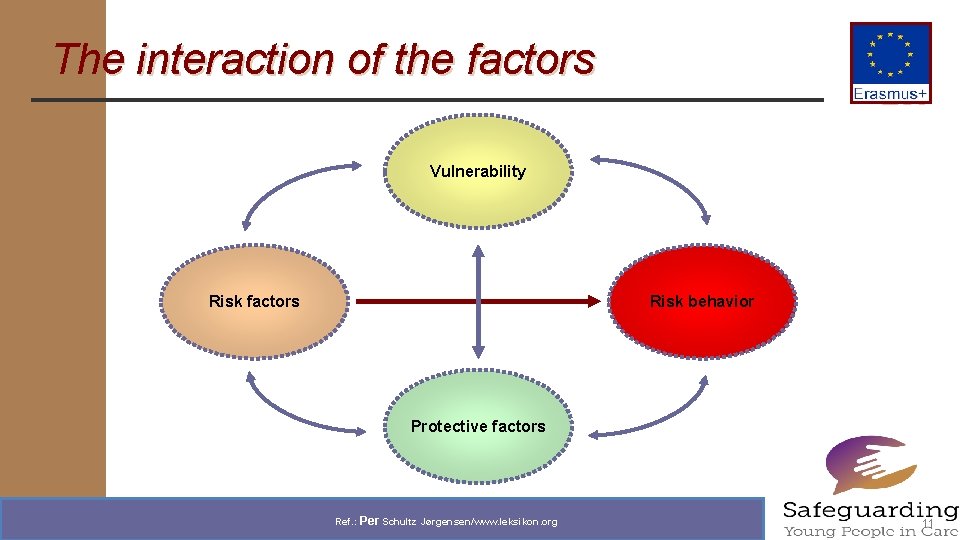
The interaction of the factors Vulnerability Risk factors Risk behavior Protective factors Ref. : Per Schultz Jørgensen/www. leksikon. org 11
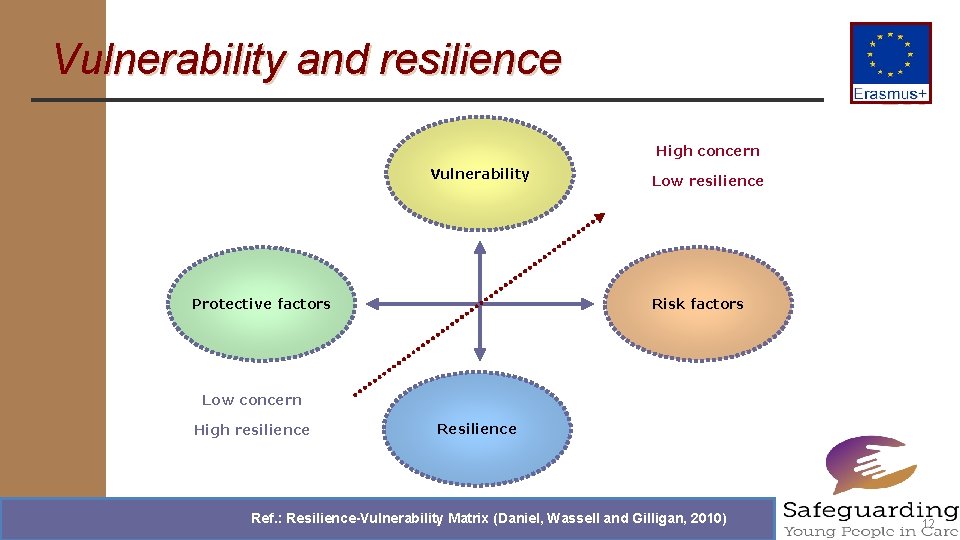
Vulnerability and resilience High concern Vulnerability Protective factors Low resilience Risk factors Low concern High resilience Ref. : Resilience-Vulnerability Matrix (Daniel, Wassell and Gilligan, 2010) 12
Drill your reflective use of protective factors Use the information provided so far to reflect on the use of protective factors – Find a peer from another country and do an “Walk and Talk” session – Together with your peer discuss how you can use protective factors in practical institutional care settings. – Which pro and cons do you see in the concept of risk & protective factors as operational tools? Protective factors – You have 15 min for the exercise 13
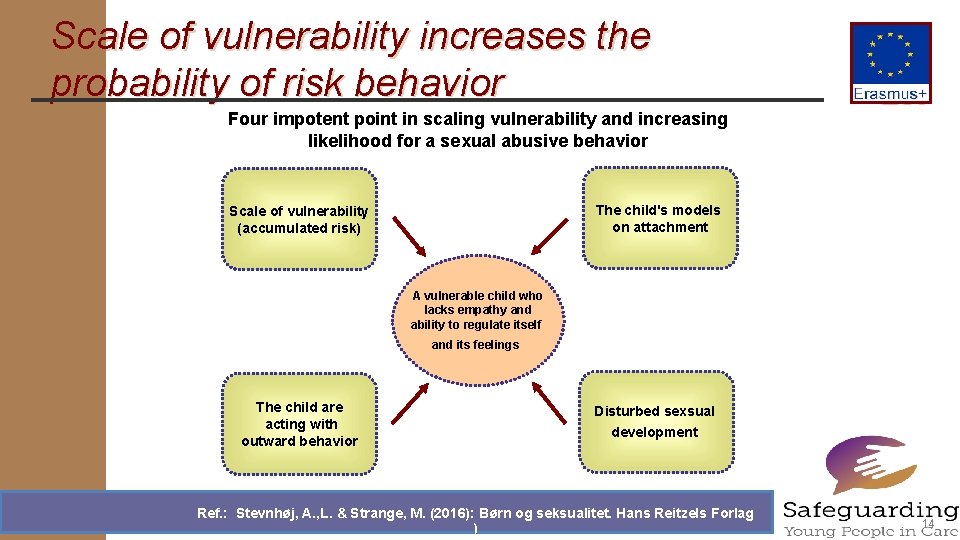
Scale of vulnerability increases the probability of risk behavior Four impotent point in scaling vulnerability and increasing likelihood for a sexual abusive behavior The child's models on attachment Scale of vulnerability (accumulated risk) A vulnerable child who lacks empathy and ability to regulate itself and its feelings The child are acting with outward behavior Disturbed sexsual development Ref. : Stevnhøj, A. , L. & Strange, M. (2016): Børn og seksualitet. Hans Reitzels Forlag ) 14
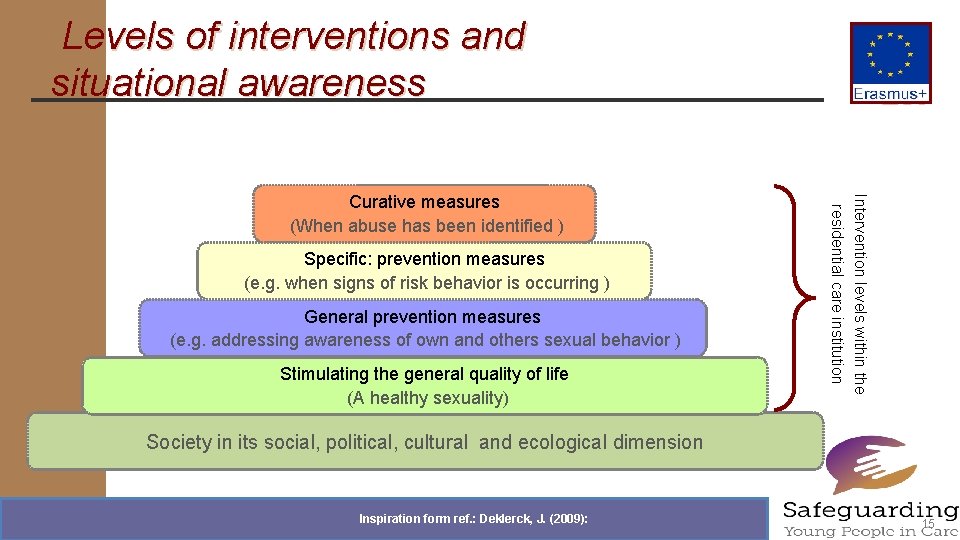
Levels of interventions and situational awareness Specific: prevention measures (e. g. when signs of risk behavior is occurring ) General prevention measures (e. g. addressing awareness of own and others sexual behavior ) Stimulating the general quality of life (A healthy sexuality) Intervention levels within the residential care institution Curative measures (When abuse has been identified ) Society in its social, political, cultural and ecological dimension Inspiration form ref. : Deklerck, J. (2009): 15
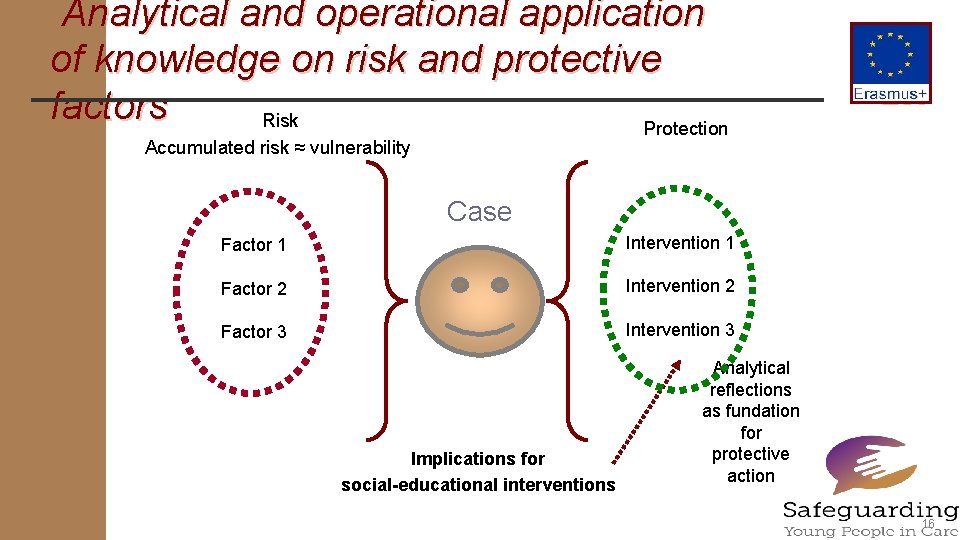
Analytical and operational application of knowledge on risk and protective factors Risk Protection Accumulated risk ≈ vulnerability Case Factor 1 Intervention 1 Factor 2 Intervention 2 Factor 3 Intervention 3 Implications for social-educational interventions Analytical reflections as fundation for protective action 16
Questions – comments 17
Reference – – – Deklerck, J. (2009): Problem behavior and prevention – the actual situation in Flanders, Belgium. International Journal of violence and school, 3 -34. Kaufman, K. , Erooga, M. , Stewart, K. , Zatkin, J. , Mc. Connell, E. , Tews, H. and Higgins, D. (2016): Risk profiles for institutional child sexual abuse - a literature review. Royal Commission into Institutional Responses to Child Sexual Abuse, Sydney. Kvello, Ø. (2013): Børn i risiko. Samfundslitteratur Schultz Jørgensen, P. (2005): Risikobørn. www. leksikon. org/art. php? n=4928 Stevnhøj, A. , L. & Strange, M. (2016): Børn og seksualitet. Hans Reitzels Forlag Zeuthen, K. (2009): Kærlighed og overlevelse - barneseksualitet og seksuelle traumer. Akademisk Forlag SISO (2010): Dialogkort. Videnscentret for Sociale Indsatser ved Vold og Seksuelle Overgreb mod børn. Socialstyrelsen SISO (2011). En tryg anbringelse Forebyggelse af seksuelle overgreb mod børn og unge. Socialstyrelsen SISO (2012) Seksuelle overgreb og fysisk eller psykisk vold. Inspirationskatalog til anbringelsessteder. Socialstyrelsen SISO (2014) Den Professionelle Tvivl. Socialstyrelsen Working together to safeguard children: March 2015. A guide to inter-agency working to safeguard and promote the welfare of children. http: //www. workingtogetheronline. co. uk/chapters/chapter_one. html 18
- Slides: 18