
On Racial Frontiers The Function of Race in
- Slides: 1
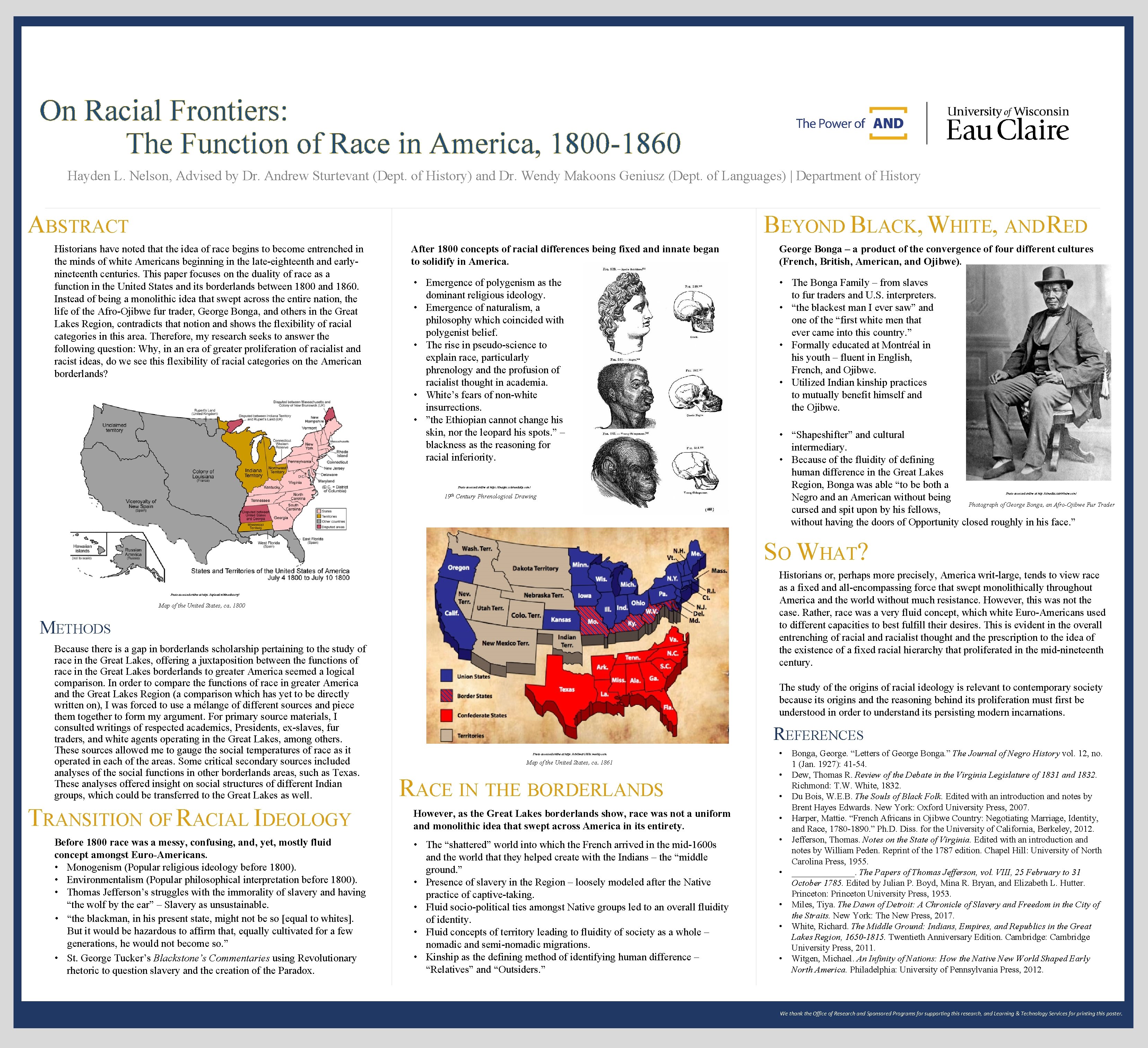
On Racial Frontiers: The Function of Race in America, 1800 -1860 Hayden L. Nelson, Advised by Dr. Andrew Sturtevant (Dept. of History) and Dr. Wendy Makoons Geniusz (Dept. of Languages) | Department of History ABSTRACT BEYOND BLACK, WHITE, AND RED Historians have noted that the idea of race begins to become entrenched in the minds of white Americans beginning in the late-eighteenth and earlynineteenth centuries. This paper focuses on the duality of race as a function in the United States and its borderlands between 1800 and 1860. Instead of being a monolithic idea that swept across the entire nation, the life of the Afro-Ojibwe fur trader, George Bonga, and others in the Great Lakes Region, contradicts that notion and shows the flexibility of racial categories in this area. Therefore, my research seeks to answer the following question: Why, in an era of greater proliferation of racialist and racist ideas, do we see this flexibility of racial categories on the American borderlands? After 1800 concepts of racial differences being fixed and innate began to solidify in America. George Bonga – a product of the convergence of four different cultures (French, British, American, and Ojibwe). • Emergence of polygenism as the dominant religious ideology. • Emergence of naturalism, a philosophy which coincided with polygenist belief. • The rise in pseudo-science to explain race, particularly phrenology and the profusion of racialist thought in academia. • White’s fears of non-white insurrections. • ”the Ethiopian cannot change his skin, nor the leopard his spots. ” – blackness as the reasoning for racial inferiority. • The Bonga Family – from slaves to fur traders and U. S. interpreters. • “the blackest man I ever saw” and one of the “first white men that ever came into this country. ” • Formally educated at Montréal in his youth – fluent in English, French, and Ojibwe. • Utilized Indian kinship practices to mutually benefit himself and the Ojibwe. Photo accessed online at https: //images. sciencedaily. com/ 19 th Century Phrenological Drawing • “Shapeshifter” and cultural intermediary. • Because of the fluidity of defining human difference in the Great Lakes Region, Bonga was able “to be both a Negro and an American without being Photograph of George Bonga, an Afro-Ojibwe Fur Trader cursed and spit upon by his fellows, without having the doors of Opportunity closed roughly in his face. ” Photo accessed online at http: //stmedia. startribune. com/ SO WHAT? Historians or, perhaps more precisely, America writ-large, tends to view race as a fixed and all-encompassing force that swept monolithically throughout America and the world without much resistance. However, this was not the case. Rather, race was a very fluid concept, which white Euro-Americans used to different capacities to best fulfill their desires. This is evident in the overall entrenching of racial and racialist thought and the prescription to the idea of the existence of a fixed racial hierarchy that proliferated in the mid-nineteenth century. Photo accessed online at https: //upload. wikimedia. org/ Map of the United States, ca. 1800 METHODS Because there is a gap in borderlands scholarship pertaining to the study of race in the Great Lakes, offering a juxtaposition between the functions of race in the Great Lakes borderlands to greater America seemed a logical comparison. In order to compare the functions of race in greater America and the Great Lakes Region (a comparison which has yet to be directly written on), I was forced to use a mélange of different sources and piece them together to form my argument. For primary source materials, I consulted writings of respected academics, Presidents, ex-slaves, fur traders, and white agents operating in the Great Lakes, among others. These sources allowed me to gauge the social temperatures of race as it operated in each of the areas. Some critical secondary sources included analyses of the social functions in other borderlands areas, such as Texas. These analyses offered insight on social structures of different Indian groups, which could be transferred to the Great Lakes as well. TRANSITION OF RACIAL IDEOLOGY Before 1800 race was a messy, confusing, and, yet, mostly fluid concept amongst Euro-Americans. • Monogenism (Popular religious ideology before 1800). • Environmentalism (Popular philosophical interpretation before 1800). • Thomas Jefferson’s struggles with the immorality of slavery and having “the wolf by the ear” – Slavery as unsustainable. • “the blackman, in his present state, might not be so [equal to whites]. But it would be hazardous to affirm that, equally cultivated for a few generations, he would not become so. ” • St. George Tucker’s Blackstone’s Commentaries using Revolutionary rhetoric to question slavery and the creation of the Paradox. The study of the origins of racial ideology is relevant to contemporary society because its origins and the reasoning behind its proliferation must first be understood in order to understand its persisting modern incarnations. REFERENCES Photo accessed online at https: //civilwar 1860 s. weebly. com • Map of the United States, ca. 1861 RACE IN THE BORDERLANDS However, as the Great Lakes borderlands show, race was not a uniform and monolithic idea that swept across America in its entirety. • The “shattered” world into which the French arrived in the mid-1600 s and the world that they helped create with the Indians – the “middle ground. ” • Presence of slavery in the Region – loosely modeled after the Native practice of captive-taking. • Fluid socio-political ties amongst Native groups led to an overall fluidity of identity. • Fluid concepts of territory leading to fluidity of society as a whole – nomadic and semi-nomadic migrations. • Kinship as the defining method of identifying human difference – “Relatives” and “Outsiders. ” • • Bonga, George. “Letters of George Bonga. ” The Journal of Negro History vol. 12, no. 1 (Jan. 1927): 41 -54. Dew, Thomas R. Review of the Debate in the Virginia Legislature of 1831 and 1832. Richmond: T. W. White, 1832. Du Bois, W. E. B. The Souls of Black Folk. Edited with an introduction and notes by Brent Hayes Edwards. New York: Oxford University Press, 2007. Harper, Mattie. “French Africans in Ojibwe Country: Negotiating Marriage, Identity, and Race, 1780 -1890. ” Ph. D. Diss. for the University of California, Berkeley, 2012. Jefferson, Thomas. Notes on the State of Virginia. Edited with an introduction and notes by William Peden. Reprint of the 1787 edition. Chapel Hill: University of North Carolina Press, 1955. _______. The Papers of Thomas Jefferson, vol. VIII, 25 February to 31 October 1785. Edited by Julian P. Boyd, Mina R. Bryan, and Elizabeth L. Hutter. Princeton: Princeton University Press, 1953. Miles, Tiya. The Dawn of Detroit: A Chronicle of Slavery and Freedom in the City of the Straits. New York: The New Press, 2017. White, Richard. The Middle Ground: Indians, Empires, and Republics in the Great Lakes Region, 1650 -1815. Twentieth Anniversary Edition. Cambridge: Cambridge University Press, 2011. Witgen, Michael. An Infinity of Nations: How the Native New World Shaped Early North America. Philadelphia: University of Pennsylvania Press, 2012. We thank the Office of Research and Sponsored Programs for supporting this research, and Learning & Technology Services for printing this poster.