
On Processor Sharing PS and Its Applications to
- Slides: 26
On Processor Sharing (PS) and Its Applications to Cellular Data Network Provisioning Yujing Wu, Carey Williamson, Jingxiang Luo Department of Computer Science University of Calgary IFIP Performance 2007
Motivation n Insensitivity of network performance to the traffic details is a desirable property, since it facilitates robust traffic engineering. Example: Erlang B call blocking formula How about 3 G cellular data networks? Are performance measures sensitive to the detailed traffic characteristics (e. g. , flow size distribution, flow inter-arrival time, number of flows, correlations) or not? IFIP Performance 2007 2
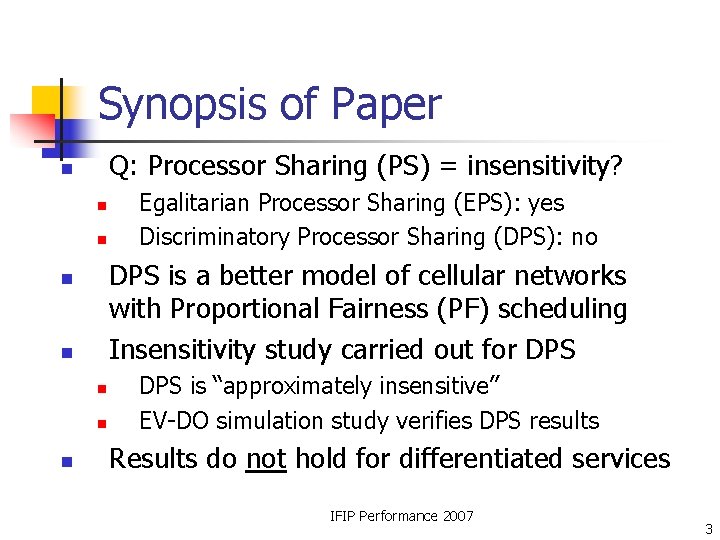
Synopsis of Paper Q: Processor Sharing (PS) = insensitivity? n n n DPS is a better model of cellular networks with Proportional Fairness (PF) scheduling Insensitivity study carried out for DPS n n n Egalitarian Processor Sharing (EPS): yes Discriminatory Processor Sharing (DPS): no DPS is “approximately insensitive” EV-DO simulation study verifies DPS results Results do not hold for differentiated services IFIP Performance 2007 3
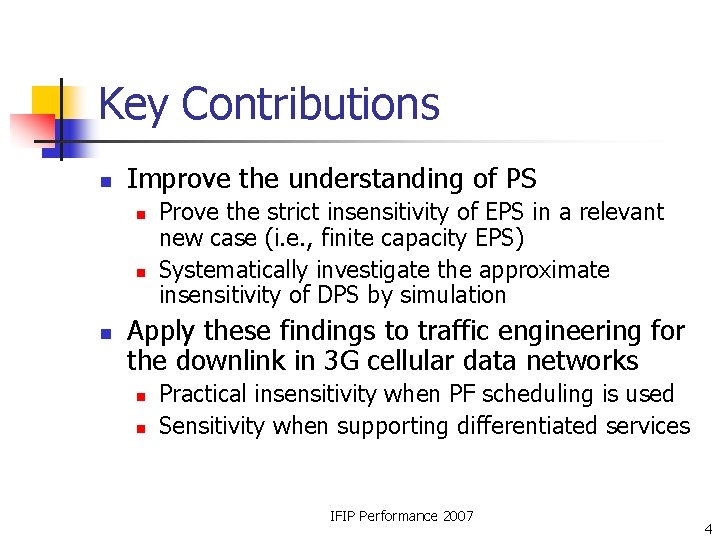
Key Contributions n Improve the understanding of PS n n n Prove the strict insensitivity of EPS in a relevant new case (i. e. , finite capacity EPS) Systematically investigate the approximate insensitivity of DPS by simulation Apply these findings to traffic engineering for the downlink in 3 G cellular data networks n n Practical insensitivity when PF scheduling is used Sensitivity when supporting differentiated services IFIP Performance 2007 4
Outline n n n Motivation & Contributions Modeling cellular data networks EPS and DPS results Simulation of a cellular system Service differentiation Summary IFIP Performance 2007 5
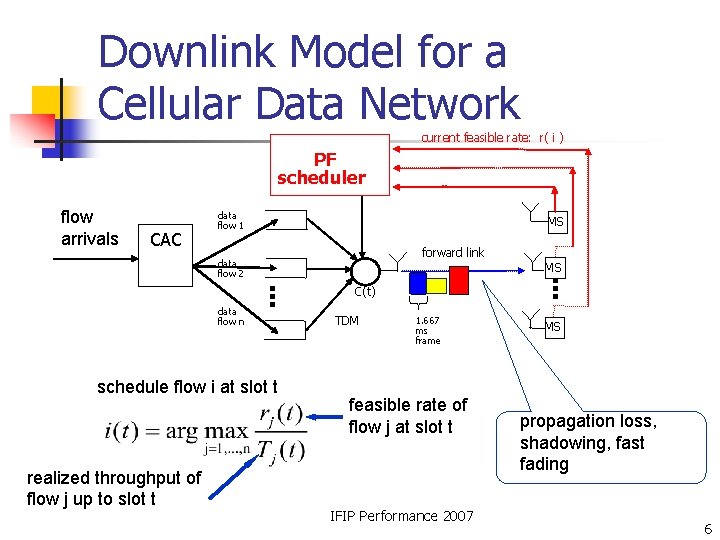
Downlink Model for a Cellular Data Network current feasible rate: r( i ) PF scheduler CAC data flow 1 MS forward link data flow 2 . . . data flow n MS schedule flow i at slot t realized throughput of flow j up to slot t . . . flow arrivals C(t) TDM 1. 667 ms frame feasible rate of flow j at slot t IFIP Performance 2007 MS propagation loss, shadowing, fast fading 6
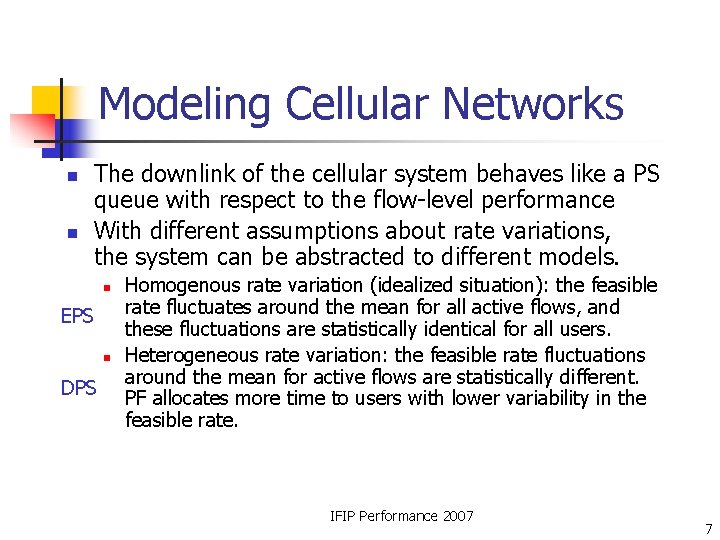
Modeling Cellular Networks n n The downlink of the cellular system behaves like a PS queue with respect to the flow-level performance With different assumptions about rate variations, the system can be abstracted to different models. n EPS n DPS Homogenous rate variation (idealized situation): the feasible rate fluctuates around the mean for all active flows, and these fluctuations are statistically identical for all users. Heterogeneous rate variation: the feasible rate fluctuations around the mean for active flows are statistically different. PF allocates more time to users with lower variability in the feasible rate. IFIP Performance 2007 7
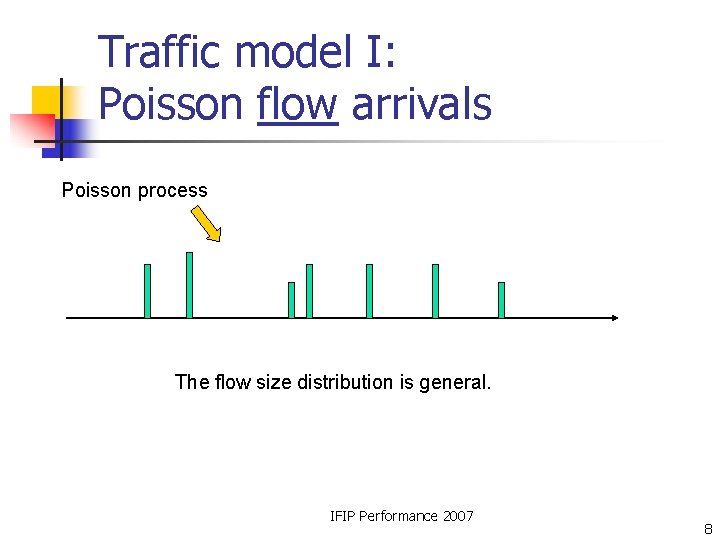
Traffic model I: Poisson flow arrivals Poisson process The flow size distribution is general. IFIP Performance 2007 8
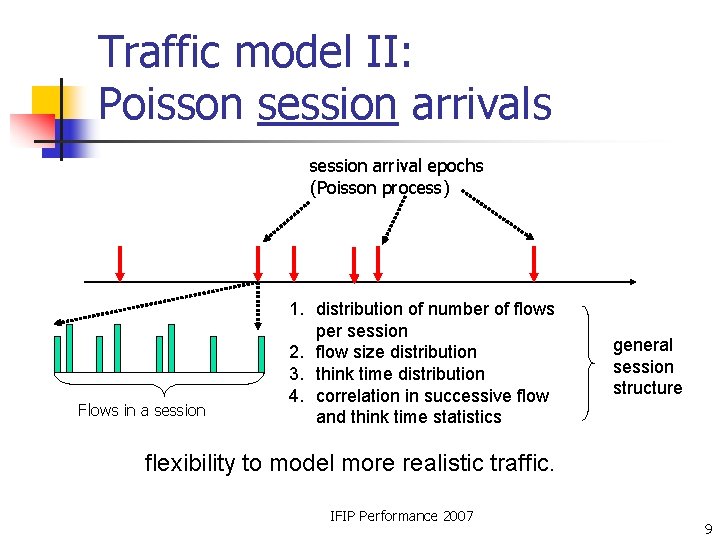
Traffic model II: Poisson session arrivals session arrival epochs (Poisson process) Flows in a session 1. distribution of number of flows per session 2. flow size distribution 3. think time distribution 4. correlation in successive flow and think time statistics general session structure flexibility to model more realistic traffic. IFIP Performance 2007 9
Outline n n n Motivation & Contributions Modeling cellular data networks EPS and DPS results Simulation of a cellular system Service differentiation Summary IFIP Performance 2007 10
EPS Queue Results n Insensitivity has been proven for: n n Poisson flow arrivals without blocking [Cohen; Kelly] Poisson session traffic with infinite capacity [Bonald et al. 2001 abc; Bonald 2006; Borst 2003] n We prove that the joint queue length distribution, mean number of active flows, and blocking probabilities are insensitive to the session structure in the finite-capacity EPS queue fed by Poisson session arrivals. IFIP Performance 2007 11
Finite Capacity EPS system n n n Model the system by a queueing network with a restricted state space. Apply results from stochastic queueing network theory for the proof. (see paper) Value? Assuming homogenous rate variation in the cellular system, we can replace the complicated Poisson session traffic with simple Poisson flows with exponentially distributed flow sizes. The simplified model will suffice for provisioning purposes. IFIP Performance 2007 12
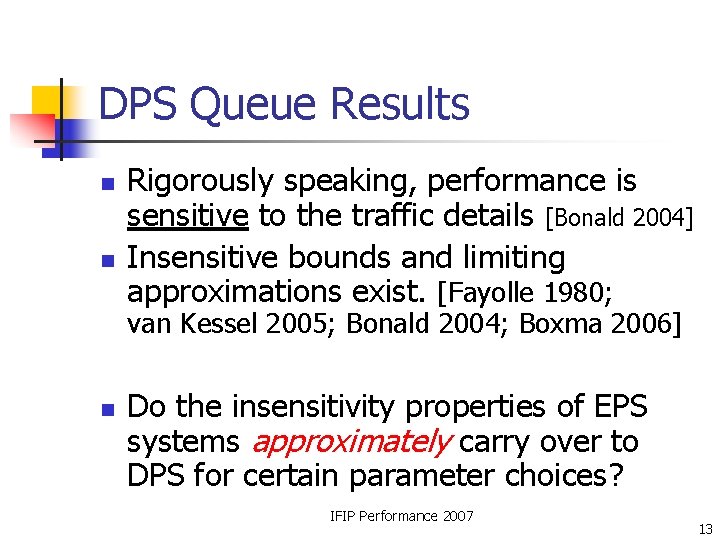
DPS Queue Results n n Rigorously speaking, performance is sensitive to the traffic details [Bonald 2004] Insensitive bounds and limiting approximations exist. [Fayolle 1980; van Kessel 2005; Bonald 2004; Boxma 2006] n Do the insensitivity properties of EPS systems approximately carry over to DPS for certain parameter choices? IFIP Performance 2007 13
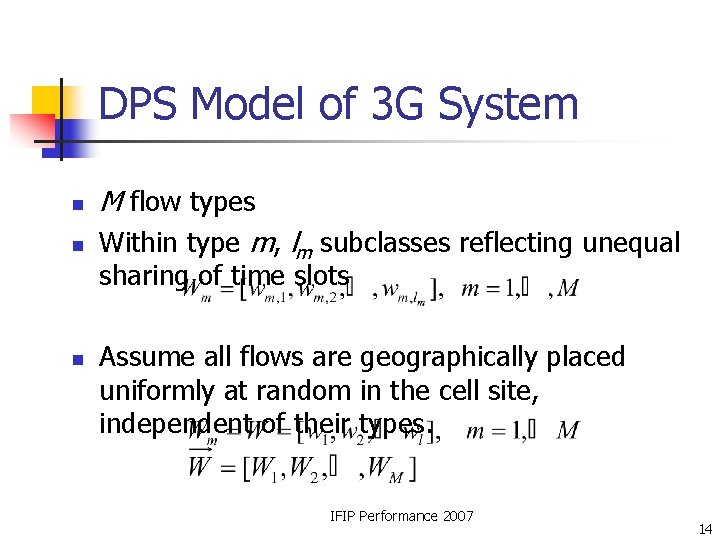
DPS Model of 3 G System n n M flow types Within type m, lm subclasses reflecting unequal sharing of time slots n Assume all flows are geographically placed uniformly at random in the cell site, independent of their types. IFIP Performance 2007 14
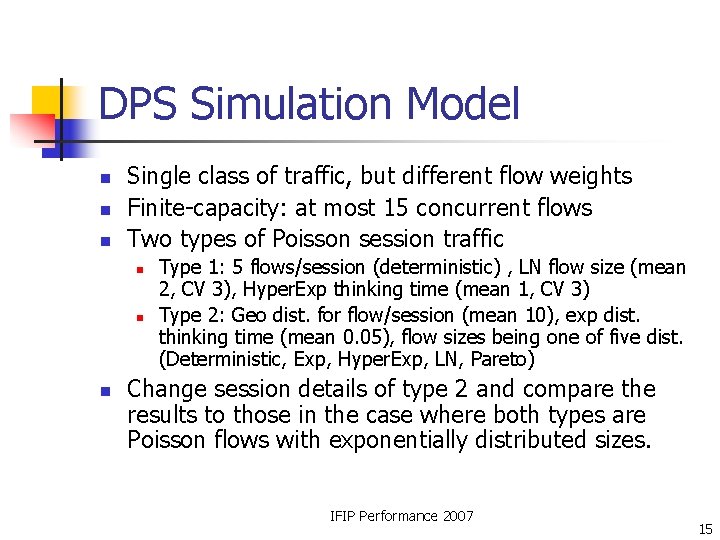
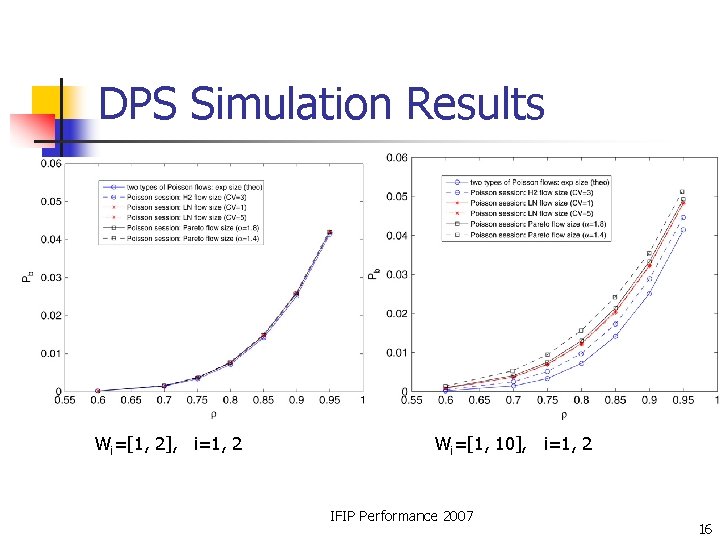
DPS Simulation Model n n n Single class of traffic, but different flow weights Finite-capacity: at most 15 concurrent flows Two types of Poisson session traffic n n n Type 1: 5 flows/session (deterministic) , LN flow size (mean 2, CV 3), Hyper. Exp thinking time (mean 1, CV 3) Type 2: Geo dist. for flow/session (mean 10), exp dist. thinking time (mean 0. 05), flow sizes being one of five dist. (Deterministic, Exp, Hyper. Exp, LN, Pareto) Change session details of type 2 and compare the results to those in the case where both types are Poisson flows with exponentially distributed sizes. IFIP Performance 2007 15
DPS Simulation Results Wi=[1, 2], i=1, 2 Wi=[1, 10], i=1, 2 IFIP Performance 2007 16
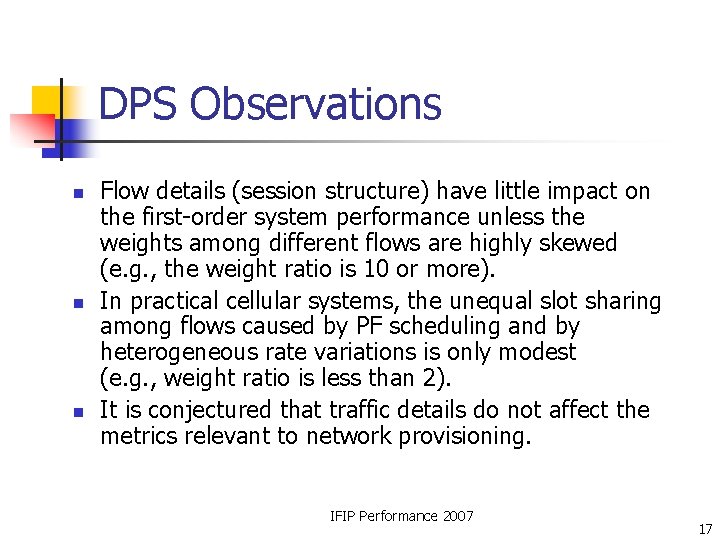
DPS Observations n n n Flow details (session structure) have little impact on the first-order system performance unless the weights among different flows are highly skewed (e. g. , the weight ratio is 10 or more). In practical cellular systems, the unequal slot sharing among flows caused by PF scheduling and by heterogeneous rate variations is only modest (e. g. , weight ratio is less than 2). It is conjectured that traffic details do not affect the metrics relevant to network provisioning. IFIP Performance 2007 17
Outline n n n Motivation & Contributions Modeling cellular data networks EPS and DPS results Simulation of a cellular system Service differentiation Summary IFIP Performance 2007 18
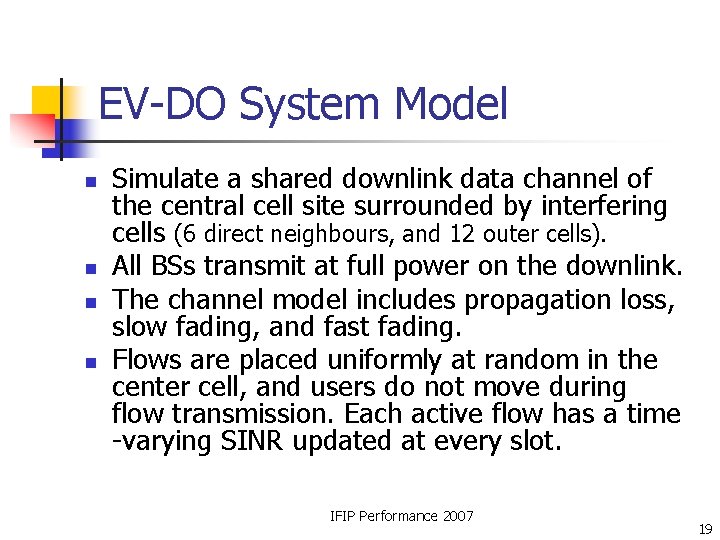
EV-DO System Model n n Simulate a shared downlink data channel of the central cell site surrounded by interfering cells (6 direct neighbours, and 12 outer cells). All BSs transmit at full power on the downlink. The channel model includes propagation loss, slow fading, and fast fading. Flows are placed uniformly at random in the center cell, and users do not move during flow transmission. Each active flow has a time -varying SINR updated at every slot. IFIP Performance 2007 19
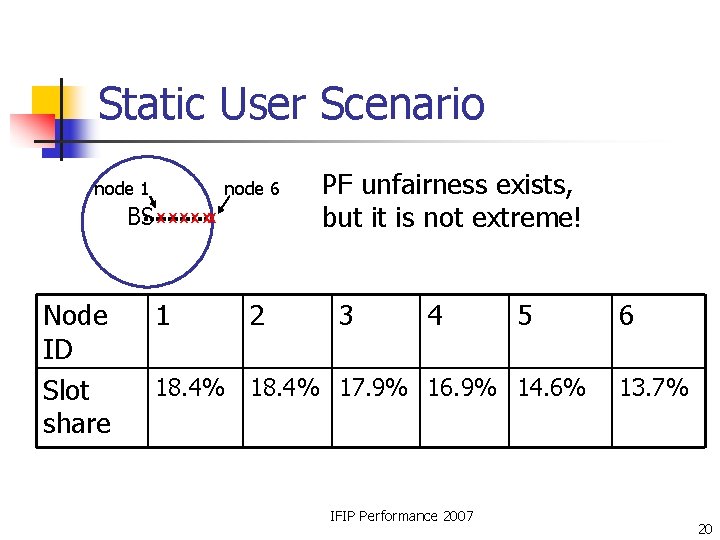
Static User Scenario node 1 node 6 BS x x xx Node ID Slot share PF unfairness exists, but it is not extreme! 1 2 3 4 18. 4% 17. 9% 16. 9% 14. 6% IFIP Performance 2007 5 6 13. 7% 20
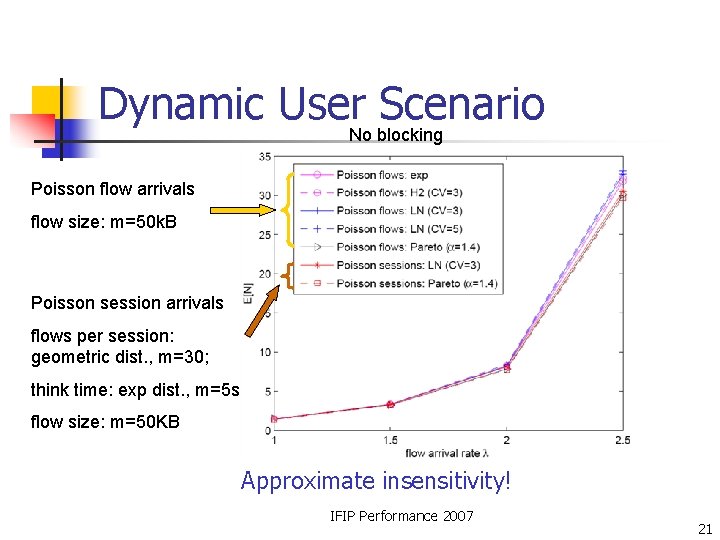
Dynamic User. No blocking Scenario Poisson flow arrivals flow size: m=50 k. B Poisson session arrivals flows per session: geometric dist. , m=30; think time: exp dist. , m=5 s flow size: m=50 KB Approximate insensitivity! IFIP Performance 2007 21
Outline n n n Motivation & Contributions Modeling cellular data networks EPS and DPS results Simulation of a cellular system Service differentiation Summary IFIP Performance 2007 22
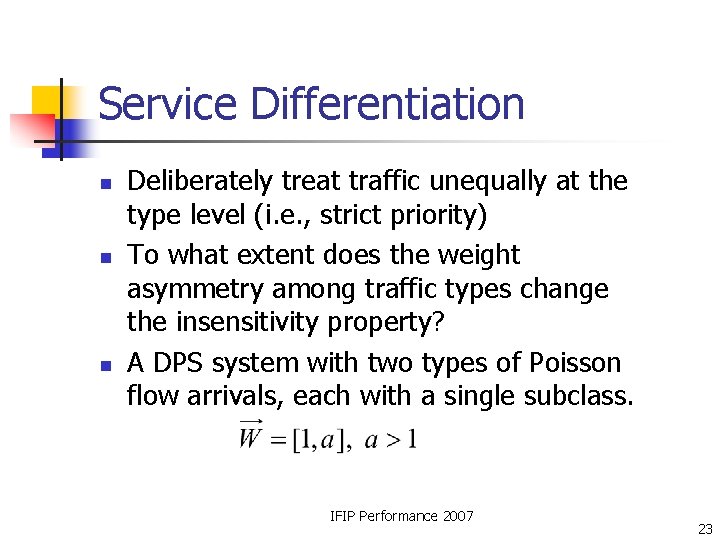
Service Differentiation n Deliberately treat traffic unequally at the type level (i. e. , strict priority) To what extent does the weight asymmetry among traffic types change the insensitivity property? A DPS system with two types of Poisson flow arrivals, each with a single subclass. IFIP Performance 2007 23
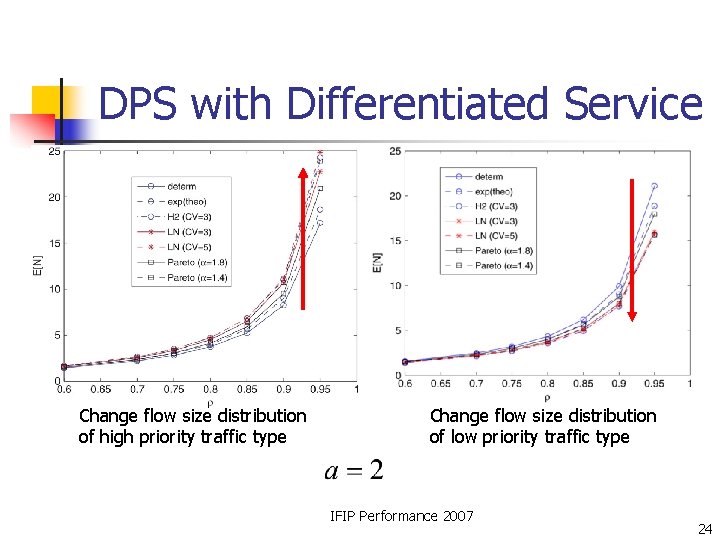
DPS with Differentiated Service Change flow size distribution of high priority traffic type Change flow size distribution of low priority traffic type IFIP Performance 2007 24
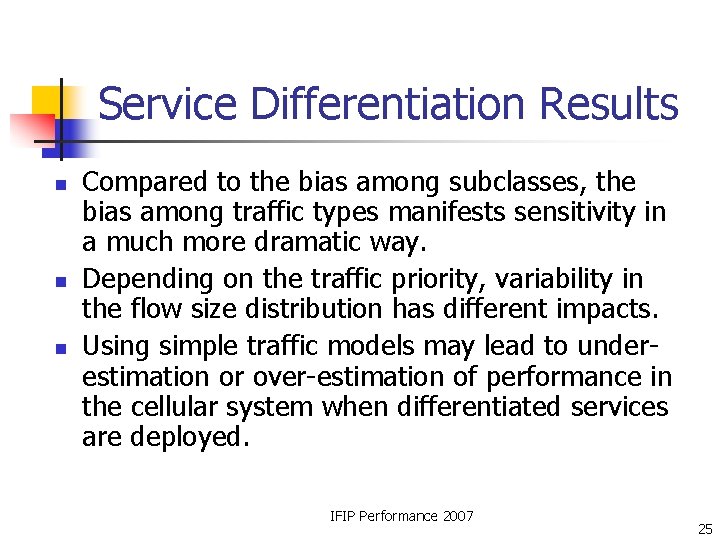
Service Differentiation Results n n n Compared to the bias among subclasses, the bias among traffic types manifests sensitivity in a much more dramatic way. Depending on the traffic priority, variability in the flow size distribution has different impacts. Using simple traffic models may lead to underestimation or over-estimation of performance in the cellular system when differentiated services are deployed. IFIP Performance 2007 25
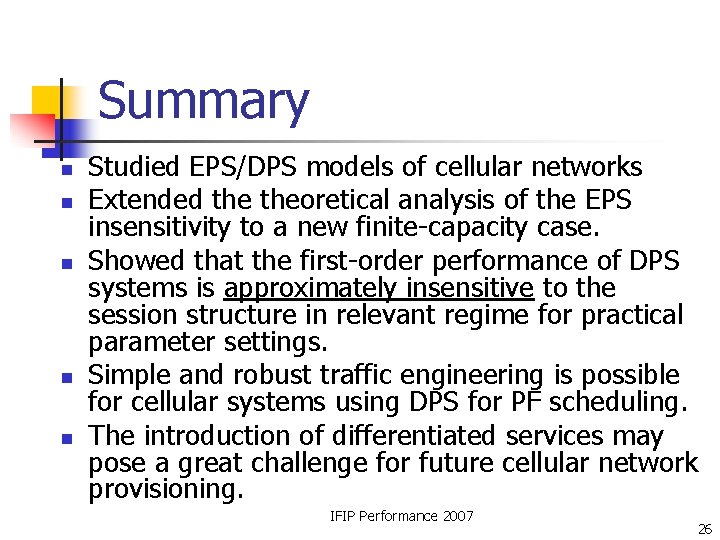
Summary n n n Studied EPS/DPS models of cellular networks Extended theoretical analysis of the EPS insensitivity to a new finite-capacity case. Showed that the first-order performance of DPS systems is approximately insensitive to the session structure in relevant regime for practical parameter settings. Simple and robust traffic engineering is possible for cellular systems using DPS for PF scheduling. The introduction of differentiated services may pose a great challenge for future cellular network provisioning. IFIP Performance 2007 26