
On Learning a Language By Alice Omaggio Hadley
On Learning a Language By Alice Omaggio Hadley
Behaviorist view of L 2 learning “The command of a language is not a matter of knowledge…[it] is a matter of practice… Language learning is overlearning: anything else is of no use” (Bloomfield 1942) n Are there parts of this quote that are still evident in L 2 methodology? n
Universal Grammar view of L 2 acquisition LAD n Universals n – Fixed features of languages (e. g. possible sounds, word categories): – Constraints on possible rule systems (e. g. question formation):
Criticism of UG view of L 2 acquisition Circular argument: we need theory to explain language n No empirical evidence that UG operates in L 2 learning n – Adult learners experience significantly more difficulty acquiring L 2, which may mean UG is not accessible – Motivation and attitude are factors for adults but not children
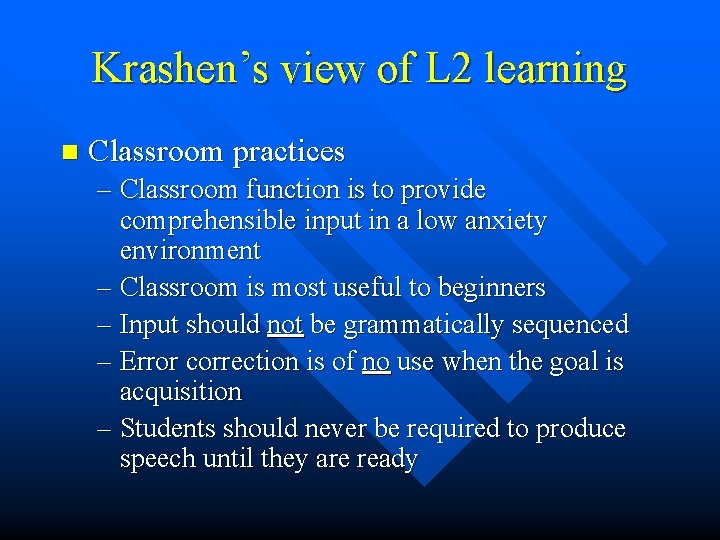
Krashen’s view of L 2 learning n Classroom practices – Classroom function is to provide comprehensible input in a low anxiety environment – Classroom is most useful to beginners – Input should not be grammatically sequenced – Error correction is of no use when the goal is acquisition – Students should never be required to produce speech until they are ready
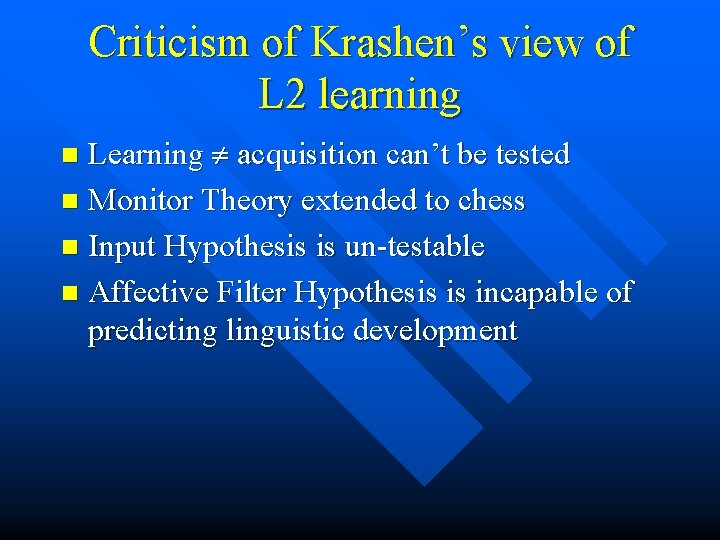
Criticism of Krashen’s view of L 2 learning Learning acquisition can’t be tested n Monitor Theory extended to chess n Input Hypothesis is un-testable n Affective Filter Hypothesis is incapable of predicting linguistic development n
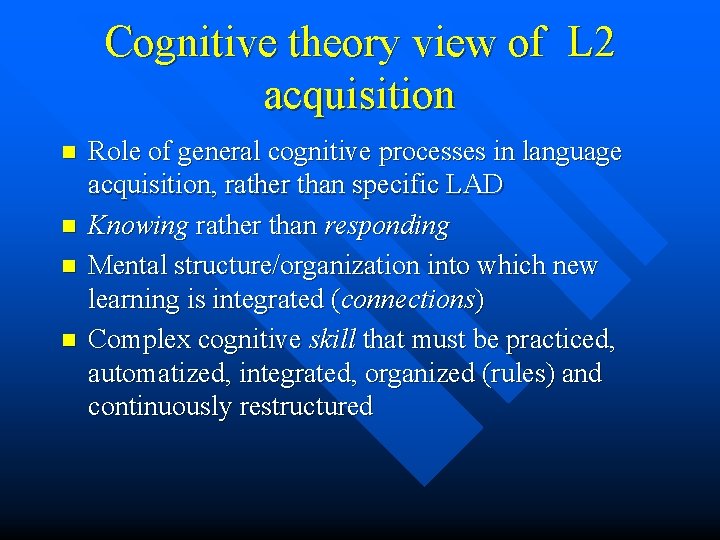
Cognitive theory view of L 2 acquisition n n Role of general cognitive processes in language acquisition, rather than specific LAD Knowing rather than responding Mental structure/organization into which new learning is integrated (connections) Complex cognitive skill that must be practiced, automatized, integrated, organized (rules) and continuously restructured
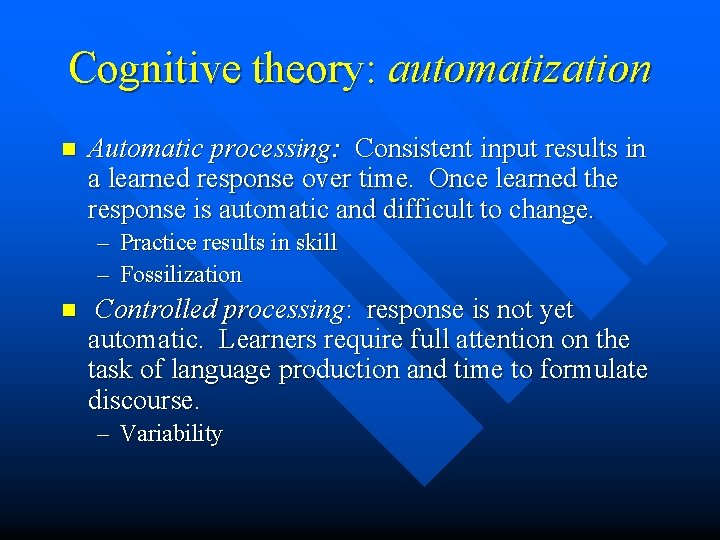
Cognitive theory: automatization n Automatic processing: Consistent input results in a learned response over time. Once learned the response is automatic and difficult to change. – Practice results in skill – Fossilization n Controlled processing: response is not yet automatic. Learners require full attention on the task of language production and time to formulate discourse. – Variability
- Slides: 8