
On Ice Biology of Antarctic springtails at Cape

On Ice: Biology of Antarctic springtails at Cape Hallett
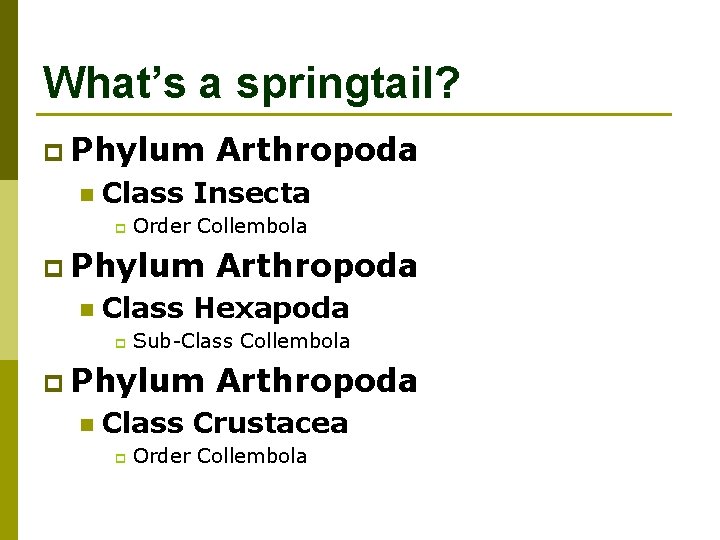
What’s a springtail? p Phylum n Class Insecta p Order Collembola p Phylum n Arthropoda Class Hexapoda p Sub-Class Collembola p Phylum n Arthropoda Class Crustacea p Order Collembola

What’s a springtail? p Six legs (Hexapods) p Primitive eye spots (ocelli) p A springing organ (Furca)
Several flavours of springtails p Poduromorphs p Sminthurimorphs p Entomobryomorphs

Famous springtails p ‘Snow Fleas’ p Folsomia candida p Orchesella cincta p Cryptopygus antarcticus
K 140 Matt Scott University of Otago, New Zealand (now an ecological consultant in Christchurch, New Zealand) John Terblanche U. Stellenbosch, South Africa (now a professor in South Africa) Jaco Klok U. Stellenbosch (now a postdoc at Arizona State)
Goals of the expedition 1. What’s there? p 2. A survey of the invertebrate fauna and its habitats How does it survive? p Survival physiology of Antarctic springtails p 3. Temperature & Water balance Do environmental tolerances limit distribution of Antarctic springtails?
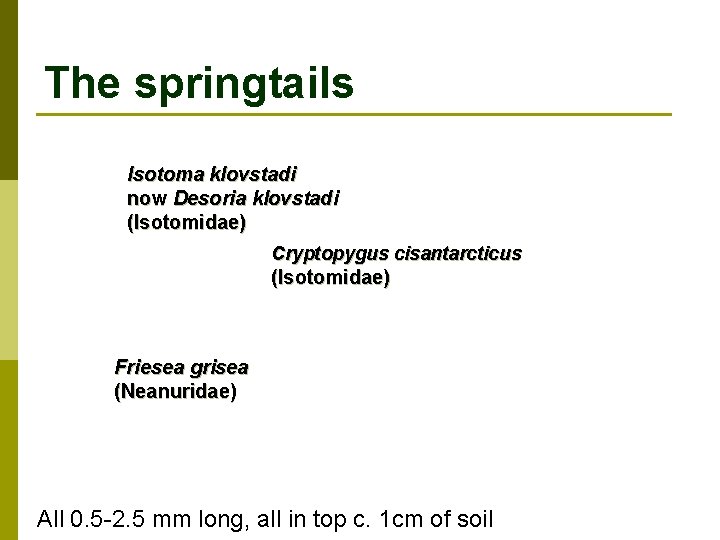
The springtails Isotoma klovstadi now Desoria klovstadi (Isotomidae) Cryptopygus cisantarcticus (Isotomidae) Friesea grisea (Neanuridae) All 0. 5 -2. 5 mm long, all in top c. 1 cm of soil
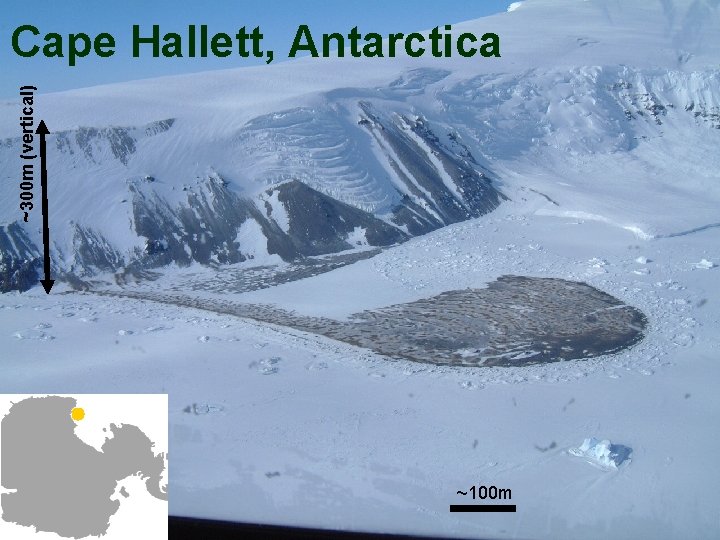
~300 m (vertical) Cape Hallett, Antarctica ~100 m
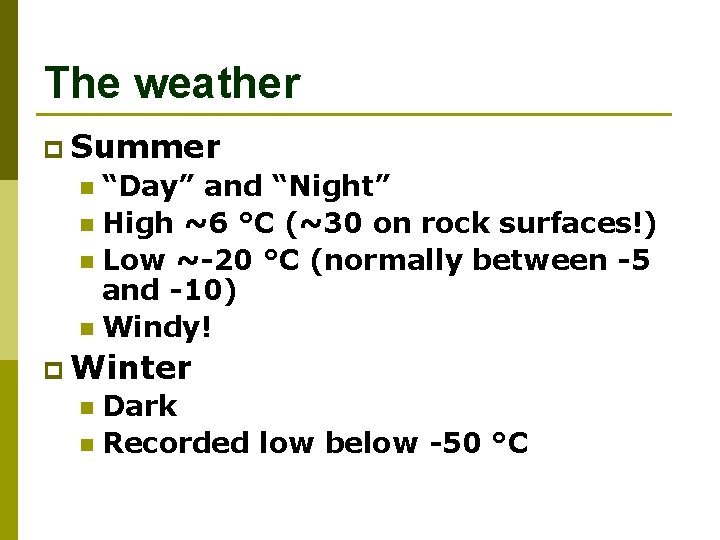
The weather p Summer “Day” and “Night” n High ~6 °C (~30 on rock surfaces!) n Low ~-20 °C (normally between -5 and -10) n Windy! n p Winter Dark n Recorded low below -50 °C n
Goals of the expedition 1. What’s there? p 2. A survey of the invertebrate fauna and its habitats How does it survive? p Survival physiology of Antarctic springtails p 3. Temperature & Water balance Do environmental tolerances limit distribution of Antarctic springtails?
Upper and lower activity limits
Thermal & Desiccation tolerance
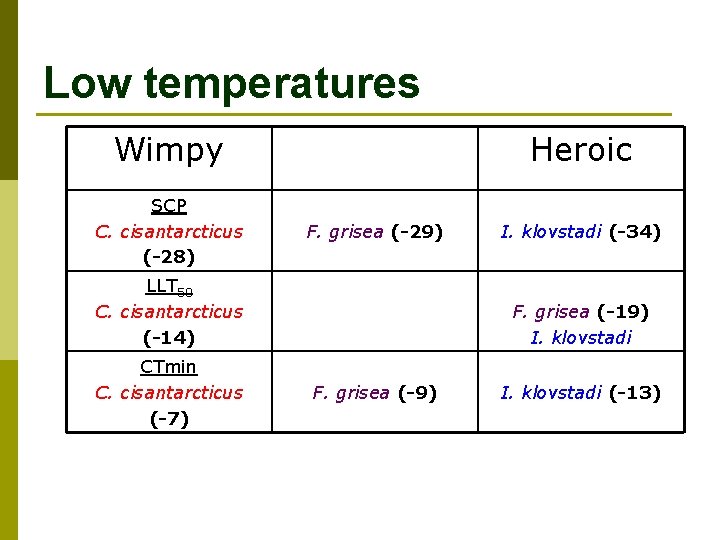
Low temperatures Wimpy SCP C. cisantarcticus (-28) Heroic F. grisea (-29) LLT 50 C. cisantarcticus (-14) CTmin C. cisantarcticus (-7) I. klovstadi (-34) F. grisea (-19) I. klovstadi F. grisea (-9) I. klovstadi (-13)
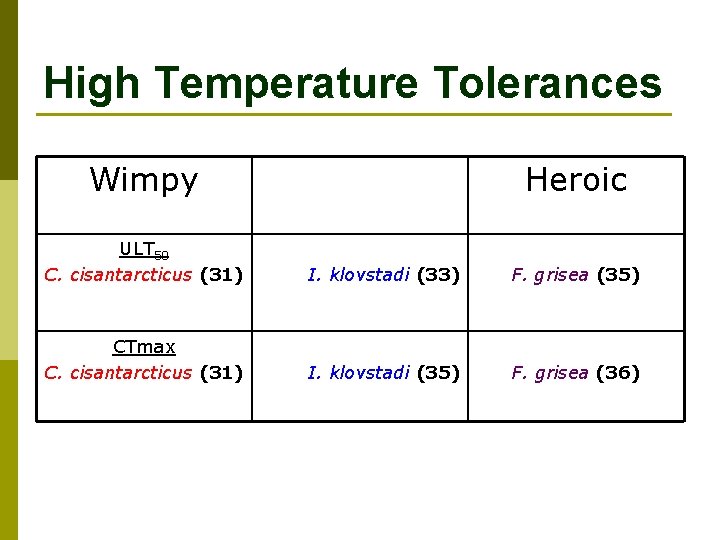
High Temperature Tolerances Wimpy Heroic ULT 50 C. cisantarcticus (31) I. klovstadi (33) F. grisea (35) CTmax C. cisantarcticus (31) I. klovstadi (35) F. grisea (36)
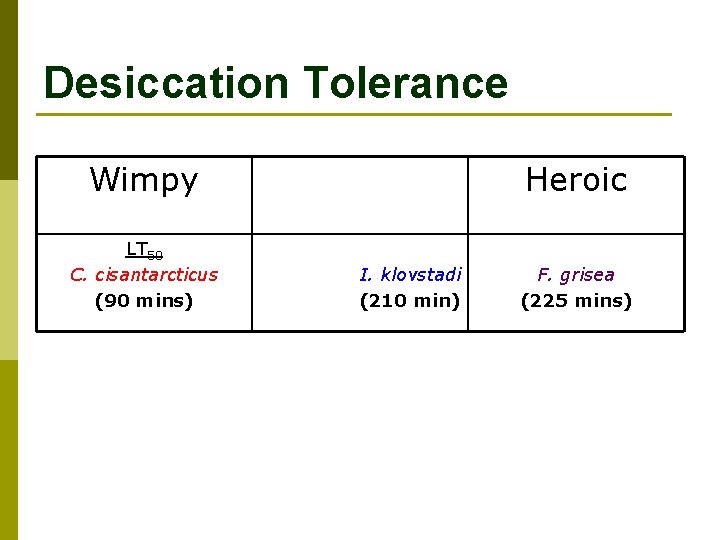
Desiccation Tolerance Wimpy LT 50 C. cisantarcticus (90 mins) Heroic I. klovstadi (210 min) F. grisea (225 mins)
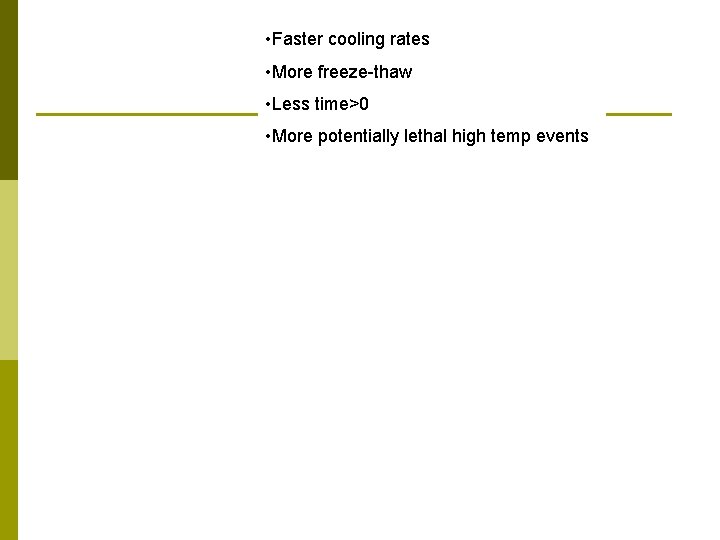
• Faster cooling rates • More freeze-thaw • Less time>0 • More potentially lethal high temp events
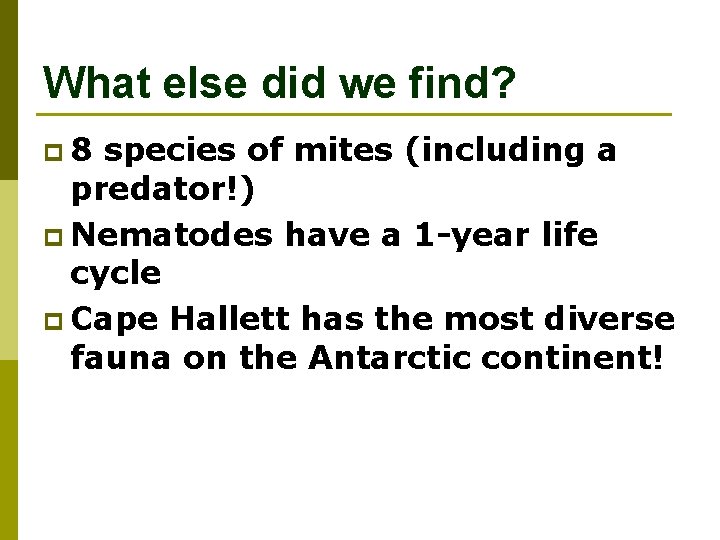
What else did we find? p 8 species of mites (including a predator!) p Nematodes have a 1 -year life cycle p Cape Hallett has the most diverse fauna on the Antarctic continent!
- Slides: 18