
On error and erasure correction coding for networks

![Generalized Singleton bound [Kim, Ho, Effros & Avestimehr 09, Kosut, Tong & Tse 09]:](https://slidetodoc.com/presentation_image_h2/dd8ef96c976179550ddb5533c9bb0dd9/image-54.jpg "Generalized Singleton bound [Kim, Ho, Effros & Avestimehr 09, Kosut, Tong & Tse 09]:")

- Slides: 70
On error and erasure correction coding for networks and deadlines Tracey Ho Caltech NTU, November 2011
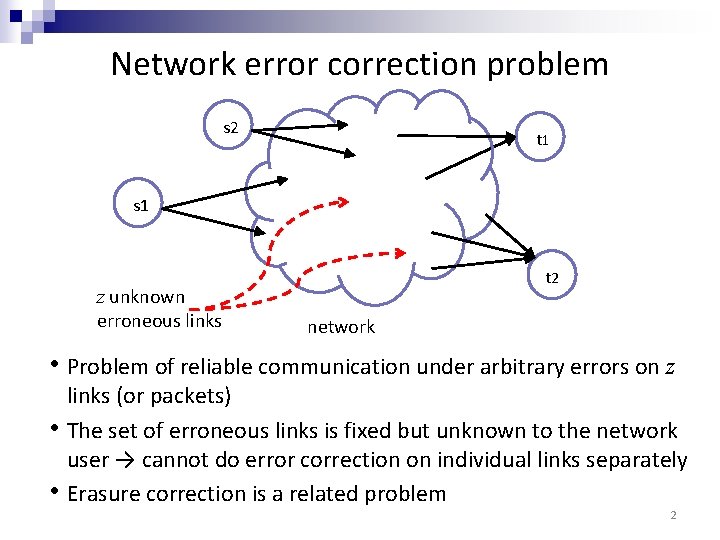
Network error correction problem s 2 t 1 s 1 z unknown erroneous links t 2 network • Problem of reliable communication under arbitrary errors on z • • links (or packets) The set of erroneous links is fixed but unknown to the network user → cannot do error correction on individual links separately Erasure correction is a related problem 2
Background – network error correction The network error correction problem was introduced by [Cai & Yeung 03] • Extensively studied in the single-source multicast case with uniform errors − Equal capacity network links (or packets), any z of which may be erroneous − Various capacity-achieving code constructions, e. g. [Cai & Yeung 03, Jaggi et al. 07, Zhang 08, Koetter & Kschischang 08] •
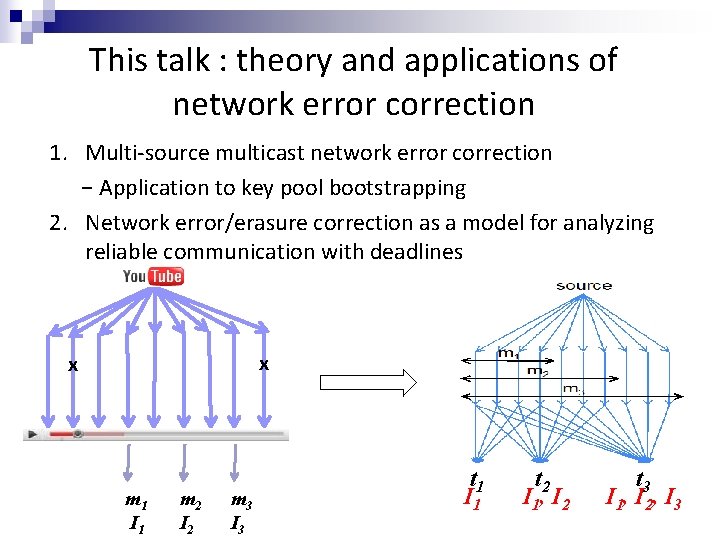
This talk : theory and applications of network error correction 1. Multi-source multicast network error correction − Application to key pool bootstrapping 2. Network error/erasure correction as a model for analyzing reliable communication with deadlines 3. Combining information theoretic and cryptographic security against adversarial errors for computationally limited nodes x x m 1 I 1 m 2 I 2 m 3 I 3 t 1 I 1 t 2 I 1, I 2 t 3 I 1, I 2, I 3
This talk : theory and applications of network error correction 1. Multi-source multicast network error correction − Application to key pool bootstrapping 2. Network error/erasure correction as a model for analyzing reliable communication with deadlines 3. Combining information theoretic and cryptographic security against adversarial errors for computationally limited nodes 4. Non-uniform network error correction
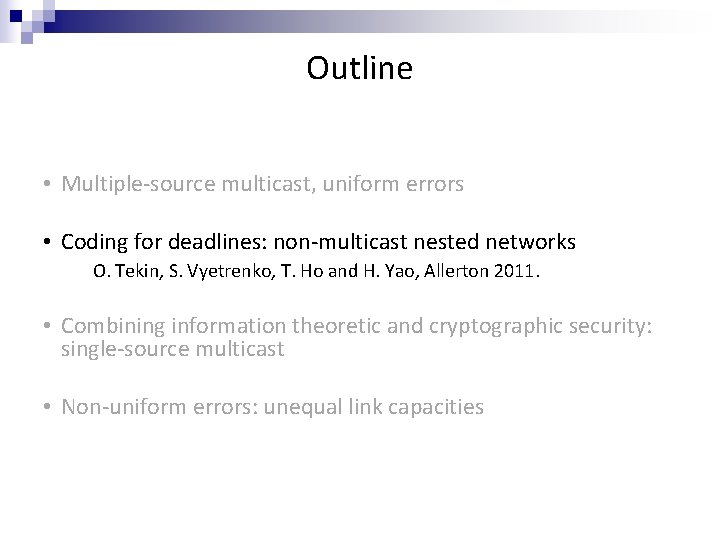
Outline • Multiple-source multicast, uniform errors • Coding for deadlines: non-multicast nested networks • Combining information theoretic and cryptographic security: single-source multicast • Non-uniform errors: unequal link capacities
Outline • Multiple-source multicast, uniform errors T. Dikaliotis, T. Ho, S. Jaggi, S. Vyetrenko, H. Yao, M. Effros, J. Kliewer and E. Erez, IT Transactions 2011. • Coding for deadlines: non-multicast nested networks • Combining information theoretic and cryptographic security: single-source multicast • Non-uniform errors: unequal link capacities
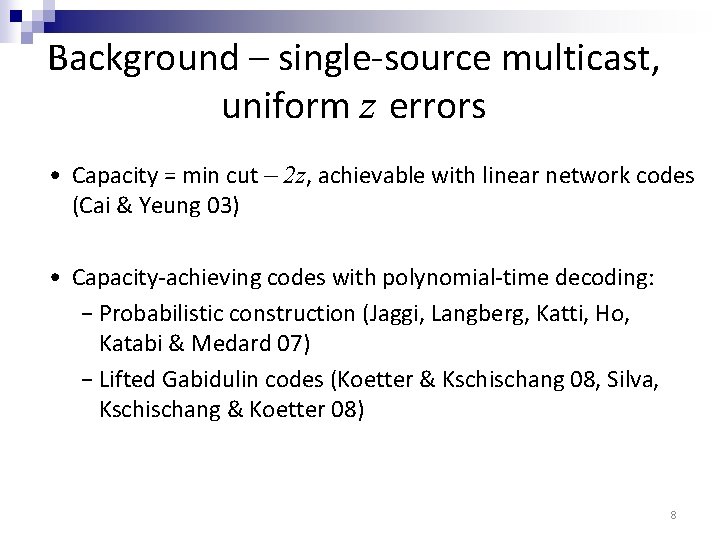
Background – single-source multicast, uniform z errors • Capacity = min cut – 2 z, achievable with linear network codes (Cai & Yeung 03) • Capacity-achieving codes with polynomial-time decoding: − Probabilistic construction (Jaggi, Langberg, Katti, Ho, Katabi & Medard 07) − Lifted Gabidulin codes (Koetter & Kschischang 08, Silva, Kschischang & Koetter 08) 8
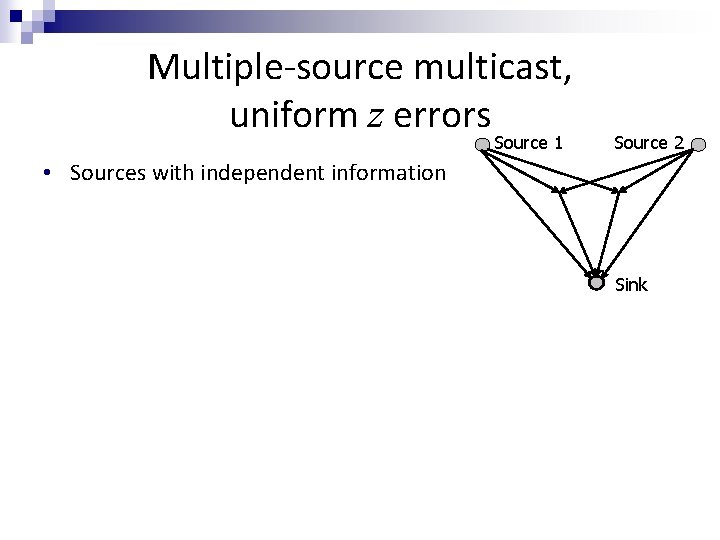
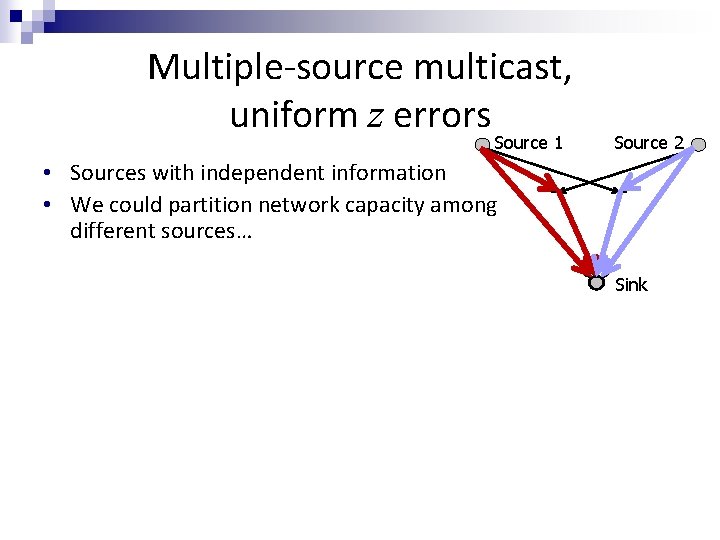
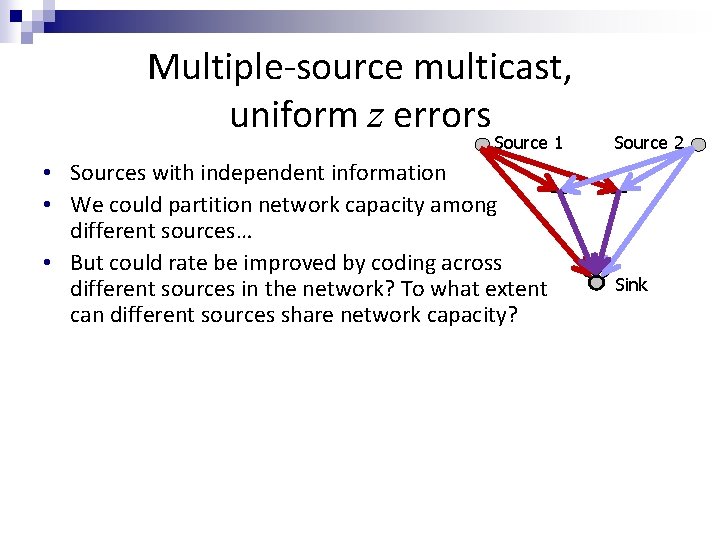
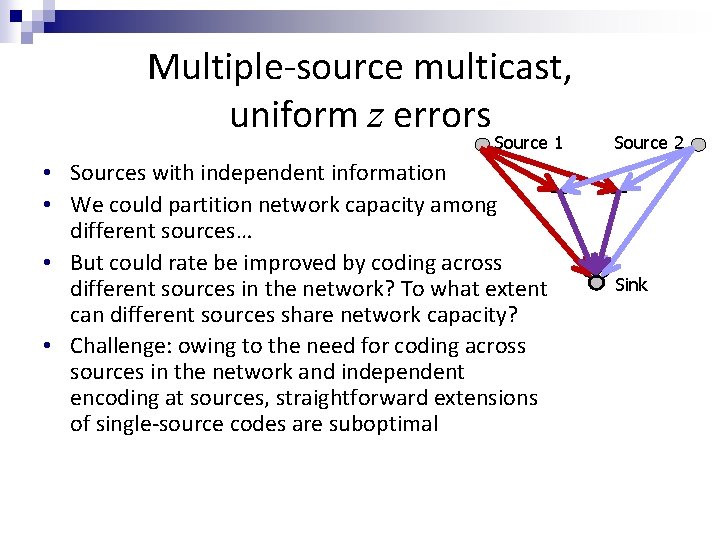
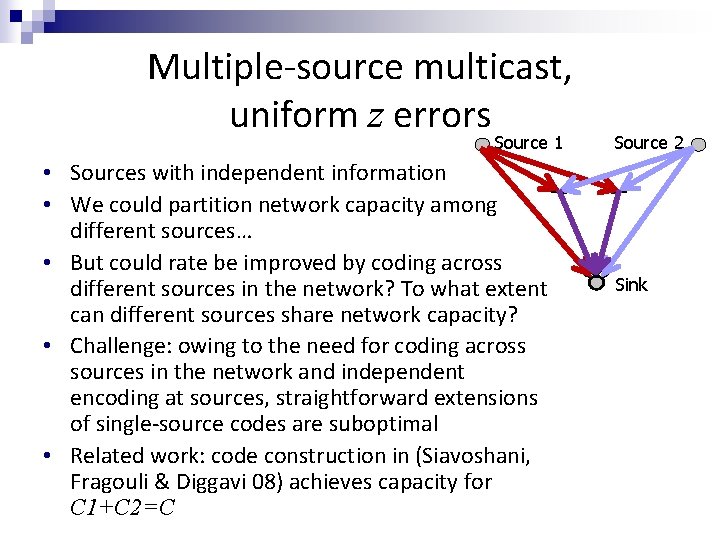
Multiple-source multicast, uniform z errors Source 1 • Sources with independent information • We could partition network capacity among different sources… • But could rate be improved by coding across different sources in the network? To what extent can different sources share network capacity? • Challenge: owing to the need for coding across sources in the network and independent encoding at sources, straightforward extensions of single-source codes are suboptimal • Related work: code construction in (Siavoshani, Fragouli & Diggavi 08) achieves capacity for C 1+C 2=C Source 2 Sink
Multiple-source multicast, uniform z errors Source 1 • Sources with independent information • We could partition network capacity among different sources… • But could rate be improved by coding across different sources in the network? To what extent can different sources share network capacity? • Challenge: owing to the need for coding across sources in the network and independent encoding at sources, straightforward extensions of single-source codes are suboptimal • Related work: code construction in (Siavoshani, Fragouli & Diggavi 08) achieves capacity for C 1+C 2=C Source 2 Sink
Multiple-source multicast, uniform z errors Source 1 • Sources with independent information • We could partition network capacity among different sources… • But could rate be improved by coding across different sources in the network? To what extent can different sources share network capacity? • Challenge: owing to the need for coding across sources in the network and independent encoding at sources, straightforward extensions of single-source codes are suboptimal • Related work: code construction in (Siavoshani, Fragouli & Diggavi 08) achieves capacity for C 1+C 2=C Source 2 Sink
Multiple-source multicast, uniform z errors Source 1 • Sources with independent information • We could partition network capacity among different sources… • But could rate be improved by coding across different sources in the network? To what extent can different sources share network capacity? • Challenge: owing to the need for coding across sources in the network and independent encoding at sources, straightforward extensions of single-source codes are suboptimal • Related work: code construction in (Siavoshani, Fragouli & Diggavi 08) achieves capacity for C 1+C 2=C Source 2 Sink
Multiple-source multicast, uniform z errors Source 1 • Sources with independent information • We could partition network capacity among different sources… • But could rate be improved by coding across different sources in the network? To what extent can different sources share network capacity? • Challenge: owing to the need for coding across sources in the network and independent encoding at sources, straightforward extensions of single-source codes are suboptimal • Related work: code construction in (Siavoshani, Fragouli & Diggavi 08) achieves capacity for C 1+C 2=C Source 2 Sink
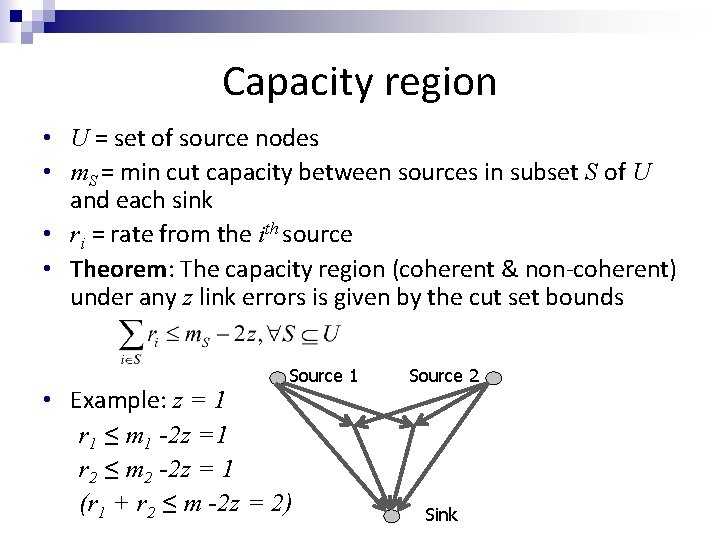
Capacity region • U = set of source nodes • m. S = min cut capacity between sources in subset S of U and each sink • ri = rate from the ith source • Theorem: The capacity region (coherent & non-coherent) under any z link errors is given by the cut set bounds Source 1 • Example: z = 1 r 1 ≤ m 1 -2 z =1 r 2 ≤ m 2 -2 z = 1 (r 1 + r 2 ≤ m -2 z = 2) Source 2 Sink
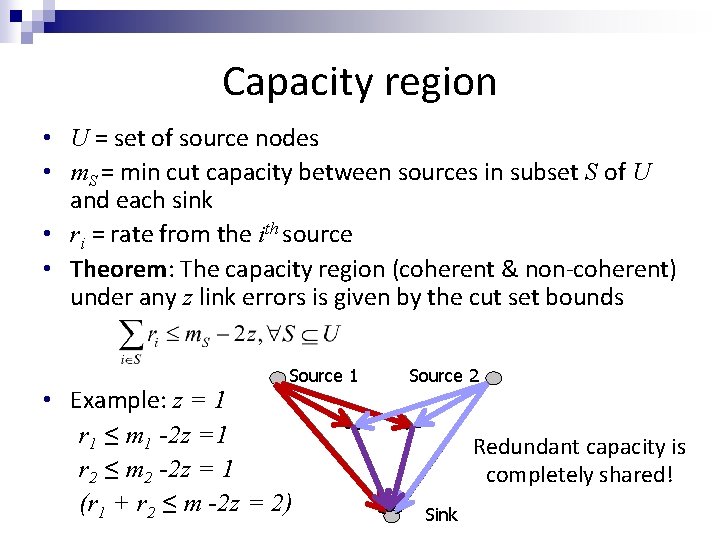
Capacity region • U = set of source nodes • m. S = min cut capacity between sources in subset S of U and each sink • ri = rate from the ith source • Theorem: The capacity region (coherent & non-coherent) under any z link errors is given by the cut set bounds Source 1 • Example: z = 1 r 1 ≤ m 1 -2 z =1 r 2 ≤ m 2 -2 z = 1 (r 1 + r 2 ≤ m -2 z = 2) Source 2 Redundant capacity is completely shared! Sink
Achievable constructions 1. Probabilistic construction, joint decoding of multiple sources − Requires a different distance metric for decoding than single source multicast decoding metric from Koetter & Kschischang 08 2. Gabidulin codes in nested finite fields, successive decoding
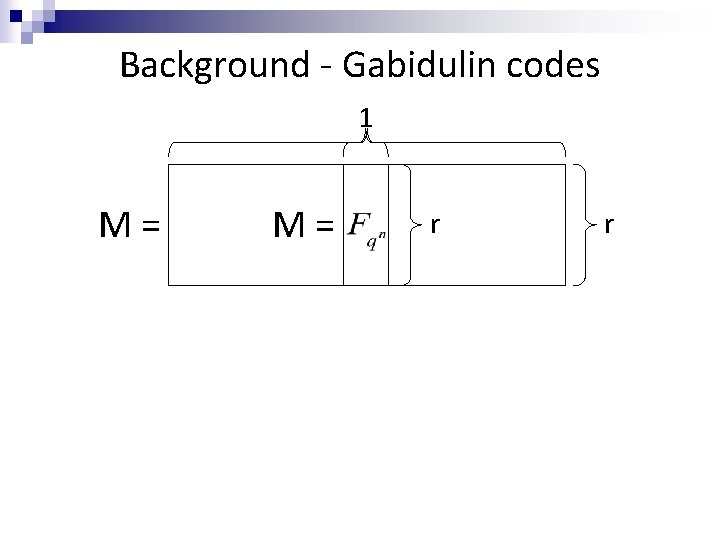
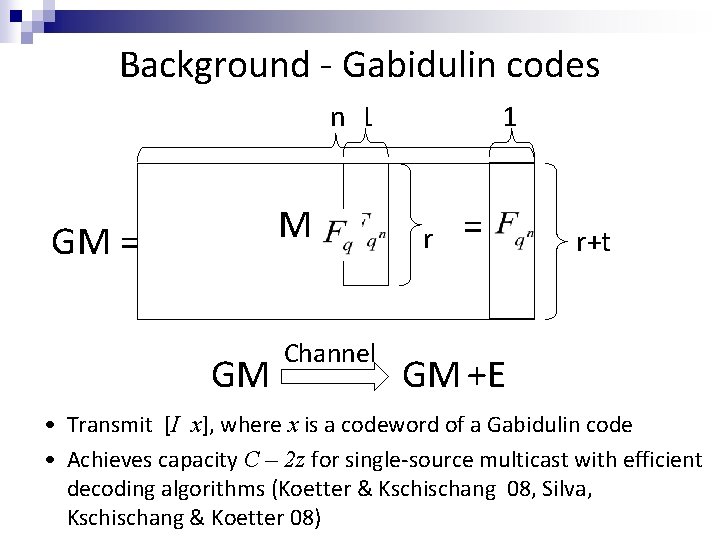
Background - Gabidulin codes n 1 M= M= r r
Background - Gabidulin codes n 1 M= GM Channel 1 r = r+t GM +E • Transmit [I x], where x is a codeword of a Gabidulin code • Achieves capacity C – 2 z for single-source multicast with efficient decoding algorithms (Koetter & Kschischang 08, Silva, Kschischang & Koetter 08)
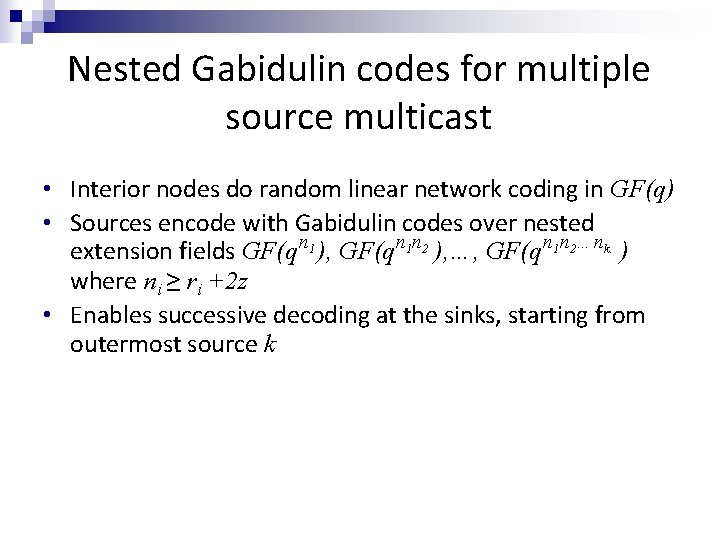
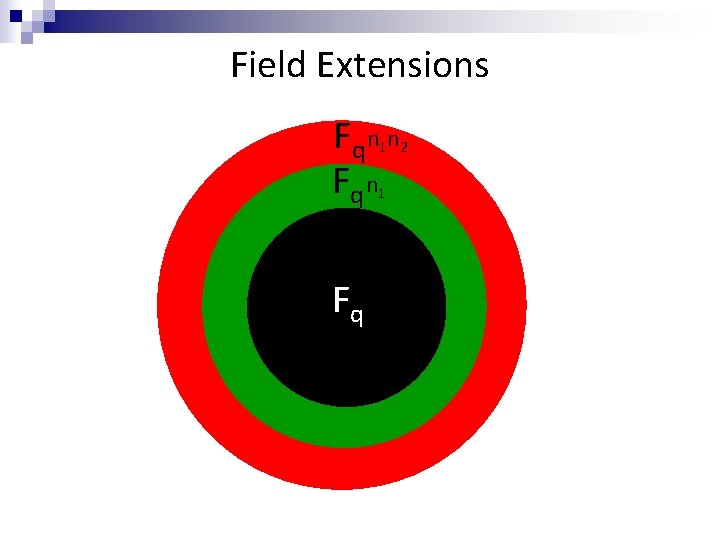
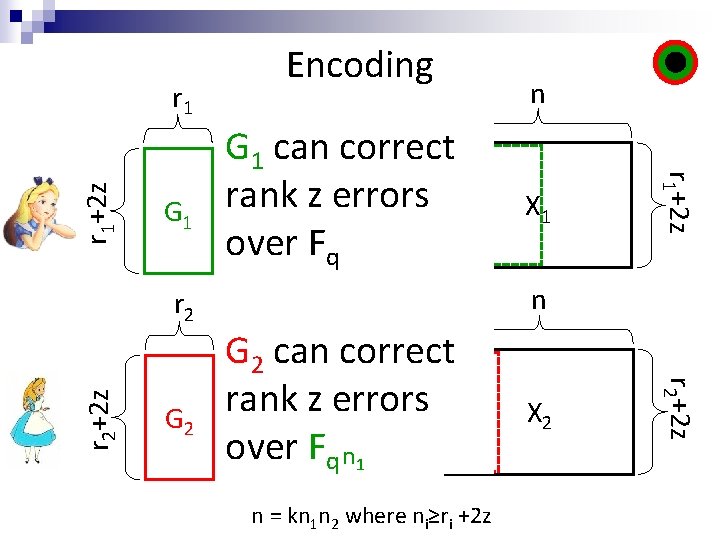
Nested Gabidulin codes for multiple source multicast • Interior nodes do random linear network coding in GF(q) • Sources encode with Gabidulin codes over nested extension fields GF(q n 1 ), GF(qn 1 n 2 ), …, GF(q n 1 n 2…nk. ) where ni ≥ ri +2 z • Enables successive decoding at the sinks, starting from outermost source k
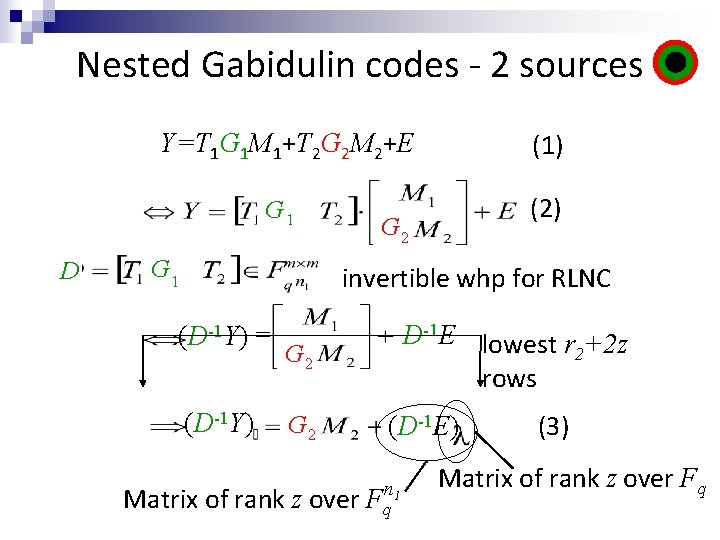
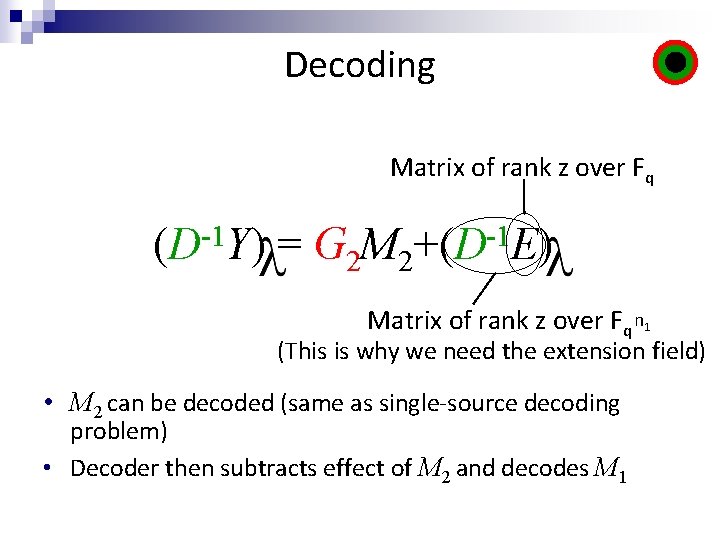
Nested Gabidulin codes - 2 sources Y=T 1 G 1 M 1+T 2 G 2 M 2+E G 1 D G 1 (1) (2) G 2 invertible whp for RLNC (D-1 Y) = (D-1 Y) D-1 E lowest r +2 z 2 rows G 2 (D-1 E) n 1 Matrix of rank z over Fq (3) Matrix of rank z over Fq
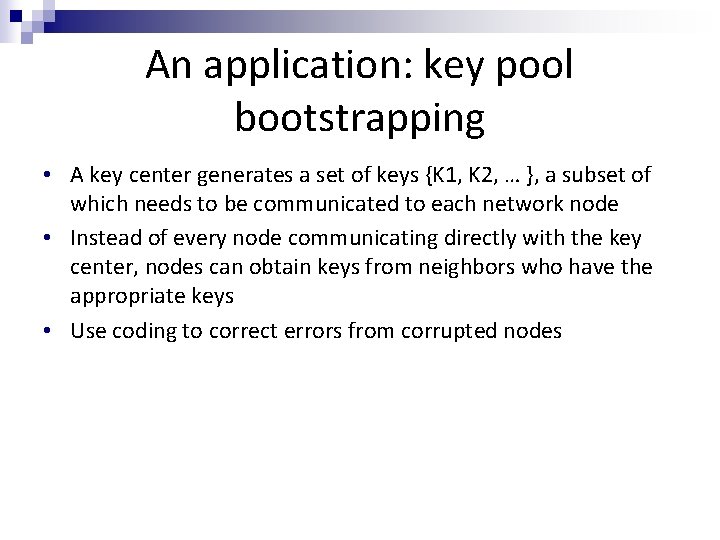
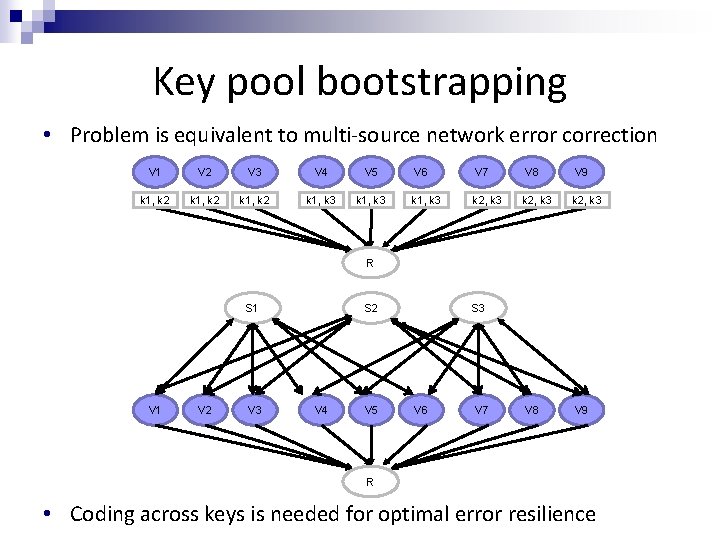
An application: key pool bootstrapping • A key center generates a set of keys {K 1, K 2, … }, a subset of which needs to be communicated to each network node • Instead of every node communicating directly with the key center, nodes can obtain keys from neighbors who have the appropriate keys • Use coding to correct errors from corrupted nodes
Key pool bootstrapping • Problem is equivalent to multi-source network error correction V 1 V 2 V 3 V 4 V 5 k 1, k 2 k 1, k 3 V 6 V 7 V 8 V 9 k 1, k 3 k 2, k 3 V 8 V 9 R S 2 S 1 V 2 V 3 V 4 V 5 S 3 V 6 V 7 R • Coding across keys is needed for optimal error resilience
Outline • Multiple-source multicast, uniform errors • Coding for deadlines: non-multicast nested networks O. Tekin, S. Vyetrenko, T. Ho and H. Yao, Allerton 2011. • Combining information theoretic and cryptographic security: single-source multicast • Non-uniform errors: unequal link capacities
Background - non-multicast • Finding the capacity region of a general non-multicast network even in the erasure-free case is an open problem − Coding across different sinks’ packets (inter-session coding) is sometimes required − We don’t know in general when intra-session coding is sufficient • We can derive cut set bounds by analyzing three-layer networks (Vyetrenko, Ho & Dikaliotis 10)
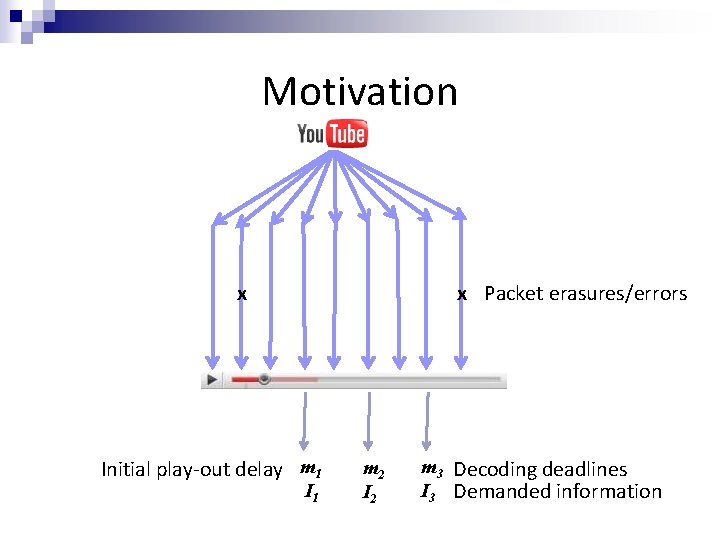
Motivation x x Packet erasures/errors Initial play-out delay m 1 I 1 m 2 I 2 m 3 Decoding deadlines I 3 Demanded information
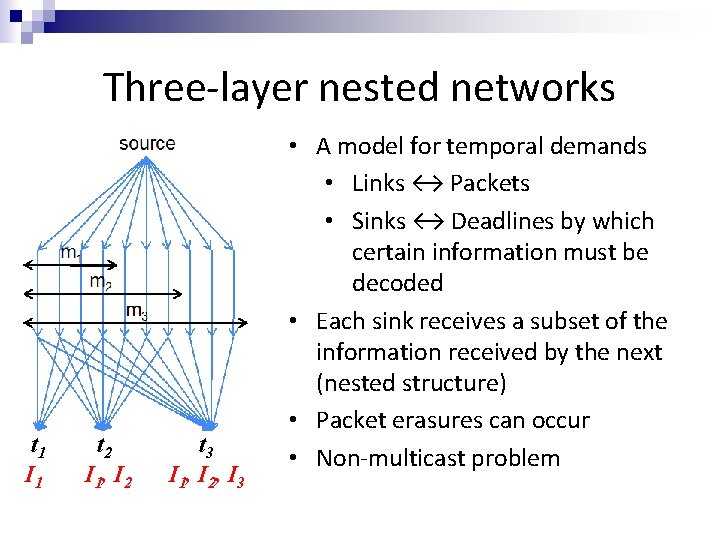
Three-layer nested networks t 1 I 1 t 2 I 1, I 2 t 3 I 1, I 2, I 3 • A model for temporal demands • Links ↔ Packets • Sinks ↔ Deadlines by which certain information must be decoded • Each sink receives a subset of the information received by the next (nested structure) • Packet erasures can occur • Non-multicast problem
Erasure models We consider two erasure models: • z erasures (uniform model) − At most z links can be erased, locations are unknown a priori. • Sliding window erasure model
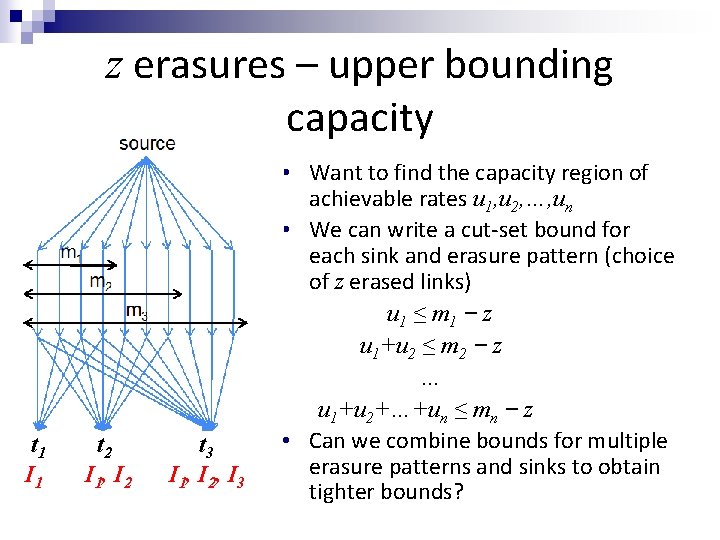
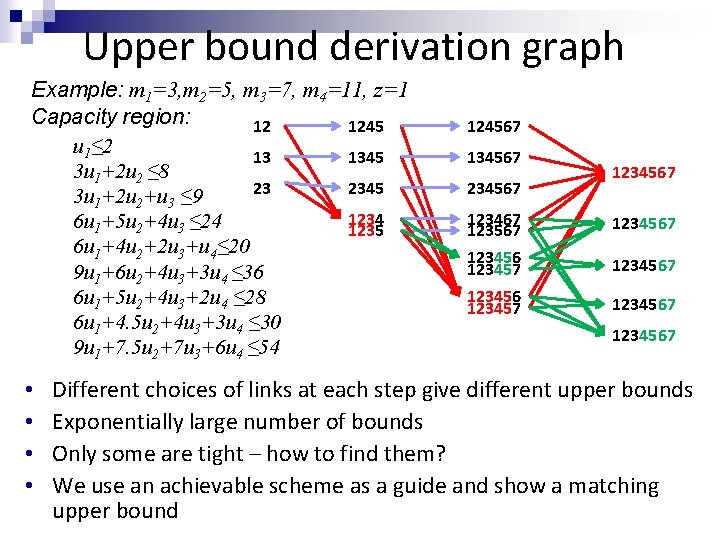
z erasures – upper bounding capacity t 1 I 1 t 2 I 1, I 2 t 3 I 1, I 2, I 3 • Want to find the capacity region of achievable rates u 1, u 2, …, un • We can write a cut-set bound for each sink and erasure pattern (choice of z erased links) u 1 ≤ m 1 z u 1+u 2 ≤ m 2 z … u 1+u 2+…+un ≤ mn z • Can we combine bounds for multiple erasure patterns and sinks to obtain tighter bounds?
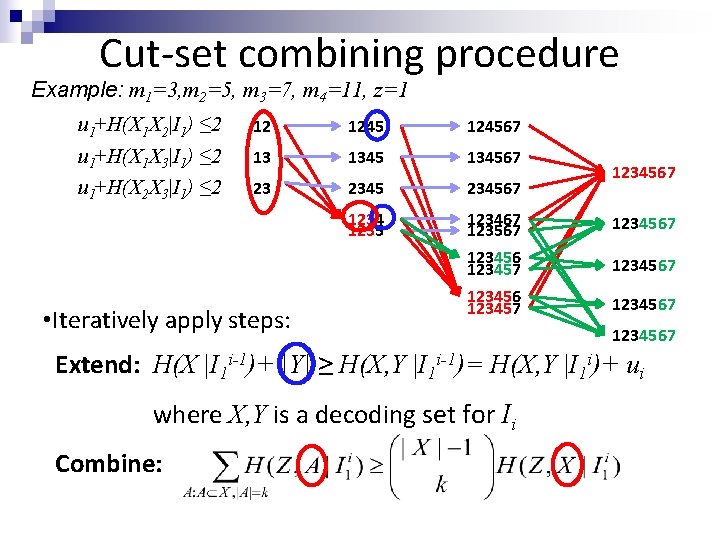
Cut-set combining procedure Example: m 1=3, m 2=5, m 3=7, m 4=11, z=1 u 1+H(X 1 X 2|I 1) ≤ 2 u 1+H(X 1 X 3|I 1) ≤ 2 u 1+H(X 2 X 3|I 1) ≤ 2 12 124567 13 134567 23 234567 1234 1235 123467 123567 123456 123457 1234567 • Iteratively apply steps: 1234567 Extend: H(X |I 1 i-1)+ |Y| ≥ H(X, Y |I 1 i-1)= H(X, Y |I 1 i)+ ui where X, Y is a decoding set for Ii Combine:
Upper bound derivation graph Example: m 1=3, m 2=5, m 3=7, m 4=11, z=1 Capacity region: 12 1245 u 1≤ 2 13 1345 3 u 1+2 u 2 ≤ 8 23 2345 3 u 1+2 u 2+u 3 ≤ 9 1234 6 u 1+5 u 2+4 u 3 ≤ 24 1235 6 u 1+4 u 2+2 u 3+u 4≤ 20 9 u 1+6 u 2+4 u 3+3 u 4 ≤ 36 6 u 1+5 u 2+4 u 3+2 u 4 ≤ 28 6 u 1+4. 5 u 2+4 u 3+3 u 4 ≤ 30 9 u 1+7. 5 u 2+7 u 3+6 u 4 ≤ 54 • • 124567 134567 234567 123467 123567 123456 123457 1234567 Different choices of links at each step give different upper bounds Exponentially large number of bounds Only some are tight – how to find them? We use an achievable scheme as a guide and show a matching upper bound
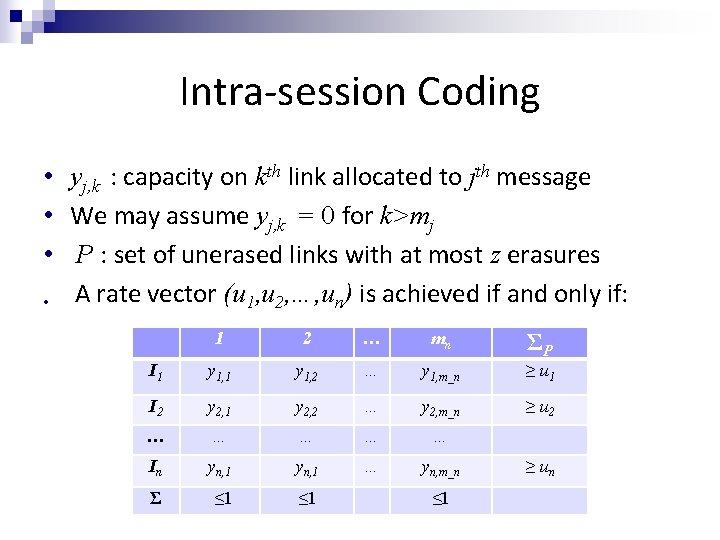
Intra-session Coding • yj, k : capacity on kth link allocated to jth message • We may assume yj, k = 0 for k>mj • P : set of unerased links with at most z erasures • A rate vector (u 1, u 2, …, un) is achieved if and only if: 1 2 … mn ΣP I 1 y 1, 2 … y 1, m_n ≥ u 1 I 2 y 2, 1 y 2, 2 … y 2, m_n ≥ u 2 … … … In yn, 1 … yn, m_n Σ ≤ 1 ≤ 1 ≥ un
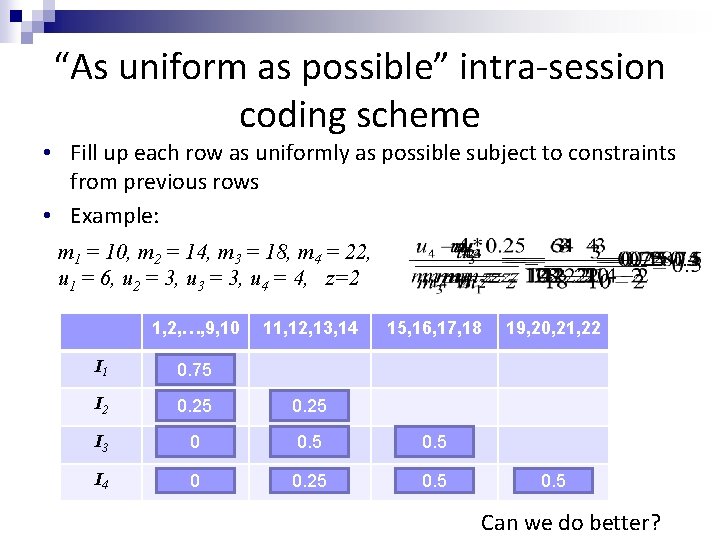
“As uniform as possible” intra-session coding scheme • Fill up each row as uniformly as possible subject to constraints from previous rows • Example: m 1 = 10, m 2 = 14, m 3 = 18, m 4 = 22, u 1 = 6, u 2 = 3, u 3 = 3, u 4 = 4, z=2 1, 2, …, 9, 10 11, 12, 13, 14 15, 16, 17, 18 I 1 0. 75 I 2 0. 25 I 3 0 0. 1875 0. 1875 I 4 0. 2 0 0. 25 0. 4 0. 2 0. 5 19, 20, 21, 22 0. 4 0. 2 0. 5 Can we do better?
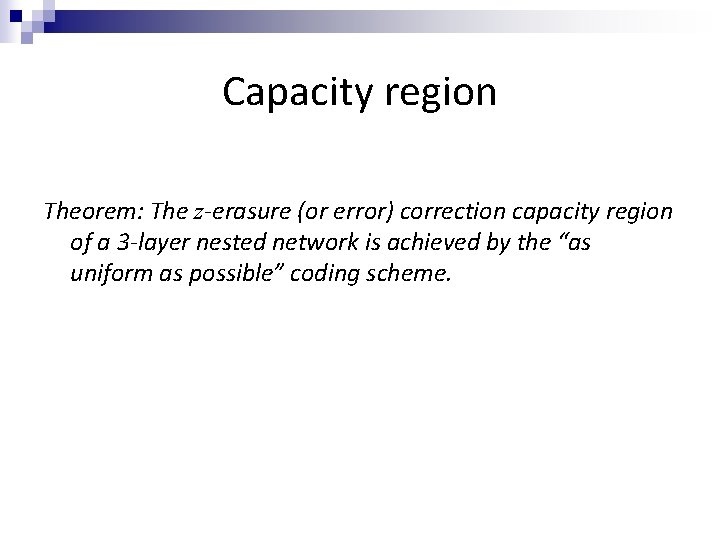
Capacity region Theorem: The z-erasure (or error) correction capacity region of a 3 -layer nested network is achieved by the “as uniform as possible” coding scheme.
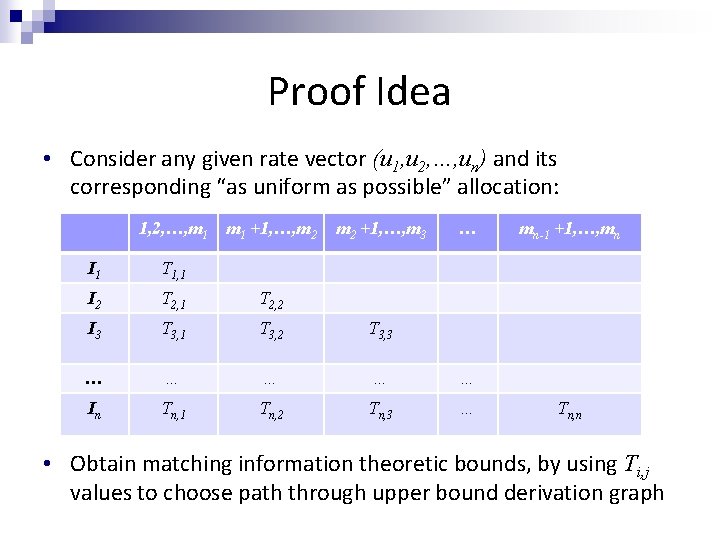
Proof Idea • Consider any given rate vector (u 1, u 2, …, un) and its corresponding “as uniform as possible” allocation: 1, 2, …, m 1 +1, …, m 2 +1, …, m 3 … I 1 T 1, 1 I 2 T 2, 1 T 2, 2 I 3 T 3, 1 T 3, 2 T 3, 3 … … … In Tn, 1 Tn, 2 Tn, 3 … mn-1 +1, …, mn Tn, n • Obtain matching information theoretic bounds, by using Ti, j values to choose path through upper bound derivation graph
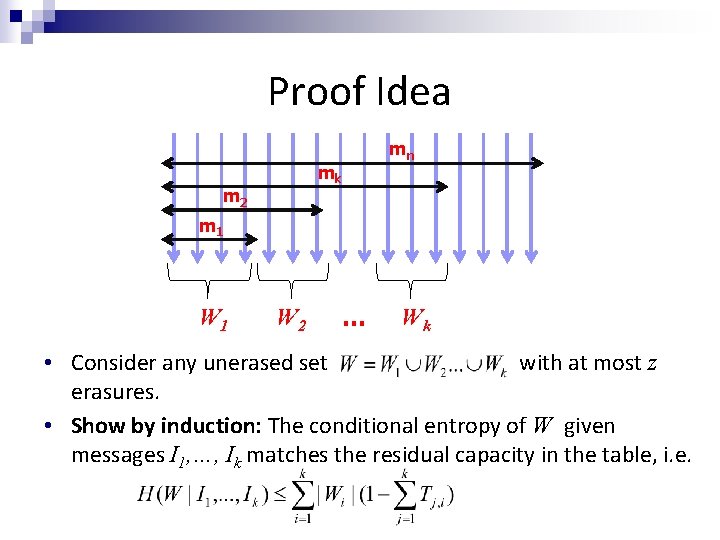
Proof Idea mk m 2 mn m 1 W 2 … Wk • Consider any unerased set with at most z erasures. • Show by induction: The conditional entropy of W given messages I 1, …, Ik matches the residual capacity in the table, i. e.
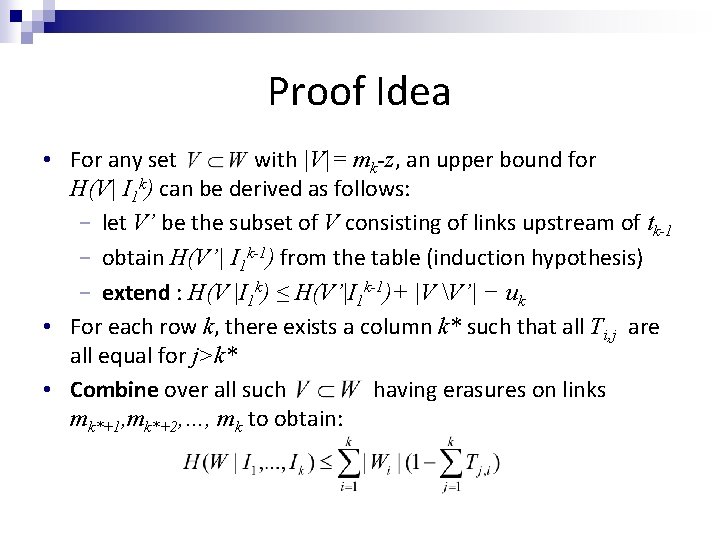
Proof Idea • For any set with |V|= mk-z, an upper bound for H(V| I 1 k) can be derived as follows: − let V’ be the subset of V consisting of links upstream of tk-1 − obtain H(V’| I 1 k-1) from the table (induction hypothesis) − extend : H(V |I 1 k) ≤ H(V’|I 1 k-1)+ |V V’| − uk • For each row k, there exists a column k* such that all Ti, j are all equal for j>k* • Combine over all such having erasures on links mk*+1, mk*+2, …, mk to obtain:
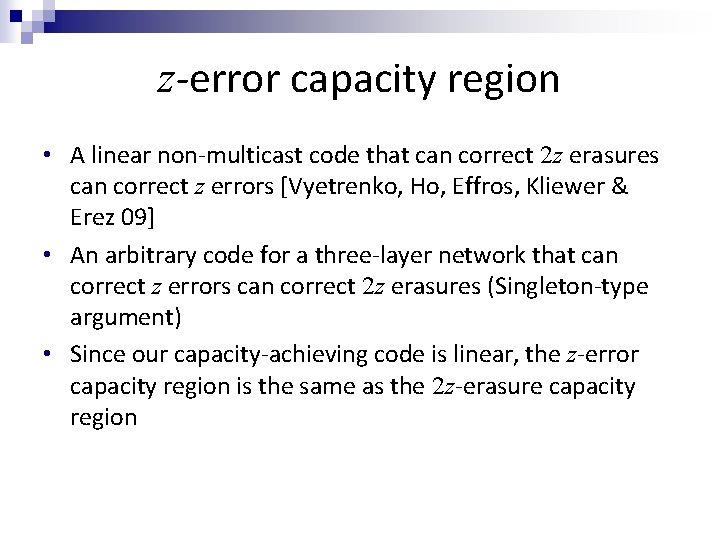
z-error capacity region • A linear non-multicast code that can correct 2 z erasures can correct z errors [Vyetrenko, Ho, Effros, Kliewer & Erez 09] • An arbitrary code for a three-layer network that can correct z errors can correct 2 z erasures (Singleton-type argument) • Since our capacity-achieving code is linear, the z-error capacity region is the same as the 2 z-erasure capacity region
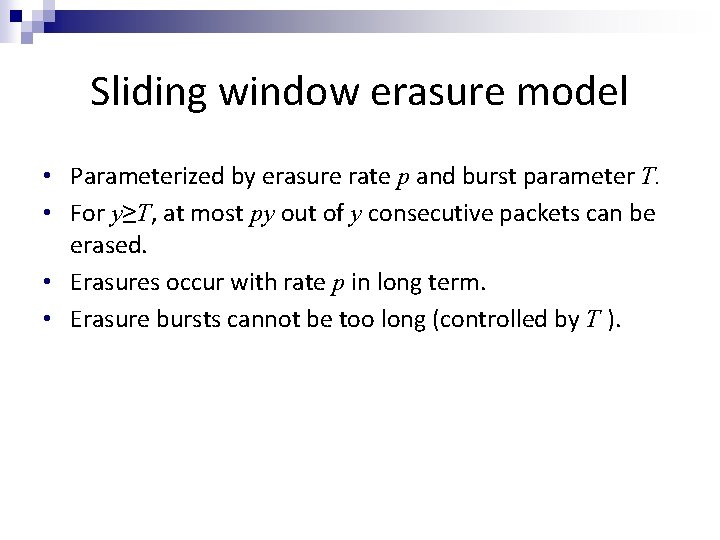
Sliding window erasure model • Parameterized by erasure rate p and burst parameter T. • For y≥T, at most py out of y consecutive packets can be erased. • Erasures occur with rate p in long term. • Erasure bursts cannot be too long (controlled by T ).
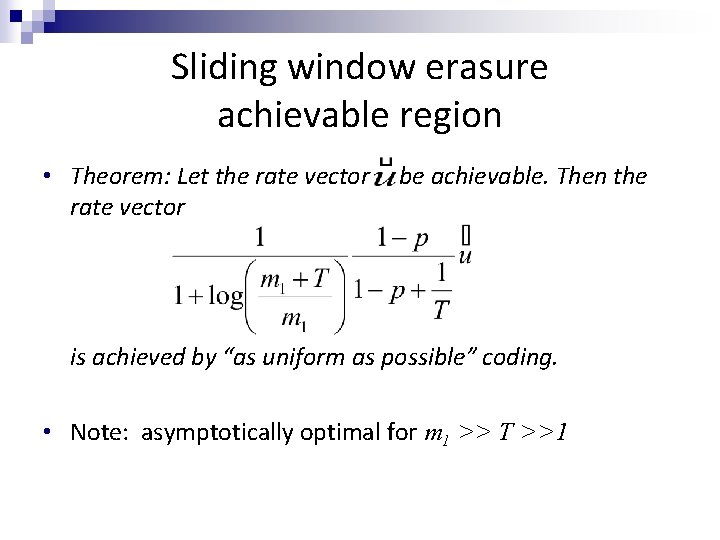
Sliding window erasure achievable region • Theorem: Let the rate vector be achievable. Then the is achieved by “as uniform as possible” coding. • Note: asymptotically optimal for m 1 >> T >>1
Outline • Multiple-source multicast, uniform errors • Coding for deadlines: non-multicast nested networks • Combining information theoretic and cryptographic security: single-source multicast S. Vyetrenko, A. Khosla & T. Ho, Asilomar 2009. • Non-uniform errors: unequal link capacities
Problem statement • Single source, multicast network • Packets may be corrupted by adversarial errors • Computationally limited network nodes (e. g. low-power wireless/sensor networks)
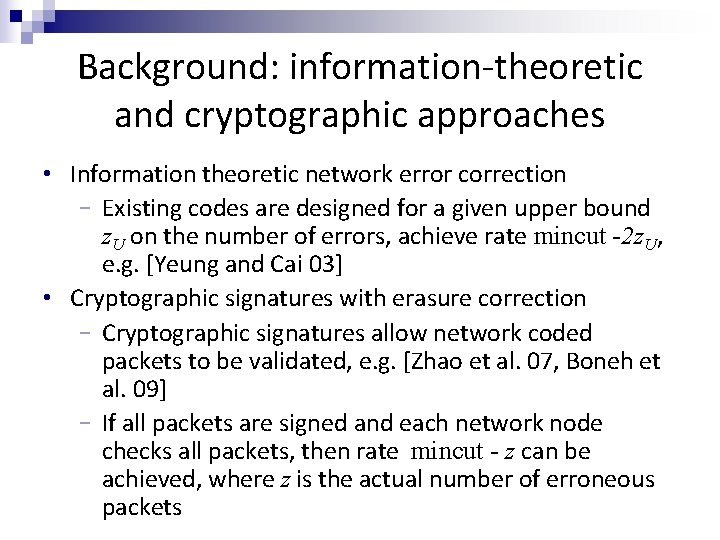
Background: information-theoretic and cryptographic approaches • Information theoretic network error correction − Existing codes are designed for a given upper bound z. U on the number of errors, achieve rate mincut -2 z. U, e. g. [Yeung and Cai 03] • Cryptographic signatures with erasure correction − Cryptographic signatures allow network coded packets to be validated, e. g. [Zhao et al. 07, Boneh et al. 09] − If all packets are signed and each network node checks all packets, then rate mincut - z can be achieved, where z is the actual number of erroneous packets
Motivation for hybrid schemes • Performing signature checks at network nodes requires significant computation • Checking all packets at all nodes can limit throughput when network nodes are computationally weak • Want to use both path diversity as well as cryptographic computation as resources, to achieve rates higher than with each separately
Approach • Cannot afford to check all packets use probabilistic signature checking • Deterministic bound on number of erroneous packets is needed in existing network error correction code constructions • Rather than have to choose a conservative bound, we want a code construction that does not require an upper bound on the number of errors to be known in advance
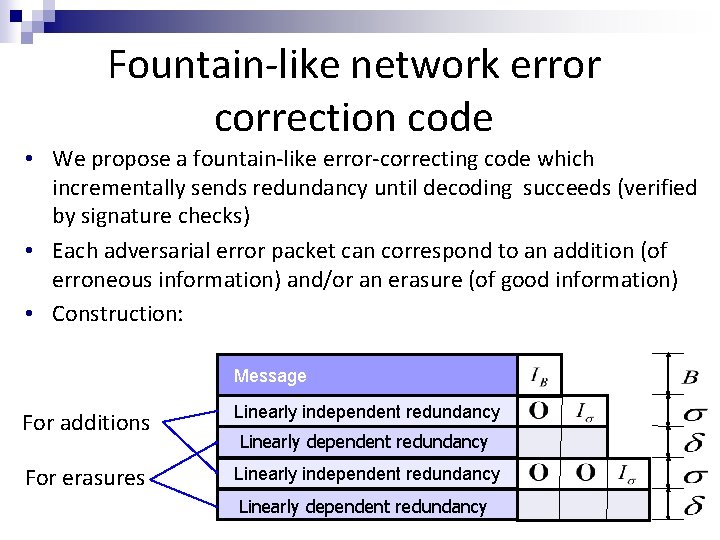
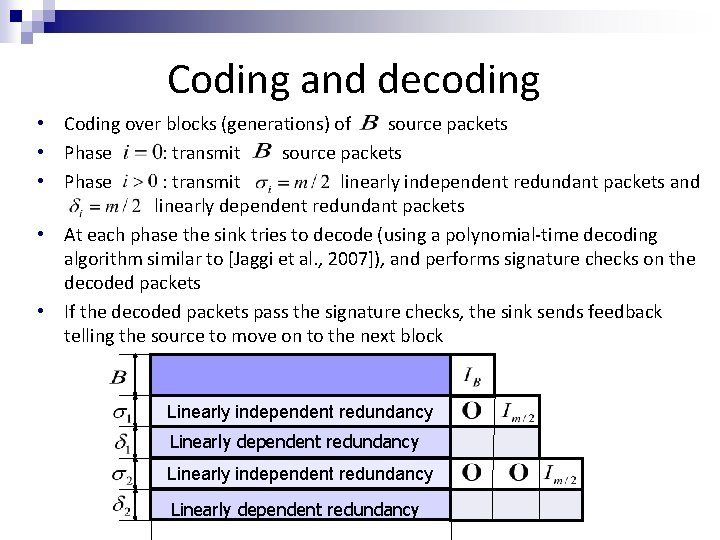
Fountain-like network error correction code • We propose a fountain-like error-correcting code which incrementally sends redundancy until decoding succeeds (verified by signature checks) • Each adversarial error packet can correspond to an addition (of erroneous information) and/or an erasure (of good information) • Construction: Message For additions Linearly independent redundancy For erasures Linearly independent redundancy Linearly dependent redundancy
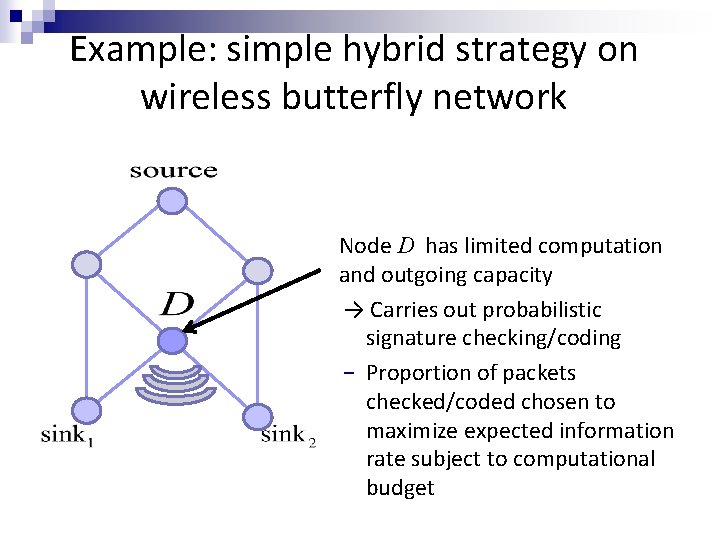
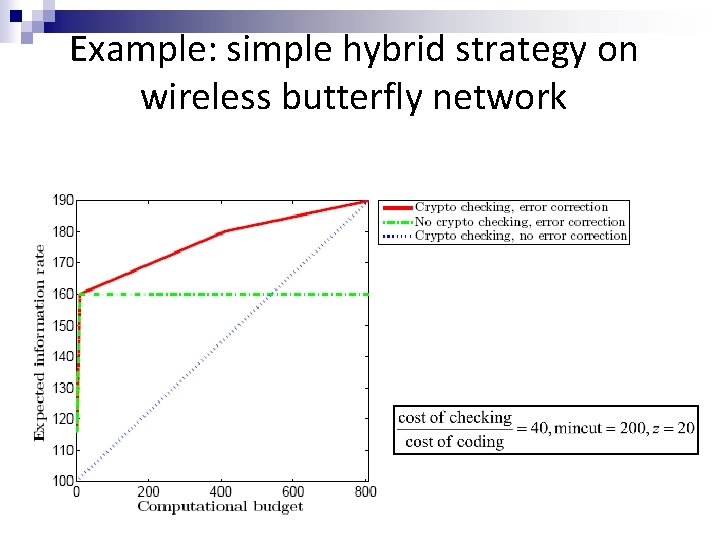
Example: simple hybrid strategy on wireless butterfly network Node D has limited computation and outgoing capacity → Carries out probabilistic signature checking/coding − Proportion of packets checked/coded chosen to maximize expected information rate subject to computational budget
Example: simple hybrid strategy on wireless butterfly network
Outline • Multiple-source multicast, uniform errors • Coding for deadlines: non-multicast nested networks • Combining information theoretic and cryptographic security: single-source multicast • Non-uniform errors: unequal link capacities S. Kim, T. Ho, M. Effros and S. Avestimehr, IT Transactions 2011. T. Ho, S. Kim, Y. Yang, M. Effros and A. S. Avestimehr, ITA 2011.
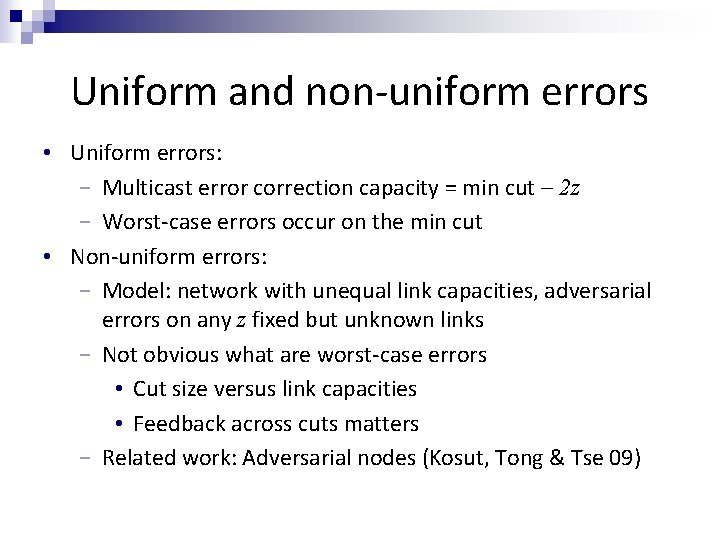
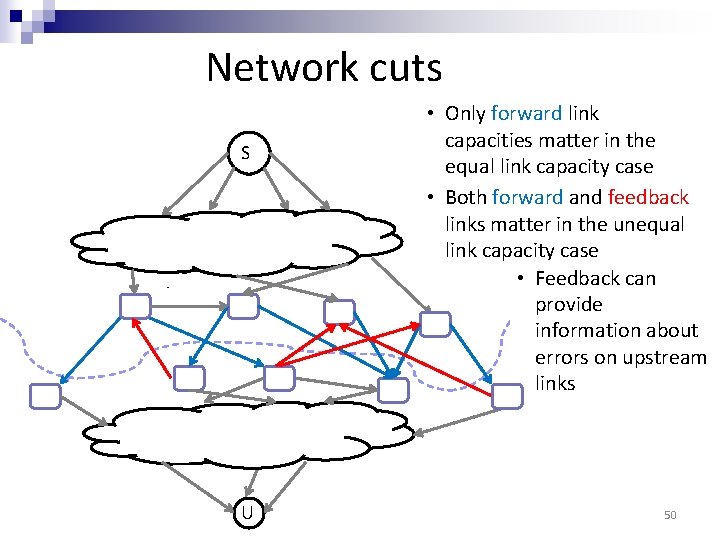
Uniform and non-uniform errors • Uniform errors: − Multicast error correction capacity = min cut – 2 z − Worst-case errors occur on the min cut • Non-uniform errors: − Model: network with unequal link capacities, adversarial errors on any z fixed but unknown links − Not obvious what are worst-case errors • Cut size versus link capacities • Feedback across cuts matters − Related work: Adversarial nodes (Kosut, Tong & Tse 09)
Network cuts S U • Only forward link capacities matter in the equal link capacity case • Both forward and feedback links matter in the unequal link capacity case • Feedback can provide information about errors on upstream links 50
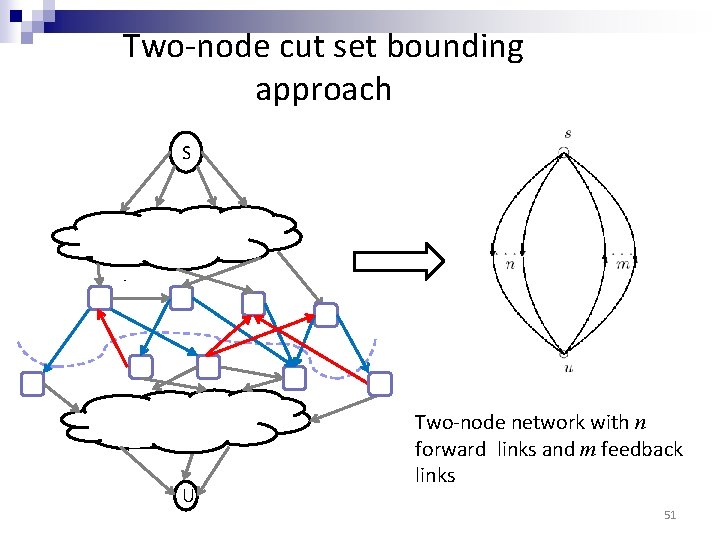
Two-node cut set bounding approach S U Two-node network with n forward links and m feedback links 51
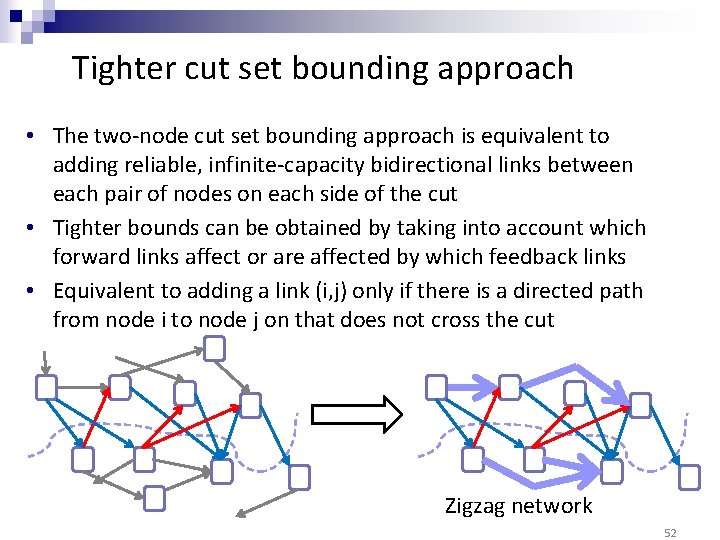
Tighter cut set bounding approach • The two-node cut set bounding approach is equivalent to adding reliable, infinite-capacity bidirectional links between each pair of nodes on each side of the cut • Tighter bounds can be obtained by taking into account which forward links affect or are affected by which feedback links • Equivalent to adding a link (i, j) only if there is a directed path from node i to node j on that does not cross the cut Zigzag network 52
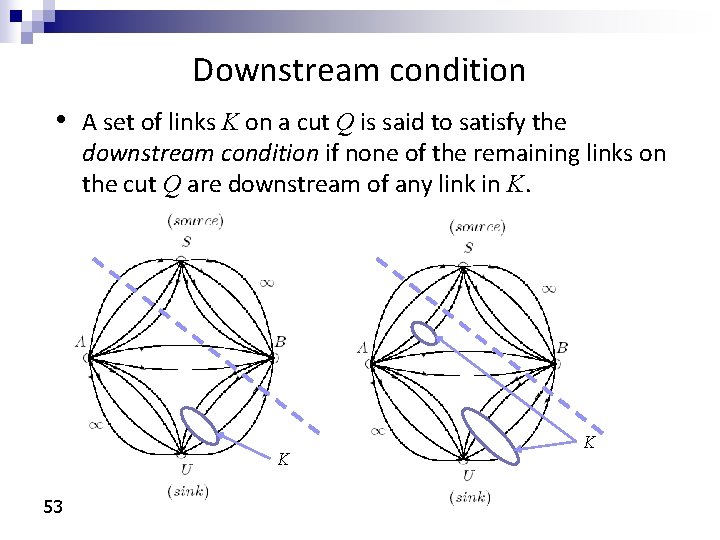
Downstream condition • A set of links K on a cut Q is said to satisfy the downstream condition if none of the remaining links on the cut Q are downstream of any link in K. K 53 K
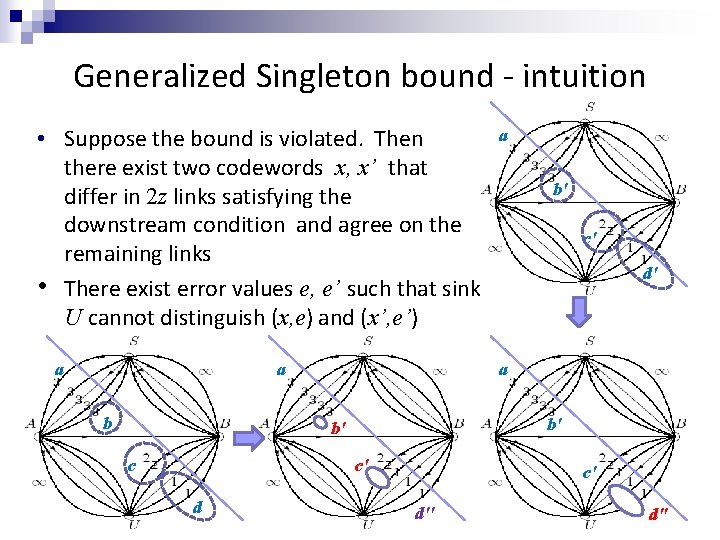
Generalized Singleton bound [Kim, Ho, Effros & Avestimehr 09, Kosut, Tong & Tse 09]: For any cut Q, after erasing any 2 z links satisfying the downstream condition, the total capacity of the remaining links in Q is an upper bound on error correction capacity. When z=3, generalized Singleton bound is 3+3+3+3=12 54
Generalized Singleton bound - intuition • Suppose the bound is violated. Then there exist two codewords x, x’ that differ in 2 z links satisfying the downstream condition and agree on the remaining links • There exist error values e, e’ such that sink U cannot distinguish (x, e) and (x’, e’) a a b 55 c' d' b' c' d b' a b' c a c' d'' d"
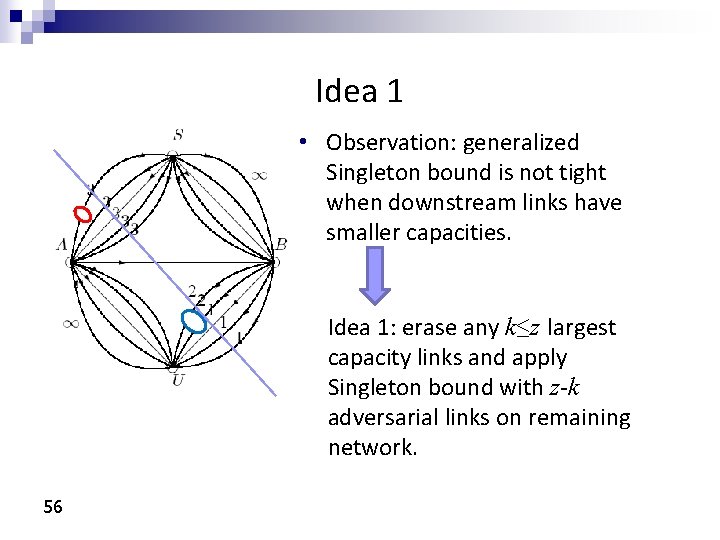
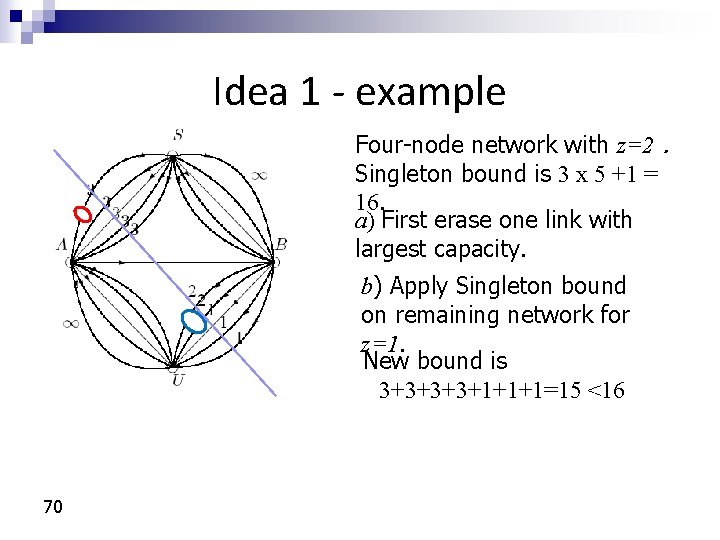
Idea 1 • Observation: generalized Singleton bound is not tight when downstream links have smaller capacities. Idea 1: erase any k≤z largest capacity links and apply Singleton bound with z-k adversarial links on remaining network. 56
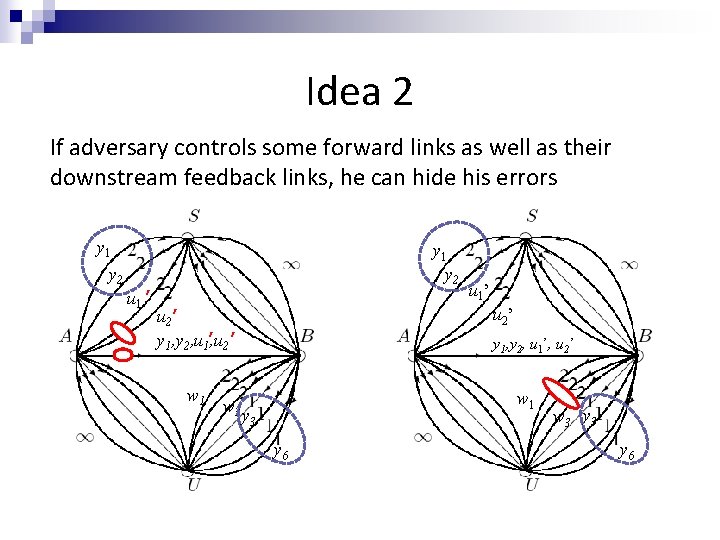
Idea 2 If adversary controls some forward links as well as their downstream feedback links, he can hide his errors y 1 y 2 u 1 ’ y 1 y 2 u 2’ y 1, y 2, u 1’, u 2 ’ w 1 w 3 u 1’ y 1, y 2, u 1’, u 2’ w 1 ’ y 3 y 6 w 3 ’ y 3 yy 66
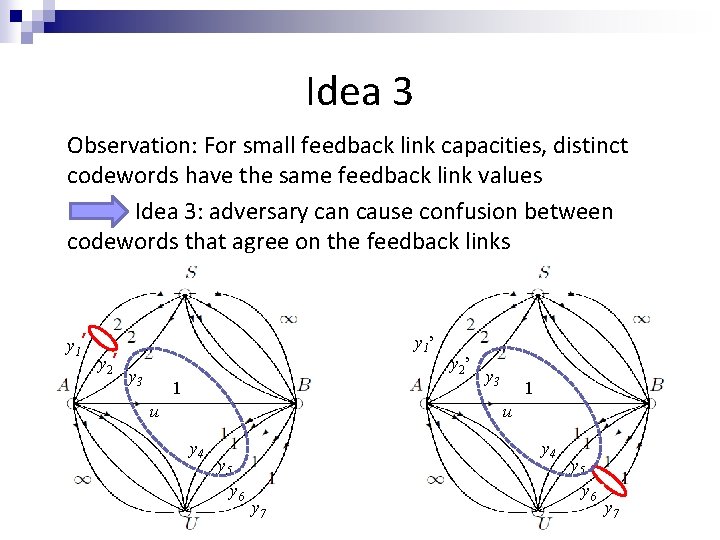
Idea 3 Observation: For small feedback link capacities, distinct codewords have the same feedback link values Idea 3: adversary can cause confusion between codewords that agree on the feedback links y 1 ’ y 2’ y 1 ’ y 3 1 u y 2 ’ y 3 1 u y 4 y 5 y 6 y 4 y 7 y 5 y 6 ' y 7 '
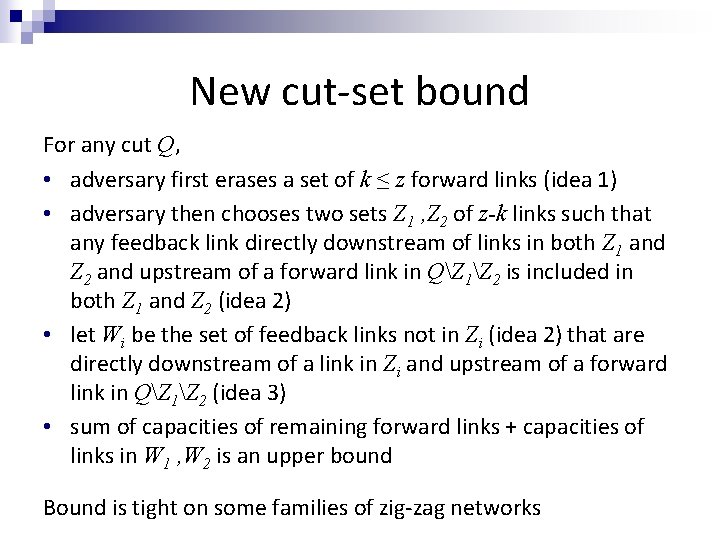
New cut-set bound For any cut Q, • adversary first erases a set of k ≤ z forward links (idea 1) • adversary then chooses two sets Z 1 , Z 2 of z-k links such that any feedback link directly downstream of links in both Z 1 and Z 2 and upstream of a forward link in QZ 1Z 2 is included in both Z 1 and Z 2 (idea 2) • let Wi be the set of feedback links not in Zi (idea 2) that are directly downstream of a link in Zi and upstream of a forward link in QZ 1Z 2 (idea 3) • sum of capacities of remaining forward links + capacities of links in W 1 , W 2 is an upper bound Bound is tight on some families of zig-zag networks
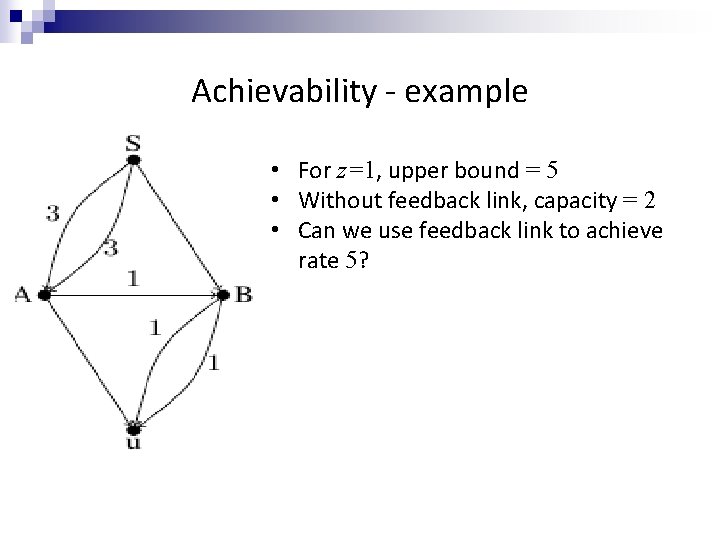
Achievability - example • For z=1, upper bound = 5 • Without feedback link, capacity = 2 • Can we use feedback link to achieve rate 5? z=1 Achieve rate 3 using new code construction
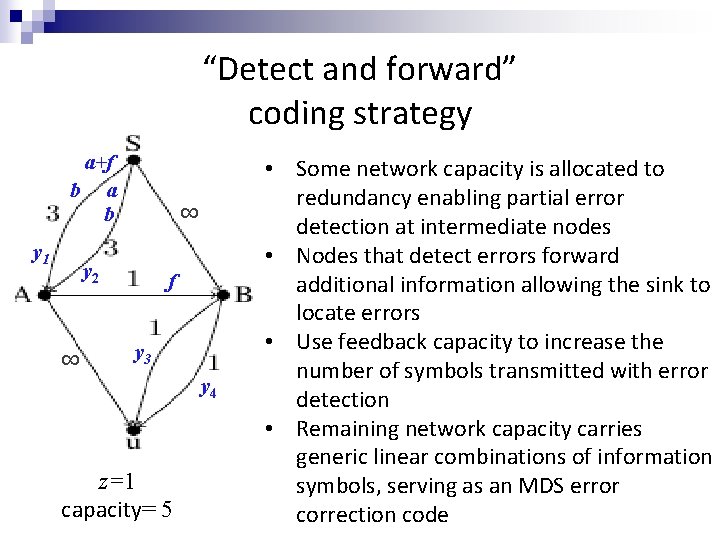
“Detect and forward” coding strategy a +f b a b y 1 ∞ y 2 ∞ f y 3 y 4 z=1 capacity= 5 • Some network capacity is allocated to redundancy enabling partial error detection at intermediate nodes • Nodes that detect errors forward additional information allowing the sink to locate errors • Use feedback capacity to z=1 increase the number of symbols transmitted with error Achieve rate 3 detection using new code • Remaining network capacity carries construction generic linear combinations of information symbols, serving as an MDS error correction code
Conclusion • Network error correction as a model for analyzing and designing codes for robust streaming • Coding for adversaries: Information theoretic and hybrid cryptographic approaches • New codes and outer bounds for more general networks and communication demands
• Thank you!
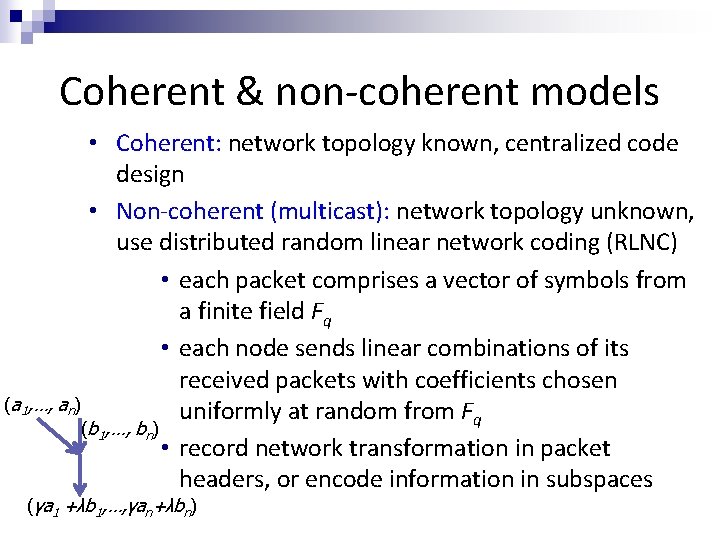
Coherent & non-coherent models • Coherent: network topology known, centralized code design • Non-coherent (multicast): network topology unknown, use distributed random linear network coding (RLNC) • each packet comprises a vector of symbols from a finite field Fq • each node sends linear combinations of its received packets with coefficients chosen (a 1, …, an) uniformly at random from Fq (b 1, …, bn) • record network transformation in packet headers, or encode information in subspaces (γa 1 +λb 1, …, γan+λbn)
Coding and decoding • Coding over blocks (generations) of source packets • Phase : transmit linearly independent redundant packets and linearly dependent redundant packets • At each phase the sink tries to decode (using a polynomial-time decoding algorithm similar to [Jaggi et al. , 2007]), and performs signature checks on the decoded packets • If the decoded packets pass the signature checks, the sink sends feedback telling the source to move on to the next block Linearly independent redundancy Linearly dependent redundancy
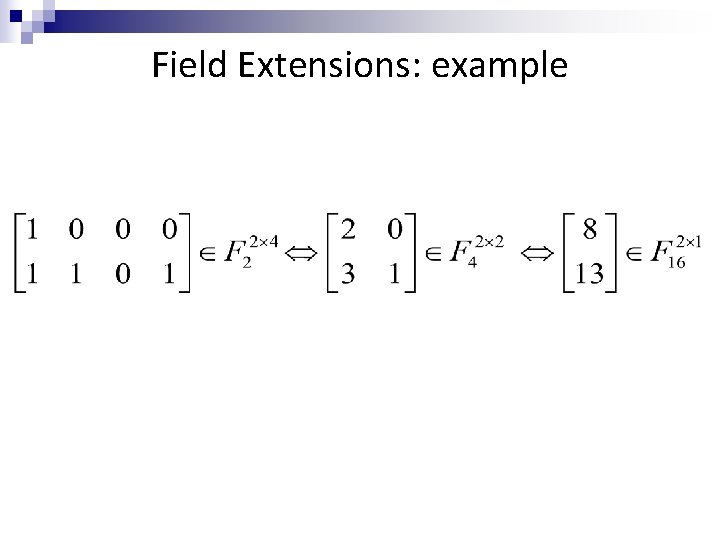
Field Extensions: example
Field Extensions Fq n n Fq n 1 2 1 Fq
G 1 G 2 G 1 can correct xrank z Merrors = 1 over Fq n G 2 can correct xrank z Merrors = 2 over Fq n 1 n = kn 1 n 2 where ni≥ri +2 z X 1 n X 2 r 2+2 z r 2 n n r 1+2 z r 1 Encoding
Decoding Matrix of rank z over Fq (D-1 Y) = G 2 M 2+(D-1 E) Matrix of rank z over Fq n 1 (This is why we need the extension field) • M 2 can be decoded (same as single-source decoding problem) • Decoder then subtracts effect of M 2 and decodes M 1
Idea 1 - example Four-node network with z=2. Singleton bound is 3 x 5 +1 = 16. a) First erase one link with largest capacity. b) Apply Singleton bound on remaining network for z=1. New bound is 3+3+1+1+1=15 <16 70