
On Close Reading The Three Layers of Meaning




- Slides: 20
On Close Reading The Three Layers of Meaning
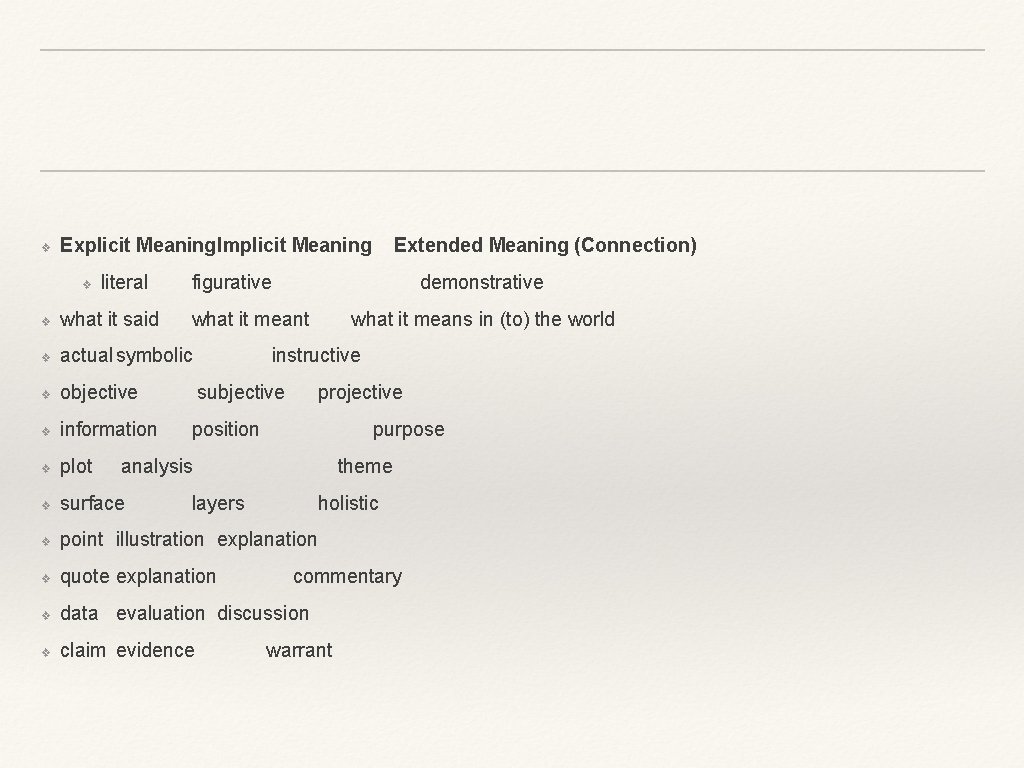
❖ Explicit Meaning. Implicit Meaning ❖ literal Extended Meaning (Connection) figurative demonstrative ❖ what it said what it meant what it means in (to) the world ❖ actual symbolic ❖ objective subjective ❖ information position ❖ plot ❖ surface ❖ point illustration explanation ❖ quote explanation ❖ data evaluation discussion ❖ claim evidence instructive projective purpose analysis theme layers holistic commentary warrant
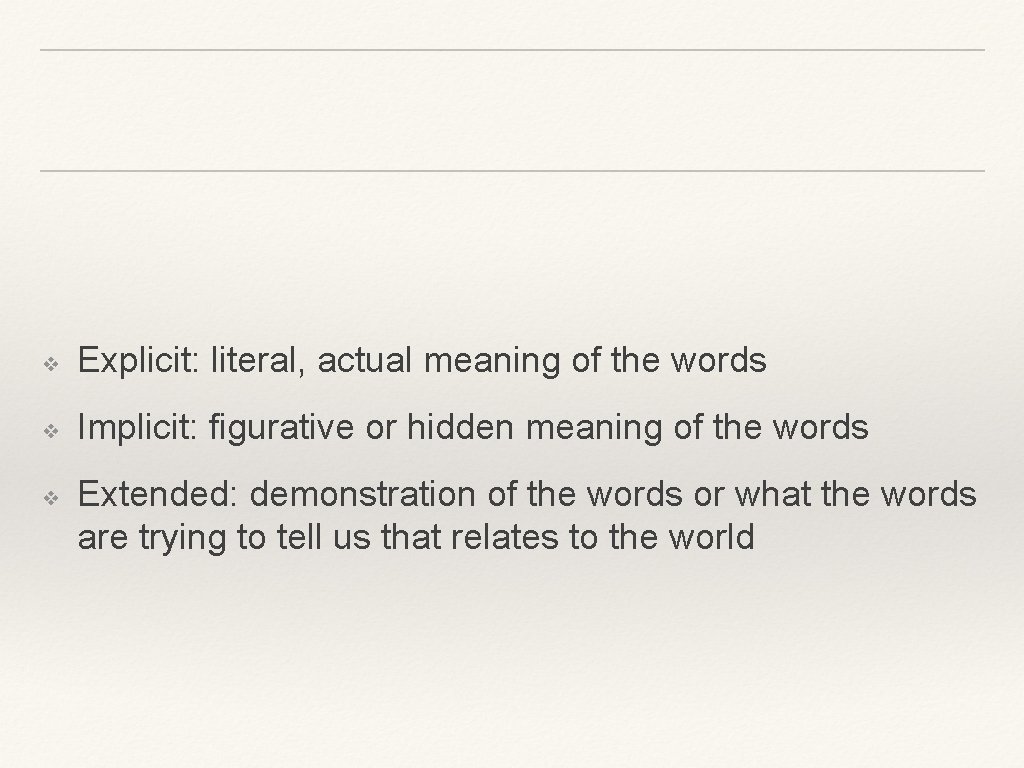
❖ Explicit: literal, actual meaning of the words ❖ Implicit: figurative or hidden meaning of the words ❖ Extended: demonstration of the words or what the words are trying to tell us that relates to the world
❖ ❖ ❖ Implicit, Explicit and Extended meanings inform each other to produce the meaning of a text Some texts favor one form of meaning over another. For example, a letter from the IRS would be mostly explicit, a poem would be more implicit, and the Declaration of Independence would be mostly extended. If you read the letter from the IRS too implicitly, then you may not realize that they are informing you that you owe money. If you read a poem in a literal way, you often will not be able to understand it or see its purpose. If you focus only on the explicit or implicit in the Declaration of Independence then you will miss the life changing purpose of this text. If we keep these layers of meaning in mind as we read, we can pull apart (close read) any text: movie scene, poem, fine print on a contract, argument essay, public policy statement, newspaper editorial etc.
❖ For example, the information in a novel is about a character facing a firing squad (the plot), and the writer uses short, quick sentences with dark symbolic imagery to provide an undercurrent of meaning (the pressure and fear the character feels) that leads the reader to an extended meaning (the violence and evil of capital punishment).
❖ Different disciplines use different terminology to refer to the three layers. Writers work hard to include three layers in the right balance. When we write a sociology field report for example, we present data (explicit), evaluate the data (implicit) and interpret what the data means or why it is important (extended). This is why close readers make better writers.
❖ Analyze three layers of meaning to each text line below. ❖ Rose is a rose. (Stein) ❖ A screaming comes across the sky. (Pynchon) ❖ It was a bright cold day in April, and the clocks were striking thirteen. (Orwell)
❖ Write a sample paragraph description of a river in three different ways. In the first, emphasize the explicit, in the second the implicit, and in the third the extended.
❖ literally: A is A ❖ things are what they are ❖ In Stein's view, the sentence expresses the fact that simply using the name of a thing already invokes the imagery and emotions associated with it.
Essay Tools Thesis
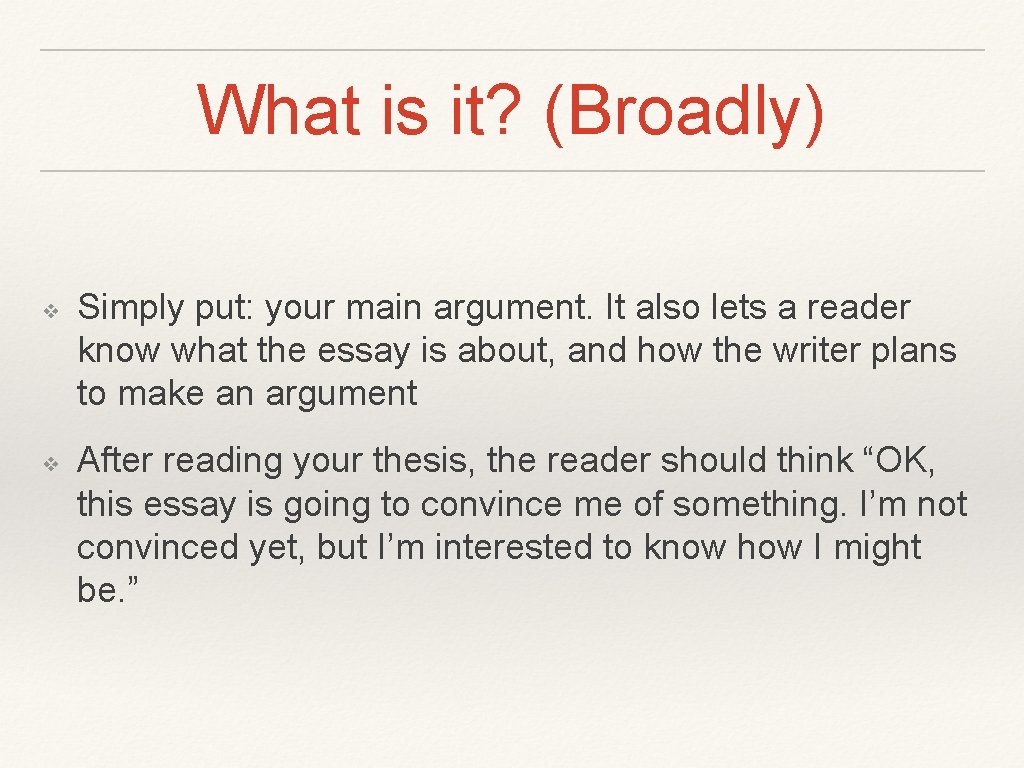
What is it? (Broadly) ❖ ❖ Simply put: your main argument. It also lets a reader know what the essay is about, and how the writer plans to make an argument After reading your thesis, the reader should think “OK, this essay is going to convince me of something. I’m not convinced yet, but I’m interested to know how I might be. ”
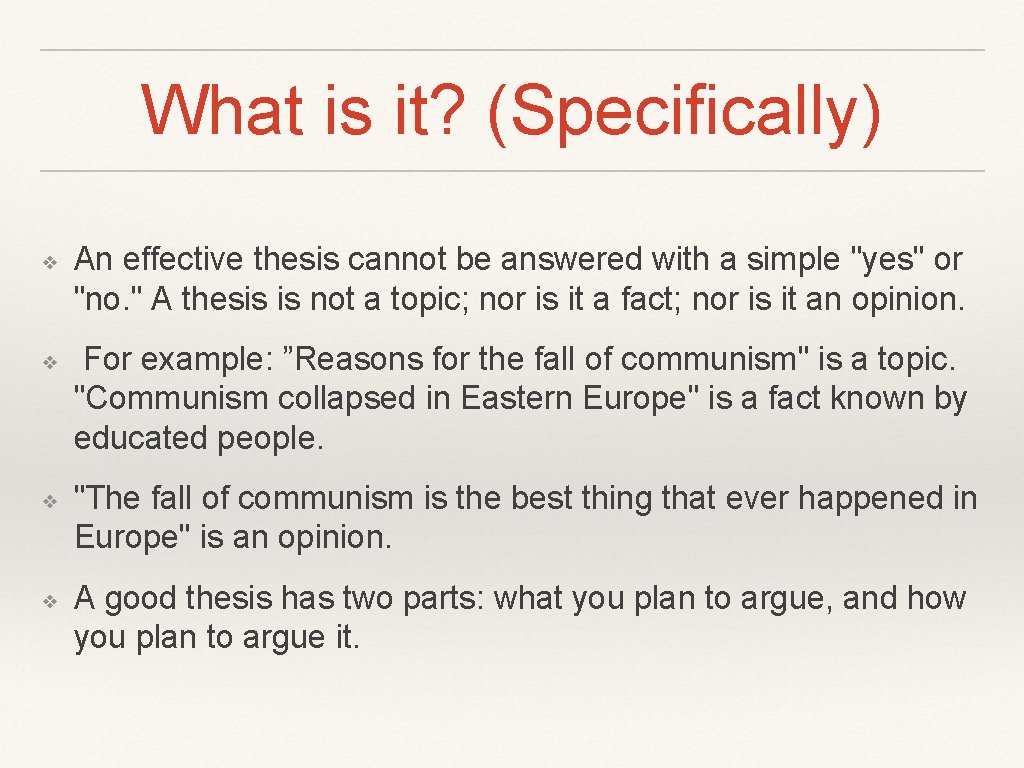
What is it? (Specifically) ❖ ❖ An effective thesis cannot be answered with a simple "yes" or "no. " A thesis is not a topic; nor is it a fact; nor is it an opinion. For example: ”Reasons for the fall of communism" is a topic. "Communism collapsed in Eastern Europe" is a fact known by educated people. "The fall of communism is the best thing that ever happened in Europe" is an opinion. A good thesis has two parts: what you plan to argue, and how you plan to argue it.
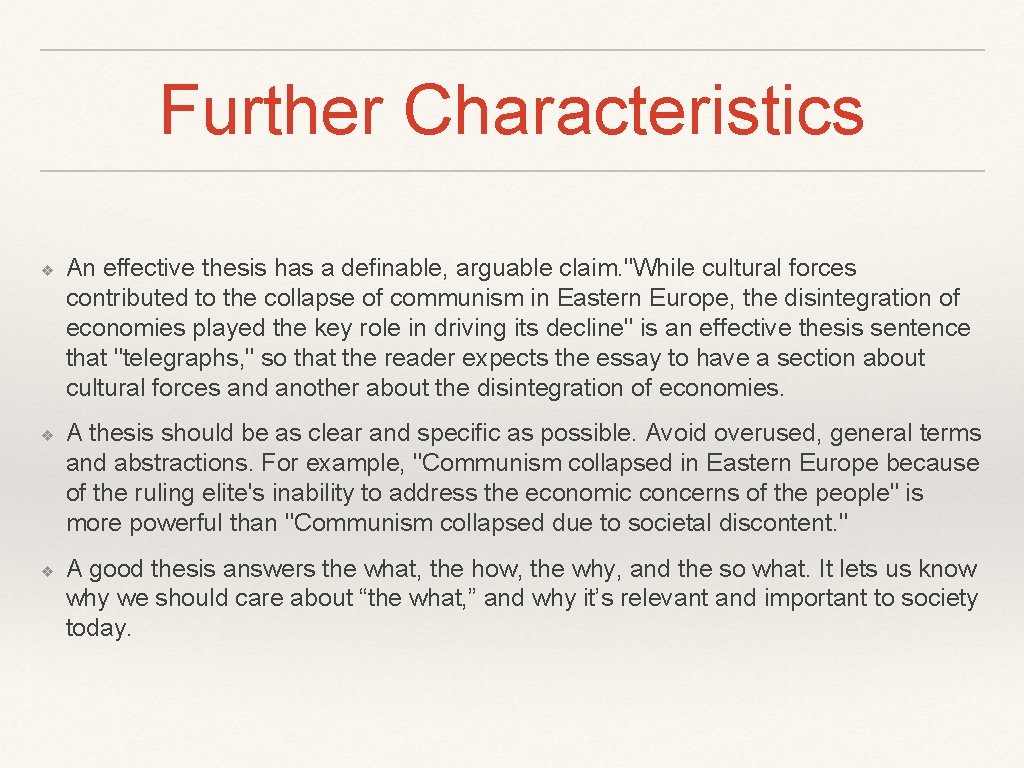
Further Characteristics ❖ ❖ ❖ An effective thesis has a definable, arguable claim. "While cultural forces contributed to the collapse of communism in Eastern Europe, the disintegration of economies played the key role in driving its decline" is an effective thesis sentence that "telegraphs, " so that the reader expects the essay to have a section about cultural forces and another about the disintegration of economies. A thesis should be as clear and specific as possible. Avoid overused, general terms and abstractions. For example, "Communism collapsed in Eastern Europe because of the ruling elite's inability to address the economic concerns of the people" is more powerful than "Communism collapsed due to societal discontent. " A good thesis answers the what, the how, the why, and the so what. It lets us know why we should care about “the what, ” and why it’s relevant and important to society today.
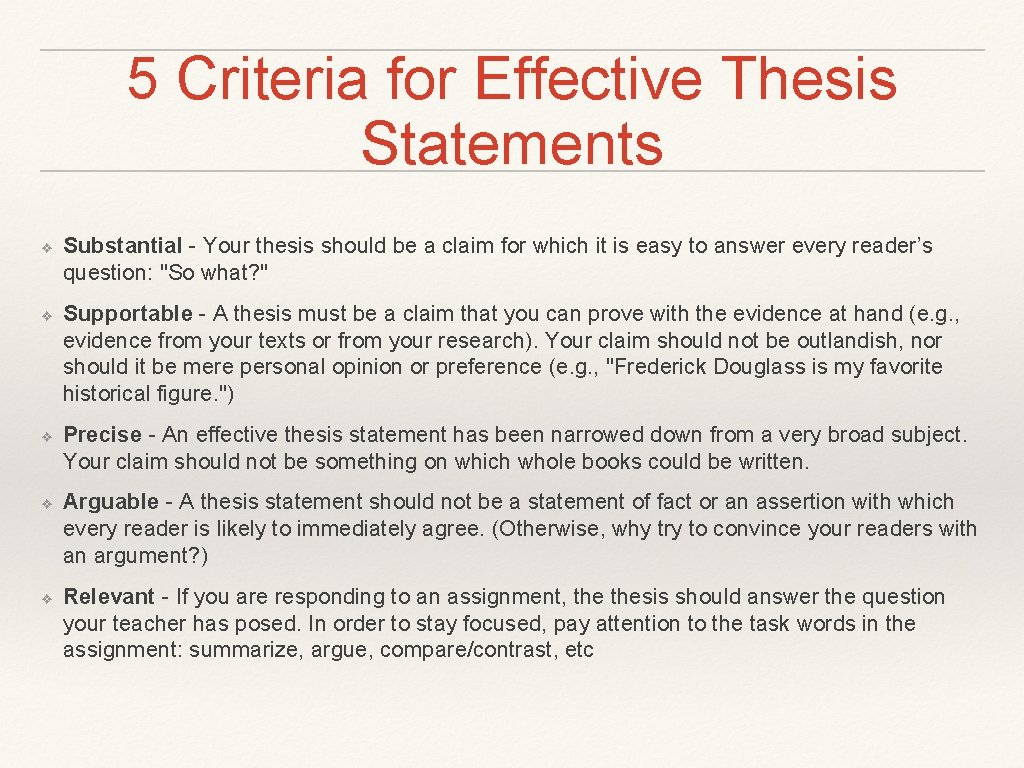
5 Criteria for Effective Thesis Statements ❖ ❖ ❖ Substantial - Your thesis should be a claim for which it is easy to answer every reader’s question: "So what? " Supportable - A thesis must be a claim that you can prove with the evidence at hand (e. g. , evidence from your texts or from your research). Your claim should not be outlandish, nor should it be mere personal opinion or preference (e. g. , "Frederick Douglass is my favorite historical figure. ") Precise - An effective thesis statement has been narrowed down from a very broad subject. Your claim should not be something on which whole books could be written. Arguable - A thesis statement should not be a statement of fact or an assertion with which every reader is likely to immediately agree. (Otherwise, why try to convince your readers with an argument? ) Relevant - If you are responding to an assignment, thesis should answer the question your teacher has posed. In order to stay focused, pay attention to the task words in the assignment: summarize, argue, compare/contrast, etc
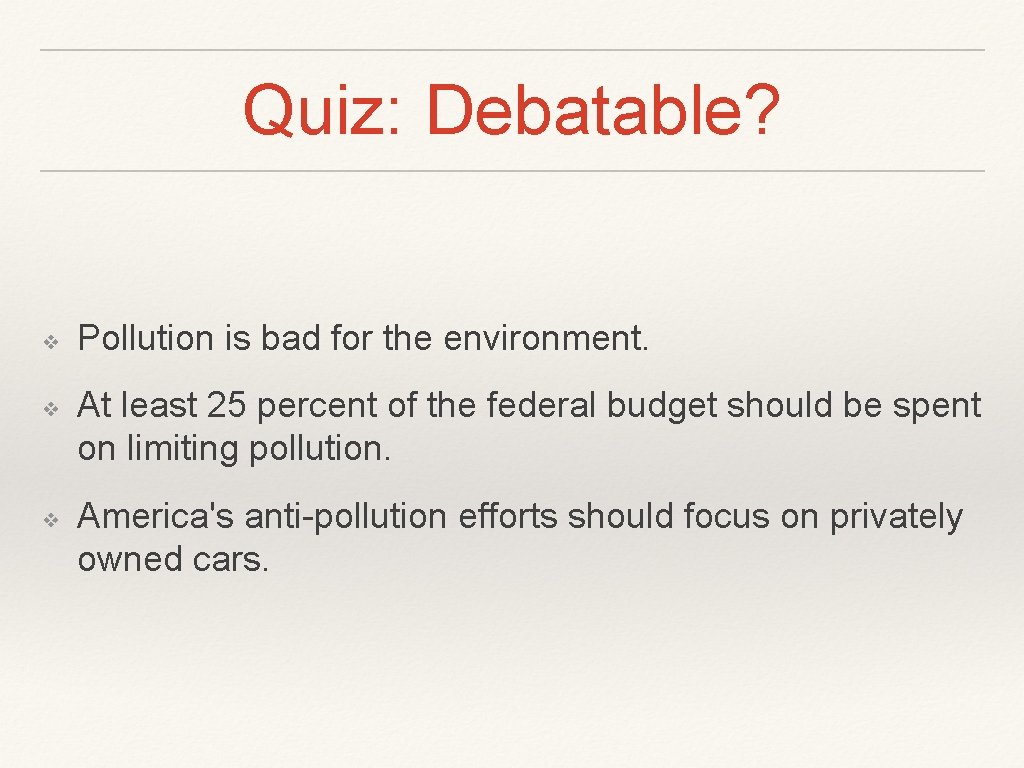
Quiz: Debatable? ❖ ❖ ❖ Pollution is bad for the environment. At least 25 percent of the federal budget should be spent on limiting pollution. America's anti-pollution efforts should focus on privately owned cars.
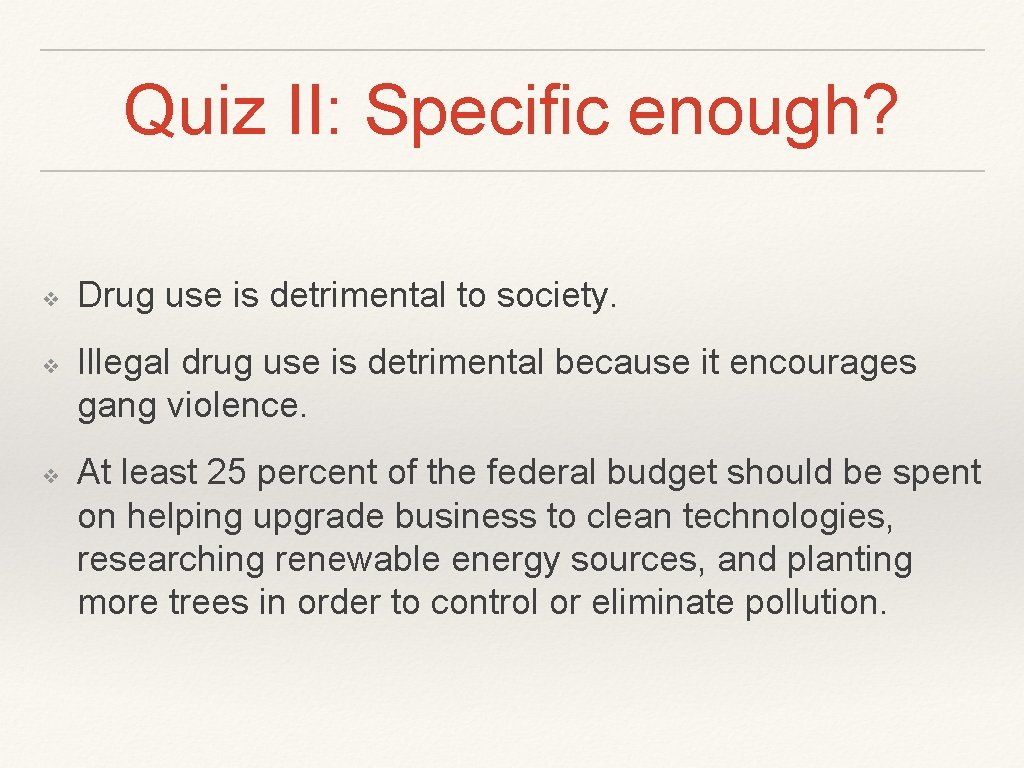
Quiz II: Specific enough? ❖ ❖ ❖ Drug use is detrimental to society. Illegal drug use is detrimental because it encourages gang violence. At least 25 percent of the federal budget should be spent on helping upgrade business to clean technologies, researching renewable energy sources, and planting more trees in order to control or eliminate pollution.
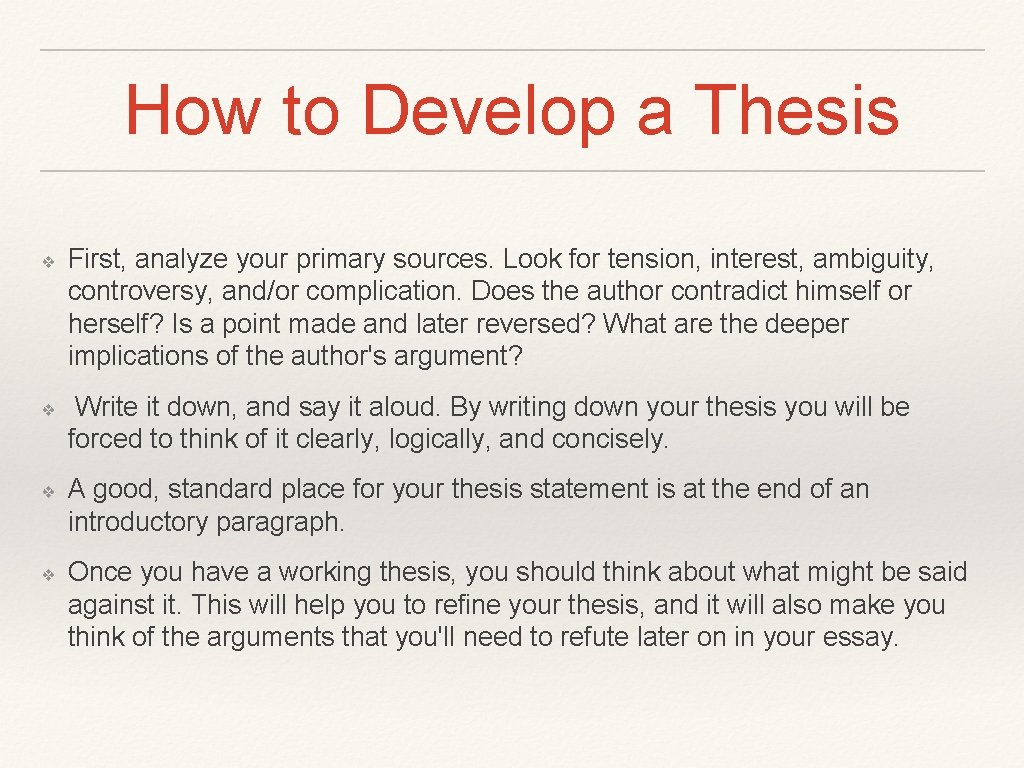
How to Develop a Thesis ❖ ❖ First, analyze your primary sources. Look for tension, interest, ambiguity, controversy, and/or complication. Does the author contradict himself or herself? Is a point made and later reversed? What are the deeper implications of the author's argument? Write it down, and say it aloud. By writing down your thesis you will be forced to think of it clearly, logically, and concisely. A good, standard place for your thesis statement is at the end of an introductory paragraph. Once you have a working thesis, you should think about what might be said against it. This will help you to refine your thesis, and it will also make you think of the arguments that you'll need to refute later on in your essay.