
ON ADVANCES IN THEORY OF SEISMIC WAVE PROPAGATION


- Slides: 35
ON ADVANCES IN THEORY OF SEISMIC WAVE PROPAGATION IN LAYERED VISCOELASTIC MEDIA Roger D. Borcherdt U. S. Geological Survey Menlo Park, CA borcherdt@usgs. gov Workshop Active and Passive Seismics in Laterally Inhomogeneous Media Loučeň Castle, Czech Republic June 8 -12, 2015
Outline Linearof. Superposition § Brief • History Advances in theprinciple Theory of Viscoelastic Seismic Wave Propagation (Boltzmann 1874) 1 § Discuss New Characteristics of Seismic Waves Implied by Theoretical Solutions for Anelastic Media not Implied by Elasticity Theory § Discuss Implications of these Advances for Seismology and Exploration Geophysics
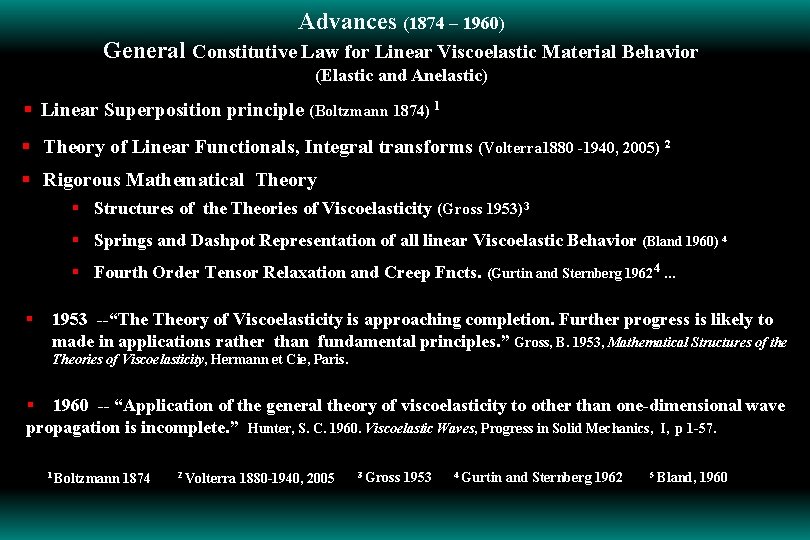
Advances (1874 – 1960) General Constitutive Law for Linear Viscoelastic Material Behavior (Elastic and Anelastic) § Linear Superposition principle (Boltzmann 1874) 1 • Linear Superposition principle 1874) 1 Integral transforms (Volterra 1880 -1940, 2005) 2 § Theory(Boltzmann of Linear Functionals, § Rigorous Mathematical Theory § Structures of the Theories of Viscoelasticity (Gross 1953)3 § Springs and Dashpot Representation of all linear Viscoelastic Behavior (Bland 1960) 4 § Fourth Order Tensor Relaxation and Creep Fncts. (Gurtin and Sternberg 19624 … § 1953 --“The Theory of Viscoelasticity is approaching completion. Further progress is likely to made in applications rather than fundamental principles. ” Gross, B. 1953, Mathematical Structures of the Theories of Viscoelasticity, Hermann et Cie, Paris. § 1960 -- “Application of the general theory of viscoelasticity to other than one-dimensional wave propagation is incomplete. ” Hunter, S. C. 1960. Viscoelastic Waves, Progress in Solid Mechanics, I, p 1 -57. 1 Boltzmann 1874 2 Volterra 1880 -1940, 2005 3 Gross 1953 4 Gurtin and Sternberg 1962 5 Bland, 1960
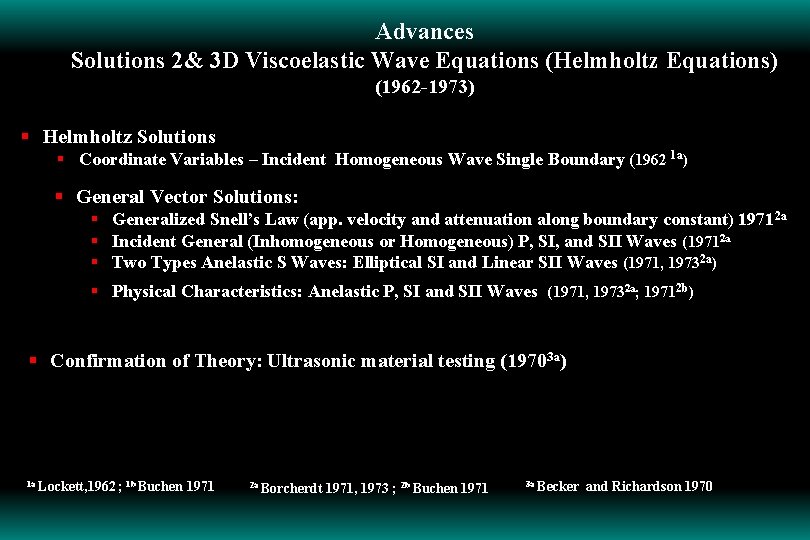
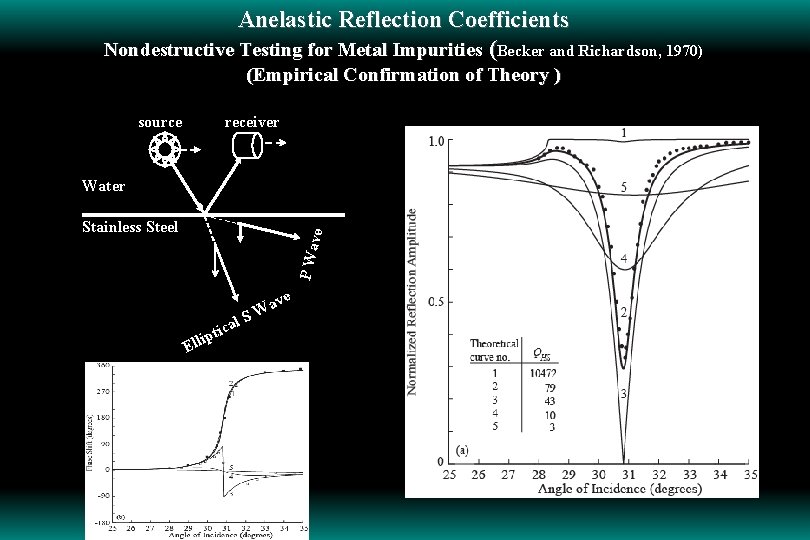
Advances Solutions 2& 3 D Viscoelastic Wave Equations (Helmholtz Equations) (1962 -1973) § Helmholtz Solutions § Coordinate Variables – Incident Homogeneous Wave Single Boundary (1962 1 a) § General Vector Solutions: § Generalized Snell’s Law (app. velocity and attenuation along boundary constant) 19712 a § Incident General (Inhomogeneous or Homogeneous) P, SI, and SII Waves (19712 a § Two Types Anelastic S Waves: Elliptical SI and Linear SII Waves (1971, 19732 a) § Physical Characteristics: Anelastic P, SI and SII Waves (1971, 19732 a; 19712 b) § Confirmation of Theory: Ultrasonic material testing (19703 a) 1 a Lockett, 1962 ; 1 b Buchen 1971 2 a Borcherdt 1971, 1973 ; 2 b Buchen 1971 3 a Becker and Richardson 1970
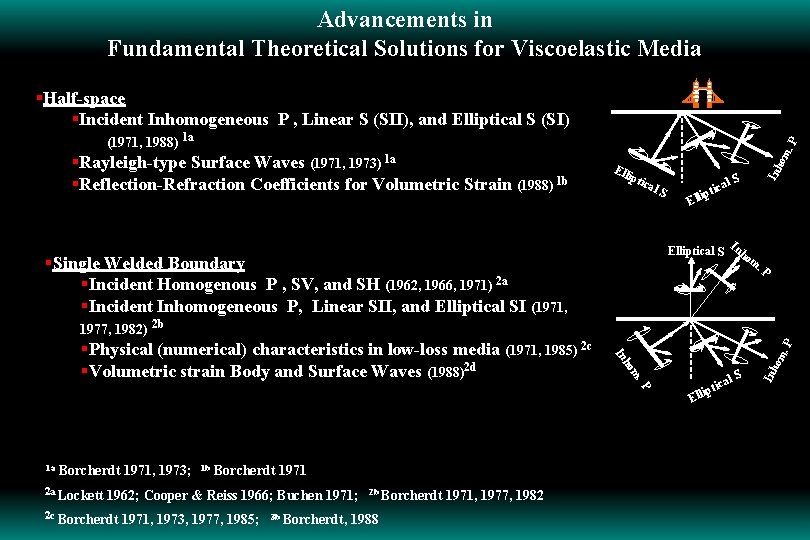
Advancements in Fundamental Theoretical Solutions for Viscoelastic Media §Half-space §Incident Inhomogeneous P , Linear S (SII), and Elliptical S (SI) §Rayleigh-type Surface Waves (1971, 1973) 1 a §Reflection-Refraction Coefficients for Volumetric Strain (1988) 1 b Ell ip tica l. S S cal i t ip Ell I Elliptical S nho m §Single Welded Boundary §Incident Homogenous P , SV, and SH (1962, 1966, 1971) 2 a §Incident Inhomogeneous P, Linear SII, and Elliptical SI (1971, Inh om . P (1971, 1988) 1 a . P 2 a Lockett 1 b Borcherdt 1971 1962; Cooper & Reiss 1966; Buchen 1971; 2 c Borcherdt 1971, 1973, 1977, 1985; 3 b Borcherdt, 2 b Borcherdt 1988 1971, 1977, 1982 om S cal E ti llip Inh . P Borcherdt 1971, 1973; m ho 1 a In §Physical (numerical) characteristics in low-loss media (1971, 1985) 2 c §Volumetric strain Body and Surface Waves (1988)2 d . P 1977, 1982) 2 b
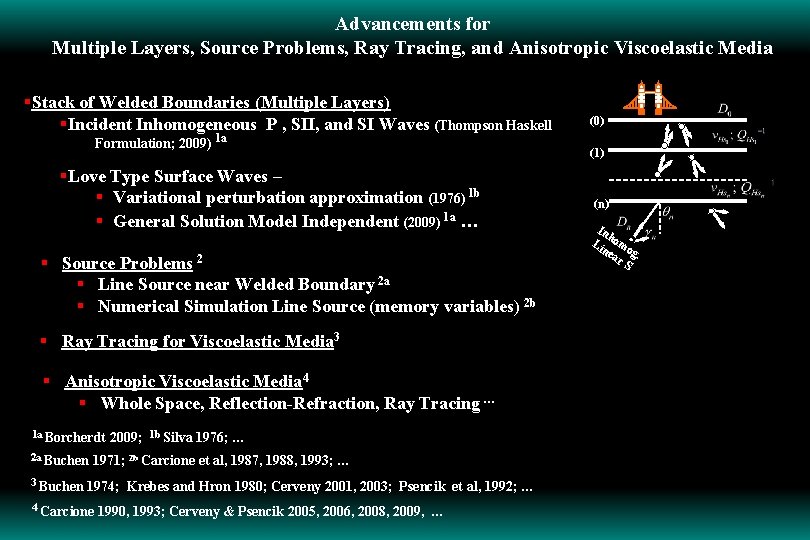
Advancements for Multiple Layers, Source Problems, Ray Tracing, and Anisotropic Viscoelastic Media §Stack of Welded Boundaries (Multiple Layers) §Incident Inhomogeneous P , SII, and SI Waves (Thompson Haskell Formulation; 2009) 1 a §Love Type Surface Waves – § Variational perturbation approximation (1976) 1 b § General Solution Model Independent (2009) 1 a … § Source Problems 2 § Line Source near Welded Boundary 2 a § Numerical Simulation Line Source (memory variables) 2 b § Ray Tracing for Viscoelastic Media 3 § Anisotropic Viscoelastic Media 4 § Whole Space, Reflection-Refraction, Ray Tracing … 1 a Borcherdt 2 a Buchen 3 Buchen 2009; 1 b Silva 1976; … 1971; 2 b Carcione et al, 1987, 1988, 1993; … 1974; Krebes and Hron 1980; Cerveny 2001, 2003; Psencik et al, 1992; … 4 Carcione 1990, 1993; Cerveny & Psencik 2005, 2006, 2008, 2009, … (0) (1) (n) In h Li omo ne ar g. S
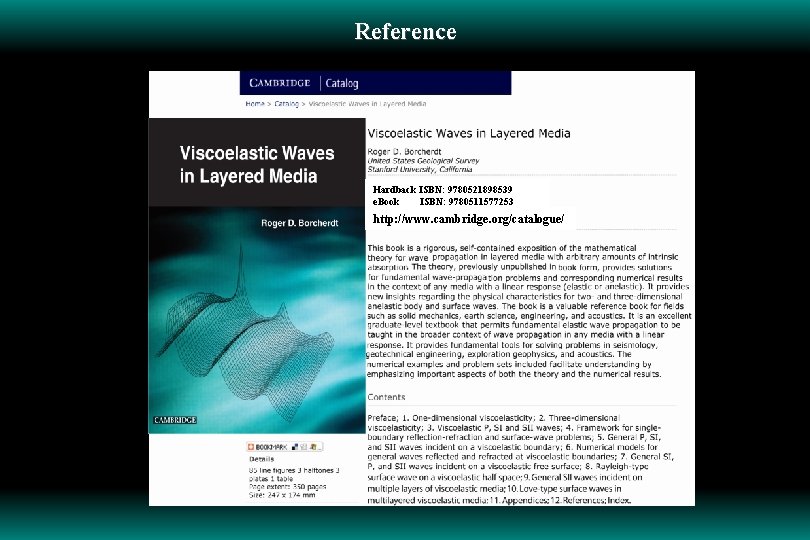
Reference Hardback ISBN: 9780521898539 e. Book ISBN: 9780511577253 http: //www. cambridge. org/catalogue/
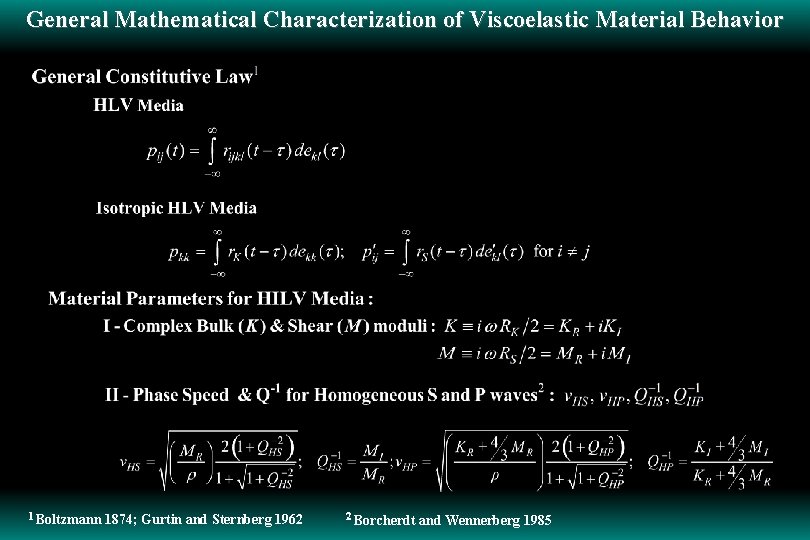
General Mathematical Characterization of Viscoelastic Material Behavior 1 Boltzmann 1874; Gurtin and Sternberg 1962 2 Borcherdt and Wennerberg 1985
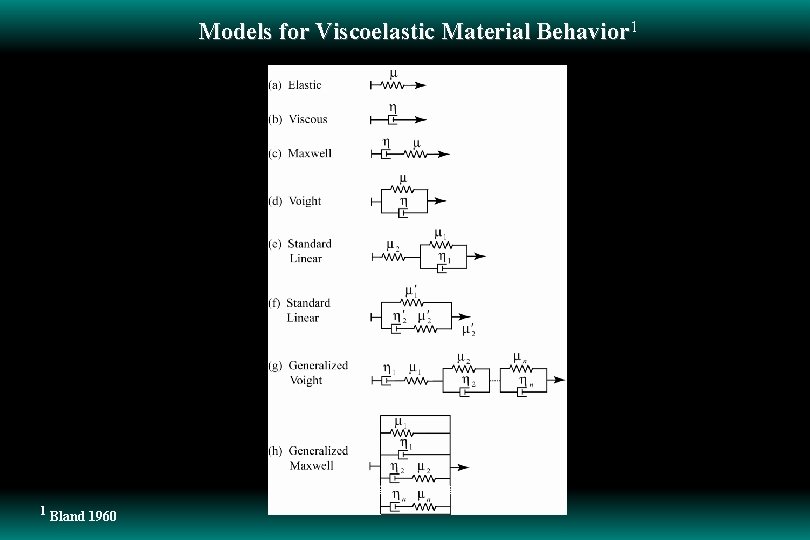
Models for Viscoelastic Material Behavior 1 1 Bland 1960
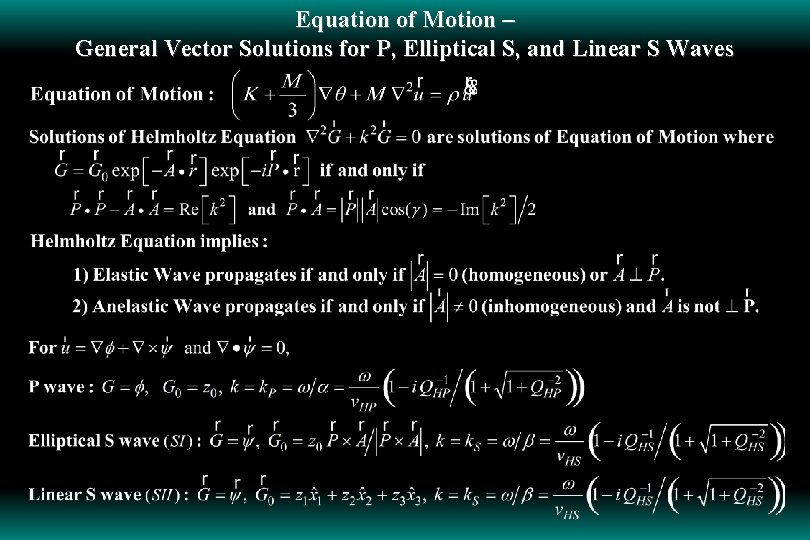
Equation of Motion – General Vector Solutions for P, Elliptical S, and Linear S Waves
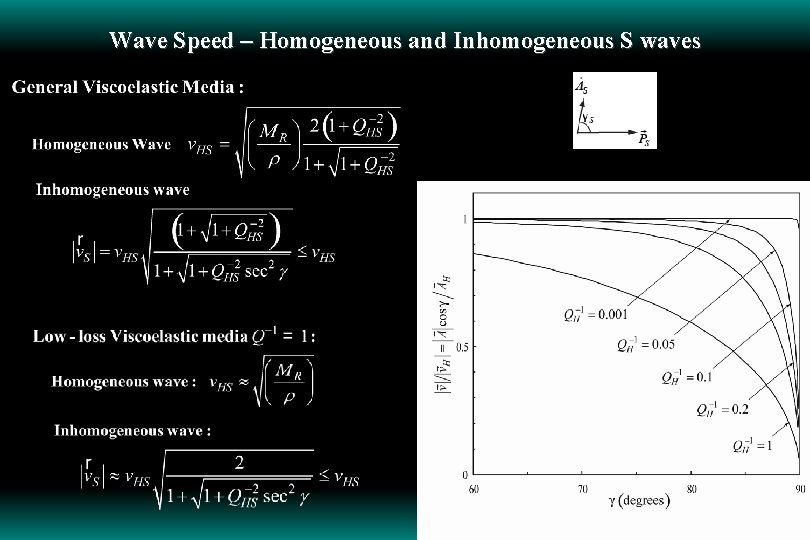
Wave Speed – Homogeneous and Inhomogeneous S waves
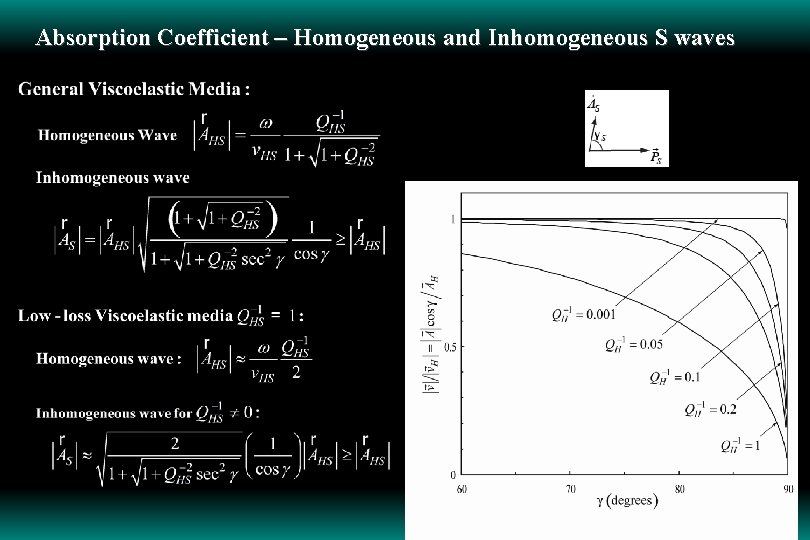
Absorption Coefficient – Homogeneous and Inhomogeneous S waves
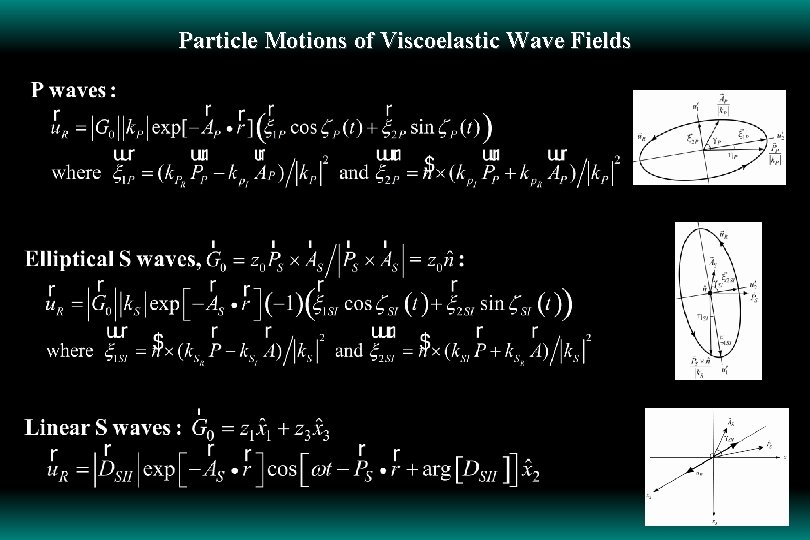
Particle Motions of Viscoelastic Wave Fields
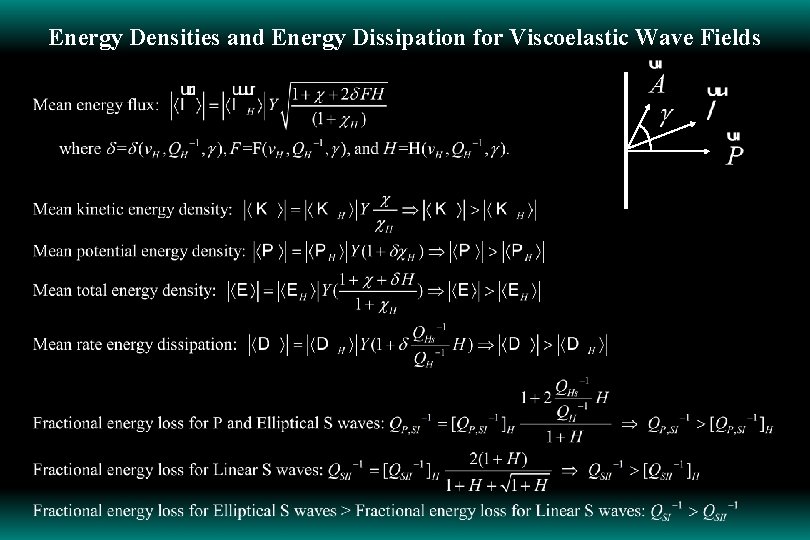
Energy Densities and Energy Dissipation for Viscoelastic Wave Fields
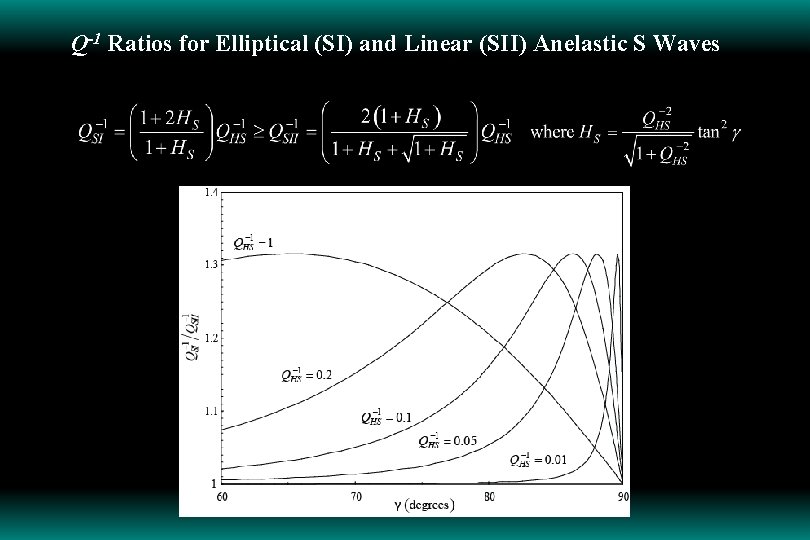
Q-1 Ratios for Elliptical (SI) and Linear (SII) Anelastic S Waves
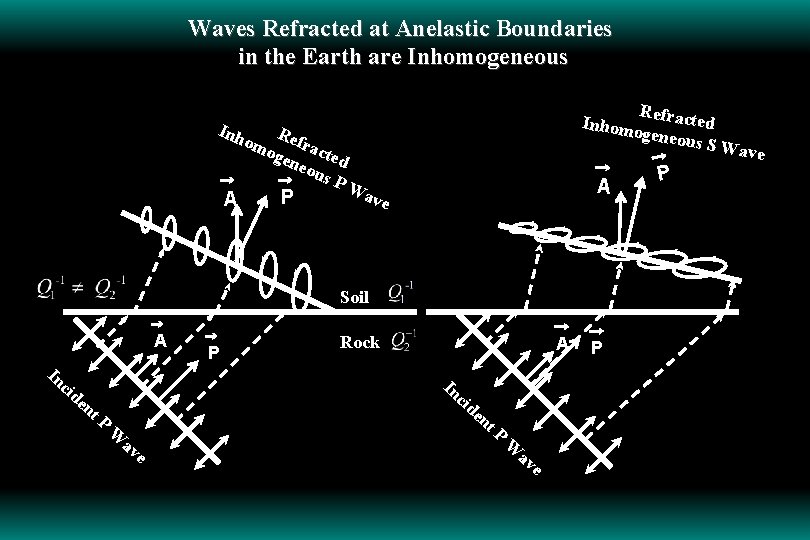
Waves Refracted at Anelastic Boundaries in the Earth are Inhomogeneous Inh om Refra c oge neo ted us P W A P Re Inhomo fracted geneou s S Wa ve A ave Soil A In cid en P Rock A In t. P cid en W av e t. P W av e P P
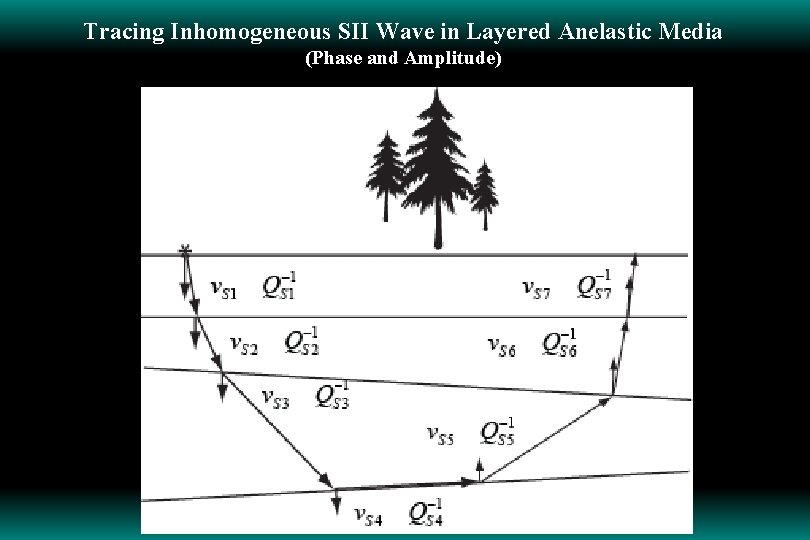
Tracing Inhomogeneous SII Wave in Layered Anelastic Media (Phase and Amplitude)
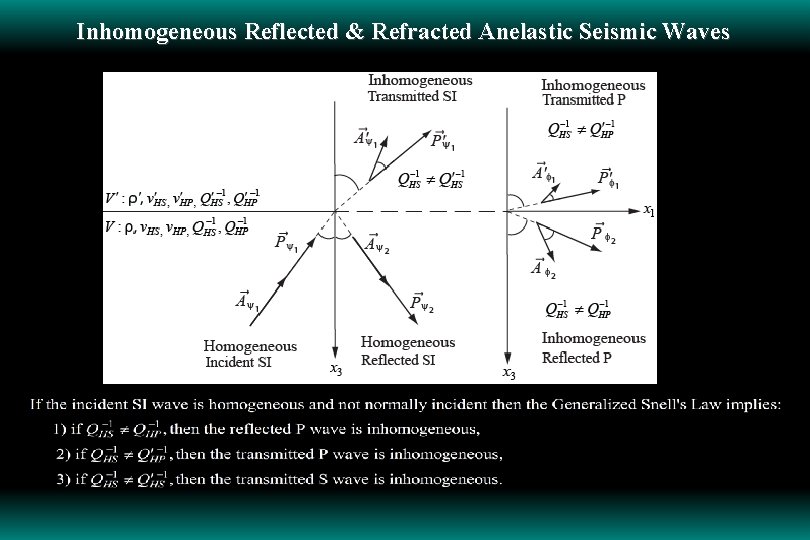
Inhomogeneous Reflected & Refracted Anelastic Seismic Waves
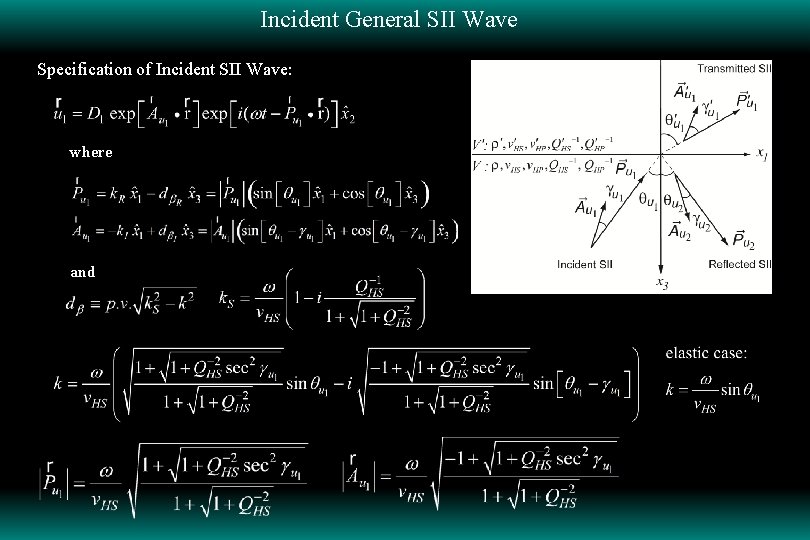
Incident General SII Wave Specification of Incident SII Wave: where and
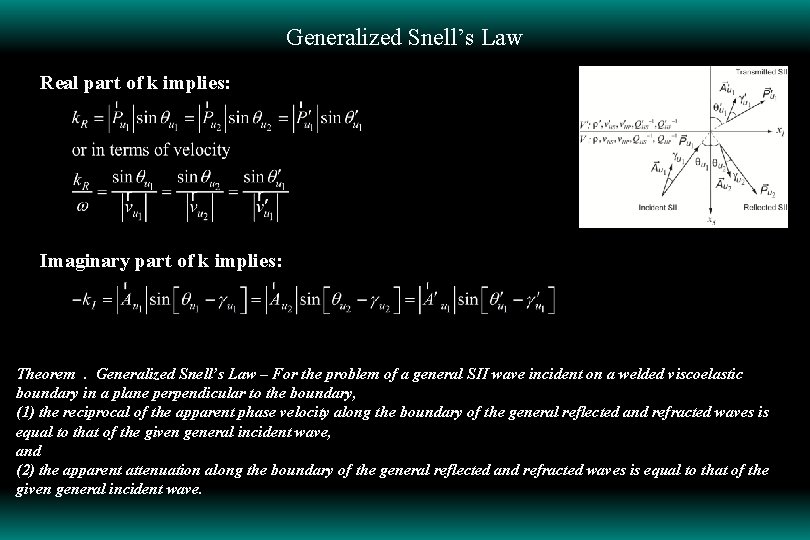
Generalized Snell’s Law Real part of k implies: Imaginary part of k implies: Theorem. Generalized Snell’s Law – For the problem of a general SII wave incident on a welded viscoelastic boundary in a plane perpendicular to the boundary, (1) the reciprocal of the apparent phase velocity along the boundary of the general reflected and refracted waves is equal to that of the given general incident wave, and (2) the apparent attenuation along the boundary of the general reflected and refracted waves is equal to that of the given general incident wave.
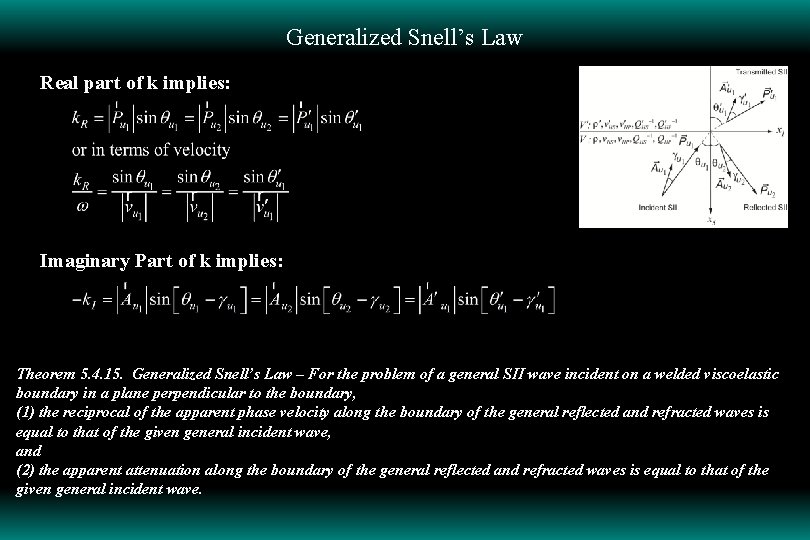
Generalized Snell’s Law Real part of k implies: Imaginary Part of k implies: Theorem 5. 4. 15. Generalized Snell’s Law – For the problem of a general SII wave incident on a welded viscoelastic boundary in a plane perpendicular to the boundary, (1) the reciprocal of the apparent phase velocity along the boundary of the general reflected and refracted waves is equal to that of the given general incident wave, and (2) the apparent attenuation along the boundary of the general reflected and refracted waves is equal to that of the given general incident wave.
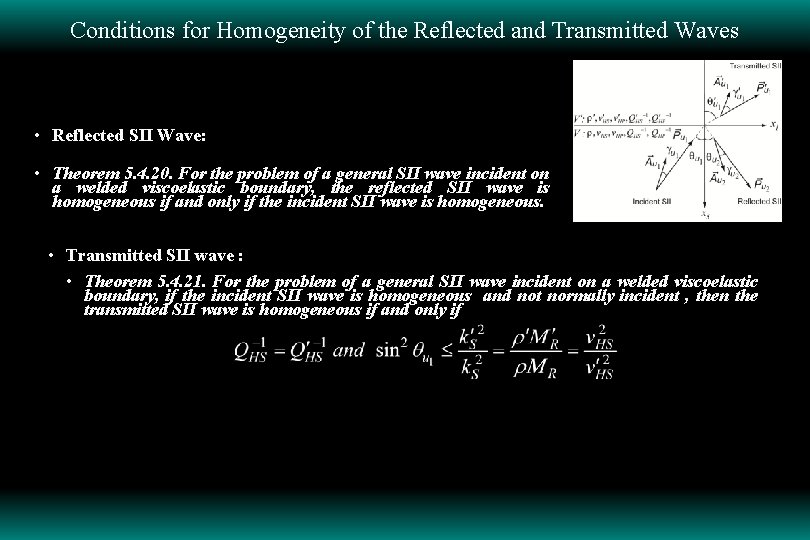
Conditions for Homogeneity of the Reflected and Transmitted Waves • Reflected SII Wave: • Theorem 5. 4. 20. For the problem of a general SII wave incident on a welded viscoelastic boundary, the reflected SII wave is homogeneous if and only if the incident SII wave is homogeneous. • Transmitted SII wave : • Theorem 5. 4. 21. For the problem of a general SII wave incident on a welded viscoelastic boundary, if the incident SII wave is homogeneous and not normally incident , then the transmitted SII wave is homogeneous if and only if
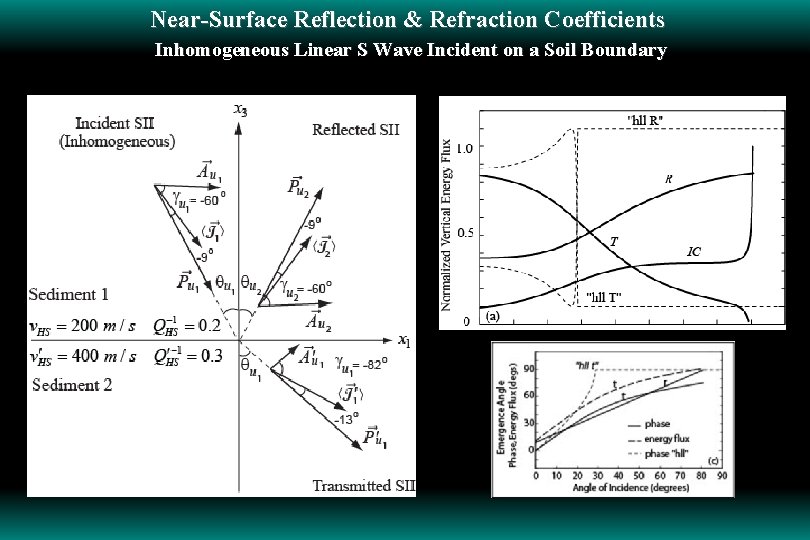
Near-Surface Reflection & Refraction Coefficients Inhomogeneous Linear S Wave Incident on a Soil Boundary
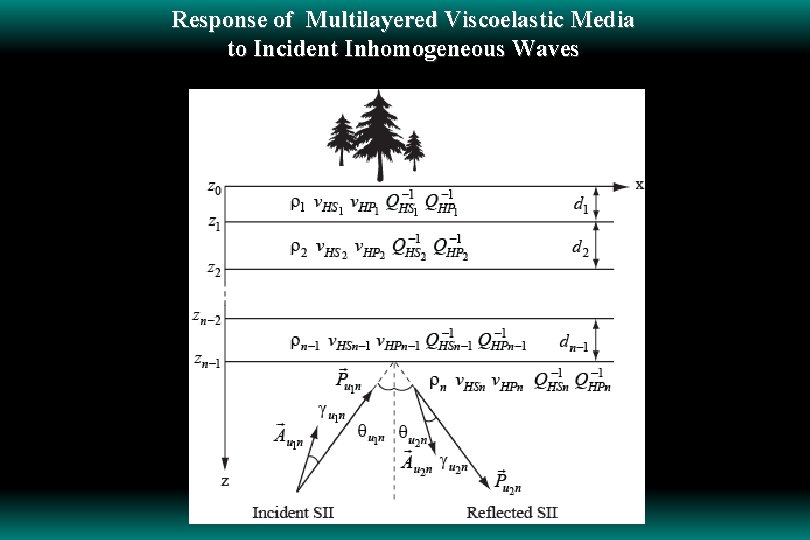
Response of Multilayered Viscoelastic Media to Incident Inhomogeneous Waves
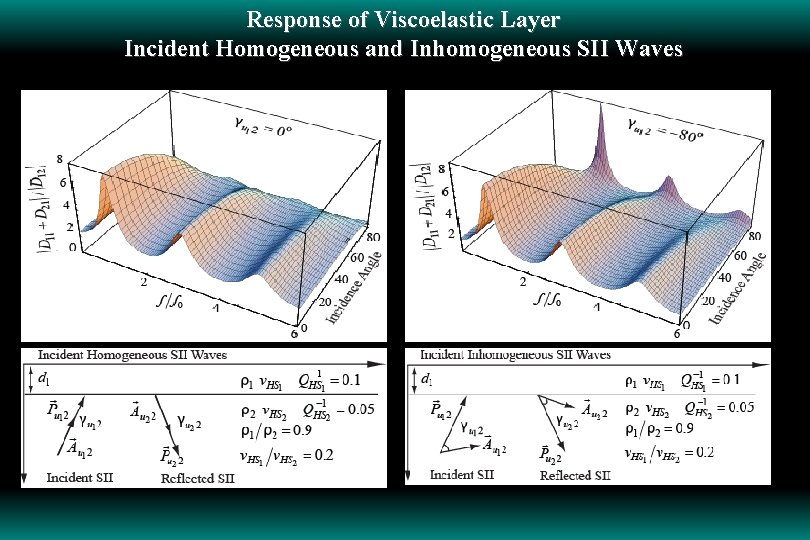
Response of Viscoelastic Layer Incident Homogeneous and Inhomogeneous SII Waves
Anelastic Reflection Coefficients Nondestructive Testing for Metal Impurities (Becker and Richardson, 1970) (Empirical Confirmation of Theory ) source receiver Water P Wa ve Stainless Steel Ell ica ipt l. S ve a W
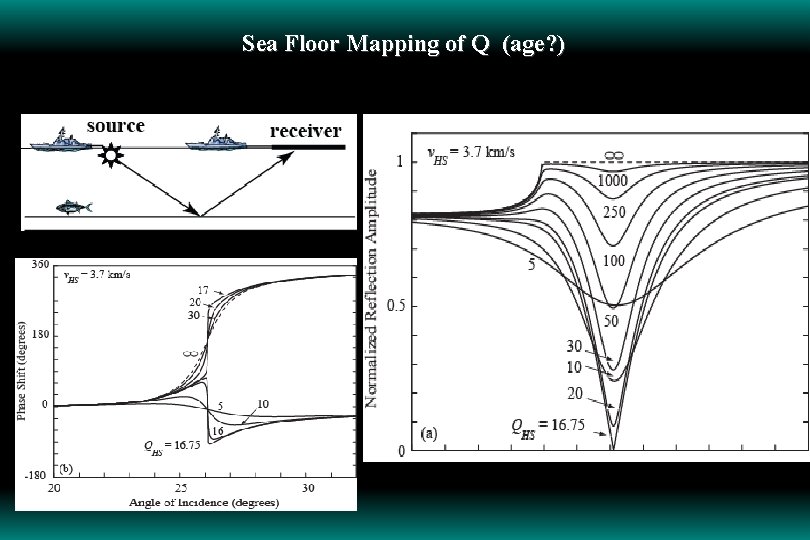
Sea Floor Mapping of Q (age? )
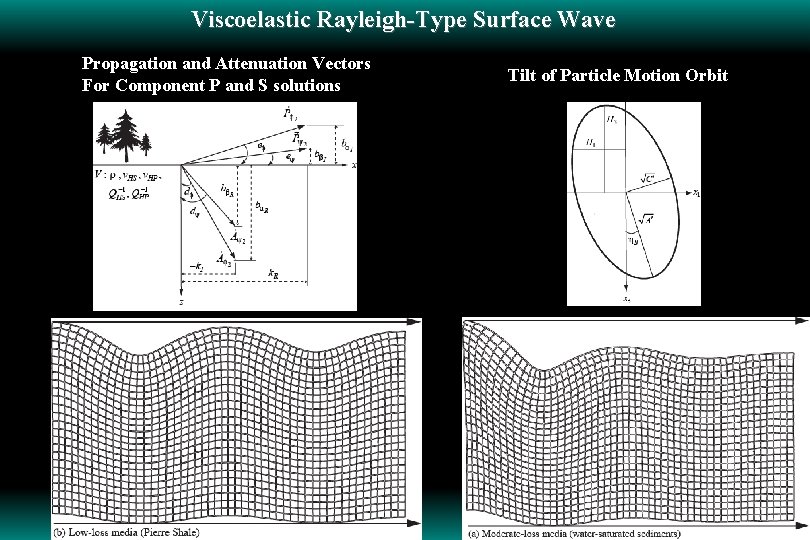
Viscoelastic Rayleigh-Type Surface Wave Propagation and Attenuation Vectors For Component P and S solutions Tilt of Particle Motion Orbit
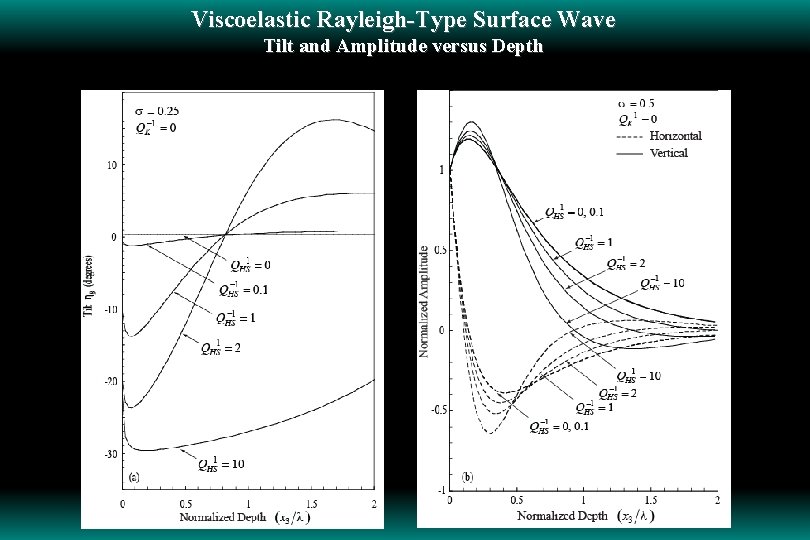
Viscoelastic Rayleigh-Type Surface Wave Tilt and Amplitude versus Depth
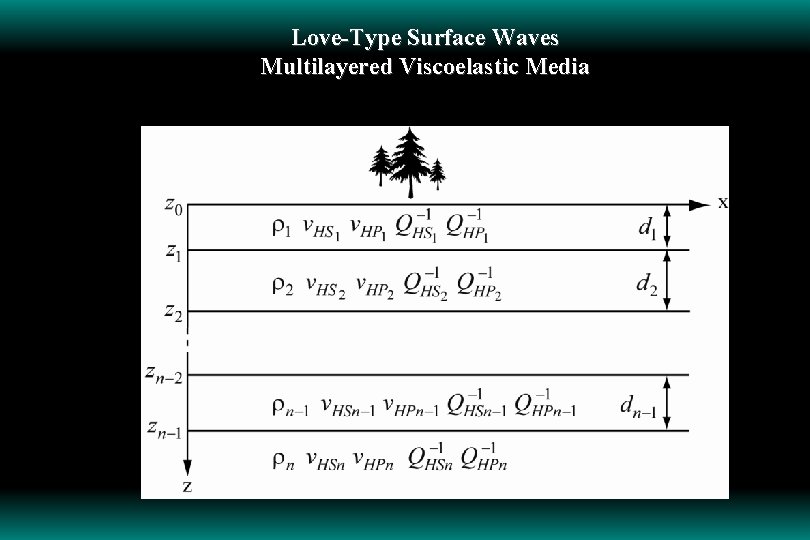
Love-Type Surface Waves Multilayered Viscoelastic Media
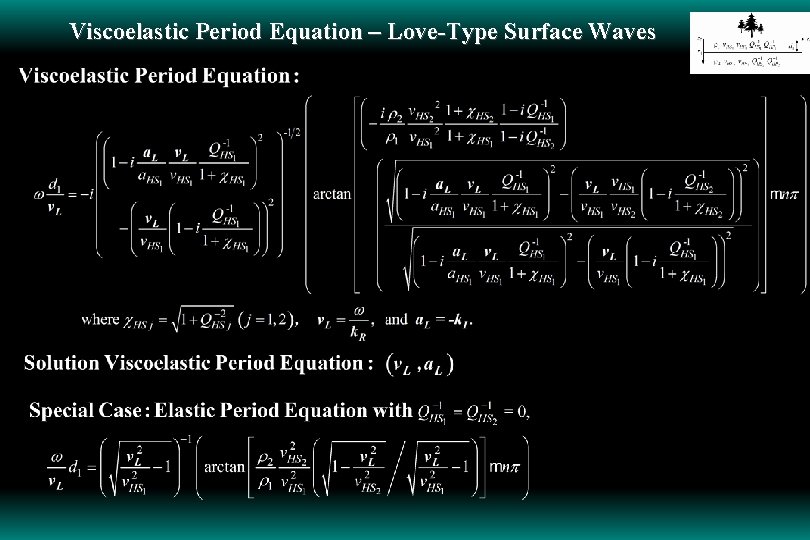
Viscoelastic Period Equation – Love-Type Surface Waves
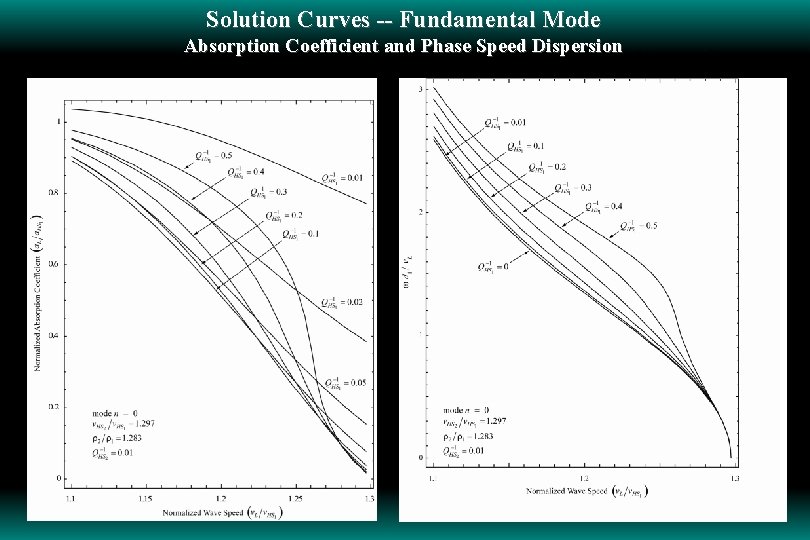
Solution Curves -- Fundamental Mode Absorption Coefficient and Phase Speed Dispersion
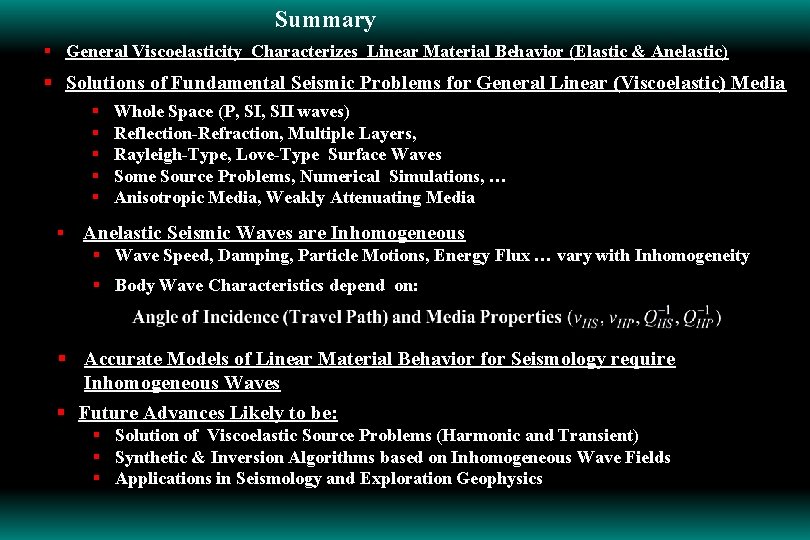
Summary § General Viscoelasticity Characterizes Linear Material Behavior (Elastic & Anelastic) § Solutions of Fundamental Seismic Problems for General Linear (Viscoelastic) Media § § § Whole Space (P, SII waves) Reflection-Refraction, Multiple Layers, Rayleigh-Type, Love-Type Surface Waves Some Source Problems, Numerical Simulations, … Anisotropic Media, Weakly Attenuating Media Anelastic Seismic Waves are Inhomogeneous § Wave Speed, Damping, Particle Motions, Energy Flux … vary with Inhomogeneity § Body Wave Characteristics depend on: § Accurate Models of Linear Material Behavior for Seismology require Inhomogeneous Waves § Future Advances Likely to be: § Solution of Viscoelastic Source Problems (Harmonic and Transient) § Synthetic & Inversion Algorithms based on Inhomogeneous Wave Fields § Applications in Seismology and Exploration Geophysics
Thank You
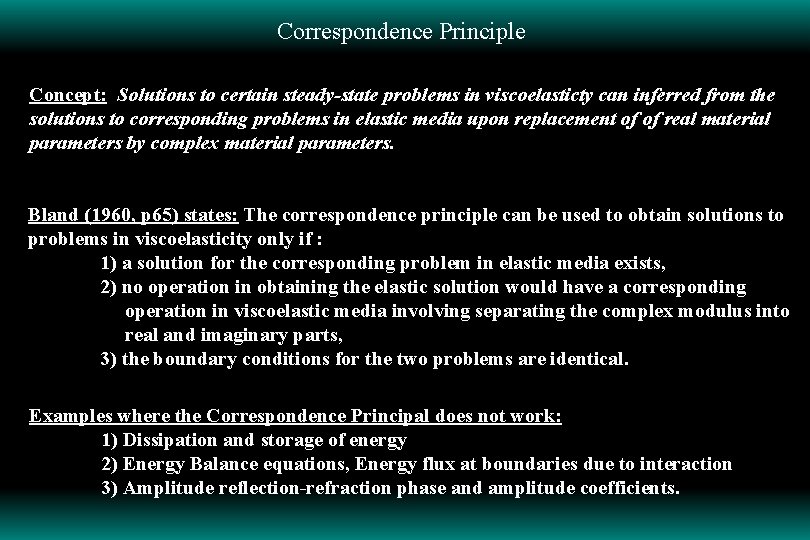
Correspondence Principle Concept: Solutions to certain steady-state problems in viscoelasticty can inferred from the solutions to corresponding problems in elastic media upon replacement of of real material parameters by complex material parameters. Bland (1960, p 65) states: The correspondence principle can be used to obtain solutions to problems in viscoelasticity only if : 1) a solution for the corresponding problem in elastic media exists, 2) no operation in obtaining the elastic solution would have a corresponding operation in viscoelastic media involving separating the complex modulus into real and imaginary parts, 3) the boundary conditions for the two problems are identical. Examples where the Correspondence Principal does not work: 1) Dissipation and storage of energy 2) Energy Balance equations, Energy flux at boundaries due to interaction 3) Amplitude reflection-refraction phase and amplitude coefficients.