
On a common preamble between WiFi and NRU
On a common preamble between Wi-Fi and NR-U IEEE Coexistence Workshop, July 2019 Proprietary and Confidential. © 2018 Broadcom Inc. All rights reserved. 1
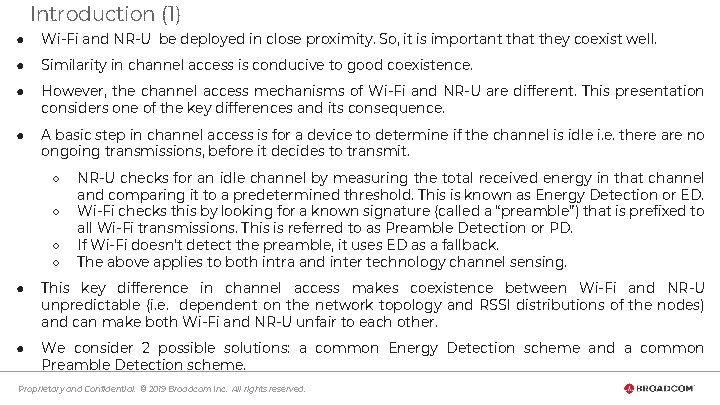
Introduction (1) ● Wi-Fi and NR-U be deployed in close proximity. So, it is important that they coexist well. ● Similarity in channel access is conducive to good coexistence. ● However, the channel access mechanisms of Wi-Fi and NR-U are different. This presentation considers one of the key differences and its consequence. ● A basic step in channel access is for a device to determine if the channel is idle i. e. there are no ongoing transmissions, before it decides to transmit. ○ ○ NR-U checks for an idle channel by measuring the total received energy in that channel and comparing it to a predetermined threshold. This is known as Energy Detection or ED. Wi-Fi checks this by looking for a known signature (called a “preamble”) that is prefixed to all Wi-Fi transmissions. This is referred to as Preamble Detection or PD. If Wi-Fi doesn’t detect the preamble, it uses ED as a fallback. The above applies to both intra and inter technology channel sensing. ● This key difference in channel access makes coexistence between Wi-Fi and NR-U unpredictable (i. e. dependent on the network topology and RSSI distributions of the nodes) and can make both Wi-Fi and NR-U unfair to each other. ● We consider 2 possible solutions: a common Energy Detection scheme and a common Preamble Detection scheme. Proprietary and Confidential. © 2019 Broadcom Inc. All rights reserved.
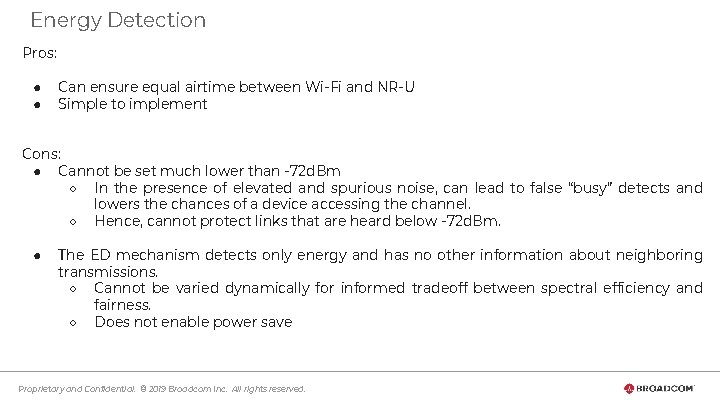
Energy Detection Pros: ● ● Can ensure equal airtime between Wi-Fi and NR-U Simple to implement Cons: ● Cannot be set much lower than -72 d. Bm ○ In the presence of elevated and spurious noise, can lead to false “busy” detects and lowers the chances of a device accessing the channel. ○ Hence, cannot protect links that are heard below -72 d. Bm. ● The ED mechanism detects only energy and has no other information about neighboring transmissions. ○ Cannot be varied dynamically for informed tradeoff between spectral efficiency and fairness. ○ Does not enable power save Proprietary and Confidential. © 2019 Broadcom Inc. All rights reserved.
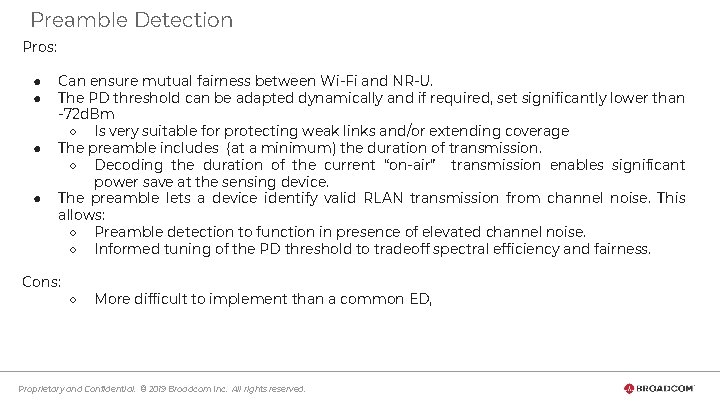
Preamble Detection Pros: ● ● Can ensure mutual fairness between Wi-Fi and NR-U. The PD threshold can be adapted dynamically and if required, set significantly lower than -72 d. Bm ○ Is very suitable for protecting weak links and/or extending coverage The preamble includes (at a minimum) the duration of transmission. ○ Decoding the duration of the current “on-air” transmission enables significant power save at the sensing device. The preamble lets a device identify valid RLAN transmission from channel noise. This allows: ○ Preamble detection to function in presence of elevated channel noise. ○ Informed tuning of the PD threshold to tradeoff spectral efficiency and fairness. Cons: ○ More difficult to implement than a common ED, Proprietary and Confidential. © 2019 Broadcom Inc. All rights reserved.
Common Detection Mechanism and Thresholds Based on the previous discussion, the following can be inferred: ● Fair coexistence between Wi-Fi and NR-U requires either a common ED or a common PD. ● A common ED is simpler to implement than a common PD. ● A common PD has significant performance advantages over a common ED. Given the above, the following aspects need to be considered: ● Can a common ED along with other associated procedures provide performance similar to a common PD? ● What should be the nature of a common PD and can it be implemented by Wi-Fi and NR -U? Proprietary and Confidential. © 2019 Broadcom Inc. All rights reserved.
Can a common ED provide performance similar to a common PD? ● Coexistence performance of Common ED + technology specific PD ○ Setting the ED threshold lower results in many false “busy” detects in an idle channel. ○ To alleviate this, it has been proposed that Wi-Fi and NR-U can select a common ED at -72 d. Bm and each technology can implement its own technology-specific PD which can then be varied dynamically. ○ However, this solution has limited utility in a mixed NR-U + Wi-Fi environment as the mutual deferral zone for Wi-Fi and NR-U will still be limited by the common ED threshold at -72 d. Bm. ● No power saving opportunity in a common ED ○ It has been claimed that other technology-specific procedures such as DRX offer sufficient opportunities for power save, and so PD enabled power save is not necessary. ○ However, power save via DRX requires an environment where a g. NB is able to opportunistically transition a UE in and out of DRX. This in turn requires the ability to transmit/receive at predictable times. It is not effective in an unlicensed environment where the transmit/receive opportunities are unpredictable. Proprietary and Confidential. © 2019 Broadcom Inc. All rights reserved.
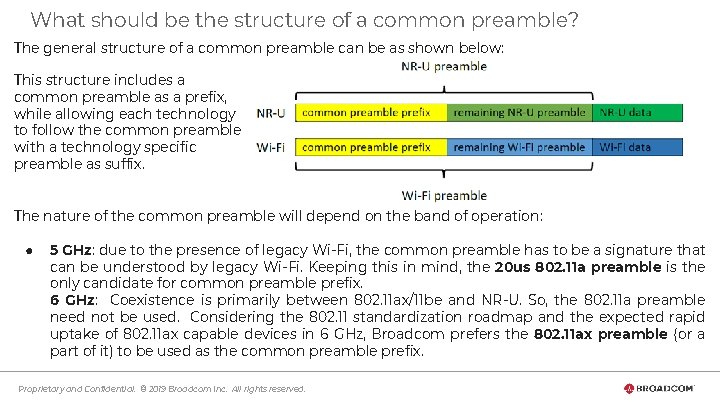
What should be the structure of a common preamble? The general structure of a common preamble can be as shown below: This structure includes a common preamble as a prefix, while allowing each technology to follow the common preamble with a technology specific preamble as suffix. The nature of the common preamble will depend on the band of operation: ● 5 GHz: due to the presence of legacy Wi-Fi, the common preamble has to be a signature that can be understood by legacy Wi-Fi. Keeping this in mind, the 20 us 802. 11 a preamble is the only candidate for common preamble prefix. 6 GHz: Coexistence is primarily between 802. 11 ax/11 be and NR-U. So, the 802. 11 a preamble need not be used. Considering the 802. 11 standardization roadmap and the expected rapid uptake of 802. 11 ax capable devices in 6 GHz, Broadcom prefers the 802. 11 ax preamble (or a part of it) to be used as the common preamble prefix. Proprietary and Confidential. © 2019 Broadcom Inc. All rights reserved.
Implementation of a common preamble via co-located Wi-Fi The proposal is as follows: ● A Wi-Fi module colocated with NR-U manages CCA on behalf of NR-U, including Energy Detection and Tx/Rx of the 802. 11 a preamble. ● NR-U informs Wi-Fi of the channel access parameters and Tx time instants. ● Wi-Fi indicates channel access status and any parsed 802. 11 a preamble to NR-U. ● Handsets already implement front-end sharing and signaling between LTE and Wi-Fi. NRU can use this signaling interface to instruct Wi-Fi to Tx/Rx the 802. 11 preamble. ● Base stations can use an interface similar to handsets ○ Minimal BOM and testing required to integrate NR-U with a Wi-Fi module with limited functionality ○ Some LAA small cells may already use a Wi-Fi IC solely to Tx/Rx the 802. 11 a preamble ● Broadcom has verified that its Wi-Fi module and the existing LTE - Wi-Fi interface in handsets is capable of performing the above functionality. Sample interface exchanges are illustrated for 4 typical NR-U scenarios. ● Proprietary and Confidential. © 2019 Broadcom Inc. All rights reserved.
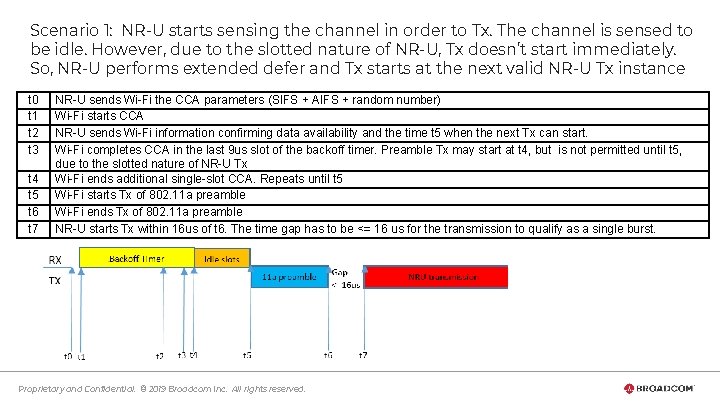
Scenario 1: NR-U starts sensing the channel in order to Tx. The channel is sensed to be idle. However, due to the slotted nature of NR-U, Tx doesn’t start immediately. So, NR-U performs extended defer and Tx starts at the next valid NR-U Tx instance t 0 t 1 t 2 t 3 t 4 t 5 t 6 t 7 NR-U sends Wi-Fi the CCA parameters (SIFS + AIFS + random number) Wi-Fi starts CCA NR-U sends Wi-Fi information confirming data availability and the time t 5 when the next Tx can start. Wi-Fi completes CCA in the last 9 us slot of the backoff timer. Preamble Tx may start at t 4, but is not permitted until t 5, due to the slotted nature of NR-U Tx Wi-Fi ends additional single-slot CCA. Repeats until t 5 Wi-Fi starts Tx of 802. 11 a preamble Wi-Fi ends Tx of 802. 11 a preamble NR-U starts Tx within 16 us of t 6. The time gap has to be <= 16 us for the transmission to qualify as a single burst. Proprietary and Confidential. © 2019 Broadcom Inc. All rights reserved.
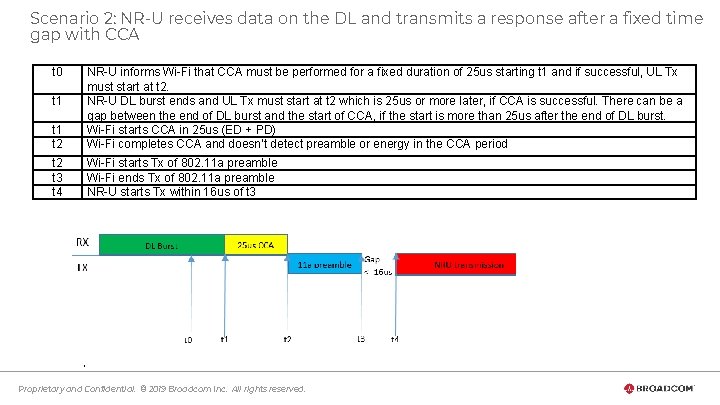
Scenario 2: NR-U receives data on the DL and transmits a response after a fixed time gap with CCA t 0 t 1 t 2 NR-U informs Wi-Fi that CCA must be performed for a fixed duration of 25 us starting t 1 and if successful, UL Tx must start at t 2. NR-U DL burst ends and UL Tx must start at t 2 which is 25 us or more later, if CCA is successful. There can be a gap between the end of DL burst and the start of CCA, if the start is more than 25 us after the end of DL burst. Wi-Fi starts CCA in 25 us (ED + PD) Wi-Fi completes CCA and doesn’t detect preamble or energy in the CCA period t 2 t 3 t 4 Wi-Fi starts Tx of 802. 11 a preamble Wi-Fi ends Tx of 802. 11 a preamble NR-U starts Tx within 16 us of t 3 t 1 Proprietary and Confidential. © 2019 Broadcom Inc. All rights reserved.
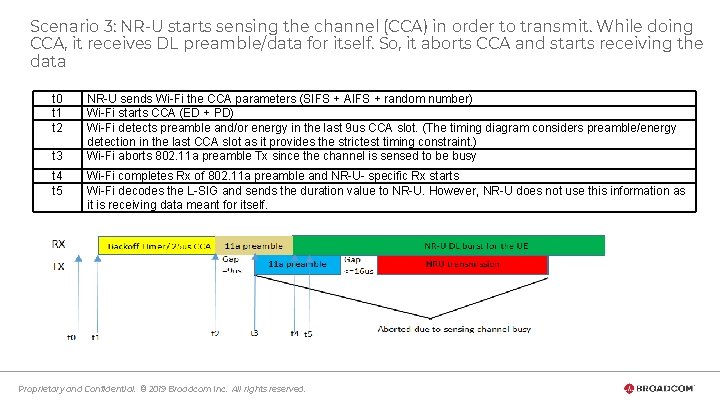
Scenario 3: NR-U starts sensing the channel (CCA) in order to transmit. While doing CCA, it receives DL preamble/data for itself. So, it aborts CCA and starts receiving the data t 0 t 1 t 2 t 3 t 4 t 5 NR-U sends Wi-Fi the CCA parameters (SIFS + AIFS + random number) Wi-Fi starts CCA (ED + PD) Wi-Fi detects preamble and/or energy in the last 9 us CCA slot. (The timing diagram considers preamble/energy detection in the last CCA slot as it provides the strictest timing constraint. ) Wi-Fi aborts 802. 11 a preamble Tx since the channel is sensed to be busy Wi-Fi completes Rx of 802. 11 a preamble and NR-U- specific Rx starts Wi-Fi decodes the L-SIG and sends the duration value to NR-U. However, NR-U does not use this information as it is receiving data meant for itself. Proprietary and Confidential. © 2019 Broadcom Inc. All rights reserved.
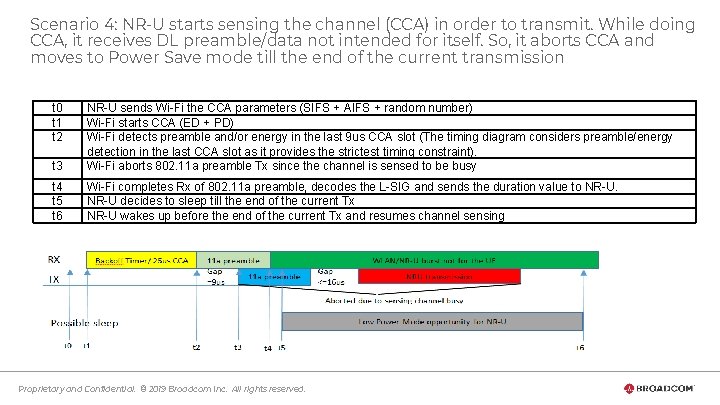
Scenario 4: NR-U starts sensing the channel (CCA) in order to transmit. While doing CCA, it receives DL preamble/data not intended for itself. So, it aborts CCA and moves to Power Save mode till the end of the current transmission t 0 t 1 t 2 t 3 NR-U sends Wi-Fi the CCA parameters (SIFS + AIFS + random number) Wi-Fi starts CCA (ED + PD) Wi-Fi detects preamble and/or energy in the last 9 us CCA slot (The timing diagram considers preamble/energy detection in the last CCA slot as it provides the strictest timing constraint). Wi-Fi aborts 802. 11 a preamble Tx since the channel is sensed to be busy t 4 t 5 t 6 Wi-Fi completes Rx of 802. 11 a preamble, decodes the L-SIG and sends the duration value to NR-U decides to sleep till the end of the current Tx NR-U wakes up before the end of the current Tx and resumes channel sensing Proprietary and Confidential. © 2019 Broadcom Inc. All rights reserved.
Implementation of a common preamble directly by NR-U Tx/Rx of the 802. 11 a preamble can also be implemented directly in the NR-U module. ● 802. 11 a preamble consists of STF (8 us), LTF (8 us) and L-SIG (4 us). ● Tx: – – – ● Rx: – – STF/LTF can be treated as fixed time-domain signals; precomputed and stored in memory. Don’t need frequency domain processing or IFFT. L-SIG is BPSK rate ½. – Doesn’t require scrambling or puncturing. – Simple interleaver and mapper designs. STF/LTF needed to decode BPSK rate ½ L-SIG. Coarse channel estimation suffices. L-SIG: – Contains only 24 bits including tail bits. – Traceback design is simple as tail bits are included – Convolution decoder design (via Viterbi) is simple (unlike classic Viterbi). – As L-SIG is BPSK rate ½, de-mapper and de-interleaver designs are simple. Proprietary and Confidential. © 2019 Broadcom Inc. All rights reserved.
Conclusion and Way Forward (1) ● A common preamble will lead to better coexistence between NR-U and Wi-Fi than a common energy detection threshold. ● For 5 GHz, the 802. 11 a preamble can be the only candidate for a common preamble. ● For 6 GHz, the 802. 11 a preamble need not be used. ○ ● Considering the 802. 11 standardization roadmap and the expected rapid uptake of 802. 11 ax capable devices in 6 GHz, Broadcom prefers the 802. 11 ax preamble (or a part of it) to be used as the common preamble. It is technically feasible for NR-U to implement Tx/Rx of the 802. 11 a preamble, either via a colocated Wi-Fi module or directly in NR-U. ○ Broadcom has verified that its Wi-Fi module and the existing LTE - Wi-Fi interface in handsets is capable of performing the above functionality within the required timing constraints. Proprietary and Confidential. © 2019 Broadcom Inc. All rights reserved.
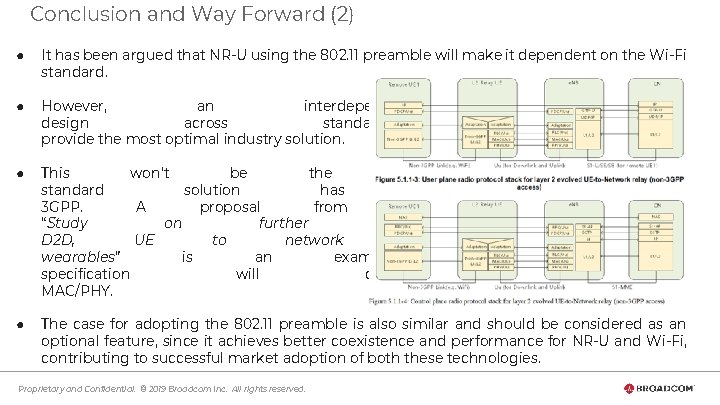
Conclusion and Way Forward (2) ● It has been argued that NR-U using the 802. 11 preamble will make it dependent on the Wi-Fi standard. ● However, an interdependent design across standards provide the most optimal industry solution. ● This won’t be the first time an standard solution has been devised 3 GPP. A proposal from the 3 GPP TR “Study on further enhancements to D 2 D, UE to network relays for Io. T wearables” is an example where the specification will depend on MAC/PHY. ● The case for adopting the 802. 11 preamble is also similar and should be considered as an optional feature, since it achieves better coexistence and performance for NR-U and Wi-Fi, contributing to successful market adoption of both these technologies. Proprietary and Confidential. © 2019 Broadcom Inc. All rights reserved. and can common sometimes interin 36. 746 LTE and 3 GPP Wi-Fi
End Proprietary and Confidential. © 2018 Broadcom Inc. All rights reserved. 16
- Slides: 16