
Omori Shz and his Wittgensteininspired solution to the










- Slides: 68
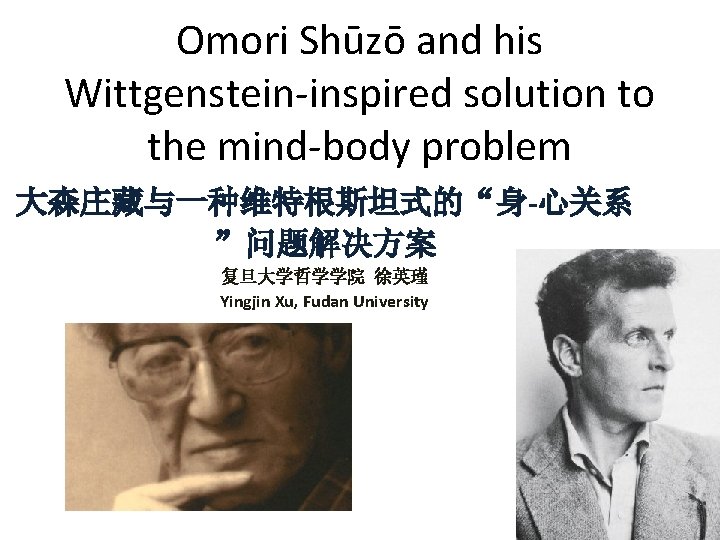
Omori Shūzō and his Wittgenstein-inspired solution to the mind-body problem 大森庄藏与一种维特根斯坦式的“身-心关系 ”问题解决方案 复旦大学哲学学院 徐英瑾 Yingjin Xu, Fudan University
The route-map of my talk: • 1. Nearly all of the currently fashionable solutions to the Mind-Body problem, including the physicalist, dualist, idealist, etc. , appeal to some type of “construction metaphor ” in the sense that some items in the world are viewed as the starting point for building up the rest of the world.
The route-map of my talk: • 2. However, Wittgenstein’s solution to the same problem cannot be categorized as any of the fashionable solutions to the same problem, since he rejected the “construction metaphor” radically by viewing both the mental and the physical as ordinary objects primarily given to language-game participants.
The route-map of my talk: • 3. As I will argue, Japanese philosopher Omori Shūzō offered a systematic re-working of Wittgenstein’s proposal which cannot be categorized as any of the fashionable solutions to the mind-body problem either. More specifically, Omori views the physical language as a tool to redescribe what has been described by our ordinary language, and hence precludes the possibility of separating either the physical or the mental from each other as a discrete ontological domain.
The Mind-body problem: how many possible solutions?
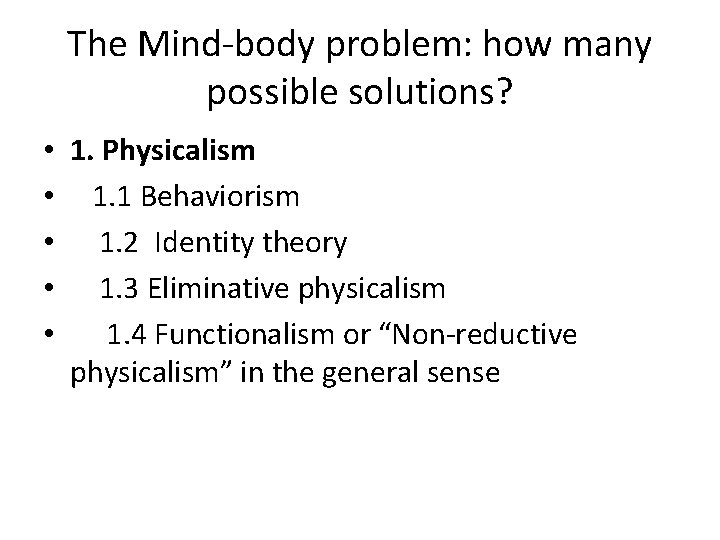
The Mind-body problem: how many possible solutions? • • • 1. Physicalism 1. 1 Behaviorism 1. 2 Identity theory 1. 3 Eliminative physicalism 1. 4 Functionalism or “Non-reductive physicalism” in the general sense
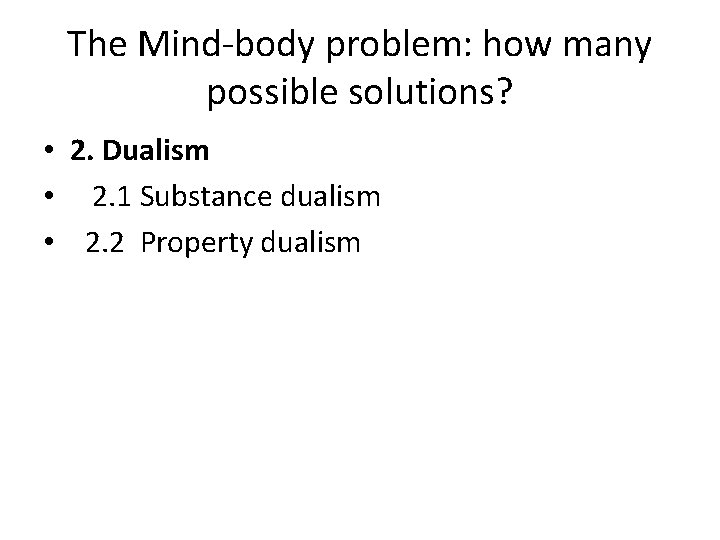
The Mind-body problem: how many possible solutions? • 2. Dualism • 2. 1 Substance dualism • 2. 2 Property dualism
The Mind-body problem: how many possible solutions? • 2. Dualism • 2. 1 Substance dualism • 2. 2 Property dualism
The Mind-body problem: how many possible solutions? • 3. Idealism (Berkeley) • 4. Panpsychism (Leibniz, Hegel) • 5. Neutral monism (Ernst Mach)
The commonalities among these solutions THEY HAVE ALL ASSUMED THE VALIDITY OF THE “CONSTRUCTION METAPHOR”
The “construction” metaphor: how to create the world? • Suppose there were a God as the Creator: What He should do in order to create everything in the world that we know? • 1. Physicalism: He should create the physical stuff only. Then the mental stuff would emerge automatically. • 2. Dualism: He should create the physical stuff on the one hand, the mental stuff on the other. • 3. Neutral monism: the neutral stuff to be provided first, then both the mind and the body could be constructed out of them.
More on the “construction metaphor” • Some asymmetry between “something should be built primarily” and “something should be built afterwards”. • Even in the dualist narrative, such asymmetry exists in the sense that dualists, while assuming that both the mental and the physical are fundamental, do not intend to claim that the mental states of other minds are as fundamental as mine. • Needless to say Panpsychism, according to which the physical space should be rebuilt from the mental stuff prevalent in the universe.
Some conceptual clarifications • The employment of the “construction metaphor” is not the same as that of the notion of “reduction”. “Reduction” surely offers a typical illustration of such a metaphor, but it does not exhaust all of the latter’s meanings. • For instance, though non-reductive physicalism is definitely non-reductive, it still fits the pattern of the “construction metaphor” in the sense that the “supervenience relationship” itself is asymmetrical.
WHAT WITTGENSTEIN WOULD SAY ABOUT ALL OF THIS?
The 1929’s paper: Some remarks on logical forms • In this paper, Wittgenstein shows a strong tendency to accept either subjective idealism or neutral monism in the sense that he intends to view atomic propositions, out of which all other propositions can be logically constructed, as something representing sensedata.
However • The primacy of the so-called “phenomenal language” was immediately abandoned by him. • His words dictated to Waisman (WWK p, 45): • I used to believe that there was the everyday language that we all usually spoke and a primary language that expressed what we really knew, namely phenomena. l also spoke of a first system and a second system. Now I wish to explain why I do not adhere to that conception any more. I think that essentially we have only one language, and that is our everyday language. We need not invent a new language or construct a new symbolism, but our everyday language already is tbe language, provided we rid it of the obscurities that lie hidden in it.
A MORE EXPRESSIVE CITATION FROM THE BIG TYPESCRIPT AS THE CORE TEXT OF “MIDDLE WITTGENSTEIN” :
BT p. 365 e • Memory-time. It (like visual space) is not a part of time in the larger sense, but is the specific order of events or situations in memory. In this time there is no future, for instance; visual and physical space, memory-time and physical time are not related to each other as a section of the series of cardinal numbers is to the law of this series (“of 6 the entire number series”), but rather as the system of cardinal numbers is to that of the rational numbers. • And this relationship also makes sense of the idea that the one space encloses, contains, the other one.
This citation implies that • 1. The physical space embraces the phenomenal one; • 2. The former embraces the latter in the sense that the system of cardinal numbers embraces that of the rational numbers. • 3 (2) implies that the phenomenal and the physical are just the results of viewing the same stuff from two different aspects.
It is really hard to find a proper position in the conceptual map of contemporary philosophy of mind for accommodating Wittgenstein’s view on the mind-body problem!!!
An approximation to what he wants to say: • His position is definitely monist, but neither idealist monism nor physicalist monism nor neutral monism. • Or: non-idealist-non-physicalist-non-neutral monism. • His ontological catalogue includes mental entities like pain, but not in the sense of endorsing dualism. Pain should be viewed as “public” as the teeth where the very pain is located. Or in other words, he believes that “pain” is something which is already visualized rather than something crying out to be visualized (as behaviorists suggest).
BUT WHAT ON EARTH DOES THIS POSITION MEAN?
His real starting point: • 1. A broader (much broader than its Husserlian or Heideggerian counterparts) sense of “phenomenology” which takes the linguistic phenomena as crucial indications for making ontological commitments. • 2. In ordinary discourse, no need to discriminate the ontological border between the mental and the physical, or to build the hierarchy among the relevant items. • 3. Therefore, you teeth are real, my pain in my teeth is real, your pain is as real as mine.
But why does Wittgenstein’s position now look like a forgotten one? • By “the physical”, the post-Wittgenstein philosophers of mind mean something different from W’s time. To re-think Prof. Alice Crary’s paper on objectivity. • Nowadays “the physical” no longer refers to ordinary objects like a table or an apple, but scientific entities like “C-fiber firing”. Wittgenstein seems either to say too little about the “physical” in this sense, or what he said related to this looks too ambiguous.
MOST CONTEMPORARY PHILOSOPHERS MAY FEEL: W AND US ARE NOT ON THE SAME PAGE!
That is the reason why we need to introduce Omori’s philosophy!!
Some background information • His initial academic background is physics, and served in the Imperial Japanese Navy for building the laser weapons in the wartime. He moved to United Sates to study analytical philosophy after the war, and became very interested in later Wittgenstein by reading BLUE BOOKS。 • When returned back to Japan, he tried his best to reshape the Japanese intellectual circle by combining the Anglo-phone philosophy with some local resources like Buddhism.
I don’t think Omori’s philosophy is entirely discontinuous to Nishida Kitaro’s philosophy, although the latter has never been identified as an analytical thinker.
UNFORTUNATELY, I DON’T KNOW THERE IS ANY ENGLISH TRANSLATION OF OMORI’S WORKS
The only book by Omori that has been translated into Chinese: Elapse and Deposition: Philosophical Fragments (Nagare to yodomi)
The core idea of Omori’s position concerning the mind-body problem • 1. He endorses the achievements by neuroscientists and experts in other areas of natural sciences. • 2. He also has a rich catalogue for making ontological commitments, a catalogue which is no less rich than the one in Wittgenstein’s mind. • 3. He further claims that science cannot offer an appropriate causal explanation of phenomenal entities like the feeling of red or that of pain.
大森如何做到兼得鱼与熊掌 ? HOW COULD OMORI HAVE HIS CAKE AND EAT IT TOO?
His solution • The scientific narrative on vision in terms of “electromagnet waves” “is another way of talking about”(“即ち ”, Japanese reading “sunawachi”) the visional image that the perceiving subject acquires.
BUT ISN’T THIS ANOTHER VERSION OF IDENTITY THEORY?
Some comparisons • Identity theorists would • By contrast, according to also say “pain is nothing Omori, to say “pain is nothing but C-fiber firing”, but by but C-fiber firing” is saying that, what they tantamount to say “C-fiber actually mean is the firing is nothing but pain”, or in following: we can construct other words, they are the two our feeling out of the aspects of the same entities, scientific narrative, not and neither is verse versa. ontological/epistemological prior to the other.
Omori has two enemies in his mind • 1. Dualist arguments, like “What Mary didn’t know” argument (knowledge argument), according to which the knowledge about neural activities cannot exhaust the phenomenal feelings. • 2. Physicalist arguments, according to which phenomenal feelings either have a secondrate or no ontological status in the physical world.
His recipe for refuting both • 1. To dualism: the mental does not exist in a space which is different from the physical space. • 2. To physicalim: the relationship of “sunawachi” is by no means a causal one, hence, not an asymmetrical one. Hence, any “supervenince” narrative, which is based on some asymmetrical relationship, is misleading.
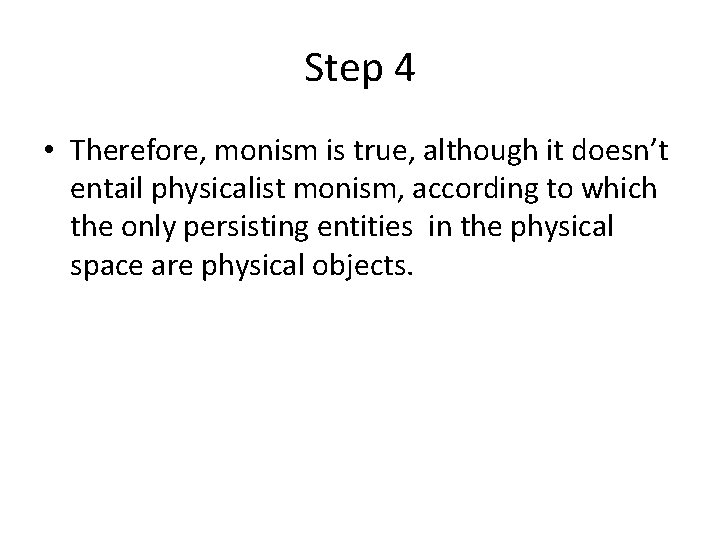
The refutation of dualism • Basic ideas: • 1. Like Platonists, Dualists have assumed that phenomenal feelings exist in a “space” other than the physical space. • 2. Such an assumption is based on the misuse of our language, and such mistakes can be revealed by appealing to some thought-experiments in which the configurations of our bodies are supposed to be in another way around. • 3. Since there is no need to posit the so-called “phenomena space”, there is only one space left, i. e. , the physical space. • 4. Therefore, monism is true, although it doesn’t entail physicalist monism, according to which the only persisting entities in the physical space are physical objects.
Step 1 • To reconsider Platonism. The knowledge of specific apples does not suffice for the knowledge on the Form “APPLE”, hence, the Forms do not exist in the same space as that in which specific apples do. Hence, the intelligible world should be separated from the perceivable one.
Step 1 • This is somehow parallel to the knowledge argument in philosophy of mind: Mary’s knowledge of neuroscience does not suffice for her knowledge about what RED looks like to her, hence, RED does not exist in the same physical world in which neural activities exist. • But the feeling of RED actually exist. • Therefore, it should exist in a “space” separated from the space for neural activities.
Step 1 We may call this space, following Wittgenstein, the “private space” (think about the “beetle-in-thebox” metaphor in Philosophical Investigation), in contrast with the “public space”(think about the “box”).
Step 2 But why to say that to posit such a “private space” is the result of misusing our language ? The basic reasons: (1)Our ordinary language evolved for the purpose of making our behaviors adaptive to the actual environment, not for the purpose of being accommodated in all possible counterfactual environments. (2)Hence, our language is not a proper linguistic tool for doing philosophy, which should take counterfactual scenarios into account. (3) Therefore, to directly use our ordinary language to do philosophy would not be beneficial to philosophy
Step 2 • A Wittgenstein-inspired approach to do philosophy is appeal to some counterfactualscenario-invoking thought experiment to see what part of our actually used grammar should be viewed as superficial and hence revisable in other scenarios. • By doing this, we can approach the “deep grammar” step by step.
Step 2 • But this methodological adoption is by no means Kripkean, by which in the evoked counterfactual scenarios intuitions in the actual world are still decisive in the process of knowledge (semantic knowledge included) attribution. • By contrast, in a Wittgenstein-inspired approach, counterfactual scenarios are evoked mainly for demonstrating the intuition in the actual world is merely locally valid. • Thus, the Wittgenstein-inspired approach has a Buddhist bite in the sense that both intend to negate the universal validity of the intuition that are locally valid.
Step 2 • Omori applies the Wittgensteinian approach in this studies of the mind-body problem, especially in his refutation of dualism.
Step 2 • Omori’s argument: • 1. If dualism is true, there should be a fixed boundary between the “private space” and the “public space”. • 2. But this boundary, if exists, is only the result of conventions, which are by nature posteriori. • 3. Therefore, dualism cannot be true.
Step 2 • So the point of the foregoing argument is to prove (2). To get (2), Omori introduced an auxiliary argument: • a. The main reason inducing us to admit that such a boundary exists is typically based on the observation that there is some asymmetry between what “I” see and what “we” see. For instance, I can see the front side of a cube, but “we” can see the other sides that “I” cannot currently see.
Step 2 • b. But maybe this boundary cannot be found in the following scenario: • (a) our eyes have a 360 degree vision without any dead angle; (b) The eyes and the rest of the body are separately distributed in different parts of the world, say, the left eye in Tokyo, the right eye in Rome, other parts in London and Shanghai, etc. . (c)all of the parts of my body, including the eyes, are entirely transparent.
Step 3 • C. In such a scenario, there is no distinction between “what I see in Tokyo” and “what people in Shanghai would see”, since I (from Tokyo) can simultaneously see the scenes in Shanghai. In addition, since there is no dead angle of vision, no unseen side of an object, I cannot say that what I see is specific-aspectbased.
Step 3 • This thought-experiment (cf. Elapse and Deposition: Philosophical Fragments, Chinese version, pp. 100) is originally proposed by Wittgenstein. Cf. Philosophical Remarks, section 72. I have more comments on this in my published dissertation, pp. 202.
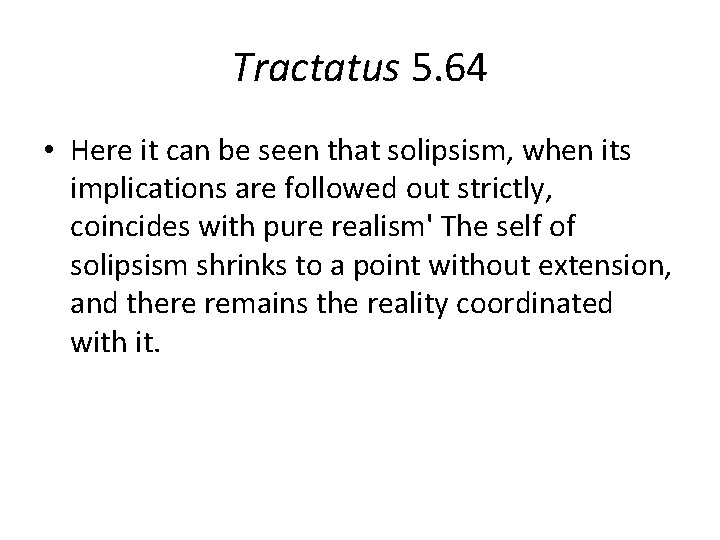
Step 3 Since there is no way to posit the so-called “phenomena space” in a cross-world manner, there is , philosophically speaking, only one space left, i. e. , the physical space. • But if one asks “why the only left world should be viewed as ‘physical’, why not ‘mental’”, Omori would respond in this way: Okay, it is fairly well for me to accept the label of “idealism”. For me, it means the same thing as “realism” does. You may take either label as you like, I don’t care…. • This would remind us what young Wittgenstein said….
Tractatus 5. 64 • Here it can be seen that solipsism, when its implications are followed out strictly, coincides with pure realism' The self of solipsism shrinks to a point without extension, and there remains the reality coordinated with it.
Step 4 • Therefore, monism is true, although it doesn’t entail physicalist monism, according to which the only persisting entities in the physical space are physical objects.
Now let us turn to another side of the coin: WHY DOES OMORI REFUTE PHYSICALISM AS WELL?
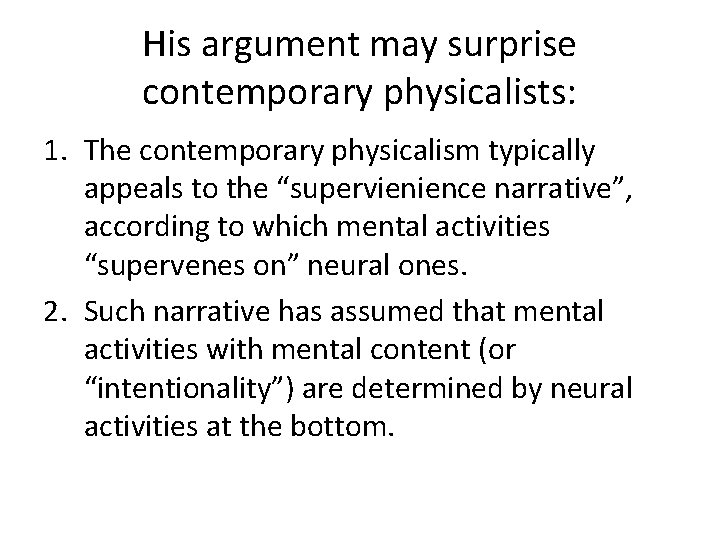
His argument may surprise contemporary physicalists: 1. The contemporary physicalism typically appeals to the “supervienience narrative”, according to which mental activities “supervenes on” neural ones. 2. Such narrative has assumed that mental activities with mental content (or “intentionality”) are determined by neural activities at the bottom.
His argument may surprise contemporary physicalists: • 3. Neural activities are surely within the skull, whereas mental activities can be “about” something outside the skull, say, Mars. • 4. Hence, according to supervenience physicalism, the thought about the Mars supervenes something in the skull. • 5. Hence, according to supervenience physicalism, mental activities are, causally speaking, within the skull.
His argument may surprise contemporary physicalists: • 6. But physicalists still need to concede that the mental activities can be about the Mars, although they are within the brain. However, how can something within the skull be about other things outside of it? The only logically plausible solution seems to say that what is within the skull is not the Mars itself, rather, it should be the representation of the Mars.
His argument may surprise contemporary physicalists: • 7. The foregoing step has assumed some boundary between “A” and “the representation of A”. • 8. But such boundary does not really actually exist. Here is an auxiliary argument for saying so: • (8 a) Think about a picture of Mr. W. • (8 b) When you see the picture, and if you also know that this is the picture of Mr. W, you should have already known Mr. W. himself. It does not make any sense to say that “I know that this is his picture but I don’t know him”.
His argument may surprise contemporary physicalists: • (8 c) Hence, the subject’s knowledge is not about the picture representing the person, but the person represented by the picture. • (8 d) Hence, it is redundant to say that “This is the picture of X”. To say “This is X” is enough, otherwise, one may evoke regress. • (8 e) The whole analysis can be applied to the case of mental representation. To say that the subject’s mental representation of X in his skull has assumed that X is in his skull. • (8 f) But it is ridiculous to say that a person, or a planet like Mars, is in one’s skull.
His argument may surprise contemporary physicalists: • (8 g) Hence, the only solution is to reinterpret the meaning of the claim “a person, or a planet like Mars, is in one’s skull”. More specifically, if the environment accommodating the subject can be viewed part of his skull, then to say “a person, or a planet like Mars, is in one’s skull” is not different from saying that “a person, or a planet like Mars, is in one’s environment”. This sentence is no longer ridiculous. • (8 h) However, such an interpretative maneuver definitely blurs the boundary between “inner” and “outer” again.
His argument may surprise contemporary physicalists: 9. Since the claim that “the mental activities, with its content, are within one’s skull” is entailed by supervenience physicalism, and as we have seen, such a claim has been refuted in step (8), it is not hard to conclude that physicalism has been refuted.
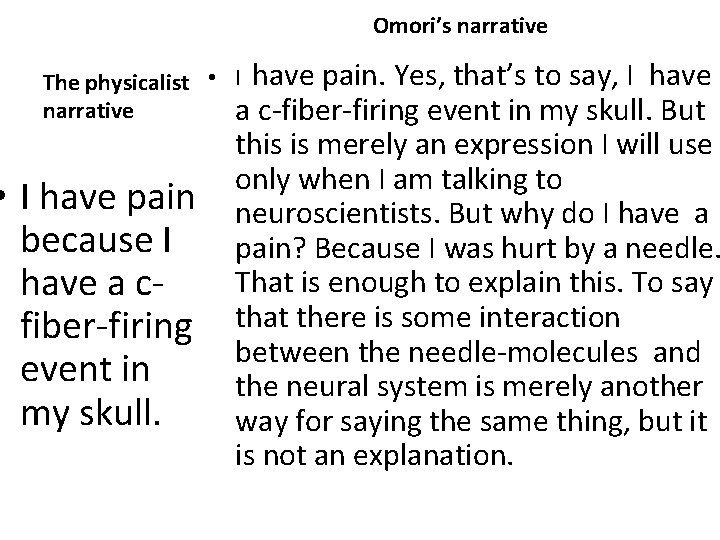
Omori’s positive position: • What neuroscientists said about mentality is nothing but the re-description of the ordinary view about mentality. • Such view could fairly fit the commonsense that when your brain malfunctions, your memory goes wrong. You don’t need to say that your memory supervenes on your brain activities in order to explain this. Think about the contrast between the two expressions:
Omori’s narrative The physicalist • I have pain. Yes, that’s to say, I have narrative a c-fiber-firing event in my skull. But • I have pain because I have a cfiber-firing event in my skull. this is merely an expression I will use only when I am talking to neuroscientists. But why do I have a pain? Because I was hurt by a needle. That is enough to explain this. To say that there is some interaction between the needle-molecules and the neural system is merely another way for saying the same thing, but it is not an explanation.
Conclusion • By now, I have tried my best to reconstruct Omori’s position concerning the mind-body problem. • I do not mean to say that I have been completely persuaded by Omori, or even that my understanding of Omori has been entirely on the right track, but as at least some of you may agree, what he said about the topic widened our vision and offered possibilities of approaching the mindbody problem from new perspectives.
Your take-home message: • Don’t underestimate the importance of Japanese philosophy when we are engaged in the East-West philosophical dialogue. Anyway, Chinese philosophy cannot exhaust “Eastern philosophy” and all its variants. • Japanese thinkers do matter.