
OMI HCHO measurements to test isoprene emissions and
![Relating HCHO Columns to Isoprene Emissions [1015 molecules cm-2] [1013 atoms. C cm-2 s-1]](https://slidetodoc.com/presentation_image/04d46f19e0aecf978ab420d3f995e3ac/image-8.jpg "Relating HCHO Columns to Isoprene Emissions [1015 molecules cm-2] [1013 atoms. C cm-2 s-1]")

![MEGAN isoprene emissions using 2 land cover databases Guenther [2006] (MODIS) – G 2006](https://slidetodoc.com/presentation_image/04d46f19e0aecf978ab420d3f995e3ac/image-16.jpg "MEGAN isoprene emissions using 2 land cover databases Guenther [2006] (MODIS) – G 2006")
- Slides: 18
OMI HCHO measurements to test isoprene emissions and land cover Dylan Millet, Daniel Jacob, and May Fu Harvard University Thomas Kurosu and Kelly Chance Harvard-Smithsonian Astrophysical Observatory Alex Guenther NCAR Colette Heald UC Berkeley GEOS-Chem Meeting April 11, 2007
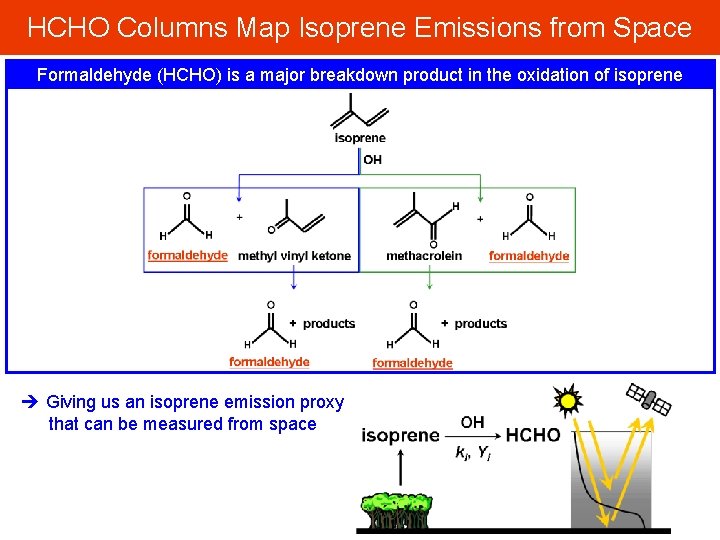
HCHO Columns Map Isoprene Emissions from Space Formaldehyde (HCHO) is a major breakdown product in the oxidation of isoprene Giving us an isoprene emission proxy that can be measured from space
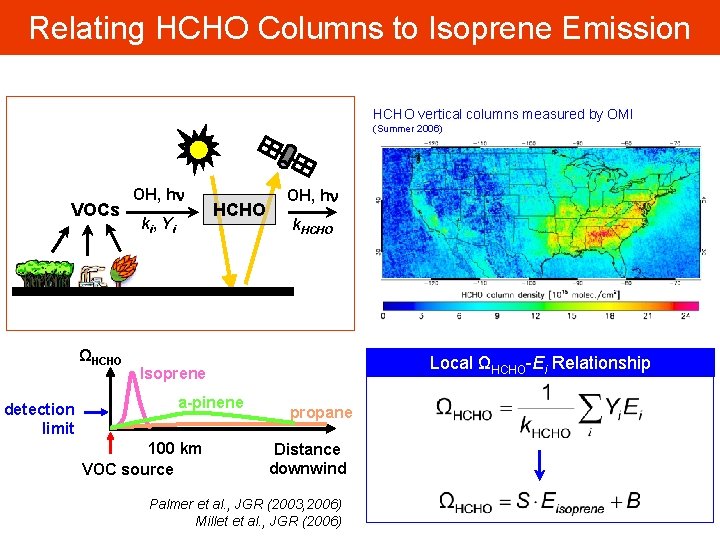
Relating HCHO Columns to Isoprene Emission HCHO vertical columns measured by OMI (Summer 2006) VOCs ΩHCHO detection limit OH, h ki, Yi HCHO OH, h k. HCHO Local ΩHCHO-Ei Relationship Isoprene a-pinene 100 km VOC source propane Distance downwind Palmer et al. , JGR (2003, 2006) Millet et al. , JGR (2006)
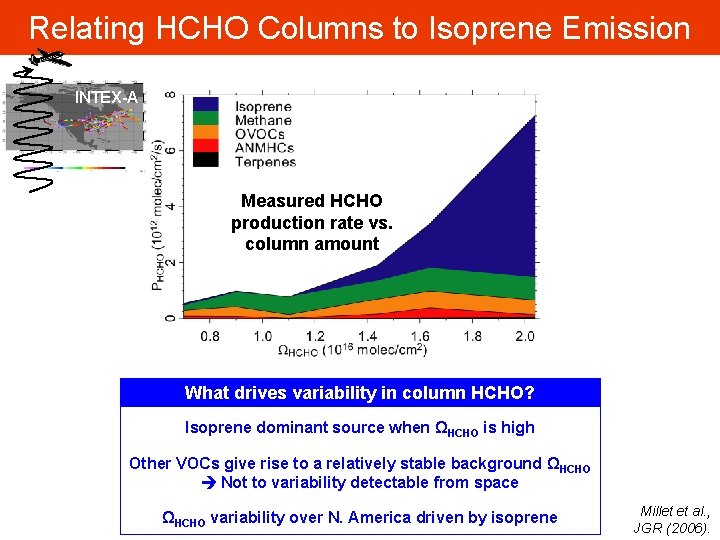
Relating HCHO Columns to Isoprene Emission INTEX-A Measured HCHO production rate vs. column amount What drives variability in column HCHO? Isoprene dominant source when ΩHCHO is high Other VOCs give rise to a relatively stable background ΩHCHO Not to variability detectable from space ΩHCHO variability over N. America driven by isoprene Millet et al. , JGR (2006).
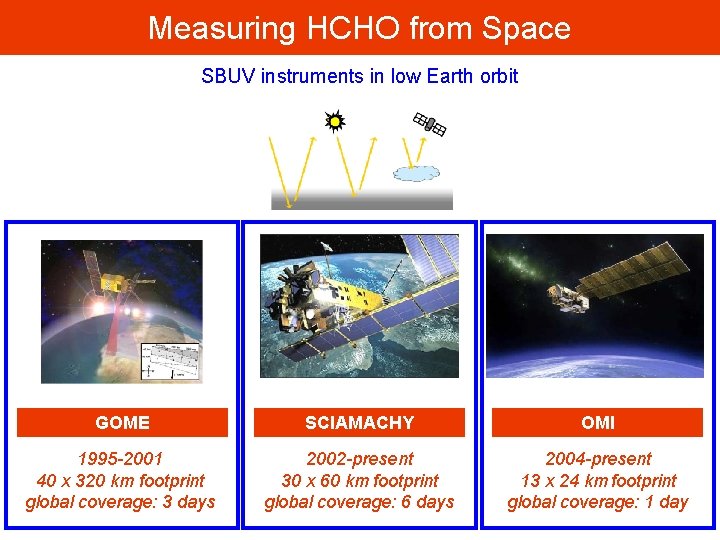
Measuring HCHO from Space SBUV instruments in low Earth orbit GOME SCIAMACHY OMI 1995 -2001 40 x 320 km footprint global coverage: 3 days 2002 -present 30 x 60 km footprint global coverage: 6 days 2004 -present 13 x 24 km footprint global coverage: 1 day
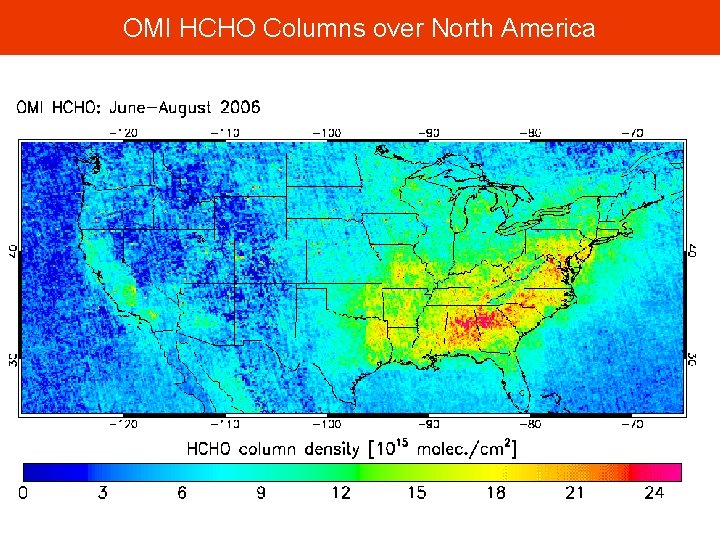
OMI HCHO Columns over North America
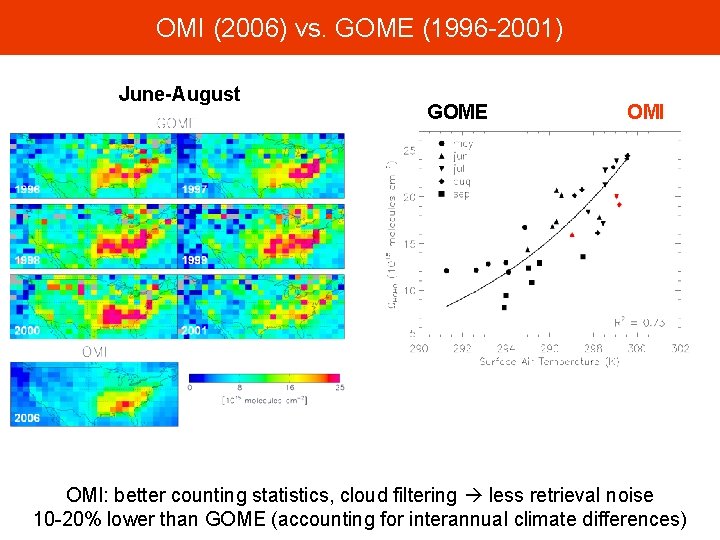
OMI (2006) vs. GOME (1996 -2001) June-August GOME OMI: better counting statistics, cloud filtering less retrieval noise 10 -20% lower than GOME (accounting for interannual climate differences)
Relating HCHO Columns to Isoprene Emissions [1015 molecules cm-2] [1013 atoms. C cm-2 s-1] ΩHCHO = SEisoprene+ B Uniform ΩHCHO-Eisoprene relationship Variable ΩHCHO-Eisoprene relationship OMI Isoprene Emission
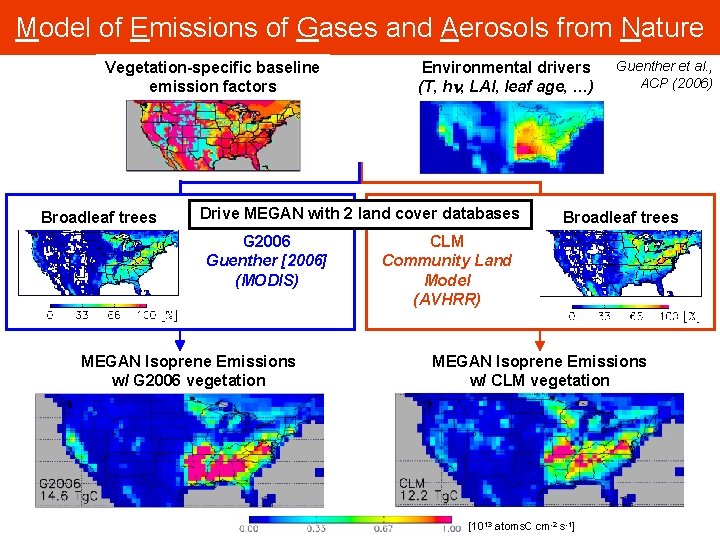
Model of Emissions of Gases and Aerosols from Nature Vegetation-specific baseline emission factors Broadleaf trees Environmental drivers (T, h , LAI, leaf age, …) Drive MEGAN with 2 land cover databases G 2006 Guenther [2006] (MODIS) MEGAN Isoprene Emissions w/ G 2006 vegetation Guenther et al. , ACP (2006) Broadleaf trees CLM Community Land Model (AVHRR) MEGAN Isoprene Emissions w/ CLM vegetation 12. 2 Tg. C [1013 atoms. C cm-2 s-1]
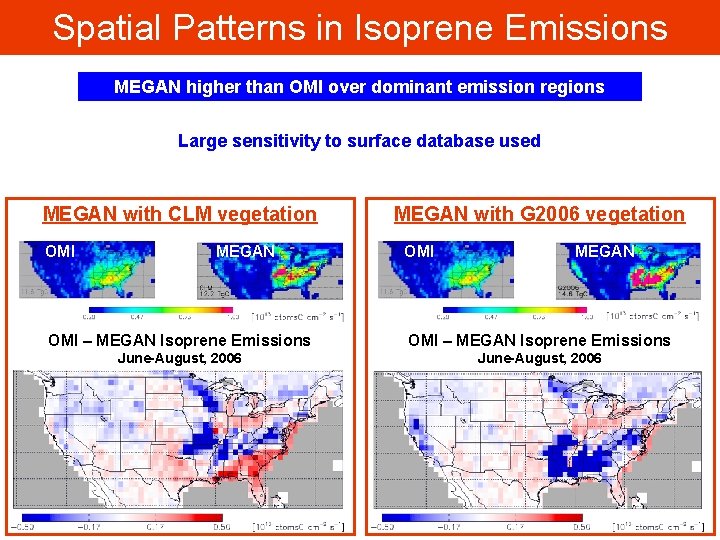
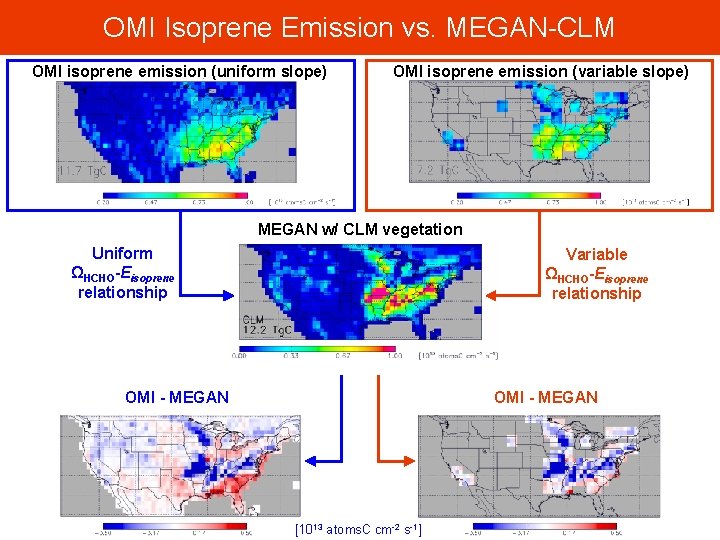
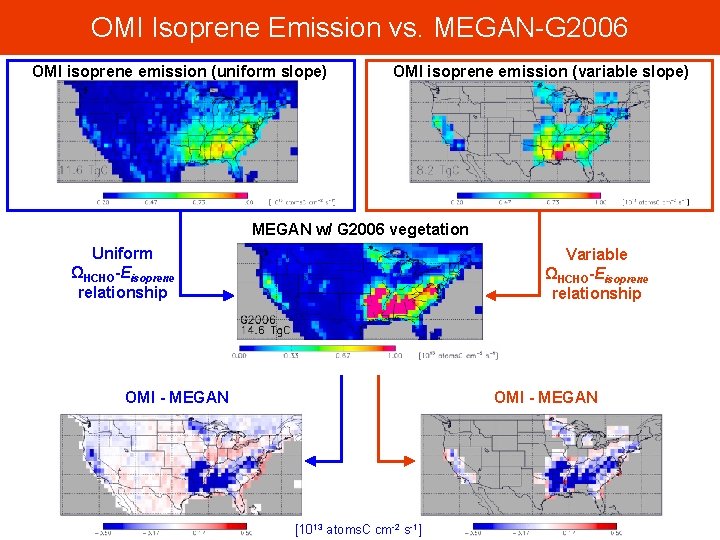
Spatial Patterns in Isoprene Emissions MEGAN higher than OMI over dominant emission regions Large sensitivity to surface database used MEGAN with CLM vegetation OMI MEGAN with G 2006 vegetation OMI MEGAN OMI – MEGAN Isoprene Emissions June-August, 2006
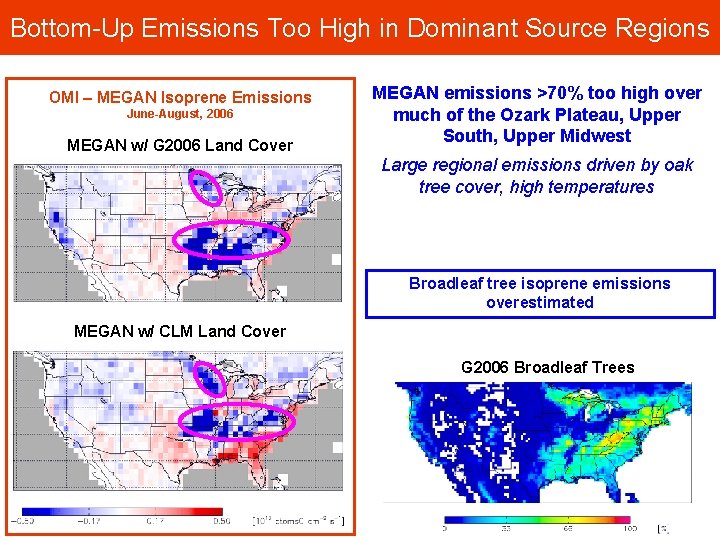
Bottom-Up Emissions Too High in Dominant Source Regions OMI – MEGAN Isoprene Emissions June-August, 2006 MEGAN w/ G 2006 Land Cover MEGAN emissions >70% too high over much of the Ozark Plateau, Upper South, Upper Midwest Large regional emissions driven by oak tree cover, high temperatures Broadleaf tree isoprene emissions overestimated MEGAN w/ CLM Land Cover G 2006 Broadleaf Trees
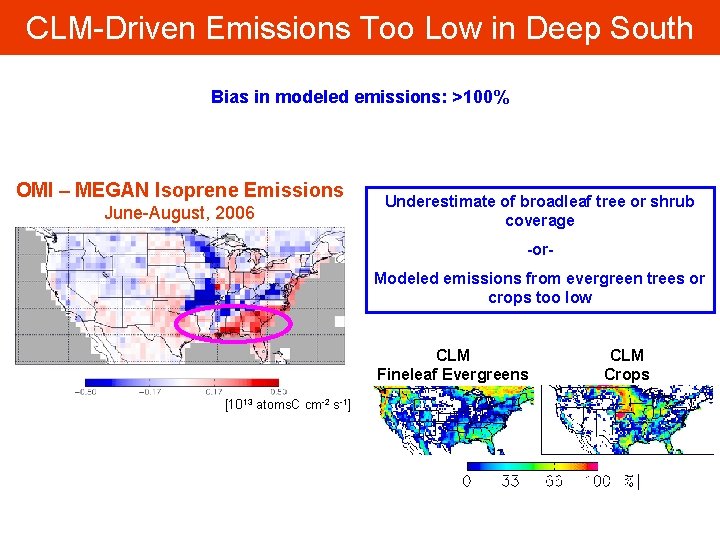
CLM-Driven Emissions Too Low in Deep South Bias in modeled emissions: >100% OMI – MEGAN Isoprene Emissions June-August, 2006 Underestimate of broadleaf tree or shrub coverage -or. Modeled emissions from evergreen trees or crops too low CLM Fineleaf Evergreens [1013 atoms. C cm-2 s-1] CLM Crops
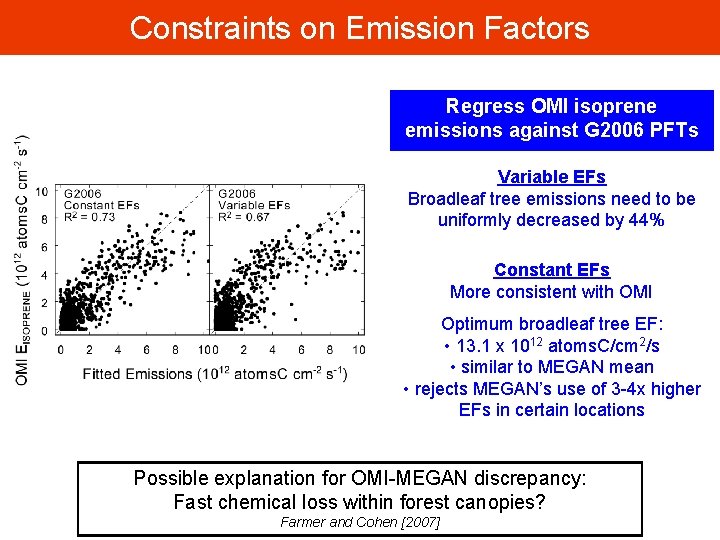
Constraints on Emission Factors Regress OMI isoprene emissions against G 2006 PFTs Variable EFs Broadleaf tree emissions need to be uniformly decreased by 44% Constant EFs More consistent with OMI Optimum broadleaf tree EF: • 13. 1 x 10¹² atoms. C/cm 2/s • similar to MEGAN mean • rejects MEGAN’s use of 3 -4 x higher EFs in certain locations Possible explanation for OMI-MEGAN discrepancy: Fast chemical loss within forest canopies? Farmer and Cohen [2007]
The End
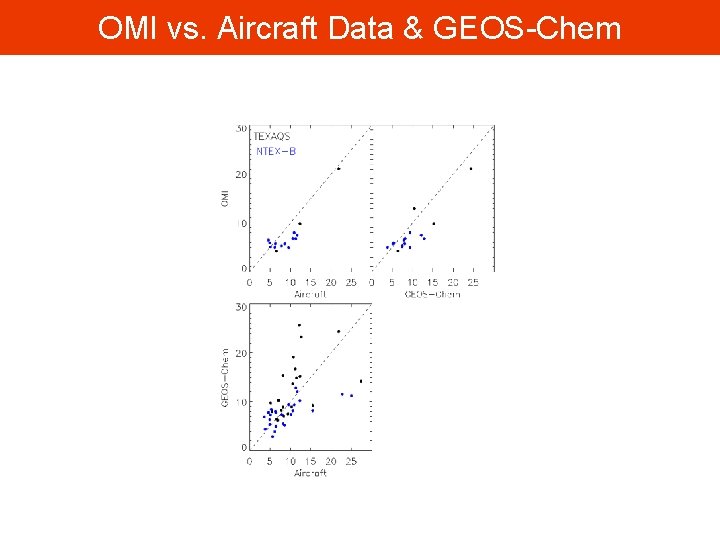
OMI vs. Aircraft Data & GEOS-Chem
MEGAN isoprene emissions using 2 land cover databases Guenther [2006] (MODIS) – G 2006 Community Land Model (AVHRR) - CLM PFT Coverage and Isoprene Emission Factors (EFs) G 2006 CLM [%] Isoprene Emission EF [1010 atoms. C/cm 2/s] [1013 atoms. C cm-2 s-1]
OMI Isoprene Emission vs. MEGAN-CLM OMI isoprene emission (uniform slope) OMI isoprene emission (variable slope) MEGAN w/ CLM vegetation Uniform ΩHCHO-Eisoprene relationship Variable ΩHCHO-Eisoprene relationship OMI - MEGAN [1013 atoms. C cm-2 s-1]
OMI Isoprene Emission vs. MEGAN-G 2006 OMI isoprene emission (uniform slope) OMI isoprene emission (variable slope) MEGAN w/ G 2006 vegetation Uniform ΩHCHO-Eisoprene relationship Variable ΩHCHO-Eisoprene relationship OMI - MEGAN [1013 atoms. C cm-2 s-1]