
Oligosaccharides An overview of manufacturing and application in
- Slides: 43
Oligosaccharides An overview of manufacturing and application in food products Osama O. Ibrahim, Ph. D Consultant Biotechnology Gurnee, IL. 60031 U. S. A. bioinnovation 04@yahoo. com 1
Agenda • • • Known oligo-Saccharides. Properties. Benefits. Legal status. Manufacturing processes. Conclusion 2
Oligosaccharides • Oligosaccharides are important group of polymeric carbohydrates that are found in all living organisms. • Oligosaccharides composed of 2 to 10 monosaccharide residues. • These monosaccharide's linked together by glycoside (α-1, 4 or α-1, 6 ) bonds. • The discovery of new enzymes helps in developing other oligosaccharides of monosaccharide's with other linked bonds. Trehalose (α, α 1, 1), Gentio-oligosaccharides (β-1, 6), Nigero-oligosaccharides (α-1, 3), Cyclodextrin (α-1 -4). 3
Oligosaccharides groups • Sucrose-related oligosaccharides. • Starch-related oligosaccharides. • Lactose-related oligosaccharides. • Others-oligosaccharides. 4
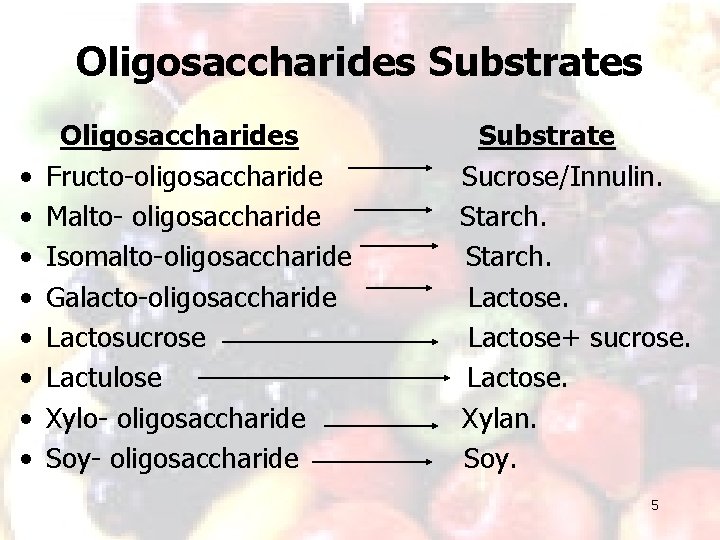
Oligosaccharides Substrates • • Oligosaccharides Fructo-oligosaccharide Malto- oligosaccharide Isomalto-oligosaccharide Galacto-oligosaccharide Lactosucrose Lactulose Xylo- oligosaccharide Soy- oligosaccharide Substrate Sucrose/Innulin. Starch. Lactose+ sucrose. Lactose. Xylan. Soy. 5
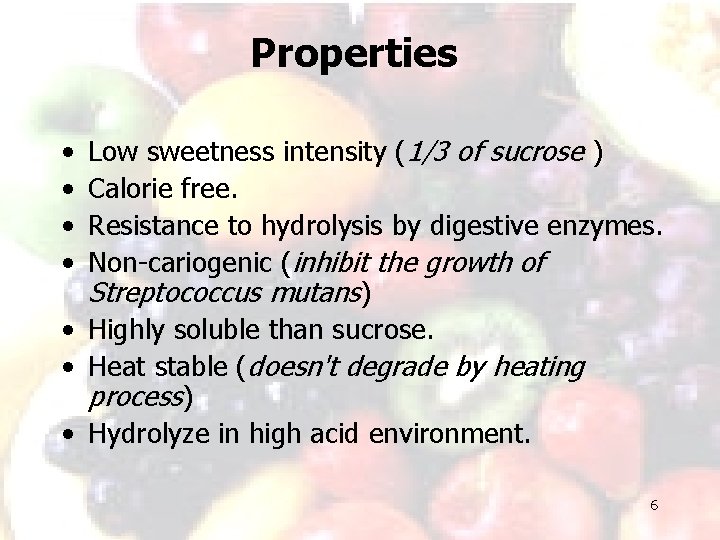
Properties Low sweetness intensity (1/3 of sucrose ) Calorie free. Resistance to hydrolysis by digestive enzymes. Non-cariogenic (inhibit the growth of Streptococcus mutans) • Highly soluble than sucrose. • Heat stable (doesn't degrade by heating process) • Hydrolyze in high acid environment. • • 6
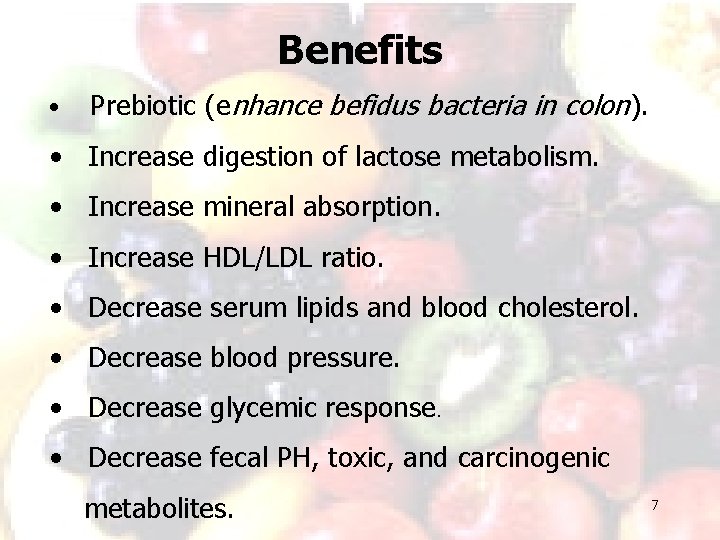
Benefits • Prebiotic (enhance befidus bacteria in colon). • Increase digestion of lactose metabolism. • Increase mineral absorption. • Increase HDL/LDL ratio. • Decrease serum lipids and blood cholesterol. • Decrease blood pressure. • Decrease glycemic response. • Decrease fecal PH, toxic, and carcinogenic metabolites. 7
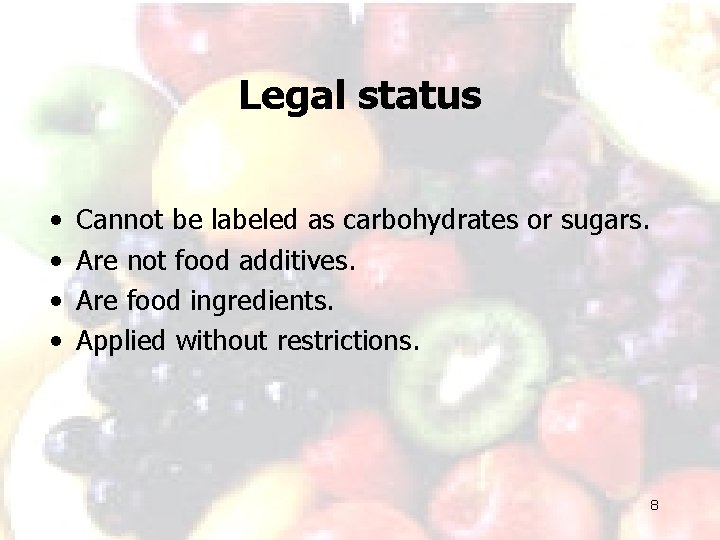
Legal status • • Cannot be labeled as carbohydrates or sugars. Are not food additives. Are food ingredients. Applied without restrictions. 8
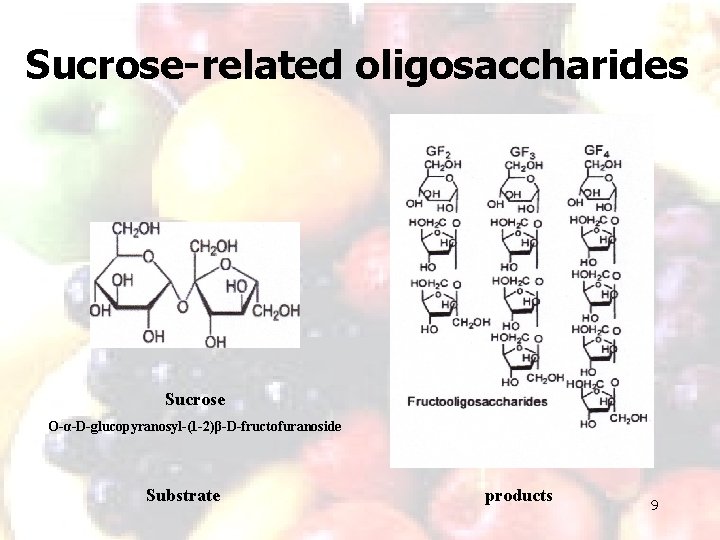
Sucrose-related oligosaccharides Sucrose O-α-D-glucopyranosyl-(1 -2)β-D-fructofuranoside Substrate products 9
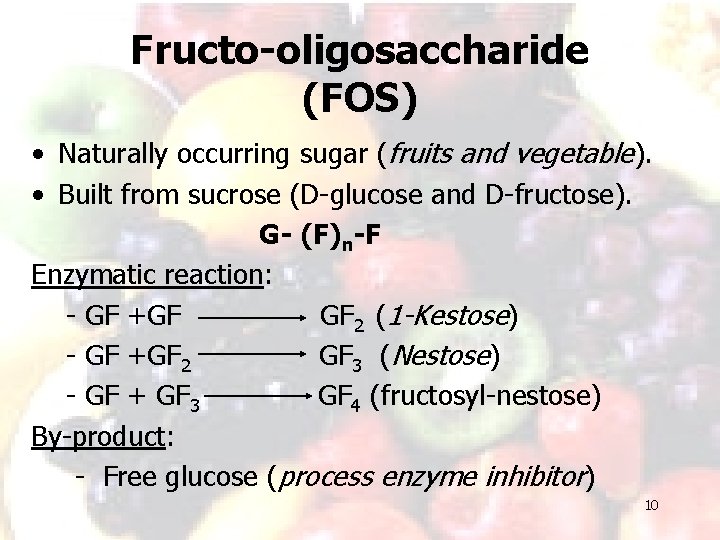
Fructo-oligosaccharide (FOS) • Naturally occurring sugar (fruits and vegetable). • Built from sucrose (D-glucose and D-fructose). G- (F)n-F Enzymatic reaction: - GF +GF GF 2 (1 -Kestose) - GF +GF 2 GF 3 (Nestose) - GF + GF 3 GF 4 (fructosyl-nestose) By-product: - Free glucose (process enzyme inhibitor) 10
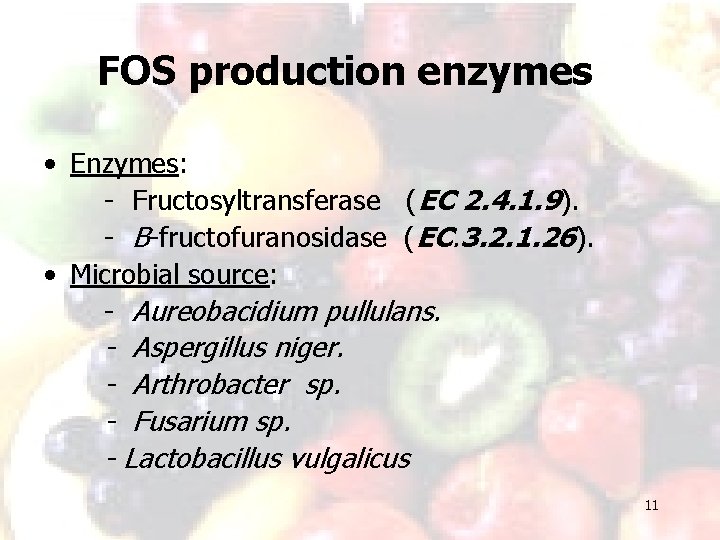
FOS production enzymes • Enzymes: - Fructosyltransferase (EC 2. 4. 1. 9). - B-fructofuranosidase (EC. 3. 2. 1. 26). • Microbial source: - Aureobacidium pullulans. - Aspergillus niger. - Arthrobacter sp. - Fusarium sp. - Lactobacillus vulgalicus 11
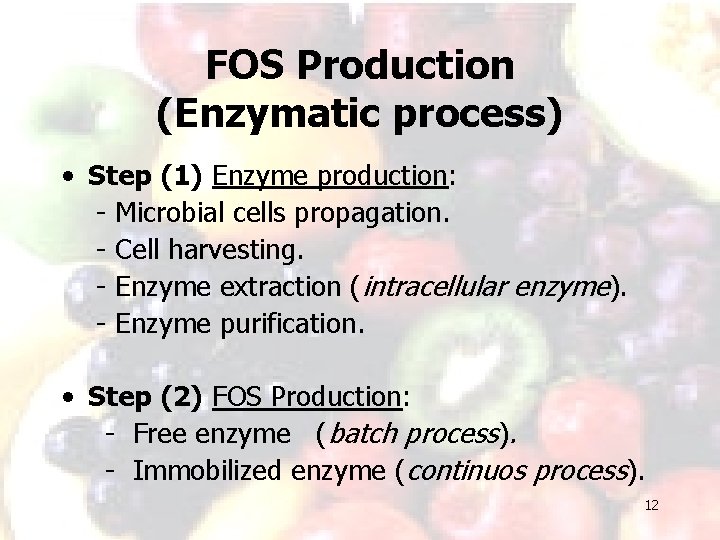
FOS Production (Enzymatic process) • Step (1) Enzyme production: - Microbial cells propagation. - Cell harvesting. - Enzyme extraction (intracellular enzyme). - Enzyme purification. • Step (2) FOS Production: - Free enzyme (batch process). - Immobilized enzyme (continuos process). 12
FOS Production (Whole cells process) • Step (1) Enzyme production: - Microbial cells propagation. - Cell harvesting (centrifugation). • Step (2) FOS Production: - Free whole cells (batch process). - Immobilized whole cells (continuous process). 13
Optimum production conditions - The raw material is sucrose or molasses. Optimum sucrose concentration (70 -80%). Higher enzyme activity. Absence of hydrolytic enzymes (invertase). Optimum bioconversion p. H (5. 0 -6. 5), and temperature (50 -600 C). - Low by-product concentration (glucose/ fructose). - Addition of glucose oxidase or glucose isomerase (enrichment process) 14
Enzymatic process vs. whole cells process • Immobilized enzymes are superior to immobilized cells (faster processing) • Stability of the immobilized cells is proved to be higher than immobilized enzymes. • The minimum economical shelf life for the immobilized system is 3 months. • Batch process needs additional process to remove enzymes or cells. 15
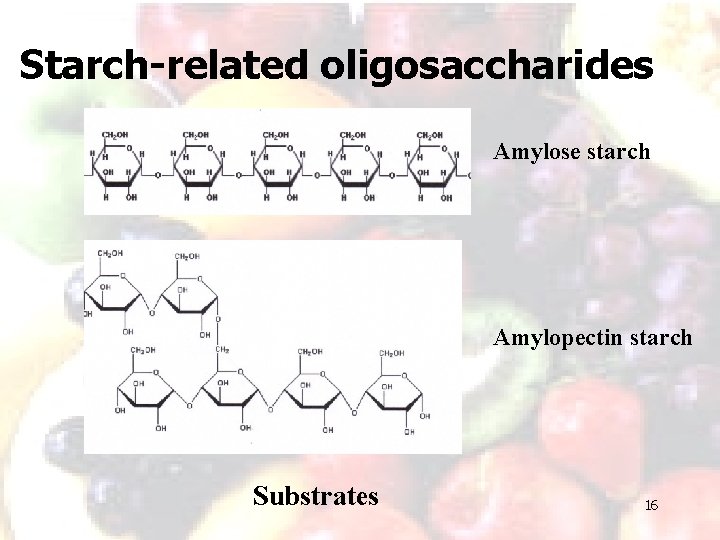
Starch-related oligosaccharides Amylose starch Amylopectin starch Substrates 16
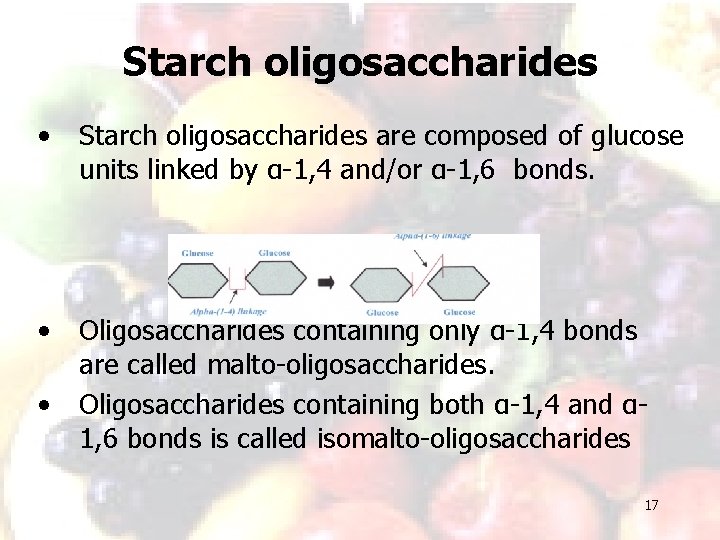
Starch oligosaccharides • Starch oligosaccharides are composed of glucose units linked by α-1, 4 and/or α-1, 6 bonds. • Oligosaccharides containing only α-1, 4 bonds are called malto-oligosaccharides. Oligosaccharides containing both α-1, 4 and α 1, 6 bonds is called isomalto-oligosaccharides • 17
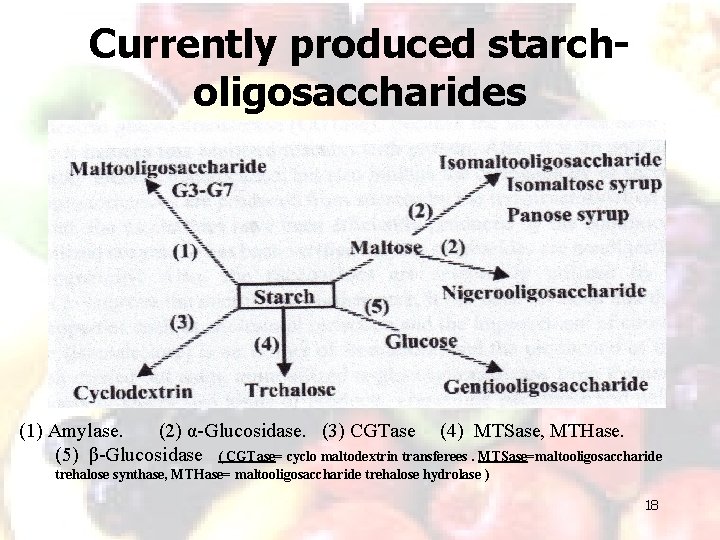
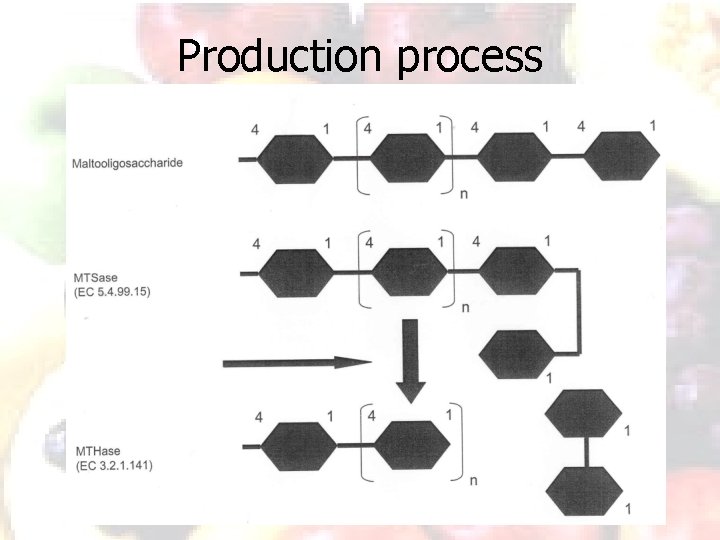
Currently produced starcholigosaccharides (1) Amylase. (2) α-Glucosidase. (3) CGTase (4) MTSase, MTHase. (5) β-Glucosidase ( CGTase= cyclo maltodextrin transferees. MTSase=maltooligosaccharide trehalose synthase, MTHase= maltooligosaccharide trehalose hydrolase ) 18
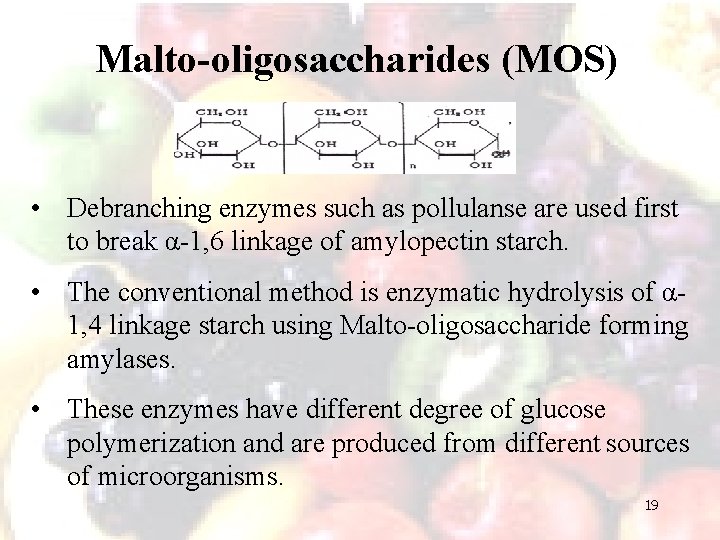
Malto-oligosaccharides (MOS) • Debranching enzymes such as pollulanse are used first to break α-1, 6 linkage of amylopectin starch. • The conventional method is enzymatic hydrolysis of α 1, 4 linkage starch using Malto-oligosaccharide forming amylases. • These enzymes have different degree of glucose polymerization and are produced from different sources of microorganisms. 19
Malto-oligosaccharides Properties • Malto-oligosaccharides are widely used as a ingredients in foods and has the following characteristics: - Carry a mellow sweetener. - The degree of coloring is lower than that of glucose. - Have a high moisture retaining capacity. - Have an ability to suppress aging of starchy food products. 20
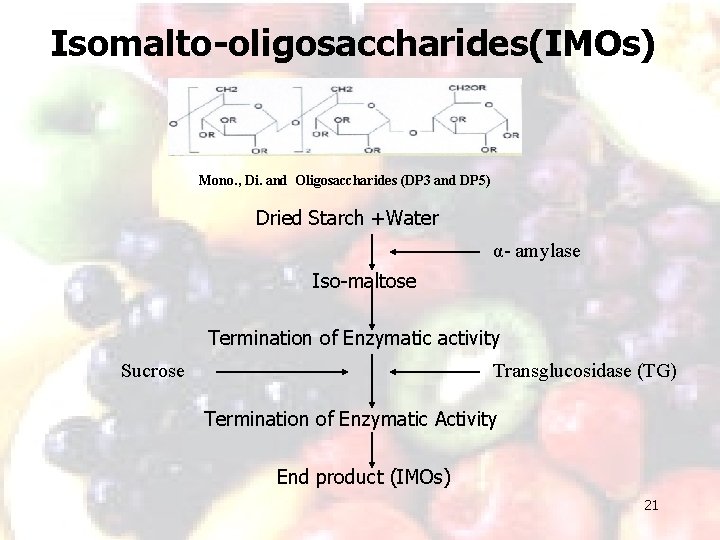
Isomalto-oligosaccharides(IMOs) Mono. , Di. and Oligosaccharides (DP 3 and DP 5) Dried Starch +Water α- amylase Iso-maltose Termination of Enzymatic activity Sucrose Transglucosidase (TG) Termination of Enzymatic Activity End product (IMOs) 21
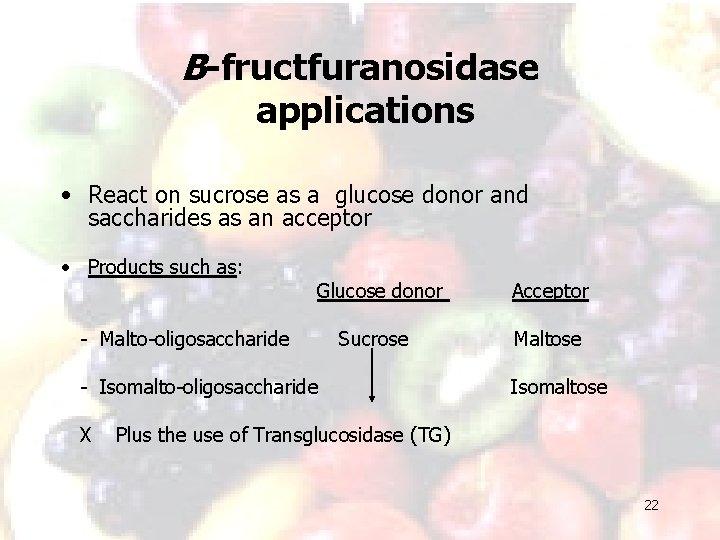
B-fructfuranosidase applications • React on sucrose as a glucose donor and saccharides as an acceptor • Products such as: Glucose donor - Malto-oligosaccharide Sucrose - Isomalto-oligosaccharide X Acceptor Maltose Isomaltose Plus the use of Transglucosidase (TG) 22
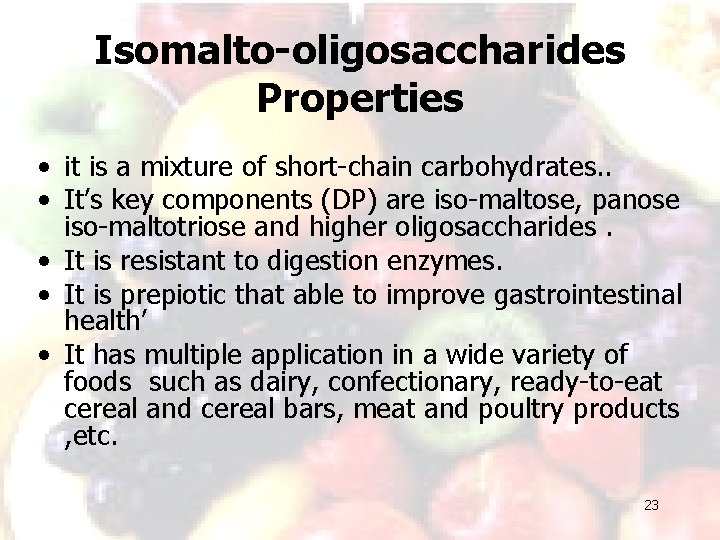
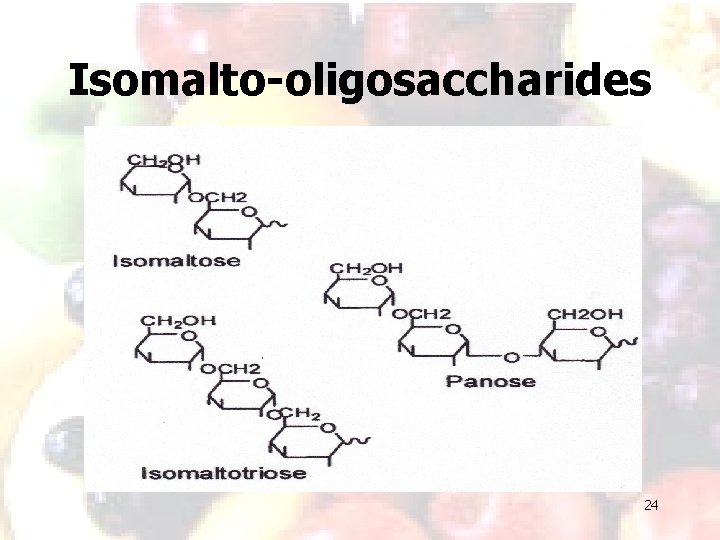
Isomalto-oligosaccharides Properties • it is a mixture of short-chain carbohydrates. . • It’s key components (DP) are iso-maltose, panose iso-maltotriose and higher oligosaccharides. • It is resistant to digestion enzymes. • It is prepiotic that able to improve gastrointestinal health’ • It has multiple application in a wide variety of foods such as dairy, confectionary, ready-to-eat cereal and cereal bars, meat and poultry products , etc. 23
Isomalto-oligosaccharides 24
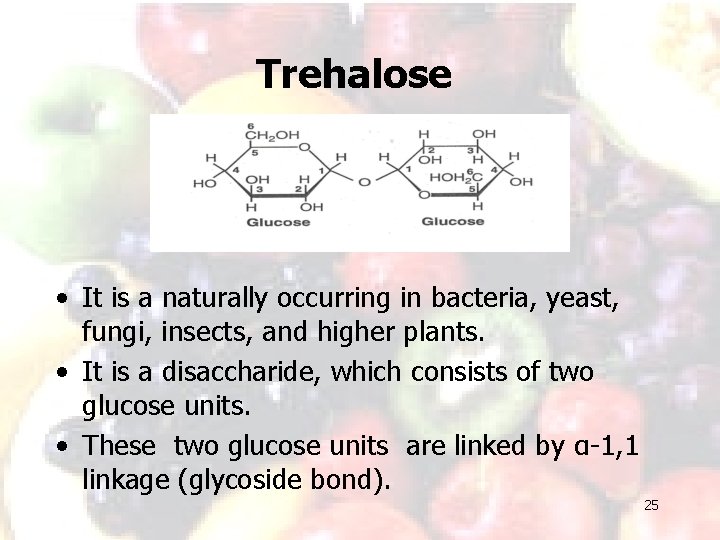
Trehalose • It is a naturally occurring in bacteria, yeast, fungi, insects, and higher plants. • It is a disaccharide, which consists of two glucose units. • These two glucose units are linked by α-1, 1 linkage (glycoside bond). 25
Production process 26
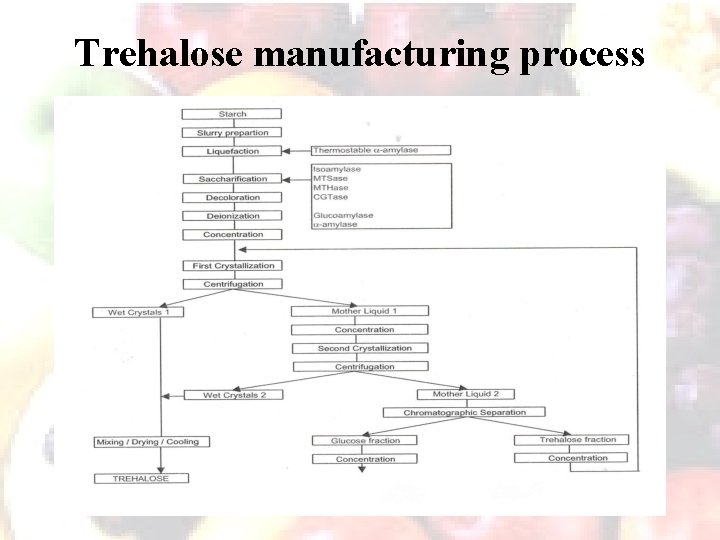
Trehalose manufacturing process 27
Trehalose Properties • Non-reducing disaccharide sugar. • It has 40 -45% sweetness in sucrose. • Odorless, almost white crystals with sweet taste. • Stable at all p. H and temperature conditions. 28
Trehalose applications • • • Bulk sweetener Texturizer. Stabilizer. Humectants. Formulation aid 29
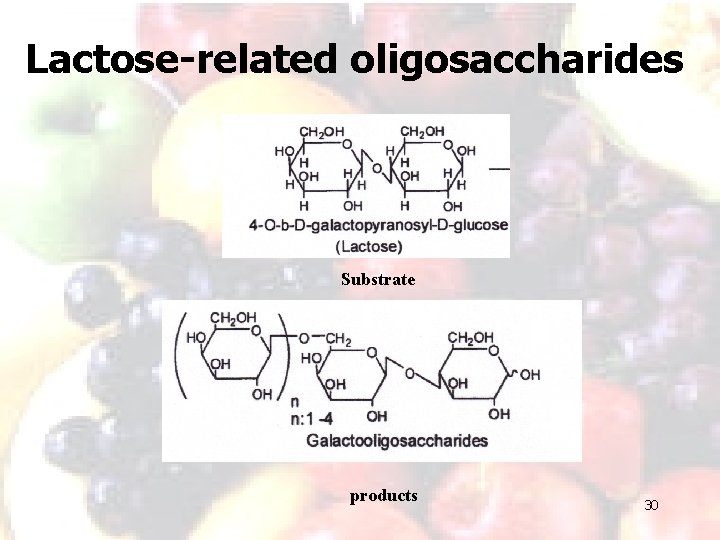
Lactose-related oligosaccharides Substrate products 30
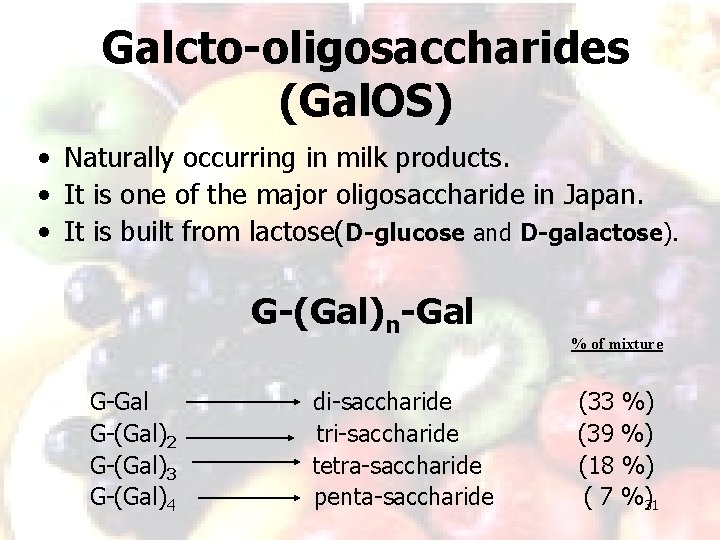
Galcto-oligosaccharides (Gal. OS) • Naturally occurring in milk products. • It is one of the major oligosaccharide in Japan. • It is built from lactose(D-glucose and D-galactose). G-(Gal)n-Gal G-(Gal)2 G-(Gal)3 G-(Gal)4 di-saccharide tri-saccharide tetra-saccharide penta-saccharide % of mixture (33 %) (39 %) (18 %) ( 7 %)31
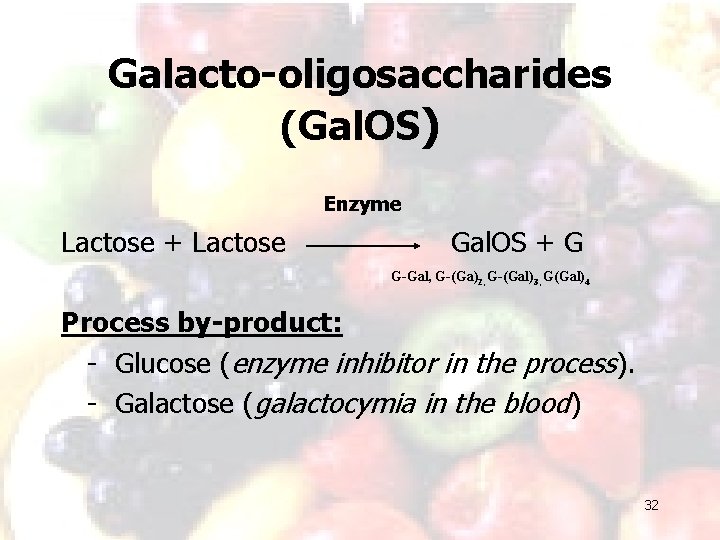
Galacto-oligosaccharides (Gal. OS) Enzyme Lactose + Lactose Gal. OS + G G-Gal, G-(Ga)2, G-(Gal)3, G(Gal)4 Process by-product: - Glucose (enzyme inhibitor in the process). - Galactose (galactocymia in the blood) 32
Gal. OS Production Enzyme • Enzyme name: - B-galactosidase (EC 3. 2. 1. 22). (Also known by the name lactase and B-galactosyl transferase) • Microbial source: - Aspergillus niger. - Aspergillus oryzae. - Kluyveromycin lactis. - Kluyveromycin Fragili. - Bacillus circulans. - Streptococcus thermophilus. 33
Gal. OS Production process • Step (1) Enzyme production: - Microbial propagation (inducible enzyme). - Cell mass removal (exracellular enzyme). - Enzyme purification. • Step (2) Gal. OS Production: - Free enzyme (batch process) - Immobilized enzyme (continuous process). 34
Optimum Production conditions - The raw material is lactose or whey Optimum Lactose concentration (70 -80%). Higher enzyme activity. Optimum bioconversion p. H (5. 0 -6. 5), and temperature (50 -600 C). - Low by-product concentration (glucose / galactose) - Addition of glucose oxidase or glucose isomerase (enrichment process). - Elimination of free galactose. 35
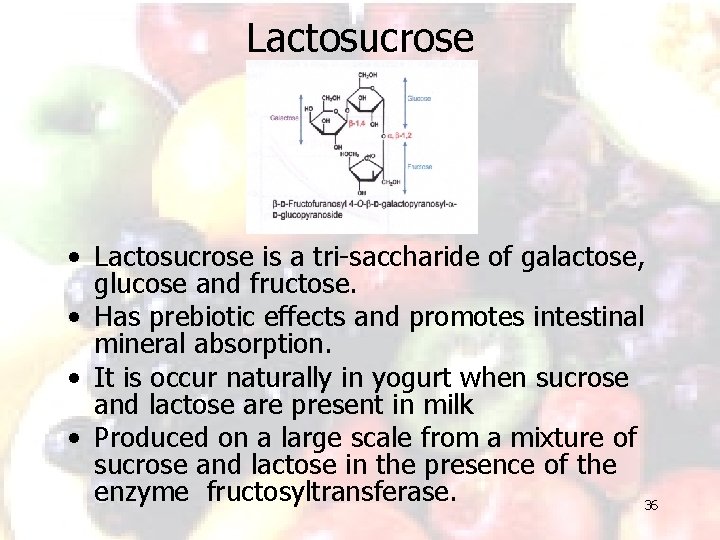
Lactosucrose • Lactosucrose is a tri-saccharide of galactose, glucose and fructose. • Has prebiotic effects and promotes intestinal mineral absorption. • It is occur naturally in yogurt when sucrose and lactose are present in milk • Produced on a large scale from a mixture of sucrose and lactose in the presence of the enzyme fructosyltransferase. 36
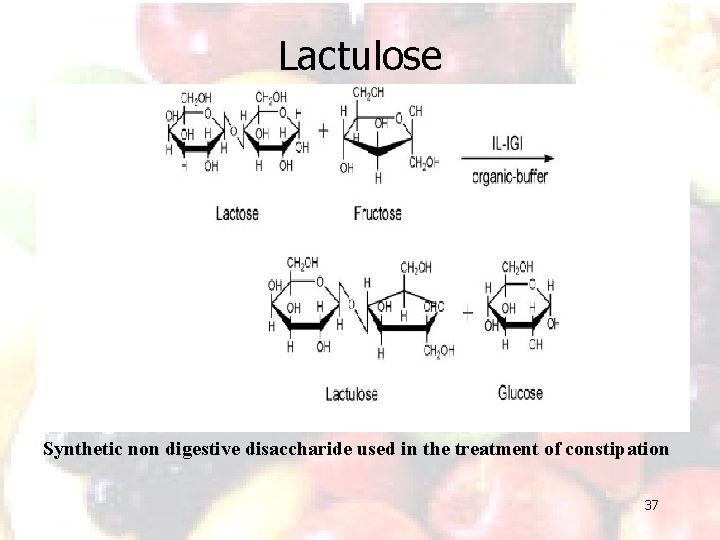
Lactulose Synthetic non digestive disaccharide used in the treatment of constipation 37
Other-oligosaccharides • Xylo-oligosaccharides. • Soy-oligosaccharides 38
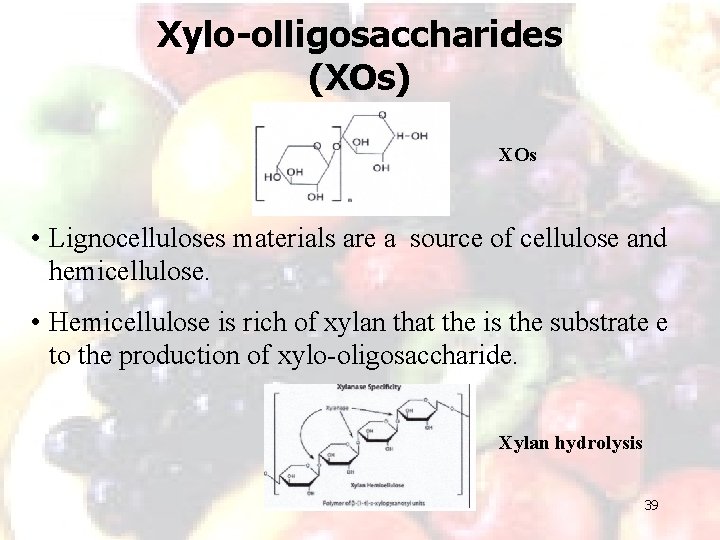
Xylo-olligosaccharides (XOs) XOs • Lignocelluloses materials are a source of cellulose and hemicellulose. • Hemicellulose is rich of xylan that the is the substrate e to the production of xylo-oligosaccharide. Xylan hydrolysis 39
Xylo-oligosaccharides (XOs) • XOs is a non-digestible oligosaccharide (prebiotic) • It is odorless white powder or yellowish liquid. • It is water soluble, has low caloric value, good taste with 40% sweetness of cane sugar. • It has antimicrobial (inhibit microbial growth) and humectants properties. • It is used in a wide variety of products, such as: functional beverages, sugarless /low sugar confections, dairy products, functional healthy foods, acid products (salad dressing), beer & wine, prebiotic supplements, etc. 40
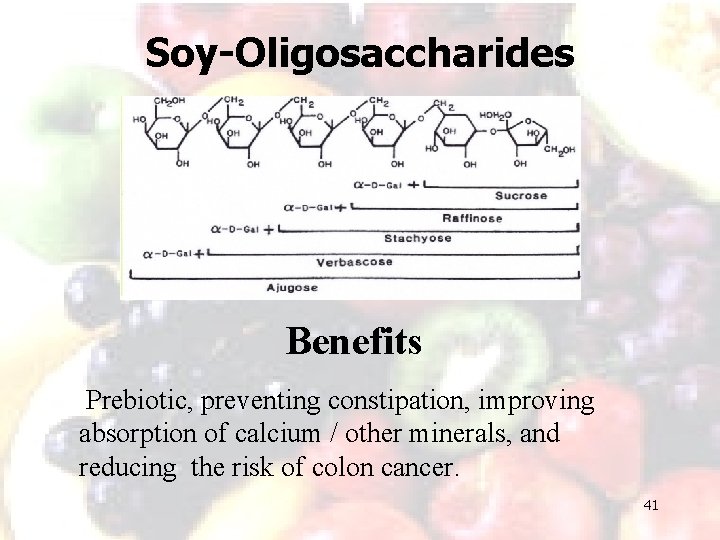
Soy-Oligosaccharides Benefits Prebiotic, preventing constipation, improving absorption of calcium / other minerals, and reducing the risk of colon cancer. 41
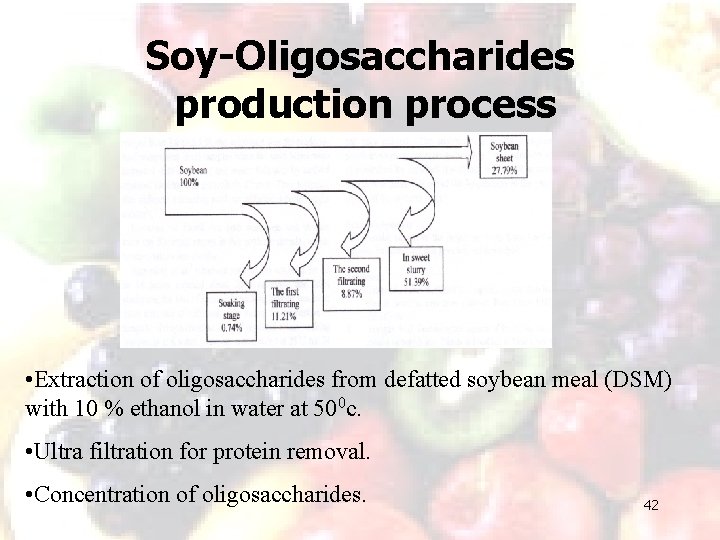
Soy-Oligosaccharides production process • Extraction of oligosaccharides from defatted soybean meal (DSM) with 10 % ethanol in water at 500 c. • Ultra filtration for protein removal. • Concentration of oligosaccharides. 42
Summary • Great concern for health food impact the need for healthier food products. • Much attention has been paid recently for functional oligosaccharides which promote the growth of Bifidobacteria in vivo. • A number of different oligosaccharides are currently used as low calorie sweeteners. • One of these oligosaccharides is Galactooligosachharides which represent one way to add value to cheese whey. 43