
Oligopoly Look for 1 Determination of the profit
- Slides: 38
Oligopoly Look for: 1. Determination of the profit maximizing price and quantity. 2. Implications for efficiency Issues of Oligopoly • Game theory and collusion • 3 oligopoly models • Profit maximization • Efficiency Please listen to the audio as you work through the slides.
Learning objectives Students should be able to thoroughly and completely explain: 1. The characteristics of oligopoly 2. The conditions under which the Oligopolist firm achieves profit maximization and loss minimization. 3. Oligopoly Behavior, including collusion and game theory.
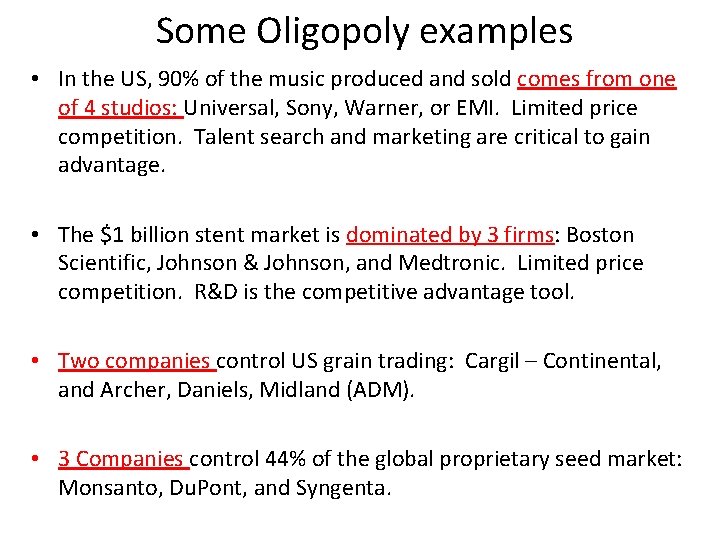
Some Oligopoly examples • In the US, 90% of the music produced and sold comes from one of 4 studios: Universal, Sony, Warner, or EMI. Limited price competition. Talent search and marketing are critical to gain advantage. • The $1 billion stent market is dominated by 3 firms: Boston Scientific, Johnson & Johnson, and Medtronic. Limited price competition. R&D is the competitive advantage tool. • Two companies control US grain trading: Cargil – Continental, and Archer, Daniels, Midland (ADM). • 3 Companies control 44% of the global proprietary seed market: Monsanto, Du. Pont, and Syngenta.
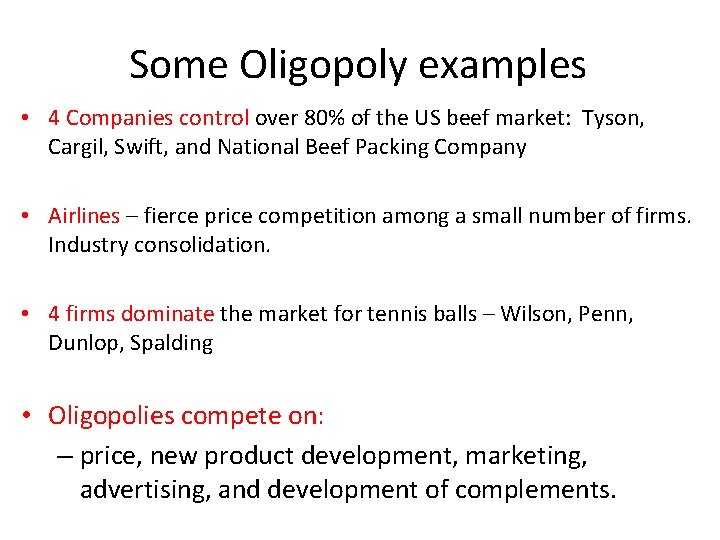
Some Oligopoly examples • 4 Companies control over 80% of the US beef market: Tyson, Cargil, Swift, and National Beef Packing Company • Airlines – fierce price competition among a small number of firms. Industry consolidation. • 4 firms dominate the market for tennis balls – Wilson, Penn, Dunlop, Spalding • Oligopolies compete on: – price, new product development, marketing, advertising, and development of complements.
The market structures – compare the characteristics • • • Type of products Control over price Exit and entry Non price competition Price output determination Efficiency
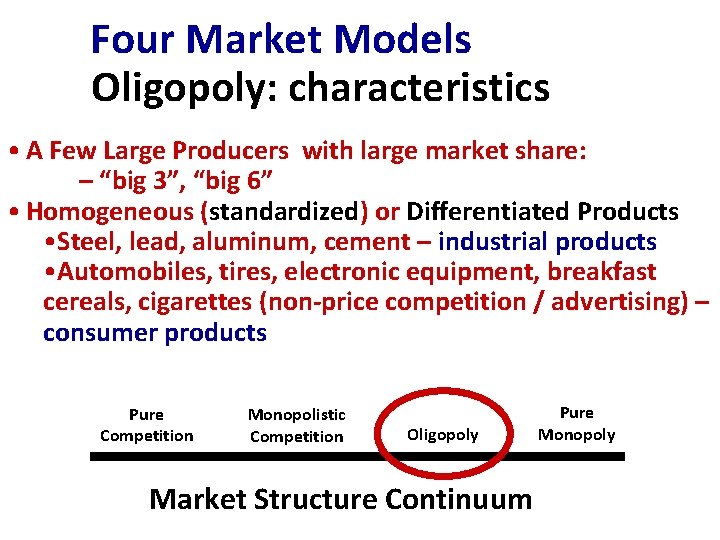
Four Market Models Oligopoly: characteristics • A Few Large Producers with large market share: – “big 3”, “big 6” • Homogeneous (standardized) or Differentiated Products • Steel, lead, aluminum, cement – industrial products • Automobiles, tires, electronic equipment, breakfast cereals, cigarettes (non-price competition / advertising) – consumer products Pure Competition Monopolistic Competition Oligopoly Market Structure Continuum Pure Monopoly
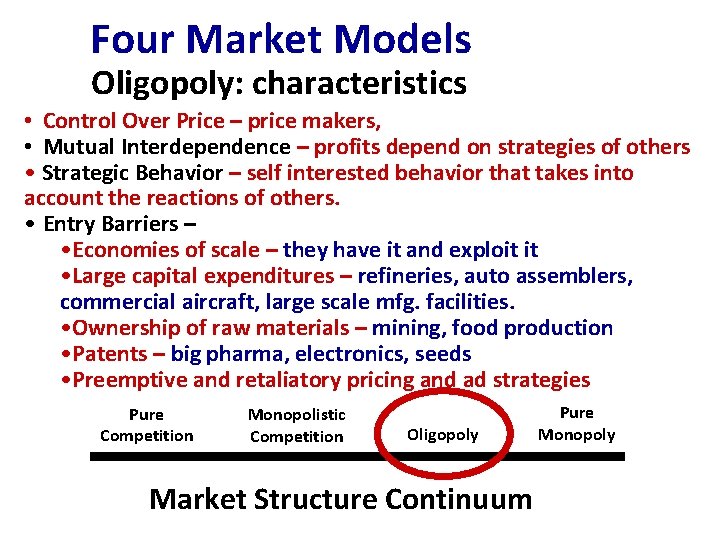
Four Market Models Oligopoly: characteristics • Control Over Price – price makers, • Mutual Interdependence – profits depend on strategies of others • Strategic Behavior – self interested behavior that takes into account the reactions of others. • Entry Barriers – • Economies of scale – they have it and exploit it • Large capital expenditures – refineries, auto assemblers, commercial aircraft, large scale mfg. facilities. • Ownership of raw materials – mining, food production • Patents – big pharma, electronics, seeds • Preemptive and retaliatory pricing and ad strategies Pure Competition Monopolistic Competition Oligopoly Market Structure Continuum Pure Monopoly
Evolution of Oligopolies Where do Oligopolies come from? Growth of dominant firms – they just get big Mergers – auto industry, banking, food manufacturers, airlines, They attempt to achieve monopoly power – without attracting the attention of the anti-trust division of the Justice Dept.
Oligopoly Behavior Game theory – a subfield of economics that analyzes the choices made by rival firms, people, and even governments as they try to maximize their own well-being while anticipating and reacting to the actions of others in their environment. A key tool during the Cold War period.
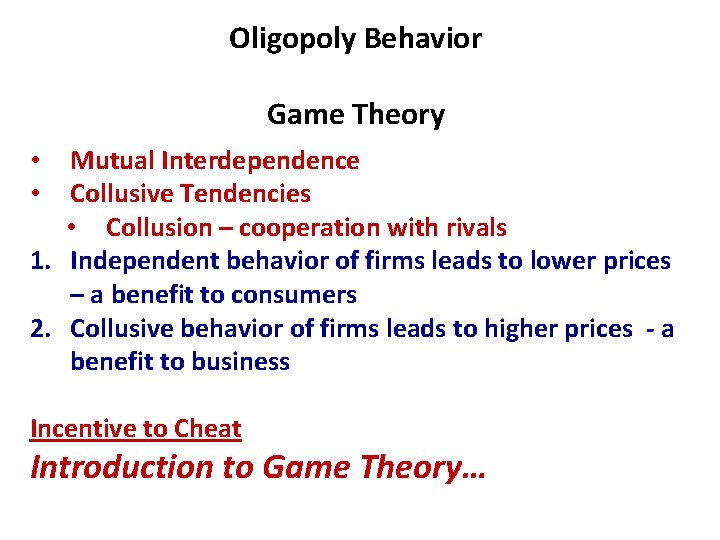
Oligopoly Behavior Game Theory Mutual Interdependence Collusive Tendencies • Collusion – cooperation with rivals 1. Independent behavior of firms leads to lower prices – a benefit to consumers 2. Collusive behavior of firms leads to higher prices - a benefit to business • • Incentive to Cheat Introduction to Game Theory…
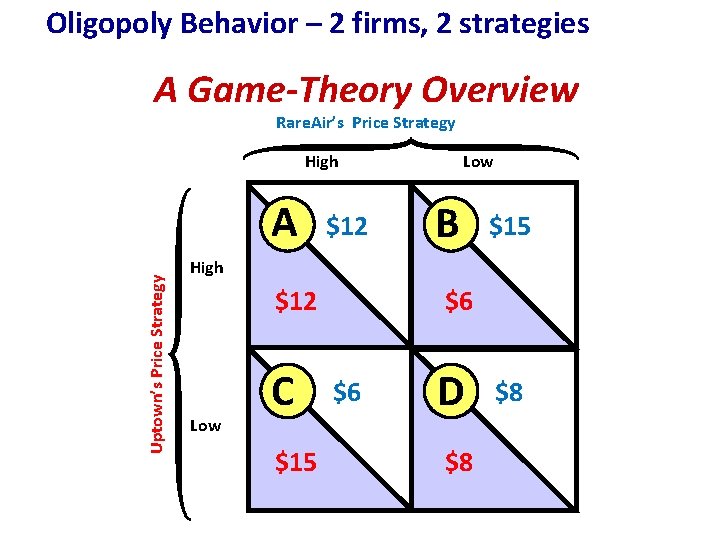
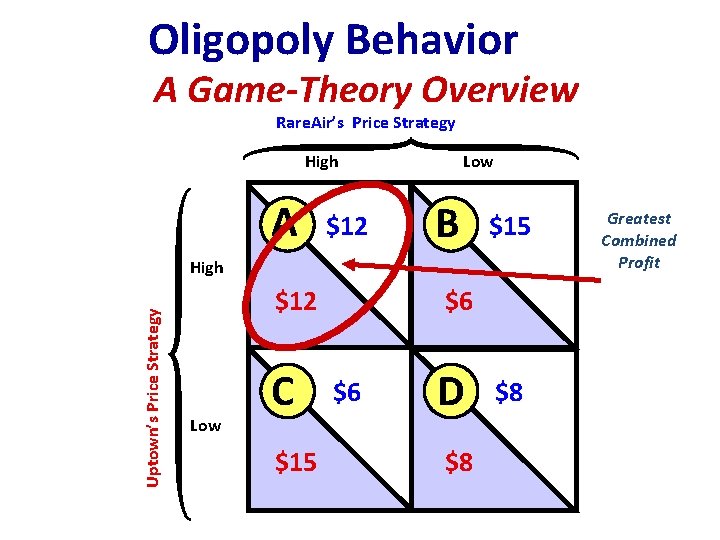
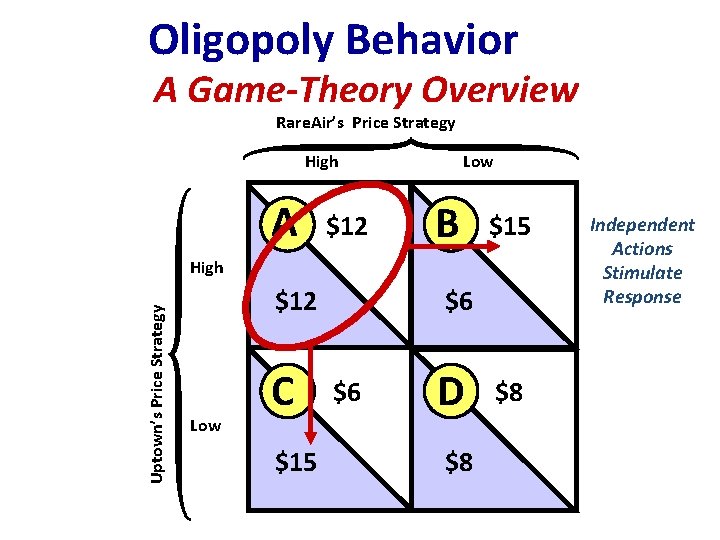
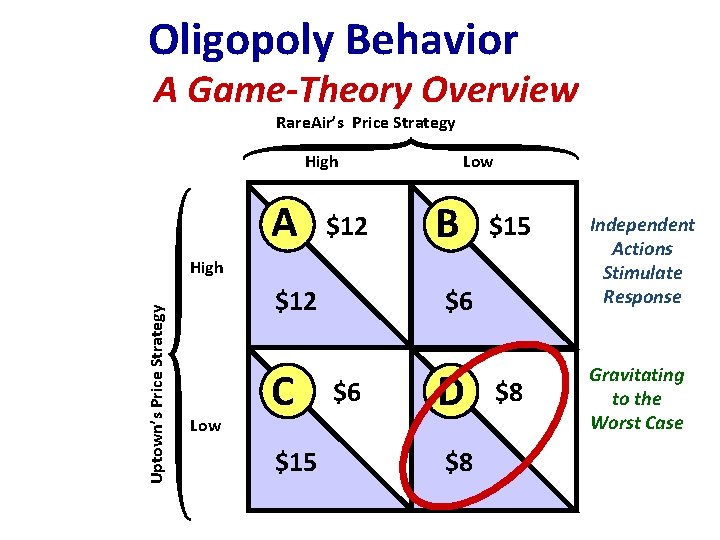
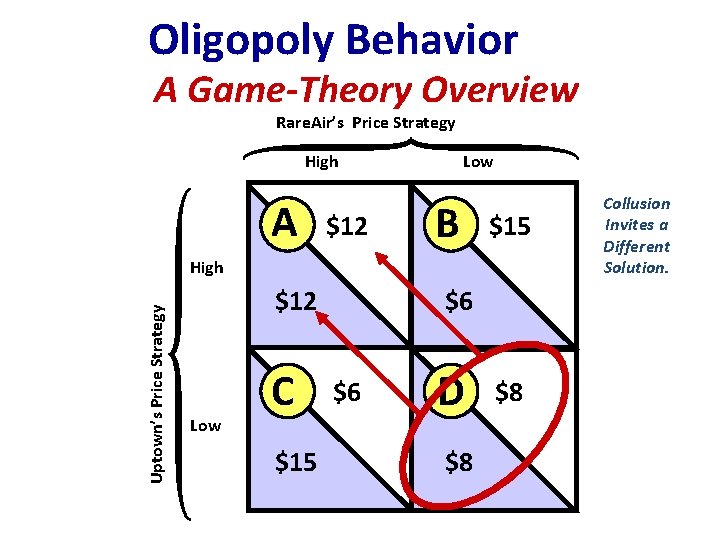
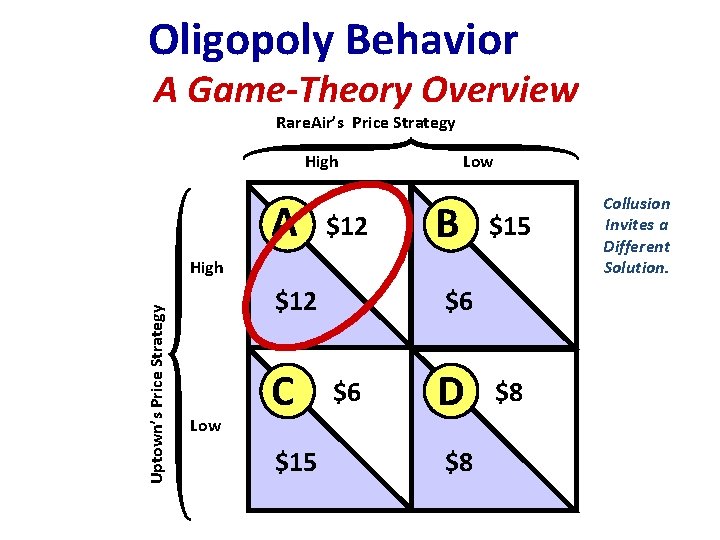
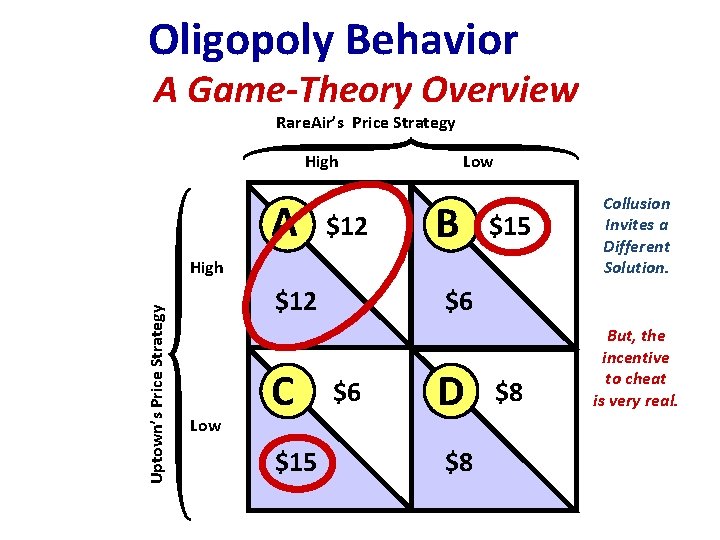
Oligopoly Behavior – 2 firms, 2 strategies A Game-Theory Overview Rare. Air’s Price Strategy High Uptown’s Price Strategy A $12 Low B $15 High $12 Low C $15 $6 $6 D $8 $8
Oligopoly Behavior A Game-Theory Overview Rare. Air’s Price Strategy High A $12 Low B $15 Uptown’s Price Strategy High $12 Low C $15 $6 $6 D $8 $8 Greatest Combined Profit
Oligopoly Behavior A Game-Theory Overview Rare. Air’s Price Strategy High A $12 Low B $15 Uptown’s Price Strategy High $12 Low C $15 $6 $6 D $8 $8 Independent Actions Stimulate Response
Oligopoly Behavior A Game-Theory Overview Rare. Air’s Price Strategy High A $12 Low B $15 Uptown’s Price Strategy High $12 Low C $15 $6 $6 D $8 $8 Independent Actions Stimulate Response Gravitating to the Worst Case
Oligopoly Behavior A Game-Theory Overview Rare. Air’s Price Strategy High A $12 Low B $15 Uptown’s Price Strategy High $12 Low C $15 $6 $6 D $8 $8 Collusion Invites a Different Solution.
Oligopoly Behavior A Game-Theory Overview Rare. Air’s Price Strategy High A $12 Low B $15 Uptown’s Price Strategy High $12 Low C $15 $6 $6 D $8 $8 Collusion Invites a Different Solution.
Oligopoly Behavior A Game-Theory Overview Rare. Air’s Price Strategy High A $12 Low B $15 Uptown’s Price Strategy High $12 Low C $15 Collusion Invites a Different Solution. $6 $6 D $8 $8 But, the incentive to cheat is very real.
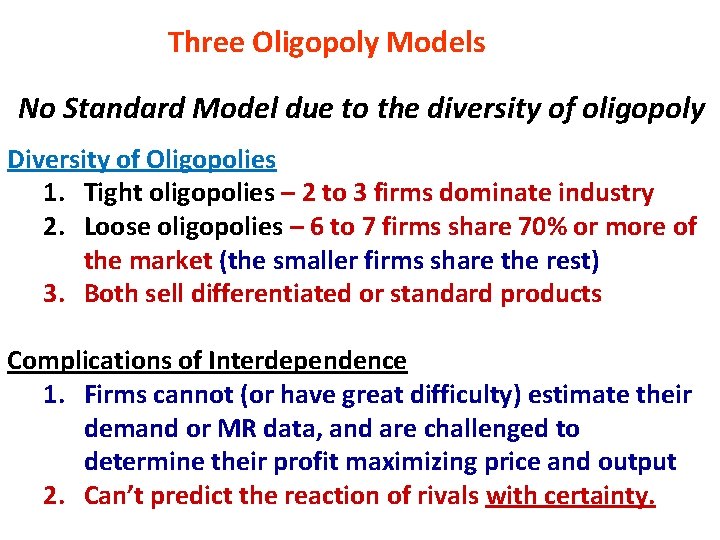
Three Oligopoly Models No Standard Model due to the diversity of oligopoly Diversity of Oligopolies 1. Tight oligopolies – 2 to 3 firms dominate industry 2. Loose oligopolies – 6 to 7 firms share 70% or more of the market (the smaller firms share the rest) 3. Both sell differentiated or standard products Complications of Interdependence 1. Firms cannot (or have great difficulty) estimate their demand or MR data, and are challenged to determine their profit maximizing price and output 2. Can’t predict the reaction of rivals with certainty.
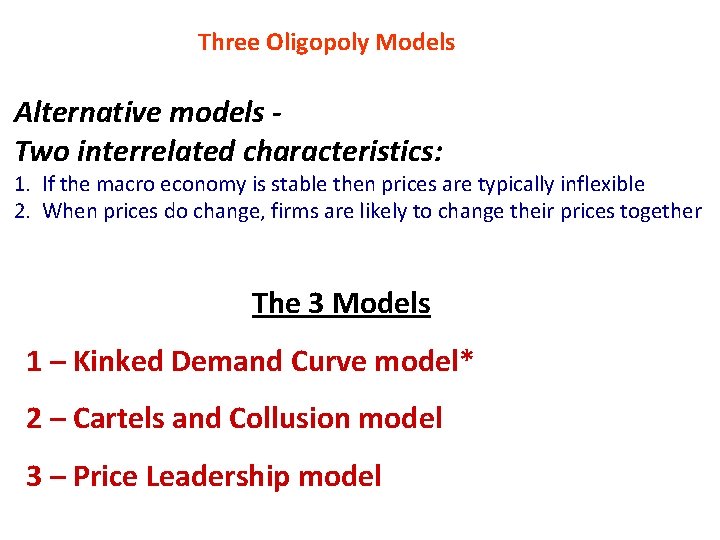
Three Oligopoly Models Alternative models Two interrelated characteristics: 1. If the macro economy is stable then prices are typically inflexible 2. When prices do change, firms are likely to change their prices together The 3 Models 1 – Kinked Demand Curve model* 2 – Cartels and Collusion model 3 – Price Leadership model
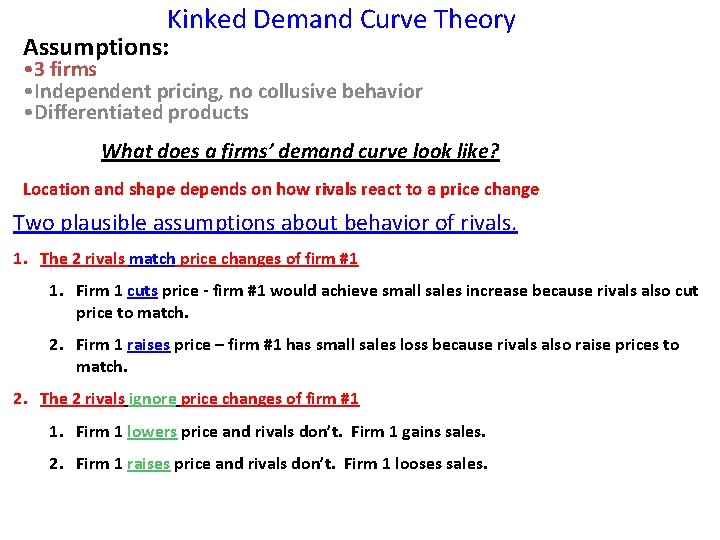
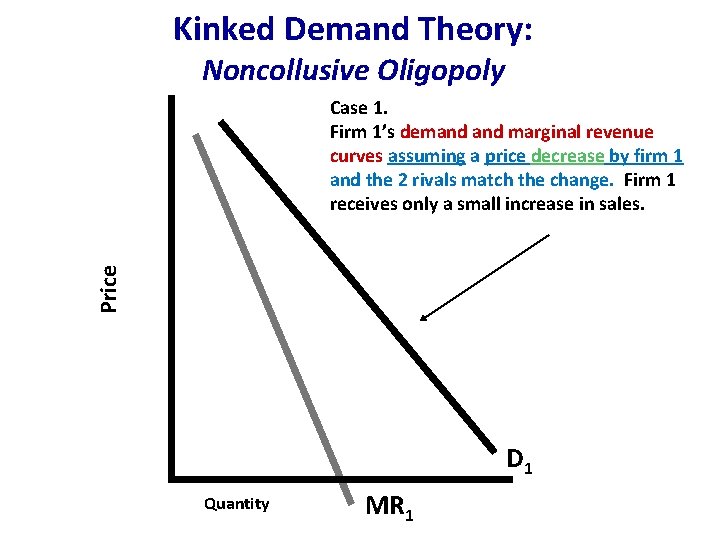
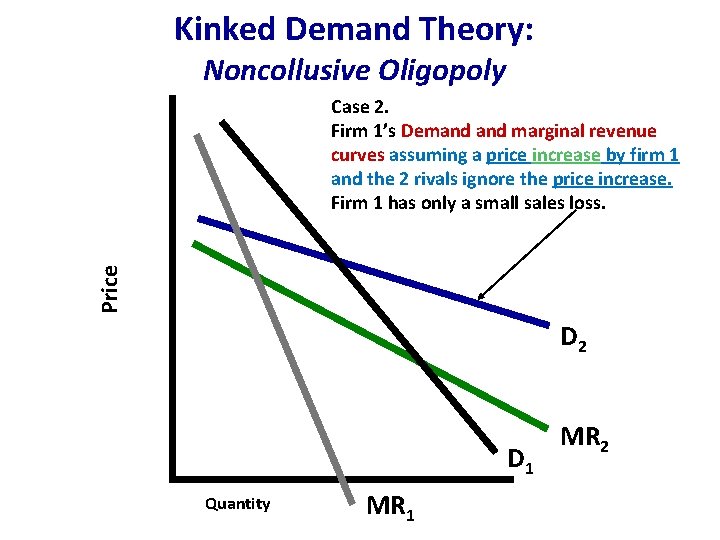
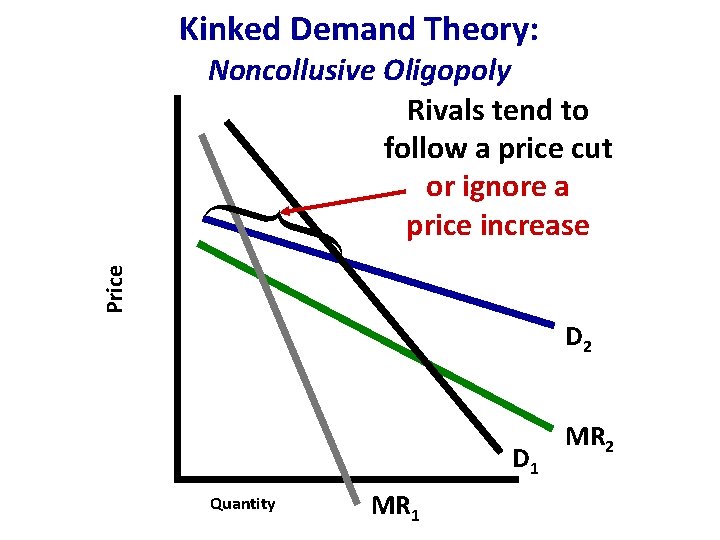
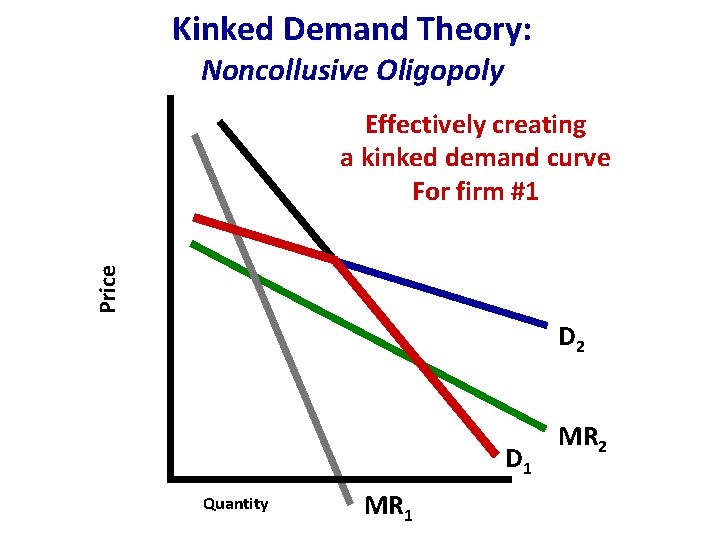
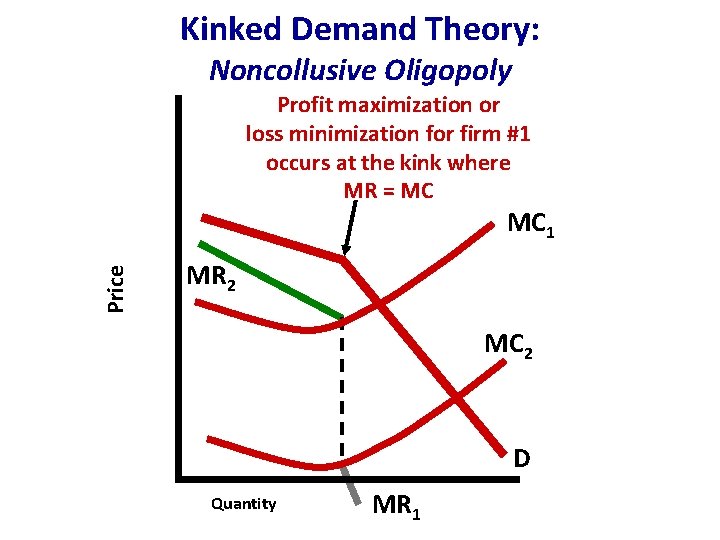
Kinked Demand Curve Theory Assumptions: • 3 firms • Independent pricing, no collusive behavior • Differentiated products What does a firms’ demand curve look like? Location and shape depends on how rivals react to a price change Two plausible assumptions about behavior of rivals. 1. The 2 rivals match price changes of firm #1 1. Firm 1 cuts price - firm #1 would achieve small sales increase because rivals also cut price to match. 2. Firm 1 raises price – firm #1 has small sales loss because rivals also raise prices to match. 2. The 2 rivals ignore price changes of firm #1 1. Firm 1 lowers price and rivals don’t. Firm 1 gains sales. 2. Firm 1 raises price and rivals don’t. Firm 1 looses sales.
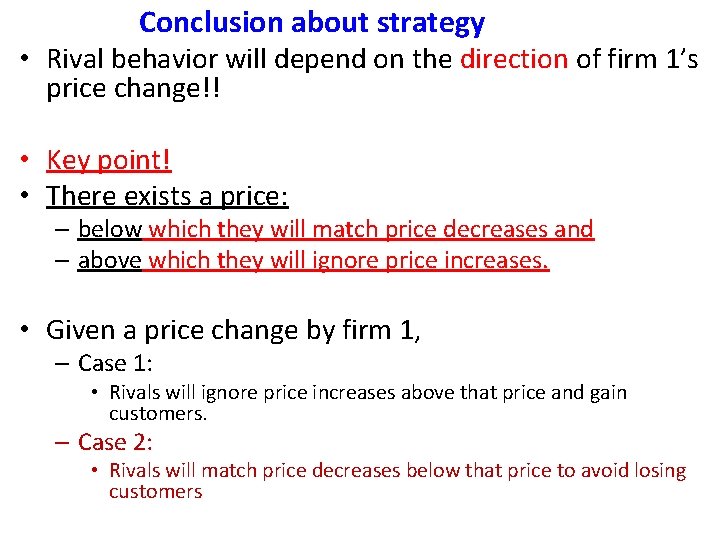
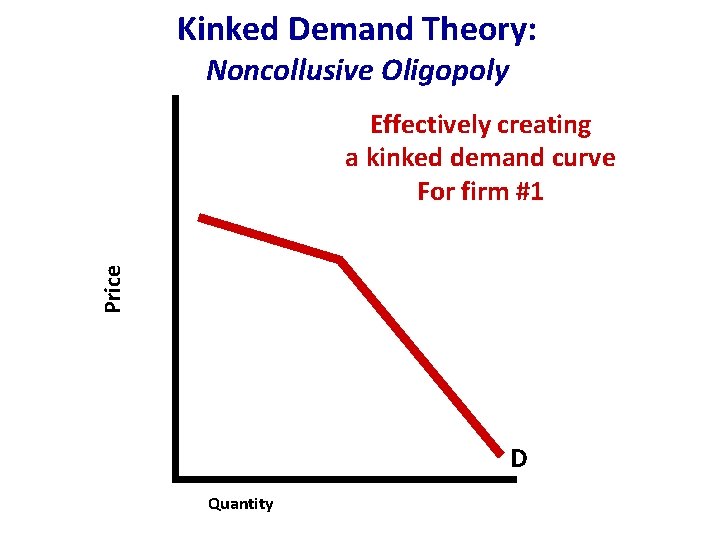
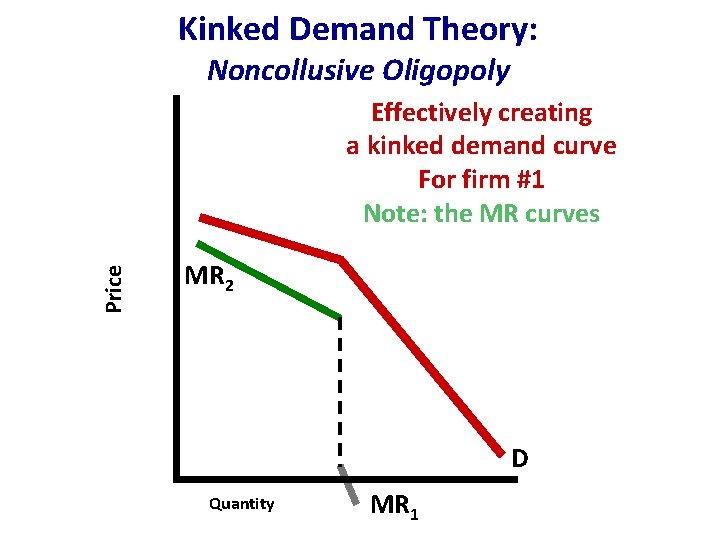
Conclusion about strategy • Rival behavior will depend on the direction of firm 1’s price change!! • Key point! • There exists a price: – below which they will match price decreases and – above which they will ignore price increases. • Given a price change by firm 1, – Case 1: • Rivals will ignore price increases above that price and gain customers. – Case 2: • Rivals will match price decreases below that price to avoid losing customers
Kinked Demand Theory: Noncollusive Oligopoly Price Case 1. Firm 1’s demand marginal revenue curves assuming a price decrease by firm 1 and the 2 rivals match the change. Firm 1 receives only a small increase in sales. D 1 Quantity MR 1
Kinked Demand Theory: Noncollusive Oligopoly Price Case 2. Firm 1’s Demand marginal revenue curves assuming a price increase by firm 1 and the 2 rivals ignore the price increase. Firm 1 has only a small sales loss. D 2 D 1 Quantity MR 1 MR 2
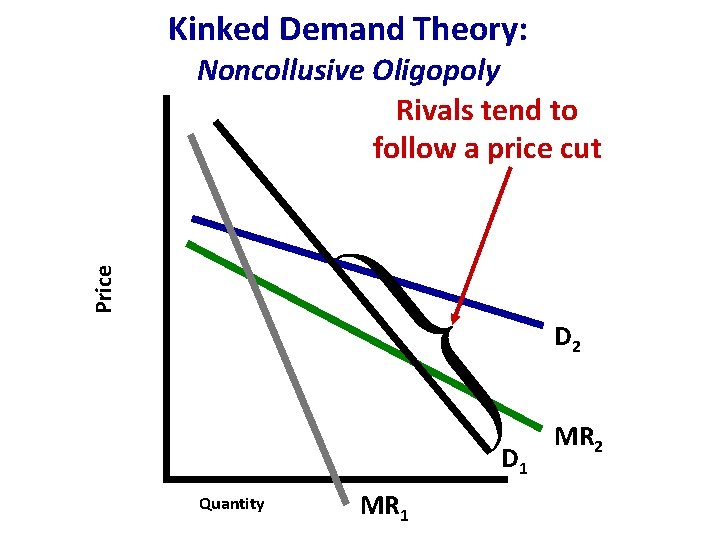
Kinked Demand Theory: Price Noncollusive Oligopoly Rivals tend to follow a price cut D 2 D 1 Quantity MR 1 MR 2
Kinked Demand Theory: Price Noncollusive Oligopoly Rivals tend to follow a price cut or ignore a price increase D 2 D 1 Quantity MR 1 MR 2
Kinked Demand Theory: Noncollusive Oligopoly Price Effectively creating a kinked demand curve For firm #1 D 2 D 1 Quantity MR 1 MR 2
Kinked Demand Theory: Noncollusive Oligopoly Price Effectively creating a kinked demand curve For firm #1 D Quantity
Kinked Demand Theory: Noncollusive Oligopoly Price Effectively creating a kinked demand curve For firm #1 Note: the MR curves MR 2 D Quantity MR 1
Kinked Demand Theory: Noncollusive Oligopoly Profit maximization or loss minimization for firm #1 occurs at the kink where MR = MC Price MC 1 MR 2 MC 2 D Quantity MR 1
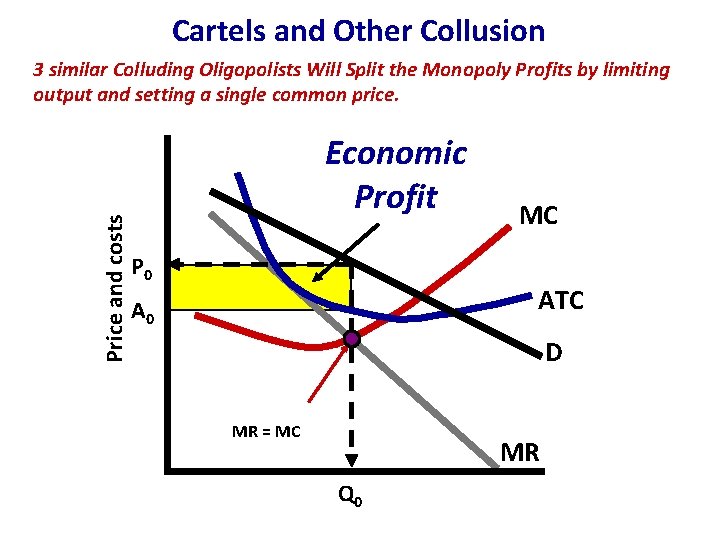
Cartels and Other Collusion Oligopoly is conducive to collusion. If a few firms face identical or highly similar demand costs. . . they will tend to seek joint profit maximization. Graphically…
Cartels and Other Collusion Price and costs 3 similar Colluding Oligopolists Will Split the Monopoly Profits by limiting output and setting a single common price. Economic Profit P 0 MC ATC A 0 D MR = MC MR Q 0
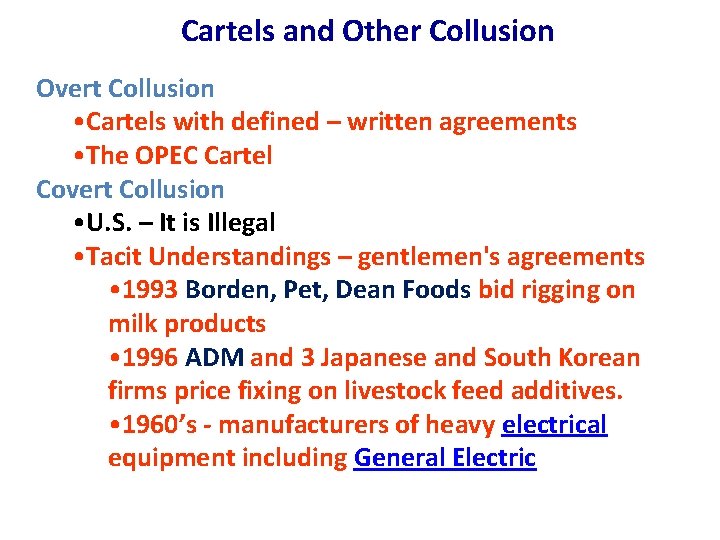
Cartels and Other Collusion Overt Collusion • Cartels with defined – written agreements • The OPEC Cartel Covert Collusion • U. S. – It is Illegal • Tacit Understandings – gentlemen's agreements • 1993 Borden, Pet, Dean Foods bid rigging on milk products • 1996 ADM and 3 Japanese and South Korean firms price fixing on livestock feed additives. • 1960’s - manufacturers of heavy electrical equipment including General Electric
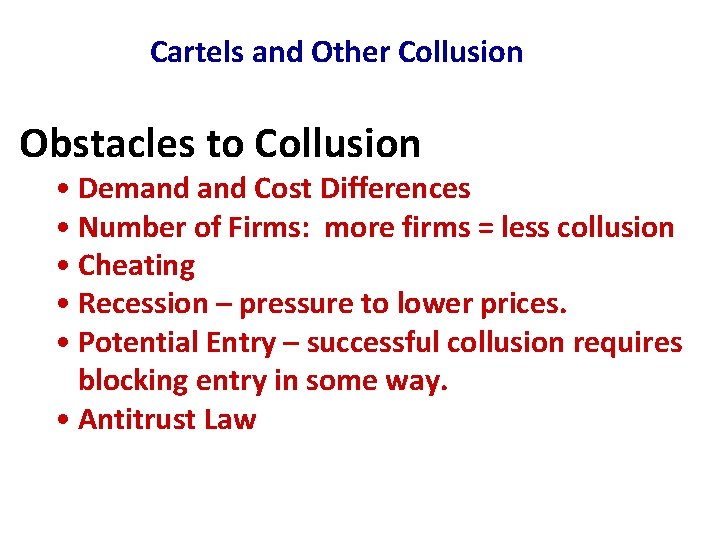
Cartels and Other Collusion Obstacles to Collusion • Demand Cost Differences • Number of Firms: more firms = less collusion • Cheating • Recession – pressure to lower prices. • Potential Entry – successful collusion requires blocking entry in some way. • Antitrust Law
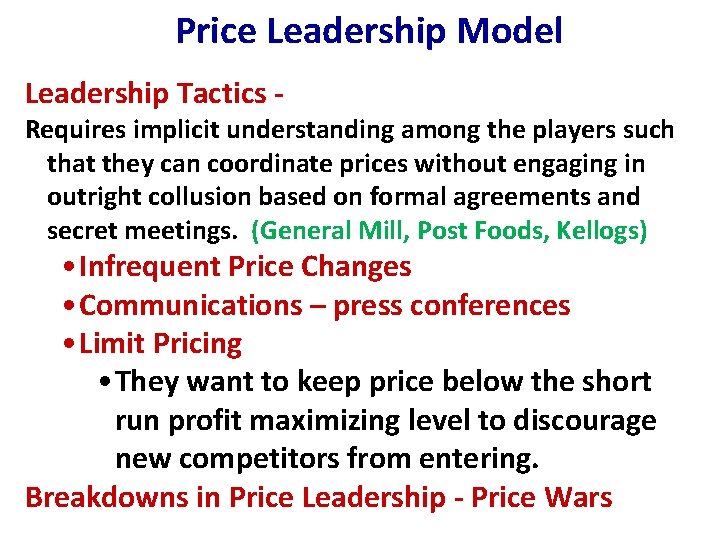
Price Leadership Model Leadership Tactics - Requires implicit understanding among the players such that they can coordinate prices without engaging in outright collusion based on formal agreements and secret meetings. (General Mill, Post Foods, Kellogs) • Infrequent Price Changes • Communications – press conferences • Limit Pricing • They want to keep price below the short run profit maximizing level to discourage new competitors from entering. Breakdowns in Price Leadership - Price Wars
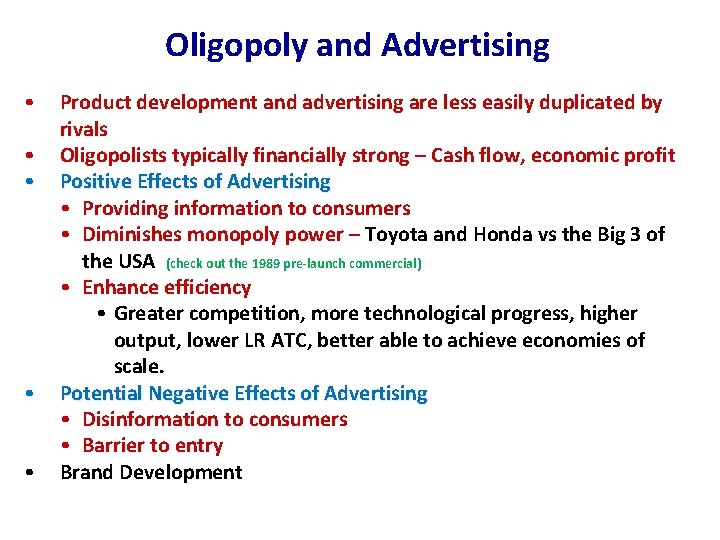
Oligopoly and Advertising • • • Product development and advertising are less easily duplicated by rivals Oligopolists typically financially strong – Cash flow, economic profit Positive Effects of Advertising • Providing information to consumers • Diminishes monopoly power – Toyota and Honda vs the Big 3 of the USA (check out the 1989 pre-launch commercial) • Enhance efficiency • Greater competition, more technological progress, higher output, lower LR ATC, better able to achieve economies of scale. Potential Negative Effects of Advertising • Disinformation to consumers • Barrier to entry Brand Development
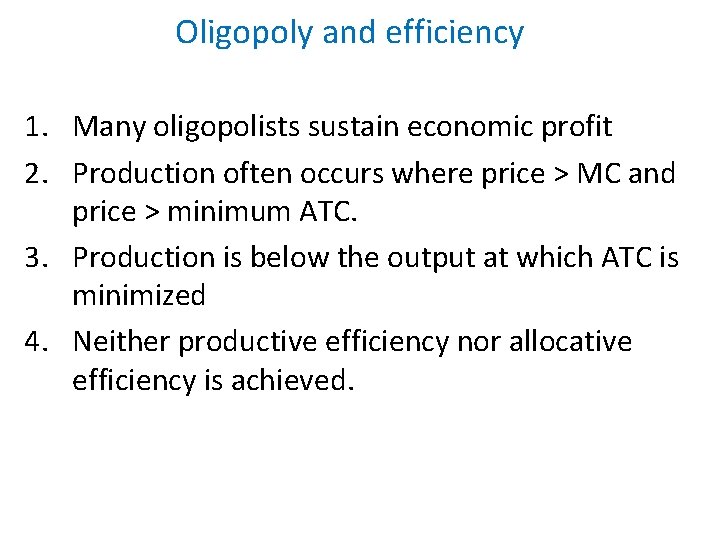
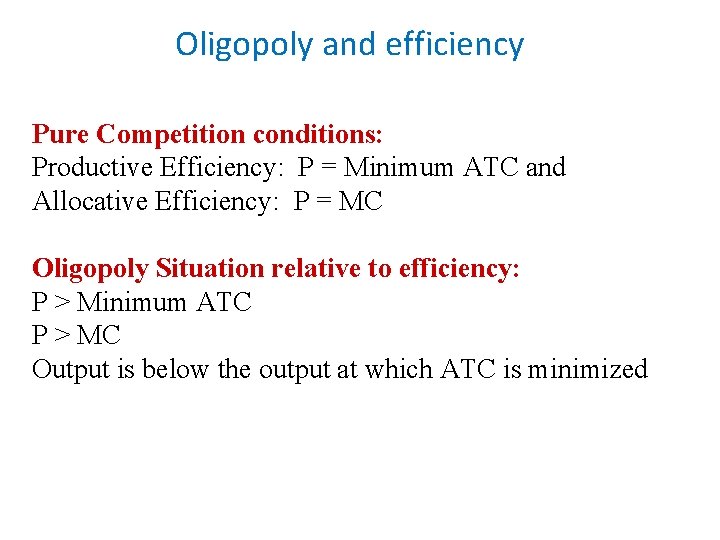
Oligopoly and efficiency 1. Many oligopolists sustain economic profit 2. Production often occurs where price > MC and price > minimum ATC. 3. Production is below the output at which ATC is minimized 4. Neither productive efficiency nor allocative efficiency is achieved.
Oligopoly and efficiency Pure Competition conditions: Productive Efficiency: P = Minimum ATC and Allocative Efficiency: P = MC Oligopoly Situation relative to efficiency: P > Minimum ATC P > MC Output is below the output at which ATC is minimized
monopolistic competition product differentiation nonprice competition excess capacity oligopoly homogeneous oligopoly differentiated oligopoly interindustry competition import competition Herfindahl index game-theory model collusion kinked-demand curve price war cartel tacit understandings price leadership