
Olecranon fracture Lonnie Froberg MD Ph D Odense
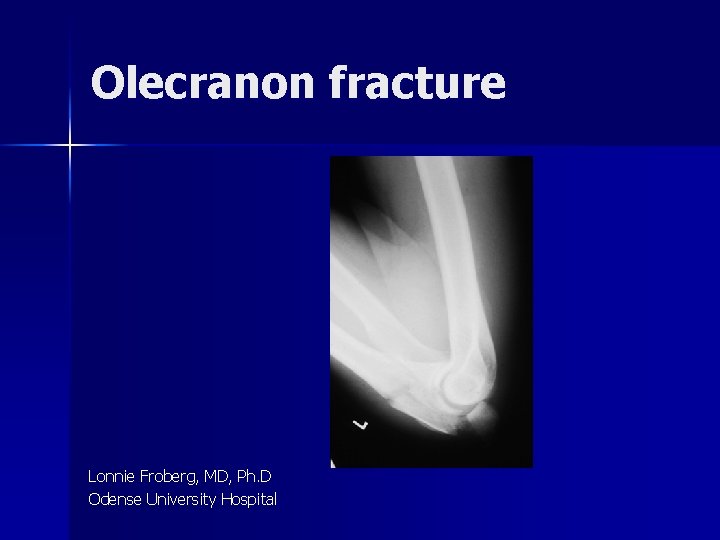
Olecranon fracture Lonnie Froberg, MD, Ph. D Odense University Hospital
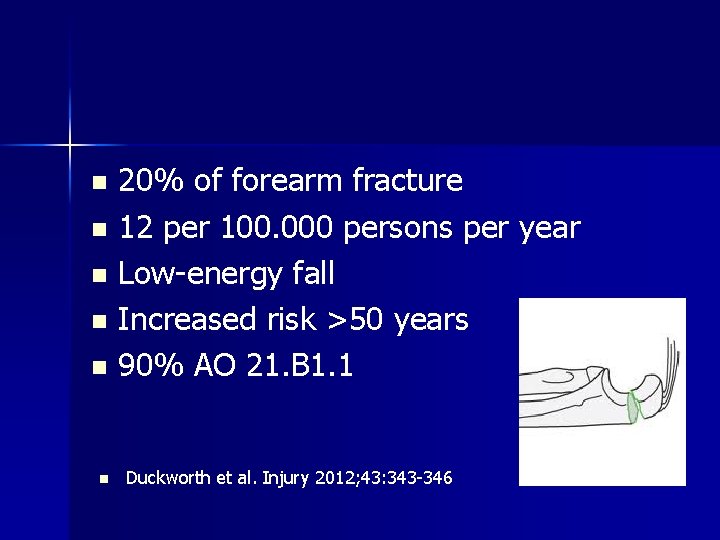
20% of forearm fracture n 12 per 100. 000 persons per year n Low-energy fall n Increased risk >50 years n 90% AO 21. B 1. 1 n n Duckworth et al. Injury 2012; 43: 343 -346
Why operate? n Methods of fixation n – K-wire, cerklage – Plating Outcome n Summary n

Why operate? Restore articular surface n Achieve absolute stability n Commence early active movement n Preservation of range of motion and power n Avoidance of complications n

Methods of fixation?
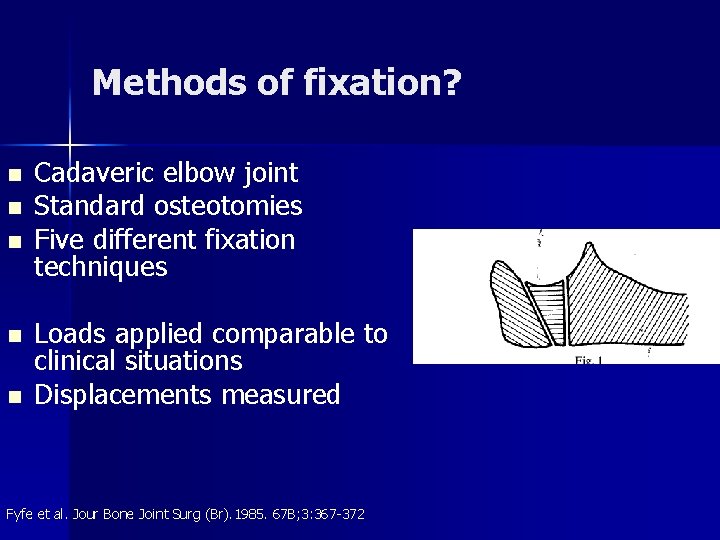
Methods of fixation? n n n Cadaveric elbow joint Standard osteotomies Five different fixation techniques Loads applied comparable to clinical situations Displacements measured Fyfe et al. Jour Bone Joint Surg (Br). 1985. 67 B; 3: 367 -372
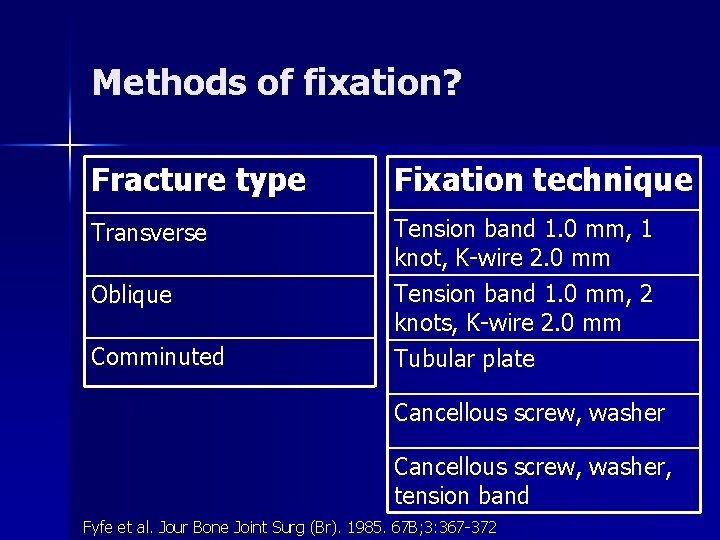
Methods of fixation? Fracture type Fixation technique Transverse Tension band 1. 0 mm, 1 knot, K-wire 2. 0 mm Tension band 1. 0 mm, 2 knots, K-wire 2. 0 mm Tubular plate Oblique Comminuted Cancellous screw, washer, tension band Fyfe et al. Jour Bone Joint Surg (Br). 1985. 67 B; 3: 367 -372
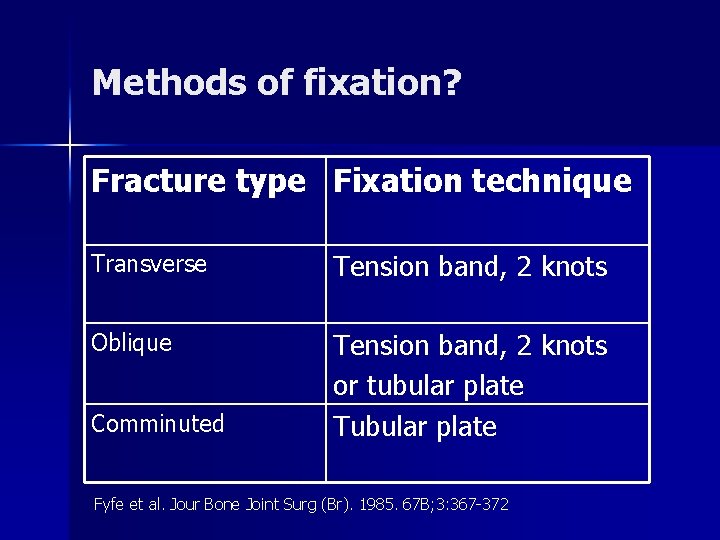
Methods of fixation? Fracture type Fixation technique Transverse Tension band, 2 knots Oblique Tension band, 2 knots or tubular plate Tubular plate Comminuted Fyfe et al. Jour Bone Joint Surg (Br). 1985. 67 B; 3: 367 -372
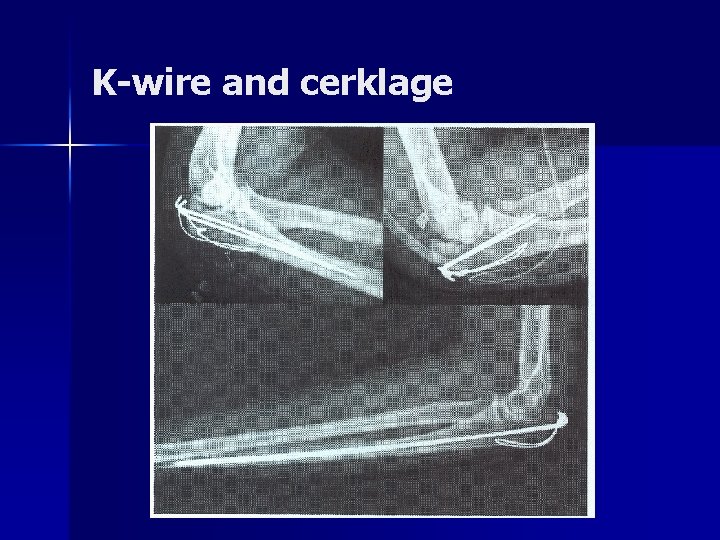
K-wire and cerklage
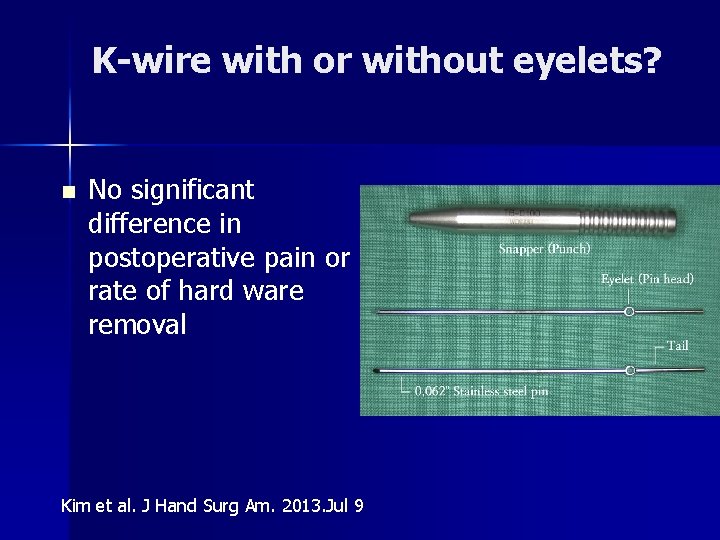
K-wire with or without eyelets? n No significant difference in postoperative pain or in rate of hard ware removal Kim et al. J Hand Surg Am. 2013. Jul 9
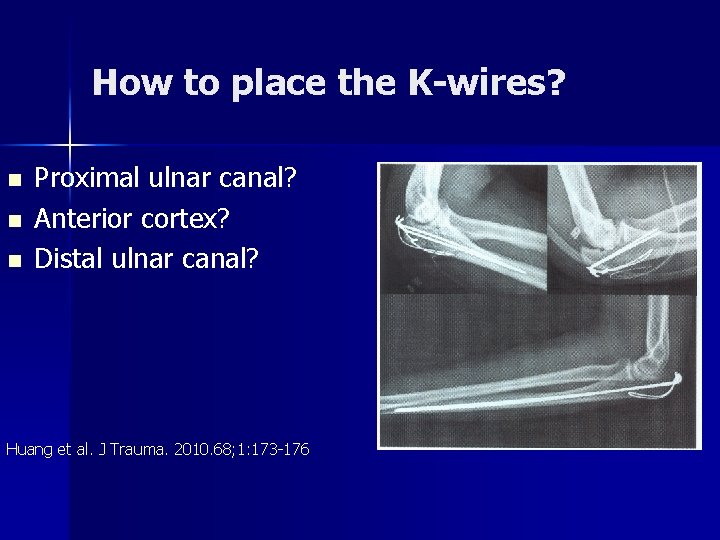
How to place the K-wires? n n n Proximal ulnar canal? Anterior cortex? Distal ulnar canal? Huang et al. J Trauma. 2010. 68; 1: 173 -176
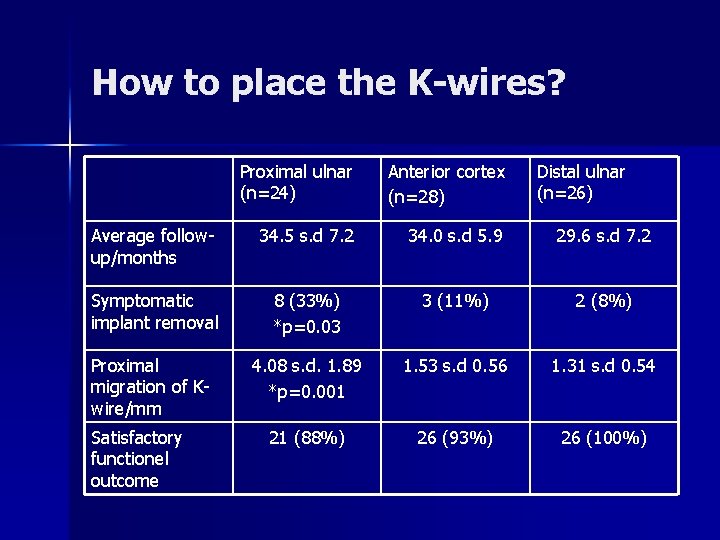
How to place the K-wires? Proximal ulnar (n=24) Anterior cortex (n=28) Average followup/months 34. 5 s. d 7. 2 34. 0 s. d 5. 9 29. 6 s. d 7. 2 Symptomatic implant removal 8 (33%) *p=0. 03 3 (11%) 2 (8%) Proximal migration of Kwire/mm 4. 08 s. d. 1. 89 *p=0. 001 1. 53 s. d 0. 56 1. 31 s. d 0. 54 21 (88%) 26 (93%) 26 (100%) Satisfactory functionel outcome Distal ulnar (n=26)
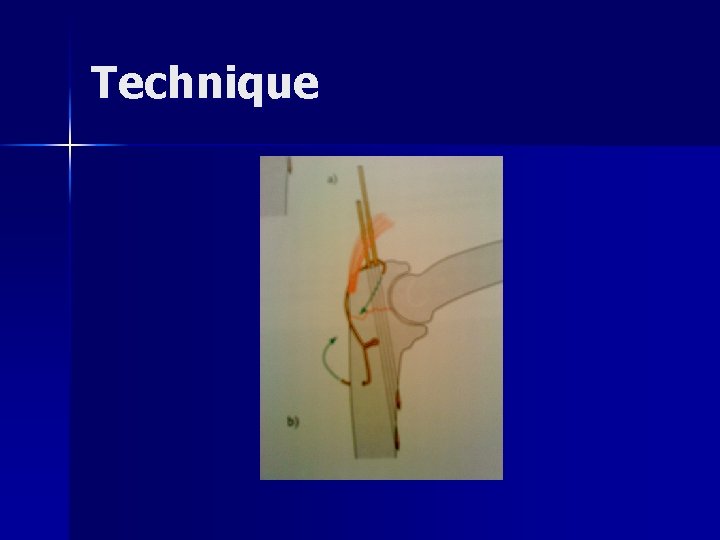
How to place the K-wires? Inserted as close as possible to the articular surface n Back 1 cm from final position, cut obliquely, bent n Incisions with lines in triceps n K-wires are impacted into ulna n Newman et al. 2009. Injury; 40(6): 575 -581
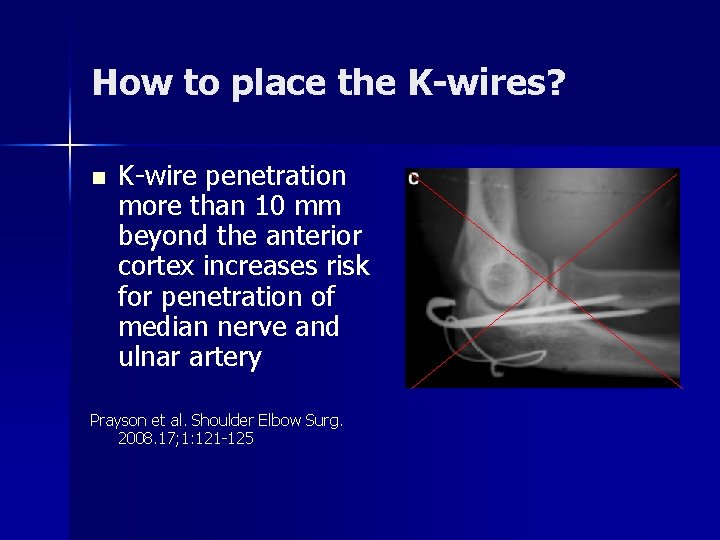
How to place the K-wires? n K-wire penetration more than 10 mm beyond the anterior cortex increases risk for penetration of median nerve and ulnar artery Prayson et al. Shoulder Elbow Surg. 2008. 17; 1: 121 -125
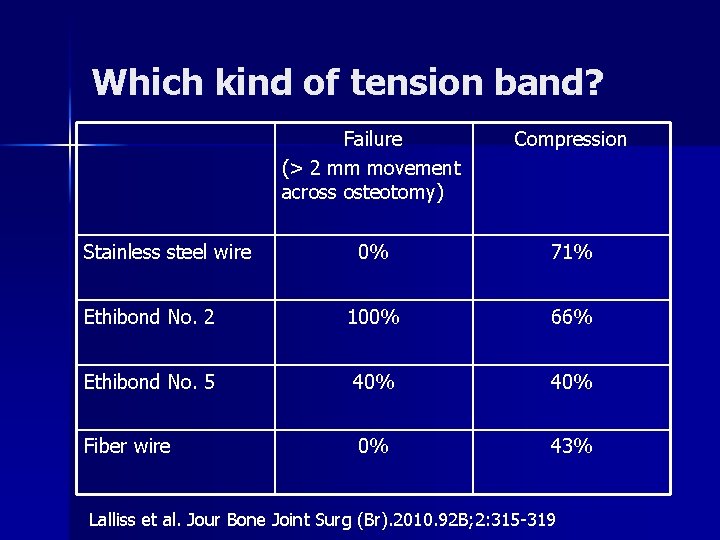
Which kind of tension band? Failure (> 2 mm movement across osteotomy) Compression 0% 71% Ethibond No. 2 100% 66% Ethibond No. 5 40% Fiber wire 0% 43% Stainless steel wire Lalliss et al. Jour Bone Joint Surg (Br). 2010. 92 B; 2: 315 -319
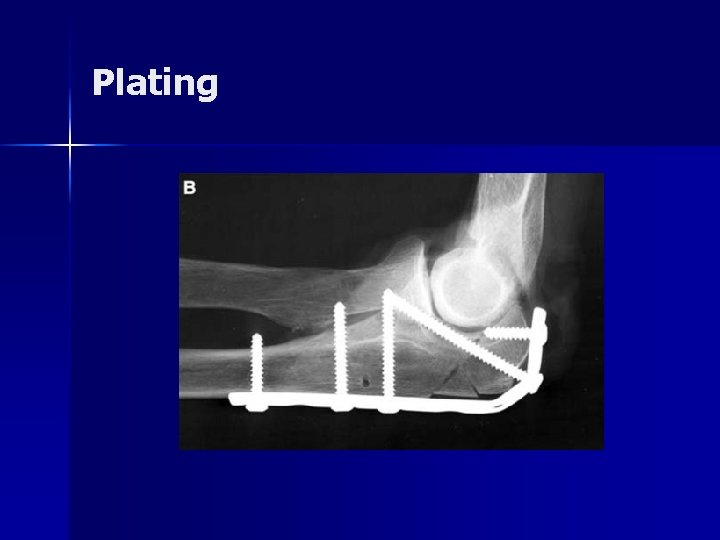
Plating
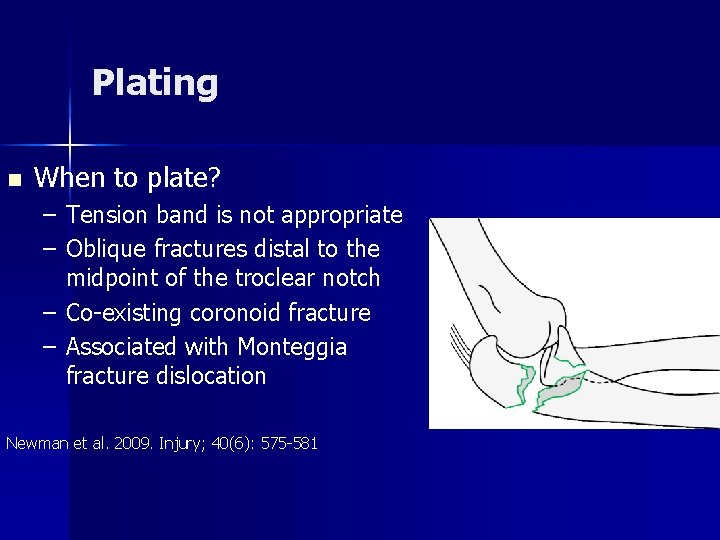
Plating n When to plate? – Tension band is not appropriate – Oblique fractures distal to the midpoint of the troclear notch – Co-existing coronoid fracture – Associated with Monteggia fracture dislocation Newman et al. 2009. Injury; 40(6): 575 -581
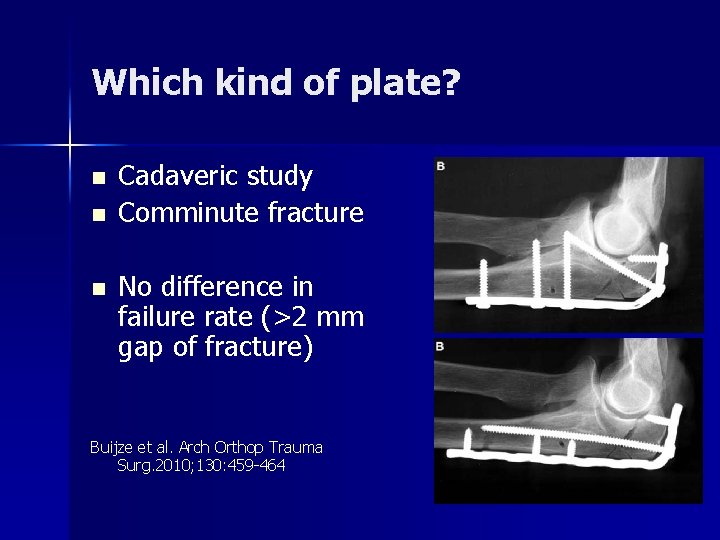
Which kind of plate? n n n Cadaveric study Comminute fracture No difference in failure rate (>2 mm gap of fracture) Buijze et al. Arch Orthop Trauma Surg. 2010; 130: 459 -464
Which kind of plate? n Advantage of locking compression plate to conventionel plate: – Angular and axial stability – Preserves periosteal blood supply – No toggling of unlocked screws (improves fixation in osteoporotic fractures and comminution)
Which kind of plate? n Stainless steel or titanium? n More screw in proximal fragment better than fewer screws? n Larger screws better than small screws?
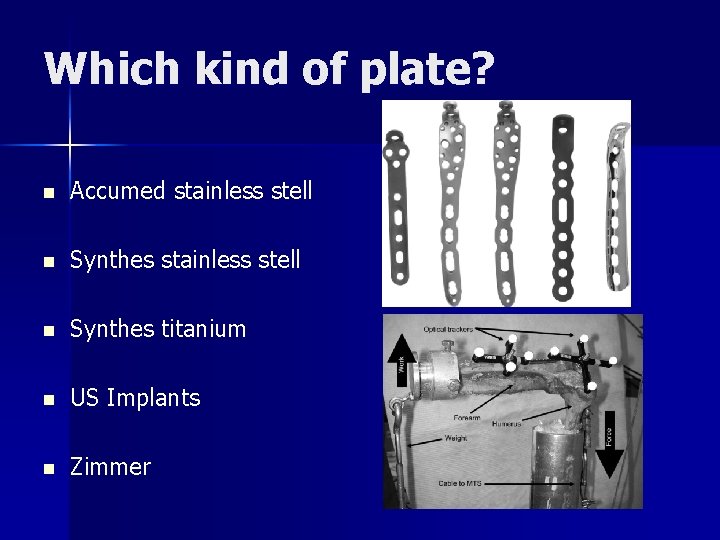
Which kind of plate? n Accumed stainless stell n Synthes titanium n US Implants n Zimmer
Which kind of plate? n n No statistical difference between maximum load and cycles survived Edwards et al. J Orthop Trauma 2011; 25(5): 306 -311
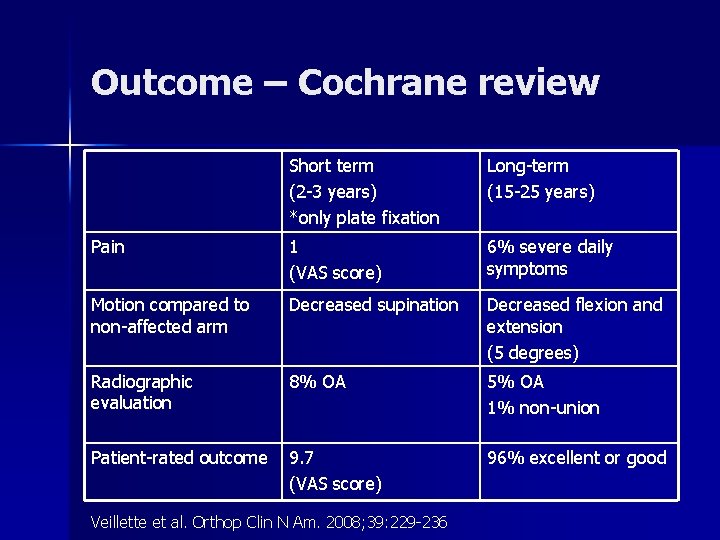
Outcome – Cochrane review Short term (2 -3 years) *only plate fixation Long-term (15 -25 years) Pain 1 (VAS score) 6% severe daily symptoms Motion compared to non-affected arm Decreased supination Decreased flexion and extension (5 degrees) Radiographic evaluation 8% OA 5% OA 1% non-union Patient-rated outcome 9. 7 (VAS score) 96% excellent or good Veillette et al. Orthop Clin N Am. 2008; 39: 229 -236
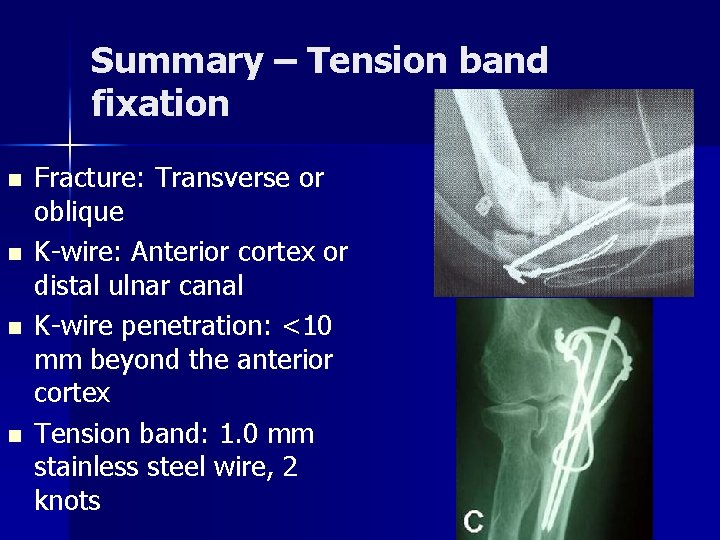
Summary – Tension band fixation n n Fracture: Transverse or oblique K-wire: Anterior cortex or distal ulnar canal K-wire penetration: <10 mm beyond the anterior cortex Tension band: 1. 0 mm stainless steel wire, 2 knots
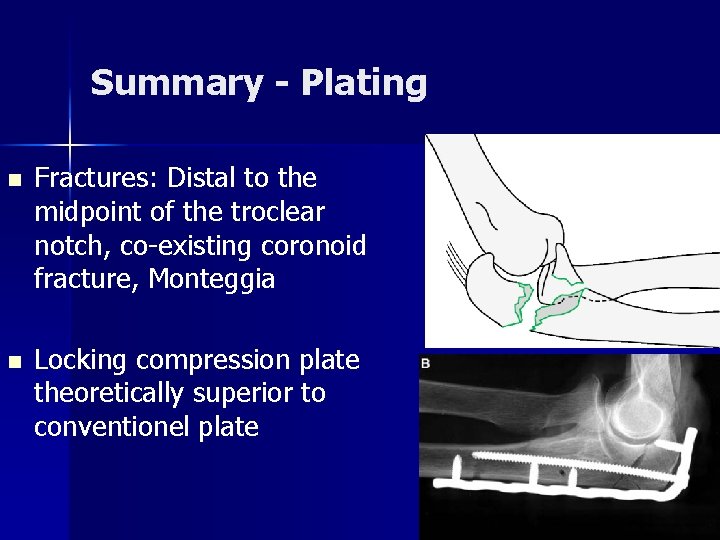
Summary - Plating n Fractures: Distal to the midpoint of the troclear notch, co-existing coronoid fracture, Monteggia n Locking compression plate theoretically superior to conventionel plate
Thank you
Technique
Technique
Technique
- Slides: 29