
OLE Futures Impact of Open Source Business Models
OLE Futures Impact of Open Source Business Models
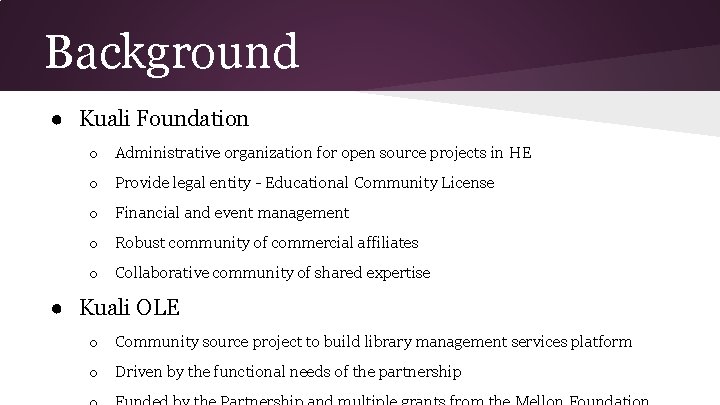
Background ● Kuali Foundation o Administrative organization for open source projects in HE o Provide legal entity - Educational Community License o Financial and event management o Robust community of commercial affiliates o Collaborative community of shared expertise ● Kuali OLE o Community source project to build library management services platform o Driven by the functional needs of the partnership
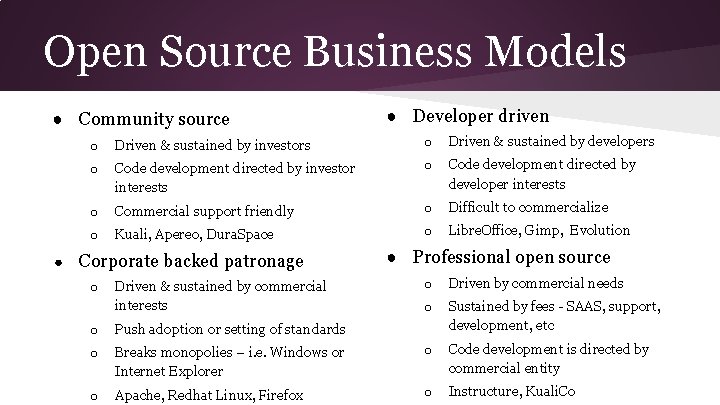
Open Source Business Models ● Community source ● ● Developer driven o Driven & sustained by investors o Driven & sustained by developers o Code development directed by investor interests o Code development directed by developer interests o Commercial support friendly o Difficult to commercialize o Kuali, Apereo, Dura. Space o Libre. Office, Gimp, Evolution Corporate backed patronage o Driven & sustained by commercial interests ● Professional open source o Driven by commercial needs o Sustained by fees - SAAS, support, development, etc o Push adoption or setting of standards o Breaks monopolies – i. e. Windows or Internet Explorer o Code development is directed by commercial entity o Apache, Redhat Linux, Firefox o Instructure, Kuali. Co
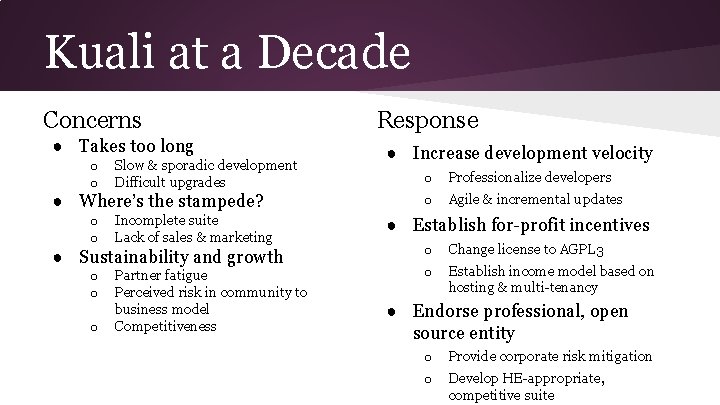
Kuali at a Decade Concerns ● Takes too long o o Slow & sporadic development Difficult upgrades o o Incomplete suite Lack of sales & marketing o o Partner fatigue Perceived risk in community to business model Competitiveness ● Where’s the stampede? ● Sustainability and growth o Response ● Increase development velocity o o Professionalize developers Agile & incremental updates ● Establish for-profit incentives o o Change license to AGPL 3 Establish income model based on hosting & multi-tenancy ● Endorse professional, open source entity o o Provide corporate risk mitigation Develop HE-appropriate, competitive suite
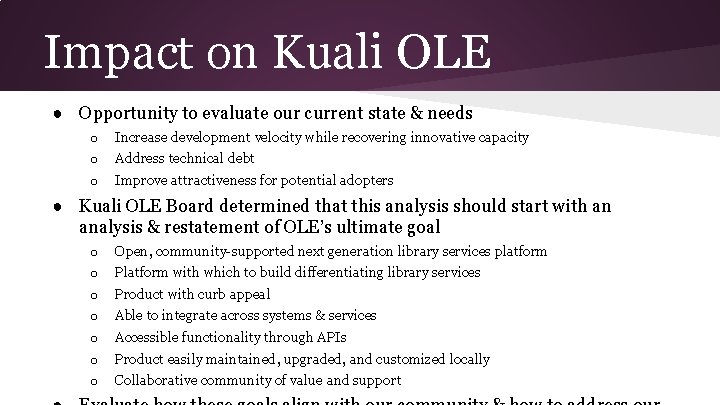
Impact on Kuali OLE ● Opportunity to evaluate our current state & needs o o o Increase development velocity while recovering innovative capacity Address technical debt Improve attractiveness for potential adopters ● Kuali OLE Board determined that this analysis should start with an analysis & restatement of OLE’s ultimate goal o o o o Open, community-supported next generation library services platform Platform with which to build differentiating library services Product with curb appeal Able to integrate across systems & services Accessible functionality through APIs Product easily maintained, upgraded, and customized locally Collaborative community of value and support

OLE Core Values OLE is committed: ● To sustaining a community focused on delivering an open source library management system that is freely available to implement ● To building an inclusive partnership focused on sustaining OLE through financial support, functional and technical design, software development, and user support for OLE implementers ● To researching, designing, and deploying high-quality, standards-based next-generation technology ● To re-examine library business operations to lead the library community through innovation and business efficiency, particularly in the diversifying of library collections in digital formats and new approaches to managing the scholarly work. ● To building a core technology environment that leverages integration with enterpriselevel systems ● To encouraging a services-based ecosystem of open innovation for applications focused on discovery, open data integration, user experience and accessible, data analysis, and much more
Futures Team Process ● Assessed project resources ● Researched options for technical development ● Reviewed project alignment with its administrative home
Findings ● Transformation is necessary but not urgent ● Position the project to … leverage commercial & open source tools strategically coordinate commercial dev opportunities o refine the partner contribution program o o ● Expand the partner base
Next Steps ● Review the strategic development plan ● Develop a long term budget plan, including contingencies ● Assess resources needed to achieve goals ● Align the project with the appropriate community ● Create a transition time-line --18 months
Questions Carlen Ruschoff - University of Maryland Tim Mc. Geary - Duke University Michael Winkler - University of Pennsylvania
- Slides: 10