
Old Testament Reflection What is the Bible Christians
Old Testament Reflection
What is the Bible? Christians believe the Bible is the word of God. The Bible however is not just one book, but an entire library, with stories, songs, poetry, letters and history. The Bible has two sections - the Old Testament and the New Testament. The Old Testament is the original Hebrew Bible, the sacred scriptures of the Jewish faith, written at different times between about 1200 and 165 BC. The New Testament books were written by Christians in the first century AD and it contains accounts of Jesus’ life, death and resurrection. Context
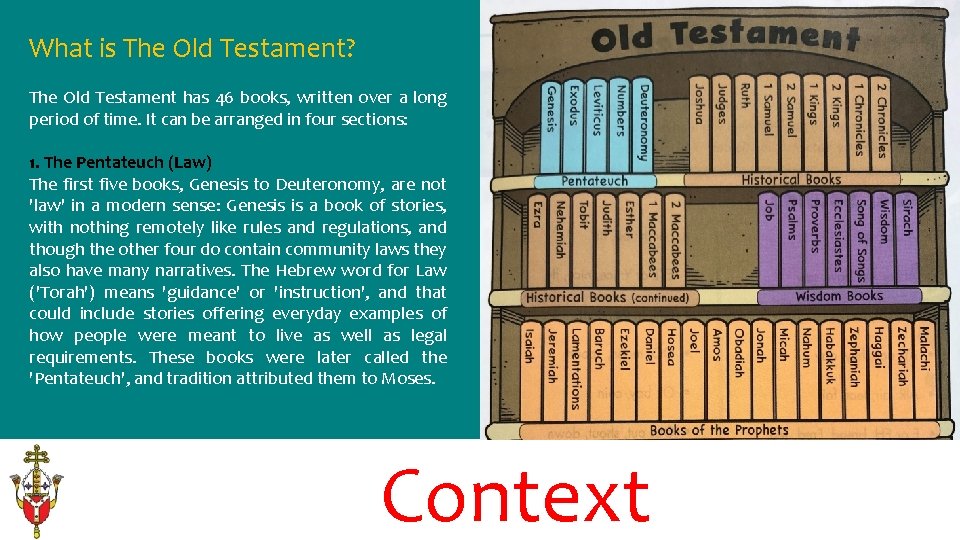
What is The Old Testament? The Old Testament has 46 books, written over a long period of time. It can be arranged in four sections: 1. The Pentateuch (Law) The first five books, Genesis to Deuteronomy, are not 'law' in a modern sense: Genesis is a book of stories, with nothing remotely like rules and regulations, and though the other four do contain community laws they also have many narratives. The Hebrew word for Law ('Torah') means 'guidance' or 'instruction', and that could include stories offering everyday examples of how people were meant to live as well as legal requirements. These books were later called the 'Pentateuch', and tradition attributed them to Moses. Context

2. Historical Books They are history books, but they not only record information, they interpret it, explaining its significance in relation to other events in the history of Israel, and of the wider world of their day. 3. The Wisdom Books These include: - Job (a drama that explores the nature of suffering) - Psalms (songs, prayers and liturgies for worship) - Proverbs (sayings of wisdom) - Song of Songs (love poems) 4. The Prophets This is the largest section of The Old Testament and contains stories of religious and political activists (prophets) who served as the spiritual conscience of the nation throughout its history, reminding people of the values and practices that would reflect the character of God. Context

What is the Old Testament? Before we begin…
Lord, Give us wisdom as we prepare to read your word, clarity for when we read, and understanding whilst we reflect on their meaning. May your words change our actions and draw us closer to you. Amen Gather
I will raise up a prophet and put my words into his mouth Moses said to the people: ‘The Lord your God will raise up for you a prophet like myself, from among yourselves, from your own; you must listen. This is what yourselves asked of the Lord your God at Horeb on the day of the Assembly. “Do not let me hear again” you said “the voice of the Lord my God, nor look any longer on this great fire, or I shall die”; and the Lord said to me, “All they have spoken is well said. I will raise up a prophet like yourself for them from their own; I will put my words into their mouth and they shall tell them all I command. The person who does not listen to my words that is spoken in my name, shall be held answerable to me for it. But the prophet who presumes to say in my name a thing I have not commanded to say, or who speaks in the name of other gods, that prophet shall die. ”’ Listen (Deuteronomy 18: 15 -20 )
What do you think this Old Testament reading means? Who is the ‘prophet’ it is referring to? In which way can you live out the message? How can you be a modern day prophet and speak out ‘all that God commands’? Reflect
Let us pray
We give thanks to you, our God For all the prophets in times past: David and Deborah, Jacob and Jonah… And for sending Jesus who surpasses all prophets. As Jesus said – "When you lift up the Son of Man, then you will know that I am he, and I do nothing on my own initiative, but I speak these things as the Father taught me (John 8: 28) May we learn from Jesus and speak up in our own times for all that is right, just and good. Amen
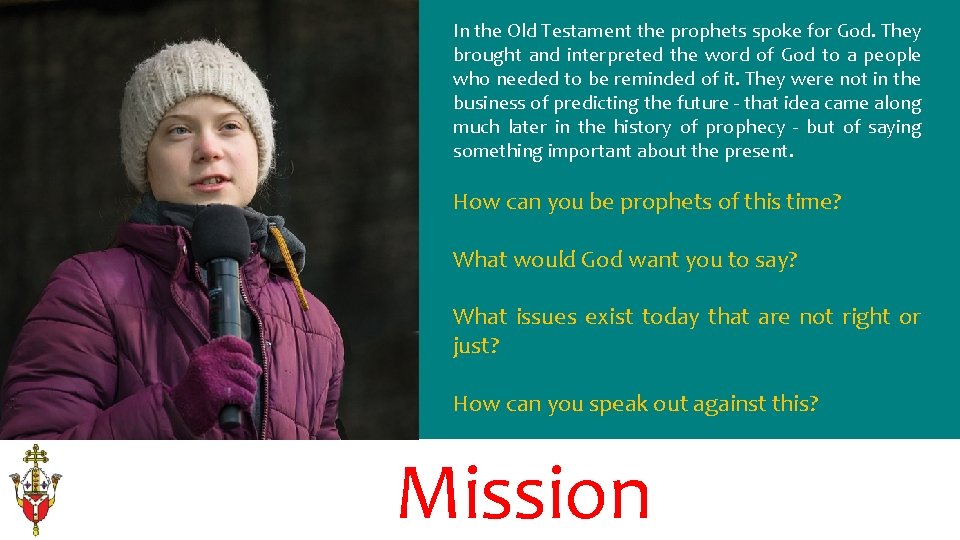
In the Old Testament the prophets spoke for God. They brought and interpreted the word of God to a people who needed to be reminded of it. They were not in the business of predicting the future - that idea came along much later in the history of prophecy - but of saying something important about the present. How can you be prophets of this time? What would God want you to say? What issues exist today that are not right or just? How can you speak out against this? Mission
- Slides: 11