
Old English Literature The Celts and the AngloSaxons
- Slides: 33
Old English Literature The Celts and the Anglo-Saxons Brought to you by The Passionate Shepherd
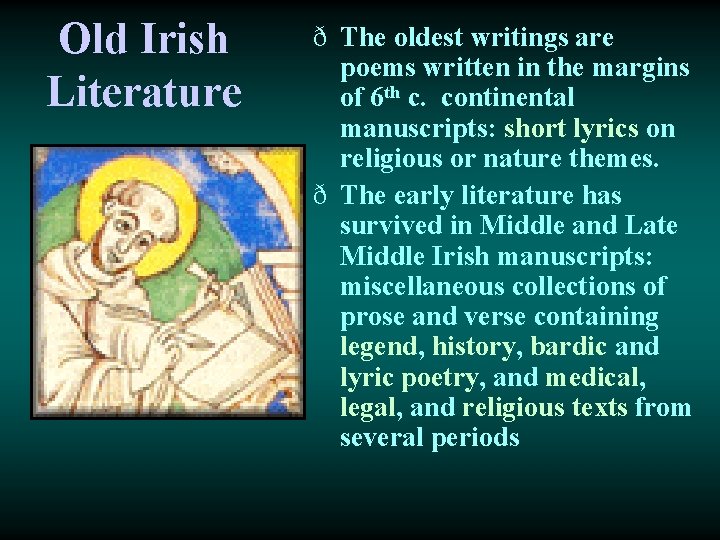
Old Irish Literature ð The oldest writings are poems written in the margins of 6 th c. continental manuscripts: short lyrics on religious or nature themes. ð The early literature has survived in Middle and Late Middle Irish manuscripts: miscellaneous collections of prose and verse containing legend, history, bardic and lyric poetry, and medical, legal, and religious texts from several periods
Bards ð In Old Irish culture, the bards were the performers of the filíd’s poems ð They were record keepers and lineage holders, for the bards could determine a king's legitimacy. ð To satirize a king was to declare his access to the throne suspect. ð The role of the bard was historian and social commentator. They glorified heroes while insulting cowards and villains. ð They were both the newspaper and the opinion page.
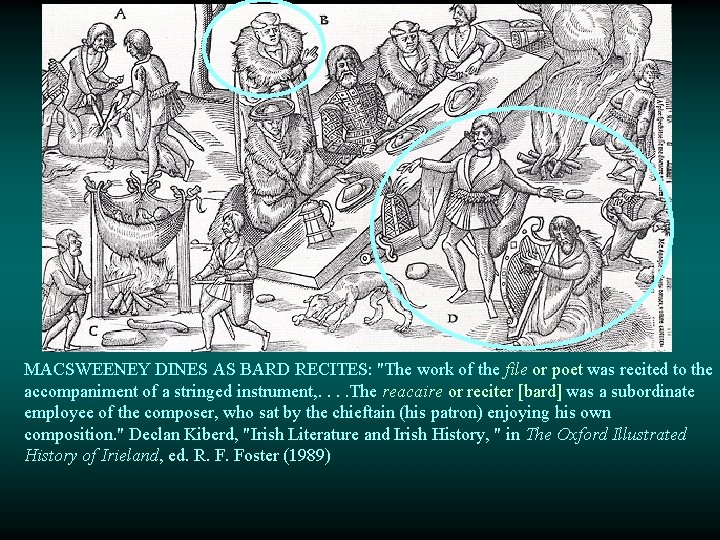
MACSWEENEY DINES AS BARD RECITES: "The work of the file or poet was recited to the accompaniment of a stringed instrument, . . The reacaire or reciter [bard] was a subordinate employee of the composer, who sat by the chieftain (his patron) enjoying his own composition. " Declan Kiberd, "Irish Literature and Irish History, " in The Oxford Illustrated History of Irieland, ed. R. F. Foster (1989)
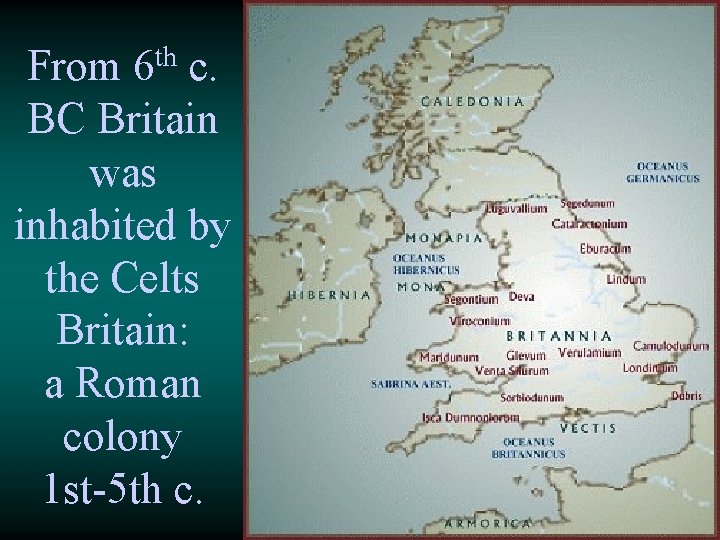
th From 6 c. BC Britain was inhabited by the Celts Britain: a Roman colony 1 st-5 th c.
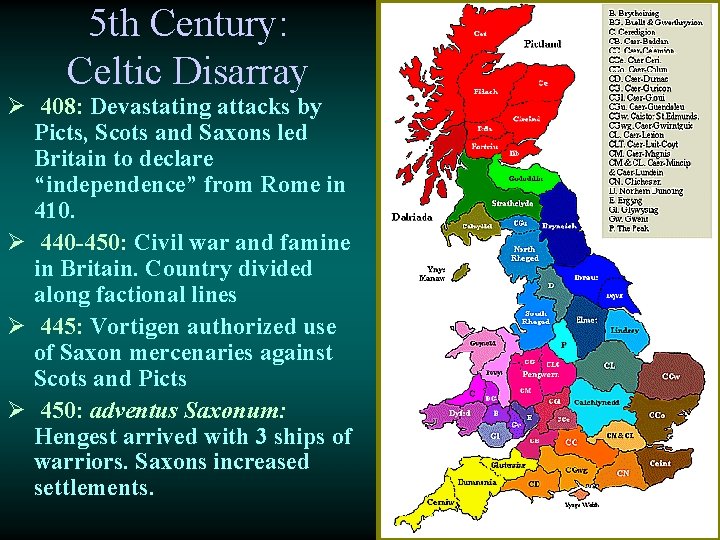
5 th Century: Celtic Disarray 408: Devastating attacks by Picts, Scots and Saxons led Britain to declare “independence” from Rome in 410. 440 -450: Civil war and famine in Britain. Country divided along factional lines 445: Vortigen authorized use of Saxon mercenaries against Scots and Picts 450: adventus Saxonum: Hengest arrived with 3 ships of warriors. Saxons increased settlements.
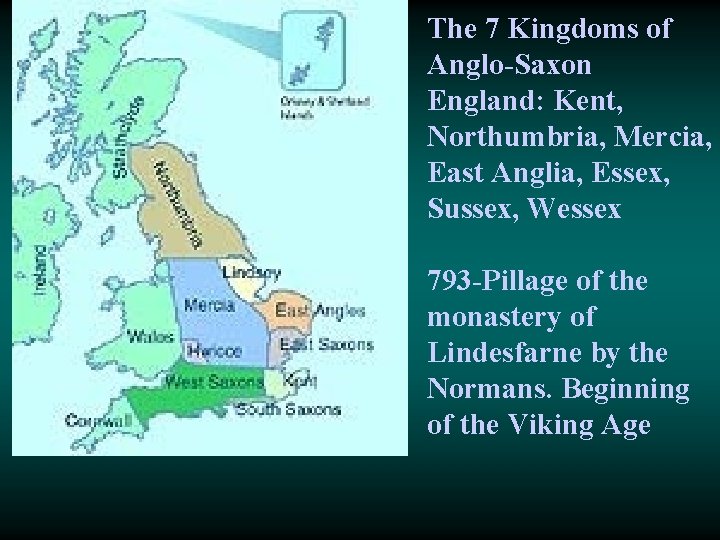
The 7 Kingdoms of Anglo-Saxon England: Kent, Northumbria, Mercia, East Anglia, Essex, Sussex, Wessex 793 -Pillage of the monastery of Lindesfarne by the Normans. Beginning of the Viking Age
England as a Nation ð Bede articulated the idea of the English as one people in 732 in his History of the English Church and People. ð Viking Invasions ð Alfred was compelled to unify the 7 kingdoms to resist the Norman invasion ð Destroyed kingdoms of Northumbria and East Angles in the 860 s ð Wessex emerged as the power that defeated the Vikings under Alfred the Great ð 878: Alfred defeated the Vikings at Edington ð At his death in 899, Alfred was the most powerful regional king in England
Wessex Dynasty ð Edward the Elder (r. 899 -924) succeeded his father Alfred and conquered the Midlands and East Anglia. ð His son, Athelstan (r. 924 -40), brought the Scots, the Welsh, the Cumbrians and the Cornish under English rule by 928: he became King of all England “Emperor of the World of Britain. ”
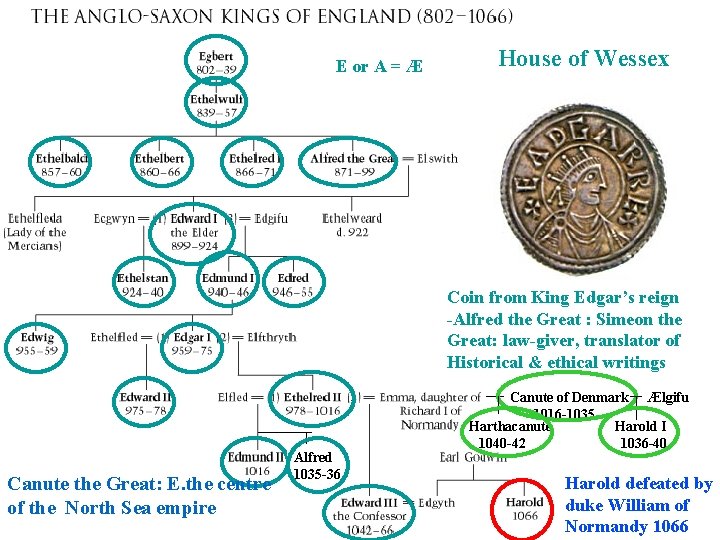
E or A = Æ House of Wessex Coin from King Edgar’s reign -Alfred the Great : Simeon the Great: law-giver, translator of Historical & ethical writings Canute the Great: E. the centre of the North Sea empire Alfred 1035 -36 Canute of Denmark Ælgifu 1016 -1035 Harthacanute Harold I 1040 -42 1036 -40 Harold defeated by duke William of Normandy 1066
Social setup of early AS kingdoms • Primitive organization of society: the earl and the churl, the master and the servant • Transformed into feudal stratification with William's system of vassalage
The Christianization • In 314 AD clergymen from London & York attended a Church Council in Gaul • The Welsh had adopted Christianity during the Roman occupation • The Conversion of the English came from Rome & a little later from Ireland by way of Iona • In 597 Augustine landed in Kent with 40 monks [mʌŋks]Essex & East Anglia followed the conversion of Kent. • The 2 c. b/n the adoption of Christianity & the coming of the Northmen: remarkable standard of learning. In Jarrow, Bede, the most learned man in Europe at the time lived & worked
• Literary works Secular literature • Christian literature • Literary prose, associated with Alfred & his reform • Sec. Lit. includes A: Gnomic verse: lists of proverbs & sayings B: Mnemonic verse [ni: 'mɔnik] C: the OE Riddles: delicate works D: the Lays: heroic poems of fighting, tragic atmosphere, internal conflict E: the Epics, expansion of the Lays, strings of heroic deeds. BEOWULF-the only AS epic preserved F: Lyrical poetry: elegies
Genres: Prose ð Sermons: most popular of prose genres ð Translations of Latin religious works and Biblical works ð Saints’ Lives ð Legal texts: wills, records, deeds, laws, etc. ð Scientific and Medical texts ð Chronicles: historical writing: Anglo Saxon Chronicle
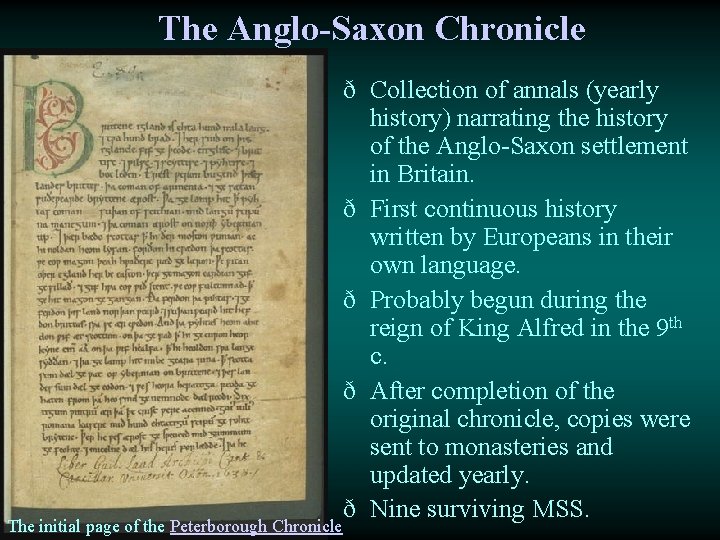
The Anglo-Saxon Chronicle The initial page of the Peterborough Chronicle ð Collection of annals (yearly history) narrating the history of the Anglo-Saxon settlement in Britain. ð First continuous history written by Europeans in their own language. ð Probably begun during the reign of King Alfred in the 9 th c. ð After completion of the original chronicle, copies were sent to monasteries and updated yearly. ð Nine surviving MSS.
Genres: Poetry ð ð ð Thula: alliterative lists of names or tribes Gnomic verse: proverbs, traditional wisdom Spells: invoke natural and supernatural powers Riddles: what am I? Religious poetry: retellings of Old Testament stories, saints’ lives, “Dream of the Rood” ð Adaptations of classical philosophical texts: e. g. Boethius’ Consolation of Philosophy ð Wisdom poetry: lyrical, meditative, elegiac – “The Wanderer, ” “The Wife’s Lament, ” etc. ð Heroic court poetry: celebration of historical events related by scops: Beowulf, etc.
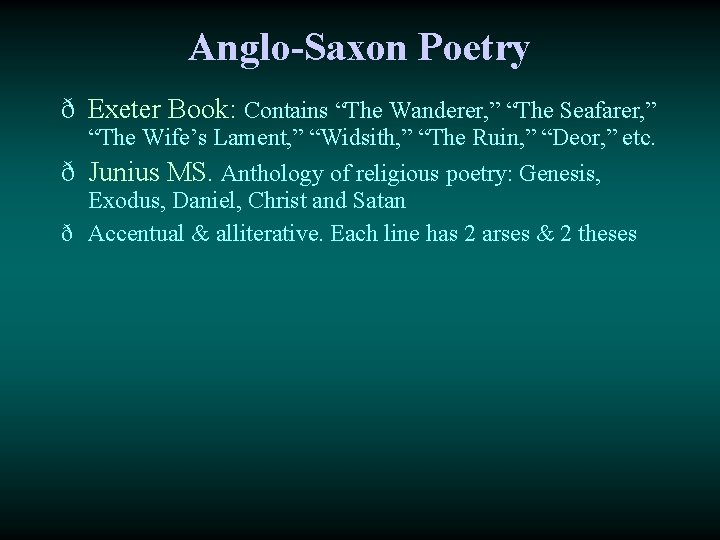
Anglo-Saxon Poetry ð Exeter Book: Contains “The Wanderer, ” “The Seafarer, ” “The Wife’s Lament, ” “Widsith, ” “The Ruin, ” “Deor, ” etc. ð Junius MS. Anthology of religious poetry: Genesis, Exodus, Daniel, Christ and Satan ð Accentual & alliterative. Each line has 2 arses & 2 theses
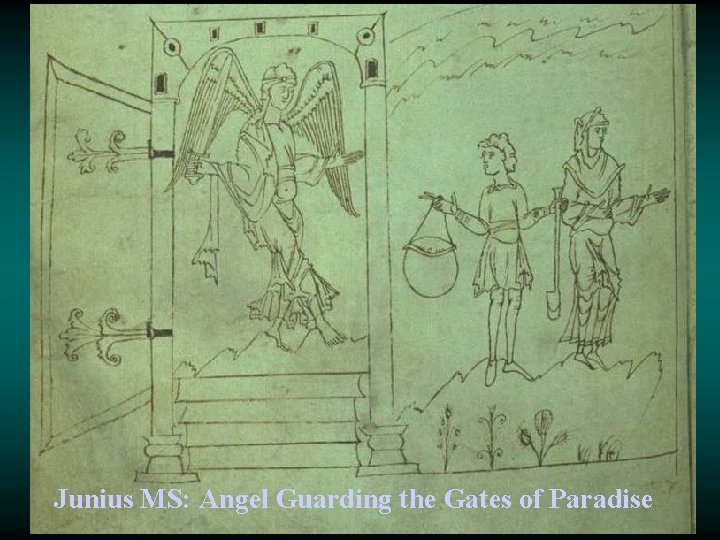
Junius MS: Angel Guarding the Gates of Paradise
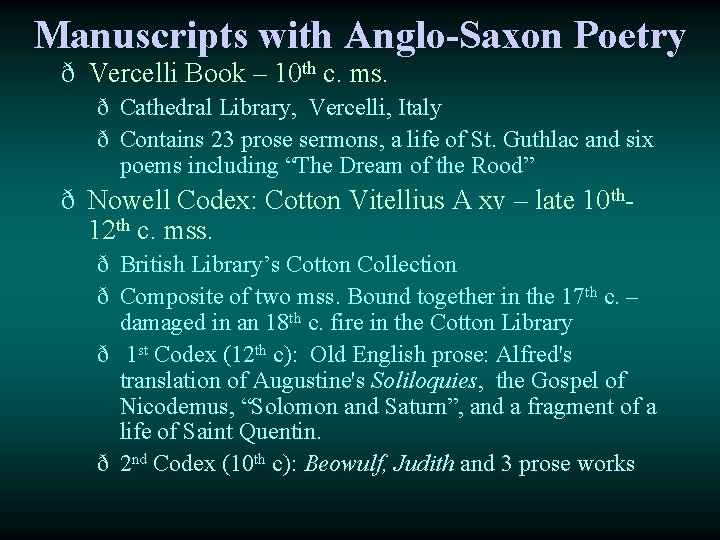
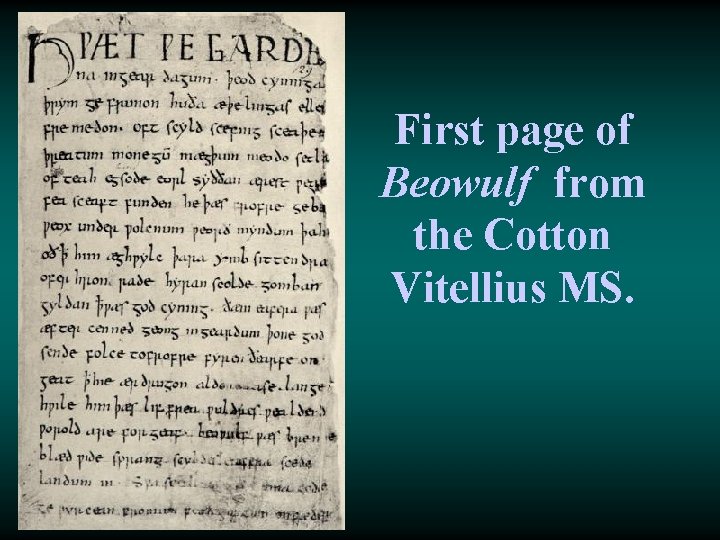
Manuscripts with Anglo-Saxon Poetry ð Vercelli Book – 10 th c. ms. ð Cathedral Library, Vercelli, Italy ð Contains 23 prose sermons, a life of St. Guthlac and six poems including “The Dream of the Rood” ð Nowell Codex: Cotton Vitellius A xv – late 10 th 12 th c. mss. ð British Library’s Cotton Collection ð Composite of two mss. Bound together in the 17 th c. – damaged in an 18 th c. fire in the Cotton Library ð 1 st Codex (12 th c): Old English prose: Alfred's translation of Augustine's Soliloquies, the Gospel of Nicodemus, “Solomon and Saturn”, and a fragment of a life of Saint Quentin. ð 2 nd Codex (10 th c): Beowulf, Judith and 3 prose works
First page of Beowulf from the Cotton Vitellius MS.
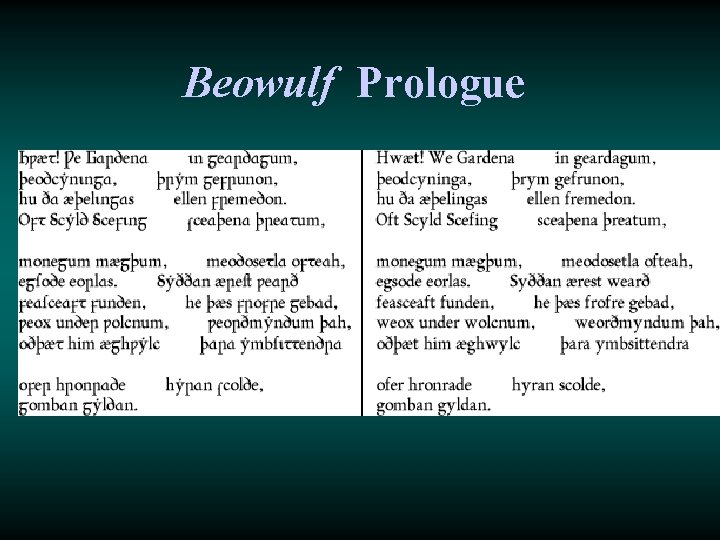
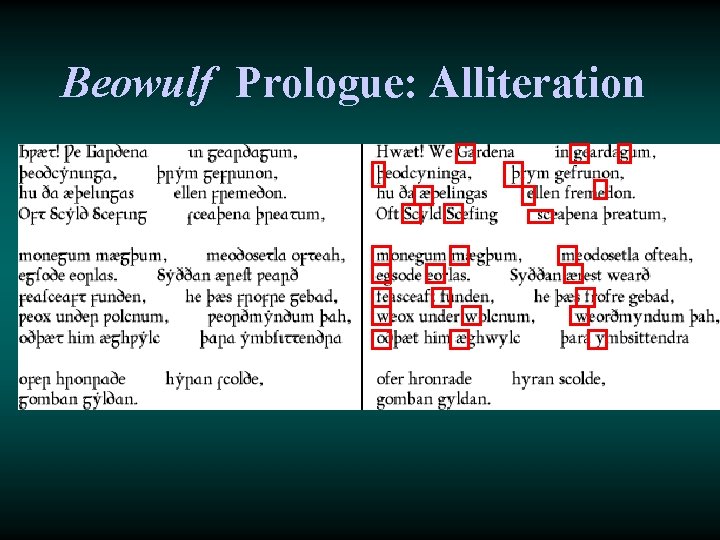
Beowulf Prologue
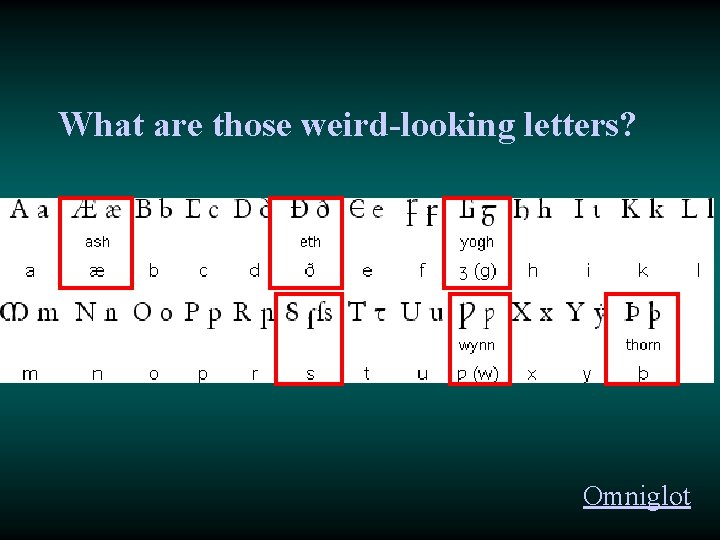
What are those weird-looking letters? Omniglot
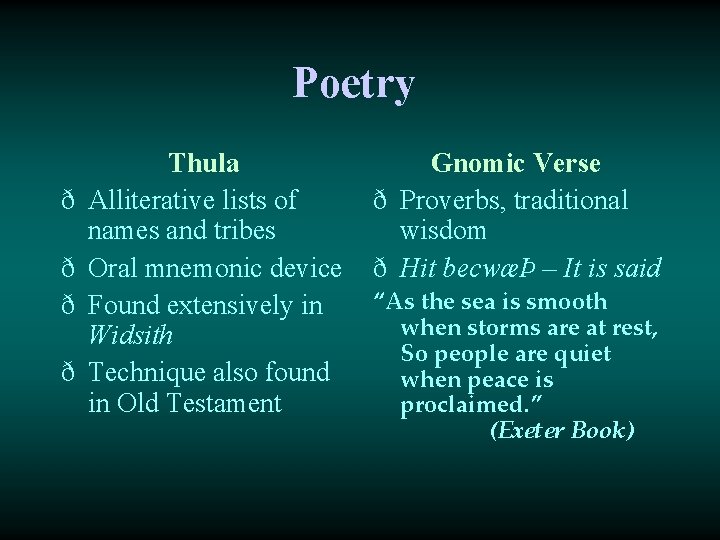
Poetry ð ð Thula Alliterative lists of names and tribes Oral mnemonic device Found extensively in Widsith Technique also found in Old Testament Gnomic Verse ð Proverbs, traditional wisdom ð Hit becwæÞ – It is said “As the sea is smooth when storms are at rest, So people are quiet when peace is proclaimed. ” (Exeter Book)
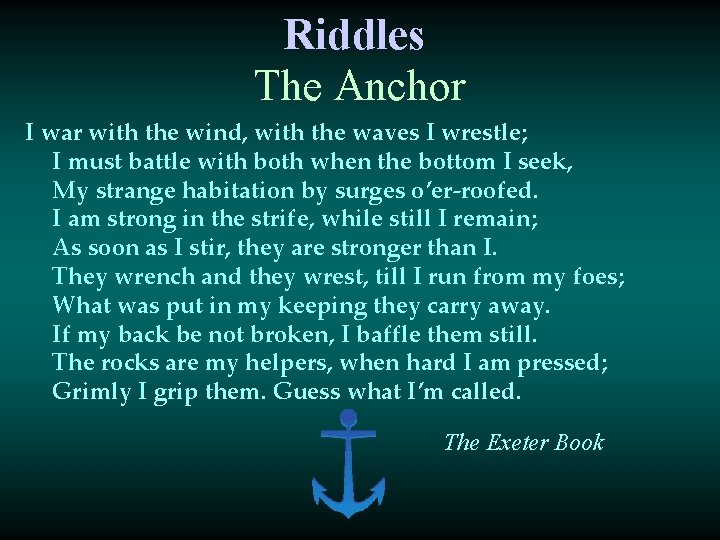
Riddles The Anchor I war with the wind, with the waves I wrestle; I must battle with both when the bottom I seek, My strange habitation by surges o’er-roofed. I am strong in the strife, while still I remain; As soon as I stir, they are stronger than I. They wrench and they wrest, till I run from my foes; What was put in my keeping they carry away. If my back be not broken, I baffle them still. The rocks are my helpers, when hard I am pressed; Grimly I grip them. Guess what I’m called. The Exeter Book
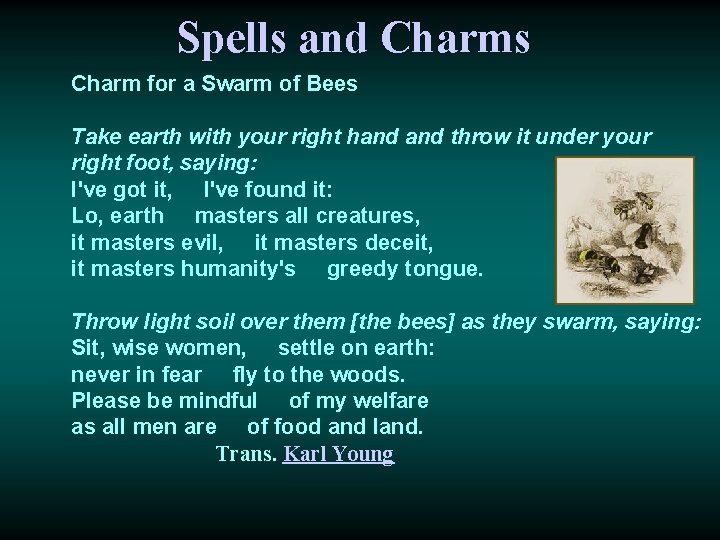
Spells and Charms Charm for a Swarm of Bees Take earth with your right hand throw it under your right foot, saying: I've got it, I've found it: Lo, earth masters all creatures, it masters evil, it masters deceit, it masters humanity's greedy tongue. Throw light soil over them [the bees] as they swarm, saying: Sit, wise women, settle on earth: never in fear fly to the woods. Please be mindful of my welfare as all men are of food and land. Trans. Karl Young
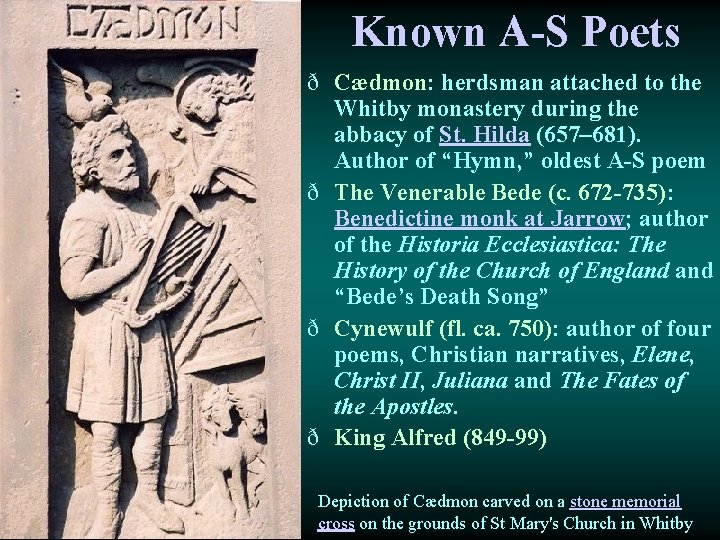
Known A-S Poets ð Cædmon: herdsman attached to the Whitby monastery during the abbacy of St. Hilda (657– 681). Author of “Hymn, ” oldest A-S poem ð The Venerable Bede (c. 672 -735): Benedictine monk at Jarrow; author of the Historia Ecclesiastica: The History of the Church of England “Bede’s Death Song” ð Cynewulf (fl. ca. 750): author of four poems, Christian narratives, Elene, Christ II, Juliana and The Fates of the Apostles. ð King Alfred (849 -99) Depiction of Cædmon carved on a stone memorial cross on the grounds of St Mary's Church in Whitby
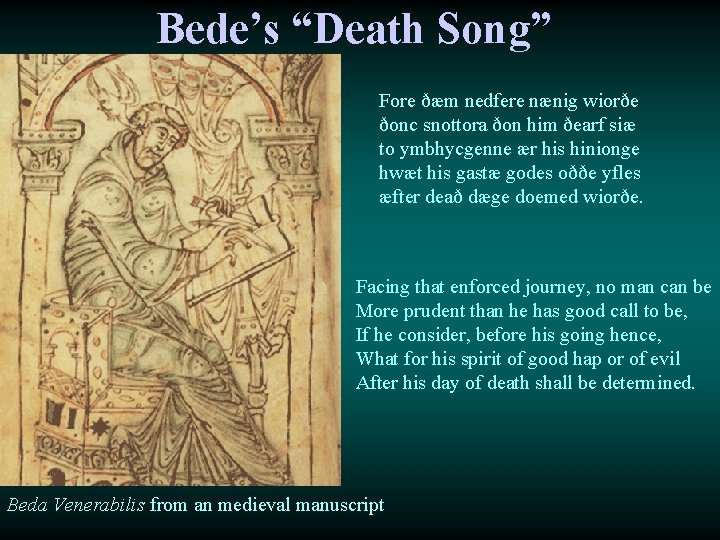
Bede’s “Death Song” Fore ðæm nedfere nænig wiorðe ðonc snottora ðon him ðearf siæ to ymbhycgenne ær his hinionge hwæt his gastæ godes oððe yfles æfter deað dæge doemed wiorðe. Facing that enforced journey, no man can be More prudent than he has good call to be, If he consider, before his going hence, What for his spirit of good hap or of evil After his day of death shall be determined. Beda Venerabilis from an medieval manuscript
Anglo-Saxon Poetic Conventions ð Elegiac mood: the transitoriness of life ð Ubi sunt: Where are they? ? ? ð Heroic mode: active, loyal to kinship group, boastful ð The inevitability of Wyrd: fate ð Figures of speech ð Kennings: two words as metaphor for one: hron-rāde whale-road – sea; hord-cofan word-hoard – mind, thoughts ð Litotes: ironic understatement -- "That [sword] was not useless / to the warrior now. " (Beowulf) ð Variation: parallel appositive phrases – see “Cædmon’s Hymn” ð Alliterative verse: alliteration is used as the principal device to unify lines of poetry
Beowulf Prologue: Alliteration
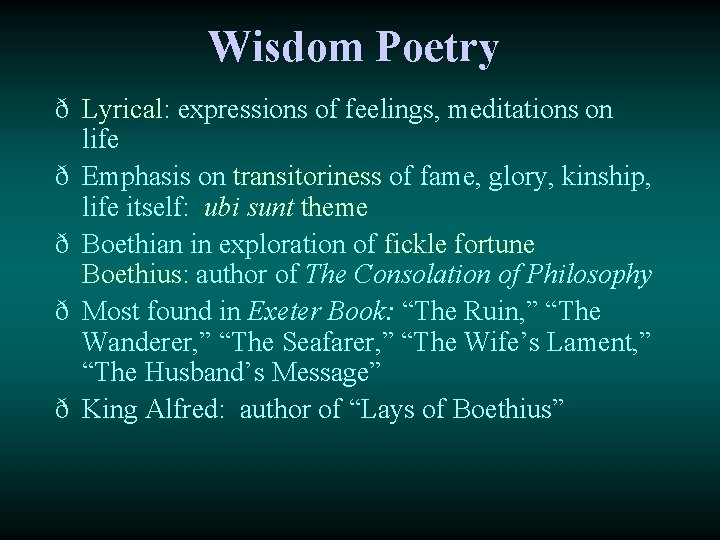
Wisdom Poetry ð Lyrical: expressions of feelings, meditations on life ð Emphasis on transitoriness of fame, glory, kinship, life itself: ubi sunt theme ð Boethian in exploration of fickle fortune Boethius: author of The Consolation of Philosophy ð Most found in Exeter Book: “The Ruin, ” “The Wanderer, ” “The Seafarer, ” “The Wife’s Lament, ” “The Husband’s Message” ð King Alfred: author of “Lays of Boethius”
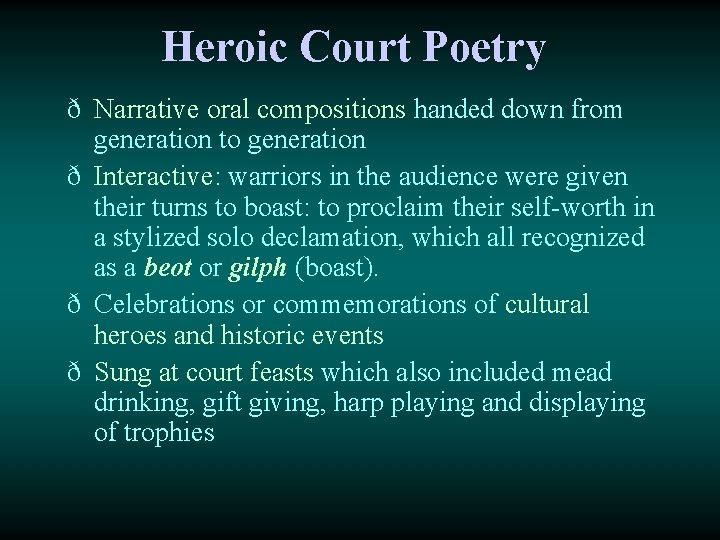
Heroic Court Poetry ð Narrative oral compositions handed down from generation to generation ð Interactive: warriors in the audience were given their turns to boast: to proclaim their self-worth in a stylized solo declamation, which all recognized as a beot or gilph (boast). ð Celebrations or commemorations of cultural heroes and historic events ð Sung at court feasts which also included mead drinking, gift giving, harp playing and displaying of trophies
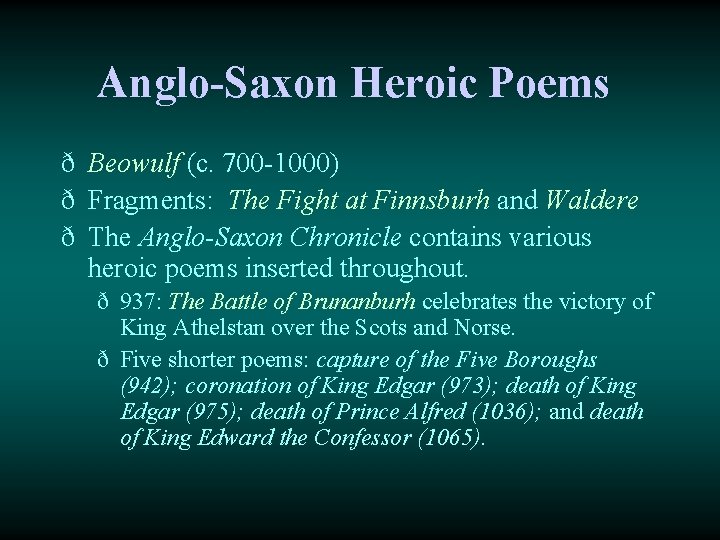
Anglo-Saxon Heroic Poems ð Beowulf (c. 700 -1000) ð Fragments: The Fight at Finnsburh and Waldere ð The Anglo-Saxon Chronicle contains various heroic poems inserted throughout. ð 937: The Battle of Brunanburh celebrates the victory of King Athelstan over the Scots and Norse. ð Five shorter poems: capture of the Five Boroughs (942); coronation of King Edgar (973); death of King Edgar (975); death of Prince Alfred (1036); and death of King Edward the Confessor (1065).
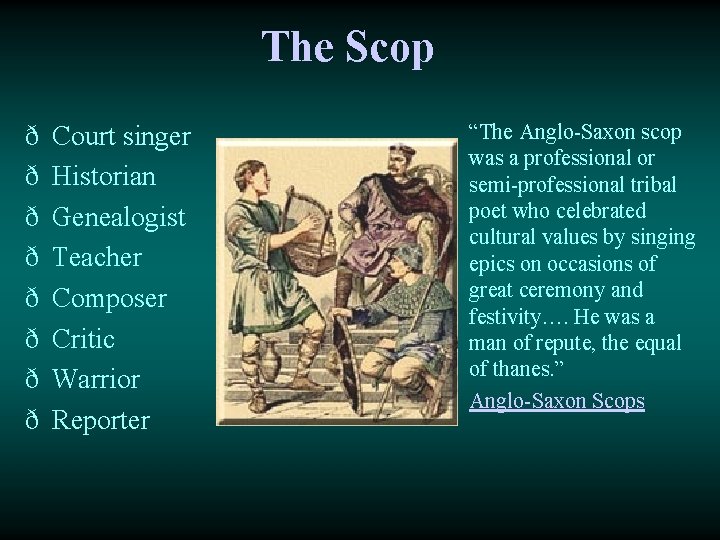
The Scop ð ð ð ð Court singer Historian Genealogist Teacher Composer Critic Warrior Reporter “The Anglo-Saxon scop was a professional or semi-professional tribal poet who celebrated cultural values by singing epics on occasions of great ceremony and festivity…. He was a man of repute, the equal of thanes. ” Anglo-Saxon Scops