
Old and new KeplerPoinsot solids Dirk Huylebrouck KULeuven
Old and new Kepler-Poinsot solids Dirk Huylebrouck KULeuven Faculty of Architecture Brussels - Gent, Belgium

Old and new Kepler-Poinsot solids, D. Huylebrouck, KU LEUVEN, BELGIUM Mandatory opening joke…

Old and new Kepler-Poinsot solids I. The five Platonic solids and the four Kepler. Poinsot solids
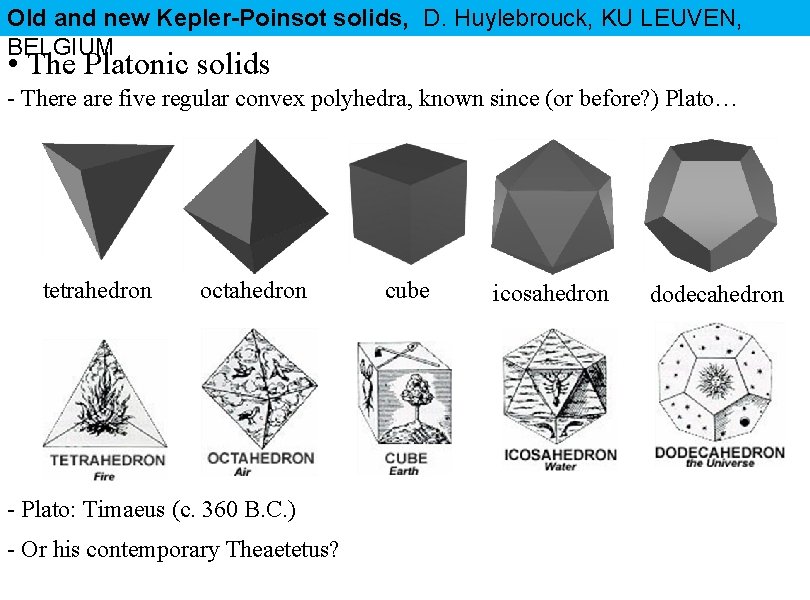
Old and new Kepler-Poinsot solids, D. Huylebrouck, KU LEUVEN, BELGIUM • The Platonic solids - There are five regular convex polyhedra, known since (or before? ) Plato… tetrahedron octahedron - Plato: Timaeus (c. 360 B. C. ) - Or his contemporary Theaetetus? cube icosahedron dodecahedron
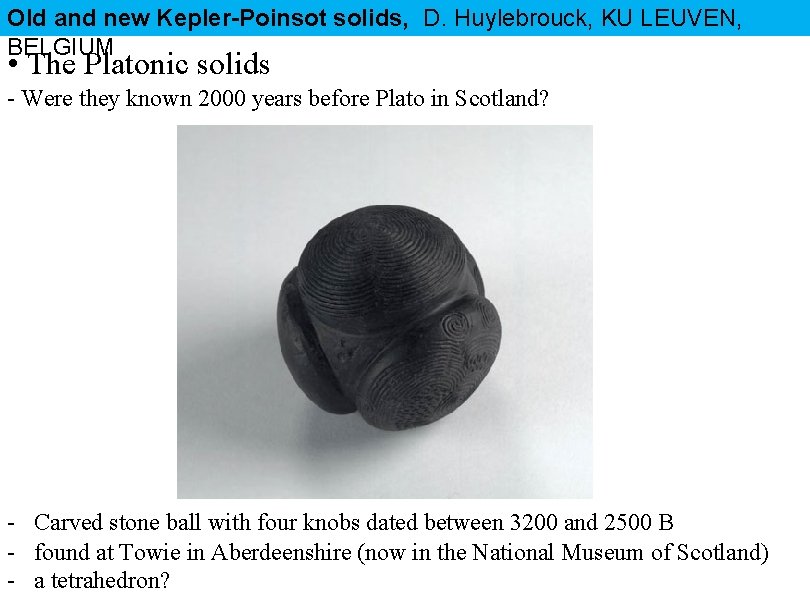
Old and new Kepler-Poinsot solids, D. Huylebrouck, KU LEUVEN, BELGIUM • The Platonic solids - Were they known 2000 years before Plato in Scotland? - Carved stone ball with four knobs dated between 3200 and 2500 B - found at Towie in Aberdeenshire (now in the National Museum of Scotland) - a tetrahedron?
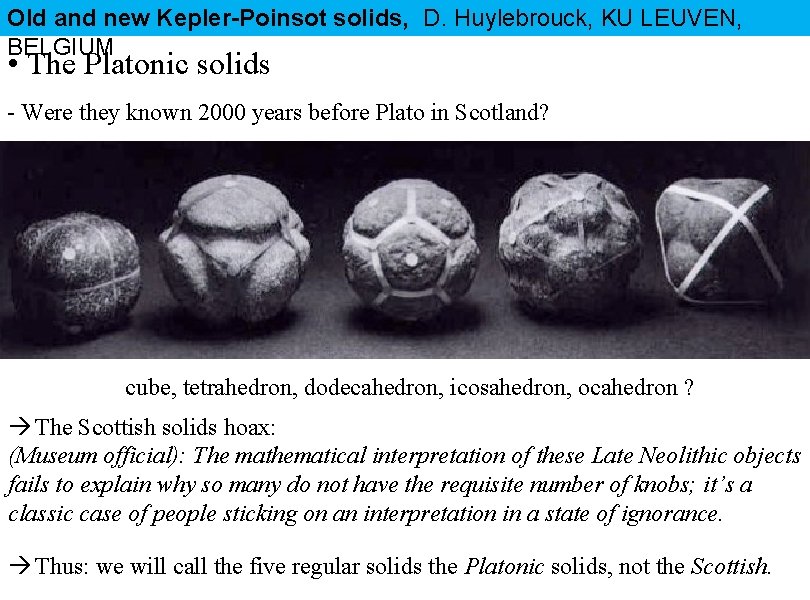
Old and new Kepler-Poinsot solids, D. Huylebrouck, KU LEUVEN, BELGIUM • The Platonic solids - Were they known 2000 years before Plato in Scotland? cube, tetrahedron, dodecahedron, icosahedron, ocahedron ? The Scottish solids hoax: (Museum official): The mathematical interpretation of these Late Neolithic objects fails to explain why so many do not have the requisite number of knobs; it’s a classic case of people sticking on an interpretation in a state of ignorance. Thus: we will call the five regular solids the Platonic solids, not the Scottish.
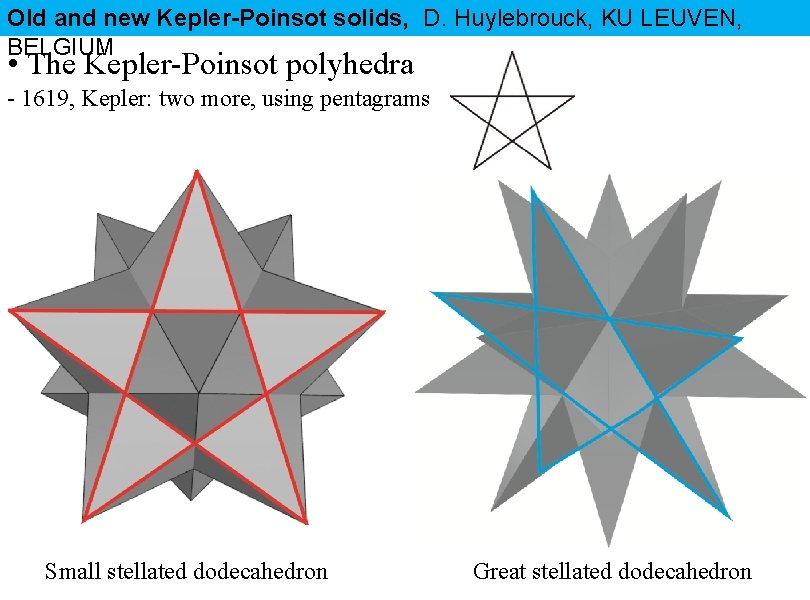
Old and new Kepler-Poinsot solids, D. Huylebrouck, KU LEUVEN, BELGIUM • The Kepler-Poinsot polyhedra - 1619, Kepler: two more, using pentagrams Small stellated dodecahedron Great stellated dodecahedron
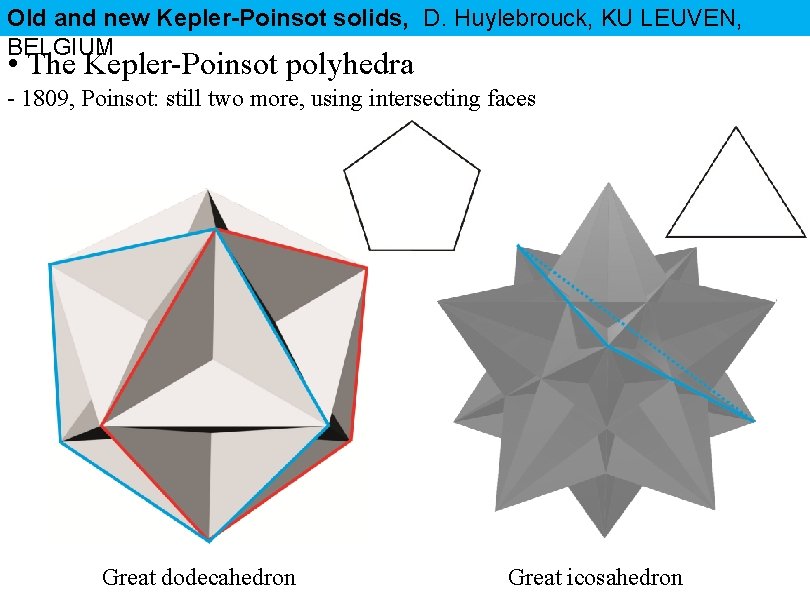
Old and new Kepler-Poinsot solids, D. Huylebrouck, KU LEUVEN, BELGIUM • The Kepler-Poinsot polyhedra - 1809, Poinsot: still two more, using intersecting faces Great dodecahedron Great icosahedron
Old and new Kepler-Poinsot solids II. Other ‘discoverers’ of the Kepler-Poinsot solids
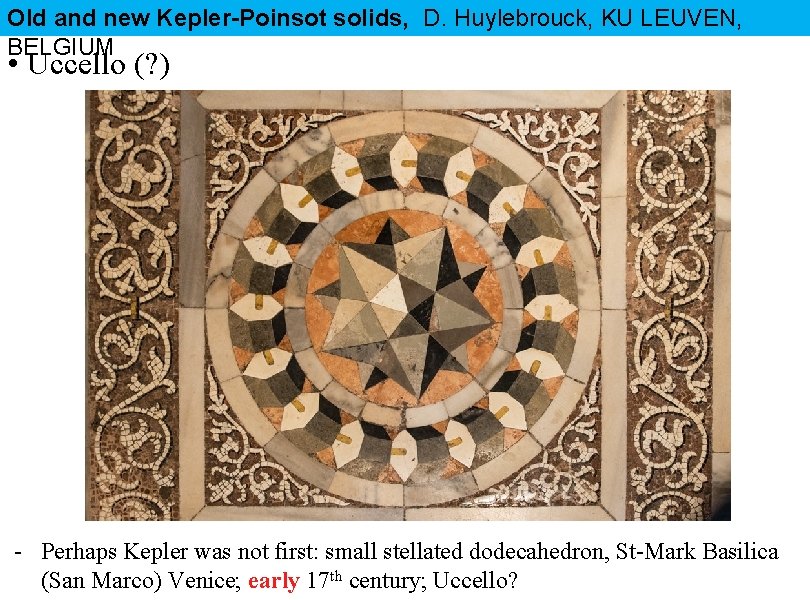
Old and new Kepler-Poinsot solids, D. Huylebrouck, KU LEUVEN, BELGIUM • Uccello (? ) - Perhaps Kepler was not first: small stellated dodecahedron, St-Mark Basilica (San Marco) Venice; early 17 th century; Uccello?
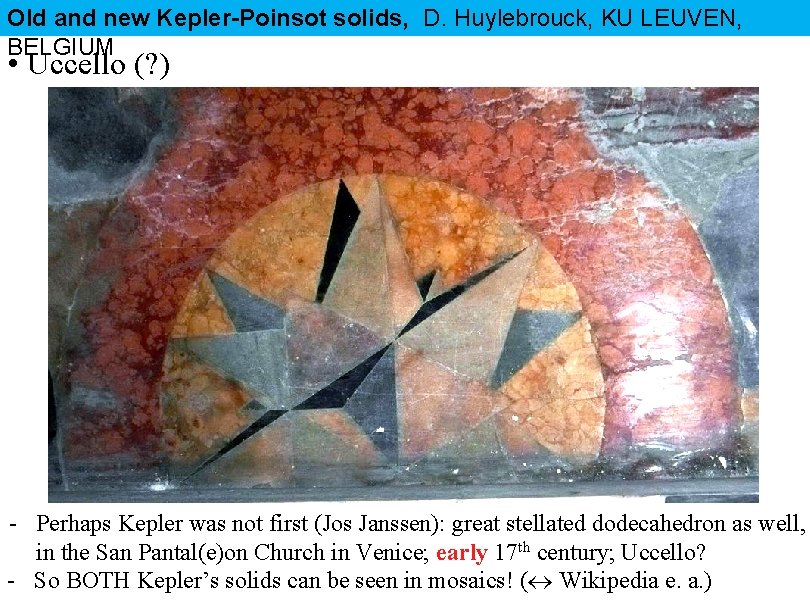
Old and new Kepler-Poinsot solids, D. Huylebrouck, KU LEUVEN, BELGIUM • Uccello (? ) - Perhaps Kepler was not first (Jos Janssen): great stellated dodecahedron as well, in the San Pantal(e)on Church in Venice; early 17 th century; Uccello? - So BOTH Kepler’s solids can be seen in mosaics! ( Wikipedia e. a. )
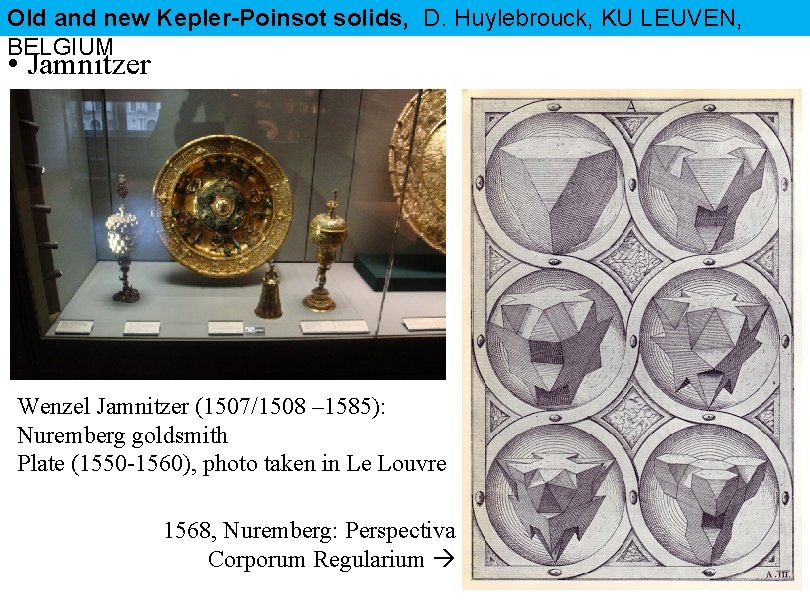
Old and new Kepler-Poinsot solids, D. Huylebrouck, KU LEUVEN, BELGIUM • Jamnitzer Wenzel Jamnitzer (1507/1508 – 1585): Nuremberg goldsmith Plate (1550 -1560), photo taken in Le Louvre 1568, Nuremberg: Perspectiva Corporum Regularium
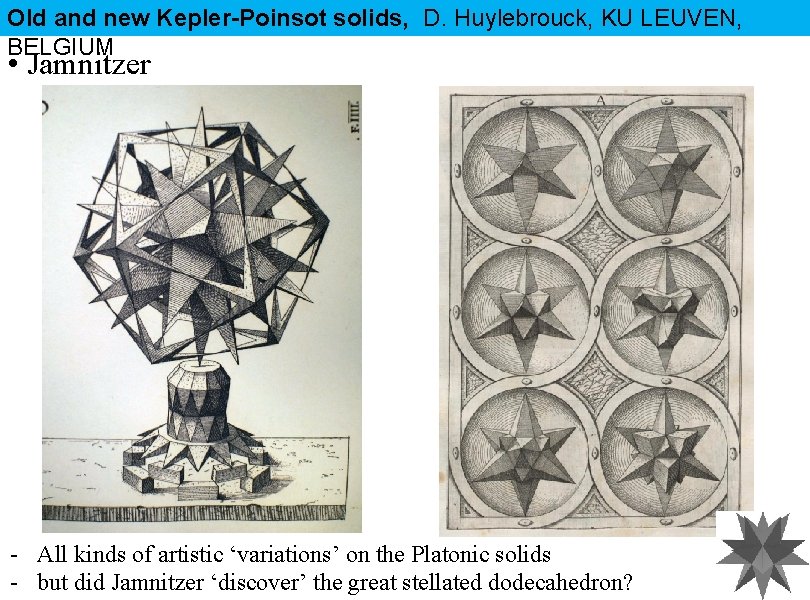
Old and new Kepler-Poinsot solids, D. Huylebrouck, KU LEUVEN, BELGIUM • Jamnitzer - All kinds of artistic ‘variations’ on the Platonic solids - but did Jamnitzer ‘discover’ the great stellated dodecahedron?
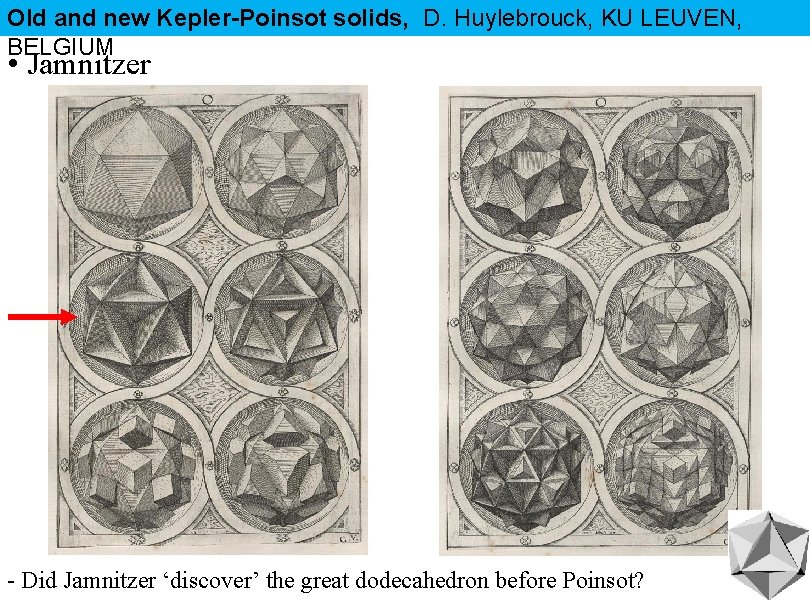
Old and new Kepler-Poinsot solids, D. Huylebrouck, KU LEUVEN, BELGIUM • Jamnitzer - Did Jamnitzer ‘discover’ the great dodecahedron before Poinsot?
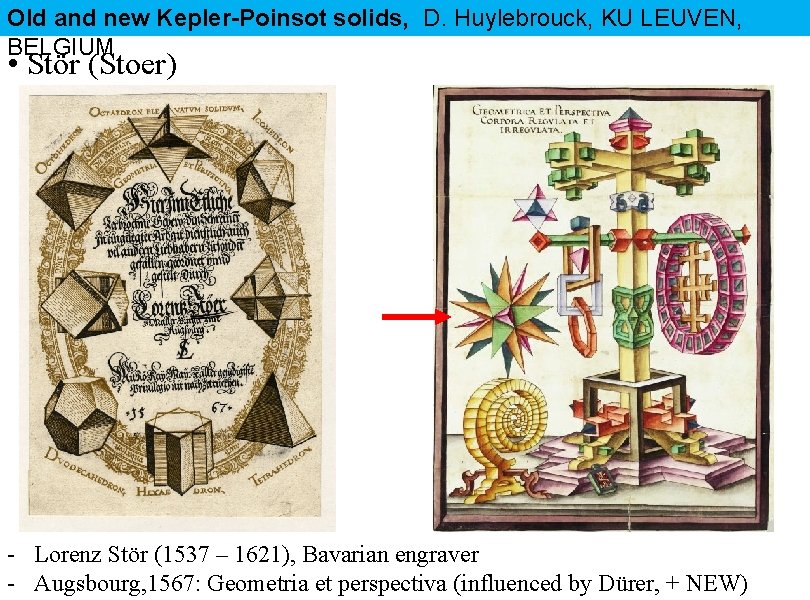
Old and new Kepler-Poinsot solids, D. Huylebrouck, KU LEUVEN, BELGIUM • Stör (Stoer) - Lorenz Stör (1537 – 1621), Bavarian engraver - Augsbourg, 1567: Geometria et perspectiva (influenced by Dürer, + NEW)
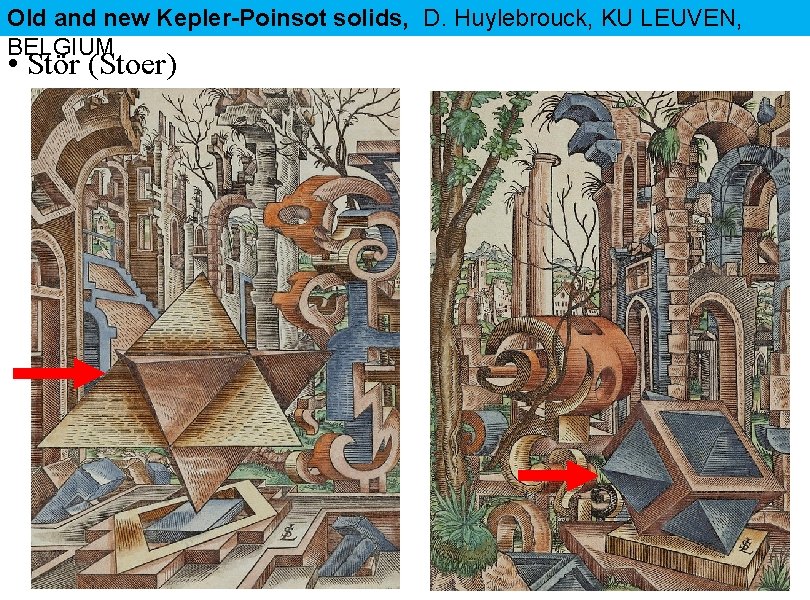
Old and new Kepler-Poinsot solids, D. Huylebrouck, KU LEUVEN, BELGIUM • Stör (Stoer)
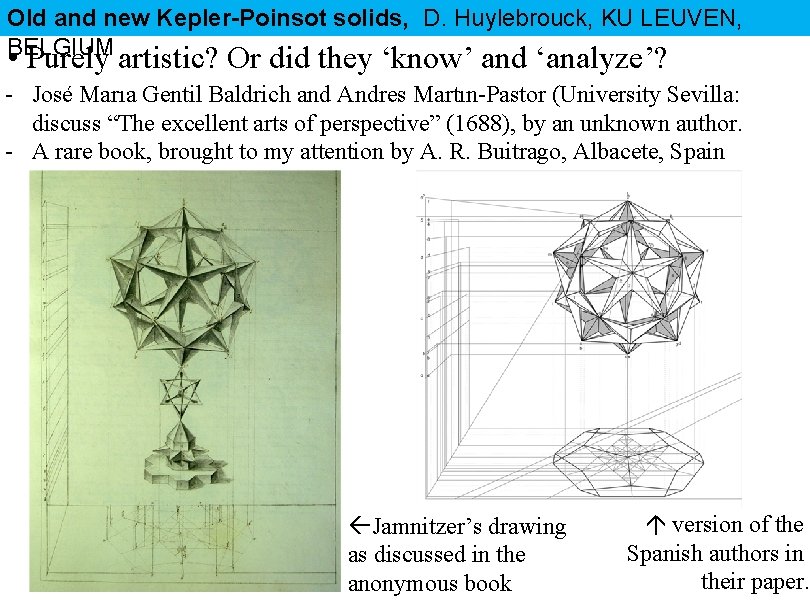
Old and new Kepler-Poinsot solids, D. Huylebrouck, KU LEUVEN, BELGIUM • Purely artistic? Or did they ‘know’ and ‘analyze’? - José Marıa Gentil Baldrich and Andres Martın-Pastor (University Sevilla: discuss “The excellent arts of perspective” (1688), by an unknown author. - A rare book, brought to my attention by A. R. Buitrago, Albacete, Spain ßJamnitzer’s drawing as discussed in the anonymous book version of the Spanish authors in their paper.
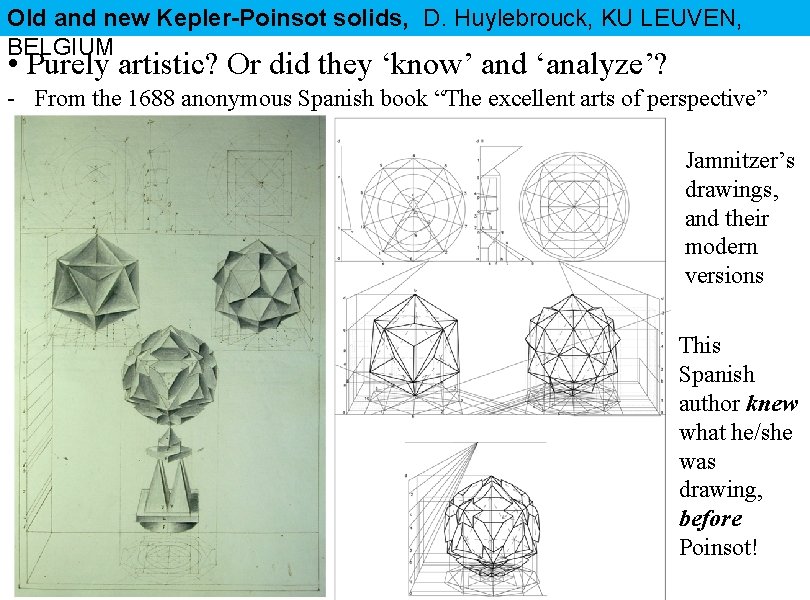
Old and new Kepler-Poinsot solids, D. Huylebrouck, KU LEUVEN, BELGIUM • Purely artistic? Or did they ‘know’ and ‘analyze’? - From the 1688 anonymous Spanish book “The excellent arts of perspective” Jamnitzer’s drawings, and their modern versions This Spanish author knew what he/she was drawing, before Poinsot!
Old and new Kepler-Poinsot solids III. New Kepler-Poinsot solids
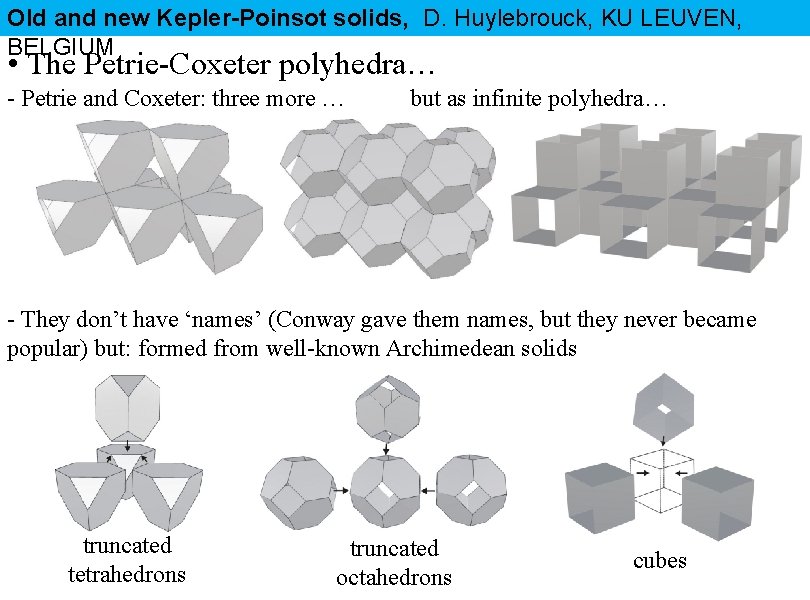
Old and new Kepler-Poinsot solids, D. Huylebrouck, KU LEUVEN, BELGIUM • The Petrie-Coxeter polyhedra… - Petrie and Coxeter: three more … but as infinite polyhedra… - They don’t have ‘names’ (Conway gave them names, but they never became popular) but: formed from well-known Archimedean solids truncated tetrahedrons truncated octahedrons cubes
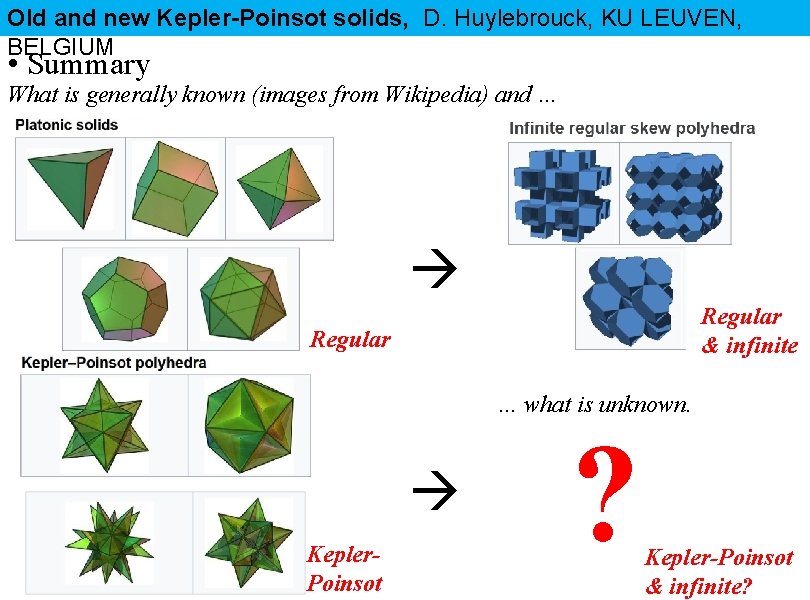
Old and new Kepler-Poinsot solids, D. Huylebrouck, KU LEUVEN, BELGIUM • Summary What is generally known (images from Wikipedia) and … Regular & infinite Regular … what is unknown. Kepler. Poinsot ? Kepler-Poinsot & infinite?
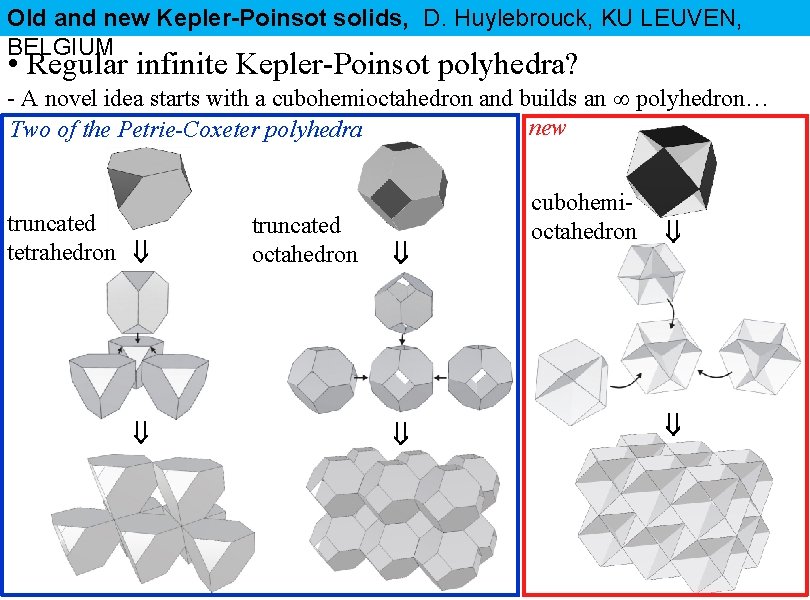
Old and new Kepler-Poinsot solids, D. Huylebrouck, KU LEUVEN, BELGIUM • Regular infinite Kepler-Poinsot polyhedra? - A novel idea starts with a cubohemioctahedron and builds an polyhedron… new Two of the Petrie-Coxeter polyhedra truncated octahedron truncated tetrahedron cubohemioctahedron
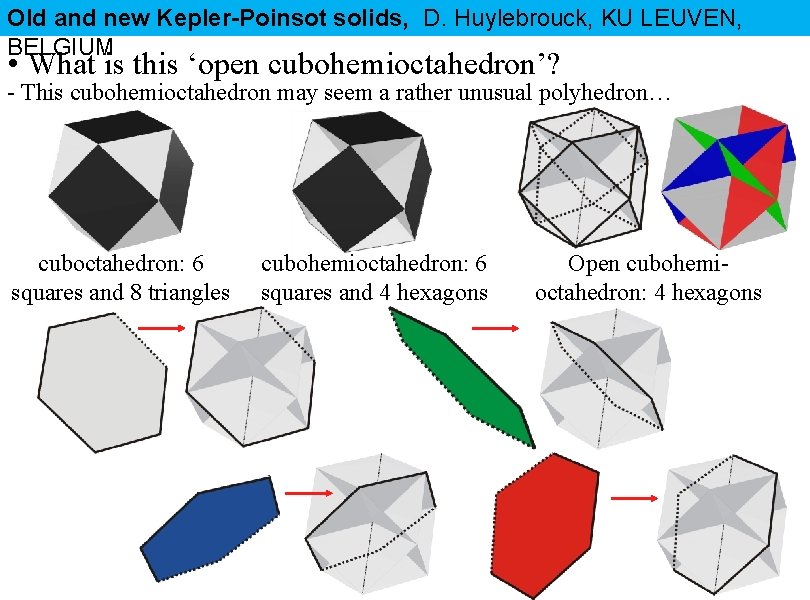
Old and new Kepler-Poinsot solids, D. Huylebrouck, KU LEUVEN, BELGIUM • What is this ‘open cubohemioctahedron’? - This cubohemioctahedron may seem a rather unusual polyhedron… cuboctahedron: 6 squares and 8 triangles cubohemioctahedron: 6 squares and 4 hexagons Open cubohemioctahedron: 4 hexagons
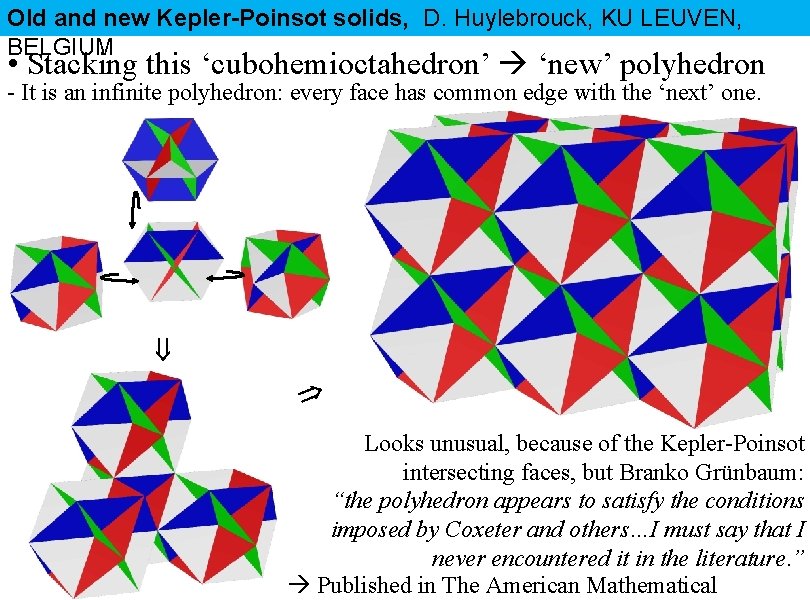
Old and new Kepler-Poinsot solids, D. Huylebrouck, KU LEUVEN, BELGIUM • Stacking this ‘cubohemioctahedron’ ‘new’ polyhedron - It is an infinite polyhedron: every face has common edge with the ‘next’ one. Looks unusual, because of the Kepler-Poinsot intersecting faces, but Branko Grünbaum: “the polyhedron appears to satisfy the conditions imposed by Coxeter and others…I must say that I never encountered it in the literature. ” Published in The American Mathematical
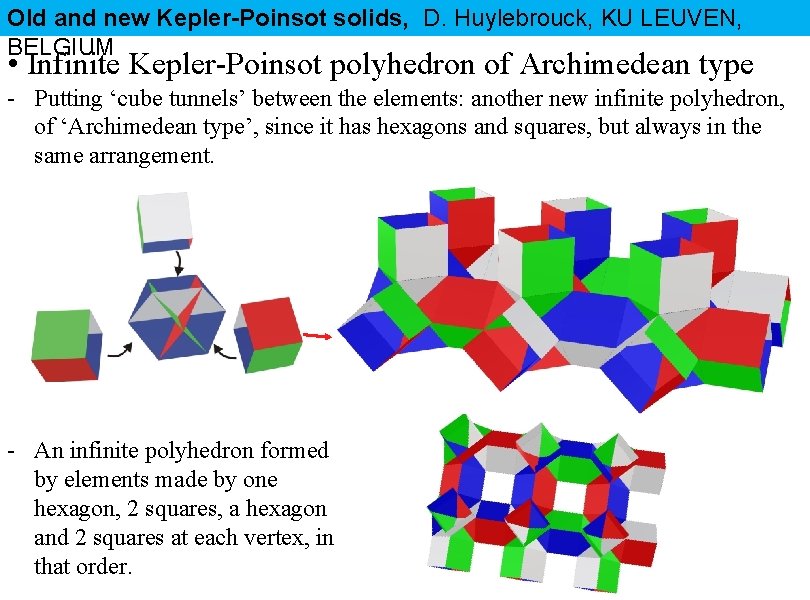
Old and new Kepler-Poinsot solids, D. Huylebrouck, KU LEUVEN, BELGIUM • Infinite Kepler-Poinsot polyhedron of Archimedean type - Putting ‘cube tunnels’ between the elements: another new infinite polyhedron, of ‘Archimedean type’, since it has hexagons and squares, but always in the same arrangement. - An infinite polyhedron formed by elements made by one hexagon, 2 squares, a hexagon and 2 squares at each vertex, in that order.
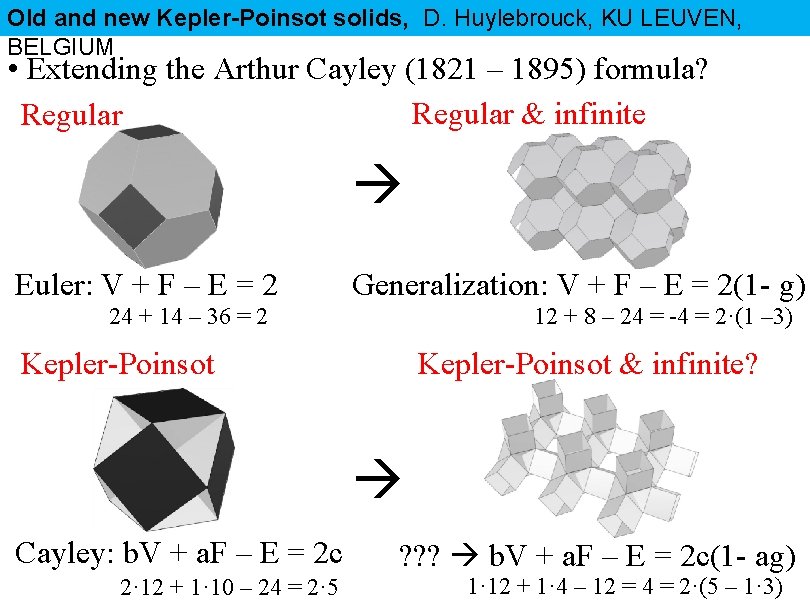
Old and new Kepler-Poinsot solids, D. Huylebrouck, KU LEUVEN, BELGIUM • Extending the Arthur Cayley (1821 – 1895) formula? Regular & infinite Regular Euler: V + F – E = 2 Generalization: V + F – E = 2(1 - g) 24 + 14 – 36 = 2 12 + 8 – 24 = -4 = 2·(1 – 3) Kepler-Poinsot & infinite? Cayley: b. V + a. F – E = 2 c 2· 12 + 1· 10 – 24 = 2· 5 ? ? ? b. V + a. F – E = 2 c(1 - ag) 1· 12 + 1· 4 – 12 = 4 = 2·(5 – 1· 3)
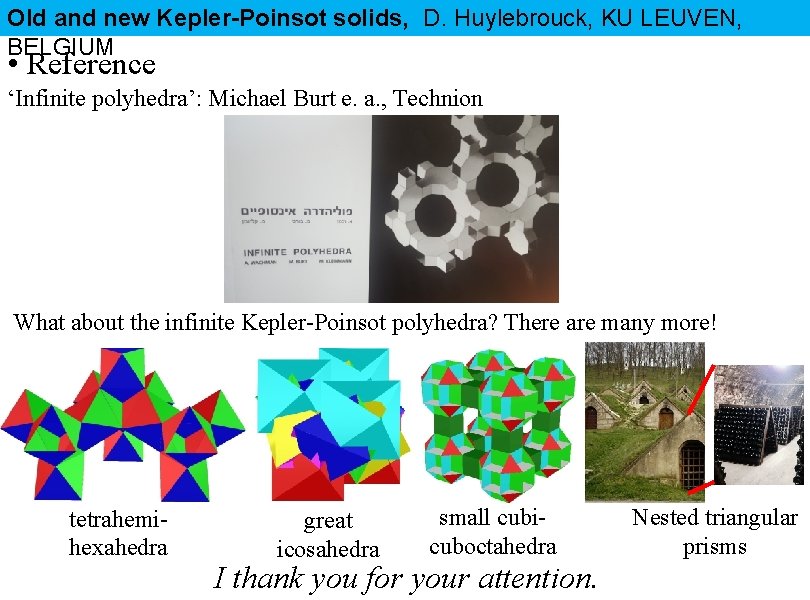
Old and new Kepler-Poinsot solids, D. Huylebrouck, KU LEUVEN, BELGIUM • Reference ‘Infinite polyhedra’: Michael Burt e. a. , Technion What about the infinite Kepler-Poinsot polyhedra? There are many more! tetrahemihexahedra great icosahedra small cubicuboctahedra I thank you for your attention. Nested triangular prisms
- Slides: 27