
Olanrewaju Onigbogi MBBS MPH Department of Community Medicine
Olanrewaju Onigbogi MBBS, MPH Department of Community Medicine, University College Hospital, Ibadan, Nigeria.
Introduction • Harm reduction (HR) has largely become accepted as the philosophical underpinning of the public health response to substance use. • Strategies include: Methadone maintenance, needle exchange and server intervention programs. In general, HR interventions seem to have adult substance users as their implicit target.
Introduction • Increasingly HR is being advocated as a populationbased strategy for all youth, not just those at high risk of harm. Supporters of HR point to factors such as: • High rates of substance use among youth. • The limited effectiveness of drug prevention programs. • Difficulty of targeting programs to high-risk adolescents as reasons for youth- specific interventions.
Introduction United Nations Convention on the Rights of the Child identifies the civil, political, economic, social and cultural rights of the child. Article 33 identifies abstinence as the goal of measures to protect children from psychotropic substances. Articles 5, 12 and 13 stress the notion of the child’s rights being in accordance with age, maturity and evolving capacity within the context of parental responsibility and community involvement.
Introduction HR for youth is seen by some as controversial. HR is controversial because there is little evidence regarding the effectiveness and safety of HR as approach to substance use by youth. However, a different approach has to be explored bearing in mind the large number s of young people who use illicit substances.
Introduction HR is defined as an approach that focuses on the risks and consequences of substance use rather than on the use itself. HR accepts the fact that many people use substances and considers a drug-free society impractical. HR has remains neutral on the topic of abstinence use is neither condoned nor condemned.
Introduction The HR philosophy views abstinence as only one potential strategy among a broad range of options that can reduce the health and social harms associated with illicit drug use. HR activities relate to the adoption of policies and programmes which attempt primarily to reduce the adverse consequences of all psychoactive substances to drug users and their families.
HR and Youth HR among youths is characterized by 3 major issues: 1. Complexities associated with ability of youths to make decisions concerning substance use. 2. The specific risks and harms associated with youth substance use. 3. Unique opportunities for drug policies and programs targeting youth.
HR and Youth The term “youth” for the purpose of this presentation is loosely defined and not necessarily bound by age, occupation or residence. Youth can approximately be put as those between 10 to 25 years of age. This encompasses a wide breadth of intellectual and emotional maturity, personal independence and legal status vis-à-vis substances and other behaviours that may be affected by substance use.
HR and Youth A 2004 Canadian Addiction Survey, states that youth in all parts of the world continue to be at increased risk of substance-related harm for several years after having attained the legal age of access to alcohol and tobacco.
HR and Youth Regarding decision making, HR is not a passive strategy that is “done to” participants. Rather, it is an active and interactive process. To practice HR, individuals must be engaged in “selfmanagement so that they may be capable of anticipating risky situations and generating viable alternatives.
HR and Youth To practice HR, individuals must be engaged in selfmanagement so that they may be capable of anticipating risky situations. The main challenges for HR addressing legal-aged youth are therefore pragmatic, focusing on the implementation of effective strategies.
HR and Youth Adolescence is a life stage characterized by increasing autonomy. The wide variability in emotional, social and intellectual development during this life stage gives rise to uncertainty or disagreement about adolescents’ decision-making capacity in general and as it concerns the fundamentally illegal behaviors of substance use.
HR and Youth HR might be practiced by an individual under-aged youth and as a basis for population-based policies and programs targeting groups of under-aged youth. An individual under-aged youth may be fully competent in making a decision to use substances and to adopt HR philosophy. From a population perspective however, policies and programs must be based on a weighing of the benefits and risks to the population.
Individual Vs Population approach Population-based HR methods ought to be adopted at the average at which a substantial proportion of the under-aged population is foregoing abstinence and is at material risk of harm. One of the features of youth-centred risks and harms is that youth themselves may not recognize them to be risks or problems. Hence the need for a combination of the individual and the population approaches.
Interventions among Youth Interventions focusing on youth substance: Universal Selective Indicated Selective and indicated interventions target individuals or groups of individuals with specific characteristics or risk factors. The level of maturity and autonomy, and of substance use and risk, can be gauged with some accuracy.
Interventions among Youth Universal prevention is by definition an approach applied to a whole population, undifferentiated as to level of use risk and maturity. HR as a universal intervention targeting under-aged youth therefore needs to be informed by the legal and policy constraints placed on school and youth recreation areas. The substances most commonly used by youths are alcohol, cannabis and tobacco.
Interventions among Youth Motivational interviewing - is an approach that “seeks to promote reflection on drug use and its personal consequences in the context of the values and goals of the individual. ” It is considered especially suitable for college youth as it is non-confrontational and does not impose specific outcomes. It calls into play the model of behaviour change.
Interventions among Youth Web-based applications are a natural progression from the more traditional delivery provided in person or by mail. - This intervention bears in mind the time many youths spend on the internet. Telephone-based interventions – with specific interest in voice prompts about HR options.
Bibliography Duncan, D. F. , Nicholson, T. , Clifford, P. , Hawkins, W. , Petosa, R. (1994). Harm reduction: An emerging new paradigm for drug education. Journal of Drug Education, 24(4), 281 -290. Erickson, P. G. (1997). Reducing the harm of adolescent substance use. Canadian Medical Association Journal, 156(10), 1397 -1399. Marlatt, G. A. (1996). Harm reduction: Come as you are. Journal of Addictive Behavior, 21(6), 779 -788. Poulin, C. , Nicholson, J. (2005). Should harm minimization as an approach to adolescent substance use be embraced by junior and senior high schools? Empirical evidence from an integrated school- and community-based demonstration intervention addressing drug use among adolescents. International Journal of Drug Policy, 16, 03 -414.
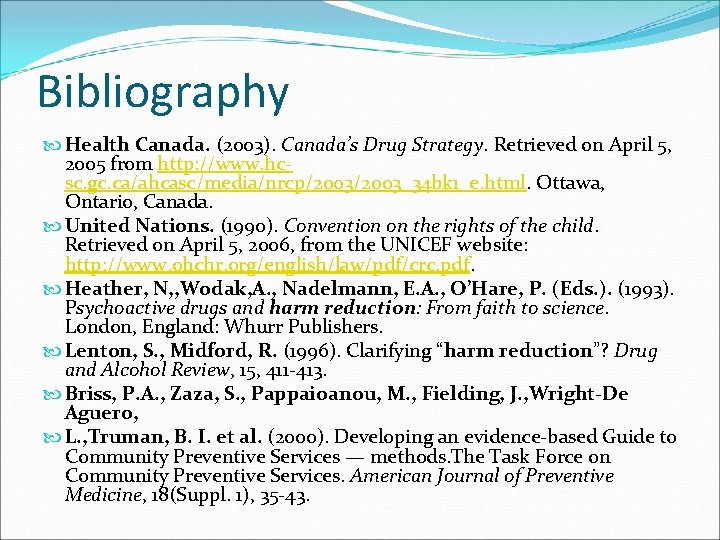
Bibliography Health Canada. (2003). Canada’s Drug Strategy. Retrieved on April 5, 2005 from http: //www. hcsc. gc. ca/ahcasc/media/nrcp/2003_34 bk 1_e. html. Ottawa, Ontario, Canada. United Nations. (1990). Convention on the rights of the child. Retrieved on April 5, 2006, from the UNICEF website: http: //www. ohchr. org/english/law/pdf/crc. pdf. Heather, N, , Wodak, A. , Nadelmann, E. A. , O’Hare, P. (Eds. ). (1993). Psychoactive drugs and harm reduction: From faith to science. London, England: Whurr Publishers. Lenton, S. , Midford, R. (1996). Clarifying “harm reduction”? Drug and Alcohol Review, 15, 411 -413. Briss, P. A. , Zaza, S. , Pappaioanou, M. , Fielding, J. , Wright-De Aguero, L. , Truman, B. I. et al. (2000). Developing an evidence-based Guide to Community Preventive Services — methods. The Task Force on Community Preventive Services. American Journal of Preventive Medicine, 18(Suppl. 1), 35 -43.
- Slides: 21