
OLA Super Conference Session 408 Building ICT Capacity
OLA Super. Conference Session #408 Building ICT Capacity Through Interdisciplinary Studies (IDC) Tim Gauntley ©Tim Gauntley 2010 1
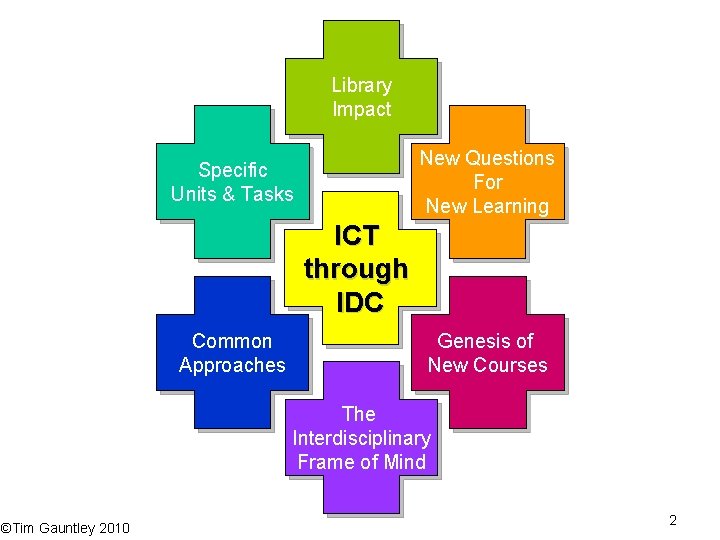
Library Impact New Questions For New Learning Specific Units & Tasks ICT through IDC Common Approaches Genesis of New Courses The Interdisciplinary Frame of Mind ©Tim Gauntley 2010 2

New Questions for New Learning • How can students study and apply important ICT skills and knowledge for personal learning and achievement across the curriculum? • How can teachers become more comfortable with ICT and build capacity for its integration in their professional practice? • How can school cultures shift ─ with staff and students working together for a more conscious infusion of ICT for global communication, teaching, and learning? ©Tim Gauntley 2010 3
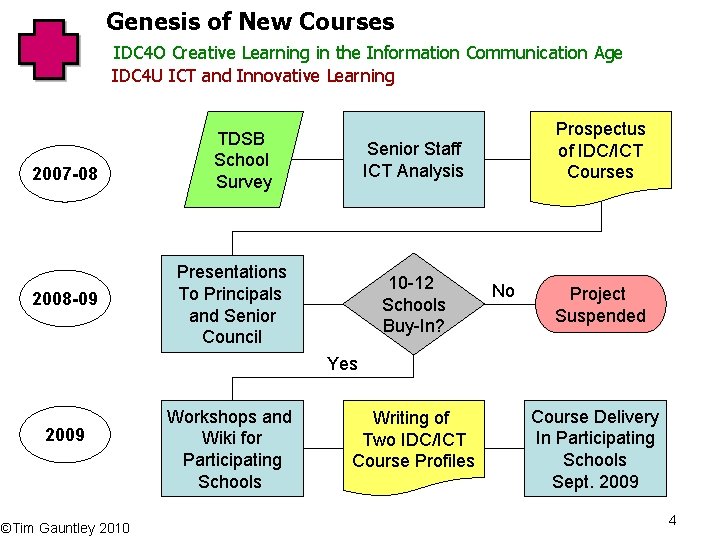
Genesis of New Courses IDC 4 O Creative Learning in the Information Communication Age IDC 4 U ICT and Innovative Learning 2007 -08 2008 -09 TDSB School Survey Prospectus of IDC/ICT Courses Senior Staff ICT Analysis Presentations To Principals and Senior Council 10 -12 Schools Buy-In? No Project Suspended Yes 2009 ©Tim Gauntley 2010 Workshops and Wiki for Participating Schools Writing of Two IDC/ICT Course Profiles Course Delivery In Participating Schools Sept. 2009 4
The Interdisciplinary Frame of Mind There is no true expertise in the humanities without knowing all the humanities. Art is a vast, ancient interconnected web-work, a fabricated tradition. Over-concentration on any point is a distortion. Camille Paglia ©Tim Gauntley 2010 5
![The Interdisciplinary Frame of Mind [It was] an initiation into the love of learning,](http://slidetodoc.com/presentation_image_h2/94e60b93f84dfb3aa2b2f7eaf3dd2aa5/image-6.jpg "The Interdisciplinary Frame of Mind [It was] an initiation into the love of learning,")
The Interdisciplinary Frame of Mind [It was] an initiation into the love of learning, of learning how to learn, that was revealed to me by my … masters as a matter of interdisciplinary cognition ─ that is, learning to know something by its relation to something else. Leonard Bernstein ©Tim Gauntley 2010 6
The Interdisciplinary Frame of Mind Interdisciplinary curriculum provides a vehicle for higher-level thinking. When students are challenged to move beyond memorizing facts, to pursue a topic in depth, and to see patterns and relationships, they are engaged in constructing knowledge rather than merely acquiring information. Susan Drake ©Tim Gauntley 2010 7
The Interdisciplinary Frame of Mind Most essential questions are interdisciplinary in nature. They cut across the lines created by schools and scholars to mark the terrain of departments and disciplines. Essential questions probe the deepest issues confronting us. Jamie Mc. Kenzie ©Tim Gauntley 2010 8
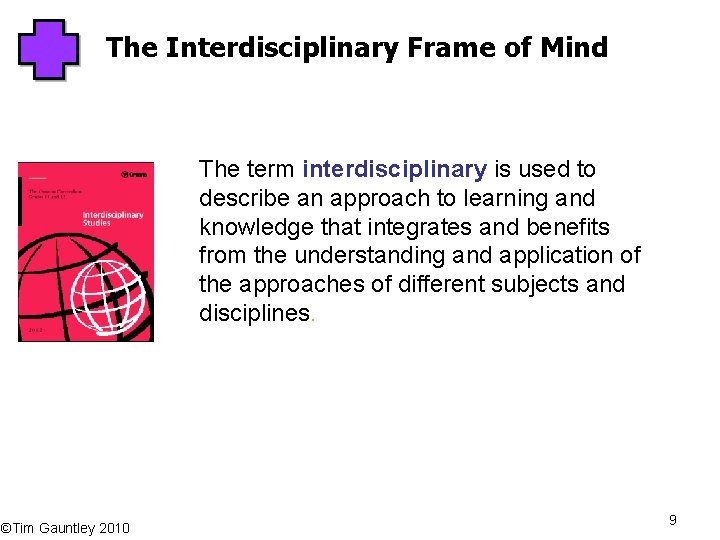
The Interdisciplinary Frame of Mind The term interdisciplinary is used to describe an approach to learning and knowledge that integrates and benefits from the understanding and application of the approaches of different subjects and disciplines. ©Tim Gauntley 2010 9
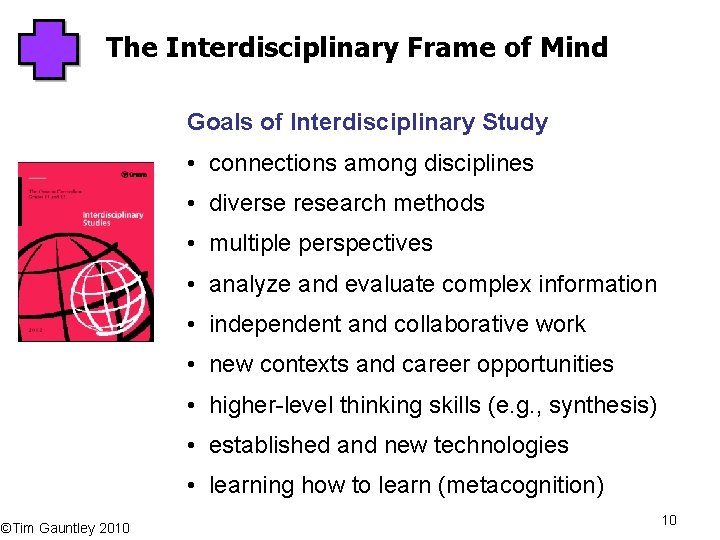
The Interdisciplinary Frame of Mind Goals of Interdisciplinary Study • connections among disciplines • diverse research methods • multiple perspectives • analyze and evaluate complex information • independent and collaborative work • new contexts and career opportunities • higher-level thinking skills (e. g. , synthesis) • established and new technologies • learning how to learn (metacognition) ©Tim Gauntley 2010 10

The Interdisciplinary Frame of Mind Interdisciplinary Studies Course 1 + Relevant Expectations from Other course 1 Relevant Expectations from Other course 2 Relevant Expectations from Other courses 3, 4, 5 etc. All expectations of the appropriate Interdisciplinary Studies course are combined with a relevant selection of expectations from two or more “other” courses. These “other” courses can be q from the same grade or the grade immediately preceding or following q of different types (Open, Workplace, College Preparation, University Preparation etc. ). ©Tim Gauntley 2010 11

The Interdisciplinary Frame of Mind Discipline-based expectations of the other courses provide the appropriate context and content for developing practical applications or exploring topics and themes using an interdisciplinary approach. ©Tim Gauntley 2010 12
The Interdisciplinary Frame of Mind When students take an Interdisciplinary Studies course, they are doing and getting credit for Interdisciplinary Studies (i. e. , not Technology, English, etc. ). Only the Interdisciplinary Studies expectations are evaluated (see Interdisciplinary Studies Achievement Chart) ©Tim Gauntley 2010 13

Common Approaches IDC 40 Creative Learning in the Information Communication Age Innovative Learning and ICT IDC 4 U ©Tim Gauntley 2010 14
Common Approaches IDC 40 These Interdisciplinary Studies courses explore the impact of the information communication technology age on society, education, and culture, with particular reference to students’ contribution to learning and teaching in their own school. IDC 4 U ©Tim Gauntley 2010 15
Common Approaches IDC 40 Using interdisciplinary sources and methodologies, students will examine the nature, application, and significance of ICTassisted learning including: • societal trends stimulating the development of new literacies and lifelong learning IDC 4 U ©Tim Gauntley 2010 • ICT skills, knowledge, and attitudes necessary for success by engaged teachers and students • matching learning tasks to appropriate digital media and tools in diverse content areas 16
Common Approaches Using diverse approaches, students will: • pair with willing teachers to assist their use of ICT in transforming class projects IDC 40 • reflect unit-by-unit with teachers on their mutual learning • build capacity for teacher implementation of ICT • share research to engage the community in IDC 4 U feedback • reflect on each unit task in a continuous electronic journal that is shared with the school community. ©Tim Gauntley 2010 17
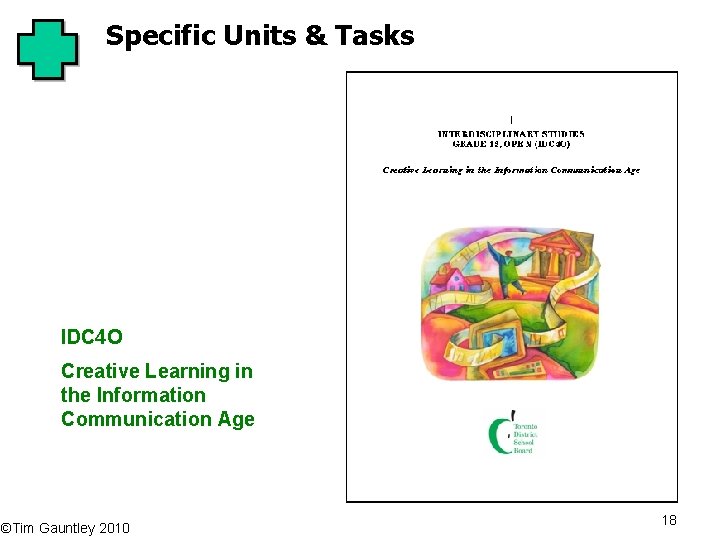
Specific Units & Tasks IDC 4 O Creative Learning in the Information Communication Age ©Tim Gauntley 2010 18
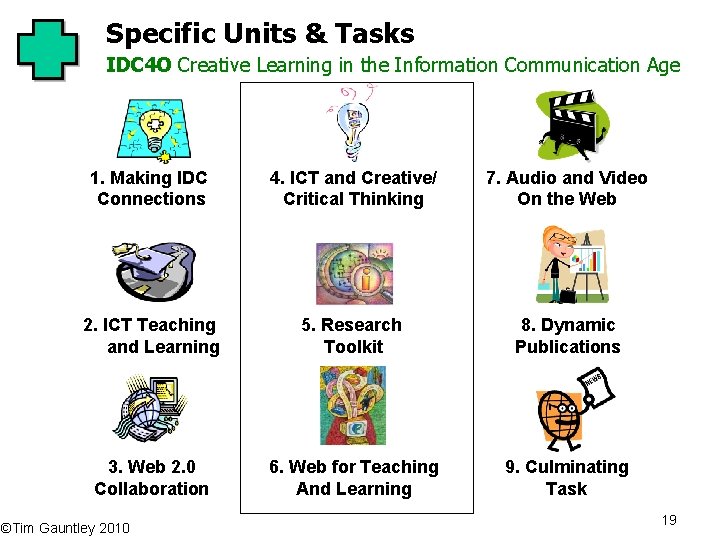
Specific Units & Tasks IDC 4 O Creative Learning in the Information Communication Age 1. Making IDC Connections 4. ICT and Creative/ Critical Thinking 7. Audio and Video On the Web 2. ICT Teaching and Learning 5. Research Toolkit 8. Dynamic Publications 3. Web 2. 0 Collaboration 6. Web for Teaching And Learning 9. Culminating Task ©Tim Gauntley 2010 19
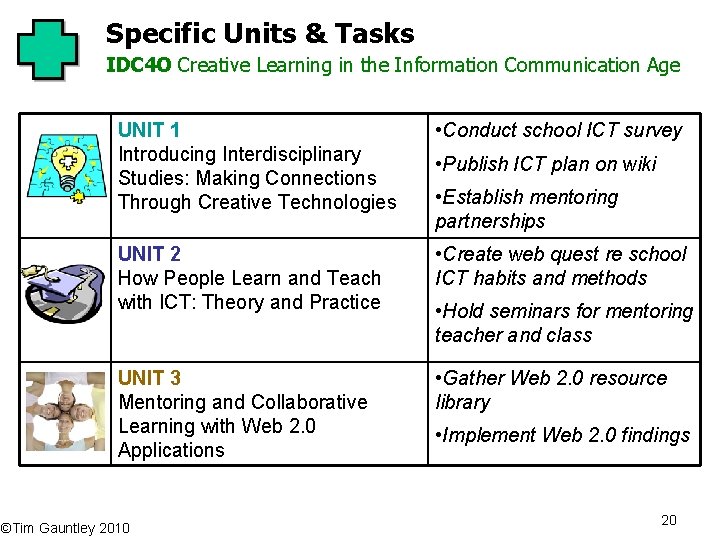
Specific Units & Tasks IDC 4 O Creative Learning in the Information Communication Age UNIT 1 Introducing Interdisciplinary Studies: Making Connections Through Creative Technologies • Conduct school ICT survey UNIT 2 How People Learn and Teach with ICT: Theory and Practice • Create web quest re school ICT habits and methods UNIT 3 Mentoring and Collaborative Learning with Web 2. 0 Applications • Gather Web 2. 0 resource library ©Tim Gauntley 2010 • Publish ICT plan on wiki • Establish mentoring partnerships • Hold seminars for mentoring teacher and class • Implement Web 2. 0 findings 20
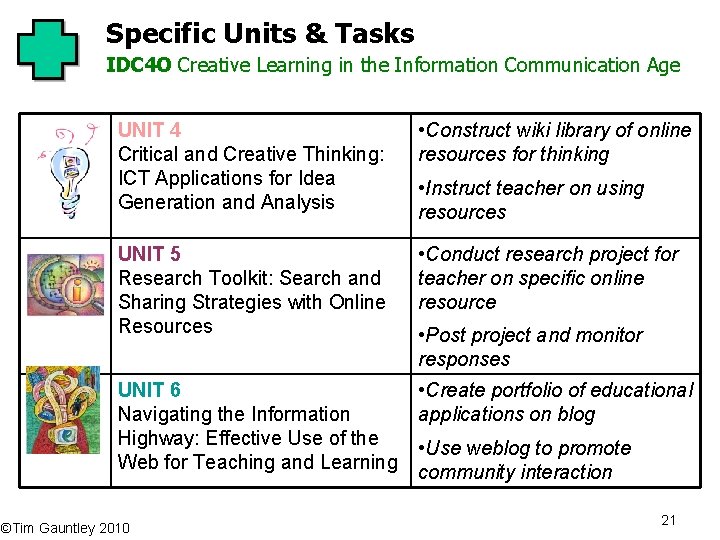
Specific Units & Tasks IDC 4 O Creative Learning in the Information Communication Age UNIT 4 Critical and Creative Thinking: ICT Applications for Idea Generation and Analysis • Construct wiki library of online resources for thinking UNIT 5 Research Toolkit: Search and Sharing Strategies with Online Resources • Conduct research project for teacher on specific online resource UNIT 6 Navigating the Information Highway: Effective Use of the Web for Teaching and Learning • Create portfolio of educational applications on blog ©Tim Gauntley 2010 • Instruct teacher on using resources • Post project and monitor responses • Use weblog to promote community interaction 21
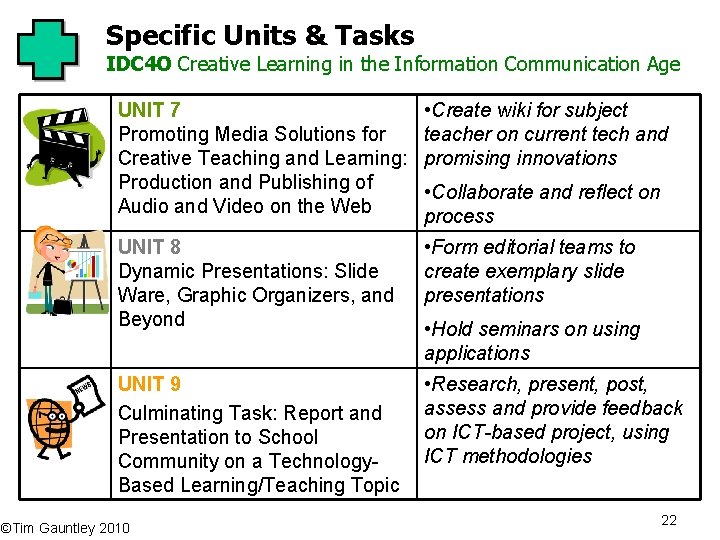
Specific Units & Tasks IDC 4 O Creative Learning in the Information Communication Age UNIT 7 Promoting Media Solutions for Creative Teaching and Learning: Production and Publishing of Audio and Video on the Web • Create wiki for subject teacher on current tech and promising innovations UNIT 8 Dynamic Presentations: Slide Ware, Graphic Organizers, and Beyond • Form editorial teams to create exemplary slide presentations UNIT 9 Culminating Task: Report and Presentation to School Community on a Technology. Based Learning/Teaching Topic • Research, present, post, assess and provide feedback on ICT-based project, using ICT methodologies ©Tim Gauntley 2010 • Collaborate and reflect on process • Hold seminars on using applications 22
UNIT 9 (16 hours) Culminating Task: Report and Presentation to School Community on a Technology-Based Learning/Teaching Topic CULMINATING UNIT TASK: SUMMARY Based on their reflections, conference with the course teacher and appropriate subject teachers, and feedback from peers, each student will: q choose a topic for a major research project that is mutually beneficial to both the student and the school community, q engage in an independent study research project. ©Tim Gauntley 2010 23
UNIT 9 (16 hours) Culminating Task: Report and Presentation to School Community on a Technology-Based Learning/Teaching Topic CULMINATING UNIT TASK: SUMMARY This project includes: q using the research process to research the topic, using interdisciplinary approaches, methods, and resources q producing and posting (on his or her blog and class wiki) the research findings in a report or essay of 2000– 2500 words in both print and electronic format q presenting a five-minute media presentation to his or her IDC class and one of the subject teacher’s classes he or she collaborated with during the course q posting the presentation on the school website for the community q self- and peer assessment and teacher evaluation based on the Interdisciplinary Studies Achievement Chart ©Tim Gauntley 2010 24
UNIT 9 (16 hours) Culminating Task: Report and Presentation to School Community on a Technology-Based Learning/Teaching Topic CULMINATING UNIT TASK: SUMMARY The following topics are suggested for this task; however, students may choose another topic, with the advice and permission of the IDC teacher. • Assistive technologies: Clicker, Kurzwell, and beyond • Collaborative e-learning: a team approach • Collecting data with Web-based tools • Global networks for students: case studies • ICT career opportunities in creative occupations, management positions, and skilled trades • Internet video: what teachers need to know ©Tim Gauntley 2010 25

UNIT 9 (16 hours) Culminating Task: Report and Presentation to School Community on a Technology-Based Learning/Teaching Topic CULMINATING UNIT TASK: SUMMARY • Lifelong-learning in the virtual world • Managing i. Tunes: apps and other resources for learning • Mastering Power. Point graphics and animation • Motivation, self-regulation, and online learning • Online learning tools: a comparison of wikis and blogs • Online roles: students and teachers together • The Internet in the workplace • The online transformation of school libraries ©Tim Gauntley 2010 26
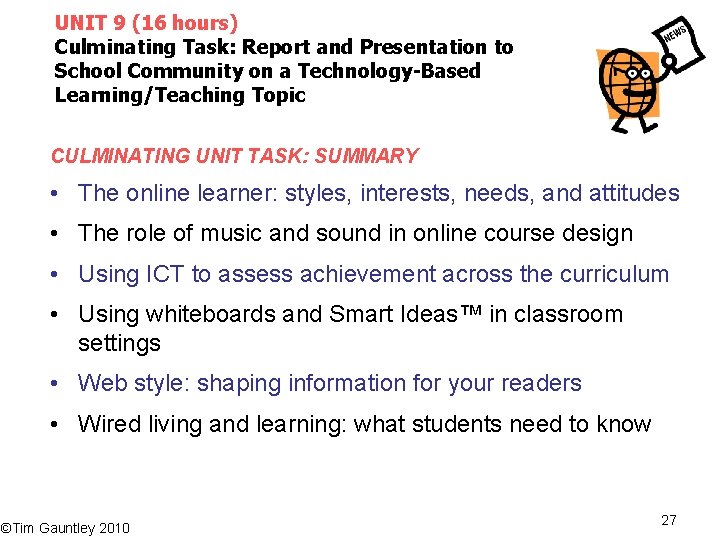
UNIT 9 (16 hours) Culminating Task: Report and Presentation to School Community on a Technology-Based Learning/Teaching Topic CULMINATING UNIT TASK: SUMMARY • The online learner: styles, interests, needs, and attitudes • The role of music and sound in online course design • Using ICT to assess achievement across the curriculum • Using whiteboards and Smart Ideas™ in classroom settings • Web style: shaping information for your readers • Wired living and learning: what students need to know ©Tim Gauntley 2010 27
Specific Units & Tasks IDC 4 U Innovative Learning and ICT ©Tim Gauntley 2010 28

Specific Units & Tasks IDC 4 U Innovative Learning and ICT 1. Building IDC Connections 4. Digital Literacies 7. Innovative Technologies 2. Inclusive ICT 5. Research Toolkit 8. Dynamic Publications 3. Collaborative Culture 6. Web design ©Tim Gauntley 2010 9. Culminating Task 29
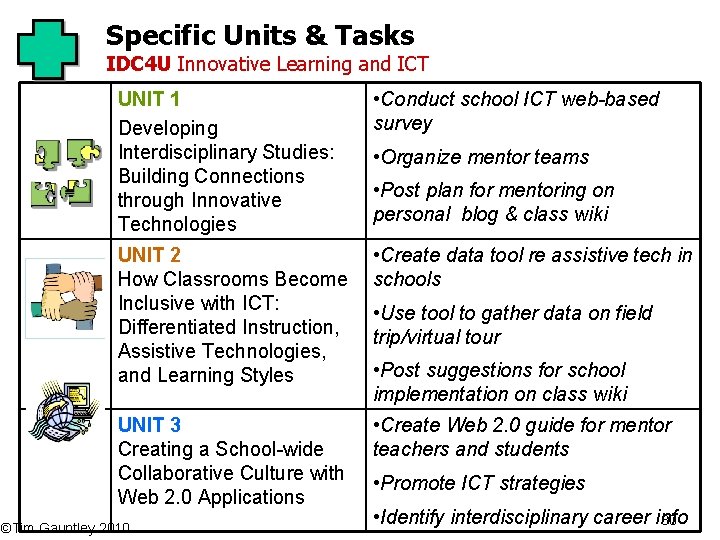
Specific Units & Tasks IDC 4 U Innovative Learning and ICT UNIT 1 Developing Interdisciplinary Studies: Building Connections through Innovative Technologies • Conduct school ICT web-based survey UNIT 2 How Classrooms Become Inclusive with ICT: Differentiated Instruction, Assistive Technologies, and Learning Styles • Create data tool re assistive tech in schools UNIT 3 Creating a School-wide Collaborative Culture with Web 2. 0 Applications • Create Web 2. 0 guide for mentor teachers and students ©Tim Gauntley 2010 • Organize mentor teams • Post plan for mentoring on personal blog & class wiki • Use tool to gather data on field trip/virtual tour • Post suggestions for school implementation on class wiki • Promote ICT strategies • Identify interdisciplinary career info 30
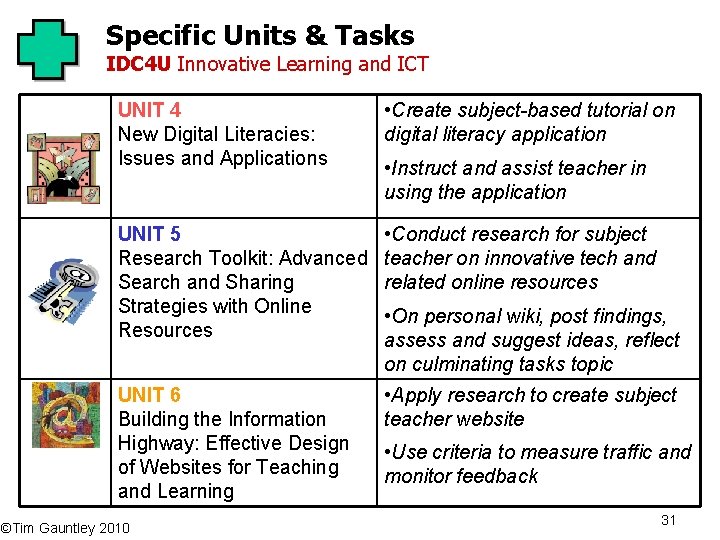
Specific Units & Tasks IDC 4 U Innovative Learning and ICT UNIT 4 New Digital Literacies: Issues and Applications • Create subject-based tutorial on digital literacy application UNIT 5 Research Toolkit: Advanced Search and Sharing Strategies with Online Resources • Conduct research for subject teacher on innovative tech and related online resources UNIT 6 Building the Information Highway: Effective Design of Websites for Teaching and Learning • Apply research to create subject teacher website ©Tim Gauntley 2010 • Instruct and assist teacher in using the application • On personal wiki, post findings, assess and suggest ideas, reflect on culminating tasks topic • Use criteria to measure traffic and monitor feedback 31
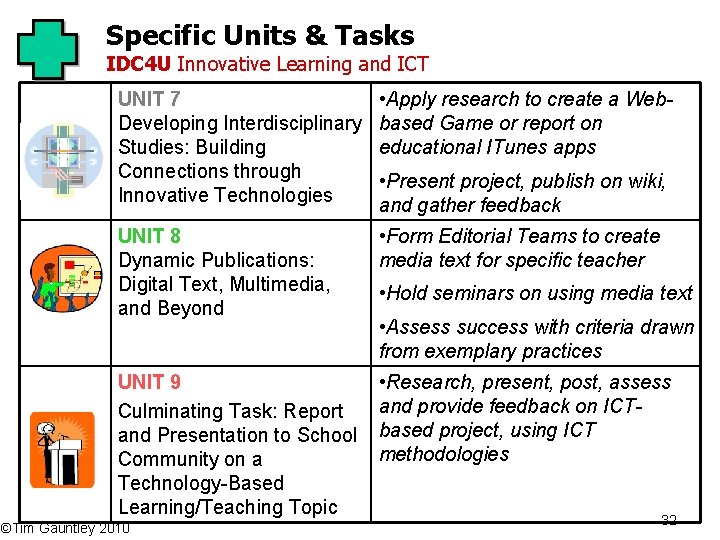
Specific Units & Tasks IDC 4 U Innovative Learning and ICT UNIT 7 Developing Interdisciplinary Studies: Building Connections through Innovative Technologies • Apply research to create a Webbased Game or report on educational ITunes apps UNIT 8 Dynamic Publications: Digital Text, Multimedia, and Beyond • Form Editorial Teams to create media text for specific teacher UNIT 9 Culminating Task: Report and Presentation to School Community on a Technology-Based Learning/Teaching Topic • Research, present, post, assess and provide feedback on ICTbased project, using ICT methodologies ©Tim Gauntley 2010 • Present project, publish on wiki, and gather feedback • Hold seminars on using media text • Assess success with criteria drawn from exemplary practices 32
UNIT 9 (16 hours) Culminating Task: Report and Presentation to School Community on a Technology-Based Learning/Teaching Topic CULMINATING UNIT TASK: SUMMARY Based on their reflections, conference with the course teacher and appropriate subject teachers, and feedback from peers, each student will: q choose a topic for a major research project that is mutually beneficial to both the student and the school community, q engage in an independent study research project. ©Tim Gauntley 2010 33
UNIT 9 (16 hours) Culminating Task: Report and Presentation to School Community on a Technology-Based Learning/Teaching Topic CULMINATING UNIT TASK: SUMMARY This project includes: q using the research process to research the topic, using interdisciplinary approaches, methods, and resources q producing and posting (on his or her blog and class wiki) the research findings in a report or essay of 2000– 2500 words in both print and electronic format q presenting a five-minute media presentation to his or her IDC class and one of the subject teacher’s classes he or she collaborated with during the course q posting the presentation on the school website for the community q self- and peer assessment and teacher evaluation based on the Interdisciplinary Studies Achievement Chart ©Tim Gauntley 2010 34
UNIT 9 (16 hours) Culminating Task: Report and Presentation to School Community on a Technology-Based Learning/Teaching Topic CULMINATING UNIT TASK: SUMMARY The following topics are suggested for this task; however, students may choose another topic, with the advice and permission of the IDC teacher. • Assessing achievement in online learning: issues and practices • Assistive technologies: Dragon Naturally Speaking, Read & Write, and beyond • Creating electronic portfolios for career and education plans • From search engine to portal: history and impact of Google • Google Tools: what students need to know ©Tim Gauntley 2010 35
UNIT 9 (16 hours) Culminating Task: Report and Presentation to School Community on a Technology-Based Learning/Teaching Topic CULMINATING UNIT TASK: SUMMARY • Learning theories and equitable online learning • Online learning tools: what teachers need to know • Online resources: the end of traditional libraries? • Plagiarism and online learning • Problem-based learning in online courses • Search engine optimization for post-secondary preparation • Social networking culture: My. Space, You. Tube, and beyond • The ethics of online teaching and learning ©Tim Gauntley 2010 36
UNIT 9 (16 hours) Culminating Task: Report and Presentation to School Community on a Technology-Based Learning/Teaching Topic CULMINATING UNIT TASK: SUMMARY • The impact of video gaming on learning • The Library Commons: toward a new learning culture • The role of art and visual information in online design • Using video conferencing in classroom settings • Virtual international collaboration: case studies • Web style: writing, organizing, and editing on the Internet ©Tim Gauntley 2010 37
School Library Impact The ICT teacher (teacher-librarian) model: • the ability to make connections among and investigate diverse approaches to different curriculum and disciplinary knowledge • an understanding of and comfort with the “Net Generation” • experience in integrating online applications in educational settings • the regular use of commonly used information communication technologies such as word processing, spreadsheets, and databases • exploration of innovative technologies for personal and professional interest • enjoyment in collaborating with other teachers in different disciplines and students in different classroom settings • incorporation of variety of visual and multi-media forms in the classroom • the ability to access, analyze, and integrate electronic information easily. ©Tim Gauntley 2010 38
School Library Impact The participating subject teachers and teacher-librarians must be willing to work with the teacher and students of the IDC course to: • risk new approaches to teaching and learning, especially in using ICT • accept and promote greater student leadership and collaboration • actively explore teaching and learning styles, strategies, and technologies beyond their current comfort zone • share knowledge, skills, and attitudes gained from interdisciplinary experience with the school community. ©Tim Gauntley 2010 39
The Interdisciplinary Frame of Mind … my purpose is to employ facts as tentative probes, as means of insight, of pattern recognition. … I want to map new terrain rather than chart old landmarks. Marshall Mc. Luhan ©Tim Gauntley 2010 40
The Interdisciplinary Frame of Mind Imagination is more important than knowledge. Albert Einstein ©Tim Gauntley 2010 41
- Slides: 41