
OLA Online Language Assessment An introduction Rationale for
- Slides: 21
OLA Online Language Assessment An introduction
Rationale for change OLA replaces the former GOML scheme Key factors for consideration have been to : • Modernise and update the scheme • Align it to the NI curriculum • Update assessment methods • Introduce On-line assessments • Increase flexibility for teachers • Incorporate CILT language standards • Motivate learners and promote greater interest in languages
Key features • Retains best features of former GOML scheme • Extends further to new areas such as careers, health and the environment • Uses levels to report on learners’ achievements • Assesses candidates through a combination of online and centre-based tests • Allows learners to track progress and set attainable targets through self –assessment records
Summary of OLA • Unitised structure • 4 distinct, recognised levels (replacing old GOML 1 -4) • 4 units per level • 5 language pathways – Irish/French/Spanish/ Italian/ German • Units follow CILT National Occupational standards for languages • Mapped to key objectives of NI Curriculum
OLA levels and pass mark OLA has 4 distinct levels: Introductory levels: • Entry 2 - similar to GOML 1 • Entry 3 – similar to GOML 2 Progression to : • Level 1 - similar to GOML 3 • Level 2 – more difficult than GOML Excellent preparation for GCSE or as alternative • Pass mark is 55% as before
Assessment Information Entry 2 and Entry 3 • Online tests in reading, writing and listening • Centre-assessed test in speaking Levels 1 and 2 • Online tests in reading, writing and listening • Centre assessed test in Speaking
Speaking Test New Format from 2011 • Role play – Dated To be replaced by Presentation and Questions The new Speaking will be introduced from February 2011. The winter series of OLA assessment will use the role play for the last time
Online Tests • State of the art generic system, tailored to suit needs of OLA • Innovative learning and assessment method • Efficient Marking • User-friendly system • Access required for each teacher • Usernames and passwords will be issued on request
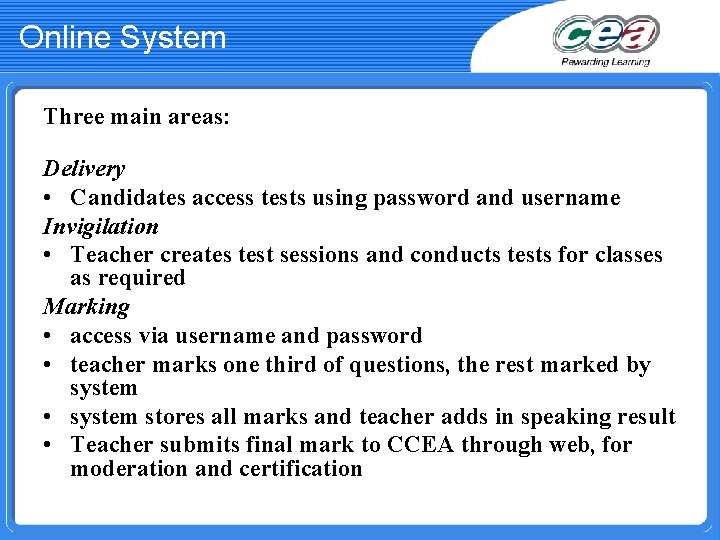
Online System Three main areas: Delivery • Candidates access tests using password and username Invigilation • Teacher creates test sessions and conducts tests for classes as required Marking • access via username and password • teacher marks one third of questions, the rest marked by system • system stores all marks and teacher adds in speaking result • Teacher submits final mark to CCEA through web, for moderation and certification
Moderation and Sampling • Sampling of all components will continue • Speaking samples will be requested by CCEA • On-line moderation will take place for reading and writing and listening units • Internal moderation – Speaking only
Instruments to assist Teachers 1. Self Assessment grids • Valuable resource for learners to reflect on progress and for teachers to track learners 2. Defined Language Content • Provides essential information on required language • Presented by level and language • Content arranged by context and incorporating vocabulary, grammar and structures • Flexible - designed to allow teachers more scope
Resources • • Power. Point presentation to introduce OLA Mapping to revised curriculum Specification at a glance Regular training events and agreement trials • Demonstration of on-line system • Demo-online tests
Additional considerations for OLA Centres should also consider the following : • Access to computer suite - Earphones required - Access required - Planning required - Training available
Data capture form • Centres are required to complete on-line form in order to obtain access to the OLA system • All teachers who will be delivering OLA should obtain a unique login for access to system for testing purposes
Time-frame • First Teaching – September 2010 • Winter Series( Dec-January) – – Small numbers of centres taking part Speaking test will be Role Play Teachers commence teaching new defined content New content combines best of old with new • Summer Series – 2011 Full-blown change take effect, including new Speaking format
Entry Dates Winter Series • 7 -21 October Method: EDI Summer Series • 7 -21 February Note: • Codes and titles will change to reflect OLA • Details will be published in Administration Handbook
Direct Claim Status is based on: • Self assessment • Continuous improvement • Continuing professional development of teachers, tutors and internal moderators • Quality assurance systems in centres • Regulatory Authority advice
Direct Claim Status • Direct Claim Status is awarded on a qualification and level basis • When the qualification is awarded Direct Claim Status certificate claims may be forwarded to CCEA and certificates will be issued • There is no requirement to wait until external moderation of teacher-assessed levels takes place • The Direct Claims process will be supported by an online ICT system
Direct Claim Status Where a centre has Direct Claim Status for a qualification; – The level will not be adjusted at external moderation – Centres will be externally moderated as part of CCEA quality assurance – Centres will be monitored as part of CCEA quality assurance Centres, in return, are required to – Maintain all internal moderation records – Inform CCEA regarding any changes in coordinator or internal moderator – Ensure centre representative attend CCEA Agreement Trials – Keep all components of learners’ work for 12 months after certification
Introduction of Direct Claims Status • Initially pilot centres required September 2010 onwards 2011 – 2012 - Roll-out All dates will be posted to website once confirmed
Contact for OLA If you require further information on any aspect of OLA, please contact: Sheila Armstrong Mobile: 07825141627 Email : sarmstrong@ccea. org. uk Tel: 028 90 261200 Ext. 2447