
OKMC model for Fe Ni Mn with solute
- Slides: 14
OKMC model for Fe. Ni. Mn with solute transport: first results and importance of method of analysis N. Castin, M. Chiapetto, C. Domain, C. Becquart and L. Malerba lmalerba@sckcen. be Copyright © 2016 SCK • CEN
Synopsis l What did we do? l We introduced explicit solute transport in an object kinetic Monte Carlo model l We applied it to study an Fe. Mn. Ni alloy l How was the solute transport modelled? l Ni and Mn dragged by single point-defects, as according to the latest DFT studies l What did we obtain? l Spontaneous formation of solute clusters around point-defect clusters. l Analyse the results with the eyes of APT l Comparison with experimental measurement shows encouraging signs Copyright © 2016 SCK • CEN
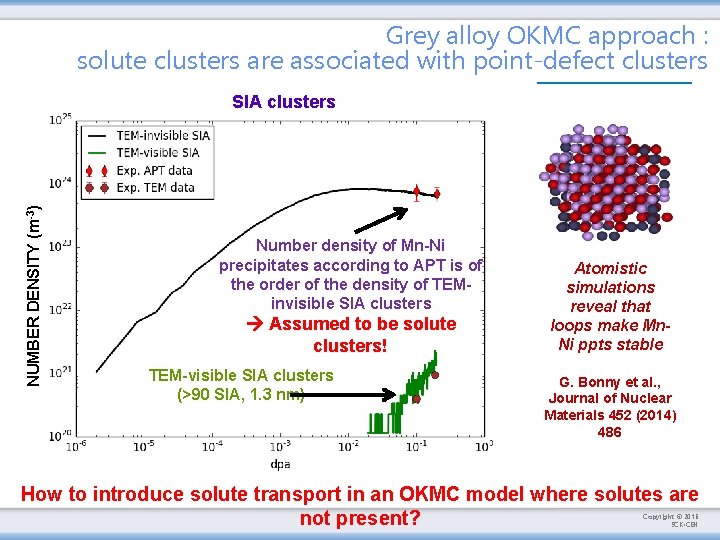
Grey alloy OKMC approach : solute clusters are associated with point-defect clusters NUMBER DENSITY (m-3) SIA clusters Number density of Mn-Ni precipitates according to APT is of the order of the density of TEMinvisible SIA clusters Assumed to be solute clusters! TEM-visible SIA clusters (>90 SIA, 1. 3 nm) Atomistic simulations reveal that loops make Mn. Ni ppts stable G. Bonny et al. , Journal of Nuclear Materials 452 (2014) 486 How to introduce solute transport in an OKMC model where solutes are not present? Copyright © 2016 SCK • CEN
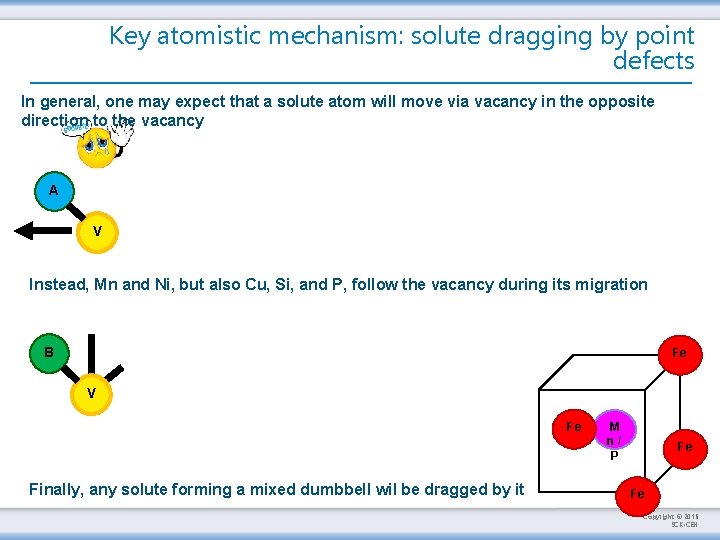
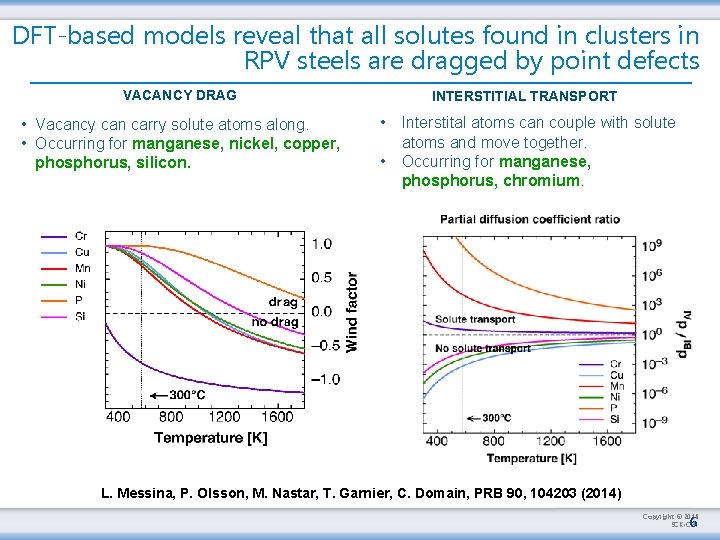
Key atomistic mechanism: solute dragging by point defects In general, one may expect that a solute atom will move via vacancy in the opposite direction to the vacancy A V Instead, Mn and Ni, but also Cu, Si, and P, follow the vacancy during its migration B Fe V Fe Finally, any solute forming a mixed dumbbell wil be dragged by it M n/ P Fe Fe Copyright © 2016 SCK • CEN
DFT-based models reveal that all solutes found in clusters in RPV steels are dragged by point defects VACANCY DRAG INTERSTITIAL TRANSPORT • Vacancy can carry solute atoms along. • Occurring for manganese, nickel, copper, phosphorus, silicon. • Interstital atoms can couple with solute atoms and move together. • Occurring for manganese, phosphorus, chromium. L. Messina, P. Olsson, M. Nastar, T. Garnier, C. Domain, PRB 90, 104203 (2014) Copyright © 2016 SCK • CEN 6
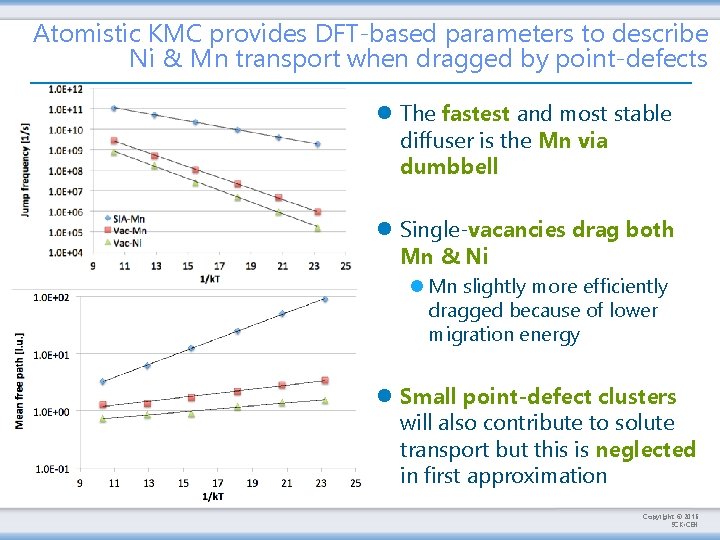
Atomistic KMC provides DFT-based parameters to describe Ni & Mn transport when dragged by point-defects l The fastest and most stable diffuser is the Mn via dumbbell l Single-vacancies drag both Mn & Ni l Mn slightly more efficiently dragged because of lower migration energy l Small point-defect clusters will also contribute to solute transport but this is neglected in first approximation Copyright © 2016 SCK • CEN
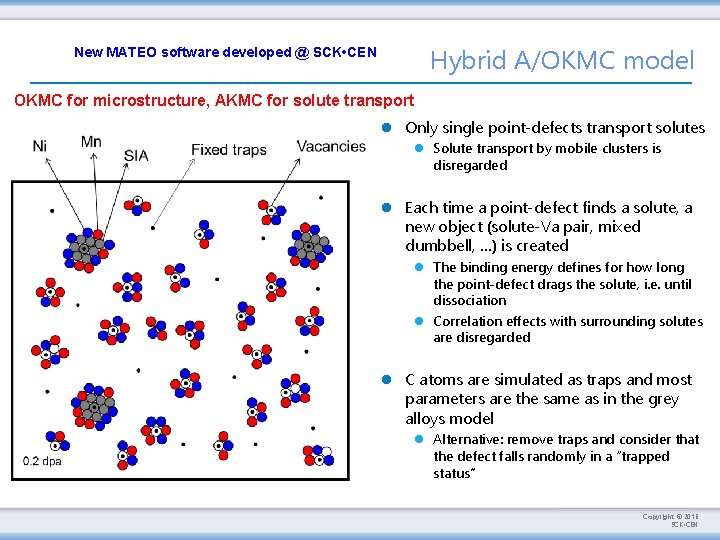
Hybrid A/OKMC model New MATEO software developed @ SCK • CEN OKMC for microstructure, AKMC for solute transport l Only single point-defects transport solutes l Solute transport by mobile clusters is disregarded l Each time a point-defect finds a solute, a new object (solute-Va pair, mixed dumbbell, …) is created l The binding energy defines for how long the point-defect drags the solute, i. e. until dissociation l Correlation effects with surrounding solutes are disregarded l C atoms are simulated as traps and most parameters are the same as in the grey alloys model l Alternative: remove traps and consider that the defect falls randomly in a “trapped status” Copyright © 2016 SCK • CEN
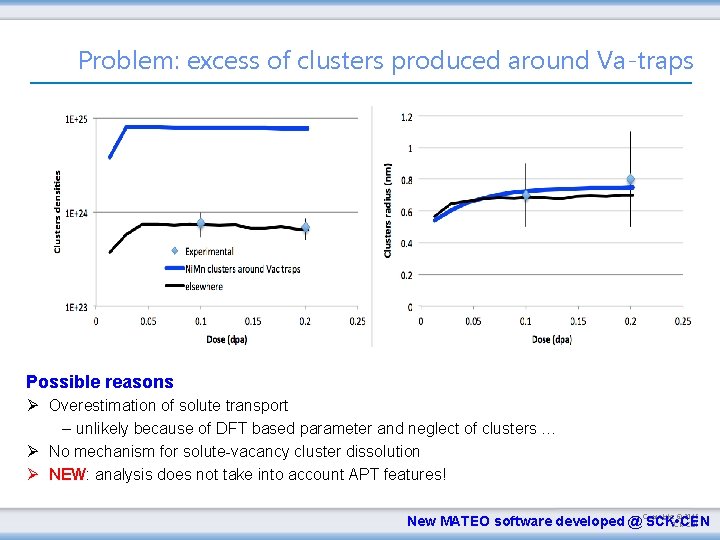
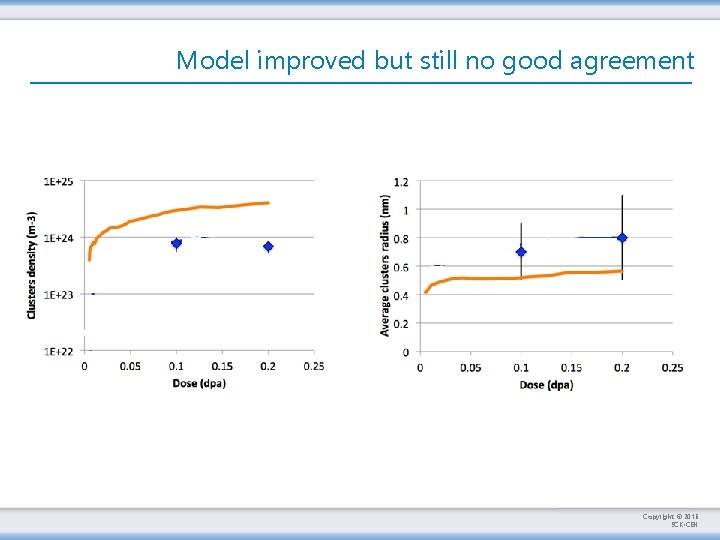
Problem: excess of clusters produced around Va-traps Possible reasons Ø Overestimation of solute transport – unlikely because of DFT based parameter and neglect of clusters … Ø No mechanism for solute-vacancy cluster dissolution Ø NEW: analysis does not take into account APT features! Copyright © 2016 New MATEO software developed @ SCK • CEN
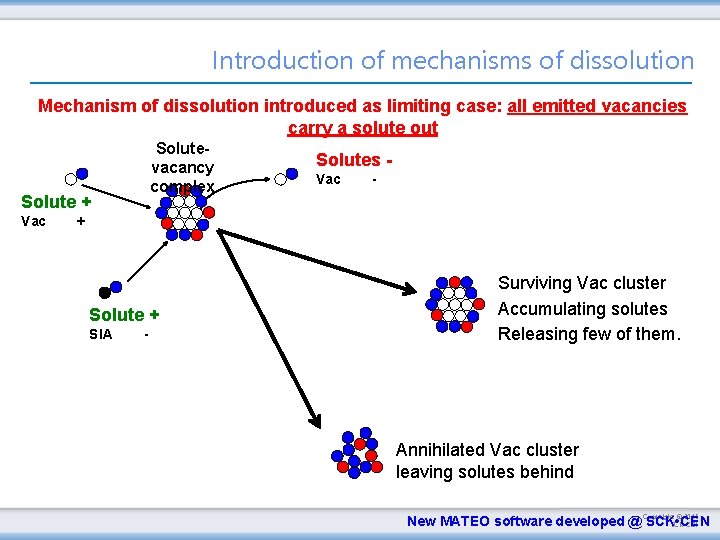
Introduction of mechanisms of dissolution Mechanism of dissolution introduced as limiting case: all emitted vacancies carry a solute out Solutevacancy complex Solute + Vac Solutes Vac - + Solute + SIA - Surviving Vac cluster Accumulating solutes Releasing few of them. Annihilated Vac cluster leaving solutes behind Copyright © 2016 New MATEO software developed @ SCK • CEN
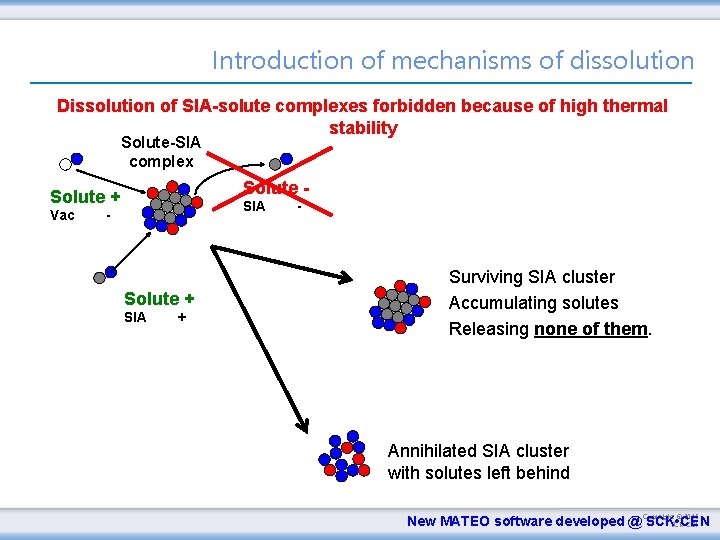
Introduction of mechanisms of dissolution Dissolution of SIA-solute complexes forbidden because of high thermal stability Solute-SIA complex Solute - Solute + Vac SIA - Solute + SIA + - Surviving SIA cluster Accumulating solutes Releasing none of them. Annihilated SIA cluster with solutes left behind Copyright © 2016 New MATEO software developed @ SCK • CEN
Model improved but still no good agreement Copyright © 2016 SCK • CEN
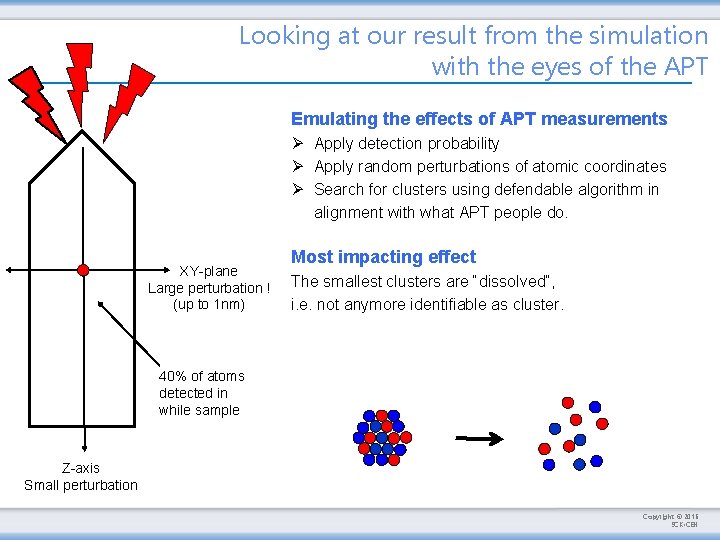
Looking at our result from the simulation with the eyes of the APT Emulating the effects of APT measurements Ø Apply detection probability Ø Apply random perturbations of atomic coordinates Ø Search for clusters using defendable algorithm in alignment with what APT people do. XY-plane Large perturbation ! (up to 1 nm) Most impacting effect The smallest clusters are “dissolved”, i. e. not anymore identifiable as cluster. 40% of atoms detected in while sample Z-axis Small perturbation Copyright © 2016 SCK • CEN
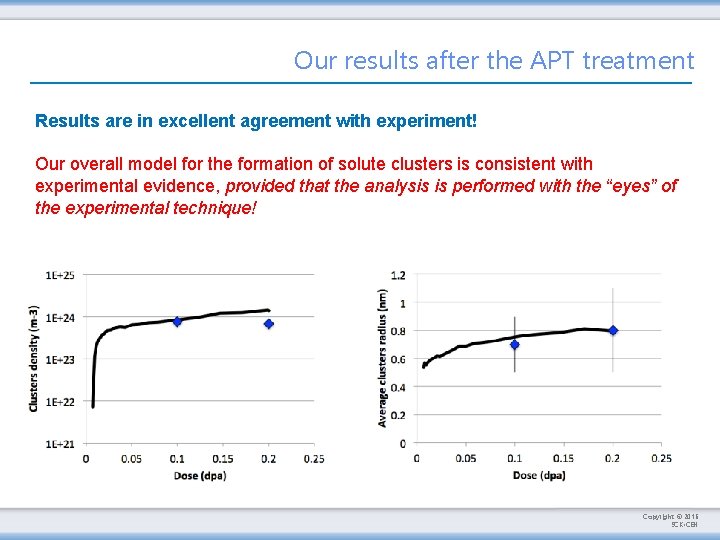
Our results after the APT treatment Results are in excellent agreement with experiment! Our overall model for the formation of solute clusters is consistent with experimental evidence, provided that the analysis is performed with the “eyes” of the experimental technique! Copyright © 2016 SCK • CEN
Summary & Outlook • Dragging of solutes by point-defects leading to segregation of solutes on point-defect clusters has been identified as the key mechanism leading to formation of solute clusters in iron alloys and specifically RPV steels • A hybrid Object/Atomistic KMC model (new code Mateo) has been developed to include explicitly the transport of solutes • Its use with a "not-too-unrealistic“ set of parameters leads to the formation of solute clusters in the correct amount and of the correct size • Outlook: verify the model in all its parts (visible loops, …) and develop the parameterisation further, to have a single allincluding model Copyright © 2016 SCK • CEN 15