
Oklahoma State University Institute for Creativity Innovation Create


- Slides: 74
Oklahoma State University Institute for Creativity & Innovation Create, Innovate, Educate Essential Skills in the 21 st Century: A Call for Creativity and Creative Leadership Gerard J. Puccio, Ph. D. International Center for Studies in Creativity Buffalo State - State University of New York
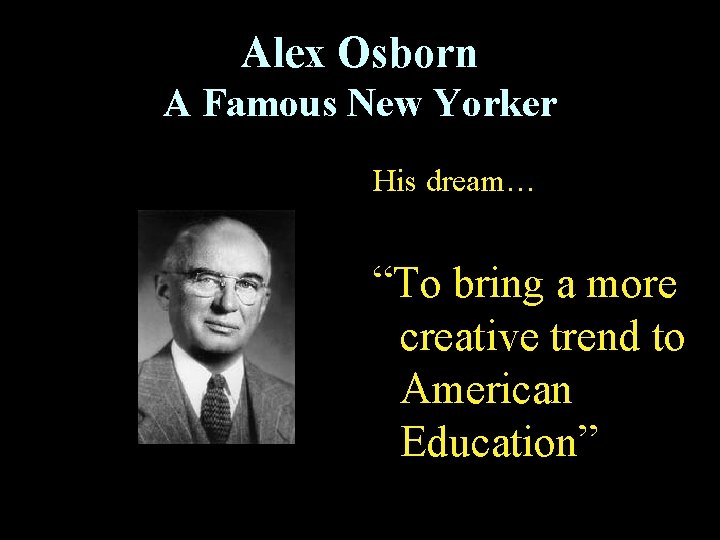
Alex Osborn A Famous New Yorker His dream… “To bring a more creative trend to American Education”
International Center for Studies in Creativity Buffalo State – State University of New York Fast Facts • Founded 1967 • Offer MS in Creativity • Certificate in Creativity and Change Leadership • Program for Distance Learners • Nearly 400 alumni
Objectives of Workshop 1) To highlight the importance of developing creativity and creative thinking in students 2) To challenge you to be creative leaders
Workshop Flow 1) Trends 2) A Close Look at Creativity 1) Creative Leadership 2) Strategies for deliberate creativity
Trends In Our World & Education
Trends 1. Exponential increase in speed of life altering change In the 2, 000 years before 1800 - 10 technical/social inventions In the last 200 years, more than 25 life altering technical/social inventions Source: Henry (2001)
Trends 2. Shorter Product Life Cycles Manufactured products are subject to fundamental redesign every 5 to 10 years High-tech products every 6 to 12 months Source: Hunter & Schmidt (1996), Williams & Yang (1999)
Trends 3. Erosion of permanent/stable work life Students in school today can expect to change jobs more than 11 times between age 18 & 42. Source: U. S. Bureau of Labor Statistics, 2008
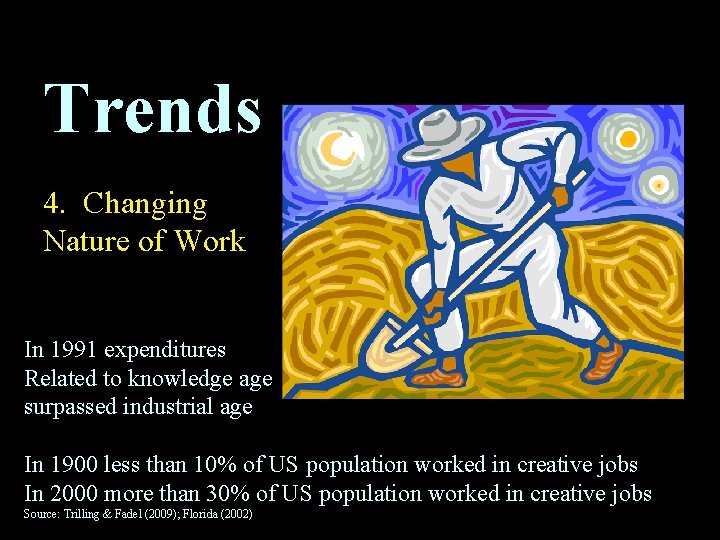
Trends 4. Changing Nature of Work In 1991 expenditures Related to knowledge age surpassed industrial age In 1900 less than 10% of US population worked in creative jobs In 2000 more than 30% of US population worked in creative jobs Source: Trilling & Fadel (2009); Florida (2002)
Welcome to the Innovation Age “After the age of efficiency in the 1950 s and 1960 s, quality in the 1970 s and 1980 s, and flexibility in the 1980 s and 1990 s, we now live in an age of innovation” (Janszen, 2000, p. 3). More than 70% of senior executives report that innovation is in their top three divers for growth. Source: Mc. Kinsey Quarterly (2008)
Trends 5. Exponential increase in content and its ubiquitous availability Content doubles every 18 months (Mehaffy, 2010) In 2006 You. Tube posted 65, 000 new videos every 24 hours. Today 2 billion videos are viewed per day. (Sources: Wikipedia & http: //www. youtube. com/t/fact_sheet)
Trends Recommended Focus in Education: Response to 21 st Century Trends
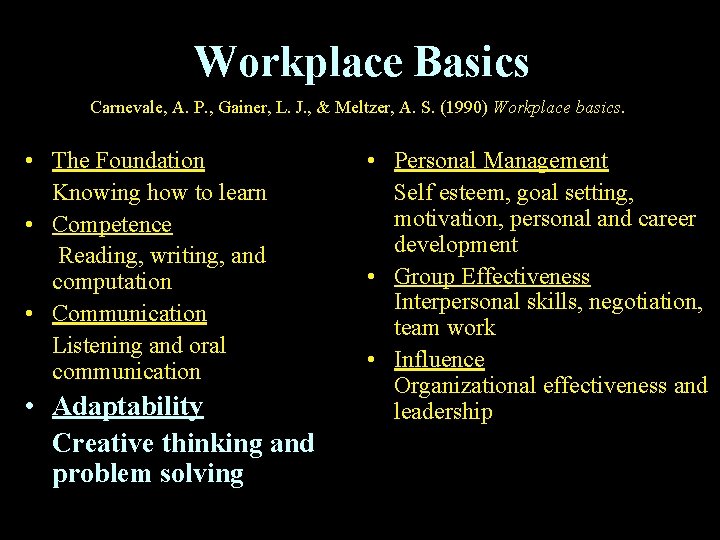
Workplace Basics Carnevale, A. P. , Gainer, L. J. , & Meltzer, A. S. (1990) Workplace basics. • The Foundation Knowing how to learn • Competence Reading, writing, and computation • Communication Listening and oral communication • Adaptability Creative thinking and problem solving • Personal Management Self esteem, goal setting, motivation, personal and career development • Group Effectiveness Interpersonal skills, negotiation, team work • Influence Organizational effectiveness and leadership
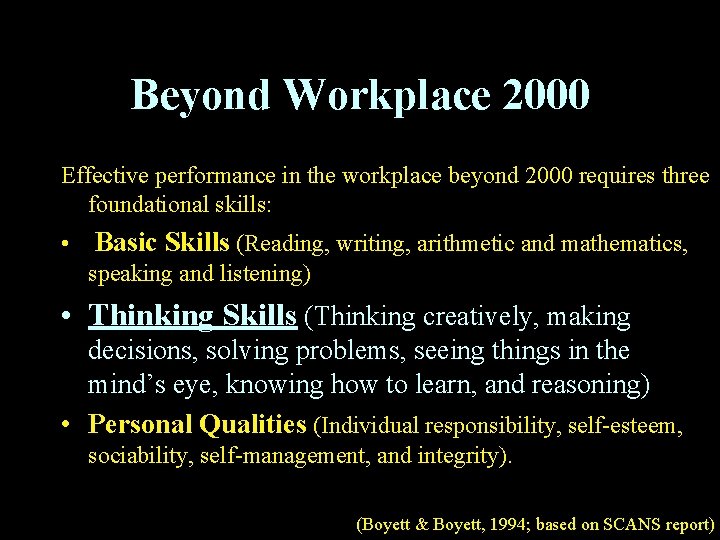
Beyond Workplace 2000 Effective performance in the workplace beyond 2000 requires three foundational skills: • Basic Skills (Reading, writing, arithmetic and mathematics, speaking and listening) • Thinking Skills (Thinking creatively, making decisions, solving problems, seeing things in the mind’s eye, knowing how to learn, and reasoning) • Personal Qualities (Individual responsibility, self-esteem, sociability, self-management, and integrity). (Boyett & Boyett, 1994; based on SCANS report)
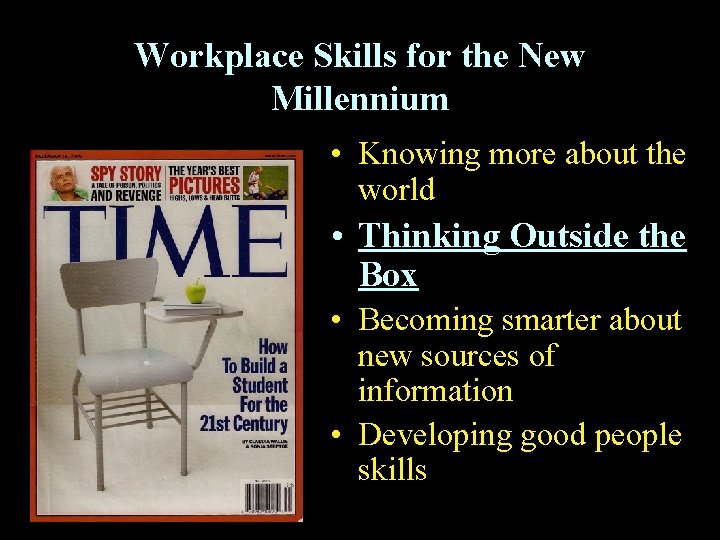
Workplace Skills for the New Millennium • Knowing more about the world • Thinking Outside the Box • Becoming smarter about new sources of information • Developing good people skills
21 st Century Skills: Learning for Life in Our Times Learning and Innovation Skills Critical thinking & Problem Solving Communication & Collaboration Creativity & Innovation Digital Literacy Skills Information Literacy Media Literacy Information & Communication Technologies Career & Life Skills Flexibility & Adaptability Initiative & Self-Direction Social & Cross-Cultural Interaction Productivity & Accountability Leadership & Responsibility Trilling & Fadel (2009)
The New Commission on Skills of the American Workforce “Creativity, innovation, and flexibility will not be the special province of an elite. It will be demanded of virtually everyone who is making a decent living, from graphic artists to assembly line workers, from insurance brokers to home builders. ” Tough Choices or Tough Times (2008)
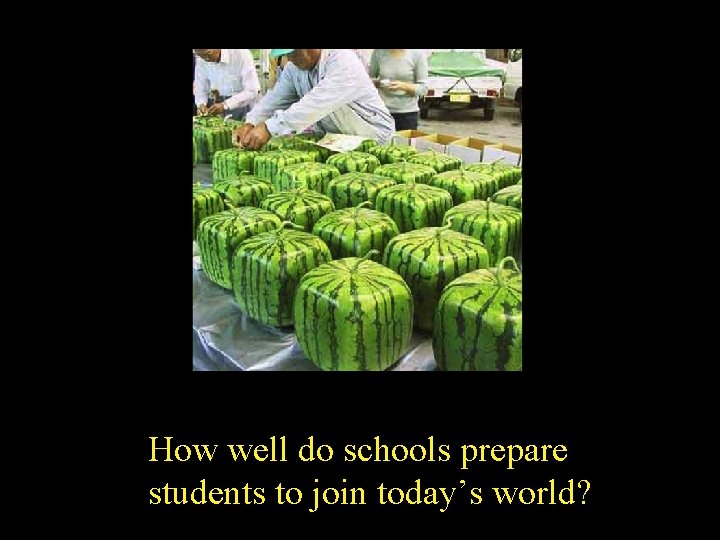
How well do schools prepare students to join today’s world?
“Most educational efforts emphasize convergent thinking, and therefore may do very little, if anything, for creative potential. ” Runco (2007)
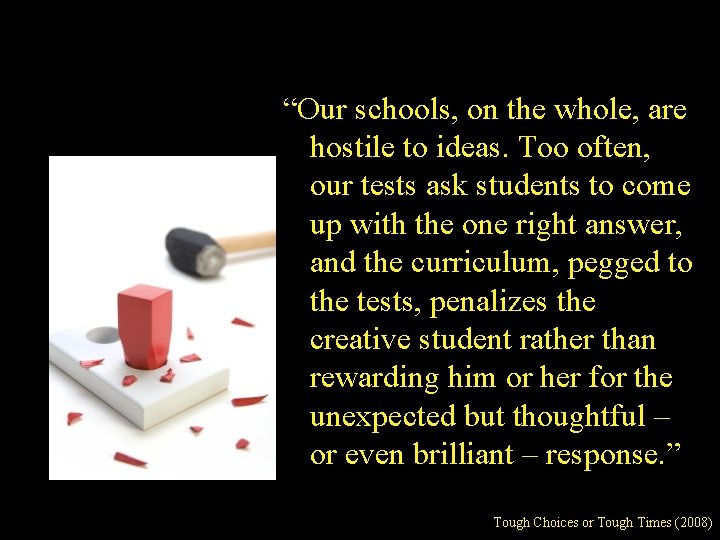
“Our schools, on the whole, are hostile to ideas. Too often, our tests ask students to come up with the one right answer, and the curriculum, pegged to the tests, penalizes the creative student rather than rewarding him or her for the unexpected but thoughtful – or even brilliant – response. ” Tough Choices or Tough Times (2008)
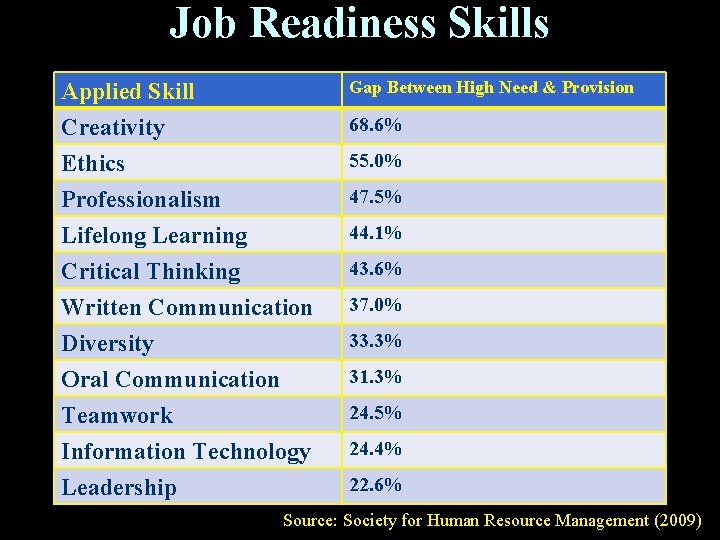
Job Readiness Skills Applied Skill Creativity Ethics Professionalism Gap Between High Need & Provision Lifelong Learning Critical Thinking Written Communication Diversity Oral Communication Teamwork Information Technology Leadership 44. 1% 68. 6% 55. 0% 47. 5% 43. 6% 37. 0% 33. 3% 31. 3% 24. 5% 24. 4% 22. 6% Source: Society for Human Resource Management (2009)
A Closer Look at Creativity
Creativity is. . . the ability to modify self-imposed constraints. Ackoff & Vergara (1988)
Creativity is an Ability implies… • All people are creative • People vary in regard to their creative ability • Whatever your level of creative ability it can be enhanced
Recent CBS Telephone Poll Showed People Believe… • Creativity is inborn (53%) • Creativity can be taught (35%) • Both (7%) Source: CBS News Poll (January 10, 2010)
Classic Definitions Creativity is the production of original ideas that are made useful. Innovation is the successful introduction of new useful ideas. (Burnside, Amabile & Gryskiewicz, 1988)
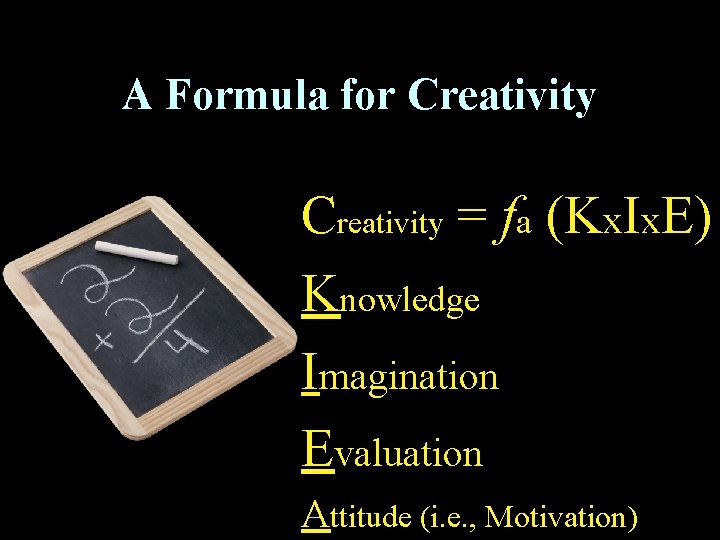
A Formula for Creativity = fa (Kx. Ix. E) Knowledge Imagination Evaluation Attitude (i. e. , Motivation)
Can Creativity be Taught & Enhanced
Does Creativity Training Work? “Perhaps the most clear-cut conclusion to emerge from this study is that creativity training is effective. ” (p. 381) Scott, Leritz, & Mumford (2004)
Conclusions Regarding Effective Programs “Some support for these conclusions may be found in the more successful of the creativity training programs currently available…the Creative Problem Solving program begins by describing the key cognitive processes underlying creative thought. Subsequently, strategies for effectively applying these processes are described and illustrations of their application provided”. (p. 383) Scott, Leritz, & Mumford (2004)
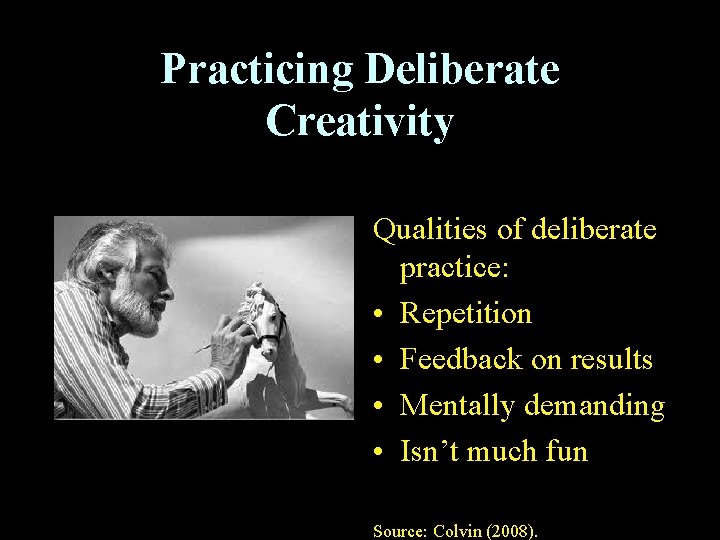
Practicing Deliberate Creativity Qualities of deliberate practice: • Repetition • Feedback on results • Mentally demanding • Isn’t much fun Source: Colvin (2008).
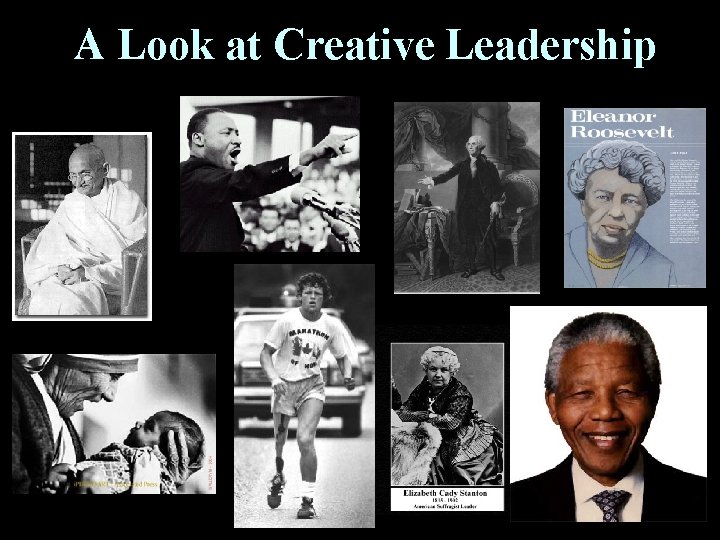
A Look at Creative Leadership
Management and Leadership “Management is basically a process, the function of which is to produce consistent results on important dimensions. . . Leadership, by contrast, is a process whose function is change. ” (Kotter, 1988)
IBM Global CEO Study 2010 “CEOs told us they operate in a world that is substantially more volatile, uncertain and complex. Many shared the view that incremental changes are no longer sufficient in a world that is operating in fundamentally different ways. ” (p. 8)
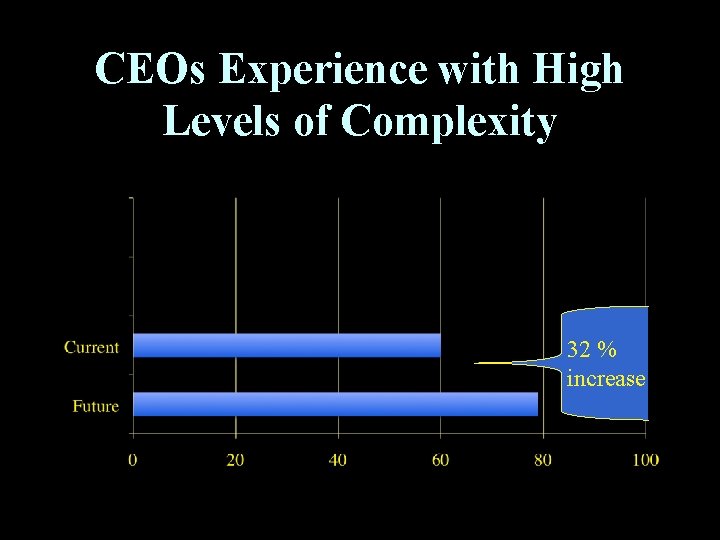
CEOs Experience with High Levels of Complexity 32 % increase
IBM Global CEO Study Primary Findings 4. Creativity is the most important leadership quality.
IBM Global CEO Study Creative Leaders… Practice and encourage experimentation and innovation throughout their organisations. Make deep business model changes to realise strategies. Take calculated risks, finding new ideas and keep innovating in how they lead and innovate.
Leadership Performance: An Ability to Solve Complex Social Problems • Ill-defined: No single solution path – no right or wrong answer – thus allowing the problem to be defined in a number of ways. • Novel: Past experience and knowledge is not sufficient to resolve the present situation, adaptive responses are needed for new or changing situations. • Ambiguous: Gaps in information and/or a plethora of information of which only some is relevant.
CPS a Core Leadership Competency “The available evidence indicates that creative problem solving may indeed represent an important influence on leader performance” Mumford et al. (2000)
Enhancing Creative. Thinking Skills Through Deliberate Practice
Don’t Short Change Your Thinking: Quantity Leads to Quality • Scientists who have won the Nobel Prize publish, on average, 3. 24 papers per year versus 1. 48 by non-winners • Edison held 1, 093 patents • Einstein had 248 publications • Mozart had well over 600 compositions • J. S. Bach had more than 1, 000 compositions to his credit • Picasso completed more than 20, 000 works (Simonton, 1984)
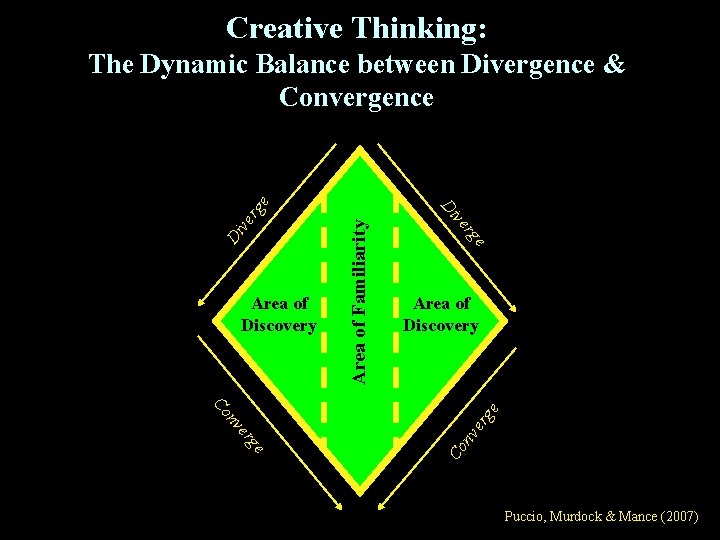
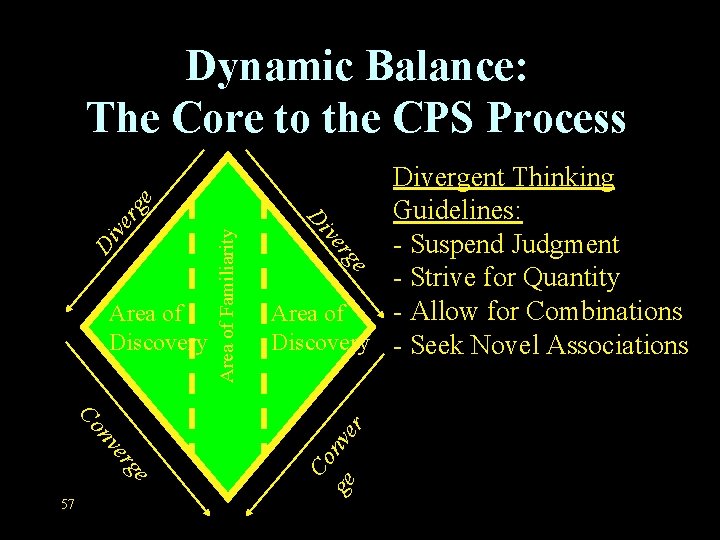
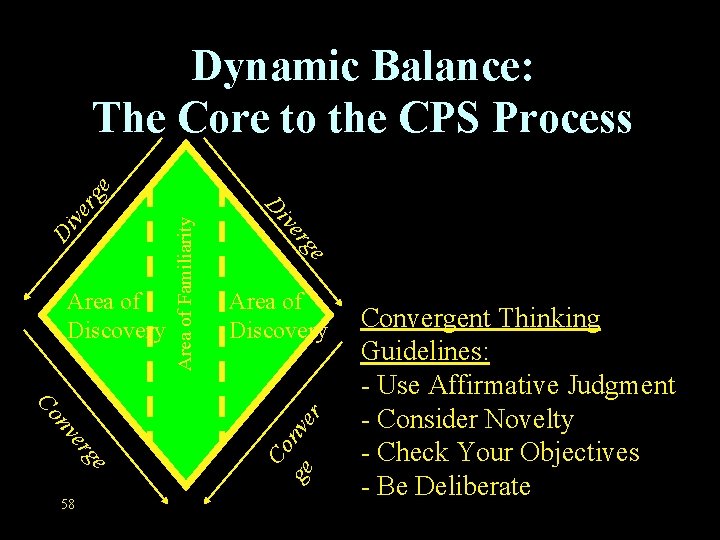
Creative Thinking: nv e rg e nv Co er ge Area of Discovery Co Area of Familiarity ve rg Di e rg ve Area of Discovery Di e The Dynamic Balance between Divergence & Convergence Puccio, Murdock & Mance (2007)
Creative Problem Solving An introduction Nielsen & Thurber (2010) based on the work of Puccio & Miller (2003)
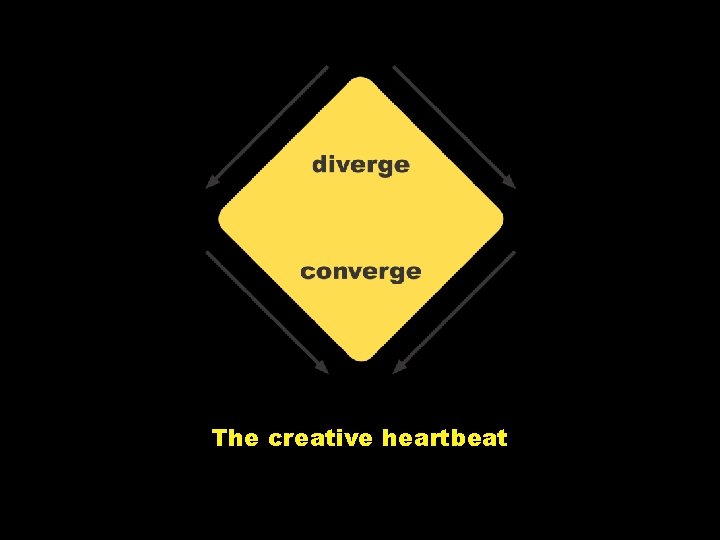
The creative heartbeat
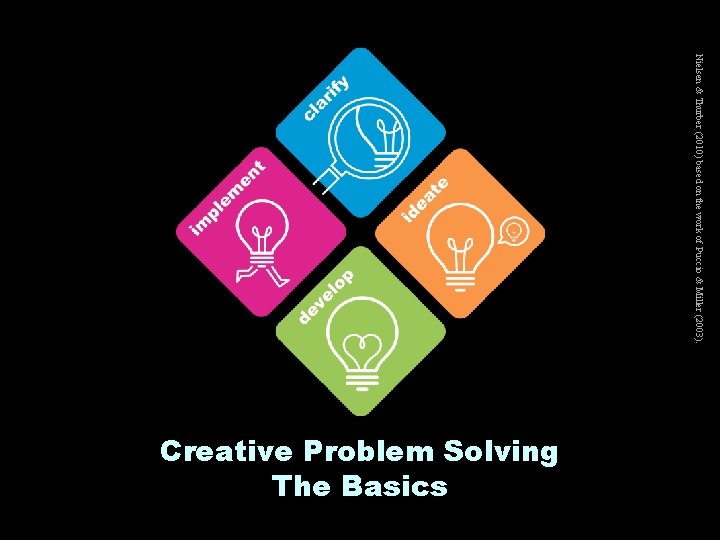
Nielsen & Thurber (2010) based on the work of Puccio & Miller (2003). Creative Problem Solving The Basics
The Four. Sight Model • universal & intuitive • research based • 4 distinct steps • unique thinking skills
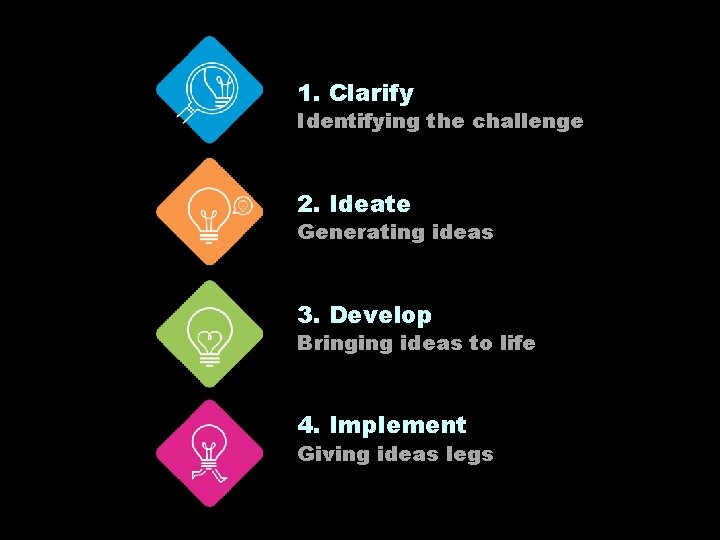
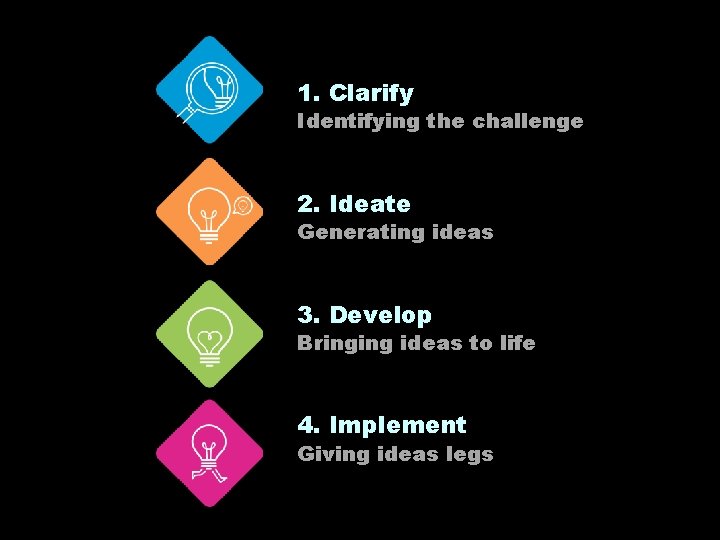
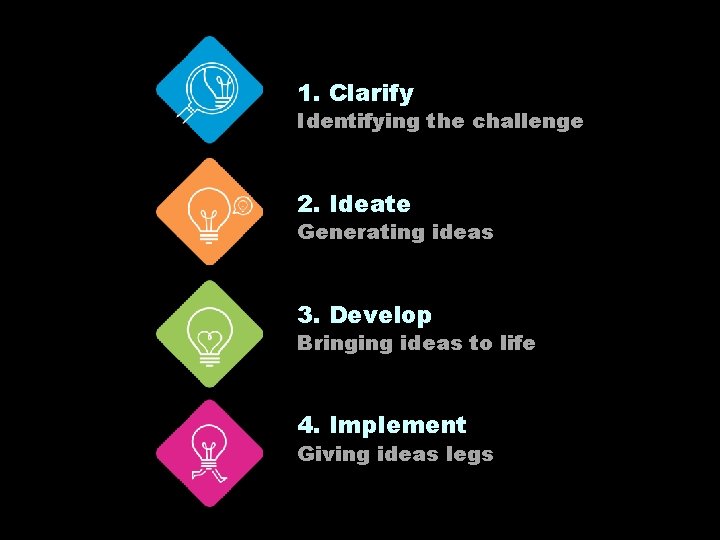
1. Clarify Identifying the challenge 2. Ideate Generating ideas 3. Develop Bringing ideas to life 4. Implement Giving ideas legs
Clarify Identifying the challenge • define a goal • gather data • formulate the challenge When you clarify you use strategic thinking.
The definition of Strategic thinking the ability to sense the problem, identify the key issues, and see paths that will move you toward a desired future.
Ideate Generating ideas • think up lots of options • explore new combinations • build on ideas When you ideate you use ideational thinking.
The definition of Ideational thinking the ability to produce a variety of original options, images or thoughts that address challenges.
Develop Bringing ideas to life • evaluate and strengthen ideas • craft ideas into useful solutions • take an idea from good to great When you develop you use evaluative thinking.
The definition of Evaluative thinking the ability to evaluate and transform a broad idea into a specific, workable solution that resolves the challenge.
Implement Giving ideas legs • explore acceptance • make a plan • get into action When you implement you use tactical thinking.
The definition of Tactical thinking the ability to devise and carry out a plan that includes specific, measurable steps for attaining the desired state.
ve r ge ge r ve Co n Di ve Area of Familiarity e n Co 57 rg ve Area of Discovery Divergent Thinking Guidelines: - Suspend Judgment - Strive for Quantity - Allow for Combinations Area of Discovery - Seek Novel Associations Di rg e Dynamic Balance: The Core to the CPS Process
ve r Area of Discovery ge e Co n Di ve Area of Familiarity e rg ve n Co 58 rg ve Area of Discovery Di rg e Dynamic Balance: The Core to the CPS Process Convergent Thinking Guidelines: - Use Affirmative Judgment - Consider Novelty - Check Your Objectives - Be Deliberate
1. Clarify Identifying the challenge 2. Ideate Generating ideas 3. Develop Bringing ideas to life 4. Implement Giving ideas legs
1. Clarify Identifying the challenge 2. Ideate Generating ideas 3. Develop Bringing ideas to life 4. Implement Giving ideas legs
Develop Tips and Tools
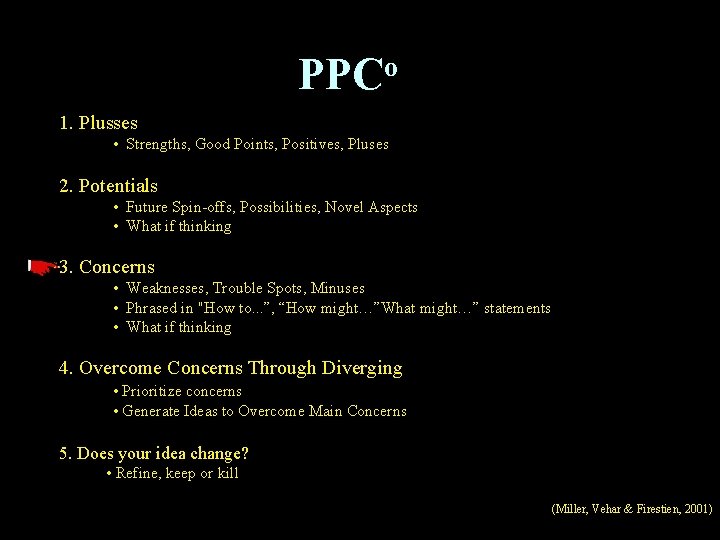
o PPC 1. Plusses • Strengths, Good Points, Positives, Pluses 2. Potentials • Future Spin-offs, Possibilities, Novel Aspects • What if thinking 3. Concerns • Weaknesses, Trouble Spots, Minuses • Phrased in "How to. . . ”, “How might…”What might…” statements • What if thinking 4. Overcome Concerns Through Diverging • Prioritize concerns • Generate Ideas to Overcome Main Concerns 5. Does your idea change? • Refine, keep or kill (Miller, Vehar & Firestien, 2001)
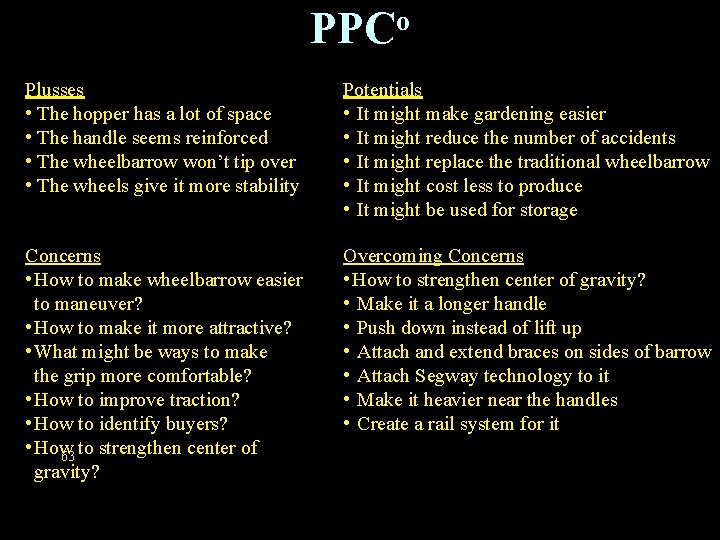
PPCo Plusses • The hopper has a lot of space • The handle seems reinforced • The wheelbarrow won’t tip over • The wheels give it more stability Potentials • It might make gardening easier • It might reduce the number of accidents • It might replace the traditional wheelbarrow • It might cost less to produce • It might be used for storage Concerns • How to make wheelbarrow easier to maneuver? • How to make it more attractive? • What might be ways to make the grip more comfortable? • How to improve traction? • How to identify buyers? • How 63 to strengthen center of gravity? Overcoming Concerns • How to strengthen center of gravity? • Make it a longer handle • Push down instead of lift up • Attach and extend braces on sides of barrow • Attach Segway technology to it • Make it heavier near the handles • Create a rail system for it
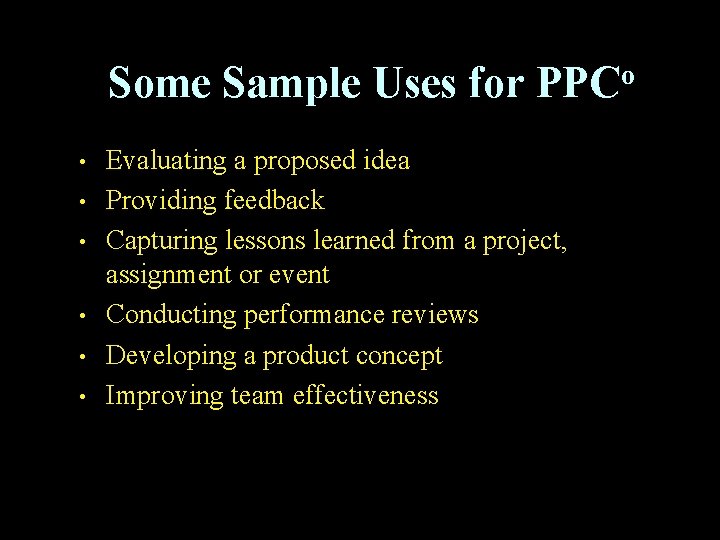
Some Sample Uses for • • • o PPC Evaluating a proposed idea Providing feedback Capturing lessons learned from a project, assignment or event Conducting performance reviews Developing a product concept Improving team effectiveness
Thank You & Good Luck!! Puccio, G. J. , Murdock, M. C. , & Mance, M. (2007) Creative Leadership: Skills that Drive Change. Thousand Oaks, CA: Sage. www. buffalostate. edu/centers/creativity
Clarify Identifying the challenge • define a goal • gather data • formulate the challenge When you clarify you use strategic thinking.
The definition of Strategic thinking the ability to sense the problem, identify the key issues, and see paths that will move you toward a desired future. What’s the ‘real’ challenge?
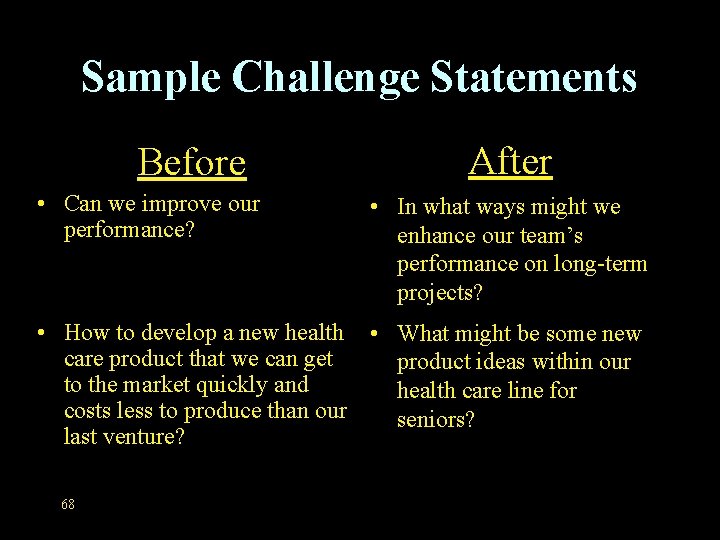
Sample Challenge Statements Before • Can we improve our performance? After • In what ways might we enhance our team’s performance on long-term projects? • How to develop a new health • What might be some new care product that we can get product ideas within our to the market quickly and health care line for costs less to produce than our seniors? last venture? 68
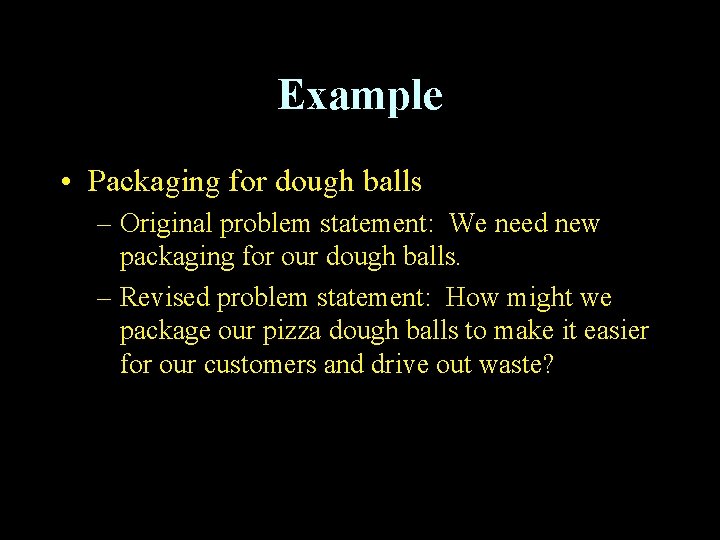
Example • Packaging for dough balls – Original problem statement: We need new packaging for our dough balls. – Revised problem statement: How might we package our pizza dough balls to make it easier for our customers and drive out waste?
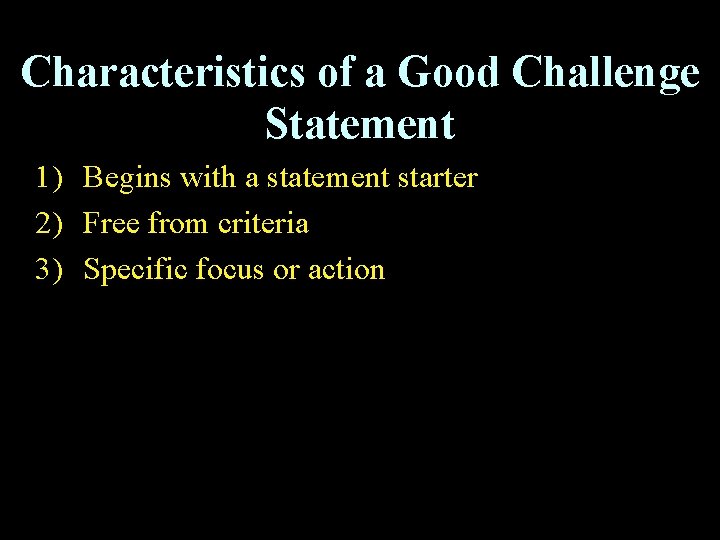
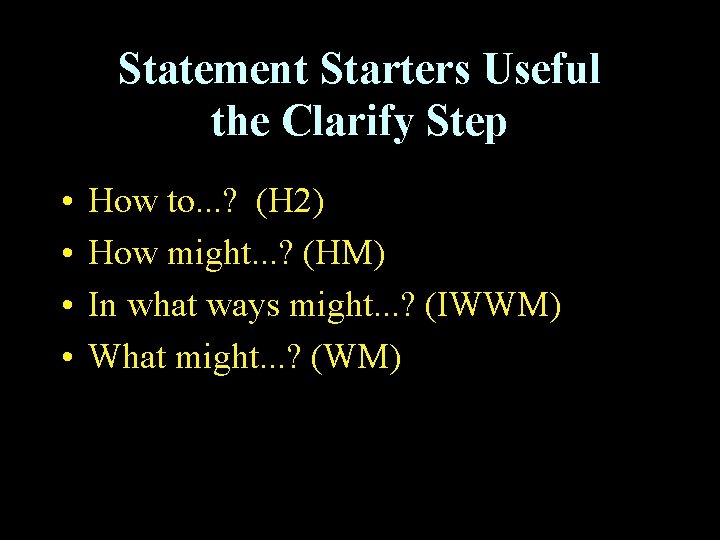
Characteristics of a Good Challenge Statement 1) Begins with a statement starter 2) Free from criteria 3) Specific focus or action
Statement Starters Useful the Clarify Step • • How to. . . ? (H 2) How might. . . ? (HM) In what ways might. . . ? (IWWM) What might. . . ? (WM)
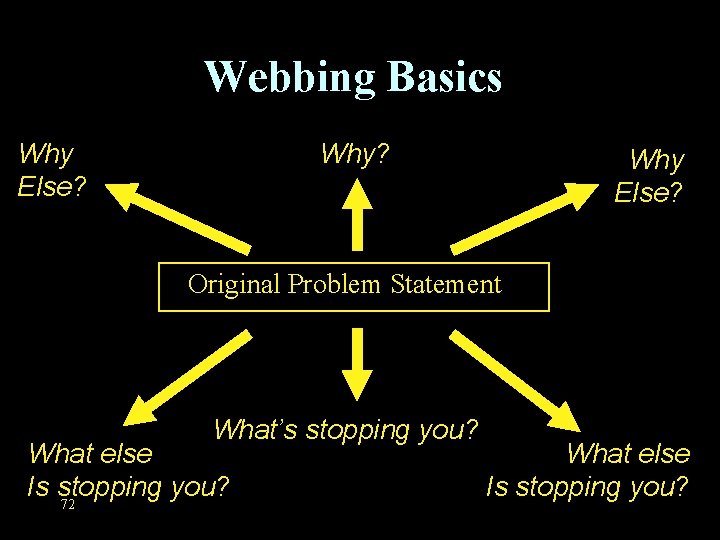
Webbing Basics Why Else? Original Problem Statement What’s stopping you? What else Is stopping you? 72 What else Is stopping you?
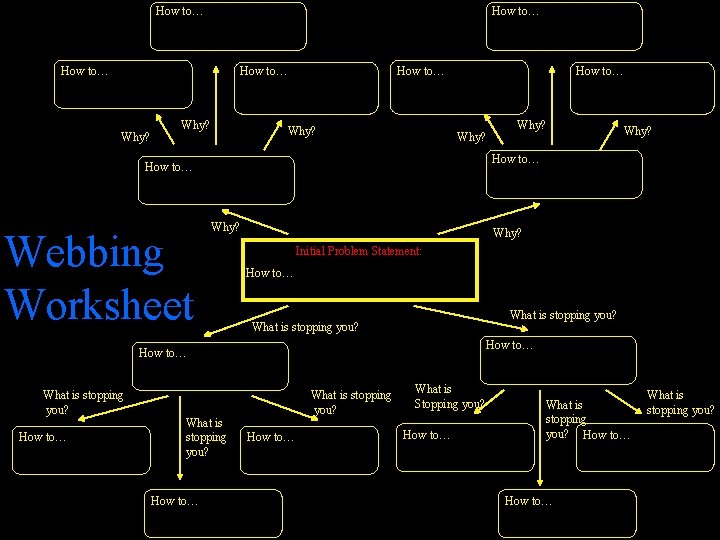
How to… Why? How to… Why? Why? Initial Problem Statement: How to… What is stopping you? How to… What is stopping you? How to… Why? How to… Webbing Worksheet Why? What is stopping you? How to… What is Stopping you? How to… What is stopping you?
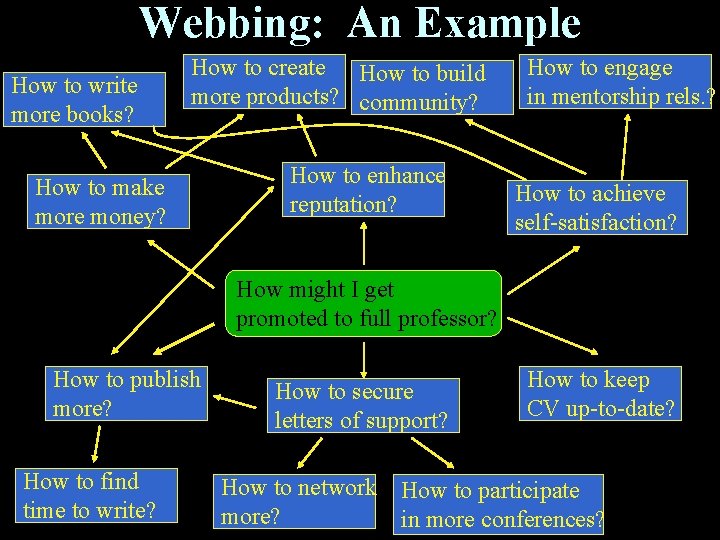
Webbing: An Example How to write more books? How to create How to build more products? community? How to make more money? How to enhance reputation? How to engage in mentorship rels. ? How to achieve self-satisfaction? How might I get promoted to full professor? How to publish more? How to find time to write? How to secure letters of support? How to network more? How to keep CV up-to-date? How to participate in more conferences?